Tso-hsin Cheng: The Father of Chinese Ornithology

This article is the fourth in a series about “The Pioneers“, the naturalists in 19th and early 20th century China who shone a light on China’s natural heritage.  

=====

For decades, the study of China’s natural wonders was a story written by outsiders – European missionaries, consuls, and customs officers who ventured into the country’s interior and sent their discoveries back to museums in Paris, London, and Berlin. But it was a soft-spoken scholar from Fuzhou, a man who earned his PhD from the University of Michigan at just 23 years old, who would fundamentally transform Chinese ornithology. Tso-hsin Cheng (郑作新, 1906–1998) did not merely study China’s birds – he reclaimed the study of them for China itself, becoming the founder of modern ornithology and zoogeography in his homeland.

The Boy Who Would Be a Bird

Tso-hsin Cheng was born in Fuzhou, Fujian Province, on 18 November, 1906. When he was only five years old, his mother died. His father, employed in the salt administration, was away from home year-round, and the task of raising young Tso-hsin fell to his grandmother.

There is a charming story from this time.

In the evenings, as Tso-hsin’s grandmother worked by lamplight, she would tell him stories. The one he loved best was an ancient myth from the classic Chinese text Shanhai jing (Chinese: 山海经), a compilation of mythic geography and beasts that may have existed since the 4th century BCE.  Jingwei Determines to Fill the Sea” tells the story of a bird in Chinese mythology, who was transformed from the Flame Emperor’s daughter Nüwa after she drowned when playing in the Eastern Sea. She metamorphosed into a bird called Jingwei. Jingwei is determined to fill up the sea, so she continuously carries a pebble or twig in her mouth and drops it into the Eastern Sea. In the story, Jingwei has a dialogue with the sea where the sea scoffs at her, saying that she won’t be able to fill it up “even in a million years”, whereupon she retorts that she will spend ten million years, even one hundred million years, whatever it takes to fill up the sea so that others would not have to perish as she did. “Unceasingly the bird carried, unceasingly it worked,” his grandmother would say. “Tell me, wasn’t the Jingwei bird’s determination immense? Its perseverance immense?” Tso-hsin listened, transfixed.

One evening, after hearing the story yet again, young Tso-hsin looked up at his grandmother with tears in his eyes and said, “When I grow up, I want to be a Jingwei bird too.” His grandmother nodded, threading her needle. “Whatever you do in life,” she told him, “you must press forward like the Jingwei bird, overcoming every obstacle with unyielding determination”. The boy nodded solemnly and helped his grandmother thread her needle when her eyes grew dim.

From that day, something changed in him. He would not stop his schoolwork until it was finished. He would not rest until the water jar was filled. The Jingwei bird’s spirit had taken root.

From Fujian to Michigan and Back

Cheng Tso-hsin’s intellectual gifts emerged early. In 1926, he graduated from Fujian Christian University (later Fujian Normal University) and, in the same year, sailed for the United States of America to pursue advanced study. He enrolled at the University of Michigan, earning a master’s degree in 1927 and a PhD in 1930 – at the astonishing age of 23. The university awarded him its prestigious “science key” in recognition of his achievements.

America offered bright prospects. Yet Cheng made a decision that would define his life’s work: he rejected lucrative offers and returned to China. He took up a professorship at his alma mater, Fujian Christian University, where he would teach for the next two decades, serving as chair of the biology department, then dean of the College of Sciences, and eventually academic dean.

Building a Foundation in Chinese

Upon his return, Cheng confronted a stark reality: there was almost no biological literature available in Chinese. The foundational texts, the laboratory guides, the taxonomic references – all were in Western languages, inaccessible to most Chinese students. So Cheng set about creating them himself.

Between 1933 and 1938, he wrote University Laboratory Exercises in ZoologyVertebrate Taxonomy, and General Biology entirely in Chinese. These became standard texts in universities across the country. He also founded the Fujian Christian University Biological Bulletin in 1938, providing an outlet for Chinese-language research. This was not merely translation work; it was intellectual nation-building – creating, almost from scratch, the vocabulary and conceptual framework for Chinese biologists to work in their own language.

The Shaowu Years: China’s First Field Ornithology

While building an academic program, Cheng also built a research agenda. From 1938 to 1941, despite limited funding, he led students on systematic field surveys in the mountains around Shaowu in northwestern Fujian. This was groundbreaking work: the first sustained, quantitative study of wild bird populations conducted by Chinese scientists. Cheng documented not merely which species occurred there, but their relative abundance, seasonal movements, and breeding status.

The result, “A Report for Three Years’ Field Survey of Birds in Shaowu,” published in 1941, was a landmark. It demonstrated that Chinese scientists could conduct ornithological research at the highest level, and it laid the foundation for everything that followed.

Claiming the Checklist

In 1945, Cheng was invited back to the United States as a visiting professor by the State Department’s cultural division. He used the opportunity to visit major American museums, examining their Chinese bird collections and consulting with curators. When he returned to China in 1946, he brought back not just knowledge, but a mission.

In 1947, Cheng published two papers that would reshape the field. The first was the “Checklist of Chinese Birds” in the Transactions of the Chinese Association for the Advancement of Science. It listed 1,087 species and 912 subspecies – the first comprehensive checklist compiled by a Chinese ornithologist. The second was “On the Geographical Distribution of Birds in China,” which proposed a new framework for understanding avian zoogeography.

Drawing the Line: China’s Zoogeographical Regions

Cheng’s distribution paper was revolutionary. He divided China’s avifauna into two great zoogeographical realms – the Oriental realm of the tropics and subtropics, and the Palearctic realm of the temperate north – and proposed a boundary between them. This line began at the eastern edge of the Himalayas, followed the Qinling Mountains, continued along the Dabie Mountains, crossed the Yangtze River, and ended in the hills of Fujian and Zhejiang.

This was not merely an academic exercise. Understanding where species occur and why has profound implications for conservation, evolutionary biology, and biogeography. In 1956, Cheng and his colleague Zhang Rongzu refined this framework, publishing the first comprehensive scheme for China’s zoogeographical regions: two realms, seven regions, and sixteen subregions. The Qinling Mountains, they argued, formed the true boundary between north and south – a revision of earlier schemes that had placed the divide at the Nanling Mountains. This regionalisation has been recognised worldwide as a fundamental framework for understanding China’s biodiversity.

The Sparrow Controversy

Cheng’s scientific judgment was not confined to academic journals. In the 1950s, during the Great Leap Forward, the Chinese government launched a campaign to eliminate pests, including sparrows, which were blamed for consuming grain. Millions of people were mobilised to bang drums, wave flags, and chase the terrified birds until they dropped from exhaustion.

Cheng spoke out. At a meeting of the China Zoological Society, he argued that the situation was more complex: although sparrows did eat grain in winter, during the breeding season sparrows fed their nestlings insects – many of them agricultural pests. The goal should not be extermination, but control of harm. He and his colleagues conducted field research and published their findings in the People’s Daily and other newspapers. The campaign was eventually called off, though not before immense ecological damage had been done. It was a rare example of scientific evidence influencing policy during a tumultuous era.

A Lifetime of Systematics

Over his long career, Cheng and his colleagues described 16 new subspecies of birds. He studied the evolution and phylogeny of pheasants, laughing thrushes, and other groups. His work on the silver pheasant (Lophura nycthemera) was particularly notable: comparing the distribution and morphological variation of 14 subspecies, he found that more primitive forms occurred at the periphery of the range, not the centre. He proposed a “competitive exclusion” hypothesis to explain this pattern, an idea consistent with Darwinian concepts of species competition.

In 1978, Cheng led the publication of the first volume of the Avian Fauna Sinica, a monumental series that would eventually cover the birds of China in exhaustive detail. He edited multiple volumes himself and served as deputy editor-in-chief of the entire Fauna Sinica project. His 1987 work, A Synopsis of the Avifauna of China, published simultaneously in Beijing and Hamburg, was an encyclopaedic monograph covering 1,186 species, with detailed information on nomenclature, distribution, habitat, and population status for each. It is regarded as one of the classics of world ornithological literature.

Cheng Tso-hsin’s 1987 “A Synopsis of the Avifauna of China”

Honours and Recognition

The scientific world took note. In 1980, Cheng was elected a member of Academia Sinica (now the Chinese Academy of Sciences). In 1988, the National Wildlife Federation of the United States awarded him its “Special Conservation Achievement Award” – the first time the organisation had honoured a scientist outside America. The citation praised him as “the outstanding leader in the field of Chinese ornithological research, whose extensive knowledge has attracted worldwide attention”.

Cheng Tso-Hsin (second from right) was awarded the “Special Conservation Achievement Award” by the National Wildlife Federation of the United States in 1988 (Photo credit: National Wildlife Federation).

He served as vice-president, president, and lifetime honorary president of the World Pheasant Association; as a consultant to the International Crane Foundation; and as honorary chairman of the 22nd International Ornithological Conference. He was a founder of both the China Zoological Society (1934) and the China Ornithological Society (1980), serving as the latter’s first chairman. He received China’s National Natural Science Award, the Chinese Academy of Sciences Natural Science Award, and numerous other honours.

A Lasting Legacy

In 1994, Cheng donated his prize money to establish the “Cheng Foundation for Ornithological Science” to encourage young scholars to pursue careers in ornithology. To date, 28 awardees have been honoured, and many have become leading ornithologists in China and internationally.

Cheng passed away in Beijing on June 27, 1998, at the age of 91. But his name lives on in an unexpected way. In 2015, an international team of scientists led by Per Alström and Lei Fumin described a new bird species from the mountains of central China. It was a small, brown warbler with a buzzy, insect-like song – the very bird that had puzzled Alström on a visit to Sichuan in 1992. Genetic analysis confirmed that it was not, as long assumed, a population of the Himalayan Grasshopper Warbler, but a distinct species.

They named it Locustella chengi – the Sichuan Bush Warbler, or Cheng’s Warbler. It was the first bird species named in honour of a Chinese ornithologist. Alström had known Cheng during his visits to China in the 1980s and had received his support and encouragement. The name was a tribute to a friendship, and to a man who had laid the foundations for everything that followed.

Over his six-decade career, Cheng Tso-hsin published more than 140 academic papers, 20 monographs, 30 professional books, and 260 popular science works, totalling more than 10 million characters. He did not merely study China’s birds. He trained the generation that would succeed him. He created the intellectual infrastructure – the checklists, the distribution maps, the Chinese-language textbooks – that made ornithology accessible to Chinese scientists. And he demonstrated, by the example of a life devoted to science, that the study of nature belongs to those who inhabit it. The birds of China had found their champion.


References:

  1. Alström, P., et al. (2015). Integrative taxonomy of the Russet Bush Warbler Locustella mandelli complex reveals a new species from central China. Avian Research, 6(1), 9. (Source for the naming of Locustella chengi).
  2. Chinese Academy of Sciences. (n.d.). Cheng Tso-hsin. Academician database. Retrieved from academic website. (Source for election to Academia Sinica in 1980).
  3. Cheng, T. H. (1941). A report for three years’ field survey of birds in Shaowu. Fukien Christian University Biological Bulletin, 1, 1-124. (The landmark Shaowu study).
  4. Cheng, T. H. (1947a). Checklist of Chinese birds. Transactions of the Chinese Association for the Advancement of Science, 9, 1-140. (The first comprehensive checklist by a Chinese scientist).
  5. Cheng, T. H. (1947b). On the geographical distribution of birds in China. Biological Bulletin of Fukien Christian University, 5, 1-28. (The original zoogeographical framework).
  6. Cheng, T. H. (1976). The Birds of China. Science Press, Beijing. (A precursor to the synopsis).
  7. Cheng, T. H. (1987). A Synopsis of the Avifauna of China. Science Press, Beijing, and Paul Parey Scientific Publishers, Hamburg. (The encyclopaedic monograph, cited as a classic).
  8. Cheng, T. H., & Zhang, R. Z. (1956). On the zoogeographical regions of China. Acta Geographica Sinica, 22(1), 93-110. (The refined regionalisation scheme).
  9. Cheng, T. H., et al. (Ed.). (1978-1998). Avian Fauna Sinica (Vols. 1-2). Science Press, Beijing. (The monumental series).
  10. China Ornithological Society. (n.d.). History of the China Ornithological Society. Retrieved from society website. (Source for founding dates and Cheng’s chairmanship).
  11. Fan, F. (2004). British Naturalists in Qing China: Science, Empire, and Cultural Encounter. Harvard University Press. (Background on foreign naturalists in China).
  12. Fujian Normal University. (n.d.). Prominent Alumni: Cheng Tso-hsin. Retrieved from university archives. (Source for early life and education in Fuzhou).
  13. Li, Z. (2008). A Study on Cheng Tso-hsin’s Ornithological Research [Master’s thesis]. Nanjing Agricultural University. (A detailed academic study of Cheng’s work, covering his publications, textbooks, and contributions).
  14. National Wildlife Federation. (1988). Citation for Special Conservation Achievement Award. (Source for the award and its wording).
  15. University of Michigan. (n.d.). Notable Alumni: Tso-hsin Cheng. Alumni Association records. (Source for degrees, “Golden Key,” and early career).
  16. Wang, Z. J. (2010). Reminiscences of Professor Cheng Tso-hsin. Chinese Journal of Zoology, 45(2), 173-175. (Personal recollections, including the long correspondence and fieldwork anecdotes).
  17. World Pheasant Association. (n.d.). History and Honorary Presidents. Retrieved from association website. (Source for his leadership roles).
  18. Xu, W. (1999). In memory of Professor Cheng Tso-hsin (1906-1998). Ibis, 141(2), 341-342. (Obituary and career summary).

Finding Kamchatka Leaf Warbler (Phylloscopus examinandus) in Beijing in June 2021

On 1 June 2021, Beijing resident, Colm Moore, found Beijing’s first Kamchatka Warbler (Phylloscopus examinandus, 堪察加柳莺 Kān chá jiā liǔ yīng) at the Ming Tombs Reservoir in Beijing.  It is the latest in a series of excellent records from Colm, crowned by the astonishing record of a Streak-throated Swallow (Petrochelidon fluvicola 彩石燕 Cǎi shíyàn) at Shahe Reservoir in May 2014 which was not only a first record for Beijing but also for the whole of China!

Colm is one of the best birders I know and also one of the most genuine guys around.  This is his account of the incredible find on 1 June.

=====

By Colm Moore.

More than half a decade ago, on Professor Per Alström’s advice, I began the slow, laborious process of recording Beijing warbler songs in some systematic manner. This was solely to further my own meagre knowledge and in order to make sense of the plethora of spring song from that myriad of phylloscopid taxa we hear and see each year. Per’s breakthrough work (Alstrom, P, et al., Ibis (2011), 153, 395–410) on the three “borealis” sibling species, Arctic Warbler P. borealis, Kamchatka Leaf Warbler P. examinandus and Japanese Leaf Warbler P. xanthodryas was on my desktop but surely an academic exercise, and not for the field….. surely.

Six years later, almost to the day, I crept into the woodland of pollarded Salix at Ming Tombs Reservoir’s Flower Garden to record Arctic Warbler P. borealis and compare it with some earlier recordings. I carried a lightweight Sony PCM D100 digital recorder and enough water to last an eight hour vigil. Six years has taught me infinite patience.

Four days of light easterly breezes, a drier than usual Meiyu Low Pressure System and a waning gibbous moon meant that on 1st June, there were very few nocturnal migrant warblers present, but a mellifluous fall of Black-naped Orioles Oriolus chinensis also guaranteed that the trees were alive with an orchestra of sound.  Against this background I could hear the ‘dzrt’ calls of a few Arctic Warblers and an occasional burst of song from the same species, transcribed here as ‘zezezezezezezezezezezezezeze’, increasing in strength mid-way and fading somewhat at the end. All other warblers had indeed vacated the area, apparently. Every phylloscopid sound was borealis-like in nature, all my photographs showed borealis-type birds apparently and so I settled down to listen and perhaps make a few decent recordings.

About two hours into the vigil, listening with too little deep attention to the ‘dzrt‘ and the high mechanical ‘zezezeze‘, like a dreamer awakening from a drowsy woodland sleep, I began to hear a distant stuttering call, ‘drt‘..’drrt‘, audibly underneath and beyond the rest.  It had probably been present for hours. Still stupefied, I slowly rummaged for my recorder, with all the time in the world, apparently.  Meanwhile the bird or the sound had moved to my right and a short strophe of pumping action phylloscopid song leaked out from behind an Oriole’s chortle. Galvanized, I swung around wildly to catch some precious phrase, stumbled upon the correction direction and there, 10s into the recording, was that unique harsh pumping action of an examinandus song, electronically captured, and transcribed in the field as: ‘zeze-zeh zeze-zeh zeze-zeh zeze-zeh zeze-zeh zeze-zeh zeze-zeh’.  It was a rather rough, rapid, short series of notes with a regular pumping, pulsing rhythm.  The pumping rhythm seemed to be caused by two different syllables ‘zeze’ and ‘zeh’ being repeated.

Minutes passed in exquisite breathless panic as I waited for the bird to sing again. But the shadow of a Black Stork Cigonia nigra, flying low over the wood now threw the place into silence and though the Orioles were undisturbed, the bird with that unique examinandus sound had departed or rendered silent. Hours and hours later I stumbled into the light, exhausted from combing the wood, leaf by warbler-shaped leaf, frequency by dizzy frequency.  I had dozens of photographs of borealis-types, but I could not definitively match call with image. I even noted wing-flick behaviour in some, but again was unable to match behaviour with call.

Terry Townshend, to whom I sent the recording, was able to support my tentative identification as examinandus, and with his encouragement I sent the recording and all my photographs to Per Alström, who confirmed the song, saying:

…. I note that there’s a Kamchatka Leaf Warbler on your recording. First there’s a call which sounds like borealis, shortly afterwards is a call that sounds like examinandus (though I’ve heard birds which I thought were borealis on migration in SE China calling pretty examinandus-like, though I couldn’t be absolutely sure they were indeed borealis). However, at c. 10 s, behind an oriole is a very faint song strophe of a definite examinandus….. I see the odd wing flicking behaviour in one or two of your photos. I haven’t noted this in any ”Arctic Warbler”….. Something to check.
Colm’s original recording, with the call of Arctic Warbler (Phylloscopus borealis), followed by a two-note call that could be Kamchatka Warbler (P. examinandus), then the diagnostic strophe of song from Kamchatka Warbler (P. examinandus), with background Black-naped Orioles (Oriolus chinensis).


The taxon examinandus was first described by Professor E. Stresemann in 1913 but the morphological similarity to xanthodryas and borealis meant that it took a century to fully untangle the phylogenetic complexity of what are now considered three unambiguous clades, based on mitochondrial DNA, an analysis of songs and detailed morphometrics.  But it became clear that for field workers, calls and songs were essentially the field evidence and recordings the tools by which to map the distribution of these sibling species.  It has been established that examinandus breeds in south Kamchatka, Sakhalin and north-east Hokkaido. Likewise, among two-hundred sound-recordings in Xeno-canto (Xeno-canto Foundation and Naturalis Biodiversity Center 2005-2021: accessed September 13, 2021), winter-time records concentrate in S.S.E. Asia, specifically Indonesia. Passage migrants have been recorded in Japan, Nansei-Shoto, S.Korea and China. Remarkably, it has been recorded in Australia and in Finland (www.birdguides.com/articles/western-palearctic/kamchatka-leaf-warbler-in-finland-a-new-western-palearctic-species/).

Some records of the species on presumed passage, have come from as near to Beijing as Dandong, in Liaoning (Birding Beijing: accessed September 13, 2021), Tianjin (eBird Explore: Cornell Lab of Ornithology: accessed September 13, 2021) and coastal Hebei, with one recorded by Matt Slaymaker on 26 May 2013 and 1 June 2013 at the ‘prison trees’ at Nanpu, Tangshan (see https://www.xeno-canto.org/species/Phylloscopus-examinandus?pg=1). Thus the Beijing record is probably not wholly unexpected, given the geographical location of the capital, just west of the mapped migratory trajectory.

=====

Big thanks to Colm for writing up his extraordinary find and for helping to raise awareness about this poorly-known species and its occurrence in Beijing.  With greater awareness among birders, we can expect more records from the capital in future.


Title image: a ‘wing-flicking’ Phylloscopus, possibly the P. examinandus, from 1 June 2021 at Ming Tombs Reservoir (Colm Moore) 

Identification of Eastern Vagrants to Britain

Professor Per Alström is a renowned authority on birds, particularly the birds of East Asia. Earlier this year, he delivered the RSPB Birders’ Lecture at the BirdFair with the title “Identification of Eastern Vagrants to Britain“. It’s a masterclass for anyone hoping to find a rarity in the UK, whether on Shetland, Scilly, the east coast or, more optimistically, at an inland local patch.

A PDF of his slides and a recording of the lecture can be downloaded from the British Birds website or directly here:

PDF

Audio file of Professor Per Alström’s RSPB Birders’ lecture

Title image: A youthful Per attracting the attention of bewildered locals

Seven For A Secret Never To Be Told?

Since as far back as the 16th century, the Common Magpie (Pica pica) has been considered, in many cultures, a bird of ill omen.  The superstition was put into a rhyme, the first iteration of which was published in 1780, which read:

“One for sorrow,
Two for mirth,
Three for a funeral
And four for birth”

Since then, the rhyme has evolved and the modern version, which I learned from the children’s TV show “Magpie” (1968-1980), goes something like this:

One for sorrow,
Two for joy,
Three for a girl,
Four for a boy,
Five for silver,
Six for gold,
Seven for a secret,
Never to be told.
Eight for a wish,
Nine for a kiss,
Ten for a bird,
You must not miss.

With a distribution across Eurasia, northwest Africa, Arabia and western North America, the humble Magpie must be one of the best-known birds in these regions.  Yet, this most familiar of birds has been keeping a secret, only now revealed by new research; the Common Magpie is actually seven different species!

The new research, led by Professor Per Alström and Gang Song, was recently published in the Journal of Avian Biology and a summary by Prof Alström for the British Ornithological Union can be read here.

In short, the research shows that despite looking very similar, there is significant divergence between geographic populations of Magpie and, on that basis, the authors suggest that seven species should be recognised:

1. Eurasian Magpie Pica pica sensu stricto (comprising six subspecies from Europe to northeast Russia);

2. Maghreb Magpie P. mauritanica (Northwest Africa);

3. Asir Magpie P. asirensis (southwest Saudi Arabia);

4. Black-rumped Magpie P. bottanensis (eastern Tibetan plateau);

5. Oriental Magpie P. serica (east China and neighbouring areas);

6. Black-billed Magpie P. hudsonia (northwestern North America); and

7. Yellow-billed Magpie P. nutalli (California).


This means that Beijing’s Magpies should, from now on, be known as Oriental Magpies.

And so, the Magpie’s secret is finally told… and it just goes to prove that there is still much to discover, even about our most common and familiar birds.


References:

I. Opie and M. Tatem, eds, A Dictionary of Superstitions (Oxford University Press, 1989), pp. 235-6.

J Brand, “Observations on Popular Antiquities” (1780)

2016: What A Year!

Looking out of my apartment window on the first day of 2017, a blanket of toxic smog seems to drain all colour out of life and the perennial question question pops into my head – why do I live in such a polluted, congested place?

Header image: the view from my apartment at 1200 on 1 January 2017

The answer, of course, is the excitement and adventure of living in the capital city of the world’s most populous nation.  And when one considers the positives – the stunning biodiversity, the opportunity for discovery, the potential to make a difference and the wonderful people – the negatives are seen in context and they become far more tolerable.

Looking back, 2016 has been an astonishing year with many highlights, thankfully few lowlights, and progress made in some key conservation issues.  Together, they give me a genuine sense of optimism for the future.

January began with the unexpected discovery, by two young Beijing birders, Xing Chao and Huang Mujiao, of a small flock of the “Endangered” Jankowski’s Buntings at Miyun Reservoir.  This was the first record of Jankowski’s Bunting in Beijing since 1941 and, given the precipitous decline in the population of this poorly known species, a most unexpected find.  The fact they were found by young Chinese is testament to the growing community of talented young birders in Beijing.  There are now more than 200 members of the Birding Beijing WeChat group, in which sightings and other bird-related issues are discussed and shared. Huge credit must go to world-class birders such as Paul Holt and Per Alström who have been generous in sharing their knowledge of Chinese birds with the group. As well as the expanding WeChat group, there are now more than 400 members of the Beijing-based China Birdwatching Society (up from 300 in the last 12 months).  So, although starting from a low baseline, the increasing membership, together with the increase in the number of local birdwatching societies, such as in Zigong in Sichuan, and the development of international birding festivals, such as in Lushun, Dalian, shows that there is the beginning of an upsurge in the number of young people interested in birdwatching.  That is a positive sign for the future of China’s rich and unique avifauna.

In tandem with the growth in birding is the emergence of a number of organisations dedicated to environmental education across China.  Given the relative lack of environment in the Chinese State Curriculum, there is high demand amongst many parents for their children to develop a connection with nature.  I’m fortunate to work with one such organisation – EcoAction – set up and run by dynamic Sichuan lady, Luo Peng.    With a birding club for Beijing school kids, a pilot ‘environmental curriculum’ in two of Beijing’s State Schools and bespoke sustainable ecotourism trips to nature reserves for families and schools, Peng deserves great credit for her energy and vision in helping to change the way people interact with the environment.  I am looking forward to working with her much more in 2017.

lp-with-local-boys
Luo Peng in her element – with local children in Hainan

After the boon of seeing Jankowski’s Buntings in Beijing, a lowlight in late January was the desperately sad passing of a much-loved mentor and friend, the inspirational Martin Garner.  Martin fought a brave and typically dignified and open, battle with cancer.  I feel enormously lucky to have met Martin and to have corresponded with him on many birding-related issues.  His wisdom, positivity and selfless outlook on life will be missed for years to come and his influence continues to run through everything I do.

Much of the early part of the spring was spent making the arrangements for what has been, for me, the highlight of the year – The Beijing Cuckoo Project. Following the success of the Beijing Swift Project, the results of which proved for the first time that Swifts from Beijing winter in southern Africa, the obvious next step was to replicate the British Trust for Ornithology’s Cuckoo Tracking Project in China.  We needed to find Chinese partners, secure the necessary permissions, raise funds to pay for the transmitters and satellite services, and make the logistical arrangements for the visit of “Team Cuckoo”.  At the end of May, everything was set and the international team arrived in Beijing.  Together with the local team, we caught and fitted transmitters to five Common Cuckoos, subsequently named by Beijing schoolchildren and followed via a dedicated webpage and on social media.  We could not have wished for a better result.  Three of the five are now in Africa,  after making incredible journeys of up to 12,500km since being fitted with their transmitters, including crossing the Arabian Sea.  As of 1 January, Flappy McFlapperson and Meng Zhi Juan are in Tanzania and Skybomb Bolt is in Mozambique.

Skybomb Bolt, the Beijing Cuckoo who made landfall in Africa on 30 October 2016.
Skybomb Bolt, the first Beijing Cuckoo to make landfall in Africa on 30 October 2016.

beijing-cuckoos-as-at-1-january-2017
The migration routes, and current positions, of the Beijing Cuckoos, 1 January 2017.

dulwich-applause
Pupils at Dulwich International School broke into spontaneous applause after hearing that SKYBOMB BOLT had made it to Africa…

This Beijing Cuckoo Project has combined groundbreaking science with public engagement.  With articles in Xinhua (China’s largest news agency), Beijing Youth Daily, China Daily, Beijing Science and Technology Daily, India Times, African Times and even the front page of the New York Times, these amazing birds have become, undoubtedly, the most famous cuckoos ever!  Add the engagement with schools, not only in Beijing but also in other parts of China, and the reach and impact of the project has been way beyond our wildest dreams.  I’d like to pay tribute to everyone involved, especially the Chinese partners – the Beijing Wildlife Rescue and Rehabilitation Centre, China Birdwatching Society and the staff at the tagging locations (Cuihu, Hanshiqiao and Yeyahu) – who have all been brilliant, as well as the BTO’s Andy Clements and Chris Hewson for their vision and sharing of expertise and the sponsors – Zoological Society of London, Oriental Bird Club, British Birds Charitable Foundation and BirdLife International.  Finally, a big thank you to “Team Cuckoo”: Dick Newell, Lyndon Kearsley, Wu Lan, Susanne Åkesson, Aron Hejdstrom, Geert De Smet, Gie Goris and Rob Jolliffe.  You can follow the progress of the Beijing Cuckoos here.  All being well, Flappy, Meng and Skybomb will return to Beijing by the end of May.

In 2017 we are planning to expand the Beijing Cuckoo Project to become the CHINA Cuckoo Project, which will involve tagging cuckoos in different locations across the country.  More on that soon.

As well as being privileged to have been part of such a groundbreaking project, I have been fortunate to be involved with some exciting progress on some of the highest priority conservation issues, working with so many brilliant people, including Vivian Fu and Simba Chan at Hong Kong Birdwatching Society/BirdLife.  The plight of shorebirds along the East Asian Australasian Flyway is well-known, with the Spoon-billed Sandpiper the “poster species” of conservation efforts to try to save what remains of the globally important intertidal mudflats of the Yellow Sea and Bohai Bay.  More than 70% of these vital stopover sites have been destroyed already through land reclamations and much of the remaining area is slated for future reclamation projects.   Scientists, including an ever greater number of young Chinese such as Zhu Bingrun, now have the evidence to show that the population declines of many shorebird species, some of which are now classified as “Endangered”, can be attributed in large part to the destruction of the vital stopover sites in the Yellow Sea.  After meeting world-leading shorebird expert, Professor Theunis Piersma, in Beijing in May and arranging for him to address Beijing-based birders with a compelling lecture, it’s been a pleasure to support the efforts of international organisations such as BirdLife International, the East Asian Australasian Flyway Partnership (EAAFP), led by Spike Millington, IUCN, UNDP and The Paulson Institute as well as local NGOs such as Save Spoon-billed Sandpiper and 山水 (ShanShui) in their interactions with the Chinese government to try to encourage greater protection for, and sustainable management of, the remaining intertidal sites.  One of the pillars of the conservation strategy is to nominate the most important sites as a joint World Heritage Site (WHS) involving China and the Koreas (both North and South).  This would have the advantage of raising awareness of the importance of these sites to those in the highest levels of government and also requiring greater protection and management of the sites.  I am pleased to say that, due to the hard work of these organisations, much progress has been made and the Ministry of Housing, Urban and Rural Development (MoHURD), the ministry responsible for WHS nominations, is now positively taking forward the suggestion and working on the technical papers required to make a submission to the State Council for formal nomination.  Special mention should be made of John MacKinnon, whose expertise, network of contacts in China and enthusiasm has made a big difference, to Nicola Crockford of RSPB and Wang Songlin of BirdLife International for their diplomatic work to create the conditions for the WHS issue to come to the fore, to David Melville, who recently delivered a compelling presentation covering a lifetime of shorebird study, to MoHURD at a workshop convened by ShanShui, and to Hank Paulson who, through the publication of the Paulson Institute’s “Blueprint Project” and his personal engagement at a very senior level with Provincial governors, has secured a commitment from the Governor of Hebei Province to protect the sites in his Province highlighted in the Blueprint.  These are significant advances that, although far from securing the future of China’s intertidal mudflats, have significantly improved the odds of doing so.

2016-05-04 Theunis lecture1
Professor Theunis Piersma delivers his lecture to Beijing-based birders at The Bookworm, Beijing, in May 2016.

China’s east coast hosts the world’s most impressive bird migration, known as the East Asian Australasian Flyway.  That flyway consists of not only shorebirds but also many land birds and it is this concentration of migratory birds every spring and autumn that attracts not only birders but also poachers.  This year has seen several horrific media stories about the illegal trapping of birds on an industrial scale, primarily to supply the restaurant trade in southern China where wild birds are considered a delicacy.  Illegal trapping is thought to be the primary cause of the precipitous decline in the population of, among others, the Yellow-breasted Bunting, now officially classified as Endangered.

A distressed-looking male Yellow-breasted Bunting, now officially an endangered species after years of persecution.
A distressed-looking male Yellow-breasted Bunting in a cage adjacent to some illegal nets, designed to act as a lure.  Now officially an endangered species after years of persecution.

It would be easy to be depressed by such incidents but I believe there are two developments that provide optimism for the future.  First, although the legal framework is far from watertight, the authorities are now acting, the incidents are being reported in the media and the culprits are receiving, at least in the largest scale cases, heavy punishments.  And second, these cases are being uncovered by volunteers, groups of mostly young people that spend their free time – weekends and days off during weekdays – specifically looking for illegal nets and poachers at migration hotspots.  They work with law enforcement to catch the culprits and destroy their tools of the trade.  These people are heroes and, although at present it’s still easy for poachers to purchase online mist-nets and other tools used for poaching (there are ongoing efforts to change this), it’s a harder operating environment for them than in the past.  Big change doesn’t happen overnight but the combination of greater law enforcement, citizen action and media coverage are all helping to ensure that, with continued effort and strengthening of the legal framework, illegal trapping of migratory birds in China is on borrowed time.

Another conservation issue on which progress has been made is the plight of Baer’s Pochard.  The population of this Critically Endangered duck has declined dramatically in the last few decades, the reasons for which are largely unknown.  However, after 2016 there is much to be optimistic about.  First, there are now dedicated groups studying Baer’s Pochard in China, including population surveys, study of breeding ecology and contributing to an international action plan to save the species.  These groups are working with the UK’s Wildfowl and Wetlands Trust, EAAFP and others to build a knowledge base about the species, raise awareness and develop concrete steps to conserve the species at its remaining strongholds.  A record count of 293 birds in December at the most important known breeding site in Hebei Province (Paul Holt and Li Qingxin) is a brilliant end to a year that will, hopefully, be a turning point for this species.

On a personal level I was extremely lucky, alongside Marie, to experience a ‘once in a lifetime’ encounter with Pallas’s Cats in Qinghai and, just a few days later, two Snow Leopards.  Certainly two of my most cherished encounters with wildlife.

So, as I glance out of my window again, I realise that a few days of smog are a small price to pay to be part of the birding and conservation community in China.  As 2017 begins, I have a spring in my step.

First Graduates Of Environmental Curriculum In Beijing

This is the start…

Everyone knows that China is one of the most important and biodiverse countries on the planet.  It is blessed with stunning wildlife, much of it found nowhere else in the world.  China has, according to one measure, 7,516 species of vertebrates including 4,936 fish, 1,269 bird, 562 mammal, 403 reptile and 346 amphibian species.  In terms of the number of species, China ranks third in the world in mammals, eighth in birds, seventh in reptiles and seventh in amphibians. In each category, China is the most biodiverse country outside of the tropics.  Many species are endemic to China, including the country’s most famous wildlife species, the Giant Panda. In all, about one-sixth of mammal species and two-thirds of amphibian species in China are endemic to the country.

However, not surprisingly, with rapid economic development and a human population of 1.3 billion, the environment in China is coming under huge pressure and, in addition to the obvious and well-publicised air pollution, China’s water and soil are both in a desperate state, not to mention the ongoing destruction of valuable and biodiverse habitats, not least along the Yellow Sea coast where tidal mudflats – so important for millions of long-distance migratory shorebirds – are being lost at an alarming rate.  In fact, at least 840 animal species are threatened, vulnerable or in danger of local extinction in China, due mainly to human activity such as habitat destruction, pollution and poaching for food, fur and ingredients for traditional Chinese medicine.

Despite the recent high-level political rhetoric about the importance of “ecological civilisation” and “green development”, decision-making, particularly at the local level, is still not effectively taking into account the environmental cost.  One reason for this disconnect is the low level of environmental awareness among the general population, in turn caused by an almost complete lack of environmental issues in the Chinese State Curriculum.

That is why education on the environment is so important and it’s the main reason why EcoAction has developed an “Environmental Curriculum”.  The curriculum, focusing on migratory birds, has been piloted in two Beijing schools during the 2015-2016 academic year.  Given the pressures on students in China, there was no room to fit in the lessons during normal school time, so these classes have been an optional extra for the participating students.  It is testament to the thirst for knowledge of the children involved that they have committed to participate and seen it through to the end.

The curriculum has involved classroom-based lectures, field studies (including birding trips to Miyun Reservoir and Yeyahu Nature Reserve) and lectures by national and international experts, including leading ornithologist Professor Per Alström.

IMG_0011 2
Professor Per Alström provides an introduction to taxonomy – the classification of birds.

IMG_0010 2
Per’s Chinese skills have come a long way!

IMG_0009 2
The class is gripped by Per’s lecture!

The students have also been encouraged to carry out an “investigation”, for example visiting Beijing’s wild bird markets to find out who are the buyers and sellers, where the birds come from and what can be done to accelerate their demise.

94th middle school
Students from Beijing’s 94th Middle School receiving their certificates.

This week it was time for the participants to receive their certificates for completing the course.

13th middle school
Students from Beijing’s 13th Middle School received their certificates this week.

Certificate for Saving Migratory Birds from Class
The certificate. Big thanks to BirdLife and ZSL for supporting the programme.

Our hope is that we can expand the pilots to involve more schools in Beijing later this year and, if we can secure the resources, to train teachers to be able to deliver the course in other parts of China.  Eventually, our aim is to do ourselves out of a job by having the Chinese government incorporate this course into the State Curriculum!

I’d like to pay tribute to EcoAction’s Luo Peng for driving the development and delivery of the course and to BirdLife International and Zoological Society of London for their support.  Can’t wait for the 2016 course to begin!


Yeyahu with Per Alström and Zhao Min

Birding in Beijing is brilliant at any time of year but, during spring migration, it’s hard to beat and there are so many highlights from Sunday’s trip to Yeyahu Nature Reserve with Per Alström and Zhao Min that it’s hard to know where to begin.

Birding with Per has many advantages, one of which is his encyclopaedic knowledge of China’s birds, especially pipits and wagtails.  So perhaps it should not be a surprise that an encounter with a mixed flock of more than 70 pipits and wagtails at Ma Chang produced Beijing’s second ever MEADOW PIPIT (草地鹨).  Initially found by Min and identified by Per, this bird was the undoubted rarity highlight but there were so many other great moments – the 21 ORIENTAL PLOVERS (东方鴴), displaying EASTERN MARSH HARRIERS (白腹鹞), GREATER SPOTTED (乌雕) and SHORT-TOED EAGLES (短趾雕), SAKER (猎隼), a flock of 90+ BAIKAL TEAL (花脸鸭), displaying ASIAN SHORT-TOED LARK ((亚洲) 短趾百灵), a flock of 52 WHITE WAGTAILS (白鹡鸰) that included 3 subspecies – leucopsis, ocularis and baicalensis – and a flock of ‘eastern’ ROOKS (秃鼻乌鸦) – a possible future new species?

WHITE WAGTAIL ssp baicalensis, Ma Chang, 6 April 2014
WHITE WAGTAIL (白鹡鸰) ssp baicalensis, Ma Chang, 6 April 2014

We started at Ma Chang, a reliable spot for ORIENTAL PLOVER (东方鴴) in early April.  It’s important to arrive here early as this site is extremely popular with horse-riders, motorised buggies and even people driving imitation tanks, so it’s hopeless as a birding destination at the weekend after around 0800.  We were fortunate to find a single ORIENTAL PLOVER (东方鴴) with a flock of 30+ KENTISH PLOVERS (环颈鴴) and, later, we found a flock of 21 OPs in agricultural fields just east of the main site.  These birds – that winter in Australia – are special and one of the signs that Spring has arrived in Beijing.

ORIENTAL PLOVERS at Ma Chang, 6 April 2014
ORIENTAL PLOVERS (东方鴴) at Ma Chang, 6 April 2014

After enjoying the pipits, wagtails and plovers, as well as a beautiful male MERLIN (灰背隼) that buzzed us before sitting up on a stand of maize, we headed off to Yeyahu Nature Reserve.

This adult male MERLIN was a nice sighting at Ma Chang.
This adult male Merlin (灰背隼) was a nice sighting at Ma Chang.

At Yeyahu we enjoyed the spectacular sight of displaying EASTERN MARSH HARRIERS (白腹鹞), newly arrived and preparing to breed.  These are stunning raptors, the males in particular, and this adult male made a close pass when were in one of the tower hides..  awesome!

EASTERN MARSH HARRIER, Yeyahu, 6 April 2014.  Is there a more spectacular raptor anywhere?
EASTERN MARSH HARRIER (白腹鹞), Yeyahu, 6 April 2014. Is there a more spectacular raptor anywhere?

EASTERN MARSH HARRIER 'buzzing' us at Yeyahu.
EASTERN MARSH HARRIER (白腹鹞) ‘buzzing’ us at Yeyahu.

Two GREATER SPOTTED EAGLES (乌雕) added to our raptor list which, by the end of the day, had reached 10 species and bizarrely missing COMMON KESTREL (红隼)!


GREATER SPOTTED EAGLE, Yeyahu NR, 6 April 2014
GREATER SPOTTED EAGLE (乌雕), Yeyahu NR, 6 April 2014

In stunning spring weather (and clean air!) we enjoyed so many other highlights on a day that produced a total of 81 species.  Just before dusk we were treated to a magnificent flight of ducks that included MALLARD (綠頭鴨), SPOT-BILLED DUCK (斑嘴鴨), PINTAIL (针尾鸭), COMMON POCHARD (红头潜鸭), FERRUGINOUS DUCK (白眼潜鸭), SHOVELER (琵嘴鸭), GARGANEY (白眉鸭), COMMON TEAL (绿翅鸭) and, just as we had hoped, BAIKAL TEAL (花脸鸭).  A flock of at least 90 of the latter wheeled around in the fading light – a magnificent sight and a fitting end to a wonderful day at this world-class birding site.

BAIKAL TEAL. Part of a 90+ strong flock that wheeled around just before dusk.
BAIKAL TEAL (花脸鸭). Part of a 90+ strong flock that wheeled around just before dusk.

Big thanks to Per and Min for their company on a day that will live long in the memory…!

Per and Zhao Min at one of the hides at Yeyahu NR, 6 April 2014.
Per and Min (being careful not to ‘stride’) at one of the hides at Yeyahu NR, 6 April 2014.


Full species list below:

JAPANESE QUAIL   Coturnix japonica  鵪鶉   1

COMMON PHEASANT   Phasianus colchicus  雉雞  4

SWAN GOOSE   Anser cygnoides   VU  鴻雁  1

GREYLAG GOOSE   Anser anser 3

RUDDY SHELDUCK   Tadorna ferruginea  赤麻鴨  6

MANDARIN DUCK   Aix galericulata  鴛鴦  9

GADWALL   Anas strepera  赤膀鴨  94

FALCATED DUCK   Anas falcata  罗纹鸭  14

MALLARD   Anas platyrhynchos  綠頭鴨  500

CHINESE SPOT-BILLED DUCK   Anas zonorhyncha  斑嘴鴨  38

NORTHERN SHOVELER   Anas clypeata  琵嘴鸭  13

NORTHERN PINTAIL   Anas acuta  针尾鸭  6

GARGANEY   Anas querquedula  白眉鸭  4

BAIKAL TEAL   Anas formosa  花脸鸭  a flock of 90 plus a separate flock of 70, which could have been different birds.

EURASIAN TEAL   Anas crecca  绿翅鸭  350

RED-CRESTED POCHARD   Netta rufina  赤嘴潜鸭  1

COMMON POCHARD   Aythya ferina  红头潜鸭  3

FERRUGINOUS POCHARD   Aythya nyroca   NT  白眼潜鸭  8

TUFTED DUCK   Aythya fuligula  凤头潜鸭  4

COMMON GOLDENEYE   Bucephala clangula  鹊鸭  6

SMEW   Mergellus albellus  白秋沙鸭  24

LITTLE GREBE   Tachybaptus ruficollis  小鸊鷉  4

GREAT CRESTED GREBE   Podiceps cristatus  凤头鸊鷉  8

GREAT BITTERN   Botaurus stellaris  大麻鳽  1

GREY HERON   Ardea cinerea  苍鹭  16

PURPLE HERON   Ardea purpurea  草鹭  2

EASTERN GREAT EGRET   Ardea modesta  大白鹭  1

GREAT CORMORANT   Phalacrocorax carbo  普通鸬鹚  12

SHORT-TOED SNAKE EAGLE   Circaetus gallicus  短趾雕  1

EASTERN MARSH HARRIER   Circus spilonotus  白腹鹞  7

HEN HARRIER   Circus cyaneus  白尾鹞  1 adult female

EURASIAN SPARROWHAWK   Accipiter nisus  雀鹰  2

NORTHERN GOSHAWK   Accipiter gentilis  苍鹰  2

EASTERN BUZZARD   Buteo japonicus  普通鵟  19

GREATER SPOTTED EAGLE   Aquila clanga   VU  乌雕  2

MERLIN   Falco columbarius  灰背隼  1

SAKER FALCON   Falco cherrug   EN  猎隼  1

PEREGRINE FALCON   Falco peregrinus  游隼  1

COMMON COOT   Fulica atra  骨顶鸡(白骨顶)  44

BLACK-WINGED STILT   Himantopus himantopus  黑翅长脚鹬  4

NORTHERN LAPWING   Vanellus vanellus  凤头麦鸡  33

GREY-HEADED LAPWING   Vanellus cinereus  灰头麦鸡  1

LITTLE RINGED PLOVER   Charadrius dubius   金眶鴴  2

KENTISH PLOVER   Charadrius alexandrinus  环颈鴴  48

ORIENTAL PLOVER   Charadrius veredus  东方鴴  21

COMMON SNIPE   Gallinago gallinago  扇尾沙锥  9

BLACK-HEADED GULL   Chroicocephalus ridibundus  红嘴鸥  39

ORIENTAL TURTLE DOVE   Streptopelia orientalis  山斑鸠  4

EURASIAN COLLARED DOVE   Streptopelia decaocto  灰斑鸠  6

COMMON KINGFISHER   Alcedo atthis  普通翠鸟  2

EURASIAN HOOPOE   Upupa epops  戴胜  2

GREAT SPOTTED WOODPECKER   Dendrocopos major  大斑啄木鸟  1

GREY-HEADED WOODPECKER   Picus canus  灰头绿啄木鸟  1

AZURE-WINGED MAGPIE   Cyanopica cyanus  灰喜鹊  1

COMMON MAGPIE   Pica pica  喜鹊  30

DAURIAN JACKDAW   Coloeus dauuricus  达乌里寒鸦  400+

ROOK   Corvus frugilegus  秃鼻乌鸦  33

CARRION CROW   Corvus corone  小嘴乌鸦  2

MARSH TIT   Poecile palustris  沼泽山雀  1

JAPANESE TIT   Parus minor  大山雀  2

CHINESE PENDULINE TIT   Remiz consobrinus  中华攀雀  15

GREATER SHORT-TOED LARK   Calandrella brachydactyla  (大) 短趾百灵  8

ASIAN SHORT-TOED LARK   Calandrella cheleensis  (亚洲) 短趾百灵  1

EURASIAN SKYLARK   Alauda arvensis  云雀  14

BARN SWALLOW   Hirundo rustica  家燕  8

VINOUS-THROATED PARROTBILL   Sinosuthora webbianus  棕头鸦雀  40

WHITE-CHEEKED STARLING   Spodiopsar cineraceus  灰椋鸟  26

COMMON STARLING   Sturnus vulgaris  紫翅椋鸟  1

RED-THROATED THRUSH   Turdus ruficollis  赤颈鸫  1

DAURIAN REDSTART   Phoenicurus auroreus  北红尾鸲  1

EURASIAN TREE SPARROW   Passer montanus  (树) 麻雀  150

CITRINE WAGTAIL   Motacilla citreola  黄头鹡鸰  1

WHITE WAGTAIL   Motacilla alba 白鹡鸰  63

RED-THROATED PIPIT   Anthus cervinus  红喉鹨  1

BUFF-BELLIED PIPIT   Anthus rubescens japonicus  黄腹鹨  18

WATER PIPIT   Anthus spinoletta  水鹨  20

MEADOW PIPIT   Anthus pratensis  1   *** the 2nd record for Beijing***

GREY-CAPPED GREENFINCH   Carduelis sinica  金翅 (雀)  4

LITTLE BUNTING   Emberiza pusilla  小鹀  1

PALLAS’S BUNTING   Emberiza pallasi  苇鹀  22

REED BUNTING   Emberiza schoeniclus  芦鹀  1

TOTAL NUMBER OF SPECIES 81


Shorebirding at Nanpu and more illegal trapping

At the Beijing birders meet-up we arranged for a group trip to Nanpu, near Tangshan in Hebei Province.  In total, 15 of us – both ex-pats and locals – spent the weekend at this world-class site and it was a superb trip – great fun with lots of birds!

2013-08-21 Birds
The backdrop may not be pretty but the birding is spectacular at Nanpu.

Perhaps the best single bird in terms of rarity was an ORIENTAL STORK that came in off the sea.  And amongst the other highlights were impressive numbers of shorebirds with 4,700 SHARP-TAILED SANDPIPERS and 2,325 DUNLIN, a single RUFF (rare here), five juvenile RED-NECKED PHALAROPES, at least six first-year SAUNDERS’S and up to 80 RELICT GULLS and decent numbers of passerines moving down the coast.  High counts included 54 BLACK-NAPED ORIOLES (including a single flock of 23 birds!), 100 DUSKY WARBLERS, 300 SIBERIAN STONECHATS, up to 150 RICHARD’S PIPITS, two BLYTH’S PIPITS, two PECHORA PIPITS and six YELLOW-BROWED BUNTINGS.

A typically thorough full report by Paul Holt can be downloaded here: Birding coastal Tangshan, Hebei 7 & 8 September 2013

Per shorebirding at Nanpu.
Per checking out the waders on a roadside pond at Nanpu.

This is "EVA" the Bar-tailed Godwit.  Colour-flagging of migratory shorebirds helps researchers to better understand the routes these birds take and the stopover sites they use which, in turn informs conservation measures.  You can read about EVA's history in the trip report.
This is “EVA” the Bar-tailed Godwit. Colour-flagging of migratory shorebirds helps researchers to better understand the routes these birds take and the stopover sites they use which, in turn informs conservation measures. You can read about EVA’s history in the trip report.

Juvenile Red-necked Stint.  Beautiful birds!
Juvenile Red-necked Stint. Beautiful birds!

Gull-billed Tern.
Gull-billed Tern.

It was hot at Nanpu and, fortunately, there is a small village where one can purchase ice creams!  I can thoroughly recommend the ‘traditional flavour’ ice lollies..  delicious (even though I am not sure of what exactly they taste!).  The locals here make their living from the mudflats, where they harvest the shellfish and shrimps.  Here are a few maintaining their nets.

Local ladies maintaining the shrimp nets

And in the early mornings, our 0500 starts were made (slightly) easier by the delicious bao zi (steamed dumplings) that were on sale for the equivalent of 5p each…

Jan-Erik and Andrew browsing the local bao zi stall.

At the coast, where passerine migration was most impressive, we unfortunately encountered more illegal bird trapping activity.  From the car, Paul heard a Yellow-breasted Bunting singing and we stopped to investigate.  We very quickly saw a line of mist nets in the grass close by.  The poacher had set up an elaborate line of nets accompanied by caged songbirds, clearly designed to lure in wild birds.  The caged birds included Common Rosefinch, Yellow-breasted and Yellow-browed Buntings – three species that were clearly moving at this time of year.

2013-09-07 YBBunting and mist nets

A male Common Rosefinch strategically placed to lure in wild birds.

A distressed-looking male Yellow-breasted Bunting, now officially an endangered species after years of persecution.

In the nets we found alive 2 Common Rosefinches plus Yellow-browed, Arctic and Dusky Warblers, which we promptly released. But it was too late for 4 Brown Shrikes which had fallen victim to this cruel practice.

The poacher soon arrived (claiming that the nets were his friend’s and not his – yeah right).  We told him firmly that this was illegal and that we would be taking photos and reporting him to the Hebei Forestry Administration.  He did not protest and actually helped us to dismantle and destroy the nets, snap the poles, release the caged birds and destroy the cages.  On return to Beijing I posted the photos on Sina Weibo (Chinese “Twitter”) asking for help in reporting this illegal activity.  Within 10 minutes, users on the microblogging service had translated my report into mandarin and submitted it to the Hebei Forestry Administration…  wow!  The power of social media.  Thanks guys!

Ironically, the next day we were ejected from this area by local security guards from the nearby oil terminal and police who claimed that it was a “nature reserve”.  So it’s ok to drill for oil and trap wild birds in a nature reserve but birding is a step too far…!  A big thank you to Lei Ming and friends for following up on my behalf with the Hebei Forestry Administration.

The trapper was surprisingly cooperative as we dismantled the nets and freed the trapped birds.
The trapper was surprisingly cooperative as we dismantled the nets and freed the trapped birds.  Here he frees a first year/ female Common Rosefinch

Beijing Birders Meet-up

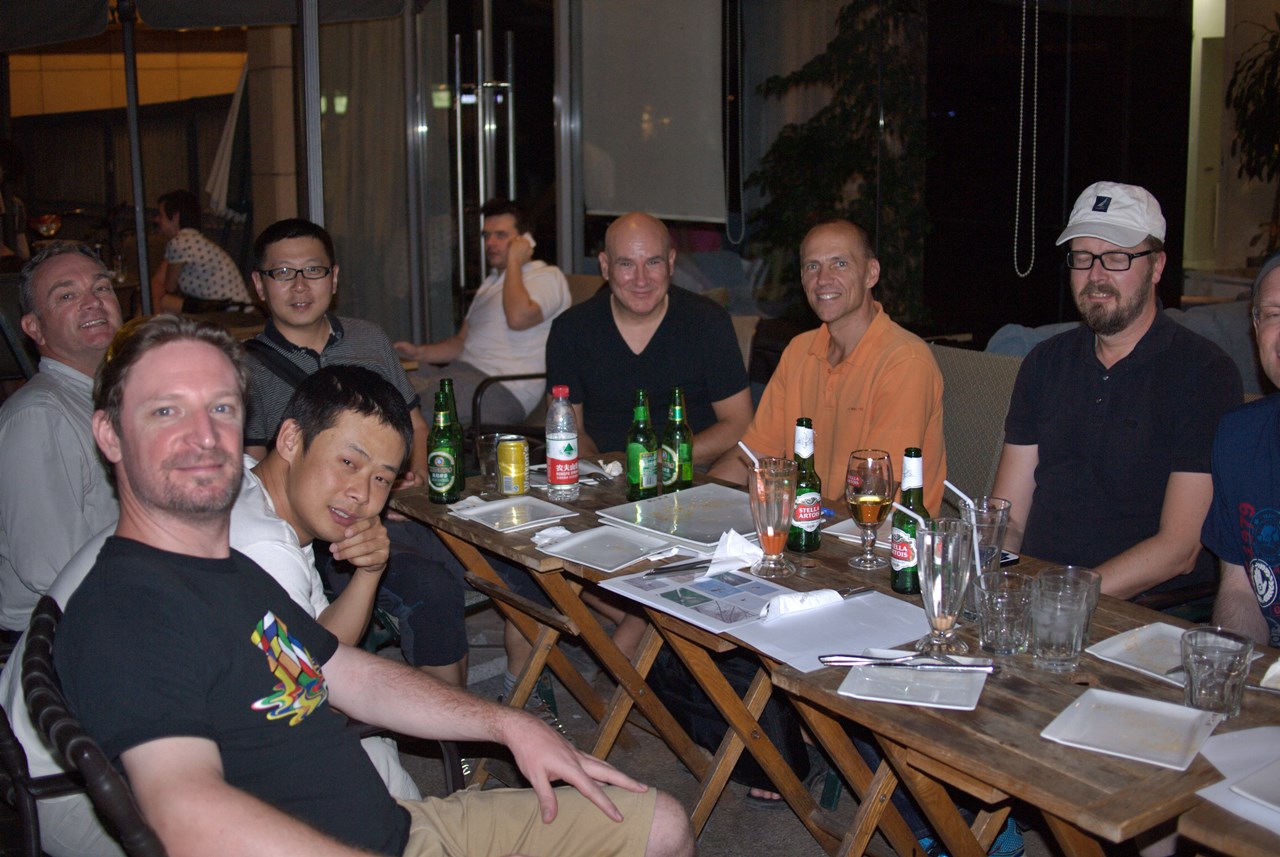
In Beijing we are blessed with a small, but excellent, group of active birders.  There is a growing band of locals, including friends Zhu Lei, Lei Ming, Zhang Shen, Chen Liang, Fu Jianping and more…  plus some ex-pat birders from the UK, Ireland, Canada, Denmark, Hong Kong (should we count Jennifer as an ex-pat?!), South Africa, Sweden and the US.

Although we have been sharing sightings and corresponding on email for some time, many of us had never met, so on Saturday we arranged a meet-up in central Beijing over the traditional birders’ diet of beer and pizza.  Guest appearances by Dalian-based Tom Beeke (complete with ice-hockey kit) and Shanghai-based Craig Brelsford added a bit of “Greater China” spice.

It was very cool to put faces to names, catch up with friends old and new, and speculate over the next addition to the Beijing list.

Thanks to Jennifer Leung for the photos below.

From left to right: Paul Holt, Colm Moore (front), Terry Townhsend and Tom Beeke.
From left to right: Paul Holt (UK), Colm Moore (front, representing Ireland), Terry Townshend (UK) and Tom Beeke (Canada, making a special guest appearance from Dalian).

From left to right: Andrew Morrissey (South Africa), Zhu Lei (China), Chen Liang (China), Steve Bale (UK), Per Alstrom (Sweden), Jan-Erik Nilsen.
Clockwise from left to right: Andrew Morrissey (South Africa), Zhu Lei (China), Paul Holt (UK), Chen Liang (China), Steve Bale (UK), Per Alström (Sweden), Jan-Erik Nilsen (Sweden) and (the right side of) Craig Brelsford (US).

Relict Gull

RELICT GULL (Larus relictus, 遗鸥) is a relatively poorly known species.  Until the early 1970s it was thought to be a race of Mediterranean Gull and some even thought it a hybrid between Mediterranean Gull x Common Gull….

It breeds inland at colonies in Kazakhstan, Mongolia and China and winters almost exclusively on the mudflats of the Bohai Bay in eastern China.  It is classified as “Vulnerable” by BirdLife International, partly because of its susceptibility to changes in climate but also because almost the entire population is reliant on the tidal mudflats of the Bohai Bay in winter, a habitat that is rapidly diminishing as land reclamation intensifies – threatening not just Relict Gull but a host of East Asian flyway species, including of course the Spoon-billed Sandpiper.

Relict Gull is a bird I am always pleased to see and, occasionally, in late March and early April, these birds can be seen in Beijing – for example at Wild Duck Lake or Miyun Reservoir – as they begin their migration to the breeding grounds.  Autumn records in the capital are much scarcer which made Saturday’s sighting of an adult at Yeyahu NR with visiting Professor Steven Marsh all the more pleasing.  However, it is a trip to the Hebei coast, particularly south of Tangshan at Nanpu, that will enable any birder to get to grips with good numbers of Relict Gull at almost any time of the year…  Numbers in winter can be in the 1000s, which makes for quite a spectacle, but even in summer a few immature birds and non-breeders remain.  There is still much to learn about this gull, including its distribution – in 2012 Paul Holt discovered a wintering population of over 1,000 near Zuanghe in Liaoning Province (see image below).

Last week, in the company of Per Alstrom and Lei Ming, I visited the coast at Nanpu and we were treated to more than 100, most probably recent arrivals from the breeding grounds, patrolling the mudflats amongst the local shellfish pickers..  They feed on the local crabs, a delicacy that seems to be in plentiful supply!  Below are some images of moulting adults, second calendar year and first year birds.

Local shellfish collectors
Relict Gulls, near Zuanghe, Liaoning Province, January 2012 (image by Paul Holt).
Adult and 2cy RELICT GULLS, Nanpu Hebei Province, August 2013
Adult RELICT GULL, Nanpu, Hebei Province, August 2013
2cy RELICT GULL, Nanpu, Hebei Province, August 2013
Relict Gull (first calendar year).  Note, in particular, the dark centres to the tertials, darkish legs and bill.
Relict Gull (first calendar year). Note, in particular, the dark centres to the tertials, darkish legs and bill.
Relict Gull (first calendar year) in flight.

 And here is a short video of an adult at Nanpu in August.


_