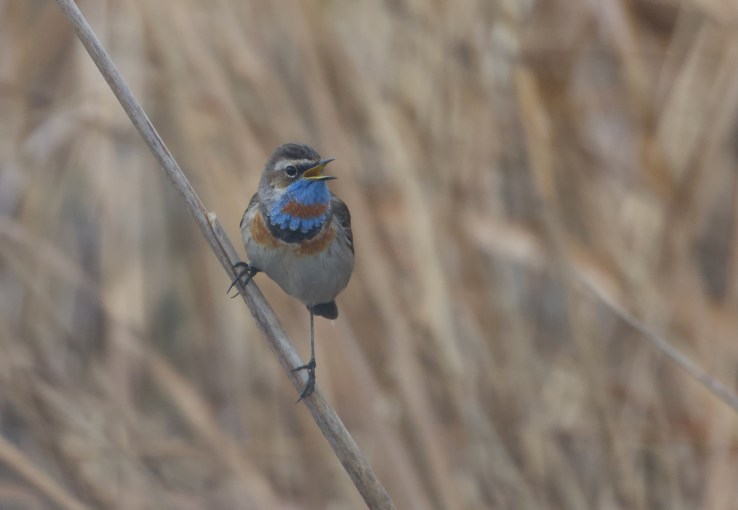
Early to mid-May sees peak passage of Bluethroat (Luscinia svecica 蓝喉歌鸲 Lán hóu gē qú) through Beijing. In suitable habitat it’s not unusual to see multiple birds at a single site during this time. On 6 May I visited ShaCheng wetlands, west of Guanting Reservoir, just over the border in Hebei Province. That morning, in one 500m stretch of reedbed and wet grassland, there were over 20 Bluethroats, the majority males, with a few singing.
One of the male Bluethroats (Luscinia svecica 蓝喉歌鸲 Lán hóu gē qú) at ShaCheng Wetlands, Hebei Province, on 6 May 2025.
It’s a long time since I have heard a Bluethroat singing and I was immediately struck by the incredible mimicry. Several times I thought I had heard a Spotted Redshank (Tringa erythropus 鹤鹬 Hè yù) and looked around frantically to see it only to realise it was a Bluethroat! I began to listen carefully to one male that was singing close by and logged the mimicry of other species I could recognise:
I recorded a few minutes of song – three bursts of around four minutes in total (with a background chorus of Dark-spotted Frogs) – have a listen and let me know what species you can hear!
In Bent, A. C. (1949)’s “Life histories of North American thrushes, kinglets, and their allies”, published in the U. S. National Museum Bulletin 196, the species account for Bluethroat reads: “The delightful song of the bluethroat has charmed all naturalists who have heard it in its northern haunts and has earned for it among the Lapps of its native country a name meaning “a hundred tongues.”
Header image: a singing male Bluethroat (Luscinia svecica 蓝喉歌鸲 Lán hóu gē qú) at ShaCheng Wetlands, Hebei Province, 6 May 2025.
In June 2017 the Hebei Provincial Forestry Department, Hebei Luannan County Government, the Paulson Institute and the World Wide Fund for Nature (WWF) signed a five-year Memorandum of Understanding (MoU) with the aim of protecting one of the most important sites along the East Asian-Australasian Flyway – Nanpu coastal wetland, near Tangshan in Hebei Province. Nanpu is a site Beijing-based birders know well. The spectacular concentrations of shorebirds, not to mention the world-class visible migration of passerines, makes it one of the best birding sites within easy reach of the capital.
Red Knot is one of the species for which Nanpu is a vital stopover site.
That agreement was one of a series of recent positive announcements from China about the Yellow Sea and Bohai Bay. In early 2017, there was a big, and symbolic, step forward when the Chinese government announced that a total of fourteen sites along the Yellow Sea and Bohai Bay had been added to the “tentative list” for UNESCO World Heritage Site nomination. I reported at the time that, although the tentative nomination, in itself, does nothing to protect these sites on the ground, it signals intent from the Chinese government. And, should these sites make it onto the formal World Heritage Site list, that listing comes with a hard commitment to protect and effectively manage them.
More recently, in January 2018, the State Oceanic Administration announced a ban on all ‘business-related’ land reclamation along China’s coast and issued an order to restore illegally-reclaimed land. Already, at Yancheng, sea-walls are being removed to allow the tide once again to feed the mudflats. In March 2018, a major government reorganisation saw environment and biodiversity elevated as government priorities and management of all protected areas being brought under one ministry. These developments are enough to put a smile on even the most pessimistic conservationist’s face!
And so it was with a spring in my step that last weekend I was fortunate to participate in a visit to Nanpu with a delegation that consisted of the mightily impressive, and growing, group of scientists – both Chinese and international – working to study shorebirds along the flyway and some VIPs including Hank and Wendy Paulson of The Paulson Institute and Pulitizer-nominated writer Scott Weidensaul.
It was such a joy to see so many young and extremely capable Chinese scientists – Zhu Bingrun, Lei Ming, Mu Tong to name a few – contributing such a huge amount to our knowledge about the importance to migratory birds of the intertidal mudflats and salt ponds and, being led by Professors Zhang Zhengwang and Theunis Piersma, they are in great hands.
As much as the scientific data is necessary to help make the case for conservation, it is not sufficient. Also needed is a champion who can make the case at senior levels of government and that’s where Hank and Wendy Paulson come into their own. With Hank’s unrivalled experience and access in China, underpinned by the work of his institute, including the Coastal Wetlands Blueprint Project, they have been instrumental in engaging with local governors and the Chinese leadership about the importance of the intertidal mudflats of the Yellow Sea and convincing them of their value. Together, it’s a formidable team.
Asian Dowitcher is one of the species for which Nanpu is an important staging site.
We enjoyed so many stimulating discussions about the latest research, the progress of the work to create Nanpu Nature Reserve and, of course, shorebirds! And thanks to the advice of the Aussie shorebird researchers (Chris Hassall, Adrian Boyle and Matt Slaymaker are back for their 10th year to monitor the Australian-banded birds!), we were on site in perfect time to witness the most amazing spectacle of RED and GREAT KNOTS commuting from their roosting sites in the ponds to the newly-exposed mud on the falling tide. Seeing these shorebirds, most of which were in full breeding plumage, was something to behold and there were gasps of awe as the flocks, sometimes numbering thousands of birds, wheeled around before settling just a few metres in front of us in stunning early morning light. It was the perfect reminder of just why protecting these mudflats is so important – the world would be a much poorer place without these incredible travellers.
There is no doubt that the intertidal mudflats are a jewel in the crown of China’s environmental and ecological heritage and they have the potential to attract thousands of visitors each year, as well as endearing a sense of pride for local people and, indeed, the whole country. With national level policy seemingly moving in the right direction, let’s hope the local progress at Nanpu will act as an example for other sites along the Flyway. Huge thanks to Hank and Wendy Paulson, Professors Zhang Zhengwang and Theunis Piersma, Scott Weidensaul, Zhu Bingrun, Mu Tong, Lei Ming, Wang Jianmin, Dietmar Grimm, Shi Jianbin, Rose Niu, Adrian Boyle, Chris Hassell, Matt Slaymaker and Kathrine Leung for making it such an enjoyable trip!
Video: RED and GREAT KNOTS at Nanpu, May 2018.
Title image: (l-r) Scott Wiedensaul, Professor Zhang Zhengwang, Professor Theunis Piersma, Wendy Paulson, Hank Paulson, Terry Townshend. Photo by Zhu Bingrun.
About Nanpu
Located in Luannan County of Hebei Province, Nanpu wetland consists of natural intertidal mudflats, aquaculture ponds, and salt pans. Its unique geographic location and wetland resources make it one of the most important stopover sites for migratory water birds along the East Asian-Australasian Flyway (EAAF), including rare and endangered species such as Red Knot, Great Knot, Curlew Sandpiper, Black-tailed Godwit, and Nordmann’s Greenshank. Each year, as many as 350,000 water birds stage and refuel here. Among the water birds at the Nanpu wetland, the population of twenty-two species exceeds one percent of their global population sizes or their population sizes along the EAAF, making it a wetland of international importance according to criteria determined by the Ramsar Convention, an intergovernmental treaty that provides the framework for the conservation of wetlands and their resources.
Nanpu wetland is facing many threats, such as reclamation, over-fishing and invasion of spartina, a rapidly spreading grass that suffocates intertidal ecosystems. Studies show that there has been a steady decrease in population of some migratory water birds that depend highly on Nanpu wetland for refueling. For instance, over the past decade, the population of Red Knots that overwinter in New Zealand and Australia along the EAAF has been declining at an annual rate of nine percent. IUCN claims that if no further conservation measures are taken, few Red Knots might remain ten years from now.
It’s a big wrench for me to leave Beijing in migration season! However, last week I was fortunate enough to spend 4 days on Happy Island (菩提岛 in Chinese) in the company of British birder, Nicholas Green. Most birders – and tour companies – visit this legendary island off the coast of Hebei Province in May when birds are singing and in breeding plumage. It is much less visited in the autumn, particularly in early autumn.
I made my first visit to Happy Island in late September 2010, shortly after arriving in Beijing, and boy has it changed. The first thing I noticed on this visit was that it is no longer an island; a new causeway now links this birding mecca to the mainland. Second, the “island”, has grown in size due to land reclamation. Third, the accommodation is excellent – comfortable modern chalets with air conditioning, WiFi and hot water 24 hours per day. Finally, there are some huge new buildings being erected with a new, much larger, temple and a massive building (for what purpose I am unsure) in the shape of a lotus leaf.
These changes might sound like a disaster but, actually, most of the good habitat remains, including the wood around the temple, now complete with wooden boardwalks.
A big target of mine was the now ultra-rare STREAKED REED WARBLER (细纹苇莺), which historically “swarmed” in the millet fields in late August and early September. Sadly, despite scrutinising every ‘acro‘ I came across, I drew a blank. However, it was a ‘birdy’ few days and we racked up a total of 125 species. The full list can be downloaded here but highlights included:
– a flock of more than 50 DAURIAN STARLINGS (北椋鸟)
– three SCHRENCK’S BITTERNS (紫背苇鳽)
– a single drake STEJNEGER’S SCOTER (斑脸海番鸭)
– a single PECHORA PIPIT (北鹨)
– both LANCEOLATED (矛斑蝗莺) and PALLAS’S GRASSHOPPER WARBLERS (小蝗莺) posing for photographs
– 5 DOLLARBIRDS (三宝鸟) on the last full day; and
– a single LONG-TAILED SHRIKE (棕背伯劳), continuing the consolidation of this species’ northerly march
It was astonishing to think that we were the only birders on the island and there must be a possibility that there will be no more visiting until May next year! I shudder to think what birds pass through unseen…
Here are a few photos from the visit. Certainly whets the appetite for this autumn’s migration.
LANCEOLATED WARBLER, Happy IslandBROWN SHRIKEGREY NIGHTJARCOMMON CUCKOO juvenileSCHRENCK’S BITTERN in the ditch in Temple Wood.
STEJNEGER’S SCOTER
And here are two videos – of one of the SCHRENCK’S BITTERNS (紫背苇鳽) and a GREY NIGHTJAR (普通夜鹰). I love the SCHRENCK’S appearing to test the temperature of the water with his toes before taking a drink…
This week I visited Nanpu with Jennifer Leung and Ben Wielstra. This site, on the Hebei coast just 2.5 hours from Beijing, offers world class shorebirding. With tens of thousands of waders, thousands of marsh terns and some rare East Asian specialities such as RELICT and SAUNDERS’S GULLS and ASIAN DOWITCHER, this site is hard to beat. Throw in some visible migration and the passerine migrant magnet of the tiny “Magic Wood” and it’s a wonderful place to spend a few days birding.
Here is a sample of just how many birds are on show here at this time of the year…
One of the most abundant shorebirds is the SHARP-TAILED SANDPIPER which can be found on the settling pools, the banks of tidal creeks and on the mudflats themselves. Of the 1000s seen over the visit, we saw only two juveniles. This one is an adult.
Adult SHARP-TAILED SANDPIPER, Nanpu, 14 August 2014
The spectacle of 1000s of waders arriving at the mudflats, as the mud becomes exposed on the falling tide, is superb… I counted 834 GREAT KNOT on the 14th and, at a different site, over 700 on 15th.. including a couple of colour-flagged birds with individual engravings.
Here is a short video of some of the GREAT KNOT shortly after they arrived at the first exposed mud. The sharp-eyed will notice one of the birds is colour-flagged with a combination of black over white on the upper right leg.
One of the GREAT KNOT sported a yellow flag with the letters “UWE”. On return to Beijing I reported it to the Aussie shorebirders and, within minutes, I had received a reply with the individual history of this bird. Our sighting was the first of this individual outside Australia…
Banding of “UWE”
06/03/2011 Boiler Point, Roebuck Bay, Broome(-18.00, 122.37)Australia 06313620 (UWE) Aged 2+
ResightingUWE
03/10/2011 Boiler Point, Roebuck Bay, Broome(17.00, 122.00)Australia Chris Hassell & Clare Morton
12/10/2011 Boiler Point, Roebuck Bay, Broome (17.00, 122.00) Australia Chris Hassell & Clare Morton
13/10/2011 Boiler Point, Roebuck Bay, Broome(17.00, 122.00)Australia Chris Hassell & Clare Morton
01/11/2011 Minton’s Straight(-17.98, 122.35)Australia Chris Hassell & Clare Morton
16/12/2011 Boiler Point, Roebuck Bay, Broome(17.00, 122.00)Australia Chris Hassell
18/12/2011 Boiler Point, Roebuck Bay, Broome(17.00, 122.00)Australia Chris Hassell
19/02/2013 Boiler Point, Roebuck Bay, Broome(17.00, 122.00)Australia Chris Hassell
20/12/2013 Minton’s Straight(-17.98, 122.35)Australia Chris Hassell
14/08/2014 Nan Pu, Bohai Bay(39.04, 118.36)China (mainland) Terry Townshend, Jennifer Leung & Ben Wielstra
Among the large numbers of GREAT KNOT were some RED KNOT and this photo shows the two species together, allowing a direct comparison. Note the size difference plus the difference in underpart markings, bill length and shape.
Great Knot with Red Knot, Nanpu, 15 August 2014
One of Nanpu’s specialities is the RELICT GULL. Although it’s primarily a wintering location, a few non-breeders remain all year round and it’s possible to see this species at any time of the year. Right now, the breeding birds are returning to the coast, along with a few first year juveniles. We saw at least three of this year’s young amongst more than 100 of these beautiful gulls. Here is an adult just beginning to moult out of breeding plumage:
Although Nanpu is primarily a shorebird site, its location on the east China coast means it is also an excellent place to witness visible migration. Even though our visit was in mid-August, we witnessed a nice passage of RICHARD’S PIPITS and YELLOW WAGTAILS and the “Magic Wood” – a tiny patch of trees and shrubs in the middle of the vast open area of ponds – hosted at least 8 EASTERN CROWNED and 6 ARCTIC WARBLERS as well as YELLOW-RUMPED, ASIAN BROWN, GREY-STREAKED and DARK-SIDED FLYCATCHERS. I can only imagine what this newly discovered ‘oasis’ will be like in September and October.
A nice surprise was this adult male DAURIAN STARLING, a scarce passage migrant in the Beijing/Hebei area.
And an even bigger surprise was an unseasonal PALLAS’S SANDGROUSE that flew backwards and forwards just inland from the sea wall and settled on some rough ground between some ‘nodding donkeys’. Bizarre.
All in all it was a brilliant few days. The full species list is below. Big thanks to Jennifer and Ben for their great company… itching to get back already!
Jennifer scanning waders on one of the pools at Nanpu.Ben watching GREAT KNOT from the bridge at Nanpu
Species List
Common Pheasant – 1 juvenile near the seawall on 15th
Common Shelduck – 1 juvenile on 14th
Spot-billed Duck – 6
Little Grebe – 3 on the pond at the sea wall by the police building
Black-crowned Night Heron – 4 in “Magic Wood” on 14th
Chinese Pond Heron – 1 in flight on 13th and 1 on 15th
Grey Heron – 6
Little Egret – 14
Chinese Egret – 2 on 14th near the bridge where the tidal channel runs into the sea and one on 15th
Great Cormorant – 287 flew in to roost on the ponds at 1745 on 14th
Common Kestrel – 2 (both females)
Amur Falcon – 2 (both adult females)
Black-winged Stilt – not counted but 1000s
Pied Avocet – not counted but 1000s
Grey Plover – 27 on 15th
Little Ringed Plover – c75
Kentish Plover – c500
Lesser Sand Plover – 1 in summer plumage from the bridge at the seawall
Greater Sand Plover – 2 adults in winter plumage on the ponds
Asian Dowitcher – at least 15, including 5 feeding on the falling tide on 15th
Black-tailed Godwit – c700 on 14th
Bar-tailed Godwit – c80
Whimbrel – 23
Eurasian Curlew – 14
Far Eastern Curlew – 29
Spotted Redshank – not counted but estimate of several hundred
Common Redshank – much less common than Spotted bt still 50+
Marsh Sandpiper – 1000s
Common Greenshank – 18
Green Sandpiper – 2
Wood Sandpiper –
Grey-tailed Tattler – 3
Terek Sandpiper – 8
Common Sandpiper – 16
Ruddy Turnstone – 14
Great Knot – 832 counted on 14th from the bridge. 700+ counted on morning of 15th from east of the oil terminal causeway…
Red Knot – at least 30 in total
Red-necked Stint – c40 (never found a substantial concentration of stints)
Temminck’s Stint – 1
Long-toed Stint – 5
Sharp-tailed Sandpiper – 1000s
Curlew Sandpiper – 20
Dunlin – 8
Broad-billed Sandpiper – 3
Ruff – 1 ad male
Red-necked Phalarope – 1 adult (male?)
Black-tailed Gull – 160
Mongolian Gull – 2 adults
Relict Gull – 105 counted on 14th
Black-headed Gull – c300-400
Saunders’s Gull – 6
Common Tern –
Little Tern – 38
Gull-billed Tern – 18
White-winged Tern – 1000s
Pallas’s Sandgrouse – 1 flew back and forth over the marshy area adjacent to the sea wall (viewed from the dirt track). Landed on the rough ground amongst the ‘nodding donkeys’ but not seen on the deck.
Oriental Turtle Dove – 3 around Nanpu
Spotted Dove – 1 in Nanpu
Pacific Swift – 11 flew west along the sea wall on 15th
Common Kingfisher – 1 heard at “Magic Wood”
Brown Shrike – 17 along the roadside
Black Drongo – 1 at the “ice cream” village
Azure-winged Magpie – 4 around Nanpu
Common Magpie – 12 along the roadside
Sand Martin – 12 along the seawall on 15th
Barn Swallow – 1000s
Red-rumped Swallow – 46 counted but many more present
Zitting Cisticola – 6 along the sea wall on 15th
Chinese Bulbul – 3
Thick-billed Warbler – 2 (one in “Magic Wood” on 14th and one along the seawall on 15th)
Arctic Warbler – at least 6 in “Magic Wood” on 14th
Eastern Crowned Warbler – at least 8 in “Magic Wood” on 14th
Reed Parrotbill – 6
White-eye sp – one migrated along the sea wall, seen from the bridge, on 14th
Daurian Starling – one adult male along the roadside with White-cheeked Starlings on 14th
White-cheeked Starling – 8
Dark-sided Flycatcher – 1 adult and 1 juvenile probably this species at “Magic Wood”
Grey-streaked Flycatcher – 1 adult at “Magic Wood”
Asian Brown Flycatcher – 1 adult at “Magic Wood”
Yellow-rumped Flycatcher – an adult male and an adult female at “Magic Wood” on 15th
Tree Sparrow – not counted but numerous
Yellow Wagtail – 12 on 14th and 15 on 15th
Grey Wagtail – 2 by the sea wall seen from the bridge on 14th
White Wagtail – 2
Richard’s Pipit – 28 on 14th from the bridge and 41 on 15th from the dirt track – all migrating
Blyth’s Pipit – 2 possibly this species migrating (a call similar to Richard’s plus an extra “chip”)
Yellow-breasted Bunting – two possibly this species (yellowish buntings) migrating on 14th
During my aborted trip to the Hebei coast last week, one of the birds with which I enjoyed a close encounter was this juvenile sandplover. The recovery from my appendectomy gave me some time to examine the photos and video to try to work out the identification. I found this bird tricky. It wasn’t particularly long-legged, the ‘bulge’ on the culmen wasn’t very pronounced (suggesting Lesser) but the overall gait – including the horizontal stance – suggested Greater. I was confused. So I sent this image to Dave Bakewell who has lots of experience with sandplovers and has written extensively about them on his excellent Dig Deep blog.
A juvenile Sandplover at Nanpu, Hebei Province, 2 August 2014. But which species?
His view is that this bird is a juvenile Greater. Why? This is what he said:
“Not surprised you are struggling with this one! I do find that leg colour is more reliable as a feature for juvs than adults. And, although the bill may not be fully grown (affecting the proportion of the swollen culmen), I do find the tip shape very helpful – slender and more pointed on GSP and blunter on LSP. By now you will know what I think it is! Despite the apparent dumpy, short-legged, round-headed shape, I think this is a very young juv GSP.”
Just when I thought I was getting to grips with sandplovers, I encounter a bird that makes me think again… and that’s what makes birding such a brilliant hobby – always so much to learn!
Here is some video of the same bird, just edited from footage I took last week.
Please let me know what YOU think!
EDIT: Dave Bakewell kindly sent me a link to a similar-aged juvenile Lesser Sandplover (of the atrifons group). You can see it here. It’s a darker plumaged bird overall with noticeably darker legs, darker centres to the coverts and showing a subtly different bill shape.
Early August is a great time to see a range of east Asian shorebirds on the coast of China. So last Saturday I planned to make a 2-day trip to check out Nanpu, a vast and featureless area of salt works and ponds to the south of Tangshan in Hebei Province that hosts hundreds of thousands of waders in spring and autumn.
I woke a little earlier than usual with mild abdominal pain. I put it down to the particularly spicy curry I had consumed on the Friday evening, popped a couple of paracetamol and set off. There was no way a little stomach pain was going to stop me driving the 2.5 hours to see 100,000+ waders on the coast…
As my journey progressed I was excited to see the air and cloud clearing – having started as a smoggy and cloudy day, Saturday turned into a beautifully clear, blue sky day.
On arrival I slowly drove the long road towards the coast, checking the roadside ponds. I was buoyed by a beautiful BROAD-BILLED SANDPIPER in amongst the many SHARP-TAILED SANDPIPERS, KENTISH PLOVERS and BLACK-WINGED STILTS.
I then found a superb pond filled with mostly BLACK-TAILED GODWITS, MARSH SANDPIPERS and SPOTTED REDSHANKS. As I carefully scanned, I found a group of ASIAN DOWITCHERS, a regular but fairly scarce migrant. I counted 22, 21 adults and one juvenile, in a small area. By now my abdominal pain was worsening and I was considering whether to go to a local hotel to rest or to drive back to Beijing. Whilst I was deciding what to do, I took the opportunity to record some video of the ASIAN DOWITCHERS.
After making this recording I decided to head back to Beijing; if I was going to be ill, I would much rather be in my apartment in Beijing than in a low-grade hotel in a small Chinese town. I was glad I did. When I reached my apartment late on Saturday evening, I could hardly stand up due to the pain. I called a friend and he took me to the Emergency Room of my local hospital where, after a series of tests and a CT scan, I was diagnosed with acute appendicitis. Just a few hours later I was in the recovery room after my appendectomy, feeling glad that my appendix didn’t decide to misbehave in some remote part of the developing world!
On 26-27 July I visited the BAER’S POCHARD breeding site in Hebei Province with visiting British birders, Mike Hoit and Andrew Whitehouse, plus Beijing-based Paul Holt and Jennifer Leung. Mike and Andrew had just arrived in China ahead of a trip to Qinghai and, with a couple of days spare, were keen to see BAER’S POCHARD. I had warned them in advance that they are difficult to see in July – the birds are much more secretive once they begin breeding and, in summer, the vegetation is higher. Nevertheless, I was also keen to visit the site to see whether we could find proof of breeding. In addition to the BAER’s, the lake offers superb general birding and is probably the best place in the world to see SCHRENCK’S BITTERN, another difficult world bird. Late July is actually a good time to see the latter, usually secretive, species as the parents make constant flights to collect food for their young.
After the long drive in 35 degrees Celsius heat, we headed straight for the most reliable spot – a series of lotus ponds with areas of open water that, from my previous visits, appear to be a favourite ‘loafing’ location for both BAER’S POCHARD and FERRUGINOUS DUCK.
We were in luck. Almost immediately a stunning male SCHRENCK’S BITTERN made a fly-by at eye level in the lovely late afternoon light and, on one of the lotus pools, was a female BAER’S POCHARD. Result!
Male SCHRENCK’S BITTERN. The Baer’s Pochard breeding site in Hebei must be the most reliable place to see this difficult-to-see world bird. This photo from July 2012.Female BAER’S POCHARD, Hebei Province, 27 July 2014Female BAER’S POCHARD stretching her wings.
After checking out different sites around the lake and enjoying good views of 2 male BAER’S on the open water, we returned to the original spot and, this time, a different BAER’S POCHARD was present. With pale tips to the scapulars and spiky tail feathers, we believed it was a juvenile. I took some video – see below. Clearly, as a ‘Critically Endangered’ species, proof of breeding is significant. And although breeding is likely to have occurred, this would be the first confirmed breeding at this site since 2012. I therefore welcome comments from any ‘aythya‘ experts who might be able to confirm that this is indeed a juvenile BAER’S.
A few volunteers from the Beijing Birdwatching Society have been making occasional visits to this site this spring and summer to survey the BAER’S POCHARDS and so, together, we are slowly building up a picture of the status of this very rare duck. We still lack some basic information such as when they arrive in spring and when they leave in autumn. Given the site freezes over in winter, it’s very likely they move on but there is at least one photo of a BAER’S POCHARD from this site in January, so it’s possible that some remain if there are open patches of water.
The site is becoming an increasingly popular tourist destination. With vast lotus pools and shallow water at the northern end, it’s attracting swimmers, fishermen and general tourists who like to pick and take home a lotus flower or two. And, although it has status as a Provincial Level Nature Reserve, there are apparently plans for ‘development’. Several sets of plans have been drawn up, including proposals for a “water sports” centre, hovercrafts and an artificial ‘beach’. Thankfully, for the time being, none of these proposals have been given the go-ahead. However, the fact that the management is apparently resisting a proposal for the site to be added to the list of important wetlands (which would mean tighter restrictions on development) is a sign that commercial development of this site is clearly a possibility. Gathering data on the importance of this site for BAER’S POCHARD and other birds and wildlife will be critical in order to make the best case possible against commercial development, or at least to persuade the authorities to retain the most important part of the site as a properly-managed nature reserve. Watch this space.
One of the best places on the planet to see GREY-SIDED THRUSH (Turdus feae) is Wulingshan, a stunning mountain park just across the border from Beijing Municipality in Hebei Province. For birders, it’s a brilliant location in late spring and summer. As well as breeding Grey-sided Thrushes this site also hosts Green-backed (Elisae’s) Flycatcher, White-bellied Redstart, Siberian Blue Robin, Koklass Pheasant, Grey Nightjar, White-backed and Japanese Pygmy Woodpeckers and a plethora of leaf warblers including Claudia’s, Hume’s, Yellow-streaked, Chinese Leaf and Large-billed Leaf. Perhaps even more exciting is that it is said to still be home to Leopard.
The location of Wulingshan (red marker) in relation to Beijing. Using the Jingcheng Expressway (G45) the drive to the north gate takes about 2.5 hours, traffic permitting, with a further 30 minutes to reach the peak.
At the weekend, I visited the mountain with Marie and, despite many birds having stopped singing by mid-July, we had a great time and were very fortunate to see one of our target birds – the GREY-SIDED THRUSH – so well. This thrush, classified as “Vulnerable” by BirdLife due to its restricted range, breeds here in reasonable numbers. We saw at least 8, including 3 juveniles – the first time I had seen this plumage – and early on Sunday morning we enjoyed prolonged views, allowing me to capture some video of an adult and a juvenile.
The views are incredible and the sunsets are also spectacular if lucky enough to coincide a visit with a smog-free day.
It’s possible to drive to the top and walk a few hundred metres to the 2,118m peak.The view to the northeast from the peak at Wulingshan.Miyun Reservoir can be seen to the southwest on a clear day.Sunset at Wulingshan, Saturday 12 July 2014.Another photo of the sky just after sunset, Wulingshan, Saturday 12 July 2014.
On Thursday I visited the BAER’S POCHARD breeding site with visiting Dick Newell, Lyndon Kearsley (from the swift project) and good friends Andrew and Rachael Raine. It was one of the hottest days I have ever experienced in Beijing with the thermometer on my car peaking at 43 degrees Celsius as we drove south. It was still 38 degrees C when we left the site at 8pm.
From left to right: Lyndon, Andrew, Rachael and Dick enjoying views of Baer’s Pochard.
Despite the heat, it was a superb day. One of the objectives was to see, and count, the BAER’S POCHARDS present. As the spring wears on, these birds get more secretive but we were fortunate to see at least 18 of this “Critically Endangered” duck, 16 of which were males.. The predominance of males suggests to me that perhaps the females are on nests, which must be good news….
We enjoyed some excellent views of a male at close quarters by the side of the road and I was able to take this video using my iPhone 5 and the Swarovski ATX95 telescope. I am continually amazed at the quality of the results using this set-up.
As well as the BAER’S POCHARDS, we also enjoyed excellent views of REED PARROTBILL and displaying SCHRENCK’S BITTERNS just before dusk.
One of the threats to the BAER’S POCHARD (青头潜鸭) is hybridisation with the closely related, and range expanding, FERRUGINOUS DUCK (白眼潜鸭). At the Baer’s Pochard breeding site in Hebei Province, Ferruginous Duck is a common breeder; I counted more than 60 on site last weekend versus 24 Baer’s.
Another drake, superficially resembling a drake Baer’s, sported a chestnut cap and slightly less white on the flanks than one would expect for a pure Baer’s. It was associating with a group of Ferruginous Ducks and I recorded the video clip below. The chestnut cap is particularly noticeable towards the end of the clip.
I hope to visit the site a few more times over the coming weeks and will look out for more evidence of hybridisation and, hopefully, evidence of breeding Baer’s too.
EDIT: It has been suggested by folks at WWT, who have been catching and taking DNA samples from captive birds, that the drake in the video clip may be a first summer male. Personally, the colour of the cap, resembling the chestnut brown of Ferruginous and not the darker brown typical of Baer’s, makes me think there is some Ferruginous influence but I’ll go back soon and try to get more photos!
BAER’S POCHARD (Aythya baeri, 青头潜鸭) was once abundant in east Asia.. now it is listed as “Critically Endangered” due to an, as yet unexplained, calamitous population decline. The only known breeding site is not in the far northeast of China or in Russia (previously understood to be the species stronghold) but instead in Hebei Province, not far from Beijing.
Yesterday I visited the site and found at least 24 of these beautiful ducks on site, most of which seem paired up and ready to breed. Worryingly, at least two birds appeared to be hybrids with the closely-related Ferruginous Duck, a common breeder at the same site.
I recorded this video compilation of a male displaying to a (seemingly uninterested) female… It was almost comical seeing him try in vain to attract her attention. Let’s hope she is more interested soon – we need them to make babies!
I am in discussions with the Beijing Birdwatching Society about submitting a grant application to the Oriental Bird Club conservation fund to set up a project to monitor Baer’s Pochard at this site… We know almost nothing about this bird and its habitat requirements.. so fingers crossed we secure some resources.
Video recorded using an iPhone 5 with the Swarovski ATS95 telescope and iPhone adaptor.
At the Beijing birders meet-up we arranged for a group trip to Nanpu, near Tangshan in Hebei Province. In total, 15 of us – both ex-pats and locals – spent the weekend at this world-class site and it was a superb trip – great fun with lots of birds!
The backdrop may not be pretty but the birding is spectacular at Nanpu.
Perhaps the best single bird in terms of rarity was an ORIENTAL STORK that came in off the sea. And amongst the other highlights were impressive numbers of shorebirds with 4,700 SHARP-TAILED SANDPIPERS and 2,325 DUNLIN, a single RUFF (rare here), five juvenile RED-NECKED PHALAROPES, at least six first-year SAUNDERS’S and up to 80 RELICT GULLS and decent numbers of passerines moving down the coast. High counts included 54 BLACK-NAPED ORIOLES (including a single flock of 23 birds!), 100 DUSKY WARBLERS, 300 SIBERIAN STONECHATS, up to 150 RICHARD’S PIPITS, two BLYTH’S PIPITS, two PECHORA PIPITS and six YELLOW-BROWED BUNTINGS.
Per checking out the waders on a roadside pond at Nanpu.This is “EVA” the Bar-tailed Godwit. Colour-flagging of migratory shorebirds helps researchers to better understand the routes these birds take and the stopover sites they use which, in turn informs conservation measures. You can read about EVA’s history in the trip report.Juvenile Red-necked Stint. Beautiful birds!Gull-billed Tern.
It was hot at Nanpu and, fortunately, there is a small village where one can purchase ice creams! I can thoroughly recommend the ‘traditional flavour’ ice lollies.. delicious (even though I am not sure of what exactly they taste!). The locals here make their living from the mudflats, where they harvest the shellfish and shrimps. Here are a few maintaining their nets.
Local ladies maintaining the shrimp nets
And in the early mornings, our 0500 starts were made (slightly) easier by the delicious bao zi (steamed dumplings) that were on sale for the equivalent of 5p each…
Jan-Erik and Andrew browsing the local bao zi stall.
At the coast, where passerine migration was most impressive, we unfortunately encountered more illegal bird trapping activity. From the car, Paul heard a Yellow-breasted Bunting singing and we stopped to investigate. We very quickly saw a line of mist nets in the grass close by. The poacher had set up an elaborate line of nets accompanied by caged songbirds, clearly designed to lure in wild birds. The caged birds included Common Rosefinch, Yellow-breasted and Yellow-browed Buntings – three species that were clearly moving at this time of year.
A male Common Rosefinch strategically placed to lure in wild birds.A distressed-looking male Yellow-breasted Bunting, now officially an endangered species after years of persecution.
In the nets we found alive 2 Common Rosefinches plus Yellow-browed, Arctic and Dusky Warblers, which we promptly released. But it was too late for 4 Brown Shrikes which had fallen victim to this cruel practice.
The poacher soon arrived (claiming that the nets were his friend’s and not his – yeah right). We told him firmly that this was illegal and that we would be taking photos and reporting him to the Hebei Forestry Administration. He did not protest and actually helped us to dismantle and destroy the nets, snap the poles, release the caged birds and destroy the cages. On return to Beijing I posted the photos on Sina Weibo (Chinese “Twitter”) asking for help in reporting this illegal activity. Within 10 minutes, users on the microblogging service had translated my report into mandarin and submitted it to the Hebei Forestry Administration… wow! The power of social media. Thanks guys!
Ironically, the next day we were ejected from this area by local security guards from the nearby oil terminal and police who claimed that it was a “nature reserve”. So it’s ok to drill for oil and trap wild birds in a nature reserve but birding is a step too far…! A big thank you to Lei Ming and friends for following up on my behalf with the Hebei Forestry Administration.
The trapper was surprisingly cooperative as we dismantled the nets and freed the trapped birds. Here he frees a first year/ female Common Rosefinch
RELICT GULL (Larus relictus, 遗鸥) is a relatively poorly known species. Until the early 1970s it was thought to be a race of Mediterranean Gull and some even thought it a hybrid between Mediterranean Gull x Common Gull….
It breeds inland at colonies in Kazakhstan, Mongolia and China and winters almost exclusively on the mudflats of the Bohai Bay in eastern China. It is classified as “Vulnerable” by BirdLife International, partly because of its susceptibility to changes in climate but also because almost the entire population is reliant on the tidal mudflats of the Bohai Bay in winter, a habitat that is rapidly diminishing as land reclamation intensifies – threatening not just Relict Gull but a host of East Asian flyway species, including of course the Spoon-billed Sandpiper.
Relict Gull is a bird I am always pleased to see and, occasionally, in late March and early April, these birds can be seen in Beijing – for example at Wild Duck Lake or Miyun Reservoir – as they begin their migration to the breeding grounds. Autumn records in the capital are much scarcer which made Saturday’s sighting of an adult at Yeyahu NR with visiting Professor Steven Marsh all the more pleasing. However, it is a trip to the Hebei coast, particularly south of Tangshan at Nanpu, that will enable any birder to get to grips with good numbers of Relict Gull at almost any time of the year… Numbers in winter can be in the 1000s, which makes for quite a spectacle, but even in summer a few immature birds and non-breeders remain. There is still much to learn about this gull, including its distribution – in 2012 Paul Holt discovered a wintering population of over 1,000 near Zuanghe in Liaoning Province (see image below).
Last week, in the company of Per Alstrom and Lei Ming, I visited the coast at Nanpu and we were treated to more than 100, most probably recent arrivals from the breeding grounds, patrolling the mudflats amongst the local shellfish pickers.. They feed on the local crabs, a delicacy that seems to be in plentiful supply! Below are some images of moulting adults, second calendar year and first year birds.
Local shellfish collectorsRelict Gulls, near Zuanghe, Liaoning Province, January 2012 (image by Paul Holt).Adult and 2cy RELICT GULLS, Nanpu Hebei Province, August 2013Adult RELICT GULL, Nanpu, Hebei Province, August 20132cy RELICT GULL, Nanpu, Hebei Province, August 2013Relict Gull (first calendar year). Note, in particular, the dark centres to the tertials, darkish legs and bill.Relict Gull (first calendar year) in flight.
And here is a short video of an adult at Nanpu in August.
As the wild population of Baer’s Pochard (Aythya baeri, 青头潜鸭) has declined dramatically in the last few years, a new threat has emerged – that of hybridisation (see my article on Birding Frontiers here). The only confirmed breeding site for Baer’s Pochard also hosts the closely related Ferruginous Duck (Aythya nyroca, 白眼潜鸭) and, this year, I have personally seen drake Baer’s displaying to females of Ferruginous Duck and Common Pochard.
This spring and summer I have been making regular visits to the breeding site in Hebei Province, south of Beijing, to monitor the Baer’s Pochards. It’s a large site with many hidden ponds amongst the reeds, meaning that, in a short visit, it is not straightforward to count the birds present or to establish proof of breeding. So far this year I am unaware of any confirmation that Baer’s has bred successfully.
My most recent visit, in early August with visiting British birder Richard Bonser, produced no definite sightings. However, we did see the bird below, which we think *could be* a female Baer’s. One of the problems with identification of ducks at this time of year is that adults are in ‘eclipse’ plumage, meaning that they look very different than when sporting their spring finery. An additional complication is the spectre of hybrids. I do not have knowledge of what Baer’s Pochard should look like in eclipse and I have been unable to find any images or literature to guide me. Baer’s *ought* to be identifiable on structure but, with hybrids a very real possibility, this becomes less straightforward – we should expect at least some hybrids to exhibit Baer’s-like structure.
Clearly, given the “Critically Endangered” status of this bird, a priority must be to assemble images of known pure Baer’s in all plumages from private collections. That will help birders seeing these birds in the wild to establish whether they are true Baer’s or hybrids which, in turn, will help conservationists to better establish the likely true population and the extent of the threat of hybridisation.
In the meantime, I would very much welcome views from anyone with experience of these birds as to whether the bird below is a pure Baer’s or a likely hybrid (in my view it is clearly not a pure Ferruginous on structure and plumage tones alone).
Possible Baer’s Pochard (or hybrid), Hebei Province, 6 August 2013. Note the robust, all dark bill and flattish head (inconsistent with pure Ferruginous but is there enough here to rule out a hybrid?). The bird is an adult as it is in wing moult – a juvenile would look much ‘cleaner’.Possible Baer’s Pochard (or hybrid), Hebei Province, 6 August 2013Possible Baer’s Pochard (or hybrid), Hebei Province, 6 August 2013
Brown Accentor (Prunella fulvescens), on the Beijing-Hebei border, February 2013
BROWN ACCENTOR (Prunella fulvescens) is a bird that I have been optimistically looking out for all winter… checking all those Siberian Accentors is a tough job but someone has to do it, right? By rights, Brown Accentors shouldn’t be in Beijing. They breed to the north-west and only the occasional straggler makes it to the capital and is seen. I am aware of only one record, at Shidu, a few winters ago and I don’t know any details such as date or precise location.
It was therefore with some excitement that I saw a report from Beijing-based birder Zhang Shen about a BROWN ACCENTOR at Mentougou, the mountainous district to the west of Beijing. After contacting him, Shen kindly provided some detailed directions and the next day I was on my way…
The mountains to the west of Beijing, on a clear day, are simply stunning. And there are some good roads that help to get you into the heart of this territory where some of the special mountain birds can be seen. We arrived on site at around 0900 after a 2.5 hr drive from central Beijing and it was immediately obvious that we would have a good day. A Cinereous Vulture soaring overhead and landing on a rocky outcrop was a great start. And soon after we were enjoying views of 4 Golden Eagles soaring together, with one even displaying as Red-billed Choughs called and wheeled around the peaks. We reached the Beijing/Hebei border and parked up. A narrow paved road winds to the north, following the Yong Ting River and it was along here that we were told the Brown Accentor had been seen.
The habitat in Mentougou District. Stunning scenery.
A couple of false alarms with Siberian Accentors sharpened us up and, before long, we came across a small flock of Godlewski’s Buntings feeding alongside the track. Checking them carefully, we spotted a couple of Meadow Buntings amongst them and then, suddenly, Jennifer said “ACCENTOR”… No sooner as she had said that, the bird in question dropped behind a boulder and it was an agonising few seconds before it revealed itself again and showed that it was indeed the BROWN ACCENTOR we had hoped for. We watched it for a good 20-30 minutes as it fed around a group of rocks at the base of a cliff-face, in typical accentor style, creeping along the ground with short hops.
Unfortunately for Beijing ‘listers’ this bird seems to prefer an area of rocks just 500 metres over the border into Hebei Province.. maybe some Beijing birders will put down a trail of birdseed luring it over the border….!
The latest in the ad-hoc series of Guest Posts is authored by Beijing-based Shi Jin. The article is about the latest developments on “Happy Island” in Hebei Province and was originally published on Shi Jin’s excellent Chinese Currents website this Spring. It makes very interesting, if a little sombre, reading, in particular for anyone who has visited this birding hotspot. It should be added that, despite the development ongoing at this site, it is still attracting an amazing number and variety of migratory birds…!
So, over to Shi Jin..
Shedding Tiers
For some, Happy Island is now a happier place. The small island in the Bo sea has been promoted from 5th to 3rd tier. The shedding of two tiers is no small matter, particularly if you happen to be one of the Tangshan [3rd tier] government officials who can now make the most of the island’s sumptuously appointed sea-view villas. If you are an official of Laoting County [5th tier], however, the situation is not nearly as happy as it used to be.
That’s because the Tangshan city government has promoted Happy Island (Kuaile Dao) to an area that falls under its (not Laoting County’s) direct jurisdiction. And to make sure that everyone knows who’s the lord of this particular manor, Tangshan officials have re-named the place Puti Island (“Happy Island” was a Laoting County invention apparently). The locals, however, continue to refer to it by its ancient name of Shijiu Tuo. And, with a nod in Laoting County’s direction, I’ll continue to use “Happy Island” (because it’s a name that has been doing what it says on the can during the many visits I have made here over the past 18 years).
Laoting County, even though it “reports” directly to Tangshan, is actually two levels beneath it as far as the complicated matter of Chinese population and land administration is concerned. That’s because Laoting is a xian (county), not a shi (county-level city). Tangshan, a diji shi (regional city, or prefecture), controls 5 xian and two shi. China, in case you are wondering, is divided into 283 prefectures, 370 county-level cities, and 1,461 counties.
Tangshan “reports” to the provincial government of Hebei (seated in the provincial capital of Shijiazhuang), which in turn is administered by the central government in Beijing. By virtue of its provincial capital status, Shijiazhuang qualifies, in political terms at least, as a 2nd tier city (one of 27 provincial and autonomous region capitals to do so). The number of 2nd tier cities increases to 32 if you include Dalian, Ningbo, Qingdao, Shenzhen, and Xiamen – which are categorised as sub-provincial cities (fushengji chengshi) by virtue of their direct reporting line to Beijing in respect of all economic and legal matters (the only non provincial-capitals to do so). Then there are of course four 1st tier “super-cities” – Beijing, Shanghai, Tianjin and Chongqing – that have the distinction of being municipalities (zhixiashi).
Why is this important? Well, as a rule of thumb, the higher the tier, the more funding is available for development generally and infrastructure development in particular. In the context of Happy Island, the difference between “5th” and “3rd” tier funding is as jaw-dropping as it is eye-watering:
I first visited the island 18 years ago, when it was under the administration of Laoting County. It was low tide as the small, woodworm-riddled boat approached the landing point along a narrow channel that only a seasoned crew could navigate with any confidence. It’s impossible to say whether the crew that day were not as seasoned as they should have been, or whether it was a particularly low tide that scuppered things. One thing is for sure, we couldn’t get within 20 yards of the quay. Keen to get ashore, I decided to jump into the waist-high water to rescue the situation by dragging the boat close enough to the shore to allow a plank to be laid for my fellow passengers to make it to the island. But it wasn’t luxury that awaited us. In those days, the tin-shack accommodation didn’t even have running water, except when it leaked through the roof during heavy downpours. So much for being under the administrative umbrella of Laoting County.
Fast-forward to 2012: A fleet of shiny new tourist boats await to whisk a steady flow of day-trippers from a multi-million RMB quay development to the island’s plush new landing area. These days, there’s a deep channel that’s regularly dredged, ensuring that boats can land whatever the vagaries of the tide.
The island’s development budget has also paid for a plush restaurant with dozens of staff; a grand temple complex (that continues to get ever-grander); miles of roads serviced by chauffeur-driven electric buggies; and even something resembling a golf course. And things are just getting started. There are plans for a 300 million RMB golf and spa centre and, horror of horrors, a ghastly land-reclamation project (to enlarge Happy Island and Moon Island) that will cost a reported 1.368 billion RMB, according to the Tangshan government’s website. The impetus for development is so strong, in fact, that a link to the mainland has been built that looks like a giant’s causeway, facilitating even faster development and higher-spending on infrastructure and reclamation.
Building an island paradise fit for a prefecture-level city.
Puzzled by the number of large trucks and the size of the earth-moving vehicles, my 8 year-old daughter wanted to know how they managed to get onto the island. I too was puzzled, until I spotted the causeway. After I’d broken the news that the “monsters” had arrived here by road, her puzzlement turned to disappointment: “Dad, does that mean Happy Island isn’t an island?”
My 8 year-old makes an important observation. But please promise not to tell anyone because, from a tourist perspective, Happy Point doesn’t have anywhere the same drawing power of Happy Island. Not to mention that, without an island, there wouldn’t be the need for a car park the size of a football pitch. No need for a fleet of expensive tourist boats. And, of genuine concern, a small-army of people would be looking elsewhere for a job.
From a punter’s perspective, neither would there be the feeling that they’ve journeyed to somewhere exotic. A 30 minute boat trip tends to do more for the soul than a ten-minute bus ride. As heart-warming as the journey undoubtedly is (and there’s also the visit to the “Buddhist culture communication centre” to look forward to), it’s hard to imagine that the overall proposition would appeal to vast numbers of people.
Regardless, the visitors-per-year target for the Tangshan Bay International Travel Islands project [the other two islands are Moon Island and Lucky Cloud Island] has been set at an astonishing 2 million people [The overall investment is budgeted at 22.2 billion RMB]. But this is China, so history would suggest that you shouldn’t bet against it meeting the target. That said, it’s hard for this veteran China-watcher to arrive at any conclusion other than the “Build it and they’ll come” ethos, that has driven economic development during my time here, is being replaced by “Build it whether they come or not” desperation. This is in no small measure due to the increasing dependency on high-spending infrastructure projects to shore up the nation’s key economic indicators. In short, these projects have become the drug that enables GDP to get out of bed in the morning.
As well as testing the laws of economics, the intensity of Happy Island’s development is putting an immense strain on the area’s ecology. The island and its shoreline is an internationally-important staging post for countless numbers of migratory birds on their way to and from their northern breeding grounds (a precious few of that number are Siberian-breeding Spoon-billed Sandpipers, a species on the brink of extinction). Their twice-yearly journeys are about to get even more precarious from next year when construction of more than 100 offshore wind-turbines begins in earnest. This wind farm will be (for a while at least) China’s biggest and most costly (US$910m).
Clearly, the true cost of Happy Island’s infrastructure development, land reclamation, and so-called “green energy” project far exceeds the amount that appears in Tangshan city’s accounts.
Big hat tip to Paul Holt, not only for finding the star bird of the trip – a Common Ringed Plover – but also for somehow recording every single bird we saw or heard. Phenomenal.
Paul Holt and I have just returned from a weekend at Nanpu, near Tangshan, in Hebei Province. Nanpu is a vast area of fish ponds, salt works, reclaimed mudflats and even a prison. During migration season the area hosts tens of thousands of shorebirds. Being on the Hebei coastline, not so far from the migration hot-spot of Beidaihe, it is also on the flyway for birds hugging the coast on their journey south. So, in addition to the waders, visible migration can be superb.
I’ll post fuller details of the trip in due course, including about the resident Reed Parrotbills, the visible migration and the astonishing numbers of Brown Shrikes but this post is about the star bird of the trip – a Common Ringed Plover (Charadrius hiaticula).
Common Ringed Plover, Hebei Province, 26 August 2012
Picked out by Paul, this wader is rarer than Spoon-billed Sandpiper in eastern China. With fewer than 30 records away from Xinjiang in the far west, it was a great find. Of course, when finding a ‘Common Ringed Plover’-type, it’s important to rule out the very similar North American species, Semipalmated Plover (Charadrius semipalmatus). Call is a great way to separate the two (Semipalmated Plover has a more Spotted Redshank-like call) but, in the absence of a calling bird, there are some subtle plumage differences that allow identification if views are sufficient.
First, one of the most reliable features on Semipalmated Plover (SPP) is that the lower dark mask in the loral area meets the bill above the gape line, whereas in Common Ringed Plover (CRP) it meets at the gapeline, or slightly below. This seems to be a trustworthy feature, provided that the birds are not in active moult.
Second, the eye-ring. SPP usually shows a clearly visible pale-yellow eye-ring.
Third, the breast-band. SPP usually shows a relatively narrow breast band compared with CRP.
Additionally, SPP usually shows a slightly shorter bill and a very small (sometimes absent) white patch to the rear of the eye.
As its name suggests, SPP has some webbing between the toes but this is extremely difficult to see in the field, especially when clinging mud or wet sand can create a similar appearance.
We were fortunate with this bird in that it called several times before we were able to sneak close enough to confirm the plumage features. Incredibly, the next day, we saw and heard a flying Common Ringed Plover some 7km from the site of the original sighting. It was probably the same bird but who knows whether this species is under-recorded in this under-watched part of the world…?
Common Ringed Plover, Nanpu, near Tangshan, Hebei Province, 26 August 2012.
Common Ringed Plover breeds on the beach close to my parents’ home in Norfolk, England, and it is a bird with which I am very familiar. Seeing one as a “rarity” was a little weird… but that’s birding!
China is a good place to see bitterns. In addition to the Great Bittern (the one familiar to European readers), it is also possible to see Black Bittern, Cinnamon Bittern, Von Schrenck’s Bittern and Yellow Bittern. Of the smaller bitterns, the Yellow Bittern is most numerous in Beijing with Von Schrenck’s also breeding in small numbers. Cinnamon is an occasional (and increasing?) late Spring visitor (and possible breeder?) and there is just one record of Black Bittern.
Below are some images of Cinnamon, Von Schrenck’s and Yellow Bitterns, all taken in Beijing or neighbouring Hebei Province.
First, the beautiful richly coloured Cinnamon Bittern.
Cinnamon Bittern (male). No mistaking this species!Cinnamon Bittern (presumed female with streaking below and pale spotting on the upperparts).
Next up, Von Schrenck’s Bittern. The males and females look quite different.
Von Schrenck’s Bittern (male). Note the dark back, dark face and wing pattern (compared with Yellow Bittern below).Von Schrenck’s Bittern (male).Von Schrenck’s Bittern (female). Note the heavy and dark streaking.Von Schrenck’s Bittern (female). Note the white-spotted upperparts combined with the dark back and face.
Finally, the Yellow Bittern. A common breeder, including in the Olympic Forest Park and Yeyahu NR.
Yellow Bittern (male). The contrasting underwing is a good feature of Yellow Bittern).Yellow Bittern showing uppewing pattern. This individual has a particularly dark back.Yellow Bittern.Yellow Bittern from below.
This is the latest in a series of guest posts from China-based birders. Written by Jan-Erik Nilsen, a Swedish birder who has lived in China for 3 years, it’s an account of a recent trip into the mountains around Beijing.
Haitou Shan Mountain, Hebei Province, Saturday, 23rd June 2012.
Beijing is from SW clockwise to NE surrounded by mountain ranges and several peaks reach above 2000 m. From about 1500 m to the tree line at about 1900-2000 m, a more Northern vegetation of coniferous forest and birch trees can be found. The changing vegetation zones on the mountainsides bring an interesting diversity of bird species.
With a peak reaching to 2200 m, Haitou Shan should be the second highest in the greater Beijing area and it’s located N of the Guanting Reserve (where Ma Chang is located) in Hebei province. I have climbed this mountain two times before, then with a hiking group and no time for birding. I noticed abundant numbers of Hume’s Warblers and other interesting birds and that’s why I have nursed a plan to return by myself for proper birding, a plan to be executed this day.
Driver Mr Chen picked me up in Beijing at 01.00, in the tropical hot and very early morning. We drove the 4th ring road towards the NW, not much traffic so far, but on the Badaling Expressway trucks suddenly crowded, and we hit a traffic jam even before we had entered the mountain area NW of Beijing. We found ourselves caught among big trucks, most of them for coal transport, now emptied and on the way back to the coal fields in Inner Mongolia or Shanxi. Soon the traffic slowly began to move again, the police had narrowed the road at a certain point to reduce the traffic further on. In mornings, evenings and nights, the number of trucks on the Badaling Expressway and all the way to Inner Mongolia can be enormous in both directions. Once, on a trip by car along the 500 km way to Hohhot, capitol of the Inner Mongolia autonomous region, I hit several traffic jams and the normal 5 h ride became 10 h.
We lost some 30 minutes here before we were up to full speed again, continuing the expressway until we had crossed the bridge over the Guanting Reservoir. On the other side of the reservoir we turned north and found our way to the Dahaitou village at the western foot of the mountain. I noticed the first shade of the morning light at 03.45 but, due to the overcast skies, birding was hardly possible until 04.45, and we arrived at Dahaitou at 5.00. Last time at the same mountain, the hiking guide told me Dahaitou was the name of the village where we started the climb. It was not, and I realised it could take hours to find the right village, so I just started to hike on a track up the mountain that looked good.
The peak of the mountain and some of its many subordinated peaks where disguised in mists and clouds, bringing a mysterious feeling to the peaceful morning. Later the mist gradually decreased, lower hanging clouds disappeared, and little by little revealed spectacular views of the hills and mountains.
After one hour the track still existed but looked as if it had hardly been used for a hundred years or so. I continued anyway, and soon found myself in a several hundreds meter radius bowl, three quarters surrounded by 50 or 100 m high steeps. As giving up has never been my favourite option, I found a less steep part and climbed up there, through jungle-like dense vegetation, without any sign of a decent track. I targeted a coniferous forest some 300 m higher up, I knew it would be easier to hike there. But long before, the slope became steeper, the vegetation more dense and even more difficult. I had to grab branches of trees for each step to keep my balance.
I looked at the mountain, still disguising its highest peak in clouds and mist. A Songar Tit perched in a dead tree a few meters in front of me and looked curiously at me – a behaviour I recall from their cousin Siberian Tit in Northern Scandinavia – and soon another one joined. I bet they wondered why this strange beast could be so stupid to try to climb such difficult terrain. A glimpse on the watch convinced me it would take too long to make it to the coniferous forest. I went down again, becoming very mindful of how steep and difficult the climb up had actually been, and it was even more difficult to climb down. It took a lot more than a little effort to find the right way down and avoid the steep sides bordering the ‘bowl’, but I did find a way down, and all in all I had some good birding too, during this 4,5 h hike.
A Large Hawk Cuckoo called, Yellow-bellied Tits were around, interesting Phylloscopus warblers such as Eastern Crowned, Claudia’s, Chinese Leaf and Yellow-streaked Warblers were singing. The highlight was a Chinese Beautiful Rosefinch, at only 1300-1400 m altitude. I encountered this species above the tree limit, where they normally reside, last time I climbed the mountain. That was actually only a km or so away, so it’s not a long distance flight for them.
Back at the village, a village elder approach me and pointed out a track in a more southern direction. We could drive the car up there for 15 min, from where I began a new hike. The vegetation here was a little different from the last place, higher trees and less jungle-like. After half an hour I saw something looking like a red carpet. When I came closer I found the red carpet was spread over the stairs leading to a temple. Smoke came out from the doorway, so dense I could hardly see through it. I stepped into the temple and faced three gods staring at me from an altar. Their eyes arranged so they all three stared on you just when entering the temple, and it made the three of them look very alive.
The smoke came from incense burning in a pot in front of them, and fresh fruit had been put on the altar. Someone had obviously served the altar earlier today. I nodded to the three gods to show them respect and then left. I continued the track up the mountain, the track became very bad after a while and time was running out. The climb to the top would total 3-4 hours on a good track; there was no way I could make it that quick on this way up. So I returned, was back at the car at 13.15, after a 3,25 h second hike. Two tries in a day, but never reaching higher than about 1600 m.
The birding was quite alright also at this second hike. An Oriental Cuckoo calling, a singing White-bellied Redstart, and a Yellow-throated Bunting. The same Phylloscopus species again, except the Yellow-streaked was replaced by a Hume’s Warbler. I believe there will be a lot more Hume’s Warblers higher up the mountain, as they were very abundant the two times I went up there before. An Asian Stubtail was singing, or what we shall call the insect-like noise this 9-10 cm very small bird produces. Ref. Paul Holt, Beijing is the southern limit of the species.
I recorded calling and singing birds on my iPhone and confirmed them on Xeno-Canto at home, which worked very well, except for a few calls still to be identified.
It’s difficult to compare the birding of Haitoushan with the more frequently birded Wulingshan, NE of Beijing, as I didn’t reached that high altitude here, but I guess this place can provide similar species. An advantage of Wulingshan is of course the simple access to high altitude by car.
The temple was named Long Wang Miao, Dragon King Temple, and my Chinese teacher later explained the main god here was the Dragon King, a mid-level Dao god mainly in charge of making rain.
Early morning view over Dahaitou village.Misty morning, somewhere up there is the 2200 m peak of Haitou Shan.Long Wang Miao, The Dragon King Temple.
Full species list:
Common Pheasant 4 calling
Great Spotted Woodpecker 1
Large Hawk Cuckoo 1 calling
Oriental Cuckoo 1 calling
Rock Pigeon 2
Amur Falcon 3 Dahaitou + 8 on telephone lines N of Dahaitou
Red-billed Blue Magpie 1
Black-billed Magpie 2
Spotted Nutcracker 1
Large-billed Crow 4
Euarasian Blackbird 1
Siberian Blue Robin 1 singing
Daurian Redstart 4
White-bellied Redstart 1 singing
Eurasian Nuthatch 1 calling
Winter Wren 2 singing
Marsh Tit 1
Songar Tit 5
Coal Tit 1
Yellow-bellied Tit min. 15
Eastern Great Tit 2
Long-tailed Tit ca 25
White-browed Chinese Warbler 2 calling
Asian Stubtail 1 singing
Yellow-streaked Warbler 1 singing
Chinese Leaf Warbler 2 (1 singning+1 calling)
Hume’s Leaf Warbler 1 calling
Eastern Crown Warbler 7 singing
Claudia’s Leaf Warbler 7 ca, singing and calling
Vinous-throated Parrotbill ca 5
Eurasian Tree Sparrow ca 5
Grey-capped Greenfinch 2
Chinese Beautiful Rosefinch 1 seen and calling
Godlewski’s Bunting 2
Meadow Bunting 3
Yellow-throated (Elegant) Bunting 1m
Butterflies of 3 types ca 50
Jan-Erik Nilsén is a Swedish birder who has worked in Beijing for 3 years for a Scandinavian food company. Before that he lived in Denmark for 5 years. During his spare time he very much enjoys the many interesting birding sites in the Beijing area and has found Beijing/China rarities such as Common Ringed Plover and Pallid Harrier.