For background about the Beijing Nocturnal Bird Migration Project and details of each season, please click here.
Latest updates:
10 July 2026
Analysis of a nocturnal bioacoustic survey in the mountains of Beijing in spring 2026 can be found here. Key information:
- From 903 recordings over 78 nights, 84 bird species and 4 mammal species were recorded, with a few additional vocalisations not assigned to species level.
- The night of 6 May was the peak in terms of species richness, with 28 taxa recorded that night/early morning.
- Perhaps unexpectedly, several shorebird species were recorded, including Black-winged Stilt (Himantopus himantopus 黑翅长脚鹬 Hēi chì cháng jiǎo yù), Pied Avocet (Recurvirostra avosetta 反嘴鹬 Fǎn zuǐ yù), Greater Sand Plover (Anarhynchus leschenaultii 铁嘴沙鸻 Tiě zuǐ shā héng) – see below – and Whimbrel (Numenius phaeopus 中杓鹬 Zhōng biāo yù)
- Lesser Cuckoo (Cuculus poliocephalus 小杜鹃 Xiǎo dù juān) recorded on 8 and 12 June
- Japanese Scops Owl (Otus semitorques 北领角鸮 Běi lǐng jiǎo xiāo) recorded on five nights between 7 April and 18 May – see below
- Grey-backed Thrush (Turdus hortulorum 灰背鸫 Huī bèi dōng) recorded singing between 7 and 12 May – listen out for it in the dawn chorus recording below
- Brown Eared-Pheasant (Crossoptilon mantchuricum, 褐马鸡 Hè mǎ jī)
recorded on 31 March and 22 April
See more here: https://wildbeijing.org/2026/07/10/nocturnal-bioacoustic-survey-in-the-mountains-of-beijing-spring-2026/
20 February 2025
A summary of the nocturnal recordings from Lingshan from 5 August to 5 November 2024. The table below lists the species recorded by volume.

The chart below shows the volume of calls recorded by date. The spike on 2 November 2024 is a large movement of Brambling (Fringilla montifringilla 燕雀).

The total number of calls from Lingshan in autumn 2024 (3,383) was a little under 10% of the total recorded from the roof of AIIB in central Beijing in the autumns of 2021 (34,713) and 2022 (34,460). The date ranges of the recording periods are slightly different (5 August to 5 November in autumn 2024 at Lingshan, compared with 25 August to 2 November 2021 and 18 July to 10 November 2022 at AIIB), however these relatively minor date differences have very little influence on the totals. It is clear that other factors are at play. Could it be that the volume of migrants is higher over the low elevation North China Plain than in the mountains? Or could it be that the volume is similar but birds call more frequently when encountering light pollution (which is much greater over the city than in the mountains)? It could be a combination of these factors or other factors that are influencing the significant differences. Lots of questions still to be answered!
Thanks to the Peking University team, especially Hua Fangyuan and Liu Shuangqi, for the cooperation and support.
10 February 2025
A review of some of the unidentified calls from Lingshan is now underway. This one, obviously a goose sp., sounds different to the usual Bean Goose calls and, from comparison with some recordings on Xeno-canto, I suspect this is Swan Goose (Anser cygnoides, 鸿雁 Hóngyàn). Recorded just after midnight on 8 October 2024.

8 February 2025
The last few files from autumn 2024 at Lingshan have now been processed. Initial results will be posted here in due course. In the meantime, here is a nice clear recording of a Lapland Longspur (Calcarius lapponicus 铁爪鹀 Tiě zhǎo wú) accompanied by a barking Siberian (Eastern) Roe Deer.

28 November 2024
Working through the nocturnal flight calls from Lingshan this autumn. Below is a clear recording of Whimbrel (Numenius phaeopus 中杓鹬 Zhōng biāo yù) from 27 August at 0119hrs.

21 November 2024
A two-minute recording of the strangest series of cackles and grunts that I have ever recorded. From Lingshan at 0314hrs on 23 August 2024. Suggestions about identity welcome!
NB Two independent experts suggested these vocalisations are from Rhesus Macaques.
8 October 2024
The volume of nocturnal flight calls by date from the roof of AIIB in spring 2024 (25 March to 8 June 2024). Total number of calls was 6,165.

For comparison, the volume of nocturnal flight calls by date from Lingshan (4 April 2024 to 6 June 2024).

Note that the overall volume of calls from AIIB (6,165) was significantly higher than for Lingshan (1,006). When adjusted for the same dates (6 April 2024 to 6 June 2024), the totals are still 5,490 for AIIB and 1,006 for Lingshan. Interestingly, on 13 April – the busiest date at AIIB with 2,173 calls recorded during a major movement of Bramblings (Fringilla montifringilla 燕雀 Yànquè) – none were recorded from Lingshan. It will be interesting to see whether the contrast between the number of calls recorded at AIIB and Lingshan, at a very similar latitude but c100km apart and at different elevations, and with different levels of light pollution, is repeated in autumn.
6 October 2024
The spring 2024 recordings from the roof of AIIB have now been processed. The list of species (English common names) by volume is shown below. More detail on calls by date and date ranges for specific species will appear in due course.
| Species | Number of Calls |
|---|---|
| Brambling | 2058 |
| Yellow-bellied Tit | 394 |
| Olive-backed Pipit | 391 |
| Eurasian Skylark | 324 |
| Night Heron | 320 |
| Moorhen | 293 |
| Emberiza sp. | 208 |
| Little Bunting | 208 |
| White-eye sp. | 177 |
| White Wagtail | 173 |
| Little Grebe | 167 |
| Grey Heron | 128 |
| Eurasian Teal | 119 |
| Common Rosefinch | 116 |
| Ardeidae sp. | 110 |
| Motacillidae sp. | 106 |
| Muscicapidae sp. | 96 |
| Coot | 95 |
| Common Swift | 84 |
| Peregrine | 72 |
| Relict Gull | 46 |
| Little Ringed Plover | 36 |
| Black-capped Kingfisher | 33 |
| Eurasian Siskin | 33 |
| UNID | 28 |
| Eastern Yellow Wagtail | 26 |
| Striated Heron | 25 |
| Green Sandpiper | 24 |
| Common Sandpiper | 19 |
| Turdidae sp. | 19 |
| Indian Cuckoo | 18 |
| Muscicapidae sp. Call1 | 18 |
| Purple Heron | 18 |
| Black-winged Stilt | 16 |
| Common Cuckoo | 16 |
| Asian Koel | 15 |
| Buff-bellied Pipit | 11 |
| Richard’s Pipit | 11 |
| Falcated Duck | 10 |
| Large Hawk Cuckoo | 10 |
| Wood Sandpiper | 10 |
| Eastern Yellow Wagtail/Citrine Wagtail | 9 |
| Grey Wagtail | 9 |
| Swintail Snipe | 9 |
| Passerine sp. | 7 |
| Curlew sp. | 6 |
| Greenshank | 6 |
| Lesser Cuckoo | 6 |
| Oriental Greenfinch | 6 |
| Yellow Bittern | 6 |
| Grey-headed Lapwing | 4 |
| Carrion Crow | 3 |
| Common Kingfisher | 3 |
| Great Bittern | 2 |
| Siberian Accentor | 2 |
| Whimbrel | 2 |
| Bullfinch | 1 |
| Common Redshank | 1 |
| Common Tern | 1 |
| Red-rumped Swallow | 1 |
| winter thrush sp. | 1 |
| Yellow-browed Warbler | 1 |
2 October 2024
A nice clear recording from close to midnight on the night of 27 May 2024. It sounds like a curlew sp. and I believe it is most likely a Eurasian Curlew (Numenius arquata 白腰杓鹬 Bái yāo biāo yù). Calls of Far Eastern Curlew (Numenius madagascariensis 大杓鹬 Dà biāo yù) are very similar but usually a little ‘hoarser’.

1 September 2024
Still processing the files from the AIIB roof in spring 2024. This presumed Yellow-browed Warbler Phylloscopus inornatus 黄眉柳莺 Huáng méi liǔ yīng recorded on 4 May 2024 at 0443hrs is only the second Phylloscopus warbler recorded at night during this project. The first was a Two-barred Warbler Phylloscopus plumbeitarsus 双斑绿柳莺 Shuāng bān lǜ liǔ yīng on 16 August 2022 at 0006hrs at the same site.

18 August 2024
Another new species for the project on 2 May 2024 at 0353 hrs. A group of Falcated Duck Anas falcata 罗纹鸭 Luówén yā

10 August 2024
An intriguing recording from 15 April 2024 at 0327hrs. These four calls sound spot on for Northern Bullfinch (Pyrrhula pyrrhula pyrrhula 红腹灰雀 Hóng fù huī què), a rarity in Beijing with fewer than ten records up to 2024. Thanks to Alan Dalton for the identification.

6 August 2024
Another nice recording of Relict Gull (Ichthyaetus relictus 遗鸥 Yí ōu) from 12 April 2024 at 0424hrs.

3 August 2024
Processing of spring 2024 recordings is ongoing. One highlight thus far was this recording of Relict Gulls (Ichthyaetus relictus 遗鸥 Yí ōu) at c0100hrs on 8 April 2024.

22 November 2023
Liu Shuangqi, PhD student from Peking University, presented the results of the Beijing Nocturnal Migration Project at the British Ornithologists’ Union (BOU) conference. His poster is below.

12 November 2023
Species/species group number 115: HAWFINCH Coccothraustes coccothraustes 锡嘴雀 Xī zuǐ què recorded at 0605 hrs on 12 November 2023.

11 November 2023
Species/species group number 114: PALLAS’S ROSEFINCH Carpodacus roseus 北朱雀 Běi zhūquè recorded at 0055 hrs on 11 November 2023.

8 November 2023
Species/species group number 113: JAPANESE WAXWING Bombycilla japonica 小太平鸟 Xiǎo tàipíngniǎo recorded at 0644 hrs on 8 November 2023.

30 October 2023
Species/species group number 112: COMMON REDPOLL Carduelis flammea 白腰朱顶雀 Bái yāo zhū dǐng què recorded at 0526 hrs on 30 October.

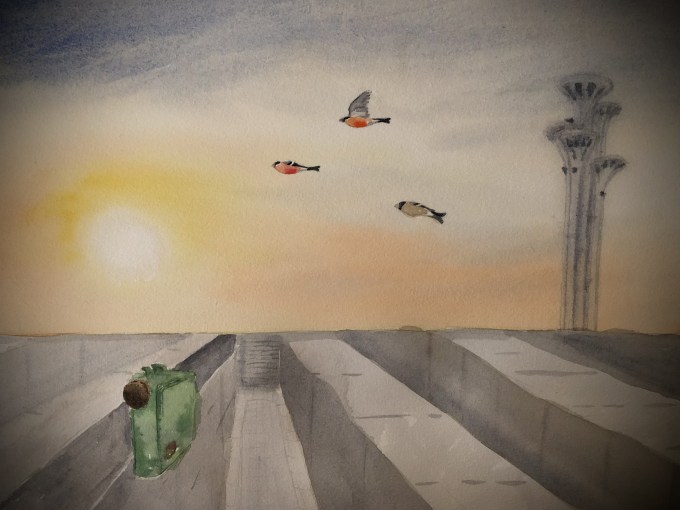
Title image: A trio of EURASIAN BULLFINCH Pyrrhula pyrrhula 红腹灰雀 Hóng fù huī què flying north over the AIIB roof in Beijing early morning.