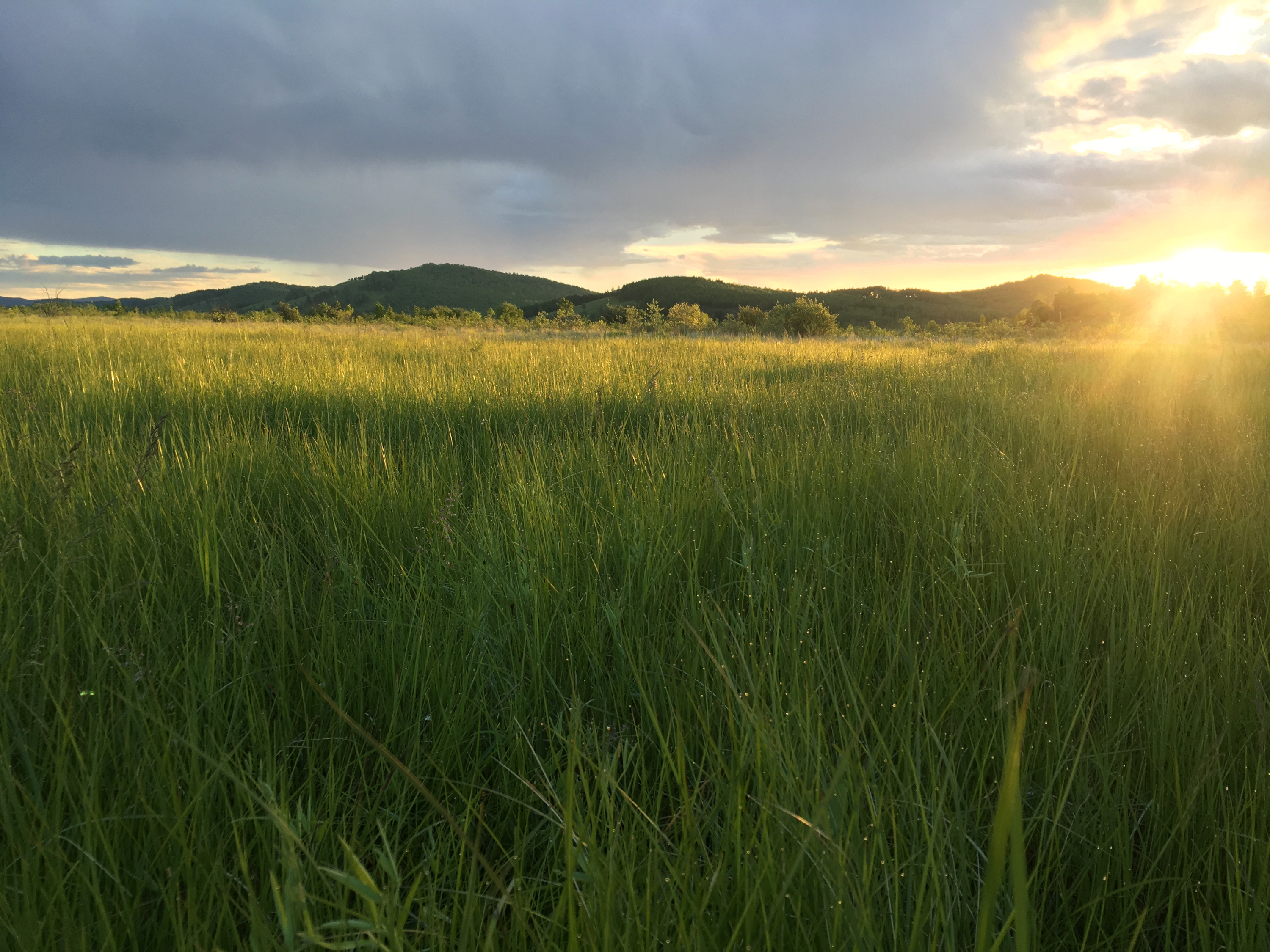
Tag: Paul Holt

  • The Search for Swinhoe’s Rail

    The Search for Swinhoe’s Rail

    Swinhoe’s Rail (Coturnicops exquisitus) must be one of east Asia’s least known birds.  Traditionally, the most reliable place to encounter it was in the wet grass around Poyang Lake in winter but sightings from there have become increasingly scarce.. and due to its secretive behaviour, it is encountered only very infrequently on migration, even in relatively well-watched areas such as Happy Island and Beidaihe in coastal China.

    It was only two years ago that Wieland Heim, Tom Wulf and Alex Thomas (of the Amur Birding Project) first recorded the ‘song’ of this secretive bird at Muraviovka Park in southeastern Russia.  And in July 2017, armed with this new knowledge, Paul Holt was the first to discover singing birds in China at Wuerqihan in northern Inner Mongolia.

    Wuerqihan is a wonderful place… it is very popular with bird photographers in winter when, despite the bitter temperatures (as low as -35 degrees Celsius), it’s possible to see very well species such as Great Grey, Hawk, Ural, Tengmalm’s, Eagle and Little Owls plus other photogenic birds such as Hazel Grouse, Black Grouse, Siberian Jay, Pine Grosbeak, Pallas’s Rosefinch and, if you are lucky, Black-billed Capercaillie, .  It is less well-known that summer is also pretty special.  In addition to the recently-discovered Swinhoe’s Rail, it is a brilliant site to see Pallas’s and Gray’s Grasshopper Warblers, Lanceolated Warbler, Band-bellied Crake, Pale-legged, Two-barred Greenish, Dusky and Radde’s Warblers, Eyebrowed Thrush, Oriental Cuckoo and many more species.  It is also just wonderful to spend time in pristine lush wet meadows, mixed deciduous forest and grassland that are all teeming with life.

    2018-06-19 Inner Mongolian wetland, Wuerqihan
    One of the wet clearings in the forest at Wuerqihan.
    2018-06-16 silver birch forest, Wuerqihan, Inner Mongolia
    The stunning birch forest at Wuerqihan is home to owls, warblers, thrushes and buntings.
    2018-06-19 Clouds over Inner Mongolia meadow
    The open wet grasslands of Wuerqihan are full of Pallas’s Grasshopper Warblers!

    I had already made two short summer trips to Wuerqihan, in 2016 with Nick Green and in 2017 with Derrick Wilby and I was keen to return.  So, with Marie, we set aside a few days to fly to Hailar, rent a car and drive the 2.5 hours east to Wuerqihan.

    We were keen just to enjoy the break and some good birding but of course we were also hoping to encounter the Swinhoe’s Rail.

    Our first day would coincide with the last day of the visit by British birder, Jon Holmes, for whom I had arranged local guide Zhang Wu and his 4×4 to take him around.  And on day two we bumped into another Brit, Dave Woodford, accompanied by Chinese bird guide, Steven An.

    The call of Swinhoe’s Rail is reasonably loud and carries for quite a distance… and during our first evening on site, we had no difficulty in hearing the Swinhoe’s Rails from the track, calling from the wet grass.  Being poorly prepared (no wellies or torch), we decided to call it a night, do a spot of shopping in the town the following day and return the next evening.

    After each picking up a pair of wellies for CNY 40 (about GBP5) we arrived on site, with Steven and Dave, around 6pm, about 2.5 hours before dusk.  Already, one bird was calling intermittently and, before long, two or three began calling.  We donned our wellies and headed along the edge of the meadow, stopping regularly to listen to the birds as they began calling more frequently as dusk approached.   You can hear a bit about our first encounter here:

    Suddenly, a dark shape flew up in front of Dave and dropped into the grass about 15m away.  It was tiny and dark with obvious white secondaries – Swinhoes’ Rail!  Almost immediately it began to call and, having my sound recording gear with me, I was fortunate to capture this seldom heard, and rarely recorded, sound.

    We were stunned and stood still, just soaking up the moment.  The wonderful rich colours of the meadow at sunset, not a breath of wind and Swinhoe’s Rails calling amongst the Pallas’s Grasshopper Warblers, Common Rosefinches, Japanese Quails and Common Cuckoos.  Simply mesmerising.

    2018-06-18 Meadow in Inner Mongolia
    Swinhoe’s Rail habitat in Inner Mongolia.
    2018-06-17 Swinhoe's Rail habitat
    The grass was around 30cm high with c15cm of water.. Wellies definitely required.
    2018-06-17 Swinhoe's Rail, Wuerqihan, Inner Mongolia (Steven An)
    Swinhoe’s Rail in flight, Wuerqihan. Photo by Steven An.

    That moment will stay with us for a very long time.   And as we made our way back to the vehicles, we were accompanied by a cacophony of birdsong with Common Cuckoos seemingly all around, Pallas’s Grasshopper Warblers reeling away and Japanese Quails uttering their squelchy call.  Magical.

    The Chinese name for Swinhoe’s Rail is 花田鸡 (Huātián jī).  Literally translated it means “flower frog”, a fantastically descriptive and apt name.

    Over the next few days, we enjoyed some pretty special encounters with some wonderful birds including a stunning Great Grey Owl in the evening light.

    Pacific Swifts were common in the town, breeding in many of the buildings, particularly the older properties.

    And the omnipresent Pallas’s Grasshopper Warbler occasionally showed well, belying its reputation as an extreme skulker.


    We recorded 98 species during our visit and had a fantastic time.  Wuerqihan is a brilliant birding destination and thoroughly recommended in summer or winter.  It is probably also extremely good in spring and autumn but, as far as I know, no birders have visited in that season.

    2018-06-16 Zhang Wu scoping for Black-billed Capercaillie, Wuerqihan
    Local guide, Zhang Wu, with his trusty 4×4.

    Anyone wanting to visit should contact local guide, Zhang Wu, who can arrange pick-up and drop-off from Hailar airport, accommodation and food, and, with his unbreakable 4×4 and local knowledge, he will ensure any visiting birder gets to the right places and has a superb time.  Although he speaks no English, it’s possible to communicate the basics using a combination of sign language and the impressive translation APP on his smartphone, and you can guarantee he will work hard to try to connect you with any target species.  He can be contacted directly on +86 13614709187 and, for any non-Chinese speakers, I’d be happy to help make arrangements if required.

    Big thanks to Marie, Jon, Dave, Steven and Zhang Wu for being great company during the trip.  And a big hat-tip to the Amur Bird Project team and Paul Holt for their discoveries in 2016 and 2017 which enabled us to connect with the enigmatic Swinhoe’s Rail.
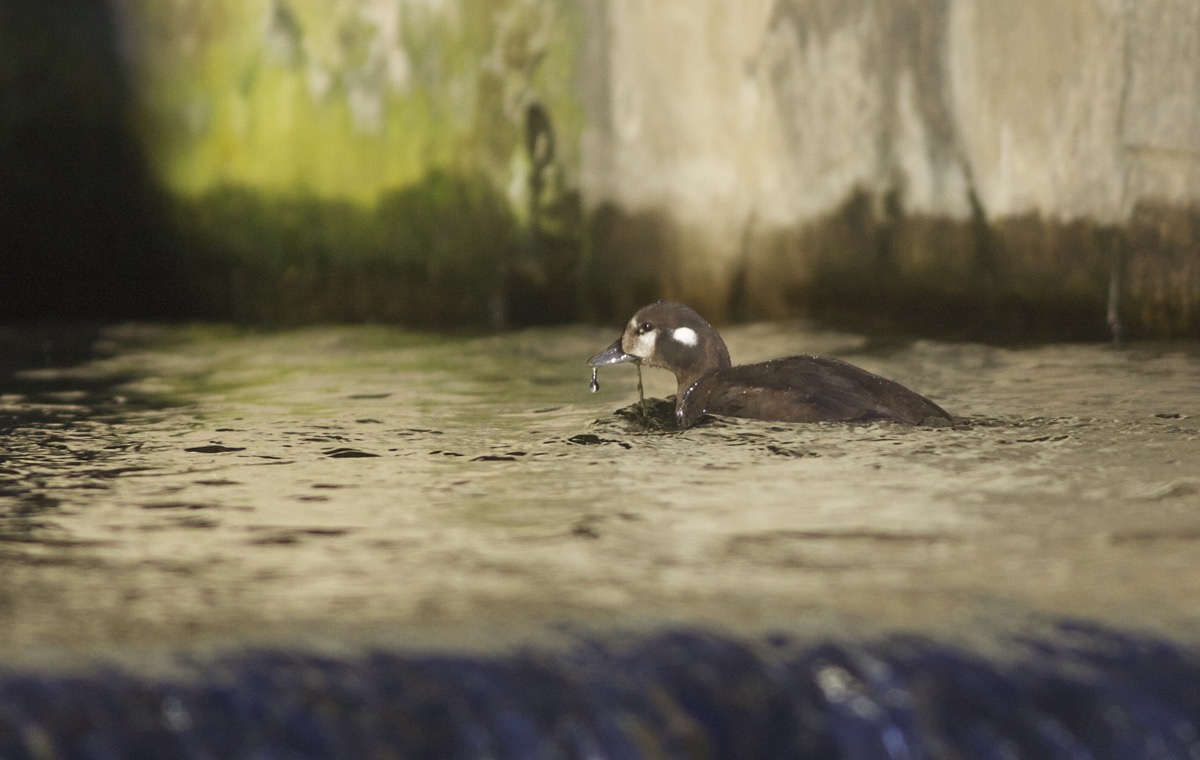


  • Harlequin Duck in Beijing

    Harlequin Duck in Beijing


    Urban birding often springs surprises.   Given Beijing’s geographic position, the spectacle of migration is particularly impressive and many unusual species can turn up in the city’s parks and gardens.  The Swinhoe’s Rail in the Temple of Heaven Park and Beijing’s first Tree Pipit in the UK Ambassador’s garden are examples of rare and scarce species appearing at unexpected locations.

    On Friday evening, news broke of another urban surprise in the shape of a female Harlequin Duck (Histrionicus histrionicus, 丑鸭, Chǒu yā) that had been photographed near Anzhenmen, close to the north 3rd ring road in central Beijing.  The photo, by local bird photographer 侯金生 (Hou Jinsheng), circulated fast on Chinese social media and very soon my Saturday plans, to accompany Paul Holt to a forested area in northern Beijing, changed to take in an early stop to look for the Harlequin.

    We arrived around 30 minutes before dawn and quickly found the site, a tiny weir along a concrete-sided canal just a stone’s throw from the busy 3rd ring road at Anzhenmen.  It seemed an odd place for a largely coastal (at least in winter) duck but there was running water which, together with the weir, provided an artificial micro-habitat not completely unlike the Harlequin’s preferred breeding habitat of fast-flowing streams.

    2017-02-11-harlequin-site-at-beitucheng
    The site of Beijing’s first HARLEQUIN, a first-winter female, near Anzhenmen.

    In the darkness, a few Mallards took to the air as local early risers began their morning walks along the canal and a few White-cheeked Starlings and Azure-winged Magpies announced their departure from roosts with raucous calls.  Even though the sun was not yet up it was possible to see that the Harlequin was not at the weir.  We waited close by, using the time to speculate whether the bird had just arrived and had used this site as a temporary stopover before moving on, or had it been here all winter undetected?  Given the location, and lack of observer coverage, the latter was certainly a possibility.  We agreed to give it until around 0730 before heading north to the Labagou Forest Park, as we had originally planned.

    Within a few minutes we were joined by some local birders, including Huang Hanchen, Zhao Min, Shen Yan, Guan Xiangyu and Zhang Xiao.  Their arrival delayed our departure as we caught up to chat about birds and all manner of issues, including the significance of the day – Lantern Festival, officially the last day of Chinese New Year.  The Lantern Festival is a family celebration, so most of the Chinese birders had limited time as they needed to visit relatives later in the day, some travelling to other Provinces.  Guan Xiangyu and Zhang Xiao were on their way to the train station to visit relatives at Hengshui, and reluctantly had to leave with the bird not having shown itself..

    Just a few minutes later, at around 0730, Paul and I were renewing our discussion about when to leave the site. Hanchen and Paul suddenly spotted something floating on the water, emerging from the tunnel and heading towards the weir.  They initially thought it was a piece of litter but very quickly realised it was the Harlequin!  It had seemingly roosted deep inside the dark tunnel and had emerged to feed around 20 minutes after sunrise.  We watched in awe as it swam and fed amongst the weed for several minutes, often at extremely close quarters and seemingly oblivious to its growing fan base.  Amused locals stopped to see what the fuss was about and, on seeing the Harlequin, one commented “Oh, that small brown duck has been there for at least 20 days”!

    Several times the Harlequin stopped to preen on the edge of the weir and, as the sun rose, it looked splendid in the early morning light.

    2017-02-11-harlequin-beitucheng-bill-open
    Beijing’s first HARLEQUIN showed extremely well in its surprisingly urban setting.

    2017-02-11-harlequin-beitucheng5

    2017-02-11-harlequin-beitucheng-wing-flap

    If it’s true, and we have no reason to suspect it isn’t, the Harlequin’s lengthy stay of “at least 20 days” means that the unfortunate Guan Xiangyu and Zhang Xiao, who had to leave just minutes before the Harlequin’s emergence, will hopefully connect when they return to Beijing next week.

    2017-02-10-harlequin-birders
    The first birders on the scene. In the foreground, He Wenbo (left) and Zhao Min with the Harlequin on the water.

    Harlequin is a difficult bird to see in China.  There are a few records from well-watched Beidaihe in neighbouring Hebei Province, and several in the northeast Provinces of Jilin, Inner Mongolia and Liaoning, so it was on the radar as a potential visitor to Beijing.  However, the urban location was a complete surprise.  As well as being the first record for Beijing, the Anzhenmen Harlequin is the 482nd species to be reliably recorded in the capital.  In a personal milestone for Paul Holt, the Harlequin was his 400th species in the Chinese capital since he first birded there around 28 years ago.  Congratulations to Paul!

    In Chinese, Harlequin is  丑鸭 (pronounced “chǒu yā”).  The second character “鸭” is pronounced “yā”, meaning duck.  The first character “丑”, pronounced “chǒu” has several meanings..  one is “clown”, the intended meaning in the case of the Harlequin, but another is “ugly”, hence Harlequin is known as “the ugly duck”!  Despite its ugliness, it’s proving to be probably the most-photographed Harlequin in China.

    What will be next?

    Big thanks to Hou Jinsheng for circulating his original photo of the Harlequin and to Huang Hanchen for passing on the news.  Thanks also to Paul Holt for driving on Saturday morning.

    Note on diet: according to HBW, the Harlequin’s diet consists of “molluscs (e.g. gastropods such as Littorina sitkana), crustaceans and, in spring and summer, insects and their larvae/pupae (e.g. blackflies Simulium); also other invertebrates (worms) and small fish; very little plant material recorded.”  The Beijing bird appeared to be feeding on weed but it’s possible it was sifting this material for tiny molluscs or invertebrates.

  • 2016: What A Year!

    2016: What A Year!

    Looking out of my apartment window on the first day of 2017, a blanket of toxic smog seems to drain all colour out of life and the perennial question question pops into my head – why do I live in such a polluted, congested place?

    Header image: the view from my apartment at 1200 on 1 January 2017

    The answer, of course, is the excitement and adventure of living in the capital city of the world’s most populous nation.  And when one considers the positives – the stunning biodiversity, the opportunity for discovery, the potential to make a difference and the wonderful people – the negatives are seen in context and they become far more tolerable.

    Looking back, 2016 has been an astonishing year with many highlights, thankfully few lowlights, and progress made in some key conservation issues.  Together, they give me a genuine sense of optimism for the future.

    January began with the unexpected discovery, by two young Beijing birders, Xing Chao and Huang Mujiao, of a small flock of the “Endangered” Jankowski’s Buntings at Miyun Reservoir.  This was the first record of Jankowski’s Bunting in Beijing since 1941 and, given the precipitous decline in the population of this poorly known species, a most unexpected find.  The fact they were found by young Chinese is testament to the growing community of talented young birders in Beijing.  There are now more than 200 members of the Birding Beijing WeChat group, in which sightings and other bird-related issues are discussed and shared. Huge credit must go to world-class birders such as Paul Holt and Per Alström who have been generous in sharing their knowledge of Chinese birds with the group. As well as the expanding WeChat group, there are now more than 400 members of the Beijing-based China Birdwatching Society (up from 300 in the last 12 months).  So, although starting from a low baseline, the increasing membership, together with the increase in the number of local birdwatching societies, such as in Zigong in Sichuan, and the development of international birding festivals, such as in Lushun, Dalian, shows that there is the beginning of an upsurge in the number of young people interested in birdwatching.  That is a positive sign for the future of China’s rich and unique avifauna.

    In tandem with the growth in birding is the emergence of a number of organisations dedicated to environmental education across China.  Given the relative lack of environment in the Chinese State Curriculum, there is high demand amongst many parents for their children to develop a connection with nature.  I’m fortunate to work with one such organisation – EcoAction – set up and run by dynamic Sichuan lady, Luo Peng.    With a birding club for Beijing school kids, a pilot ‘environmental curriculum’ in two of Beijing’s State Schools and bespoke sustainable ecotourism trips to nature reserves for families and schools, Peng deserves great credit for her energy and vision in helping to change the way people interact with the environment.  I am looking forward to working with her much more in 2017.

    lp-with-local-boys
    Luo Peng in her element – with local children in Hainan

    After the boon of seeing Jankowski’s Buntings in Beijing, a lowlight in late January was the desperately sad passing of a much-loved mentor and friend, the inspirational Martin Garner.  Martin fought a brave and typically dignified and open, battle with cancer.  I feel enormously lucky to have met Martin and to have corresponded with him on many birding-related issues.  His wisdom, positivity and selfless outlook on life will be missed for years to come and his influence continues to run through everything I do.

    Much of the early part of the spring was spent making the arrangements for what has been, for me, the highlight of the year – The Beijing Cuckoo Project. Following the success of the Beijing Swift Project, the results of which proved for the first time that Swifts from Beijing winter in southern Africa, the obvious next step was to replicate the British Trust for Ornithology’s Cuckoo Tracking Project in China.  We needed to find Chinese partners, secure the necessary permissions, raise funds to pay for the transmitters and satellite services, and make the logistical arrangements for the visit of “Team Cuckoo”.  At the end of May, everything was set and the international team arrived in Beijing.  Together with the local team, we caught and fitted transmitters to five Common Cuckoos, subsequently named by Beijing schoolchildren and followed via a dedicated webpage and on social media.  We could not have wished for a better result.  Three of the five are now in Africa,  after making incredible journeys of up to 12,500km since being fitted with their transmitters, including crossing the Arabian Sea.  As of 1 January, Flappy McFlapperson and Meng Zhi Juan are in Tanzania and Skybomb Bolt is in Mozambique.

    Skybomb Bolt, the Beijing Cuckoo who made landfall in Africa on 30 October 2016.
    Skybomb Bolt, the first Beijing Cuckoo to make landfall in Africa on 30 October 2016.
    beijing-cuckoos-as-at-1-january-2017
    The migration routes, and current positions, of the Beijing Cuckoos, 1 January 2017.
    dulwich-applause
    Pupils at Dulwich International School broke into spontaneous applause after hearing that SKYBOMB BOLT had made it to Africa…

    This Beijing Cuckoo Project has combined groundbreaking science with public engagement.  With articles in Xinhua (China’s largest news agency), Beijing Youth Daily, China Daily, Beijing Science and Technology Daily, India Times, African Times and even the front page of the New York Times, these amazing birds have become, undoubtedly, the most famous cuckoos ever!  Add the engagement with schools, not only in Beijing but also in other parts of China, and the reach and impact of the project has been way beyond our wildest dreams.  I’d like to pay tribute to everyone involved, especially the Chinese partners – the Beijing Wildlife Rescue and Rehabilitation Centre, China Birdwatching Society and the staff at the tagging locations (Cuihu, Hanshiqiao and Yeyahu) – who have all been brilliant, as well as the BTO’s Andy Clements and Chris Hewson for their vision and sharing of expertise and the sponsors – Zoological Society of London, Oriental Bird Club, British Birds Charitable Foundation and BirdLife International.  Finally, a big thank you to “Team Cuckoo”: Dick Newell, Lyndon Kearsley, Wu Lan, Susanne Åkesson, Aron Hejdstrom, Geert De Smet, Gie Goris and Rob Jolliffe.  You can follow the progress of the Beijing Cuckoos here.  All being well, Flappy, Meng and Skybomb will return to Beijing by the end of May.

    In 2017 we are planning to expand the Beijing Cuckoo Project to become the CHINA Cuckoo Project, which will involve tagging cuckoos in different locations across the country.  More on that soon.

    As well as being privileged to have been part of such a groundbreaking project, I have been fortunate to be involved with some exciting progress on some of the highest priority conservation issues, working with so many brilliant people, including Vivian Fu and Simba Chan at Hong Kong Birdwatching Society/BirdLife.  The plight of shorebirds along the East Asian Australasian Flyway is well-known, with the Spoon-billed Sandpiper the “poster species” of conservation efforts to try to save what remains of the globally important intertidal mudflats of the Yellow Sea and Bohai Bay.  More than 70% of these vital stopover sites have been destroyed already through land reclamations and much of the remaining area is slated for future reclamation projects.   Scientists, including an ever greater number of young Chinese such as Zhu Bingrun, now have the evidence to show that the population declines of many shorebird species, some of which are now classified as “Endangered”, can be attributed in large part to the destruction of the vital stopover sites in the Yellow Sea.  After meeting world-leading shorebird expert, Professor Theunis Piersma, in Beijing in May and arranging for him to address Beijing-based birders with a compelling lecture, it’s been a pleasure to support the efforts of international organisations such as BirdLife International, the East Asian Australasian Flyway Partnership (EAAFP), led by Spike Millington, IUCN, UNDP and The Paulson Institute as well as local NGOs such as Save Spoon-billed Sandpiper and 山水 (ShanShui) in their interactions with the Chinese government to try to encourage greater protection for, and sustainable management of, the remaining intertidal sites.  One of the pillars of the conservation strategy is to nominate the most important sites as a joint World Heritage Site (WHS) involving China and the Koreas (both North and South).  This would have the advantage of raising awareness of the importance of these sites to those in the highest levels of government and also requiring greater protection and management of the sites.  I am pleased to say that, due to the hard work of these organisations, much progress has been made and the Ministry of Housing, Urban and Rural Development (MoHURD), the ministry responsible for WHS nominations, is now positively taking forward the suggestion and working on the technical papers required to make a submission to the State Council for formal nomination.  Special mention should be made of John MacKinnon, whose expertise, network of contacts in China and enthusiasm has made a big difference, to Nicola Crockford of RSPB and Wang Songlin of BirdLife International for their diplomatic work to create the conditions for the WHS issue to come to the fore, to David Melville, who recently delivered a compelling presentation covering a lifetime of shorebird study, to MoHURD at a workshop convened by ShanShui, and to Hank Paulson who, through the publication of the Paulson Institute’s “Blueprint Project” and his personal engagement at a very senior level with Provincial governors, has secured a commitment from the Governor of Hebei Province to protect the sites in his Province highlighted in the Blueprint.  These are significant advances that, although far from securing the future of China’s intertidal mudflats, have significantly improved the odds of doing so.

    2016-05-04 Theunis lecture1
    Professor Theunis Piersma delivers his lecture to Beijing-based birders at The Bookworm, Beijing, in May 2016.

    China’s east coast hosts the world’s most impressive bird migration, known as the East Asian Australasian Flyway.  That flyway consists of not only shorebirds but also many land birds and it is this concentration of migratory birds every spring and autumn that attracts not only birders but also poachers.  This year has seen several horrific media stories about the illegal trapping of birds on an industrial scale, primarily to supply the restaurant trade in southern China where wild birds are considered a delicacy.  Illegal trapping is thought to be the primary cause of the precipitous decline in the population of, among others, the Yellow-breasted Bunting, now officially classified as Endangered.

    A distressed-looking male Yellow-breasted Bunting, now officially an endangered species after years of persecution.
    A distressed-looking male Yellow-breasted Bunting in a cage adjacent to some illegal nets, designed to act as a lure.  Now officially an endangered species after years of persecution.

    It would be easy to be depressed by such incidents but I believe there are two developments that provide optimism for the future.  First, although the legal framework is far from watertight, the authorities are now acting, the incidents are being reported in the media and the culprits are receiving, at least in the largest scale cases, heavy punishments.  And second, these cases are being uncovered by volunteers, groups of mostly young people that spend their free time – weekends and days off during weekdays – specifically looking for illegal nets and poachers at migration hotspots.  They work with law enforcement to catch the culprits and destroy their tools of the trade.  These people are heroes and, although at present it’s still easy for poachers to purchase online mist-nets and other tools used for poaching (there are ongoing efforts to change this), it’s a harder operating environment for them than in the past.  Big change doesn’t happen overnight but the combination of greater law enforcement, citizen action and media coverage are all helping to ensure that, with continued effort and strengthening of the legal framework, illegal trapping of migratory birds in China is on borrowed time.

    Another conservation issue on which progress has been made is the plight of Baer’s Pochard.  The population of this Critically Endangered duck has declined dramatically in the last few decades, the reasons for which are largely unknown.  However, after 2016 there is much to be optimistic about.  First, there are now dedicated groups studying Baer’s Pochard in China, including population surveys, study of breeding ecology and contributing to an international action plan to save the species.  These groups are working with the UK’s Wildfowl and Wetlands Trust, EAAFP and others to build a knowledge base about the species, raise awareness and develop concrete steps to conserve the species at its remaining strongholds.  A record count of 293 birds in December at the most important known breeding site in Hebei Province (Paul Holt and Li Qingxin) is a brilliant end to a year that will, hopefully, be a turning point for this species.

    On a personal level I was extremely lucky, alongside Marie, to experience a ‘once in a lifetime’ encounter with Pallas’s Cats in Qinghai and, just a few days later, two Snow Leopards.  Certainly two of my most cherished encounters with wildlife.

    So, as I glance out of my window again, I realise that a few days of smog are a small price to pay to be part of the birding and conservation community in China.  As 2017 begins, I have a spring in my step.

  • Rare And Scarce Birds In Beijing 2016

    Rare And Scarce Birds In Beijing 2016

    2016 has been another year of surprise and discovery in Beijing.  With eight new species recorded, and two further new records coming to light from previous years, the number of species reliably recorded in the capital now stands at 480, cementing Beijing’s position as one of the best major capital cities in the world for birding.

    The year started with the brilliant discovery, by Xing Chao and Huang Mujiao, of wintering JANKOWSKI’S BUNTINGS (Emberiza jankowskii) at Miyun Reservoir.  After the initial sighting and photograph of a single bird, subsequent visits revealed that up to 13 were present.  This group of buntings was enjoyed by many birders, both Beijing-based and visiting, until mid-March when access to the reservoir was forbidden following a major fire in the area.  It is not known for how long they stayed but, on later visits (the last was apparently on the 19 March) at least one of the males was heard in sub-song.  Although not a first record of this species in Beijing, given the “Endangered” status of Jankowksi’s Bunting, it was certainly a most unexpected find.  It was the third record of this species in the capital, following the collection of two individuals in February and March 1941 (now in the NHM Tring).  An article about these birds was published in Birding Asia, the magazine of the Oriental Bird Club.

    The next major find was a REDWING (Turdus iliacus), found by a local photographer (一路摄, Yīlù shè) in the Botanical Gardens on 6 April.  Often frustratingly elusive, it was last seen on 14 April.  The first record of this species in Beijing & indeed anywhere in eastern China.
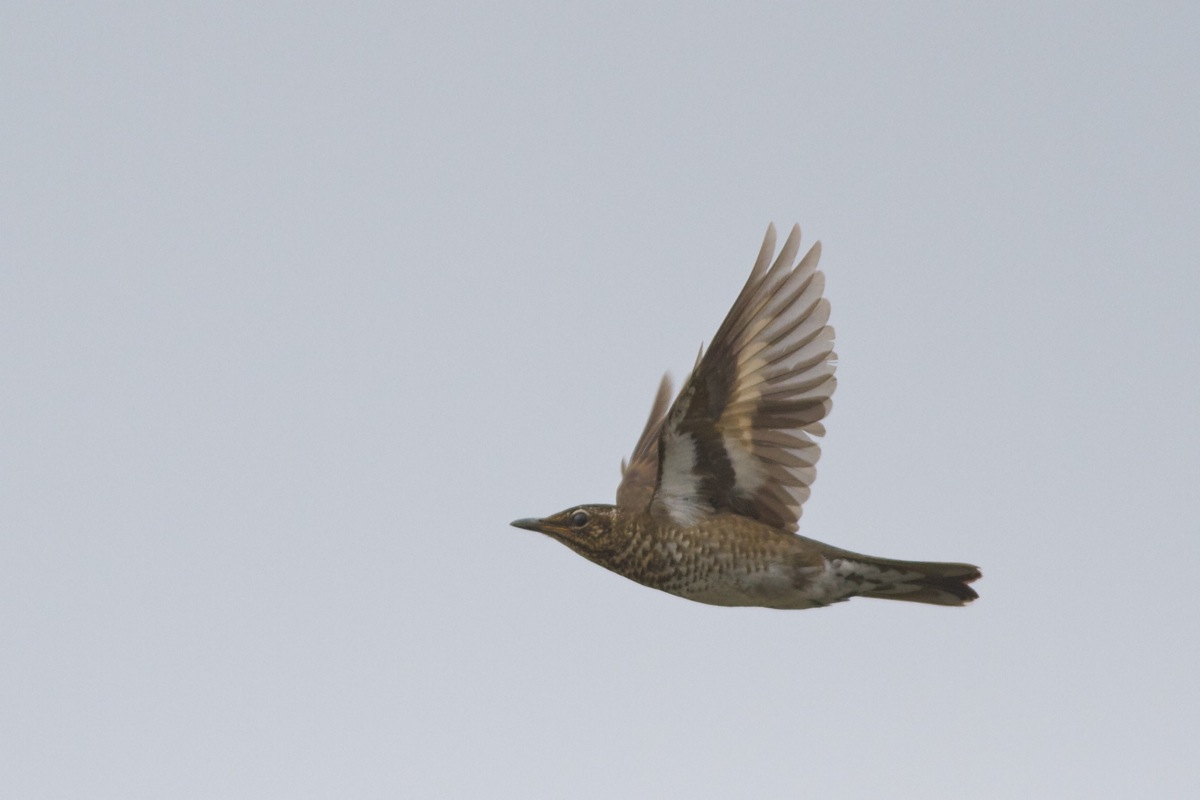
    Photo by Yan
    Beijing’s first REDWING (Turdus iliacus), Botanical Gardens.  Photo by Yan Shen.

    On 17 April, a COMMON RINGED PLOVER (Charadrius hiaticula) at Ma Chang (Guan Xueyan and Wen Hui) was possibly only the 4th record from the capital.

    img_5276

    On 23 April a BESRA (Accipiter virgatus) was photographed at Baiwangshan (Du Songhan et al). Possibly only the second record of this difficult to identify species. Photo below by Sun Zhiguang.

    2016-04-23 Besra, Baiwangshan
    The status of BESRA in Beijing is unclear, given the difficulty of separating it from the much more common JAPANESE SPARROWHAWK. This appears to be the second documented record.

    May, usually one of the best months for finding rarities, saw just one new record – a female SLATY BUNTING (Emberiza siemsseni) at the Summer Palace found by Jesper Hornskov – and two second records.  First, a GREY-HEADED CANARY-FLYCATCHER (Culicicapa ceylonensis) at Lingshan found by Professor Susanne Åkesson and the international team visiting to assist with the Beijing Swift and Cuckoo Projects.  And second, a male NARCISSUS FLYCATCHER (Ficedula narcissina) on the Wenyu River (郝建国, Hǎo jiànguó)

    2016-05-10 Narcissus Flycatcher 1s male, Wenyu He Jian Guohao
    This first summer male NARCISSUS FLYCATCHER was the second documented record for Beijing (郝建国, Hǎo jiànguó)

    June produced three new records and a second record.  First, a PALLAS’S FISH EAGLE (Haliaeetus leucoryphus) spent several days at Yeyahu NR, where it was photographed by Fang Chun, one of the nature reserve staff on 7th June.  Although there is a historical & unconfirmed report of this species in the capital, this was the first to be documented.

    Second, on 10 June, a singing BROWNISH-FLANKED BUSH WARBLER (Cettia fortipes) at Baihuashan, sound-recorded by Jan-Erik Nilsen.  The first documented record.

    Finally, on 17th June at Lingshan, Beijing’s highest mountain, Terry Townshend stumbled across a singing GREY-WINGED BLACKBIRD (Turdus boulboul).  A few days later, at least three were heard in the same area, suggesting that there is probably a small breeding population.  This species was previously thought to be a largely Himalayan bird, with the nearest breeding grounds in southwest China, and was certainly not on the radar as a potential vagrant in Beijing, let alone a probable breeding bird.  Details here.

    A few days later, on 23 June, Paul Holt found a singing male SLATY-BLUE FLYCATCHER (Ficedula tricolor) at Lingshan, the second record of this species following one found by Ben Wielstra in the grounds of Tsinghua University in September 2015.

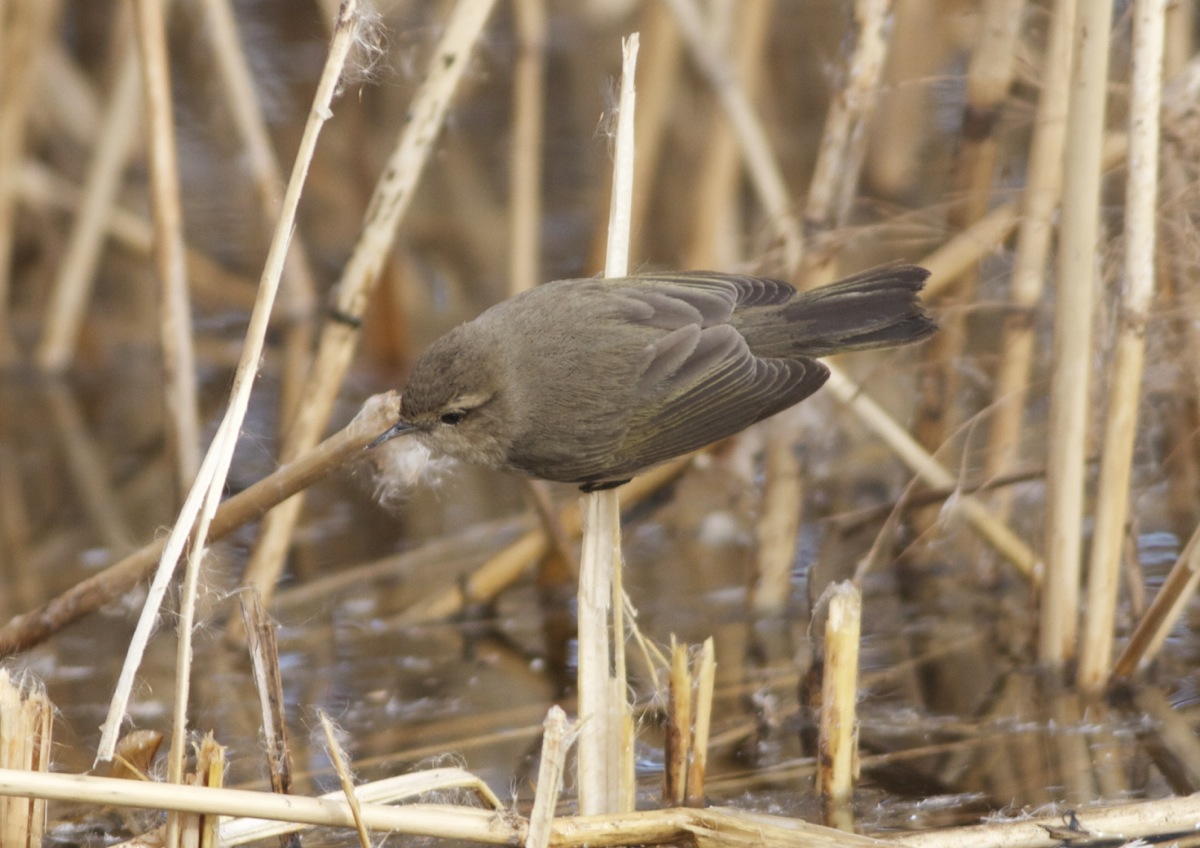
    July and August were unremarkable and it was 29 September when Paul Holt  and Wang Qingyu found the next significant bird – a SIBERIAN CHIFFCHAFF (Phylloscopus collybita tristis) at Yeyahu (PH), the second documented record for the capital.

    Colm Moore was rewarded for his loyalty to Shahe Reservoir when, on 22 October, he found a SWINHOE’S RAIL.  Seen briefly, but well, this was the fourth record for Beijing, with all records coming since 2014, a statistic that must be due to an increase in the number of birders and greater observer awareness rather than a change of its status in the wild (it is officially classified as “Vulnerable” with the population thought to be in decline).

    A week later, on 29 October, Jesper Hornskov reported a HOODED CROW (Corvus cornix) close to Beijing Capital International Airport.  This is the first record of this species in Beijing and, we think, all of eastern China.

    The next day, Beijing’s first POMARINE SKUA (Stercorarius pomarinus), a juvenile, was photographed at the ‘Rubber dam’ near Yanqing and stayed until at least 2 November (Zhang Weimin & Yang Yuhe).

    November was another productive month with the discovery, by photographers, of a small flock of REED PARROTBILLS (Paradoxornis heudei) at Wanping Hu in western Beijing (per Mr. Xu).  With breeding populations to the south in Hebei Province and to the east in coastal Hebei/Tianjin, this species was high up on the list of potential discoveries in Beijing but, despite its predictability, the group of at least seven birds proved extremely popular. They came hot on the heels of a widely seen bird in the Olympic Forest Park on the 8 June 2016. That city centre bird was believed, at the time, to have been an escape or deliberate release. But in the advent of the November sightings perhaps not…

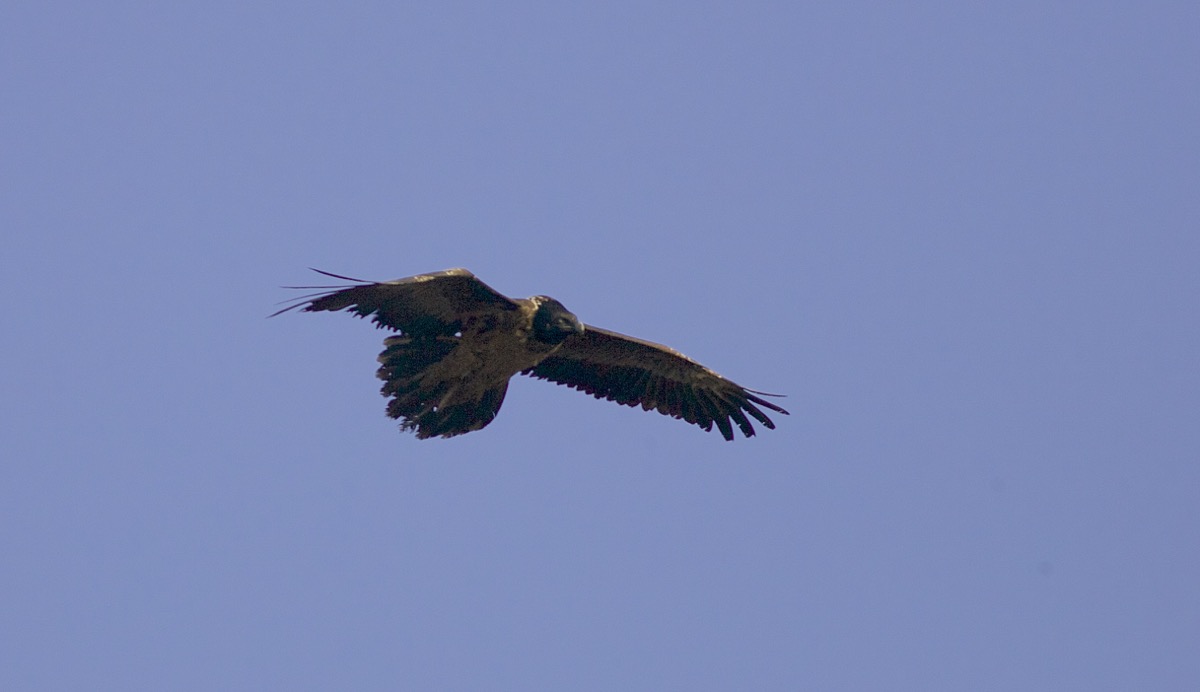
    On 12th December Beijing’s second LAMMERGEIER (Gypaetus barbatus), a juvenile, was watched by Paul Holt and Terry Townshend at head height as it drifted by the communications tower at Lingshan before slowly heading northwest and into Hebei.  It follows the first record from sometime in February 2008 at Shidu.

    2016-12-12-lammergeier-juv-lingshan5
    Beijing’s second LAMMERGEIER drifted over Lingshan on 12 December 2016.

    The following day, Paul Holt found a male SCALY-SIDED MERGANSER (Mergus squamatus) among a group of Common Mergansers at Huairou Reservoir.  With only four previous records, this was a stunning find.  One could even call it a “Christmas Quacker” (groan).

    In addition to the new species found in 2016, two further records of new species came to light.  First, a LONG-BILLED DOWITCHER (Limnodromus scolopaceus), photographed at Yeyahu on 19 October 2009 (Yan Xiaoqin), was reported by Li Xiaomai on the 6 May 2016 and an ORANGE-HEADED THRUSH (Zoothera citrina) that was photographed in Tiantan (the Temple of Heaven) on the 22 May 2011 by 青花收藏. See here.  Thanks to Huang Hanchen for uncovering this superb record.

    All in all, a brilliant year for birding in Beijing, illustrating just how much we are still learning about the birds of China’s capital city.  My personal favourite?  Given their precarious status, the appearance of the flock of JANKOWSKI’S BUNTINGS at Miyun Reservoir ranks, for me, as the best and most unexpected record of the year.  Big congratulations to Xing Chao and Huang Mujiao for their brilliant find.

    Xing Chao (left) and Huang Mujiao at Miyun Reservoir after finding JANKOWSKI'S BUNTING
    Xing Chao (left) and Huang Mujiao at Miyun Reservoir after finding JANKOWSKI’S BUNTING

    Big thanks to Paul Holt & Huang Hanchen for contributing significantly to this summary and to all Beijing-based birders who have reported sightings throughout the year, whatever the status of the species involved.  Together, we are slowly but surely gaining a better understanding of the birds of China’s capital city.

    Finally, although not in Beijing, it’s worth mentioning the record count of the “Critically Endangered” BAER’S POCHARD (Aythya baeri) from Hengshui Hu, in neighbouring Hebei Province. An astonishing 293 were counted on 9 December by Paul Holt and Li Qingxin.  That’s a positive note on which to end a remarkable year.

  • LAMMERGEIER in Beijing

    LAMMERGEIER in Beijing

    Lingshan, Beijing’s highest mountain, is probably my favourite birding site in the capital.  It’s one of those sites where, walking around, it feels as if almost anything could turn up.  That feeling is not irrational.  With wintering PRZEWALSKI’S (ALASHAN) REDSTART, Beijing’s first LESSER SPOTTED WOODPECKER, breeding GREENISH WARBLERS, ALSTROM’S WARBLERS, SLATY-BACKED FLYCATCHERS, ‘Gansu’ RED-FLANKED BLUETAILS and GREY-WINGED BLACKBIRDS all discovered in the last few years, expectation is high whatever the season.

    PRZEVALSKI'S REDSTART at Lingshan, Sunday 23 February 2014.
    PRZEVALSKI’S (ALASHAN) REDSTART, Sunday 23 February 2014.  My favourite discovery at Lingshan.

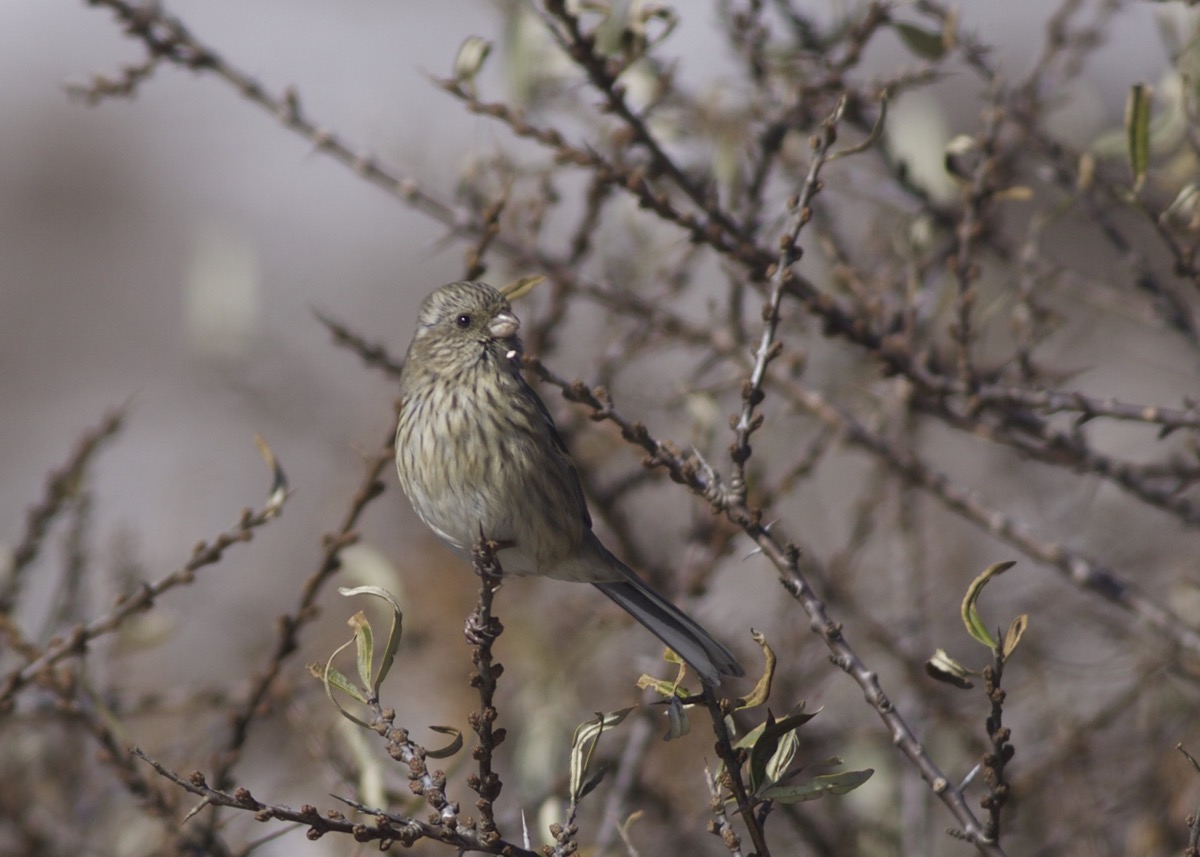
    My most recent visit was with Paul Holt on Monday.  On arrival it was cold, breezy and seemingly almost birdless.  Around the derelict buildings, at the highest point of the road, our hopes of Asian Rosy Finch drew a blank.  And there were no birds at all on the scree slopes..  However, almost the first bird we saw was a good one – a sibiricus GREAT GREY SHRIKE.  Scarce in Beijing, Lingshan in winter is certainly the best site for this monochrome predator.  A check of the sheltered side valley a little lower down was more productive, with three species of rosefinch – PALLAS’S, CHINESE BEAUTIFUL and LONG-TAILED.  The highlight here was a count of 7 LONG-TAILED ROSEFINCHES of the central China lepidus subspecies, a form only discovered in Beijing two winters ago. One male, in particular, showed spectacularly well.

    2016-12-12-long-tailed-rosefinch-ssp-lepidus-male-lingshan3
    Long-tailed Rosefinch ssp lepidus, Lingshan, 12 December 2016
    2016-12-12-long-tailed-rosefinch-ssp-lepidus-male-lingshan2
    One of the male Long-tailed Rosefinches ssp lepidus, Lingshan, 12 December 2016
    2016-12-12-long-tailed-rosefinch-ssp-lepidus-female-lingshan
    Female Long-tailed Rosefinch ssp lepidus, Lingshan, 12 December 2016

    We walked the old road which was also relatively quiet with only one WHITE-WINGED REDSTART (a male) and an owl sp (SHORT-EARED or LONG-EARED), flushed by Paul and seen only briefly.

    We decided to try an area of scrub further up the mountain and, after a 20-minute walk, we discovered four more lepidus LONG-TAILED ROSEFINCHES and flushed a EURASIAN WOODCOCK, scarce in Beijing especially in winter.  We headed back to the car, talking about how great it was to see so many rosefinches and feeling happy with the day..

    As we started to drive back to the road, a large raptor drifted past the communications tower… right at that moment, the jizz reminded me a little of Black Kite – long tail and lazy flight – but this bird was certainly not that species, it was huge!  Paul immediately shouted an expletive followed by “juvenile Lammergeier”.  Wow.  We jumped out of the car and I grabbed my camera to take a few record shots..  As it drifted behind a hill we bundled back into the car and made our way back to the road to try to see it again.. We rounded the bend just before the road descends on the Hebei side and saw it again, this time at eye-level as it drifted north in the company of several LARGE-BILLED CROWS.  The fact that we initially though the crows were RED-BILLED CHOUGHS gives an indication of its size.  We watched as this magnificent bird of prey banked around and then flew directly over our heads before slowly heading northwest.  What an encounter!

    2016-12-12-lammergeier-juv-lingshan
    Juvenile Lammergeier, Lingshan, 12 December 2016. With the dark hood and relatively dark underparts, the colouration of juveniles is different to adults. But that tail is unmistakeable!
    2016-12-12-lammergeier-juv-lingshan5
    The Lingshan Lammergeier showed very well as it drifted from Beijing into neighbouring Hebei Province.
    2016-12-12-lammergeier-juv-lingshan3
    Juvenile Lammergeier, Lingshan, 12 December 2016

    With the nearest known breeding grounds on the Tibetan Plateau, more than 1,200km to the west, LAMMERGEIER is a bird I wasn’t expecting to see in Beijing.  As far as I know there is only one previous record from the capital, from Shidu, Fangshan District, in February 2008 (Wang Qin) so this is Beijing’s second.

    Lingshan delivers again!

    A PDF site guide to Lingshan, including travel directions and a map of the best sites, can be downloaded here.

  • New for Beijing: GREY-WINGED BLACKBIRD

    New for Beijing: GREY-WINGED BLACKBIRD

    The potential for discovery is one of the most exciting elements of birding in Beijing.  Despite being probably the most-birded part of China, new species are recorded regularly.  As one would expect, vagrants make up most of the additions to Beijing’s avifauna.  However it’s an indication of just how little we know about Beijing’s birds that new breeding birds are also being discovered.  Last summer at Lingshan, Beijing’s highest mountain, Paul Holt and I discovered GREENISH WARBLERS (Phylloscopus trochiloides) – the first record of this species in Beijing – and a male SLATY-BACKED FLYCATCHER (Ficedula hodgsonii) – the second record for Beijing – both in suitable breeding habitat.  At the time, we speculated about what else could be hiding on the forested slopes of this under-birded site.  Our minds wandered to many outlandish possibilities, including WHITE-BROWED ROSEFINCH, CHESTNUT THRUSH and GREY-HEADED BULLFINCH.  However, as if to tell us we were lacking in ambition, the next secret to be revealed by Lingshan was to be even more outlandish – the discovery of GREY-WINGED BLACKBIRDS (Turdus boulboul, 灰翅鸫), a primarily Himalayan species!

    This is the story..

    Last weekend, after a particularly busy May and early June involving very little birding, I decided to escape the Beijing heat for a few days to stay at Lingshan, Beijing’s highest mountain, around 100km west of the city centre.  It’s usually at least 10 degrees Celsius cooler here and, of course, the birding is fantastic with a host of breeding phylloscopus warblers, range-restricted species such as GREEN-BACKED FLYCATCHER (Ficedula elisae), GREY-SIDED THRUSH (Turdus feae) and some spectacular Sibes such as SIBERIAN BLUE ROBIN (Luscinia cyane), ASIAN STUBTAIL (Urosphena squameiceps) and LONG-TAILED MINIVET (Pericrocotus ethologus).

    I enjoyed a wonderful time on the slopes of the mountain, enjoying prolonged views of breeding ‘GANSU’ RED-FLANKED BLUETAILS (Tarsiger cyanurus albocoeruleus) and the recently discovered breeding population of GREENISH WARBLERS (Phylloscopus trochiloides).

    GREENISH WARBLER (Phylloscopus trochiloides), Lingshan, 17 June 2016
    GREENISH WARBLER (Phylloscopus trochiloides), Lingshan, 17 June 2016

    On my final morning I decided to spend the early part of the day birding the slopes below the village by walking down the access road before heading back to Beijing around 0900.  At the furthest point, just as I was about to turn around and walk back up to the car, I heard a thrush singing close by.  The two most likely thrushes at Lingshan at this elevation are GREY-SIDED THRUSH and CHINESE THRUSH.  It definitely wasn’t a Grey-sided and, knowing the variation in Chinese Thrush, I thought it was most likely this species.  Usually, singing birds are very difficult to see but on this occasion, as I looked up the slope, I could see a thrush-sized bird perched on a bare branch on top of the ridge.  Even though it was silhouetted by the rising sun, I set up the telescope to check it out.  What I saw flummoxed me..  it appeared to be a blackish thrush with a clear yellow eye-ring, a yellow bill and a white wing-panel.  The east Asian thrushes flashed through my head but none matched what I was seeing.  Definitely not a Siberian Thrush or a Japanese Thrush…  maybe it was a CHINESE BLACKBIRD with leucism (a condition of partial loss of pigmentation resulting in white patches on the plumage)?  However, I had never before seen a Chinese Blackbird at Lingshan, it was atypical habitat and it didn’t sound like one…  I recorded a short video and committed to following up the sighting when I was home.. By now I was a little late and needed to head back to the car for the journey back to Beijing in time to meet friends for lunch.

    The original video clip, horribly backlit.

    It wasn’t until the next day that I had the chance to speak to Paul Holt about what I had seen.  He immediately suggested it could be a GREY-WINGED BLACKBIRD, a species with which he was very familiar but that I had yet to see.  After checking images of this species online, I was in no doubt that was the bird.

    After alerting the Birding Beijing WeChat group, the general reaction from birders was that it was such a bizarre record that it was almost certainly an escape.  One look at the known range of this species suggested why – it is largely a Himalayan bird and the nearest breeding grounds are in far southwest China – in Yunnan, Guangxi and southern Sichuan.

    2016-06-23 Grey-winged Blackbird range
    The known range of Grey-winged Blackbird.  Copyright BirdLife International.

    However, it just didn’t feel right that this bird – singing on a remote mountain 100km to the west of Beijing – was an escape.  A quick check of a list of species recorded in Beijing’s bird markets showed that Grey-winged Blackbird had never been recorded for sale in the capital.  In itself that didn’t prove anything, however it was certainly encouraging…

    The most obvious next step was to return to Lingshan to try to establish whether the original bird was alone or part of a small, previously undiscovered, breeding population.

    And so, on Wednesday, I teamed up with Paul Holt and headed west.  We arrived at the location of my original sighting, between km 11 and km 12 on the access road, at around 0750.  Immediately we could hear, and see, a Grey-winged Blackbird, presumably the same individual as my original sighting, singing from the same perch, high up to the east of the access road.  After spending a lot of time with this bird, including making sound-recordings and video, the bird stopped singing and so we headed up the mountain to check on the Greenish Warblers that were discovered in a high tract of forest last year.

    The following morning, we were out at 0400 to check on the blackbird.  And, as we suspected, there wasn’t just one singing male but two, and then three!  The presence of multiple birds surely reduced, if not eliminated, the chance that these birds were escapes.  Instead, it was most likely we had discovered a small breeding population, more than 1,500 kilometres from the nearest known breeding sites.  Wow!

    Grey-winged Blackbird is primarily a Himalayan bird, with the closest known populations in China being in Yunnan, Guangxi and southern Sichuan. The discovery of, most likely breeding, birds at Lingshan represents a significant range expansion.

    Thanks to the excellent contributions from Chinese birders on the Birding Beijing WeChat group, especially Lei Jinyu, we now know of several records away from the known range, including 3 records each from Shaanxi and Hubei Provinces, “a few” from Hunan and a single record from Chongqing.  So it is clear the species does occur, at least occasionally, away from southwest China.  It seems likely that the Lingshan birds represent a relict population, survivors of what once might have been a breeding range that extended across China’s mountains from the southwest to the northeast.

    Immediately after this discovery, we began to think about what else could be on this magical mountain.  Speculation on the Birding Beijing WeChat group included a suggestion from Dutch birder, Ben Wielstra – “breeding SLATY-BLUE FLYCATCHER“.  Ben found Beijing’s first record of this species last autumn in the grounds of Tsinghua University.  Incredibly, within 8 hours of his message, Paul found a singing SLATY-BLUE FLYCATCHER in the same area as the GREY-WINGED BLACKBIRDS!  The second record for Beijing and, given the date, indicative of possible breeding.  What. A. Day.

    Now, the big question is, again: what next for Lingshan?

    Big thanks to Paul Holt for his, as always, valuable counsel and for his company on the second visit to Lingshan this week.

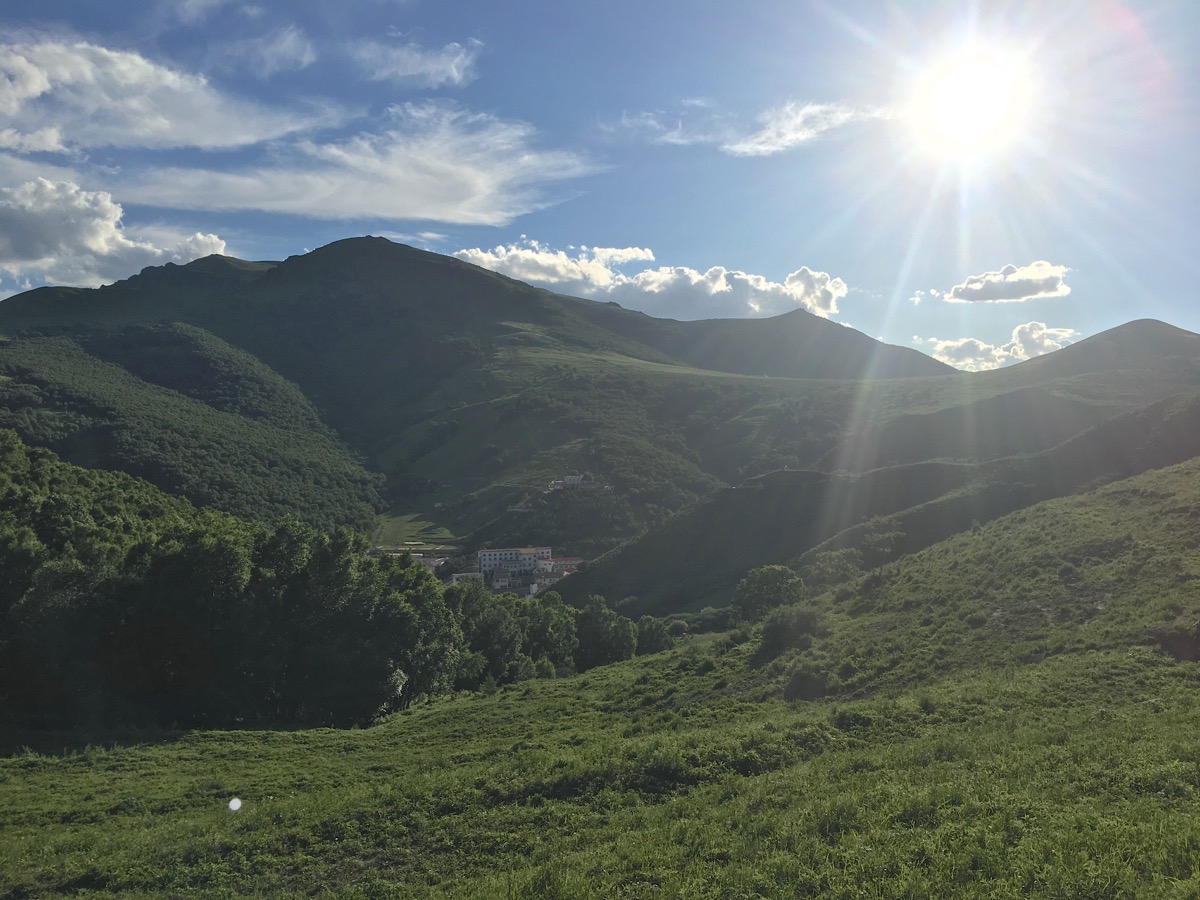
    Featured Image: Lingshan in June: a magical place.


  • Long-tailed Rosefinches in Beijing

    Long-tailed Rosefinches in Beijing

    As readers might have noticed, I take every opportunity to rave about the birding in Beijing. One of the reasons is because there is so much opportunity for discovery.  The last few weeks have proved this again.

    Until now, Beijing birders had presumed all the LONG-TAILED ROSEFINCHES (Uragus sibiricus, 长尾雀), occasionally seen in the capital in winter, are from the population breeding in NE China, Russia and Mongolia (the ussuriensis subspecies).  We don’t see many, and it was only after Paul Holt and I recently visited Wuerqihan, northern Inner Mongolia, where Long-tailed Rosefinches are common, that sharp-eyed (and sharp-eared!) Paul Holt suspected that the birds I had photographed and sound-recorded at Lingshan in October 2014 and November 2015 were of a different subspecies.

    2014-10-31 Long-tailed Rosefinch fem, Lingshan
    Female Long-tailed Rosefinch, Lingshan, Beijing, 31 October 2014.  Note the heavy and contrasting streaking and relatively thin wingbars.
    2014-11-25 Long-tailed Rosefinch male, Lingshan
    Male Long-tailed Rosefinch, Lingshan, 25 November 2014.  Note the contrasting head pattern, including the prominent dark stripe running behind the eye, and the brownish wings contrasting with the pink underparts.
    2015-11-09 Long-tailed Rosefinch fem, Lingshan
    Female Long-tailed Rosefinch, Lingshan, Beijing, 9 November 2015. Again, note the relatively thick and contrasting streaking on the underparts.

    To compare, here are a couple of photos of the northeastern ussuriensis subspecies, the only race previously presumed to occurr in Beijing, taken in the Dalian area of NE China, courtesy of Tom Beeke.

    Long-tailed Rosefinch 35vfvhj3
    (young?) Male Long-tailed Rosefinch ssp ussuriensis.  Note the lack of an obvious dark stripe behind the eye, less contrasting head pattern and less contrast on the wings.
    Long-tailed Rosefinch 333242
    Female Long-tailed Rosefinch ssp ussuriensis. Note the relative lack of contrasting streaking on the underparts, the overall ‘warmer’ look and the thicker, more prominent, wingbars.

    And here is a male from Wuerqihan, Inner Mongolia.

    2014-12-22 Long-tailed Rosefinch male2, Wuerqihan, Inner Mongolia
    Note the thick wingbar, lack of a dark stripe behind the eye and overall ‘frosty’ appearance.

    Compare the calls of one of the Lingshan birds with a bird of the ussuriensis race from Russia :

    Lingshan bird (lepidus): 

    Ussuriensis from Russia (Albert Lastukhin):

    After comparing photos and sound-recordings of ussuriensis with those from Beijing, it became clear that the Lingshan birds were NOT of the ssp ussuriensis.  Instead, the Lingshan birds show the characteristics (dark eye-stripe and brown wings on the male, heavy and contrasting streaking on the female) of the ssp lepidus, the race from central China (according to HBW, this subspecies ranges from Eastern Tibet, east to south Shaanxi and southwest Shanxi).

    Photos prove that Long-tailed Rosefinches of the lepidus subspecies have now occured at Lingshan in October/November 2014 and again in November 2015, including adult males.  This suggests that Lingshan may be a regular wintering ground for the lepidus subspecies.

    This was quite a shock.

    We don’t *think* lepidus breeds in Beijing – they are active and noisy during the breeding season and there have been a few spring/summer visits by birders to Lingshan in the last 2 years, during which one would expect these birds to have been detected had they been present.  So, for the moment at least, it looks as if these birds have moved northeast from their breeding grounds, an unexpected winter movement.

    We know that at least some of the few winter records of Long-tailed Rosefinch from lowland Beijing are of the northern subspecies ussuriensis. So Beijing has now recorded two ssp of Long-tailed Rosefinch.

    It’s another fascinating, and unexpected, discovery from Lingshan!  What next?

    Big thanks to Paul Holt for the initial discovery, to Paul Leader for comments and to Tom Beeke for permission to use his photos of Long-tailed Rosefinch from Liaoning Province.

  • The 1st China International Birding Festival: A Major Success

    The 1st China International Birding Festival: A Major Success

    After a whirlwind 48 hours, and the participation of almost 200 birders from all over China and overseas, the 1st China International Birding Festival has officially closed.  And what a success it was.

    The centrepiece was a 24-hour “bird race” during which 49 teams of 4 (age range 10 to 71) competed to record as many species of bird as possible by visiting 5 pre-determined sites in the Laotieshan area.  Each team was allocated a volunteer student from the Dalian University of Foreign Languages, a local State Forestry Fire Prevention officer and provided with a car and driver.  And, after the opening ceremony in which the Vice Mayor of Dalian and other senior government officials participated, the race began at 4pm on Friday.

    20150925_151431_Pano
    The formal opening ceremony of the 1st China International Birding Festival. A grand affair!
    IMG_5857
    However, some were briefly distracted from the speeches when an ORIENTAL HONEY BUZZARD drifted overhead..
    map of birding locations
    The map of the birding locations for the 24-hour “bird race”. The birding sites are marked in red, A to E. The accommodation and event sites marked in green, F to H.

    With China birding guru, Paul Holt, honourably serving as one of the team of judges, suddenly everyone else was in with a chance of victory!

    Our team, including Marie Louise and two fabulous and enthusiastic young birders, Zhao Tianhao and Cheng Xi, decided to spend the first two hours of the race, and the last two hours of daylight, visiting the “Tiger Tail mudflats” where we connected with, among others, Chinese Egret, Osprey, Black-tailed and Black-headed Gull as well as Red-throated Pipit, Lanceolated Warbler and a stunning adult male Yellow-breasted Bunting in the scrub.

    The
    The “Ibisbill” team (from left to right): Zhao Tianhao, our forestry minder, TT, Marie Louise and Cheng Xi)

    After the formal dinner in the evening, we arranged to meet at 0500 (half an our before dawn and the earliest the driver and forestry officer could start) to continue the race..

    We first visited the saltpans from where we hoped to be lucky with Streaked Shearwater (possible, with luck, from the sea wall).  We did not see one but we did connect with some shorebirds, including Red-necked and Temminck’s Stints, Dunlin, Kentish and Little Ringed Plovers, Marsh Sandpiper, Greenshank, Wood Sandpiper and Pacific Golden Plover.  It was shortly after sifting through the waders that we finally saw something ‘streaked’, only it was not ‘shearing’ over the sea but hiding in a small reedbed.  Astonishingly, we connected with a STREAKED REED WARBLER, an almost mythical and now almost certainly extremely rare bird.  See here for some background about this species and the story of this observation.

    After the excitement of the Streaked Reed Warbler sighting, we continued to increase our species list as we visited the other sites, including a wooded mountainside and a tidal estuary.  An encounter with two NORTHERN HOUSE MARTINS (scarce in NE China) was a nice bonus during our last hour.

    IMG_5875 2
    Zhao Tianhao suffered from an allergic reaction to the local scrub and took an emergency soaking to calm the itchiness!

    As time wore on, our ‘guide’ slowly increased the pressure on us to get back to base – any team that was late, even by a minute, would be disqualified.  So, at 1520 we left the last site and headed back for the 20 minute journey to hand in our scoresheet.  In the car we made a final count – 71 species.  Not bad.  At the beginning of the race I had thought that 70 species would be a good score, so we were pretty pleased, even though we had, alarmingly, missed some common birds; we had seen no woodpeckers, no owls, no harriers, no Little Bunting (how did that happen?), no pheasant or quail and ‘Japanese’ was the only Tit species!

    After handing in the entries the judges got to work and, following a late evening, the results were ready to be announced at the closing ceremony the following morning.

    On arrival, we were ushered to a row of seats close to the front so we knew we had won an award.  We were delighted to receive two – “The Black-faced Spoonbill Award” for the rarest bird seen (the Streaked Reed Warbler was always going to be a shoe-in for that) and also the 3rd place team award (our 71 species was just 3 behind the winners – Tong Menxiu’s “China Wild Tour” team.

    The
    The “Ibisbills” team receiving the 3rd place award.
    The China Wild Tour team receiving their award for 1st place.
    The China Wild Tour team receiving their award for 1st place.

    In addition, I was humbled and honoured to receive the judges’ “Birding Master” award…

    It was a big surprise, and a huge honour, to be presented with the
    It was a big surprise, and a huge honour, to be presented with the “Birding Master” award.

    It was hugely encouraging to see big numbers of young Chinese birders participating and, during the 24-hour race we met with teams from as far afield as Yunnan, Guangdong and Fujian, as well as several teams from host province, Liaoning and the capital, Beijing.  Even better was the gender balance – there were just as many young women as men (it was never like that in the UK when I was a young birder!).

    Huge thanks to the organisers, including the China Birdwatching Society, the Dalian local government, the Dalian University of Foreign Languages and all of the other volunteers… And a special thanks to my team mates – Marie Louise, Zhao Tianhao and Cheng Xi.

    With participation from the highest levels of the Dalian government, including generous financial support for the event, I sensed a genuine enthusiasm for birding and an appreciation for wild birds, the scale of which I have never before witnessed in China. All around were banners stating “Protect our birds” and “Dalian – honoured to be hosting the 1st China International Birding Festival”.  During the race, many of the 49 teams took the time to explain to interested passers-by what they were doing and to show them wild birds..  And the bird race was covered by national and local TV as well as print media, including the most popular Chinese language newspaper, the People’s Daily.  So the event has helped to raise awareness among the general public, as well as enthusing a new generation of Chinese birders.  I was heartened when one young Chinese student volunteer approached me at the closing ceremony and said “This event has made me want to be a birder”.

    Forget all the trophies handed out, the most important winner of all was Birding in China.

  • The Secret Is Out!

    The Secret Is Out!

    It’s time to reveal a secret.

    There is a world-class birding site, visited by very few birders, just an hour from downtown Beijing.

    Its name is Miyun Reservoir.

    Historically, most birders visiting Beijing have headed to the coast to visit the well-known birding spots of Beidaihe and Kuaile Dao (Happy Island).  This is understandable when one considers the observations made there between 1910-1917 by British Consul John D D La Touche, by Dane Axel Hemmingsen in the 1940s and by Dr Martin Williams, among others, in the mid-1980s.  These pioneers put northern China, and in particular the coastal town of Beidaihe, on the birding map.

    And these locations have dominated the northern China birding scene ever since, with international tour companies visiting annually in May to offer their clients “up close and personal” experience of some of East Asia’s specialities, including the sought after ‘Sibes’ that cause so much excitement when they turn up as vagrants in western Europe or North America.

    However, it is increasingly clear that the phenomenal migration along the East Asian flyway is not only concentrated on the coast.  It is happening on a broad front and Beijing, China’s bustling capital, is slap bang in the middle of this birding superhighway.

    Until recently, coverage of Beijing’s birds can most generously be described as ‘sparse’.  Even now, with a growing young Chinese birding community, it is no more than partial.  And yet, when one considers the diversity of species (more than 460 species have been recorded in the capital), together with the numbers, it is clear that Beijing is up there with the best birding sites in China.  And, within Beijing, there is one location that stands out right now – Miyun Reservoir.  The evidence?  How about this:

    – More than 50,000 Little Buntings in one morning on 26 September 2014

    – More than 8,000 Horned Larks on 15 October 2014

    – 7 species of goose: Bar-headed, (Taiga and Tundra) Bean, Greater and Lesser White-fronted, Greylag and Swan

    – 7 species of crane recorded in the last two years: Common, Demoiselle, Hooded, Red-crowned, Sandhill, Siberian and White-naped.

    – A raptor list that includes Amur Falcon, Lesser and Common Kestrels, Hobby, Saker, Peregrine, Chinese, Eurasian and Japanese Sparrowhawks, Goshawk, Booted, Golden, Greater Spotted, Eastern Imperial, Short-toed and White-tailed Eagles, Osprey, Grey-faced, ‘Eastern’, Oriental Honey and Rough-legged Buzzards, Cinereous Vulture, Black and Black-winged Kites, Eastern Marsh, Hen and Pied Harriers.

    – Red-throated and Black-throated Loon, Baikal and Eurasian Teal, Baer’s and Common Pochards, Falcated, Ferruginous, Spot-billed and Tufted Ducks, Gadwall, Mallard, Pintail and Wigeon, Greater Scaup and White-winged (Stejneger’s) Scoter.

    For an inland location, the shorebird list is impressive, too. Black-winged Stilt, Avocet, Northern and Grey-headed Lapwings, Jack, Common and “Swintail” Snipe, Asian Dowitcher, Bar- and Black-tailed Godwits, Eurasian, Far Eastern and Little Curlews, Whimbrel, Common and Spotted Redshank, Greenshank, Common, Curlew, Green, Marsh, Pectoral, Sharp-tailed, Terek and Wood Sandpipers, Long-toed, Red-necked and Temminck’s Stints, Ruff, Dunlin, Grey, Kentish, Little Ringed, Oriental and Pacific Golden Plovers, Greater Sandplover, Turnstone, Red Knot, Grey and Red-necked Phalarope and Oriental Pratincole have all been recorded.

    And how about this for a bunting list:  Black-faced, Chestnut, Chestnut-eared, Common Reed, Godlewski’s, Japanese Reed, Lapland, Little, Meadow, Pallas’s Reed, Pine, Rustic, Tristram’s, Yellow-breasted, Yellow-browed and Yellow-throated.

    Not to mention the cuckoos, shrikes, gulls, terns, pipits, wagtails etc

    The author (left) and Paul Holt enjoying a brilliant day at Miyun Reservoir.  Photo by Marie.
    The author (left) and Paul Holt enjoying a brilliant day at Miyun Reservoir. Photo by Marie.


    It is not unusual in spring, especially in May, to record more than 100 species in a day.  This year Paul Holt achieved that in March!  And Jan-Erik Nilsen, a Beijing-based Swedish birder, recorded 123 species last week.

    As a general birding location, it is probably THE best in the capital.

    It’s so good, we can’t keep it a secret any longer.  There is now a downloadable PDF guide to Miyun Reservoir, including travel directions and a species list.

    OK, that’s enough..  It’s mid-May and I have to be somewhere..  no prizes for guessing where!


  • 10,000 Relict Gulls

    10,000 Relict Gulls

    It was as recently as 1970 that RELICT GULL (Larus relictus, 遗鸥) was confirmed as a valid species.  Before that it was thought to be either an eastern race of Mediterranean Gull (Ichthyaetus melanocephalus) or a hybrid between Brown-headed Gull (Chroicocephalus brunnicephalus) and Pallas’s Gull (Ichthyaetus ichthyaetus)!  Since its rather late acceptance into the global ornithological fold much has been discovered about this beautiful gull.  Breeding sites have been found in China, Russia, Kazakhstan and Mongolia and it appears that, although a few spend the winter in Korea, almost the entire world population winters on the northeast China coast, around the Bohai Bay.

    And just before their spring migration, gatherings on the coast of birds in stunning breeding plumage, are simply spectacular.

    Last week, local Tianjin birder Mo Xunqian (“Nemo”) and friend Zhu Bingrun (“Drew”) counted 10,652 Relict Gulls from 3 sites around Hangu, Tianjin.  This is a world record count and was simply too much to resist.  So, together with Paul Holt and members of Beijing Birdwatching Society, including President Fu Jianping, I headed to the coast to try to catch a glimpse of these awesome birds before they left for the breeding grounds.

    With the help of Nemo and local bird photographer and conservationist Mr Wang Jianmin, we arrived on site at the perfect time – just as the tide was beginning to fall.  And we were greeted with a sea of Relict Gulls, the adults resplendent in their hooded breeding plumage and with hormones raging.  Many were engaging in courtship display, throwing back their heads and holding open their wings as they called loudly.  Superb!

    image3
    Relict Gulls pairing up ahead of the breeding season, Hangu, Tianjin. Photo by Wang Jianmin.

    After a few minutes of simply admiring this breathtaking spectacle, Paul was quick to get to work counting the flock.  His tally was an outstanding 10,405, a record for a single site.  I focused on capturing some video footage and, as the wind began to increase, making the conditions difficult for video, I began to scan the flock, observing their behaviour and enjoying the birds.

    It wasn’t long before I found a leg-flagged adult sporting an orange flag on its right tibia and then, incredibly, another with an orange flag engraved with the number “1”.

    Relict Gull with orange flag.  Another bird sported a similar flag with the engraving "1".
    Relict Gull with orange flag. Another bird sported a similar flag with the engraving “1”.

    We enjoyed several hours with these birds until, as the tide receded, the birds began to move out onto the mud to feed.  Every few minutes, as more mud became exposed, the whole flock would rise into the air, wheeling around before settling a few metres closer to the retreating sea. It was an awesome sight.  All against the unlikely backdrop of an aircraft carrier, moored to the north…

    10,000 RELICT GULLS and an aircraft carrier, Hangu, Tianjin.
    10,000 RELICT GULLS and an aircraft carrier, Hangu, Tianjin.
    2015-03-25 Relict Gull flock in flight, Tianjin
    Relict Gulls, Hangu, Tianjin, 26 March 2015
    2015-03-25 Relict Gull flock, Tianjin
    Relict Gulls, Hangu, Tianjin, 26 March 2015. Occasionally the flock would take to the air, following the retreating sea.
    2015-03-26 Relict Gull flock4, Tianjin
    At 10,405 birds, this flock was the largest ever seen at a single site.

    As the birds moved away we made our way back to the car, still buzzing from witnessing one of the most impressive birding sights during my time in China.

    Mr Wang took us to a local restaurant for lunch where we reflected on the status of Relict Gull.  It was then that a hint of sadness hit us.  As impressive as this spectacle was, the fact that so many are concentrated in one spot is not a good sign.  It’s a symptom of shrinking habitat.  And the concentration into such a small area makes the population extremely vulnerable to shocks.. A serious oil spill, for example, could devastate these birds.

    Anyone familiar with east Asia won’t be surprised that the cause of the shrinking habitat is land reclamation.  Mr Wang told us that, so far, around 80% of Tianjin’s tidal mudflats have been reclaimed, with just over 30km of coastal mudflat remaining of an original 140+km.  And then the news got worse; the site where we had just recorded a world record count of this special gull was due to be reclaimed and turned into housing.  My heart sank.

    Much has been made of the breathtaking pace of ‘development’ along China’s east coast, in particular in the context of Spoon-billed Sandpiper.  And whilst the disappearance of tidal mudflats will undoubtedly affect many shorebird species, the Relict Gull is perhaps the most vulnerable species of all.  With almost the entire global population dependent on the tidal mudflats of the Bohai Bay, this bird is being squeezed into ever-decreasing pockets of viable habitat.  At the present rate of land reclamation it is questionable for how long the remaining areas of tidal mudflats will be able to sustain the wintering population.  And with human disturbance, unsustainable water use and climate change, there are significant threats to the breeding grounds, too.  The Relict Gull fully deserves its “Vulnerable” status.

    Development is clearly necessary for the government to continue to bring millions of Chinese out of poverty.  That includes expanding ports, improving infrastructure and building homes and businesses.  The key question is whether or not this development can be more sensitive to the natural world.  Unfortunately, it is still the case that ecosystems and biodiversity have zero value in our economic model.  That’s not unique to China, it’s a global phenomenon.  To protect sites and species often requires monumental efforts from passionate individuals and groups.  It should be the default.

    Mr Wang has been championing the need to protect the remaining tidal mudflats around Tianjin.  He has exhibited his excellent photographs to raise awareness among the local community and, importantly, he has met with local government officials to highlight the global importance of this habitat.  He is committed to doing everything he can to help Relict Gull, a species that is clearly very close to his heart.  With the vast majority of the population breeding in China and wintering along the Bohai Bay, Relict Gull is a Chinese treasure, just like the Forbidden City, Temple of Heaven or the Terracotta Warriors.   I hope that, one day, it will be given the same protection.

    Big thanks to Nemo, Zhu Bingrun, Wang Jianmin, Paul Holt, Wang Qingyu, Fu Jianping and the Beijing Birdwatching Society for ensuring our trip to see Relict Gulls was successful, for the use of photographs and for their fun company in Tianjin.

    Birders at Hangu, Tianjin, on a high from seeing 10,000 Relict Gulls!
    Birders at Hangu, Tianjin, on a high from seeing 10,000 Relict Gulls!  Mr Wang is fourth from the right.
  • Red-throated Loon in Beijing – first record since 1933!

    This autumn is set to go down in Beijing birding history as the best ever (so far!).  As well as the Holy Trinity of Spoon-billed Sandpiper, Swinhoe’s Rail and Streaked Reed Warbler, there has been a stunning supporting cast.

    Yesterday at Miyun Reservoir, there were two more additions to the seemingly never ending list of rarities to be found in Beijing this autumn.

    First, regular Beijing visitor, Dutch birder Ben Wielstra, picked up a BLACK-WINGED KITE loitering over the Chao He valley to the north and then, around lunchtime, whilst scanning through a group of distant GREAT CRESTED GREBES in the hope of finding a RED-NECKED GREBE, I spotted a loon.  As soon as I had described to the others where it was, it was flushed by a fishing boat and took flight..  We all managed to get onto it and, as it flew, we were hastily discussing whether it was the more likely PACIFIC or BLACK-THROATED or the much rarer RED-THROATED.  Despite the distance, Paul Holt was already suspecting it was a RED-THROATED and, fortunately, it flew towards us and landed in a bay much closer, but still some distance away.  As soon as it landed it was immediately clear it was a RED-THROATED LOON, a species that with which I am very familiar as a winter visitor offshore from my home village of Winterton-on-Sea in Norfolk.  Wow!  Once again, the Swarovski kit of the ATX95 plus iPhone and adaptor proved its worth in being able to document a distant record that, without doubt, would have been impossible with my traditional set up of a Canon 400mm lens.

    There are two previous records of RED-THROATED LOON from Beijing.  The first was a dead female picked up “north of the river” in Tongzhou, remarkably on the same date of 22 October, in 1932.  The second was a sight record at the same site from 10-12 April 1933.  So this is the first record of RED-THROATED LOON in the capital for more than 80 years!

    Big thanks to Paul for the intelligence on the records from the 1930s.

  • GREAT WHITE PELICAN at Miyun – the 3rd record for the capital

    On 5 October, during the National Holiday, I visited Miyun Reservoir with Marie.  It was a beautiful day but with a rather chilly northerly breeze that meant the jackets didn’t come off until late morning….  On arrival, almost the first thing we saw was a distant, but still very obvious, large white bird sitting on the water.  I set up the telescope and could immediately see it was a pelican… fantastic!  The obvious question was which species?  In Beijing there are records of two pelican species – the DALMATIAN PELICAN (卷羽鹈鹕, Pelecanus crispus), a barely annual migrant, most likely to be encountered in spring,  and the much rarer GREAT WHITE PELICAN (白鹈鹕, Pelecanus onocrotalus), the latter with just two Beijing records.  I have very limited experience of both, with just one sighting of Great White and two of Dalmatians, all in spring.

    Separating the two is relatively straightforward given good views and, even at great distance, the species can be separated if seen in flight (Great White shows an obvious sharp contrast between the black primaries and secondaries and the white wing coverts).

    Frustratingly, given the distance, I decided that it was prudent to leave the Miyun pelican unidentified unless I saw it in flight… so I decided to keep an eye on it as I scanned the other birds on the reservoir.  I put out the news on the Birding Beijing WeChat group and Paul Holt, who was birding at nearby Huairou Reservoir and was already planning to come to Miyun, replied to say he’d join us in a couple of hours.

    At that time, there were lots of birds moving and it soon became apparent that there was an impressive raptor passage beginning with ‘Eastern’ Buzzards, Amur Falcons, Hobbies and Kestrels all moving…

    Juvenile COMMON KESTREL.  One of the many raptors to pass through Miyun on 5th October.
    Juvenile COMMON KESTREL. One of the many raptors to pass through Miyun on 5th October.

    It was this distraction that allowed the pelican to slip away unnoticed… one minute it was there, the next it was gone and we had not seen it fly…!  We desperately scanned the skies thinking that, even if it had left a few minutes before, we must be able to pick up a bird of its size in the sky.. but no, it had gone!

    All I had were my grainy photos taken with my iPhone through my telescope at 70x magnification.

    Pelican, Miyun Reservoir,  5 October 2014.  Taken on 70x magnification with an iPhone and the Swarovski ATX 95 telescope
    Pelican, Miyun Reservoir, 5 October 2014. Taken on 70x magnification with an iPhone and the Swarovski ATX 95 telescope

    As scheduled, Paul arrived a little later and although disappointed at not seeing the pelican himself, he suspected from the original photo that it was probably a Great White.

    Even so, it was more in hope than anticipation that I circulated the image to a few respected birders and their responses delighted me – all thought there was enough to identify it as a Great White!

    Axel Bräunlich, of the excellent Birding Mongolia blog, wrote:

    “I don’t see a problem in ID-ing your Miyun birds as Great White:

    – general very white colouration, colour of breast
    – “dent” in upper head, smooth outline of head (no shaggy crest) –> characteristic head profile
    – colour of pouch
    – rosy area around eye (poorly visible on photo, but apparently there)”

    Axel summed up the ID criteria very well and, when combined with positive responses from Paul Holt and Colm Moore, I am very happy to call this Beijing’s 3rd record of GREAT WHITE PELICAN.

    Even without the pelican, it was a brilliant day’s birding in stunning surroundings.. Miyun is spectacular when the air and weather behave themselves…  Here is a photo of Paul and me enjoying the birding that day..

    The author (left) and Paul Holt enjoying a brilliant day at Miyun Reservoir.  Photo by Marie.
    The author (left) and Paul Holt enjoying a brilliant day at Miyun Reservoir. Photo by Marie.

    Big thanks to Marie for her great company throughout the day and to Axel, Paul and Colm for taking the time to provide me with their much-valued opinions on the identification of this pelican.

    I must also thank Swarovski.  The ATX95 with iPhone adaptor makes it possible to capture images at such an incredible distance… and this bird would have been in the records as “pelican sp” had it not been for the photo I was able to capture using this impressive kit.

  • GREY PHALAROPE in Beijing!

    Phalaropes are rare in Beijing.  So when one flew in from the north and landed on the water just a few hundred metres from our watchpoint at Miyun Reservoir on Friday, Paul and I were pretty excited.  Our first instinct was that it would probably be the more regular (but still rare) Red-necked Phalarope.  However, as soon as we trained our telescopes onto the newly-arrived, and clearly tired, bird we suspected it was the much rarer GREY PHALAROPE (or RED PHALAROPE, Phalaropus fulicarius, 灰瓣蹼鷸).   A closer view was required.  So we slowly made our way towards the west from where we would have a closer view.

    The best way to distinguish these two similar species in non-breeding plumage is the structure of the bill.  On Red-necked it is long, fine and pointed, on Grey more robust and relatively blunt.  For juveniles, there is also an important additional difference in moult timings.  Juvenile Red-necked Phalaropes tends to retain their darker juvenile plumage into late autumn (well into October). Juvenile Grey Phalaropes moults earlier, often showing the typically grey mantle feathers by late August/September.

    As can be seen in the photos and video below, the Miyun bird has quite an advanced moult with few retained juvenile scapulars and mantle feathers.  It also showed a beautiful peachy wash to the neck, another good feature of juvenile Grey Phalarope.

    Record images taken with iPhone and Swarovski ATX95.

    2014-09-19 Grey Phalarope, Miyun3 2014-09-19 Grey Phalarope, Miyun2 2014-09-19 Grey Phalarope, Miyun1 2014-09-19 Grey Phalarope, Miyun

    Unfortunately, as we moved towards what would have been an even better viewing position, the bird vanished and despite extensive searching, it wasn’t seen again for the rest of the day.  It was present for just one hour (from 1035-1140).  After putting out the news, three birders from the city (Jennifer Leung, “Yu Yan” and Zhuang Weimin) came to Miyun to try to see it but unfortunately left without seeing this rare visitor.  Despite missing the phalarope, there was plenty on offer to keep them entertained.

    The phalarope – representing the second record for Beijing of this species (with fewer than 10 records in all of China!) – was the icing on the cake of a fantastic day at Miyun.  The habitat there right now is the best I have ever seen – a relatively low water level offering superb habitat for shorebirds and – due to the very high water levels in the spring – very little maize cultivation near to the shore, meaning that most of the fields around the reservoir are full of wild vegetation – perfect for migrating buntings, pipits, rubythroats and who knows what else!?

    Full list of species below.  Big thanks to Paul Holt for taking extensive notes.

    Weather

    A reasonable day – until the early evening when there was a heavy thunderstorm. Cool in the early morning – 15˚C when we left Sanlitun in urban Beijing at 05h05 but just 9˚C when we reached Hou Ba Jia Zhuang at 06h20. The day’s peak was probably about 26˚C there. Reasonable long-range visibility – perhaps about 10 kilometres in the very early morning though this gradually reduced during the morning. There was a light northerly breeze in the early morning this switching around to a south-south-west by about 09h30. This wind gradually stiffened during the day. The skies darkened quite suddenly around 16h15 & it wasn’t long before we became aware of an approaching thunderstorm. It started to rain just as we were leaving at 17h00 & continued to do so, on & off & sometimes quite heavily, until we arrived back at about 19h00.

    We recorded 91 species.

    Hou Ba Jia Zhuang, Miyun Reservoir (40°30.3’N., 117°01.1’E.). 75 metres (06h20-17h00)

    Taiga Bean Goose                                         8, a family party of tree (two adults & a juvenile) & another family party of five (two adults & three juveniles).  An early date for so many.

    Tundra Bean Goose                                      1.  It was presumably the bird that’s now been present at this site for three weeks or so.

    Greater White-fronted Goose                      1 adult.  An early date. Previous autumn reports of 1-6 (& once 31) birds span the period 1 October – 8 November while single reports in mid-June, August & September are thought to possibly relate to escapes.

    Ruddy Shelduck                                             2

    Gadwall                                                             19

    Falcated Duck                                               51

    Eurasian Wigeon                                           1

    Mallard                                                          320

    Eastern Spot-billed Duck                              20

    Northern Shoveler                                         2

    Garganey                                                       1

    Baikal Teal                                                    8

    Eurasian Teal                                                135

    Common Pheasant                                         17

    Little Grebe                                                   65

    Great Crested Grebe                                     82

    Black-necked Grebe                                     1 adult-winter (with bleached & extremely worn upperparts)

    Black Stork                                                    3 juveniles flew high to the west

    Grey Heron                                                   11

    Great Egret                                                    6

    Little Egret                                                     49

    Osprey                                            1 adult

    Short-toed Snake Eagle                                 3.  At one stage all three were visible in the air together.

    Japanese Sparrowhawk                                2 separate juveniles flew south

    Eurasian Sparrowhawk                                 11, all juveniles, flew south

    Eastern Marsh Harrier                                  3

    Hen Harrier                                                   1 juvenile. Interestingly another ringtail was seen over the Wangjinglou raptor watch point today (per Jennifer Leung – though at least one other Hen Harrier had been seen there a few days previously this autumn). Although there are four reports, all from Wild Duck Lake, involving five birds in August – ‘present’ on 4/8/2009 (韩冬, 天天, 东方云雀, Mogan(音)(美)和他的妈妈 via BirdTalker); one on 14/8/2010 (Brian Ivon Jones via BirdTalker); one on 27/8/2005 [ZLi in 2006 CBR] and two on 27/8/2006 (天台, lidove, Tim via BirdTalker) and 28 reports totalling 55 bird-days in September most of these reports are believed, by the author, to be erroneous. Genuine autumn passage probably doesn’t commence until the end of September and peaks in the second half of October and first week of November. The two highest autumn counts were both in late October 2007 and involved 17 (13 ringtails and four adult males) at a pre-roost gathering at Miyun reservoir in the early evening of the 19/10/2007 (PH pers. obs.) and, just over one week later, 19 that were counted at Wild Duck Lake during 27-28/10/2007 (高校观鸟赛总记录 via BirdTalker).

    Pied Harrier                                                   4, three juveniles & an adult male

    Black Kite                                                      3, two juveniles & an adult

    Eastern Buzzard                                            1.  Totally absent in summer, autumn migration starts in early September. The average first date between 2003-2012 is the 13 September and there are reports of single birds in three of the last ten years during the first week of that month with the earliest being the 3rd September 2005 when one was ‘present’ at Wild Duck Lake [科目, 田竹, 舒晓楠, bmlee, cccp, midway, 王沁一家及福建鸟友青竹瘦. via BirdTalker). There’s typically a marked influx during the second half of that month with a pronounced peak between the 29th September and 14 October (a 16 day period that accounts for 70% of the total autumn bird-days) before declining to the end of October.

    Brown-cheeked Rail                                     1 was heard.  Previous early autumn Beijing records include- one at Shahe Reservoir, Changping on 19/9/2004 [LHY in 2004 CBR], four at Zhongguocanaoguanliz, Shunyi on 28/9/2008 (birdslover via BirdTalker) & one at Shahe reservoir on 19/8/2010 (Jan-Erik Nilsén)

    Eurasian Coot                                                190

    Pied Avocet                                                     1

    Grey-headed Lapwing                              1

    Pacific Golden Plover                               23

    Grey Plover                                                   2

    Common Snipe                                            15

    Black-tailed Godwit                                   20 juveniles

    Spotted Redshank                                          50.  All of those seen well (30+ birds) were juveniles.

    Common Greenshank                                    4 juveniles

    Wood Sandpiper                                            4

    Red-necked Stint                                           1

    Temminck’s Stint                                            5

    Curlew Sandpiper                                          5 juveniles

    Ruff                                                                1 juvenile male

    GREY PHALAROPE                                               1 juvenile moulting to first-winter. Video recorded. The previous Beijing record was one that was photographed at Shahe reservoir, Changping on the 12 November 2010 (Guan Xiangyu et al.).

    Black-headed Gull                                        140

    Mongolian Gull                                              4, an adult & three juveniles

    Common Tern                                                1 juvenile

    Oriental Turtle Dove                                     1

    Eurasian Collared Dove                              2 together

    Spotted Dove                                                    2 together

    Pacific Swift                                                  1 flew south

    Common Kingfisher                                      1

    Great Spotted Woodpecker                          2

    Common Kestrel                                            5

    Amur Falcon                                                  6

    Eurasian Hobby                                             2

    Saker Falcon                                                  2 separate juveniles flew purposefully south. The first at 07h40, the second at 12h47.

    Peregrine Falcon                                           2, including a juvenile peregrinator or ‘Shaheen’

    Brown Shrike                                                 1

    Chinese Grey Shrike                                     2

    Red-billed Blue Magpie                                4

    Eurasian Magpie                                           25

    Yellow-bellied Tit                                         2

    Japanese Tit                                                   6

    Chinese Penduline Tit                                    1 was heard

    Eurasian Skylark                                           8.  A fairly typical first autumn date.

    Light-vented Bulbul                                       1

    Sand Martin                                                   3

    Barn Swallow                                                350, including perhaps as many as 10 saturata

    Red-rumped Swallow                                    400

    Dusky Warbler                                              5

    Radde’s Warbler                                            5

    Yellow-browed Warbler                              5

    Oriental Reed Warbler                                 1

    Black-browed Reed Warbler                     10

    Baikal (David’s) Bush Warbler                 1

    Lanceolated Warbler                                    3, one seen & the other two only heard

    Zitting Cisticola                                              4

    Plain Laughingthrush                                   1 heard

    Chinese Hill Babbler                                    2

    white-eye sp.                                                 1 was heard

    White-cheeked Starling                                1

    Common Starling                                           1.  Perhaps the second earliest autumn Beijing record? Jan-Erik Nilsen, saw one at Miyun on the 17 Sept. 2012 and this is the earliest ever autumn record from the Capital just pre-dating one at Wild Duck Lake (WDL) on either 23rd or 24th 2010 (report is unclear on exactly which date) by Brian Jones. These are the only two September reports that I know of for Beijing and they’re not followed until four at WDL on either 3rd or 4 October (2010) but it’s the middle of that month before Common Starling becomes anything like regular. Autumn passage peaks in the second half of October. Two at WDL on the 6 Nov (2011) is the latest autumn report from Beijing (& the only record from that month).

    Bluethroat                                                      5

    Siberian Rubythroat                                  7

    Taiga Flycatcher                                           1

    Daurian Redstart                                           1

    Stejneger’s Stonechat                                     20

    Eurasian Tree Sparrow                                 50

    Eastern Yellow Wagtail                                50, including 15 macronyx & one taivana

    Grey Wagtail                                                 3

    White Wagtail                                               30, including 13 leucopsis & 15 ocularis

    Richard’s Pipit                                                23

    Blyth’s Pipit                                                     3

    Olive-backed Pipit                                         60

    Red-throated Pipit                                          8

    Brambling                                                      1 was heard. Possibly the earliest ever autumn record from Beijing.. On the Hebei coast the first birds of the autumn are typically encountered in the last week of September but there appears to be just one previous Beijing record from that month, a single bird in Chaoyang Park on 23/9/2010 (Jan-Erik Nilsén). Autumn migration probably peaks in late October/early November.

    Common Rosefinch                                       26

    Meadow Bunting                                           2

    Chestnut-eared Bunting                             1

    Little Bunting                                                   75

    Pallas’s Reed Bunting                                     15

    Mammals

    Tolai Hare                                                     1

  • Stejneger’s Stonechats

    I have just returned from a few days with Paul Holt and Marie Louise at the brilliant visible migration watchpoint that is Laotieshan in Liaoning Province.  Learned lots, as we always do when we visit this superb place.  Paul is staying on for a few days and a full report will be available soon but I’ll blog about a few of my highlights over the next few days.  First up is a video compilation of a few of the 15+ STEJNEGER’S STONECHATS that frequented the point on 9 September.  Remarkably different from the stonechats with which I recently re-acquainted myself at Winterton-on-Sea in Norfolk….!

  • First for Beijing: SLENDER-BILLED GULL

    Monday and Tuesday were awful in Beijing with rain, wind and relatively chilly temperatures for the time of year.  So it was with relief and a sense of expectation that Wednesday dawned clear, sunny and with expansive blue skies….  Any bad weather during the migration season can cause birds to make unscheduled stops and often the first good day after rainy weather can be very productive for birders.

    And so, on Wednesday morning, after a ‘birdy’ few minutes on his local patch that included finding an Eye-browed Thrush, Paul Holt knew there had been a ‘fall’ of migrants and immediately abandoned his tiny area of urban scrub for potentially more productive sites..  He was rewarded with an exceptional find – a first for Beijing no less – in the shape of an adult SLENDER-BILLED GULL (细嘴鸥, Chroicocephalus genei) at Miyun Reservoir.  

    The nearest known breeding grounds of this gull are in Kazakhstan, 3-4,000 kilometres to the west.  And so, as one might expect, it’s a rare bird in China, with the possible exception of Xinjiang Province in the far north-west where it appears to be fairly regular since the first record there in 2008.  There are a handful of records from Hong Kong and also from well-watched Hebei coast around Beidaihe/Happy Island but elsewhere in China it’s very rare.  

    After Paul put out the news on the Birding Beijing WeChat group, I decided to make the trip and, along with Jennifer Leung, I was on site by 1600. Fortunately, we saw it immediately.  Later in the afternoon it came close enough for me to take some record photos and a short video using my iPhone and Swarovski ATX95 set-up.

    Adult SLENDER-BILLED GULL, Miyun Reservoir, 3 September 2014.  The first record for Beijing.
    Adult SLENDER-BILLED GULL with Black-headed Gull, Miyun Reservoir, 3 September 2014. The first record for Beijing.

    This gull turned up at exactly the same spot as the recent LESSER FRIGATEBIRD (see previous post).  

    Miyun Reservoir is simply stunning on a clear, blue-sky day...
    Miyun Reservoir is simply stunning on a clear, blue-sky day…

    Given there are so few birders in Beijing and no site is well-watched, who knows what would be seen if this site was covered on a regular basis?! There is so much opportunity for discovery, and some of the sites are stunningly beautiful, which is what makes birding in Beijing so brilliant…! 


  • LESSER FRIGATEBIRD in Beijing

    After participating in Sunbird’s tour of Qinghai and Tibet, led by Paul Holt, German birder Henning Lege decided to stay on for a spot of birding in Beijing.  On 20 August he visited Miyun Reservoir, one of Beijing’s premier birding sites, where he found a juvenile LESSER FRIGATEBIRD (白斑军舰鸟, Fregata ariel) – the third record of this species in Beijing.  Fortunately there were some Chinese birders from the Beijing Birdwatching Society, including its President, Ms Fu Jianping, on site with whom Henning could share his excitement.  And, on his return to Beijing, he was quick to alert Paul who immediately circulated a message via the rapidly growing Birding Beijing WeChat group, meaning that local birders were alerted and had an opportunity to see it.  Since its discovery on 20 August several groups of birders and photographers (possibly more than 20 in total) have visited and enjoyed this spectacular, almost prehistoric-looking bird, meaning it must be one of Beijing’s most “twitched” rarities ever.

    With the nearest coast around 150km away, seabirds are, not surprisingly, hard to see in Beijing.  There is only one record of a skua (a Long-tailed) and even species such as Saunders’s Gull and Great Knot (not uncommon on the coast), have never reliably been recorded in the capital.  So it is perhaps surprising that three LESSER FRIGATEBIRDS – truly pelagic birds – have made it to Beijing.  

    The previous two Beijing sightings were both in April – in 2007 and 2011. The first was photographed by Hong Wanping at Shahe Reservoir, Changping 14 April 2007 (see China J. of Zoology (2011.4) Lesser Frigatebird, Shahe reservoir, April 2007 for a brief account). The second was seen, and photographed, at the Ming Tombs Reservoir (Shisanling Reservoir) on 7 April 2011.

    LESSER FRIGATEBIRD is rare anywhere in China, though it may be just about annual in Hong Kong where regular pelagic trips are now taking place.  There are reports from most coastal provinces from Guangxi to Guangdong, and Fujian north to Zhejiang, Jiangsu, Shandong, Tianjin & Liaoning. Although we are not aware of any records from coastal Hebei, there are two reports of GREATER FRIGATEBIRD from Beidaihe, Qinhuangdao, Hebei with an immature on 6 June 1996 (Thalund et al. 1994) being the second of these.

    One can only assume that this most recent bird was displaced by one of the recent tropical storms, possibly Typhoon Halong that hit east Asia in early August.  

    Thankfully, documentation of this record has not been difficult.  In addition to Henning’s notes, China is blessed with some superb bird photographers.  The brilliant set of photos below is by Zhang Weimin with an additional stunning photo by Huang Hanchen, to both of whom big thanks are in order for allowing me to reproduce their wonderful photos for this post.


    04pppp

    13ppp 10ppp 15ppp 03pp 12pp 16ppp 20pp 14p 11pp 02ppp 18ppp

    photo (38)
    This photo of the Lesser Frigatebird by Huang Hanchen

    According to The Handbook Of The Birds Of The World (HBW), the LESSER FRIGATEBIRD breeds on small, remote tropical and sub-tropical islands, in mangroves or bushes, and even on bare ground on islands in the Indian and Pacific Oceans. It feeds mainly on fish (especially flying-fish) and squid, but also on seabird eggs and chicks, carrion and fish scraps (del Hoyo et al. 1992). It is “kleptoparasitic” – a great word that means it habitually steals food from other species.

    Unfortunately for Paul and me, this bird was found whilst we were overseas, Paul in Canada and me in the UK.  After arriving back in Beijing on Saturday morning I visited the site with Paul and local birders Wu Lan and Zhao Min on Sunday and despite staying all day, we failed to see it.  The last documented sighting was on Friday 29 August.  Unless it has been hiding effectively for the last couple of days, it has almost certainly moved on, hopefully on its way back to the Pacific Ocean where it belongs. 

    Big thanks again to Zhang Weimin and Huang Hanchen for the use of their photographs, to Paul Holt for the information about the status of Lesser Frigatebird in Beijing (and China) and to everyone on the WeChat group who provided updates about the bird’s whereabouts during its stay at Miyun Reservoir.


  • Juvenile BAER’S POCHARD?

    On 26-27 July I visited the BAER’S POCHARD breeding site in Hebei Province with visiting British birders, Mike Hoit and Andrew Whitehouse, plus Beijing-based Paul Holt and Jennifer Leung.  Mike and Andrew had just arrived in China ahead of a trip to Qinghai and, with a couple of days spare, were keen to see BAER’S POCHARD.  I had warned them in advance that they are difficult to see in July – the birds are much more secretive once they begin breeding and, in summer, the vegetation is higher.  Nevertheless, I was also keen to visit the site to see whether we could find proof of breeding.  In addition to the BAER’s, the lake offers superb general birding and is probably the best place in the world to see SCHRENCK’S BITTERN, another difficult world bird.  Late July is actually a good time to see the latter, usually secretive, species as the parents make constant flights to collect food for their young.

    After the long drive in 35 degrees Celsius heat, we headed straight for the most reliable spot – a series of lotus ponds with areas of open water that, from my previous visits, appear to be a favourite ‘loafing’ location for both BAER’S POCHARD and FERRUGINOUS DUCK.

    We were in luck.  Almost immediately a stunning male SCHRENCK’S BITTERN made a fly-by at eye level in the lovely late afternoon light and, on one of the lotus pools, was a female BAER’S POCHARD.  Result!

    Male SCHRENCK'S BITTERN.  The Baer's Pochard breeding site in Hebei must be the most reliable place to see this difficult-to-see world bird. This photo from July 2012.
    Male SCHRENCK’S BITTERN. The Baer’s Pochard breeding site in Hebei must be the most reliable place to see this difficult-to-see world bird. This photo from July 2012.
    Female BAER'S POCHARD, Hebei Province, 27 July 2014
    Female BAER’S POCHARD, Hebei Province, 27 July 2014
    Female BAER'S POCHARD stretching her wings.
    Female BAER’S POCHARD stretching her wings.

    After checking out different sites around the lake and enjoying good views of 2 male BAER’S on the open water, we returned to the original spot and, this time, a different BAER’S POCHARD was present.  With pale tips to the scapulars and spiky tail feathers, we believed it was a juvenile.  I took some video – see below.  Clearly, as a ‘Critically Endangered’ species, proof of breeding is significant.  And although breeding is likely to have occurred, this would be the first confirmed breeding at this site since 2012.  I therefore welcome comments from any ‘aythya‘ experts who might be able to confirm that this is indeed a juvenile BAER’S.

    A few volunteers from the Beijing Birdwatching Society have been making occasional visits to this site this spring and summer to survey the BAER’S POCHARDS and so, together, we are slowly building up a picture of the status of this very rare duck.  We still lack some basic information such as when they arrive in spring and when they leave in autumn.  Given the site freezes over in winter, it’s very likely they move on but there is at least one photo of a BAER’S POCHARD from this site in January, so it’s possible that some remain if there are open patches of water.

    The site is becoming an increasingly popular tourist destination.  With vast lotus pools and shallow water at the northern end, it’s attracting swimmers, fishermen and general tourists who like to pick and take home a lotus flower or two.  And, although it has status as a Provincial Level Nature Reserve, there are apparently plans for ‘development’.  Several sets of plans have been drawn up, including proposals for a “water sports” centre, hovercrafts and an artificial ‘beach’.  Thankfully, for the time being, none of these proposals have been given the go-ahead.  However, the fact that the management is apparently resisting a proposal for the site to be added to the list of important wetlands (which would mean tighter restrictions on development) is a sign that commercial development of this site is clearly a possibility.   Gathering data on the importance of this site for BAER’S POCHARD and other birds and wildlife will be critical in order to make the best case possible against commercial development, or at least to persuade the authorities to retain the most important part of the site as a properly-managed nature reserve.  Watch this space.

  • Streaked Reed Warbler in Beijing!

    The STREAKED REED WARBLER is a bird that is almost certainly in serious trouble.  There are very few recent records from anywhere in the world.  Nobody knows where it breeds, nobody has ever recorded its song and its only known wintering grounds in the Philippines have been “developed” ( I do hate that word!) with no recent sightings.

    So it was with great excitement that a sighting was reported in Beijing last week.  After some inquiries, it emerged that it had been seen briefly, but well, on 15 June by an experienced and well-respected local birder at a site near Yanqing (a town about 60km northwest of Beijing).  After obtaining precise site details, I was soon winging my way along the G6 expressway in the company of Paul Holt and Zhao Chao.  Hopes were high – there was a good chance that a bird in mid-June would be holding territory and, potentially, singing…

    After an hour and a half we were on site and began to search the abandoned fish pond where the bird had been seen just a couple of days before.

    An abandoned fish pond near Yanqing, the site of the STREAKED REED WARBLER sighting on Sunday 15 June 2014.
    An abandoned fish pond near Yanqing, the site of the STREAKED REED WARBLER sighting on Sunday 15 June 2014.

    We arrived a couple of hours before dusk and planned to stay until dark and, if necessary, stay over in a local hotel and try again the following dawn.

    It was a beautiful, still evening and there were several ORIENTAL REED WARBLERS chuntering loudly from the reeds.  We slowly made our way around the pond, carefully trying to filter out the racket from these large acros in the hope of picking out what we expected would be the quieter song of their smaller, rarer cousin.   During the next two hours we heard at least 2 RUDDY-BREASTED CRAKES, INDIAN and COMMON CUCKOOS, BLACK-NAPED ORIOLE, BLACK DRONGO, MOORHEN and BROWN SHRIKE but sadly there was no sign of any smaller reed warblers.

    A beautiful evening in Yanqing...
    A beautiful evening in Yanqing…

    Well after dark we headed into town, checked into a local hotel and grabbed some dinner, speculating about our chances the following morning.

    At 0415 we were checked out and on our way to the fishpond, full of optimism.  If the STREAKED REED WARBLER was still there, surely it would sing or show early morning…?

    On arrival, the RUDDY-BREASTED CRAKES were struggling to be heard above the chorus of the ‘churring’ and ‘chacking’ ORIENTAL REED WARBLERS and, again, we slowly walked around the raised bank that surrounded the reed-filled pond, desperately scanning and listening for anything that might be our target bird.  Time and again a warbler appeared on a reed stem and, after raising our binoculars, without fail it proved to be (another!) ORIENTAL REED WARBLER.

    After three hours we finally admitted defeat and decided to head back to Beijing…  if the STREAKED REED WARBLER was still on site it was extremely good at hiding!

    The most likely explanation was that it had been a late passage bird.

    And so this rare species continues to elude me.  But I won’t have long to wait to resume the search… it’s thought to be an early return migrant with peak passage in the Beijing/Hebei coast area said to be from the last week of August to mid-September, according to LaTouche.  So, yet again, I’ll be checking those reedbeds and patches of sedge in the hope that, one day, I’ll connect with this most enigmatic of birds.

    Of course, from a conservation perspective, it’s extremely difficult to do anything to help this bird.  It’s a long distance migrant whose current breeding and wintering grounds are unknown.  Recording its song would be a huge first step – at least that would help anyone travelling to northeast China and southeast Russia to locate singing birds and discover breeding sites, potentially enabling some studies to be made of the habitat requirements and hopefully identifying some of the reasons for the staggering decline in its population.  But with so few being seen in the last few years, is it already too late?

    Big thanks to Tong Menxiu and Chen Liang for their help in finding out details of this sighting and to Zhao Chao and Paul Holt for their company on a fun search…!  

    See here for more detail about the status of STREAKED REED WARBLER.


  • Amur Falcons are back!

    The journey of the AMUR FALCON is one of the most remarkable in the avian world, migrating from the Amur region in NE China and SE Russia across China, India and, eventually, to East Africa.  An incredible journey fuelled by an even more amazing migration – of dragonflies – across the Indian Ocean.

    Many of these beautiful falcons pass through Beijing each spring and autumn and a few even breed in the capital.  Whenever I encounter them for the first time each spring, I feel in awe of the almost unbelievable journeys these birds take and I feel reassured that, despite all the pressures on our wildlife, the Amur Falcons are back!

    On Saturday, in the company of Paul Holt and David Mansfield, I visited Huairou and Miyun Reservoirs and, at the latter site, we enjoyed a mixed flock of AMUR FALCONS and LESSER KESTRELS giving a magnificent display as they hunted over some freshly ploughed fields…  simply stunning.

    AMUR FALCON (female), Miyun Reservoir, 3 May 2014
    AMUR FALCON (female), Miyun Reservoir, 3 May 2014
    One of the adult male LESSER KESTRELS at Miyun, 3 May 2014
    One of the adult male LESSER KESTRELS at Miyun, 3 May 2014
    LESSER KESTREL, adult male, Miyun 3 May 2014.  Beautiful.
    LESSER KESTREL, adult male, Miyun 3 May 2014. Beautiful.
    Adult male LESSER KESTREL.  Note the pale, almost unmarked underwing.
    Adult male LESSER KESTREL. Note the pale, almost unmarked underwing.

    Here is a short video compilation of a few of the Amur Falcons.


    For a time, in the afternoon, it was very windy… and dark clouds gathered over Miyun.  Just as the weather was its most threatening, in dropped a DALMATIAN PELICAN..!  As it battled against the wind, I was able to capture it on video….

    This is the 7th DALMATIAN PELICAN in Beijing this spring and my personal first this year.  Always a delight to see.

    We ended the day on 104 species – a pretty good total but missing some usually easy to see birds such as Spotted Dove.  In Beijing in May, it should be possible to see 120-130 species in a day with a bit of effort and luck!

    A day that will live long in the memory!

  • CHIFFCHAFF – new for Beijing (or not)

    Beijing doesn’t have a rarities committee and the most recent municipality bird list was published in 2011.  So keeping a handle on the birds recorded in the capital requires a combination of finding birds oneself, building as many links as possible with local birders and monitoring the websites that showcase the work of the burgeoning local community of bird photographers.

    It was the latter that revealed the presence of what we initially thought was Beijing’s first CHIFFCHAFF (叽喳柳莺).  Early in the new year, friend Li Xiaomai spotted some images of a CHIFFCHAFF (叽喳柳莺), taken in the Olympic Forest Park, on the www.birdnet.cn website and alerted local birders.  The photographer was apparently waiting for the appearance of a WINTER WREN (鹪鹩) when a “warbler” popped into view and he, opportunistically, reeled off some photos and posted them on the Beijing section of the website.  Little did he know that he had snapped a major rarity!

    With a new smartphone “chat group” recently set up in Beijing to share bird sightings, news of the presence of this CHIFFCHAFF (叽喳柳莺) spread fast and, the next morning, there was a massive (by Beijing standards) “twitch” for the bird involving 8 birders, both ex-pat and Chinese.

    After hearing the bird call once early morning from a dense reedbed, there was no sign for the next few hours in an extensive search of the ‘wetland’ area, in which it was reported to be feeding the previous day.  Reluctantly, I decided to leave as I had lots to do, and I began to make my way out of the park to the metro station with friend, Jennifer Leung.  On the way out, almost at the end of the reedbed area, I spotted a small bird feeding low down on the edge of the reeds.  It looked promising and, quickly lifting my binoculars, I could see that it was the CHIFFCHAFF (叽喳柳莺).  Jennifer watched it as I called and messaged the other birders on site, who had by now dispersed over a wide area.  I then settled down to observe and photograph the bird as it fed, very obligingly, along the base of a small reedbed just a couple of metres away.

    2014-01-07 tristis Chiffchaff
    CHIFFCHAFF (叽喳柳莺, Phylloscopus collybita tristis), Olympic Forest Park, Beijing, 7 January 2014.
    COMMON CHIFFCHAFF ssp tristis, Olympic Forest Park, Beijing, 6 January 2014.  At the time, thought to be the first record for the capital.
    CHIFFCHAFF (叽喳柳莺, Phylloscopus collybita tristis), Olympic Forest Park. The first documented record for Beijing.
    Although slightly blurred, this photo shows the greenish/yellow tinge under the shoulder.

    Fortunately, two local birders Zhu Lei and Que Pinjia were on the scene quickly and secured excellent views but, disappointingly, the bird soon disappeared into a dense reedbed before the others arrived.  It was seen briefly later in the afternoon and has been seen on several days since.

    As expected for a vagrant CHIFFCHAFF (叽喳柳莺) in eastern China, the bird was of the ‘tristis‘ subspecies.  The greyish brown plumage, jet-black legs and bill and the high-pitched and slightly down-slurred call were all typical of this race, considered by some to be a full species.

    At the time we all thought that this bird was the first CHIFFCHAFF (叽喳柳莺) to be recorded in Beijing.  It does not appear on the municipality list by Liu Yang from 2011 and there are no reports on the Birdtalker database.  However, it has since come to light that one was seen in February 2008 at Baiwangshan (in the northwest of the city) by respected local birder, Wen Chen.  So the Olympic Forest Park bird is the second record for the capital.

    With thanks to Paul Holt, here is a short summary of the status of CHIFFCHAFF (叽喳柳莺) in China:

    “Chiffchaff wasn’t an unexpected addition to the Beijing list as there are at least three reports from coastal Hebei (one on Happy Island on 14 May 2002; one at Lighthouse Point, Beidaihe during 16-19 May 2006 & one in the Lotus Hills, Beidaihe on 10 May 2007).  Despite the timing of the Hebei records (May – when there are lots of birders in the Happy Island-Beidaihe area), winter has always been thought to be the most likely time this species would turn up in Beijing.  

    There’s at least one winter record from Yancheng NNR in coastal Jiangsu Province and seven (?) records from Hong Kong (including one recently in “Long Valley”). This form of Chiffchaff, Phylloscopus collybita tristis, winters in India & it’s sometimes split as Siberian Chiffchaff P. tristis.  In China it’s restricted to breeding in the Altai Mountains of northern Xinjiang Province (north-west China) but is a locally common passage migrant through much of at least the western part of that province. Elsewhere it occurs as a fairly common migrant in western Qinghai where Jesper Hornskov (in an unpublished report on the Birds recorded at Golmud, Qinghai Province, China, 1980-1994) recorded 256 bird-days – just one spring record (23 March 1994) but fairly common between 25 September and 21 November, plus a late straggler on the 18 December 1990. Numbers varied year on year with 132 bird-days & a high count of 10 on the 3 November in 1991 compared to just 68 bird-days and a high count of eight on the 3 October in 1993.

    There’s a record from Shandong Province in the new checklist and Common Chiffchaff has apparently also been recorded in Liaoning Province (it was included in Bai Qingquan’s unpublished List of the Birds of Liaoning, Jan. 2012), Henan Province (as it was included in an unpublished List of the Birds of Dongzhai NNR, Luoshan provided by researcher Du Zhiyong on 4 January 2010), Shaanxi Province (one at Yangxian on the 15 Dec 2003 [Phil Heath] was the first, and possibly still the only provincial record), another was photographed at Yandong Lake, Wuhan on 4 December 2009 (Zhang Shuyong in China Bird Watch 71, p32) – the first record for Hubei Province.  There’s a short article on this occurrence in the same issue. The Jiangsu record is of one that was seen at Yancheng NNR by Mark Beaman & a BirdQuest group sometime in the 1990s.”