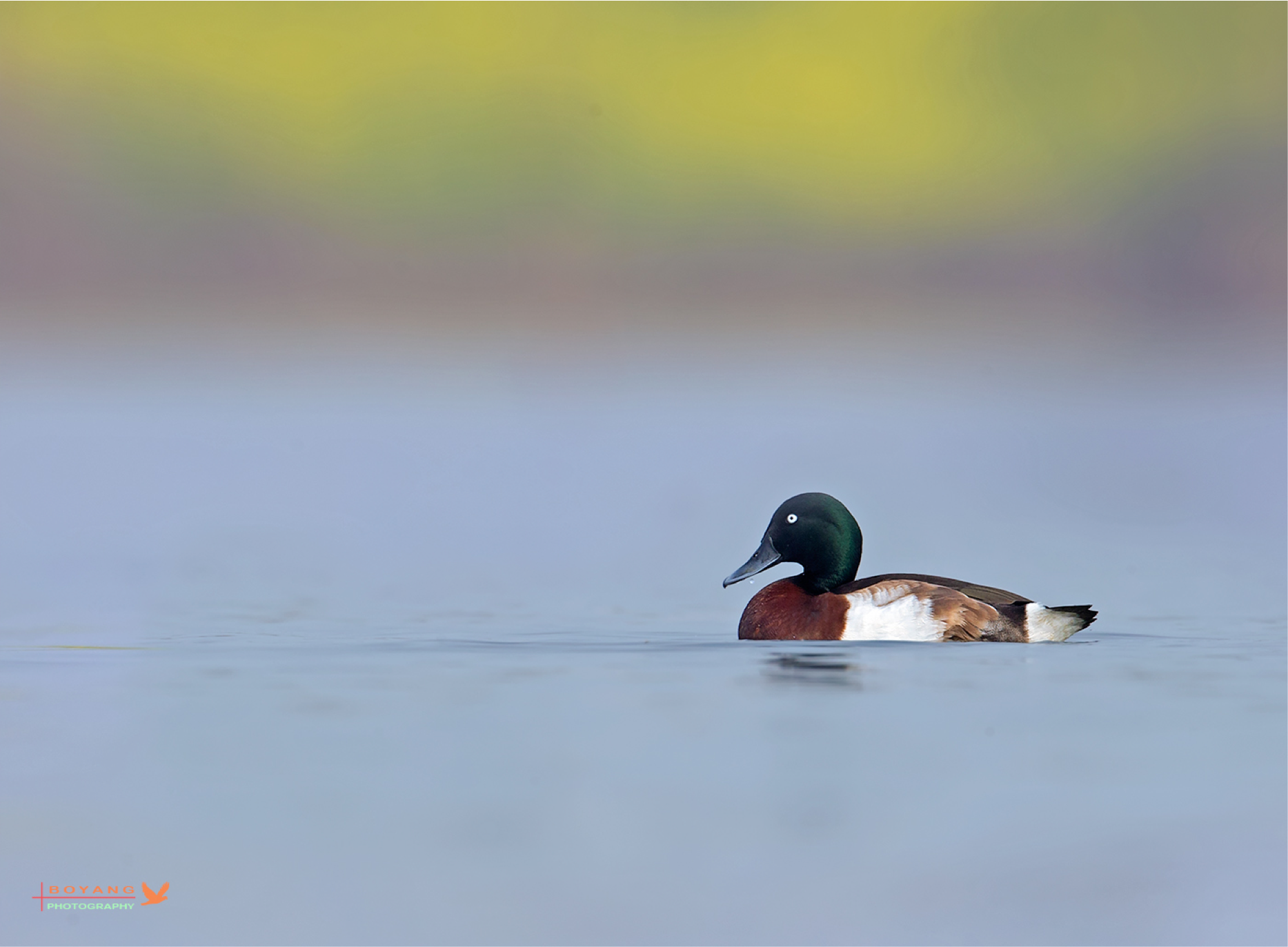
It’s heartwarming to be able to report some good news about a critically endangered species! On 19th April 2025, the National Forest and Grassland Administration (NFGA) published the results of the first comprehensive and synchronous winter survey of Baer’s Pochard (Aythya baeri 青头潜鸭 Qīng tóu qián yā) in China.
The survey, undertaken by recorded that the population of the Baer’s Pochard in China reached 2,555, a significant increase from the approximately 1,000 reported in 2012.
The survey was led and organized by the China Baer’s Pochard Conservation and Monitoring Working Group at Beijing Forestry University, under the guidance of NFGA, and involved over 400 individual surveyors at 212 sites in 21 Provinces that hold wintering populations of this species.
According to Professor Ding Changqing, Chair of the East Asian-Australasian Flyway Partnership and the China Baer’s Pochard Task Force, this is the first comprehensive wintering population census of Baer’s Pochard based and provides a strong scientific basis for formulating targeted conservation measures. It also provides important data support for the IUCN Red List to update the global population change trend.
Among the sites covered by the survey, there are 16 sites with a population of over 30 individuals (see Table 1 below), involving a total of 2,136 individuals, accounting for 83.6% of the total. Monitoring and protection of these sites must be a priority. Among the wintering habitats, freshwater lakes dominate, accounting for 71.51% of all habitats, followed by rivers and ponds. The investigation also discovered that wintering Baer’s Pochard prefer small abandoned fish ponds and medium to small-sized lakes with rich vegetation.
Table 1: the most important wintering sites for Baer’s Pochard in China.
Province
Site name and location
1
Shandong
Dongping lake, Taian
2
Jiangxi
East lake, Jiujiang
3
Henan
Minquan Ancient Yellow-river National Wetland Park
4
Shandong
South Four Lake Provincial Nature Reserve, Jining
5
Hebei
Baiyangdian wetland, Xiongan New District
6
Hubei
Fuhe wetland, Wuhan
7
Anhui
Jiaogang Wetland Park, Huainan
8
Hubei
Baoxiehu park, Wuhan
9
Hubei
Honghu Wetland National Nature Reserve
10
Hubei
Fanwan Lake National Wetland Park
11
Hebei
Hengshui Lake National Nature Reserve
12
Jiangsu
Feng County Ancient Yellow-river National Wetland Park
13
Anhui
Huangpi Lake, Hefei
14
Hubei
Jijia Lake Wetland Park, Dangyang
15
Shandong
Coal mining subsidence wetland, Jining
16
Hubei
Liangzi Lake Provincial Nature Reserve
Source: Baer’s Pochard Task Force, EAAFP
The results of this survey are a key milestone in the protection of Baer’s Pochard in China and build on the work over the last ten years. It was in 2016 that NFGA invited Beijing Forestry University to establish the “China Baer’s Pochard Protection and Monitoring Working Group”, with the responsibility for organising and coordinating the protection and monitoring the species in China. In recent years, the group has been engaged in ecological research on the Baer’s Pochard, established a national conservation and monitoring network, hosted international conferences, compiled the “National Baer’s Pochard Conservation Action Plan”, and collaborated with Beijing Zoo to establish China’s first ex-situ breeding population. Based on the research results, habitat restoration has been carried out in several important distribution areas in China, including at Hengshui Hu in Hebei Province.
It was back in 2018 that I participated in an international meeting on Baer’s Pochard at Hengshui Lake in Hebei Province, working alongside the late Rich Hearn of the Wildfowl and Wetlands Trust and Coordinator of the Baer’s Pochard Task Force. I can’t help thinking Rich would have been over the moon to see the progress on protecting Baer’s Pochard in China since that meeting, and I can think of no better tribute to Rich’s lifelong dedication to waterbirds than seeing Baer’s Pochard come back from the brink. Of course, the future of this species is far from certain but these survey results are hugely encouraging and demonstrate that, with coordination, the involvement of key stakeholders sprinkled with energy and passion, conservation works!
Thank you to Professor Ding Changqing of Beijing Forestry University for providing a summary of the recent survey and for his incredible efforts as Chair of the Baer’s Pochard Task Force to turn around the fortunes of Baer’s Pochard in China. And thank you to the hundreds of volunteers who dedicated time to look for and meticulously count these special waterbirds at wetland sites throughout China last winter.
Title image: a female Baer’s Pochard (Aythya baeri 青头潜鸭 Qīng tóu qián yā) at XiHai in Beijing in January 2025 (Terry Townshend)
As COVID-19 begins to take hold in many countries around the world, it is perhaps of no consolation to most people that the situation in Beijing appears to be stabilising. Life in the capital is slowly taking small steps towards normality, treading the fine line between continuing to contain the spread of this seemingly incredibly infectious virus and minimising the disruption to the economy and people’s lives. More shops and restaurants are open, albeit with restrictions on numbers and temperature checks on entry, and office workers are being allowed to return, with limits on the maximum number of people in an office at any one time and regular checks by the government.
However, as a reminder that things remain far from normal, housing compounds still forbid entry to non-residents and residents are checked for symptoms each time they enter, with everyone required to wear a mask when in public places. Admirably, the local staff in my compound have been religiously disinfecting the lifts, door handles and any other potential sources of transmission at least twice per day. And, given many people rely on deliveries for groceries and other essentials, these are now contactless – the couriers leave packages at the security gate for residents to collect, avoiding any direct contact.
The lockdown must be a gold mine of information for social scientists. The psychological effects of severe restrictions on human interaction beyond immediate family must be significant and there are already articles doing the rounds about an increase in the divorce rate, and also pregnancies, during these strange times.
For me, as someone who has always found solace and inspiration in nature, and particularly with birds, this time has been a reminder of their positive power. I’ve taken the opportunity to read more, something I have certainly neglected in recent years, and one book, in particular, made me realise what I have been missing… I lost myself for hours in “The Seabird’s Cry” by Adam Nicholson, a captivating book celebrating the incredible lives of seabirds, following ten species around the coasts and islands of Scotland, Ireland, the Americas and across the vast ocean in between. For a taste, here is Adam’s description of the Kittiwake:
“a sprung and beautiful thing, dawn grey, black eyes, black tips to the wings . . . its whole being like a singer’s held note, not flickering or rag-like, nor blown about like a tern, but elastic, vibrant, investigative, delicate . . . ”
Invigorated by nature writing, the self-quarantine has also allowed me time to research historical records of birds in Beijing, going through books and journals from the likes of Cai Qikan, Robert Swinhoe, J D D La Touche, Père Armand David and other early ornithologists in China. The result will be a new online resource, coming soon, which will provide the status of every species recorded in Beijing. Watch this space!
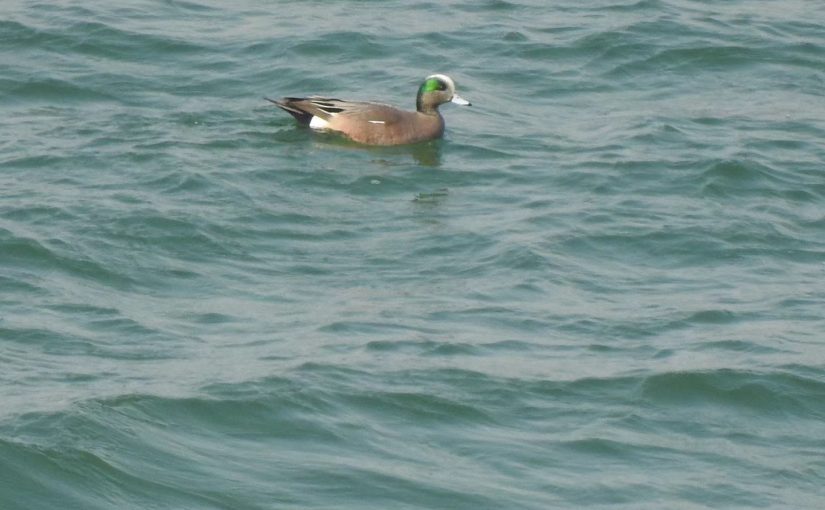
And in the last few days, as the situation stabilises, birders have been venturing out, in many ways the perfect activity in these times – small numbers of people in large, open spaces, always following the local regulations to wear a mask. And some of the young local birders have been handsomely rewarded with some special sightings. On Thursday, Wang Xue visited Ming Tombs Reservoir and found Beijing’s first ever AMERICAN WIGEON (绿眉鸭, Lǜ méi yā). The stunning drake lingered for the rest of the day, loosely associating with some MALLARD (绿头鸭 Lǜ tóu yā), a COMMON POCHARD (红头潜鸭 Hóng tóu qián yā) and a drake BAIKAL TEAL (花脸鸭 Huā liǎn yā).
A summer-plumaged PALLAS’S GULL (渔鸥, Yú ōu) at the same site would normally be the star of the show but that day it was relegated to the role of supporting actor.
An adult PALLAS’S GULL in breeding plumage at Ming Tombs Reservoir (Terry Townshend)
After putting out the news of her find on WeChat, Wang Xue stayed around to help the 60 or so birders who made the short journey to experience this rare visitor. I am grateful to Steve and Zhou Xi Bale who collected me on the way, allowing me to share the moment. The sense of elation, and even release, among the group was palpable… a rare moment of joy and celebration in what has been a tough beginning to the year.
Beijing birders enjoying a rare day out, catalysed by the presence of a drake American Wigeon, the first record of this species in Beijing.Local birders watching the American Wigeon at Ming Tombs Reservoir, 5 March 2020.
On the same day, two male BAER’S POCHARD (青头潜鸭 Qīng tóu qián yā) were found at DaShiHe in Fangshan District (Xi’ao’pai Yuren), associating with some COOT (骨顶鸡 Gǔ dǐng jī), a few GREAT CRESTED GREBE (凤头鸊鷉 Fèng tóu pì tī) and a single FERRUGINOUS DUCK (白眼潜鸭 Bái yǎn qián yā). Fortunately, they stayed around and were still present at the weekend, allowing many people to catch up with this critically endangered duck.
Of course, it’s not only rare birds that provide joy. The flocks of DAURIAN JACKDAW (达乌里寒鸦 Dá wū lǐ hán yā) migrating north, the REED PARROTBILL (震旦鸦雀 Zhèn dàn yā què) calling incessantly from a reedbed and the sight of GREAT CRESTED GREBE (凤头鸊鷉 Fèng tóu pì tī) beginning their courtship displays, were all wonderful to behold.
Daurian Jackdaws at dusk, Beijing (Terry Townshend)
The positive feelings were reinforced when we met with two groups of local forestry police, both of whom asked us if we had seen anyone setting up nets. They were actively patrolling and clearly getting ready to crack down on poaching in the forthcoming migration season. A few years ago, an encounter like that would have been just a dream!
The experience of the last few days has been uplifting and has reminded me just how positive birds can be to our every day lives, including our mental health. I am optimistic that the joy provided by these rare visitors and the inspiration they have provided to get out into nature, represent the beginning of a change in fortune for Beijing and its inhabitants. Spring, with all its optimism and anticipation, is here at last.
Title image: the drake AMERICAN WIGEON at Ming Tombs Reservoir (photo by Wang Xue)
At the end of May, I reported on the successful breeding of Baer’s Pochard at Hengshui Hu, just 300km south of Beijing. It’s remarkable progress in the conservation of this diving duck which, with fewer than 1,000 remaining, is classified as critically endangered, just one step away from extinction.
This week I paid my latest visit to Hengshui Hu to help deliver more training of the local nature reserve staff including the ‘enforcement team’ on waterbird monitoring and identification. During the three-hour train journey to Hengshui, I wondered whether the measures taken by the local government and nature reserve to clamp down on illegal fishing, egg collection and to manage the water levels during the breeding season would be sustained.
I needn’t have worried. Early morning on my first full day, we enjoyed a ‘field visit’ along the causeway to check for Baer’s Pochard and other waterbirds and there wasn’t a fishing boat or net in sight.. There were good numbers of young Great Crested and Little Grebes, Coots, a few groups of juvenile Ferruginous Ducks, tens each of Black-crowned Night, Purple and Grey Herons, Yellow Bitterns were flying back and forth with food and, in contrast to their British counterparts already well on their way to Africa, the Common Cuckoos were still very obvious, calling and chasing each other over the reed beds, much to the annoyance of the local Oriental Reed Warblers. The colony, 100s strong, of Whiskered Terns on one of the disused fishponds with a Pheasant-tailed Jacana pottering on the lotus leaves showed just how habitat, and its associated biodiversity, can recover if given the chance.
One of the many Yellow Bitterns at Hengshui Hu
This slideshow requires JavaScript.
After the training, the nature reserve staff arranged for me to be taken out on a boat patrol with the enforcement team and we found a group of at least four juvenile aythyas, tentatively identified as Baer’s Pochards based on head shape and bill size compared with juvenile Ferruginious seen earlier. And my hosts quickly sent packing two groups of fishermen who had sneaked to the shore close to the main Baer’s Pochard breeding area.
These fishermen, close to the main breeding area of Baer’s Pochard, were sent packing by the local enforcement team.
On arrival at my hotel along the east bank of Hengshui Hu, I was pleasantly surprised to receive my room card, complete with a picture of Baer’s Pochard.. and in my room was a leaflet with information about the Baer’s Pochard and the importance of Hengshui Hu for the species. Great public engagement!
The bird monitoring team at Hengshui University, led by Dr Wu Dayong and Li Feng, now have an impressive full year of waterbird data, collected at least weekly, for and they’ve even added some new species to the official list for the site.
The future of Baer’s Pochard at this site now looks bright and huge credit must go to the local government, local nature reserve, Hengshui University and the local people who now see Baer’s Pochard as a key part of their identity.
Hengshui Hu is undoubtedly the “Home of Baer’s Pochard”.
At 1748 local time on 28 May 2018, Li Feng, a researcher and bird surveyor from Hengshui University found, photographed and videoed a female BAER’S POCHARD (Aythya baeri) with ducklings at Hengshui Hu National Nature Reserve in Hebei Province, China. This is the first confirmed breeding of the “Critically Endangered” diving duck anywhere in the world in 2018 and is almost certainly a direct result of conservation efforts by the local government and nature reserve staff, supported by the Sino-German Hengshui Lake Conservation and Management Project
The breeding success follows hot on the heels of the first international workshop of the Baer’s Pochard Task Force at Hengshui Hu in March 2018 and the subsequent commitments from the local government and local nature reserve to manage the lake for the benefit of this beautiful diving duck.
Baer’s Pochard (Aythya baeri) is a poorly known migratory diving duck that was formerly widespread in eastern Asia.Since the 1980s it has suffered a precipitous decline throughout its range, estimated to be >90%, and fewer than 1,000 birds now survive in the wild, making it rarer than the Giant Panda.Since 2012 it has been classified by the IUCN as “Critically Endangered”, meaning it is just one step away from extinction in the wild.In the last five years it has become clear that Hengshui Hu in Hebei Province is the most important known site in the world for this species with more than 300 recorded during spring migration in 2017, several overwintering and a few pairs spending the summer.However, due to a combination of fluctuating water levels during the breeding season, illegal egg collection and disturbance by electro-fishermen and tourist boats, there has been no recent evidence of breeding.
It was back in March 2017 that I visited Hengshui Hu, as part of the Sino-German Hengshui Hu Project run by German Development Bank, KfW, to to help train Hengshui University and nature reserve staff about waterbird monitoring and identification of Baer’s Pochard. At that time I could not have dared dream that there would be breeding success a little over a year later.
Since then, the local groups have been systematically counting waterfowl, in particular Baer’s Pochard, on a weekly basis, helping to build up a better picture of how the lake is used by Baer’s Pochard and other waterbirds. At the same time, a series of targeted conservation actions have been initiated, including declaring the likely favoured breeding area as a seasonal fully protected zone, compensating fishermen who could no longer fish in the protected zone, clamping down on illegal activity including illegal fishing and egg collection, stabilising the water level during the breeding season to avoid nests being flooded, and beginning a public information campaign to raise awareness about the global importance of Hengshui Hu for Baer’s Pochard.
New interpretation boards focusing on Baer’s Pochard have been erected at Hengshui HuPublic information is crucial to help enthuse the local people and engender a sense of pride that they have such an endangered bird in their community
Just two months ago, the international spotlight shone on Hengshui Hu when, on 19-20 March 2018, delegates from ten countries gathered for the first international workshop on the conservation of the Baer’s Pochard under the auspices of the East-Asian Australasian Flyway Partnership (EAAFP).Delegates from Bangladesh, China, Democratic People’s Republic of Korea, India, Japan, Mongolia, Myanmar, Republic of Korea, Russia and Thailand heard from senior Chinese local and national government officials, academics and international experts, discussed urgent conservation priorities and agreed the “Hengshui Declaration”.
The actions by the local nature reserve and Hengshui University, enabled and reinforced by the political will shown by the local government, have undoubtedly created the conditions for successful breeding in 2018 and, in another demonstration of local commitment, more than 40 volunteers from Hengshui University have already set up a group to monitor the progress of these, and hopefully more, Baer’s Pochard ducklings.
The positive results from Hengshui, coming so quickly after the concerted actions to support Baer’s Pochard, are deeply heartening and demonstrate that local conservation actions can deliver results. And although there is a very long way to go to secure the future of this endangered species in the wild, successful breeding represents a positive step forward for the conservation effort.
Big congratulations to the local government, the local nature reserve, especially Mr Yuan Bo and Ms Liu Zhenjie, and to Hengshui University, in particular Dr Wu Dayong and Li Feng, and to everyone else involved, including Professors Ding Changqing and Lei Guangchun and Dr Wu Lan at Beijing Forestry University, Guido Kuchelmeister, Matthias Bechtolsheim and John Howes from the KfW project, Rich Hearn at WWT, Hyeseon Do from EAAFP and many more.
Good news on conservation seems to be coming thick and fast from China. With the recent ban on land reclamation along China’s coast – a massive boost to the tens of millions of migratory shorebirds that rely on the food-rich intertidal mudflats to fuel their marathon journeys – and the listing of a series of coastal sites on the tentative list for World Heritage Site status, there has been significant progress in the last 12 months for migratory shorebirds.
And this week there was major progress for the ‘Critically Endangered’ Baer’s Pochard (Aythya baeri). From 19-21 March I participated in a workshop at Hengshui Hu, around 300km south of Beijing. Convened by the East Asian-Australasian Flyway Partnership (EAAFP)’s Baer’s Pochard Task Force, an international coalition of partner organisations dedicated to saving this endangered duck, the workshop was designed to promote its conservation. And Hengshui Hu was a fitting location – as an important stopover site, a breeding site and with a handful spending the winter, this lake is the most important known location for this species in the world.
WWT’s Richard Hearn addresses the opening session at Hengshu Hu. With their outstanding experience with waterbirds, WWT is a key partner in the effort to save Baer’s Pochard from extinction.
The workshop, hosted by Beijing Forestry University and Hengshui Municipal Government and organised by Hengshui Hu National Nature Reserve, the School of Nature Conservation at Beijing Forestry University and Hengshui University, was opened by the Deputy Mayor of Hengshui and included participants from ten countries – Bangladesh, China, Democratic People’s Republic of Korea, India, Japan, Mongolia, Myanmar, Republic of Korea, Russia and Thailand.
Delegates from Mongolia and Russia formed part of the international delegation to Hengshui Hu.
It’s fair to say the workshop was nothing short of inspirational. The huge sense of local pride in Hengshui about being the most important (known) place in the world for this species was palpable and the research presented by Chinese academics, including Dr Wu Lan and a team of volunteers from across the Provinces (part of which showcased the results of a 2017/2018 winter survey with more than 800 birds counted) – was impressive.
In the opening session, the State Forestry Administration announced that Baer’s Pochard has been recommended to be added to the list of species with “Class 1 protection” in China, meaning that anyone killing or endangering it will face severe penalties. And, together with the contributions from all the range countries in east and south Asia, the workshop was a major step forward in consolidating knowledge, identifying research gaps and priority actions as well as significantly raising the profile of Baer’s Pochard locally and nationally. Huge kudos to the organisers, especially Professor Ding Changqing and his team from Beijing Forestry University, Dr Wu Dayong and his team from Hengshui University, the Hengshui Municipal Government, Hengshui Hu National Nature Reserve, EAAFP and the Wildfowl and Wetlands Trust. It was a privilege to be there.
First, as stated above, the State Forestry Administration announced that they have recommended BAER’S POCHARD be added to the list of species with special (Class 1) protection in China. This is significant as, if approved, it would mean severe penalties for anyone killing or endangering this species or its habitats. That is a serious deterrent to any would-be poachers and egg collectors.
Second, Hengshui Hu was urged to apply for status as a wetland of international significance under the Ramsar Convention and, importantly for building local pride, Hengshu Hu was designated as “The Home of Baer’s Pochard”.
EAAFP’s Hyeseon Do presents Mr Bo Yuan, the Director of Hengshui Lakeside New City Area, with a plaque to commemorate the workshop.
As well as the formal outcomes detailed in the Declaration, local officials committed to strengthening enforcement of laws and regulations about illegal fishing, egg collecting and habitat disturbance. Having seen many examples of electric fishing (illegal in all of China, not only in nature reserves), reed cutting and egg collection during my many visits to Hengshui Hu over the past few years, this is heartening to hear and I very much hope these wonderful words will be backed up by action on the ground. Our field visit to the site on the second day of the workshop has given me optimism – it was clear that nearly all of the fishing nets have been removed and, according to the local officials, more than 200 boats have been confiscated. Powerful stuff.
Delegates enjoyed good views of BAER’S POCHARD during the field visit to Hengshui on the second day.
One outcome not recorded in the official Declaration but nevertheless will be welcomed by many, I am sure, is the idea that the local beer will be re-branded as “Baer’s Pochard beer” with a percentage of sales going to Baer’s Pochard conservation. If any locals needed an incentive to drink more beer, this must surely be it!
It’s striking how much progress has been made in the last five years. It was only in 2012 that there were very few sightings of Baer’s Pochard anywhere in the world and in February of that year a British birder famously travelled to Japan from the UK just for the weekend to see one. The fact that he was prepared to fly half way around the world to see a single overwintering drake a few hours from Tokyo was testament not only to the rarity of this once abundant duck from eastern Asia but also that, at the time, there were no reliable sites to see it in the wild anywhere on Earth and it was thought to be on the verge of slipping away. Later that year, Chinese birders reported up to four breeding pairs of Baer’s Pochard at Hengshui Hu and, since then, this site has become THE place to see this species. More than 300 were counted there in March 2017 during spring migration.
On Wednesday evening I returned to Beijing with many of the delegates and the atmosphere among the group was joyous, so much so that even a 20-minute detention at a police checkpoint failed to dampen the spirits.
Lining up at the Hebei-Beijing border check whilst waiting for our passports to be checked.
Whilst Baer’s Pochard is a species that remains at serious risk of extinction in the wild, the prognosis today is such a contrast to 2012. Along with the announcement of the ban on land reclamation, it’s been a dream-like beginning to 2018 for conservationists in China. I could get used to this feeling!
Header photo: a drake BAER’S POCHARD by Luo Jianhong.
Background about the Baer’s Pochard
In the early 1900s Baer’s Pochard was described by La Touche as “extremely abundant” in eastern China during spring and autumn migration as it made its way to and from its breeding grounds in northeast China and southeast Russia. Some notes from formerly Beijing-based Jesper Hornskov described a flock of 114 on the lake at the Summer Palace as recently as March 1989. Many birders who visited the Chinese east coast migration hotspot of Beidaihe in the 1980s and 1990s probably saw reasonable numbers, too. Historically, it was reliable in winter at Poyang Hu in Jiangxi Province, with flocks numbering 100s of birds being reported there as recently as the 1990s and 2000s.
However, its decline since then has been dramatic and near catastrophic. In 2012 a (partial) summer survey of what was thought to be its breeding stronghold – Lake Khanka on the China-Russian border – produced not a single confirmed sighting during the core breeding season, although two were seen in August. Similarly, a 2012/2013 survey of its known core wintering grounds, coordinated by WWT and WWF China, produced just 45 individuals thinly spread across the Provinces of Anhui, Henan, Hubei, Jiangsu, Jiangxi, Sichuan and Hong Kong, an apparently calamitous drop in numbers that explains why the status of Baer’s Pochard was upgraded to “Critically Endangered” by BirdLife International.
The reasons for the dramatic decline are not well understood but are likely to include habitat destruction and degradation (partly natural, caused by a long-term drought in northeast China, but predominantly human-related), and hunting pressure at stopover sites and on the wintering grounds. However, it is an interesting contrast that the Ferruginous Duck (Aythya nyroca), a species with which Baer’s Pochard often associates and that shares similar habitat preferences, appears to be increasing in numbers and spreading north and east.
In fact, the expansion of the range of Ferruginous Duck could be an additional threat to an already vulnerable Baer’s Pochard due to the spectre of hybridisation. I have personally seen drake Baer’s Pochards displaying to female (and male!) Ferruginous Ducks in Beijing and at Hengshui Hu, and several birds during our field trip on Tuesday 20 March 2018 showed characteristics of both species.
The most recent winter survey in China produced a relatively high total of a little over 800 birds and I think it’s fair to say that probably constitutes the majority of the global population. With the location of only a handful of breeding pairs known, there’s still so much to learn about the breeding areas, distribution and ecology of Baer’s Pochard.
Did you know that one in eight of the world’s 10,000 bird species are threatened with extinction, of which more than 200 are classified as Critically Endangered, the highest category of threat of extinction? Anyone interested in conservation will be getting used to hearing statistics like these and, although many people feel sad, even angry, that this is happening, it’s often hard to know what can be done to help.
Fortunately, there are practical things we can do right now that can make a difference. One of them is to become a Species Champion under BirdLife International’s Preventing Extinctions Programme.
BirdLife International is the world’s largest nature conservation partnership, working with local partners in more than 120 countries. Since 2007 they have been running the BirdLife Preventing Extinctions Programme (PEP), specifically designed to target conservation efforts where they are most needed. The PEP creates two ‘communities’ – BirdLife Species Guardians, experts who take the lead in conserving globally threatened species in their country, and BirdLife Species Champions, individuals or organisations who raise awareness, and funding, for the vital conservation that is so urgently required. And it works. There are many examples of how conservation, driven by the Species Champions and Guardians, is making a difference. But instead of listing them (you can see some examples here on the BirdLife website), I want to convey my personal experience of being a Species Champion.
Shortly after I moved to China in 2010, I realised that several species were in real trouble. Some, such as the Spoon-billed Sandpiper and Black-faced Spoonbill, were well-known and major conservation actions were already underway. However, when I spoke with Chinese scientists and birders, they all told me that the species in most imminent danger of extinction was the Jankowski’s Bunting, a little-known small brown bird whose tiny remaining range was in a remote part of Inner Mongolia.
I researched the status of Jankowski’s Bunting and, the more I found out, the more I became concerned for its future. I knew I wanted to do something. But what could an ordinary birder like me really do? After speaking to a few friends, I heard about BirdLife’s Preventing Extinctions Programme and I was soon having a conversation with Jim Lawrence, the Director of the programme, about what was required to become a Species Champion and what it would involve. I was quickly convinced that this was the best way I could help Jankowski’s Bunting and, within days, I had donated a modest amount of money (less than the cost of a foreign holiday), pledged to raise a little more, and became a Species Champion.
Jim had explained to me what BirdLife could do to help Jankowski’s Bunting with the funding. Given there was no BirdLife partner in Mainland China, work on species there was coordinated through the Hong Kong Birdwatching Society (HKBWS). I was soon in touch with BirdLife’s China Programme Manager, Vivian Fu (now a good friend and a real hero of conservation in Asia), and we discussed plans for a survey of Jankowski’s Bunting in partnership with the Beijing Birdwatching Society (BBWS). The next thing I knew, I was walking slowly through the grasslands of Inner Mongolia alongside Vivian and volunteers from the BBWS looking for populations of this small brown bird. The surveys reinforced the anecdotal evidence that historic populations of Jankowski’s Bunting were declining fast and, in some cases, disappearing altogether.
On my side, I wrote articles about the Jankowski’s Bunting on both Birding Beijing and Birding Frontiers, and set up a crowdfunding page on behalf of BirdLife International to receive donations from the public.
After the survey, the next step was to begin a conversation with the local government and local people to see what could be done. At the invitation of the HKBWS and BBWS, I was soon participating in a workshop with local government officials and representatives of the local community to raise awareness of the plight of this small brown bird and to try to encourage some simple actions to try to support the remaining population. That first meeting was hugely important in terms of simply putting Jankowski’s Bunting into the consciousness of the local government. Subsequent meetings involved local scientists, one of whom had been studying Jankowski’s Bunting for several years. His funding was increased, enabling him to recruit a small team dedicated to surveying and studying the bunting and they’ve been working tirelessly to survey this vast area and discover the main reasons for the bunting’s decline. Without stealing the thunder of his work, there will be a paper published very soon with some welcome good news. Another major highlight for me was meeting with the Chairman of the Environment Protection Committee in the National Peoples Congress in Beijing and securing a commitment to include Jankowski’s Bunting in the updated list of “Species with Special Protection” under the Wildlife Protection Act.
Baroness Worthington presents Lu Hao, Chairman of the Environment Protection and Resources Conservation Committee with a copy of the BirdLife International special edition newsletter about Jankowski’s Bunting.
In short, my experience as a BirdLife Species Champion has been overwhelmingly positive. I moved from a sense of alarm and helplessness about the status of the Jankowski’s Bunting to understanding that something could be done… I grew a sense of ownership and, with that, a responsibility to do something. Although the heavy lifting has been done by BirdLife, the HKBWS, BBWS and local scientists, I have been been able to contribute, albeit in a small way, to practical conservation efforts, engage with the local government and local people and gain an understanding of the local dynamics and politics.
Of course, I have been fortunate to live relatively close to the range of Jankowski’s Bunting and I’ve been able to manage my time so that I can participate in the surveys and workshops. Not everyone is so fortunate. However, that is the beauty of being a Species Champion – you can be involved as little or as much as you want. Becoming a Species Champion isn’t just about donating some funds with a couple of clicks and feeling good for a few days.. it’s about developing partnerships with organisations that are best-placed to help, gaining a better understanding of the factors determining the future of your chosen species and, best of all, developing a real bond with the species. For me, being involved in the conservation efforts so far has been hugely rewarding and, with a long way to go to ensure the survival of Jankowski’s Bunting, I am looking forward to playing my part in the months and years to come.
Given the hugely positive experience of being a Species Champion, I am surprised that there are still many threatened species out there without a Champion. Wouldn’t it be cool to be Species Champion for Nordmann’s Greenshank? Or how about Chinese Crested Tern, a bird with which BirdLife is working hard with some recent success? Most of us donate to, and/or raise funding for, causes important to us but how many donate AND are involved in putting that donation to work?
Chinese Crested Tern is still without a BirdLife Species Champion!
For more details of the BirdLife Preventing Extinctions Programme, please see the dedicated pages on the BirdLife website and, if you would like more information or if you’ve already made up your mind to become a Species Champion, please contact Jim Lawrence on email: Jim.Lawrence@birdlife.org or via Facebook.
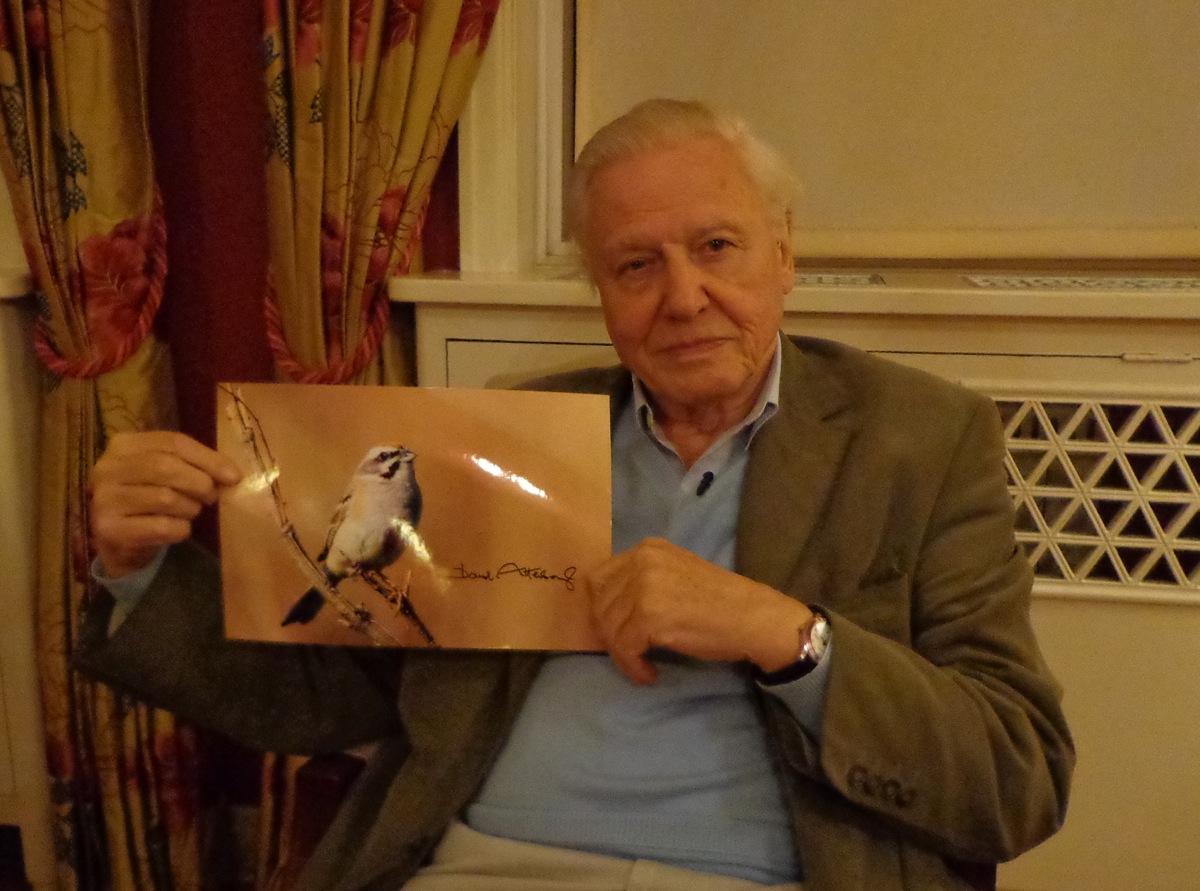
Cover image: Sir David Attenborough shows his support for the Jankowski’s Bunting conservation effort.
Last week I was invited to Hengshui Hu in Hebei Province by officials from the German government-owned development bank, KfW. In partnership with the Hengshui Hu nature reserve and Hengshui University, KfW is beginning a project to support the sustainable management of this impressive wetland which, as well as supporting breeding populations of Reed Parrotbill, Blunt-winged Warbler and Schrenck’s Bittern, happens to be the most important known site for the ‘Critically Endangered’ BAER’S POCHARD (BP).
A map of Hengshui Hu in Hebei Province.
I arrived at Hengshui Hu on the afternoon of 7 March and spent the last two hours of daylight checking the southern part of the lake. I recorded a minimum of 42 BPs as well as 21 Ferruginous Duck, at least 2,300 Coot, a handful of Smew and 2 Common Mergansers. However, as the light faded, I could see distant rafts of birds on the water in the more northerly part of the lake and I wondered what the morning would bring. On the short drive back to the hotel I was pleasantly surprised to see a banner with a large photograph of Baer’s Pochard draped over the road on the western side of the lake – public awareness!
I’d arranged to meet Guido and Matthias from KfW and Dr Wu Dayong of Hengshui University the following morning at 0630 for a survey. As we began our walk along the causeway, we were treated to a wonderful morning with little wind, a temperature hovering around freezing and beautiful clear blue skies. Perfect conditions. It wasn’t long before we were encountering small groups of BP and, in the ideal conditions, we enjoyed some superb views of males and females.
As we walked further we began to see some larger groups and, before we had even walked half of the causeway, our count was well over 200. Soon after a stunning encounter with some of the local Reed Parrotbills, Guido and Matthias reluctantly had to leave to attend a meeting as I continued my walk.
The charismatic, and curious, REED PARROTBILL is one of Hengshui Hu’s star birds that should benefit from an effective management plan.
About an hour and a half later I met Dr Wu at the southern end of the causeway having counted 308 BPs, a new record for the site, eclipsing the 293 recorded by Paul Holt and Dr Li Qingxin on 9 December 2016. An additional 5 birds were presumed BP x Ferruginous Duck hybrids (some video of females and presumed hybrids can be seen here).
After lunch with KfW and the nature reserve staff I held a short identification workshop with the nature reserve staff focusing on how to distinguish BP from the superficially similar, at least in female, immature and eclipse plumages, Ferruginous Duck. I hope to be able to provide some more support over the next few weeks to help the staff begin regular monitoring of the birds at this important site.
On the 4-hour journey home I began to think about the future of BP. With two groups of Beijing-based scientists and conservationists, led by Dr Wu Lan and Dr Li Qingxin, already researching BP’s ecology and population dynamics, the creation of an international Baer’s Pochard Task Force, a new project at Hengshui Hu involving both local and international experts that will help take into account biodiversity in the management of the reserve, a clear understanding by the nature reserve staff and local academics of the importance of Hengshui Hu to BP, their willingness to begin regular bird monitoring, signs of public engagement and a record site count of BPs, I began to smile. Of course there is a long way to go to slow, halt and reverse the decline in the population of Baer’s Pochard but it appears some of the key building blocks are beginning to be put in place.
Looking out of my apartment window on the first day of 2017, a blanket of toxic smog seems to drain all colour out of life and the perennial question question pops into my head – why do I live in such a polluted, congested place?
Header image: the view from my apartment at 1200 on 1 January 2017
The answer, of course, is the excitement and adventure of living in the capital city of the world’s most populous nation. And when one considers the positives – the stunning biodiversity, the opportunity for discovery, the potential to make a difference and the wonderful people – the negatives are seen in context and they become far more tolerable.
Looking back, 2016 has been an astonishing year with many highlights, thankfully few lowlights, and progress made in some key conservation issues. Together, they give me a genuine sense of optimism for the future.
January began with the unexpected discovery, by two young Beijing birders, Xing Chao and Huang Mujiao, of a small flock of the “Endangered” Jankowski’s Buntings at Miyun Reservoir. This was the first record of Jankowski’s Bunting in Beijing since 1941 and, given the precipitous decline in the population of this poorly known species, a most unexpected find. The fact they were found by young Chinese is testament to the growing community of talented young birders in Beijing. There are now more than 200 members of the Birding Beijing WeChat group, in which sightings and other bird-related issues are discussed and shared. Huge credit must go to world-class birders such as Paul Holt and Per Alström who have been generous in sharing their knowledge of Chinese birds with the group. As well as the expanding WeChat group, there are now more than 400 members of the Beijing-based China Birdwatching Society (up from 300 in the last 12 months). So, although starting from a low baseline, the increasing membership, together with the increase in the number of local birdwatching societies, such as in Zigong in Sichuan, and the development of international birding festivals, such as in Lushun, Dalian, shows that there is the beginning of an upsurge in the number of young people interested in birdwatching. That is a positive sign for the future of China’s rich and unique avifauna.
In tandem with the growth in birding is the emergence of a number of organisations dedicated to environmental education across China. Given the relative lack of environment in the Chinese State Curriculum, there is high demand amongst many parents for their children to develop a connection with nature. I’m fortunate to work with one such organisation – EcoAction – set up and run by dynamic Sichuan lady, Luo Peng. With a birding club for Beijing school kids, a pilot ‘environmental curriculum’ in two of Beijing’s State Schools and bespoke sustainable ecotourism trips to nature reserves for families and schools, Peng deserves great credit for her energy and vision in helping to change the way people interact with the environment. I am looking forward to working with her much more in 2017.
Luo Peng in her element – with local children in Hainan
After the boon of seeing Jankowski’s Buntings in Beijing, a lowlight in late January was the desperately sad passing of a much-loved mentor and friend, the inspirational Martin Garner. Martin fought a brave and typically dignified and open, battle with cancer. I feel enormously lucky to have met Martin and to have corresponded with him on many birding-related issues. His wisdom, positivity and selfless outlook on life will be missed for years to come and his influence continues to run through everything I do.
Much of the early part of the spring was spent making the arrangements for what has been, for me, the highlight of the year – The Beijing Cuckoo Project. Following the success of the Beijing Swift Project, the results of which proved for the first time that Swifts from Beijing winter in southern Africa, the obvious next step was to replicate the British Trust for Ornithology’s Cuckoo Tracking Project in China. We needed to find Chinese partners, secure the necessary permissions, raise funds to pay for the transmitters and satellite services, and make the logistical arrangements for the visit of “Team Cuckoo”. At the end of May, everything was set and the international team arrived in Beijing. Together with the local team, we caught and fitted transmitters to five Common Cuckoos, subsequently named by Beijing schoolchildren and followed via a dedicated webpage and on social media. We could not have wished for a better result. Three of the five are now in Africa, after making incredible journeys of up to 12,500km since being fitted with their transmitters, including crossing the Arabian Sea. As of 1 January, Flappy McFlapperson and Meng Zhi Juan are in Tanzania and Skybomb Bolt is in Mozambique.
Skybomb Bolt, the first Beijing Cuckoo to make landfall in Africa on 30 October 2016.The migration routes, and current positions, of the Beijing Cuckoos, 1 January 2017.Pupils at Dulwich International School broke into spontaneous applause after hearing that SKYBOMB BOLT had made it to Africa…
This Beijing Cuckoo Project has combined groundbreaking science with public engagement. With articles in Xinhua (China’s largest news agency), Beijing Youth Daily, China Daily, Beijing Science and Technology Daily, India Times, African Times and even the front page of the New York Times, these amazing birds have become, undoubtedly, the most famous cuckoos ever! Add the engagement with schools, not only in Beijing but also in other parts of China, and the reach and impact of the project has been way beyond our wildest dreams. I’d like to pay tribute to everyone involved, especially the Chinese partners – the Beijing Wildlife Rescue and Rehabilitation Centre, China Birdwatching Society and the staff at the tagging locations (Cuihu, Hanshiqiao and Yeyahu) – who have all been brilliant, as well as the BTO’s Andy Clements and Chris Hewson for their vision and sharing of expertise and the sponsors – Zoological Society of London, Oriental Bird Club, British Birds Charitable Foundation and BirdLife International. Finally, a big thank you to “Team Cuckoo”: Dick Newell, Lyndon Kearsley, Wu Lan, Susanne Åkesson, Aron Hejdstrom, Geert De Smet, Gie Goris and Rob Jolliffe. You can follow the progress of the Beijing Cuckoos here. All being well, Flappy, Meng and Skybomb will return to Beijing by the end of May.
In 2017 we are planning to expand the Beijing Cuckoo Project to become the CHINA Cuckoo Project, which will involve tagging cuckoos in different locations across the country. More on that soon.
As well as being privileged to have been part of such a groundbreaking project, I have been fortunate to be involved with some exciting progress on some of the highest priority conservation issues, working with so many brilliant people, including Vivian Fu and Simba Chan at Hong Kong Birdwatching Society/BirdLife. The plight of shorebirds along the East Asian Australasian Flyway is well-known, with the Spoon-billed Sandpiper the “poster species” of conservation efforts to try to save what remains of the globally important intertidal mudflats of the Yellow Sea and Bohai Bay. More than 70% of these vital stopover sites have been destroyed already through land reclamations and much of the remaining area is slated for future reclamation projects. Scientists, including an ever greater number of young Chinese such as Zhu Bingrun, now have the evidence to show that the population declines of many shorebird species, some of which are now classified as “Endangered”, can be attributed in large part to the destruction of the vital stopover sites in the Yellow Sea. After meeting world-leading shorebird expert, Professor Theunis Piersma, in Beijing in May and arranging for him to address Beijing-based birders with a compelling lecture, it’s been a pleasure to support the efforts of international organisations such as BirdLife International, the East Asian Australasian Flyway Partnership (EAAFP), led by Spike Millington, IUCN, UNDP and The Paulson Institute as well as local NGOs such as Save Spoon-billed Sandpiper and 山水 (ShanShui) in their interactions with the Chinese government to try to encourage greater protection for, and sustainable management of, the remaining intertidal sites. One of the pillars of the conservation strategy is to nominate the most important sites as a joint World Heritage Site (WHS) involving China and the Koreas (both North and South). This would have the advantage of raising awareness of the importance of these sites to those in the highest levels of government and also requiring greater protection and management of the sites. I am pleased to say that, due to the hard work of these organisations, much progress has been made and the Ministry of Housing, Urban and Rural Development (MoHURD), the ministry responsible for WHS nominations, is now positively taking forward the suggestion and working on the technical papers required to make a submission to the State Council for formal nomination. Special mention should be made of John MacKinnon, whose expertise, network of contacts in China and enthusiasm has made a big difference, to Nicola Crockford of RSPB and Wang Songlin of BirdLife International for their diplomatic work to create the conditions for the WHS issue to come to the fore, to David Melville, who recently delivered a compelling presentation covering a lifetime of shorebird study, to MoHURD at a workshop convened by ShanShui, and to Hank Paulson who, through the publication of the Paulson Institute’s “Blueprint Project” and his personal engagement at a very senior level with Provincial governors, has secured a commitment from the Governor of Hebei Province to protect the sites in his Province highlighted in the Blueprint. These are significant advances that, although far from securing the future of China’s intertidal mudflats, have significantly improved the odds of doing so.
Professor Theunis Piersma delivers his lecture to Beijing-based birders at The Bookworm, Beijing, in May 2016.
China’s east coast hosts the world’s most impressive bird migration, known as the East Asian Australasian Flyway. That flyway consists of not only shorebirds but also many land birds and it is this concentration of migratory birds every spring and autumn that attracts not only birders but also poachers. This year has seen several horrific media stories about the illegal trapping of birds on an industrial scale, primarily to supply the restaurant trade in southern China where wild birds are considered a delicacy. Illegal trapping is thought to be the primary cause of the precipitous decline in the population of, among others, the Yellow-breasted Bunting, now officially classified as Endangered.
A distressed-looking male Yellow-breasted Bunting in a cage adjacent to some illegal nets, designed to act as a lure. Now officially an endangered species after years of persecution.
It would be easy to be depressed by such incidents but I believe there are two developments that provide optimism for the future. First, although the legal framework is far from watertight, the authorities are now acting, the incidents are being reported in the media and the culprits are receiving, at least in the largest scale cases, heavy punishments. And second, these cases are being uncovered by volunteers, groups of mostly young people that spend their free time – weekends and days off during weekdays – specifically looking for illegal nets and poachers at migration hotspots. They work with law enforcement to catch the culprits and destroy their tools of the trade. These people are heroes and, although at present it’s still easy for poachers to purchase online mist-nets and other tools used for poaching (there are ongoing efforts to change this), it’s a harder operating environment for them than in the past. Big change doesn’t happen overnight but the combination of greater law enforcement, citizen action and media coverage are all helping to ensure that, with continued effort and strengthening of the legal framework, illegal trapping of migratory birds in China is on borrowed time.
Another conservation issue on which progress has been made is the plight of Baer’s Pochard. The population of this Critically Endangered duck has declined dramatically in the last few decades, the reasons for which are largely unknown. However, after 2016 there is much to be optimistic about. First, there are now dedicated groups studying Baer’s Pochard in China, including population surveys, study of breeding ecology and contributing to an international action plan to save the species. These groups are working with the UK’s Wildfowl and Wetlands Trust, EAAFP and others to build a knowledge base about the species, raise awareness and develop concrete steps to conserve the species at its remaining strongholds. A record count of 293 birds in December at the most important known breeding site in Hebei Province (Paul Holt and Li Qingxin) is a brilliant end to a year that will, hopefully, be a turning point for this species.
On a personal level I was extremely lucky, alongside Marie, to experience a ‘once in a lifetime’ encounter with Pallas’s Cats in Qinghai and, just a few days later, two Snow Leopards. Certainly two of my most cherished encounters with wildlife.
So, as I glance out of my window again, I realise that a few days of smog are a small price to pay to be part of the birding and conservation community in China. As 2017 begins, I have a spring in my step.
On 26-27 July I visited the BAER’S POCHARD breeding site in Hebei Province with visiting British birders, Mike Hoit and Andrew Whitehouse, plus Beijing-based Paul Holt and Jennifer Leung. Mike and Andrew had just arrived in China ahead of a trip to Qinghai and, with a couple of days spare, were keen to see BAER’S POCHARD. I had warned them in advance that they are difficult to see in July – the birds are much more secretive once they begin breeding and, in summer, the vegetation is higher. Nevertheless, I was also keen to visit the site to see whether we could find proof of breeding. In addition to the BAER’s, the lake offers superb general birding and is probably the best place in the world to see SCHRENCK’S BITTERN, another difficult world bird. Late July is actually a good time to see the latter, usually secretive, species as the parents make constant flights to collect food for their young.
After the long drive in 35 degrees Celsius heat, we headed straight for the most reliable spot – a series of lotus ponds with areas of open water that, from my previous visits, appear to be a favourite ‘loafing’ location for both BAER’S POCHARD and FERRUGINOUS DUCK.
We were in luck. Almost immediately a stunning male SCHRENCK’S BITTERN made a fly-by at eye level in the lovely late afternoon light and, on one of the lotus pools, was a female BAER’S POCHARD. Result!
Male SCHRENCK’S BITTERN. The Baer’s Pochard breeding site in Hebei must be the most reliable place to see this difficult-to-see world bird. This photo from July 2012.Female BAER’S POCHARD, Hebei Province, 27 July 2014Female BAER’S POCHARD stretching her wings.
After checking out different sites around the lake and enjoying good views of 2 male BAER’S on the open water, we returned to the original spot and, this time, a different BAER’S POCHARD was present. With pale tips to the scapulars and spiky tail feathers, we believed it was a juvenile. I took some video – see below. Clearly, as a ‘Critically Endangered’ species, proof of breeding is significant. And although breeding is likely to have occurred, this would be the first confirmed breeding at this site since 2012. I therefore welcome comments from any ‘aythya‘ experts who might be able to confirm that this is indeed a juvenile BAER’S.
A few volunteers from the Beijing Birdwatching Society have been making occasional visits to this site this spring and summer to survey the BAER’S POCHARDS and so, together, we are slowly building up a picture of the status of this very rare duck. We still lack some basic information such as when they arrive in spring and when they leave in autumn. Given the site freezes over in winter, it’s very likely they move on but there is at least one photo of a BAER’S POCHARD from this site in January, so it’s possible that some remain if there are open patches of water.
The site is becoming an increasingly popular tourist destination. With vast lotus pools and shallow water at the northern end, it’s attracting swimmers, fishermen and general tourists who like to pick and take home a lotus flower or two. And, although it has status as a Provincial Level Nature Reserve, there are apparently plans for ‘development’. Several sets of plans have been drawn up, including proposals for a “water sports” centre, hovercrafts and an artificial ‘beach’. Thankfully, for the time being, none of these proposals have been given the go-ahead. However, the fact that the management is apparently resisting a proposal for the site to be added to the list of important wetlands (which would mean tighter restrictions on development) is a sign that commercial development of this site is clearly a possibility. Gathering data on the importance of this site for BAER’S POCHARD and other birds and wildlife will be critical in order to make the best case possible against commercial development, or at least to persuade the authorities to retain the most important part of the site as a properly-managed nature reserve. Watch this space.
On Thursday I visited the BAER’S POCHARD breeding site with visiting Dick Newell, Lyndon Kearsley (from the swift project) and good friends Andrew and Rachael Raine. It was one of the hottest days I have ever experienced in Beijing with the thermometer on my car peaking at 43 degrees Celsius as we drove south. It was still 38 degrees C when we left the site at 8pm.
From left to right: Lyndon, Andrew, Rachael and Dick enjoying views of Baer’s Pochard.
Despite the heat, it was a superb day. One of the objectives was to see, and count, the BAER’S POCHARDS present. As the spring wears on, these birds get more secretive but we were fortunate to see at least 18 of this “Critically Endangered” duck, 16 of which were males.. The predominance of males suggests to me that perhaps the females are on nests, which must be good news….
We enjoyed some excellent views of a male at close quarters by the side of the road and I was able to take this video using my iPhone 5 and the Swarovski ATX95 telescope. I am continually amazed at the quality of the results using this set-up.
As well as the BAER’S POCHARDS, we also enjoyed excellent views of REED PARROTBILL and displaying SCHRENCK’S BITTERNS just before dusk.
One of the threats to the BAER’S POCHARD (青头潜鸭) is hybridisation with the closely related, and range expanding, FERRUGINOUS DUCK (白眼潜鸭). At the Baer’s Pochard breeding site in Hebei Province, Ferruginous Duck is a common breeder; I counted more than 60 on site last weekend versus 24 Baer’s.
Another drake, superficially resembling a drake Baer’s, sported a chestnut cap and slightly less white on the flanks than one would expect for a pure Baer’s. It was associating with a group of Ferruginous Ducks and I recorded the video clip below. The chestnut cap is particularly noticeable towards the end of the clip.
I hope to visit the site a few more times over the coming weeks and will look out for more evidence of hybridisation and, hopefully, evidence of breeding Baer’s too.
EDIT: It has been suggested by folks at WWT, who have been catching and taking DNA samples from captive birds, that the drake in the video clip may be a first summer male. Personally, the colour of the cap, resembling the chestnut brown of Ferruginous and not the darker brown typical of Baer’s, makes me think there is some Ferruginous influence but I’ll go back soon and try to get more photos!
BAER’S POCHARD (Aythya baeri, 青头潜鸭) was once abundant in east Asia.. now it is listed as “Critically Endangered” due to an, as yet unexplained, calamitous population decline. The only known breeding site is not in the far northeast of China or in Russia (previously understood to be the species stronghold) but instead in Hebei Province, not far from Beijing.
Yesterday I visited the site and found at least 24 of these beautiful ducks on site, most of which seem paired up and ready to breed. Worryingly, at least two birds appeared to be hybrids with the closely-related Ferruginous Duck, a common breeder at the same site.
I recorded this video compilation of a male displaying to a (seemingly uninterested) female… It was almost comical seeing him try in vain to attract her attention. Let’s hope she is more interested soon – we need them to make babies!
I am in discussions with the Beijing Birdwatching Society about submitting a grant application to the Oriental Bird Club conservation fund to set up a project to monitor Baer’s Pochard at this site… We know almost nothing about this bird and its habitat requirements.. so fingers crossed we secure some resources.
Video recorded using an iPhone 5 with the Swarovski ATS95 telescope and iPhone adaptor.
On Saturday 12 October I visited Wild Duck Lake (both Ma Chang and Yeyahu NR) with Jesper Hornskov and Ben Wielstra. As usual with this site in October, expectations were high as I set off at 0445 to pick up Ben, then Jesper, before heading over the mountains past Badaling Great Wall and on to Ma Chang.
On arrival, the water level at Guanting Reservoir was the highest I have ever seen. Consequently most of the viewing points that I have used in the past to observe the reservoir are no longer accessible, meaning that we had no opportunity to view the duck on the open water. A couple of CHINESE GREY SHRIKES, a MERLIN, a few lingering juvenile AMUR FALCONS, some early BEAN GEESE and a flock of 23 MONGOLIAN LARKS kept us entertained at Ma Chang before we decided to hot-foot it over to Yeyahu Nature Reserve to spend some time at the new viewing tower.
The new viewing tower at Yeyahu NR. It offers an impressive vista over the entire reserve, and beyond, as well as providing a superb place from where to watch raptors.
As we made our way out of Ma Chang along the unpaved access track I caught sight of a raptor to the north of us, gliding west. I slammed on the brakes (not as dramatic as it sounds when you are only moving at about 5mph) and glanced through my binoculars. It was big. An eagle. I should say at this point that, only a few minutes before, I was chatting to Jesper and Ben about the potential for a STEPPE EAGLE. I had seen GREATER SPOTTED EAGLE and IMPERIAL EAGLE at Wild Duck Lake before but never STEPPE. As I looked through my binoculars, I could see a pale bar on the underwing and my heart raced – it looked like a first calendar year STEPPE EAGLE! We all jumped out of the car and it began to circle, offering us superb views with the sun behind us. I grabbed my camera and reeled off a few shots before just enjoying the bird as it gained height and eventually drifted off west. Wow! A new bird for me in Beijing.
First calendar year STEPPE EAGLE, Ma Chang, 12 October 2013.
Elated, and buoyed by our seemingly potent ability to talk up species at will, we began to chat about all sorts of obviously impossible targets for the day such as SWINHOE’S RAIL, STREAKED REED WARBLER, CRESTED SHELDUCK and, of course, BAER’S POCHARD.
A few minutes later we arrived at Yeyahu NR and, after a celebratory cup of coffee, made our way into the reserve and headed for the new watchtower. On the way we experienced a modest passage of raptors with NORTHERN GOSHAWK, EURASIAN SPARROWHAWK, COMMON (EASTERN) BUZZARD and, again after talking about a likely species, SHORT-TOED EAGLE. It was turning into a very good day.
We reached the tower after about 20 minutes and set up stall, hoping that the early promise might continue. A few more NORTHERN GOSHAWKS, COMMON (EASTERN) BUZZARDS, a HEN HARRIER and an additional SHORT-TOED EAGLE kept us interested and then another large eagle came into view from the east… As it drifted closer, we could see it wasn’t the expected GREATER SPOTTED EAGLE (regular at this time of year) but a STEPPE EAGLE! Given the direction and timing, almost certainly a second individual.
As the day wore on, cloud cover increased and the raptor passage seemed to stop, so we decided to head for the newly flooded area in the hope of sighting some duck, including a target for Ben – BAIKAL TEAL.
We didn’t see any BAIKAL TEAL but we did see good numbers of MALLARD, SPOT-BILLED DUCK, GADWALL, FALCATED DUCK, RED-CRESTED POCHARD and a handful of FERRUGINOUS DUCK. As we made our way along a track through the flooded area, we encountered some COMMON REED BUNTINGS. I don’t see many COMMON REED BUNTINGS in Beijing (it’s a case of picking out a COMMON among all the PALLAS’S REED and LITTLE BUNTINGS – I can feel your sympathy) so I decided to hang back to take some photographs as Jesper and Ben headed to a small viewing area overlooking one of the ponds.
I had a frustrating time with the buntings but did manage some record photos.
COMMON REED BUNTING, Yeyahu NR, 12 October 2013. It’s a bind to pick these out amongst all the PALLAS’S REED and LITTLE BUNTINGS.. sigh…
Just as I was about to leave the buntings to catch up with Jesper and Ben, a pair of Ferruginous Duck/Baer’s Pochards flew past and, as I had my camera set up, I reeled off a couple of photos as they plunged down onto one of the small pools in the reedbed. I didn’t even look at the camera to check the images as I already felt I had been too long trying to photograph the buntings – and they would almost certainly be Ferruginous. However, as I caught up with Jesper and Ben, I mentioned that I had seen two Ferruginous/Baer’s-type ducks to which Jesper replied that they had seen three definite Ferruginous.. I (erroneously, as it turned out) assumed that I had seen two of the three birds they had seen, so I didn’t think any more of it….. ***LESSON HERE***
From the watchpoint, we viewed a small area of the pool on which ‘my’ birds alighted and it was busy – lots of Gadwall, Falcated Duck and Mallard were moving around and flying in and out. But no sign of the ‘Ferruginous/Baer’s types’. As the light began to fade, we left and headed back to Beijing.
At home, as I uploaded my photos from the day, I had a double-take when I saw the two images of the Ferruginous/Baer’s type duck I had seen. One appeared to have a green tinge to the head and, structurally, they looked wrong for Ferruginous. They were BAER’S POCHARDS!
BAER’S POCHARDS, Yeyahu NR, Beijing, 12 October 2013Another image of the BAER’S POCHARDS from Yeyahu NR yesterday. Poor photos but the structure, colouration and underpart markings all fit with Baer’s.
Having known that Ben was particularly keen to see BAER’S POCHARD, I felt terrible. If only I had looked at the photos at the time, I would have realised that there was a pair of BAER’S POCHARDS on that pool and we could have stayed longer in the hope that they reappeared. But as it was, we left in ignorance and it was only when I got home that I realised. Sorry Ben!
The silver lining is that I will almost certainly take Ben to Wild Duck Lake again while he is in Beijing and I have even offered to take him to the breeding site in Hebei Province to hopefully see them there… It’s a lesson learned.
In any case, it was another superb day at this brilliant site. Is there a capital city in the world with birding as good as this? If so, I want to know about it!
Full species list below. Thanks to Jesper and Ben for their company on the day.
Common PheasantPhasanius colchicus – 6+
Bean GooseAnser fabalis serrirostris – 15
Ruddy ShelduckTadorna ferruginea – one (plus a couple of possibly captive ones…)
Baer’s Pochard Aythya baeri – a pair photographed [TT]
Ferruginous DuckAythya nyroca – three
Smew Mergellus albellus – four brownheads
Little GrebeTachybaptus ruficollis – nine
Great Crested GrebePodiceps cristatus – three
Eurasian BitternBotaurus stellaris – one (in flight, giving ‘pao!’ call)
Chinese Pond HeronArdeola bacchus – one
Grey HeronArdea cinerea – six
Little EgretEgretta garzetta – three
Great CormorantPhalacrocorax carbo – two
Common KestrelFalco tinnunculus – one
Amur FalconFalco amurensis – 12+ (excellent views of several 1st c-y birds)
Merlin Falco columbarius – two (adult male; unaged female)
Eurasian HobbyFalco subbuteo – one
Short-toed EagleCircaetus gallicus – two
Eastern Marsh HarrierCircus spilonotus – one 1st c-y (an unusually dark individual, with hardly any pale on crown, no noticeable pale rump, effectively no pale on forewing & an at most very faint breast band)
Hen HarrierCircus cyaneus – four 1st c-y
Eurasian SparrowhawkAccipiter nisus – eight
Northern GoshawkAccipiter gentilis – two
Common BuzzardButeo buteo japonicus – 7+
Steppe EagleAquila nipalensis – 1-2 (a 1st c-y circling & gliding 10h42 as we were leaving Machang & probably another – in identical plumage, as far as we could tell – over YYH reserve at 12h20…)
Common MoorhenGallinula chloropus – two
Common CootFulica atra – 16
Northern LapwingVanellus vanellus – 70
Pacific Golden PloverPluvialis fulva – eight 1st c-y
Common SnipeGallinago gallinago – one
Common Black-headed GullLarus ridibundus – 15+
Oriental Turtle DoveStreptopelia orientalis – three
Eurasian Collared DoveStreptopelia decaocto – four
Great Spotted WoodpeckerDendrocopos major – five
Chinese Grey ShrikeLanius sphenocercus – four (mostly showing very well…)
Azure-winged MagpieCyanopica cyanus – two
Common MagpiePica pica – 60+ (not counting birds en route!)
Daurian JackdawCorvus dauuricus – c390 (main event a flock of c325)
Rook Corvus frugilegus – one (up close, feeding in a field)
Eastern Great TitParus minor – three
Yellow-bellied TitParus venustulus – nine
Marsh TitParus palustris
Chinese Penduline TitRemiz (pendulinus) consobrinus – five (incl a juvenile sitting up nicely)
Mongolian LarkMelanocorypha mongolica – 23 (one flock taking off from harvested maize field,then flying around allowing nice views before dropping back down distantly)
Asian Short-toed LarkCalandrella cheleensis – two
Eurasian SkylarkAlauda arvensis – 155+
Chinese Hill Warbler Rhopophilus pekinensis – three
As the wild population of Baer’s Pochard (Aythya baeri, 青头潜鸭) has declined dramatically in the last few years, a new threat has emerged – that of hybridisation (see my article on Birding Frontiers here). The only confirmed breeding site for Baer’s Pochard also hosts the closely related Ferruginous Duck (Aythya nyroca, 白眼潜鸭) and, this year, I have personally seen drake Baer’s displaying to females of Ferruginous Duck and Common Pochard.
This spring and summer I have been making regular visits to the breeding site in Hebei Province, south of Beijing, to monitor the Baer’s Pochards. It’s a large site with many hidden ponds amongst the reeds, meaning that, in a short visit, it is not straightforward to count the birds present or to establish proof of breeding. So far this year I am unaware of any confirmation that Baer’s has bred successfully.
My most recent visit, in early August with visiting British birder Richard Bonser, produced no definite sightings. However, we did see the bird below, which we think *could be* a female Baer’s. One of the problems with identification of ducks at this time of year is that adults are in ‘eclipse’ plumage, meaning that they look very different than when sporting their spring finery. An additional complication is the spectre of hybrids. I do not have knowledge of what Baer’s Pochard should look like in eclipse and I have been unable to find any images or literature to guide me. Baer’s *ought* to be identifiable on structure but, with hybrids a very real possibility, this becomes less straightforward – we should expect at least some hybrids to exhibit Baer’s-like structure.
Clearly, given the “Critically Endangered” status of this bird, a priority must be to assemble images of known pure Baer’s in all plumages from private collections. That will help birders seeing these birds in the wild to establish whether they are true Baer’s or hybrids which, in turn, will help conservationists to better establish the likely true population and the extent of the threat of hybridisation.
In the meantime, I would very much welcome views from anyone with experience of these birds as to whether the bird below is a pure Baer’s or a likely hybrid (in my view it is clearly not a pure Ferruginous on structure and plumage tones alone).
Possible Baer’s Pochard (or hybrid), Hebei Province, 6 August 2013. Note the robust, all dark bill and flattish head (inconsistent with pure Ferruginous but is there enough here to rule out a hybrid?). The bird is an adult as it is in wing moult – a juvenile would look much ‘cleaner’.Possible Baer’s Pochard (or hybrid), Hebei Province, 6 August 2013Possible Baer’s Pochard (or hybrid), Hebei Province, 6 August 2013
On Friday I visited Ma Chang with Global Times journalist Jiang Yuxia (writing an article about birding in Beijing) and Jennifer Leung. After a few days of cold and windy weather, the forecast was for a change in the wind from a cold northerly to a light southerly and for temperatures to soar from the recent chilly highs of 10-12 degrees Celsius to over 20 degrees C.
After a 0500 start we reached Ma Chang at around 0630. It was a stunning morning with good visibility, clear skies and almost no wind, disguising the -2 early morning temperature. Along the entrance track we encountered Jesper Hornskov with a couple of clients. They were watching a party of Bohemian Waxwings feeding on the buds of some large trees – a nice start to the day. At Ma Chang, as expected at this time of year, we soon spotted a group of ORIENTAL PLOVERS and a count revealed over 60 birds present – a fantastic total.
Oriental Plover, Ma Chang. Getting bored of these yet?? The flock now exceeds 60 birds.
We moved on to the spit and settled in alongside the local fishing folk for a little visible migration.
Yuxia speaks to the local fishermen about life at Ma Chang…
A few Buff-bellied and Water Pipits, with the odd White Wagtail, flew overhead and a couple of tightly packed flocks of Greater Short-toed Larks wheeled around the remnants of last year’s maize stubble. A Black (eared) Kite lumbered past and two female Eastern Marsh Harriers caused havoc among the flocks of Eurasian Teal.
With not much happening we decided to move on and, after a short stop at a flooded field to admire two stunning BAIKAL TEAL, we headed to the ‘island’ to the north of the desert area to look for duck… Jesper and his clients were already in situ and, although quite distant, it was clear that there were lots of duck present. Two relatively close (but distant to photograph!) Red-breasted Mergansers represented bird species number 299 for me in Beijing… result!
Red-breasted Mergansers, Ma Chang. A scarce bird in the capital. Looks as if this pair has had a quarrel…
With the duck distant, I knew that moving to the location from where I had seen the Baer’s Pochard last Sunday would again be a good vantage point. We headed to the spot and, sure enough, we were treated to stunning views of a large mixed raft of duck with the sun behind us and no wind… perfect, and very unusual, conditions at Wild Duck Lake.
We quickly found a drake BAER’S and, almost immediately, spotted another drake. There were two!
The two BAER’S POCHARDS at Ma Chang on Friday. With Ferruginous Duck, Gadwall and Common Pochard.
As on Sunday with the single drake, the two Baer’s were consorting with Ferruginous Duck and both were seen displaying… fabulous! It was from here that we also enjoyed some stunning views of Falcated Duck (including one very unusually marked male which sported a yellow mark on its lower cheek), Tufted Duck, Common Pochard, Smew, Shoveler, Gadwall, Mallard, Common Teal, Spot-billed Duck, Coot and Little and Great Crested Grebes. It was a great morning’s birding!
The gang at Ma Chang after seeing the two Baer’s Pochards…
A short time later, a couple of Black Kites appeared and, as our eyes began to be distracted from the duck to the skies, it wasn’t long before I spotted an aquila eagle some distance away… My instinct was that it was probably a Greater Spotted Eagle, the most common aquila eagle at this site at this time of year. However, as it soared, Jesper immediately suspected it was an IMPERIAL EAGLE… and he was right!
It circled distantly and was soon joined by a second, but smaller, eagle.. This second bird had a notably square tail, pale markings on the upperwing coverts and mantle and, as it turned, it was even possible to glimpse the ‘landing lights’… wow.. A BOOTED EAGLE! Two very good eagle records for Beijing in the same scope view!
Both appeared to drift away and were lost from view without allowing me to capture any photographic record. However, fortunately, the Imperial soon re-appeared, this time closer, and I grabbed the camera to capture a few record images before it drifted into the mountains to the north. The bulging secondaries, typical of immature Imperial Eagle, can be seen very well, as well as the pale markings on the under- and upperwing. The ‘jizz’ was slightly different to Greater Spotted, too. A useful lesson for me (I have only ever seen one Eastern Imperial Eagle before).
Immature Eastern Imperial Eagle, Ma Chang.Eastern Imperial Eagle (upperparts).
Unfortunately the BOOTED EAGLE didn’t return but maybe it will linger in the area.. it’s a fabulous Beijing record with only a handful of previous sightings in eastern China. It also represented my 300th species in Beijing [NB Stop Press: Booted Eagle seen at Miyun Reservoir on Saturday by Jan-Erik Nilsen – the same bird?] It’s hard for me to see new birds in the capital now, so to see two new species in one day was pretty special..
The infamous NW Wild Duck Lake wind suddenly got up at around 1130 and Jesper and his clients decided to head off to check Yeyahu NR. We decided to stay and enjoy the Baer’s Pochards a little longer. We gave it another hour or so before calling it a day and heading back to Beijing.. another cracking day at this world class site.
An adult drake BAER’S POCHARD at Ma Chang. A welcome sighting of this now Critically Endangered species.
On Sunday I visited Ma Chang, Wild Duck Lake. April and May are superb months to visit this special Beijing site. With migration in full swing, it’s fascinating to see the departure of the winter visitors, the arrival of summer visitors and the passage of migrants on their way to breeding grounds further north… Already many of the winter birds have departed – I didn’t see a single crane of any species on Sunday – but many others are just beginning to arrive. Oriental Plovers – a Ma Chang speciality – are coming through in good numbers now and it’s a great time, too, for wildfowl and some of the early raptors.
The excitement of my visit on Sunday was heightened by the news that a BAER’S POCHARD was found on Friday by local birders Zhu Lei and Zhang Shen (thanks guys!). This bird is classified as “Critically Endangered” and, I understand, a survey of its traditional wintering grounds in China produced fewer than 50 birds this winter. Look out for a forthcoming article in Birding Asia about the dramatic decline of this species.
On arrival I was delighted to see some ORIENTAL PLOVERS on site. I counted 14 and, after watching them briefly, I made my way to the first site for checking duck. Viewing wildfowl is not straightforward at Ma Chang; there are many areas that are not viewable and the precise location of the birds depends on many factors, such as the wind direction and speed and the activity on the lake of the local fishermen. I have two favourite locations – one at the spit by some yurts (also a good place for visible migration) and one on the ‘island’ to the north. On Sunday, both sites were notably empty of duck. I was beginning to think that it wasn’t going to be my day and that the duck must be hiding somewhere out of sight. Then I saw a small flock of Tufted Duck (not a common bird in Beijing) fly in and go down behind some reeds. I could see that there was a track that ran close by, so I made my way to the general area and found a good place to view the duck.
Unusually, there was no northwesterly wind blowing into my face, so the conditions were good. I soon realised that it wasn’t just the Tufted Duck present. There were some Ferruginous Duck (a species with which BAER’S POCHARD often associates), Shoveler, Common Pochard, Smew, Falcated Duck, Gadwall, Wigeon and Mallard all present. A careful scan revealed no sign of the Baer’s but I knew there were some duck asleep in the reeds, including some Ferruginous Duck and some others that were obscured.. I settled in, hoping that one of the sleeping duck out of sight might be the Baer’s.
After 45 minutes of enjoyable birding, including a nice flock of passing Swan Geese, a small passage of Buff-bellied Pipits and an early male Citrine Wagtail, I began another scan and, sure enough, in amongst the Ferruginous Duck was a stunning drake BAER’S POCHARD.
I watched the BAER’S for the next hour as it proceeded to display. Unfortunately there were no female BAER’S but that didn’t seem to matter.. this lonely male threw its head back, stretched its neck high and bowed to several female Ferruginous Ducks and a slightly startled-looking female Common Pochard… I guess when your situation is as desperate as the Baer’s Pochard, you can’t afford to be fussy!
The drake BAER’S POCHARD (left) with Falcated Duck, Coot, Gadwall and Tufted Duck
It was heartening to see this bird but, at the same time, sobering to think that it is likely to make its way north alone and, when it arrives at its favoured lake, there may be no females with which to breed. The situation for this bird is precarious. Encouragingly I have heard of two separate sightings from Liaoning Province in the last few days – one male and one female. Let’s hope it’s a good breeding season for this species.
After an hour or so, I reluctantly pulled myself away to explore the rest of Ma Chang. The Oriental Plover flock had increased to an astonishing 55 birds, with 4-5 adult males sporting gleaming white heads.
Oriental Plover (male), Ma Chang.Oriental Plover, Ma Chang.
Flocks of Little Ringed and Kentish Plovers were mixed in, many of which were displaying and calling frequently.
Little Ringed Plover, Ma ChangKentish Plover, Ma Chang
At one point, as I was watching the flock, all of the birds suddenly took flight. I suspected a raptor and, sure enough, a quick scan with the binoculars revealed a superb male LESSER KESTREL.. wow! A nice way to end a brilliant birding session at Ma Chang.
Lesser Kestrel (male), Ma Chang.
Full Species List (62 species):
Japanese Quail – 2
Common Pheasant – 12
Swan Goose – 28
Bean Goose – 6
Ruddy Shelduck – 42
Gadwall – 78
Falcated Duck – 225
Eurasian Wigeon – 19
Mallard – 67
Spot-billed Duck – 6
Northern Shoveler – 4
Eurasian Teal – 18
Common Pochard – 12
BAER’S POCHARD – 1 drake displaying to both female Ferruginous Duck and Common Pochard. Employed three ‘displays’ – one involved stretching the neck high, the second throwing the head back and the third leaning the head forward and ‘puffing up’ the back of the neck.
Ferruginous Duck – 17
Tufted Duck – 7
Goldeneye – 5
Smew – 12
Goosander – 4
Little Grebe – 8
Great Crested Grebe – 14
Great Bittern – 1 booming
Grey Heron – 7
Great Cormorant – 1
LESSER KESTREL – 1 male drifted northwest with occasional hovering spells (flushed the Oriental Plovers at one point)
Eurasian Kestrel – 1
Eastern Marsh Harrier – 3 (one adult male and two adult females)
Eurasian Sparrowhawk – 1
Northern Goshawk – 3
Common (Eastern) Buzzard – 2
Common Coot – 32
Black-winged Stilt – 16
Northern Lapwing – 63
Little Ringed Plover – 14
Kentish Plover – 33
Oriental Plover – 55 – the number seemed to increase as the day wore on with just 14 present early morning. Some disturbance from bird photographers and horses but they were not unduly perturbed.
Common Snipe – 1
Common Gull – 11
Mongolian Gull – 2 adults flew high west calling
Black-headed Gull – 18
Oriental Turtle Dove – 4
Collared Dove – 3
Common Kingfisher – 2
Hoopoe – 4
Grey-headed Woodpecker – 1
Chinese Grey Shrike – 2
Azure-winged Magpie – 6
Common Magpie – lots
Daurian Jackdaw – 10
Corvid sp – 15
Carrion Crow – 3
Bohemian Waxwing – 4 flew south
Asian Short-toed Lark – 5
Eurasian Skylark – 4
White-cheeked Starling – 5
Daurian Redstart – 4
Tree Sparrow – lots
Citrine Wagtail – one male
White Wagtail – 4
Buff-bellied Pipit – 26
Water Pipit – 9
Pallas’s Bunting – 28
Mammals:
2012 was my second full year living in China’s capital. Thanks to Libby, my understanding wife, I have been fortunate enough to make regular visits to some of the capital’s most productive birding sites and to see some stunning birds. It is a joy to spend time in the outdoors observing familiar, and some not so familiar, species whilst at the same time adding a little to the knowledge, and status, of Beijing’s avifauna. Through the growing network of Beijing-based birders, both Chinese and ex-pats, and my expanding contacts among Chinese birdwatchers, many of whom I now consider good friends, I have learned a great deal over the last 12 months.
The end of the year is traditionally a time to take stock and look forward to the opportunities ahead. As in most parts of the world, it would be easy to feel depressed about the state of wild birds in China. Jankowski’s Bunting is in desperate trouble. The prospects are also grim for Baer’s Pochard. More well-known is the Chinese Crested Tern, which is in a precarious situation but hanging on, and of course Spoon-billed Sandpiper. In total there are 9 species classified as “Critically Endangered” in China. And, although only officially classified as “Vulnerable”, there is another species that I am very concerned about, a species whose song has never been recorded. Hands up if you have seen a Streaked Reed Warbler anywhere in the world in the last few years. The status of these species, almost certainly all moving in the wrong direction primarily due to habitat destruction, together with the ongoing battle against illegal poaching and bird-trapping, make it easy to paint a grim picture.
However, as we welcome 2013 and despite the growing pressures faced by the natural world, I am more optimistic about the future of China’s birds. Why? Who had expected the inspirational efforts by birders, volunteers and local authorities to take down over 2km of illegal mist nets and, later, save the poisoned Oriental Storks at Beidagang? Or the brave journalist, Li Feng, who secretly recorded and exposed the illegal shooting of migratory birds in Hunan Province? These events and many others like them, publicised through social media, sparked a huge response from ordinary Chinese people, demonstrating that there is a deep and widespread concern for the welfare of wild birds in China. This, in turn, has resulted in a new government initiative to strengthen the enforcement of laws relating to illegal poaching. On 29th November, shortly after the crackdown was announced, it was reported that in October and November the local authorities in Guangdong had seized 51,622 wild animals and 9,497 bird nets, following investigations spanning 584 markets and 1,320 restaurants. According to the report, 102 people have been sentenced as a result of the crackdown.
As one Chinese friend told me, the events in Hunan and at Beidagang could mark a turning point in the future of wild birds in China.
So, as we enter a new year with optimism and a renewed belief that, collectively, we can make a difference, it is an appropriate time to say a big thank you to everyone who has taken the time to comment and contribute through this blog, via the associated Birding Beijing Facebook page, the Twitter feed or directly to me via email. Birding Beijing would be a shadow of itself, and less fun to write, without all of you joining in!
And I am sure that I speak for all readers as I pay tribute to the hundreds of volunteers across China who have bravely taken a stand to protect their wild birds. I wish them every success in 2013 as they seek to consign to history wild bird persecution.
Me with the Tianjin heroes. From left to right: Mo Xunqiang (Nemo), Wang Weihao, Wu Jianyu (Emily), me, Meng Xiangxi, Zhang Yue, Ma Yufang.
I wish everyone a happy, healthy and bird-filled 2013.
With apologies to my mum, that’s exactly what went through my head as I scanned a group of diving duck at Wild Duck Lake on Wednesday morning and came across a bird with a green-tinged head and pale flanks… It immediately turned away so that I could only see it’s backside and there were agonising seconds of self-doubt before it turned side-on again to show me that it was, without a doubt, most definitely, a drake BAER’S POCHARD…. Wow.
Wednesday morning started off badly. For more than half an hour I was stuck in traffic on the G6 caused by broken down lorries that failed to make the steep ascent over the Badaling Great Wall pass, meaning that I arrived at Ma Chang around 0645, about half an hour after dawn. Already, many bird photographers were driving around in 4x4s searching for something to photograph.. and there were no birds on the ‘desert area’. As usual, I went to the more isolated western end of the track, near a ‘spit’ of land on which several fishermen’s ‘tents’ or yurts are situated in the summer months. I set up my telescope here and began to watch. Visible migration was relatively slow with just Buff-bellied and a few Water Pipits accompanied by some Little Buntings and a few Skylarks. An immature male Hen Harrier and a Saker both came through in the first half an hour (the latter with prey). Initially, there were no duck to be seen but, later on, a large mixed flock flew in, presumably flushed by fishermen. They settled some distance away but were viewable with a telescope from my position. I began to scan through them and there were almost 300 Mallard, 82 Gadwall and 79 Spot-billed Duck dabbling against the far reedbed. A little closer, in a line, was a large group of diving duck. In this flock was a good number of Ferruginous Duck and, as I began to count them, I stumbled across a diving duck with pale flanks and a greenish tinge to the head.. However, just as I got onto it, it turned away. I immediately thought ” ****! That looked like a Baer’s Pochard”… At this point I lost count of the Ferruginous Duck.. I watched the BAER’S POCHARD for a couple of minutes as it fed – with short dives – amongst the Ferruginous Ducks. I then remembered that I was counting Ferruginous Ducks and, being someone who likes to finish what they have started, I began to count them again.. I got to about 12 before I saw the BAER’S POCHARD again.. and after lingering a few seconds, continued with the count.. I was working from left to right and, as I approached the far right of the flock, I saw a drake BAER’S POCHARD. Thinking that it must have been the same one that had simply moved across unseen, I scanned back to the original position and, to my amazement, the original bird was still there! So there were two drake BAER’S..!! Gulp..
The second BAER’S was the last viewable bird in the flock – the rest were behind the reeds. I realised that the angle from which I was observing the birds wasn’t great and that if I moved a little further west along the spit, I would be able to see more of the flock. I moved the car and, sitting on the back seat with the back door open, I was able to use it as a wind break to help minimise wind shake. Again, I went through the flock, this time a little closer and with much less wind shake. I counted 38 Ferruginous Ducks, 18 Common Pochard, 3 Smew and an incredible 4 BAER’S POCHARD (the same two males, the latter of which enjoyed the company of two females). This total is a minimum as there were still more birds in the flock that were not viewable.. I sent SMSs to a few people before settling down and just enjoying observing these birds.. Unfortunately they were too distant to photograph with my 400mm lens. The picture below was taken with my 400mm lens to illustrate just how distant they were.
On 17 October 2012, there were at least 4 Baer’s Pochards here (beyond the 3rd set of nets)!
My telescope was on 40-50x during the observation but the light was excellent, with the sun directly behind me.
The BAER’S POCHARD is in a perilous state. It’s status was recently amended to “Critically Endangered” reflecting the dramatic decline of this species. In a worrying sign, the surveys by Chinese ornithologists on some of its traditional wintering grounds yielded no birds in winter 2011/12. This is an extract from an internet posting by Wang Xin, Cao Lei, Lei Jinyu and Tony Fox:
“a special survey by Wuhan Birdwatching Society this winter (2011/12) did not find any Baer’s Pochard at all, even at Liangzi Lake (where the survey had found c. 130 individuals last year). Birdwatchers have also been to the upper part of Wuchang Lake in Anhui this winter where Cao Lei’s group have been finding more than 200 in recent years and found none there as well. In the Baiquan wetlands, in Wuhan, where the species was often found in the past, there are only reports of poisoned swans and geese because the water levels in winter 2011/12 are so low and people can get near to the waterbirds as never before.”
I also understand that a (partial) summer survey of its traditional breeding ground this year resulted in no confirmed sightings at all. Amongst all this gloom, one positive development has been the discovery of two breeding sites, both holding very few pairs, a long way south of the known traditional breeding range. Whether these birds represent a previously undiscovered population or whether breeding at these sites reflects an adaptation strategy to the deterioration of their preferred habitat further north is a question to which I don’t know the answer… Whatever, it is clear that this bird is in serious trouble. I hope to write something more in-depth on the plight of the Baer’s Pochard very soon. Watch this space.
PS. The four-letter word I used was “Gosh”.. 🙂
Full species list below.
Common Pheasant – 8
Bean Goose – 7
Ruddy Shelduck – 4
Gadwall – 82 @ Ma Chang plus 16 @ Yeyahu
Mallard – 280
Chinese Spot-billed Duck – 88
Eurasian Teal – 12
Common Pochard – 18 BAER’S POCHARD – 4 (two males, two females)
Ferruginous Duck – 39 (38 @ Ma Chang plus 1 @ Yeyahu) – possibly a record Beijing count.
Common Goldeneye – 6
Smew – 5 (2 @ Ma Chang, 3 @ Yeyahu)
Goosander – 3
Little Grebe – 18
Great Crested Grebe – 6
Black Stork – 2 over Yeyahu
Grey Heron – 1
Great Cormorant – 1
Common Kestrel – 1
Saker – 2
Hen Harrier – 2 (one imm male and one first winter)
Northern Goshawk – 2
Common (Eastern) Buzzard – 3
Coot – 76
Common Crane – 15
Northern Lapwing – 1
Snipe sp (Swinhoe’s or Pin-tailed) – 1
Spotted Redshank – 2
Black-headed Gull – 93
Chinese Grey Shrike – 2
Azure-winged Magpie – 7
Common Magpie – lots
Daurian Jackdaw – 431
Carrion Crow – 1
Corvid sp (Rook/Carrion/Long-billed Crow) – 28
Great Tit – 1
Marsh Tit – 2
Skylark – 8
Chinese Hill Babbler – 2
Pallas’s Leaf Warbler – 7
Yellow-browed Warbler – 1
Vinous-throated Parrotbill – 6
White-cheeked Starling – 4
Red-flanked Bluetail – 1
Daurian Redstart – 1
Tree Sparrow – lots
Buff-bellied Pipit – 44
Water Pipit – 4
Brambling – 14
Oriental Greenfinch – 1
Pine Bunting – 3
Little Bunting – 21
Pallas’s Reed Bunting – 8
Saturday was an awesome day at Wild Duck Lake but little did I know that I would discover possibly my best ever find on Sunday. Given that I had the hire car until 4pm on Sunday, I decided to try a site in northern Beijing, between the 5th and 6th ring roads – the Shahe river. It was Jan-erik Nilsen who first told me about, and showed me, this place last autumn (thanks Jan-erik – I owe you one!). There is some open water – Shahe Reservoir – some reedbeds and some nice reedy fringes to the river banks.. It looks like a great site for crakes and rails, as well as duck. On arrival this morning, I immediately found a flock of around 60 diving ducks but unfortunately I was on the north side of the river looking south on a very sunny day, so it was not easy to make out anything other than silhouettes… I hadn’t visited the southern side but with a bit of trial and error, I found a bridge and a track that followed the southern bank. I drove to the spot where I had seen the diving duck and parked up.. I crept slowly over the earth bank to see whether the duck were still there.. They were, so I had a quick scan with the bins and immediately spotted a darker duck in the group. It appeared to have lightish flanks and a greenish head and my heart started to race – could it be? As the birds were fairly distant, I nipped back to the car, grabbed my ‘scope and started to scan the flock. They were feeding very actively and my instinct suggested they had recently arrived. The first few birds were all Common Pochards but I soon got onto the much darker bird and, immediately, I could see that it was a drake BAER’S POCHARD!! After swearing in my mind several times and pinching myself, I uttered a sort of “whoop” and did a victory dance – a la Jack Black in “The Big Year”… Fortunately, as is not often the case in China, there was nobody around, so I avoided any strange stares and comments under the breath about a strange foreigner etc.. I zoomed in to 60x on the ‘scope and enjoyed fantastic views, albeit quite distant, for the next 30 minutes as I took some notes on its plumage. Although it was in the middle of a flock Common Pochard when I first saw it, the Baer’s only loosely associated with them.. at times it was several metres away from the flock and seemed to do its own thing, only occasionally joining the Common Pochard flock, usually when there was some disturbance on the far bank (fisherman, walkers etc). I grabbed a few record images with the camera and then sent a few SMSs to Beijing-based birders.. Although I received a few ‘thank you’ messages, as far as I know, nobody went to see it! Welcome to birding in China!
Baer’s Pochard is now, sadly, a very rare bird and declining fast. This text was recently posted on Birdforum by Alan Lewis (who famously ‘twitched’ a Baer’s Pochard in Japan this winter):
“Wang Xin, Cao Lei, Lei Jinyu, Tony Fox says: February 12, 2012 at 1:31 pm Based on recent compilation and collation of counts and observations from a wide array of available information, we are deeply concerned to find a drastic decline in wintering numbers and range contraction of Baer’s Pochard. The results of the exercise have been gathered in a database and analyses have been prepared for formal reporting, but given the urgency of the situation, we feel the very pressing need to report preliminary findings here. Because of lack of consistent and regular counts from many wintering sites, it is difficult to present count data in any logical way that provides a clear indication of true population trajectory.
However, it is our impression from counts and speaking directly to national experts that the species has now functionally ceased to winter in regular numbers at any site outside of mainland China as of winter 2010/11. Within China, the sum of maximum annual winter counts (November to March) from each province fell from 16,792 during 1987-1993 to 2,131 in 2002-2011. There was a marked contraction of range within China over this period, with no records from many provinces in recent years, despite increases in birdwatching activity. Clearly using maximum counts over a series of years likely over-estimates the true numbers actually present in any one year, but the relative values indicate the magnitude of the decline and the geographical contraction in range which is very evident throughout the winter quarters.
The Chinese State Forest Agency and WWF-China recently coordinated coverage of winter resorts in the middle and lower Yangtze River Floodplain (now considered the core wintering area for the species) but found less than 200 Baer’s Pochard in January 2011. Perhaps far worse, a special survey by Wuhan Birdwatching Society this winter (2011/12) did not find any Baer’s Pochard at all, even at Liangzi Lake (where the survey had found c. 130 individuals last year). Birdwatchers have also been to the upper part of Wuchang Lake in Anhui this winter where Cao Lei’s group have been finding more than 200 in recent years and found none there as well. In the Baiquan wetlands, in Wuhan, where the species was often found in the past, there are only reports of poisoned swans and geese because the water levels in winter 2011/12 are so low and people can get near to the waterbirds as never before.
Based on improved counts from very recent years, we fear that the global population of the species is now less than 1000 individuals and are deeply concerned that the true world total could be very much lower than this. Since we find very little information about current breeding and staging areas, there is an immediate need to better understand the breeding distribution and biology of Baer’s Pochard. Given the widespread and rapid decline, it seems unlikely that factors on all the non-breeding areas have simultaneously contributed to its demise alone, although we cannot rule out the effects very heavy mortality at a key staging site (such as hunting) where a large proportion of the population passes each year. Nevertheless, there is an urgent need to determine the food supply and conditions for the species on the last few remaining lakes used on the winter quarters to secure their sympathetic management in winter, if it is not already too late. There is no denying the very urgent need for rapid and coordinated actions to protect the Baer’s Pochard throughout its remaining range and recommend suitable re-grading of its current status as soon as possible.”
It is tragic to think that this bird could disappear within the next few years. With so little known about it and so few recent sightings, the future is not bright for this attractive duck. Fortunately there are several in captivity. It is a bird I have wanted to see since I moved to China in 2010 and I was beginning to think I had left it too late… so I was overjoyed to find this male today.
If anyone is interested in directions to look for this bird, please send me a message. I suspect it won’t stay for long but there must be a reasonable chance it will stay a few days.
Whilst on site I also counted two Hoopoes and a very high migrating Black-eared Kite (my first of the year). But it is due to the Baer’s that I will forever remember today!
The Baer’s Pochard on the Shahe river, Beijing, 25 March 2012Baer’s Pochard, showing its aversion to fraternising too closely with the commoners…
Baer’s Pochard giving the locals a wide berth. With Common Pochard and Little Grebes.
Another trip to Wild Duck Lake gave rewards but not in the way we had expected! A big target bird was Baer’s Pochard, a rare duck that breeds in NE China and the S Russian Far East and winters in south-eastern China. They *must* pass through Wild Duck Lake in Spring, we think.. it’s just a case of finding one! With conflicting forecasts, we had gambled on the wind being slack and, on arrival at Yanqing at 0715, it seemed the gamble had paid off. Hardly a breath of wind and a glorious sunny day. However, when we arrived at Ma Chang 20 minutes later, we could see the wind turbines rattling around at a fair pace and, as soon as we got out of the car, we were stood facing into a moderate to strong north-westerly – exactly the direction in which we needed to look to see the wildfowl.
Wind can be a real downer at this very open site – apart from the fact that it can be uncomfortable (and very cold) with icy winds from Siberia and Mongolia whipping into your face, it makes viewing the birds that much more difficult, especially using a lightweight tripod and telescope. To add to this, the wildfowl were all keeping their heads low at the relatively sheltered far side of the lake, and amongst the reeds, making viewing very difficult indeed on the choppy water.
Still, we persevered, and reached some reasonable counts of Common Crane (c200), Swan Goose (c100), Bean Goose (c250), c450 Ruddy Shelduck, c150 each of Whooper and Bewick’s Swans, Falcated Duck, Eurasian Teal, Gadwall, c350 Smew and a nice flock of 8 White-naped Cranes feeding nearby in a field. But there was no sign of the first Garganey of spring or the rare Baer’s Pochard. Never mind. Not this time.
We began the walk to Yeyahu, with the wind on our backs, and enjoyed sightings of 3 Hen Harriers (two ringtails and a beautiful adult male), 2 Kentish Plovers, a single Eurasian Curlew (first of the year), a Grey-headed Lapwing, 100s of Pallas’s Reed Buntings and 100s of Eurasian Skylarks with a few Asian Short-toed Larks mixed in (no Mongolian this time). As we reached Yeyahu, the wind suddenly seemed to drop and, almost immediately, we began to see a few raptors – first another Hen Harrier, then an Upland Buzzard, then a second Upland. At this point we had reached the long line of trees that runs south to north from Yeyahu lake to the reservoir. Here, we usually split up with one of us doing the east side, the other the west. I took the east side and, by the time I had reached almost half way down, I had seen only single Meadow and Little Buntings plus a few Tree Sparrows. Then I heard some corvids calling overhead and I looked up to see a flock of around 20 Carrion Crows very high up in the sky flying south.. they deviated slightly to intercept a much larger bird gliding east… it had to be an eagle! I could immediately see it was large and, after quickly narrowing down the possibilities in my head to Great Spotted/Imperial or Steppe, I called Spike to get him onto the bird. As I was speaking to him, it began to head north towards the mountains and I quickly gave Spike directions before focusing the telescope on it as it drifted away. In the strong light, the only colouration I could make out was that it looked mostly dark with paler undertail coverts. I counted 7 ‘fingers’ on its broad and long wings before it became just a ‘dark bird of prey’ at distance. Frustratingly, I didn’t get enough detail to confirm the identification. I made my way north towards the viewing tower that is well-situated on the south-eastern end of the reservoir in the hope that it might reappear.
Spike joined me there, unfortunately having not seen the bird. We took the opportunity to take lunch and waited, scanning the skies. It’s quite usual for large birds of prey to turn up in this area and often, with a little patience, they return. So we were hopeful. Then, about half an hour later, I got on to a large bird of prey heading our way. Large eagle. This time Spike saw it and we both enjoyed views through the telescope. We began to note the features. Great Spotted Eagle was probably the most likely species but it didn’t ‘feel’ like one. This bird had long, broad wings, black primary tips and a dark trailing edge to the wings, but with a paler panel on the inner primaries that reached the tip. The underwing coverts looked paler and the body was mottled. The head appeared dark from underneath but looked slightly paler from above. The tail was relatively long and almost two-toned. It glided on slightly bowed wings. It was clearly not an adult of any of the candidate species and immatures can be very variable. Neither of us had much experience with large eagles, so we decided to take as many notes as possible and also try to grab a few photographs. The bird stayed quite distant, so photographing it was not easy but I was able to capture a few images which, after being heavily cropped, show some of the distinctive features.
On arriving home and looking at the literature, we both independently suspected it was an immature Eastern Imperial Eagle and this was also the view of Jesper Hornskov, to whom I had sent the photographs and description. I have never seen Eastern Imperial Eagle before and it’s quite a scarce bird in the Beijing area, so we were pretty pleased with the record. The images are below.
Eastern Imperial Eagle, Yeyahu Eastern Imperial Eagle, Yeyahu, nr Yanqing, China Eastern Imperial Eagle, Yeyahu, nr Yanqing, China Eastern Imperial Eagle, Yeyahu, nr Yanqing, China Eastern Imperial Eagle, Yeyahu, nr Yanqing, China