Yesterday I had the honour of moderating a discussion between the visiting Rt. Hon. Emma Reynolds MP, UK Secretary of State for the Environment, Food and Rural Affairs and Ruth Davis OBE, UK Special Representative for Nature, with young Chinese conservationists and academics.
The fact that the conversation took place at NanHaizi, the home of the Milu, or Père David’s Deer (Elaphurus davidianus) was a reminder of what can be achieved when people from opposite sides of the world collaborate.
The case of the Père David’s Deer is a remarkable conservation story. The species was already extinct in the wild by the time Western science encountered it. The last surviving population was kept in the Imperial Hunting Park (NanHaizi) in the south of Beijing. French missionary and naturalist Père Armand David got his first look at them in 1865 — sneaking a view over the park wall — and arranged for specimens to be sent to Europe.
The NanHaizi herd was devastated twice in quick succession: first by flooding in 1894, then by soldiers during the Boxer Rebellion of 1900, leaving the species extinct in China.
Fortuitously, several deer had already been sent to European zoos. The 11th Duke of Bedford gathered the scattered survivors — around 18 animals — onto his estate at Woburn Abbey in Bedfordshire, where they thrived. In 1985, the Marquess of Tavistock (the Duke of Bedford’s heir) gifted 22 deer back to China, where they were released at NanHaizi — now the Milu Park — the very site of the original imperial herd. Further animals followed, and breeding populations were established at several sites including Dafeng on the Jiangsu coast.
From those handful of Woburn animals, the global population has grown to several thousand, with self-sustaining populations in the wild in China. It is one of conservation’s great comeback stories.
There is no doubt that there is huge potential for the UK and China to collaborate on nature conservation and, as a Brit who has a deep love of China’s nature and people, it gives me great optimism to see two of the most important voices on nature in the UK visiting Beijing.
The Secretary of State and Special Representative were given a personal tour of Nanhaizi, during which we enjoyed great views of the herd of Père David’s Deer.
Thanks to the brilliant young conservationists and scientists who asked great questions about why urban citizens should care about nature, how we finance nature conservation and what practical things the UK and China can do together on this important agenda.
What nature looks like in 2050 will be determined by the next generation and, if this group of people are representative of the decision-makers of the future, we can look forward with optimism.
On Monday 29 September 2025 I was honoured to be invited to witness the signature of a bilateral cooperation agreement between China (Li Yunqing, Vice Administrator of the National Forest and Grassland Administration) and New Zealand (Ambassador Jonathan Austin) on migratory birds. Specifically, the agreement covers cooperation between Yalu Jiang in Liaoning Province and Pukorokoro Miranda in the Firth of Thames, North Island. These two sites share thousands of Bar-tailed Godwits (Limosa lapponica, 斑尾塍鹬 Bānwěi chéng yù, Kuaka) that migrate from non-breeding grounds in New Zealand to breeding grounds in Alaska. For many, Yalu Jiang is their only stop. Incredibly, in autumn, these birds migrate non-stop from Alaska to New Zealand, completing a triangular migration that spans hemispheres. To protect migratory birds, it’s not enough to protect the breeding grounds.. it’s also vital to protect the non-breeding grounds and the important stopover sites in between. Congratulations to China and New Zealand for their leadership in elevating the importance of migratory birds and committing to collaborate to protect shared natural heritage. I very much hope this is an example that will be followed by other countries.
With huge gratitude to the speakers from China, Thailand and Vietnam, including the Supreme People’s Procuratorate, there is now a short summary of the special webinar on mist nets in Asia on the Oriental Bird Club website.
In addition to the speakers, the organisers would like to thank the 130 people who joined online from around the world and the interpreters who kindly provided simultaneous English and Mandarin translation.
A snippet of the summary is below. For the full article, please see this link.
“The webinar heard case studies from south and north Vietnam (Trang Nguyen from WildAct Vietnam and Nguyen Hoai Bao of WildTour and BirdLife International), Thailand (Rongrong Angkaew of King Mongkut’s University of Technology Thonburi) and China (Dan Liang of Princeton University). The case studies brought home the scale of illegal mist-net use in Asia for poaching and crop protection and some of the pioneering work to engage with authorities and local communities to try to reduce bird mortality, especially in wetlands and production landscapes in the region.
Representatives from the Supreme People’s Procuratorate of China – Deputy Director General Qiu Jinghui and Prosecutors Mou Qi and Ding Shu – then gave short presentations on the action being taken in China to tackle this issue. Deputy General Qiu revealed that addressing illegal mist-net use was now a high priority for the Supreme People’s Procuratorate who are focusing on “preventative, systematic and co-ordinated protection of wild birds.” The prosecutors had engaged with e-commerce platforms where mist-nets are cheaply and easily available to flag to anyone searching for mist-nets that their use to catch or kill wild birds is illegal. The national level prosecutors had also instructed provincial level prosecutors to prioritise the control of mist-nets. Case studies were presented in which local officials, after finding wild birds were being killed using mist-nets, had engaged with local communities to raise awareness of the law relating to wild bird protection and to explore alternative crop protection methods that do not involve the killing of wild birds. In 2025 research will take place into identifying a standard for anti-bird nets that protect crops but are more visible to birds, for example nets with a thick cord, and controlling the production and public sale of nets with a thinner cord. The prosecutors also noted that some of the mist-nets being used in Thailand and Vietnam had been imported from China and they will explore the potential to restrict their export from China.”
The organisers and speakers agreed to continue this discussion and there will be a meeting shortly after the Spring Festival to discuss next steps.
Thanks again to everyone involved for making the webinar possible and for shining a light on this important issue. For those that missed the webinar, it is expected that the case study presentations will soon be available via the Oriental Bird Club website. Links will be provided as soon as they are live.
Title image: a caged Yellow-breasted Bunting positioned as a lure adjacent to an illegally set mist net in Hebei Province (photo by Terry Townshend)
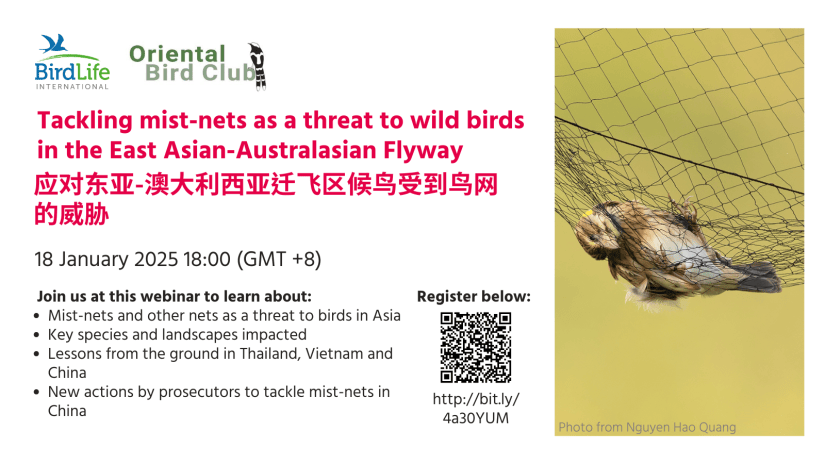
Next Saturday 18 January 2025 at 1800 China time (1000 UK, 1100 CET), BirdLife International and the Oriental Bird Club will host a special joint webinar about the use of mist nets in Asia.
Although precise figures are impossible to find, it is clear from the data available that millions of birds are trapped or killed in mist nets every year, most of them illegally. Controlling the production, sale and illegal use of mist nets would make a major contribution to helping to slow, stop and reverse biodiversity loss while strengthening law enforcement, all at a relatively low cost.
The webinar will include speakers and case studies from Vietnam, Thailand and China. Importantly, representatives from the Supreme People’s Procuratorate will join and present what they are doing to tackle this issue in China. This webinar will be the first time that China’s prosecutors participate in such an international platform and it is part of a major broader effort to tackle illegal poaching. See here for some background.
Anyone can join the webinar by scanning the QR code in the flyer (see header image) or by going to this URL: http://bit.ly/4a30YUM.
On Thursday 15 August 2024, to celebrate National Ecology Day, the New Zealand Ambassador in Beijing, Grahame Morton, hosted a ‘friends of the flyway’ event to celebrate the migratory shorebirds that connect New Zealand with Siberia and Alaska via China’s Yellow Sea.
Just last month, Yalu Jiang Estuary in Liaoning Province was inscribed as a World Heritage Site in recognition of its importance to migratory shorebirds, and the Deputy Mayor of Dandong, the city that administers these vital inter-tidal mudflats, participated in the NZ Embassy’s event alongside senior government officials from China’s Ministry of Ecology and Environment, senior diplomats from flyway countries and the Ambassadors for Nature initiative and international organisations such as the UN and Asian Development Bank.
It was an opportunity to celebrate the biodiversity that connects communities, cities, countries and even continents. The story of one particular shorebird – the Bar-tailed Godwit 斑尾塍鹬 Bān wěi chéng yù (Limosa lapponica baueri) is hard to comprehend. Each spring these birds, known as the “kuaka” by Maoris, set off from non-breeding grounds in New Zealand and head to China’s Yellow Sea, where they take a break and feed up on the rich inter-tidal mudflats, before the second part of their journey from China to Alaska to breed.
Incredibly, after breeding, these birds make a non-stop c11,000km flight from Alaska direct to New Zealand. Scientists used to think it was impossible for a bird of its size to make such a non-stop journey and when satellite tracking proved that was the case, they were baffled. Studies in Alaska revealed something remarkable. Before setting off, these birds are effectively an eating machine. They double their bodyweight to put on fat, the fuel for their journey. But even more remarkable is that, just before leaving, they shrink their digestive organs as they won’t need them for 7 days and 7 nights (excess weight) and their heart and pectoral muscles almost double in size to power their flight. They literally transform themselves from an eating machine to a flying machine. Then, on arrival after their 11,000km journey, they regenerate their digestive organs, their heart and pectoral muscles shrink back to normal size, transforming themselves back to an eating machine.
Migratory shorebirds are not only incredible athletes; they inspire us, they fill us with awe and connect people and places. Protecting them requires coordinated action on the breeding grounds, non-breeding grounds and all the places they need along the way. That is why, in the context of the global biodiversity crisis, the New Zealand Embassy should be congratulated for elevating biodiversity and, in particular migratory birds, as a pillar of their bilateral and multilateral relationships.
There are long-standing bilateral agreements between New Zealand and China on migratory shorebirds and, on Thursday evening, there was some discussion about the potential to build on that work to begin formal trilateral cooperation between New Zealand (non-breeding grounds), China (stopover sites) and the United States (breeding grounds) based on the Bar-tailed Godwit migration. Such cooperation could promote joint scientific projects through academic institutions, building international co-stewardship programs (e.g. including partnering with existing ranger programs), connecting schools and twinning towns and cities in the three countries.
More broadly, trialteral cooperation could support multiple objectives, including:
Demonstrating how international cooperation is vital to manage the risks of global
biodiversity loss and to implement the goals of the Kunming-Montreal Global Biodiversity Framework
Building bridges between countries, communities and local people across continents
that create the foundation for scientific, cultural and political cooperation
Setting a leadership example for other countries to follow
Elevating biodiversity and bio-cultural conservation to the level of leaders and attracting international media coverage
Congratulations to the New Zealand Ambassador for the successful event and, let’s hope the seeds of trilateral cooperation sowed at the event will flourish into groundbreaking NZ-China-US cooperation!
All photos courtesy of the New Zealand Embassy in Beijing.
As a birder and conservationist, there is nothing more disheartening than discovering illegal mist nets with entangled birds struggling for their lives. It’s something I have experienced many times in Beijing and, although the authorities will now respond quickly to reports of illegal poaching, at least in the capital, it is clear that the practice remains widespread.
In fact, it is estimated that hundreds of thousands, if not millions, of migratory birds are illegally killed or captured in China every year using mist nets. Some are trapped for ‘exotic’ food and some are taken for the cage bird trade. Many more thousands are killed as bycatch in nets set up to ‘protect’ crops, including shellfisheries and coastal fisheries.
Based on publicly available information about illegal hunting convictions involving birds from 2014 to 2020 (China Judgements Online [裁判文书网]), among 3,298 cases which specified the tools used, 1,795 (54%) involved mist nets. These cases were widely distributed, involving 230 prefectures (68% of 336 prefectures in China) with a high concentration in prefectures of eastern China’s provinces. The cases involved more than 1.6 million birds being killed, including some endangered species that have already been heavily impacted by illegal hunting, such as the Yellow-breasted Bunting (Emberiza aureola 黄胸鹀 Huáng xiōng wú), a species classified by the IUCN Red List as critically endangered (Kamp et al. 2015). And of course those cases that are discovered, reported and result in a conviction are likely to represent a tiny fraction of the total number of birds killed.
Last September, at the World Coastal Forum in Yancheng, Jiangsu Province, I was invited to participate in a panel discussion with prosecutors from China’s coastal provinces to discuss how prosecutors can play their part in protecting coastal wetlands. Towards the end of the session, I was asked what is the single biggest thing that prosecutors can do to help migratory birds. I had no hesitation in responding by saying “control the production and sale of mist nets”. I did not expect what happened next.
Participating in a panel discussion with Chinese prosecutors at the World Coastal Forum in Jiangsu Province, September 2023.
A few days after the World Coastal Forum, I was contacted and invited to submit a background note on mist nets, including some recommendations. With thanks to Dan Liang at Princeton University, who has studied the impact of mist nets at razor clam farms on migratory shorebirds (see this paper), and experts at BirdLife International, a short note was submitted to the prosecutors. Within a few weeks, we heard that the prosecutors were engaged and were exploring what could be done. Quickly, it was revealed that e-commerce platforms, such as Alibaba’s Taobao (similar to the online sales platform, Amazon, familiar to most in the West), had been told to add clear warnings to anyone looking to buy mist nets, that using them to trap wild birds was illegal.
A search for mist nets on Taobao now *should* return a strong message about the illegality of trapping wild birds and animals.
Then came news that the Chief Prosecutor’s office had circulated a note to all provincial prosecutors instructing them to take action to control the production, sale and use of mist nets.
At the end of 2023, the Chief Prosecutor’s office listed tackling mist nets as one of the priority issues in their annual summary and forward look to 2024 (in Chinese) and we have been told that more action will be forthcoming this year.
We understand that one of the actions they are examining is the setting of a standard for ‘anti-bird’ nets, in terms of the thickness of the cord and mesh size. Such a standard would ensure nets used to protect the legitimate interests of farmers would do so without being lethal to birds. And by banning the unlicensed production, public sale and use of nets that do not meet the standard, the supply and availability of nets used by poachers would be much reduced. This seems like a sensible approach.
The work by prosecutors, although still in its early stages, is a hugely welcome step and it is clear that the issue is now firmly on their agenda. As one of the legal officials said, controlling mist nets is a “low-hanging fruit” for prosecutors on biodiversity – it is relatively simple to enact and at low cost, with a huge benefit to wild birds. Controlling mist nets is also squarely in line with the goals of the new Kunming-Montreal Global Biodiversity Framework, agreed by more than 190 countries under China’s presidency of the UN Convention on Biological Diversity.
I am almost daring to dream that, one day, the scourge of mist nets used to trap wild birds will be consigned to history in China.
Header image: an illegal mist net, with a caged Yellow-breasted Bunting used to attract birds towards the nets, in coastal Hebei Province (Terry Townshend)
Although the week at Tiaozini involved a packed schedule, I did manage to steal away for an hour to the mudflats for the incoming tide. Watching a flock of Great Knot with Eurasian Curlew, Oystercatcher and Saunders’s Gulls overhead as the sun dropped behind me was a memorable experience. I attempted to capture at least some of the magic by recording a soundscape. Put on your headphones and transport yourself to the Yellow Sea coast!
Anyone who has worked in China will know that the bureaucracy can be stifling. At a minimum it can lead to serious time delays to even the most straightforward tasks. At its worst, it can prevent action altogether. Part of the problem, on the environment at least, is that the responsibilities for various environmental issues have been fragmented across many different government departments.
One official remarked that it used to take 12 official stamps from different government authorities to enable a decision to be taken about policies related to pilot National Parks. And often these multiple authorisations are handled in series, which can seem to take forever.
All that is set to change thanks to a sweeping reform of environmental governance that was proposed by the State Council (China’s Cabinet) and endorsed by the National People’s Congress (the country’s parliament) in March 2018.
Here are the key points you need to know:
On 17 March 2018, the National People’s Congress of China approved a State Council proposal to reorganise the way the environment is governed
Two new ‘super-ministries’ were created to consolidate the management of environmental issues – the Ministry of Natural Resources (MNR) and the Ministry of Ecology and Environment (MEE)
The Ministry of Natural Resources (MNR) will be the ‘owner’ of China’s natural resources; it will replace the Ministry of Land & Resources, State Oceanic Administration (SOA) and the national surveying and mapping bureau, and will gain authority over urban and township planning, as well as management of water, grasslands, forests, wetlands, and maritime resources;
The new Ministry of Ecology and Environment (MEE) will take on responsibility for the old Ministry of Environmental Protection’s portfolio as well as climate change and greenhouse emissions policies, which were previously under the National Development and Reform Commission, and anti-pollution tasks, previously the responsibility of the ministries of land and of water resources.
The reforms also expand the remit of the State Forestry Administration by creating a State Administration for Forestry and Grassland (SAFG), reporting to the MNR. As well as taking on the responsibilities of the old State Forestry Administration, the SAFG will gain some responsibilities that belonged to six former government departments, including management work on nature reserves, scenic spots and geological parks
The main responsibilities of the new SAFG will be overseeing and managing the development and protection of forests, grasslands, wetlands, deserts and wildlife, as well as organizing ecological protection and restoration, afforestation and the management of national parks.
In the process of reform, some existing government departments, such as the State Oceanic Administration, will be disbanded, while others, such as the Ministry of Water Resources will see their mandate reduced
A major positive is that the management of all protected areas will now be in one organisation (State Administration for Forestry and Grassland) with monitoring and evaluation by the MNR. This should help to streamline decision-making and reduce the risk of cross-departmental in-fighting.
The reorganisation is the fourth time in three decades that China’s environmental agency (currently the Ministry of Environmental Protection) will see its remit expanded in a new department, highlighting the growing priority of the environment in Chinese policy-making.
The changes are seen as a step forward towards implementing the much-quoted concept of “ecological civilisation”; the 2015 Master Plan for ecological civilisation argued that “natural resources should be properly valued,” and “holistically managed”. It also stipulated that economic activities should not result in ecological burdens that exceed the capacity of the environment to manage. Under the Master Plan, the institutional processes to deliver “ecological civilisation” were due to be in place by 2020 and it seems this reform puts the Chinese government on track.
From conversations here with officials and academics it appears that there is overwhelming support for the changes and an expectation it will lead to better, more enlightened and faster policymaking on the environment. A good early test of the new arrangements will be the anticipated publication of the revised list of specially protected species under the Environment Protection Law. Despite years of review, agreement has not yet been reached among the different responsible departments. Now, any (former cross-departmental) disagreements should be much easier to resolve. As always, the proof is in the pudding, so we’ll be watching closely to see how the new arrangements work in practice.
This summary was compiled from discussions with officials and academics, media articles and from resources provided by China Dialogue.
Zhu Bingrun (Drew) is one of a new generation of brilliant Chinese ornithologists. These young scientists are adding a great deal to our knowledge about migratory birds in China, keen to collaborate with international experts and part of a growing network of young people in this vast country who want to study, and protect, wild birds.
Zhu Bingrun, at home on the mudflats at Nanpu, coastal Hebei Province.
I first met Drew when we worked together on the 2013 survey of Jankowski’s Bunting in Inner Mongolia. Since then he has been working on his PhD in the Bohai Bay, focusing on the BLACK-TAILED GODWIT. As well as painstaking observations, Drew’s research has involved fitting satellite tags to learn more about the migration, breeding grounds and the most important stopover sites where these godwits rest and refuel. This information is vital to inform conservation efforts.
This year, Drew has spent all spring at Nanpu in coastal Hebei Province, studying the Black-tailed Godwits. One part of Drew’s studies was to catch, measure and fit rings to several Black-tailed Godwits to help gain data not available from viewing alone. Not surprisingly, they are difficult to catch. After much effort, and many attempts, three godwits were caught and tagged by Drew this spring. Resting on the shoulders of these three birds were not only satellite tags but also Drew’s hopes of finding out where they bred and the routes they took to reach the breeding sites.
On 1 May 2016 Drew captured and banded a single male Black-tailed Godwit. The usual metal ring was supplemented with colour flags (blue over yellow) with the individual engraving “H03” which would enable scientists and birders to identify this individual in the field. The bird was also fitted with a GPS transmitter, allowing Drew to monitor its location on a near real-time basis and potentially showing, for the first time, the migration route and breeding grounds.
Drew’s “H03” Black-tailed Godwit shortly after being fitted with its colour rings, 1 May 2016.Another view of “H03” in Nanpu, 1 May 2016.
After tagging, the bird was released and the satellite data showed that, just like hundreds of thousands of other shorebirds, it spent the next two weeks feeding up in the Nanpu area, preparing for its northward migration. On 17 May it began its journey north. On 18 May the last signal was received, on the border of Inner Mongolia. Three days later, on 21 May, two photos were uploaded to Facebook showing a Black-tailed Godwit with blue and yellow flags and a satellite transmitter. The bird had been shot, killed and proudly shown off by a hunter in Sakha, Russia.
This hunter published photo of himself with “H03”, a Black-tailed Godwit satellite-tagged in China by Drew. Copyright Facebook. Another image of H03 showing the satellite tag and colour rings. Copyright Facebook.
Not surprisingly, Drew was devastated when Russian researcher, Inga Bystykatova, alerted him to the photos. “H03”, one of only three birds tagged this Spring, was gunned down for sport almost as soon as it left China.
Recently, much has been written about the threats faced by shorebirds along the East Asian Australasian Flyway (EAAF), most of which has rightly focused on habitat loss in the Yellow Sea ecoregion. At least one-fifth of the waterbird populations of the EAAF are threatened, the highest proportion among the global flyways. The most endangered, and most well-known, is the Spoon-billed Sandpiper but this species is far from alone. In the last decade 12 species of shorebird have been moved onto the lists of global conservation concern, and strong declines are suspected in others in the region. In past 50 years, 51% of intertidal habitat in China has been converted to urban, industrial and agricultural land. The remaining areas are affected by numerous on-going and planned land conversion projects. The conversion of an estimated 578,000 hectares of coastal wetlands has recently been approved. On the positive side, there is a huge conservation effort, involving the East Asian Australasian Flyway Partnership, BirdLife International and many others, focused on trying to protect the remaining areas of intertidal mudflats and there are signs that this effort is making progress.
However, there are other threats. And what is much less well-known is the scale of hunting in Russia. There are apparently 2 million hunters in Russia. There is a tradition of hunting Whimbrel – they taste good and hunting this species is a special focus of hunters on coastal spits, particularly in autumn. However, hunters don’t just stick to Whimbrel and often other shorebirds, such as sandpipers, curlews and godwits, are taken when they have the opportunity, even though some of these species are officially protected. Enforcement of the law in remote eastern Siberia is almost non-existent.
When I asked Drew about this, his reply was honest, thoughtful and hard-hitting:
“China takes the blame for a long time for the population decline of migratory birds. That is fine – we have a problem and we are changing. But conservation of migratory birds is never a single country’s duty. As the major breeding ground, Russia keeps a very low profile but slaughters God knows how many birds each year.”
It is clear that there is an urgent need, in parallel to the efforts to save the remaining habitat along the Yellow Sea ecoregion, for more awareness and more constructive communication with hunters in Russia. It is, of course, impossible to stop hunting of wild birds altogether, at least in the short term. However, with better communication, it should be possible to ensure the hunters are aware of those species that are endangered and to encourage restraint when these species are encountered.
As Drew says, protecting migratory birds along the East Asian Australasian Flyway is the responsibility of all nations in the region, from New Zealand and Australia in the south to southeast Asia, China and Russia. It is only by protecting birds on the wintering grounds, the breeding grounds and the key stopover sites that the health and viability of the East Asian Australasian Flyway will be maintained.
As for “H03”, contact with the hunter in Russia has been established and he has agreed to send back the bird, complete with transmitter, to Drew. Let’s hope “H03” did not die in vain and that he is the catalyst for a new conservation effort focusing on dialogue with hunters in Russia.
On Saturday I joined leading China expert, Paul Holt, and visiting Chris Gooddie (of “The Jewel Hunter” fame) for a visit to Yeyahu Nature Reserve. We were hoping to see some late migrants – birds such as Pallas’s Grasshopper Warbler – and of course had in the back of our minds the chance of seeing the rare Streaked Reed Warbler, a possible of which I saw on Thursday at the same site.
After a 4am start and a predictably tortuous journey over the mountains past Badaling Great Wall (this route is notorious for breaking down lorries!), we arrived at the site by around 0615. After seeing Two-barred Greenish Warbler, Yellow-throated Bunting and Chinese Pond Heron along the entrance track, we took the boardwalk through the reedbed. The first stretch produced a high density of singing Oriental (Great) Reed Warblers along with a few Black-browed Reed Warblers, Pallas’s Grasshopper Warblers (most of which were picked up by Paul on call or a brief burst of song), a calling Yellow Bittern, a few Zitting Cisticolas and several Purple Herons (breeding in the reedbed in the south-west corner of the lake). But the highlight was undoubtedly the Siberian Bush WarblerBradypterus davidi (a split from Spotted Bush Warbler Bradypterus thoracicus) that was expertly identified by Paul after a very brief burst of song… I have to say I would have almost certainly walked straight past it and, if I had heard it, I would probably have passed it off as an insect! After a bit of patience and ‘pishing’, this bird showed well at very close range, albeit briefly… A very difficult bird to see and a scarce, albeit regular, migrant in the Beijing area (almost certainly overlooked due to its extreme skulky nature). This experience reinforced to me the need to get learning all of the calls and songs of some of the more irregular and difficult to see birds in the Beijing area. Unless one is familiar with the calls, identifying and seeing many of these “difficult enough at the best of times” birds becomes almost impossible.
The walk along the grove of trees alongside the lake produced a good variety of phylloscopus warblers including Arctic, Two-barred Greenish, Pallas’s, Dusky and Radde’s plus a female Siberian Blue Robin, Asian Brown Flycatcher, Black-faced Bunting, a pair of Chinese Hill Warblers and a pair of nest-building Chinese Penduline Tits. On our second circuit we paused at a gap in the trees to scan the area of reedbeds and scrub to the north. After watching a pair of Eastern Marsh Harriers, a handful of Amur Falcons, displaying Richard’s Pipits, Siberian Stonechat, Hobby and Kestrel, the surprise of the day emerged, in the form of a Short-toed Eagle that appeared from nowhere and dropped into a field a few hundred metres away.. Short-toed Eagle is a pretty rare bird in northern China, although records from recent years suggest that it is probably a scarce passage migrant with multiple annual records in Spring and, particularly, Autumn.
With the visibility shockingly poor (due to the air pollution mist), our chances of seeing more large raptors were pretty low, so we decided to make a brief visit to Ma Chang to check the reservoir before heading back to Beijing. Ma Chang was a bit of a disappointment, largely due to the heavy disturbance involving cars, motorised buggies, horses, even coaches, driving all over the area adjacent to the reservoir… We did see a few Common Terns, Night Herons, Black-headed Gulls, the local Black-winged Stilts and a few Asian Short-toed Larks but there was little else on offer, so we knocked it on the head and headed back. On the journey back, Chris regaled us with tales of various leech encounters during his Pitta quest.. the one that took the biscuit had to be the case of the leech on the eyeball (thankfully for him, not his!)… OMG.
A very good day out and it’s always a pleasure to go birding with people as knowledgeable as Paul and Chris – I learned a lot. Thanks guys!
You can see a short video of Chris tracking the Bush Warbler here… The Bush Warbler’s call is very difficult to make out on the video (an up-slurred raspy sound), so you can hear a much clearer one on Xeno-Canto.
I am always one for a new trend… and in the world of birding blogs there has been a recent move towards ‘multi-author blogs’ to pool effort, keep content fresh and provide more regular posts (because, let’s face it, we can’t all go out birding every day!). In that spirit, I thought it might be fun to pull together a few birders scattered across this vast country in which I currently reside to write some ‘guest posts’ for the Birding Beijing blog. All of those I have approached have responded enthusiastically (phew) and later today sees the publication of the first guest post from John Holmes, based in Hong Kong. Having read it already (the advantage of being the publisher), I know you will enjoy it!