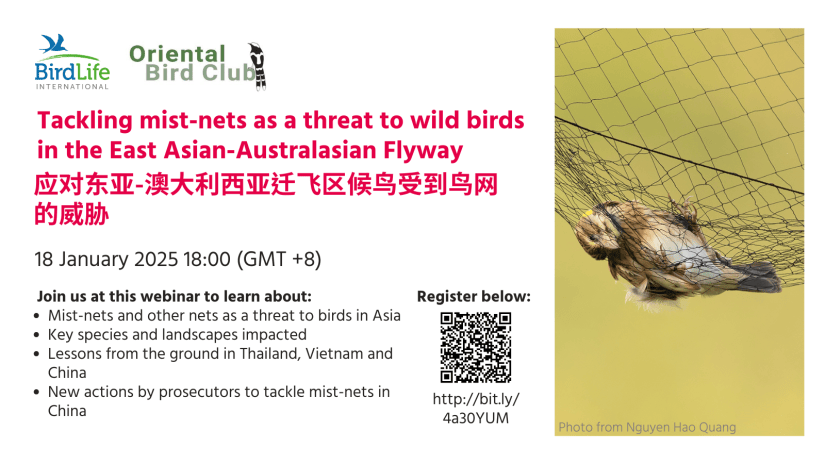
With huge gratitude to the speakers from China, Thailand and Vietnam, including the Supreme People’s Procuratorate, there is now a short summary of the special webinar on mist nets in Asia on the Oriental Bird Club website.
In addition to the speakers, the organisers would like to thank the 130 people who joined online from around the world and the interpreters who kindly provided simultaneous English and Mandarin translation.
A snippet of the summary is below. For the full article, please see this link.
“The webinar heard case studies from south and north Vietnam (Trang Nguyen from WildAct Vietnam and Nguyen Hoai Bao of WildTour and BirdLife International), Thailand (Rongrong Angkaew of King Mongkut’s University of Technology Thonburi) and China (Dan Liang of Princeton University). The case studies brought home the scale of illegal mist-net use in Asia for poaching and crop protection and some of the pioneering work to engage with authorities and local communities to try to reduce bird mortality, especially in wetlands and production landscapes in the region.
Representatives from the Supreme People’s Procuratorate of China – Deputy Director General Qiu Jinghui and Prosecutors Mou Qi and Ding Shu – then gave short presentations on the action being taken in China to tackle this issue. Deputy General Qiu revealed that addressing illegal mist-net use was now a high priority for the Supreme People’s Procuratorate who are focusing on “preventative, systematic and co-ordinated protection of wild birds.” The prosecutors had engaged with e-commerce platforms where mist-nets are cheaply and easily available to flag to anyone searching for mist-nets that their use to catch or kill wild birds is illegal. The national level prosecutors had also instructed provincial level prosecutors to prioritise the control of mist-nets. Case studies were presented in which local officials, after finding wild birds were being killed using mist-nets, had engaged with local communities to raise awareness of the law relating to wild bird protection and to explore alternative crop protection methods that do not involve the killing of wild birds. In 2025 research will take place into identifying a standard for anti-bird nets that protect crops but are more visible to birds, for example nets with a thick cord, and controlling the production and public sale of nets with a thinner cord. The prosecutors also noted that some of the mist-nets being used in Thailand and Vietnam had been imported from China and they will explore the potential to restrict their export from China.”
The organisers and speakers agreed to continue this discussion and there will be a meeting shortly after the Spring Festival to discuss next steps.
Thanks again to everyone involved for making the webinar possible and for shining a light on this important issue. For those that missed the webinar, it is expected that the case study presentations will soon be available via the Oriental Bird Club website. Links will be provided as soon as they are live.
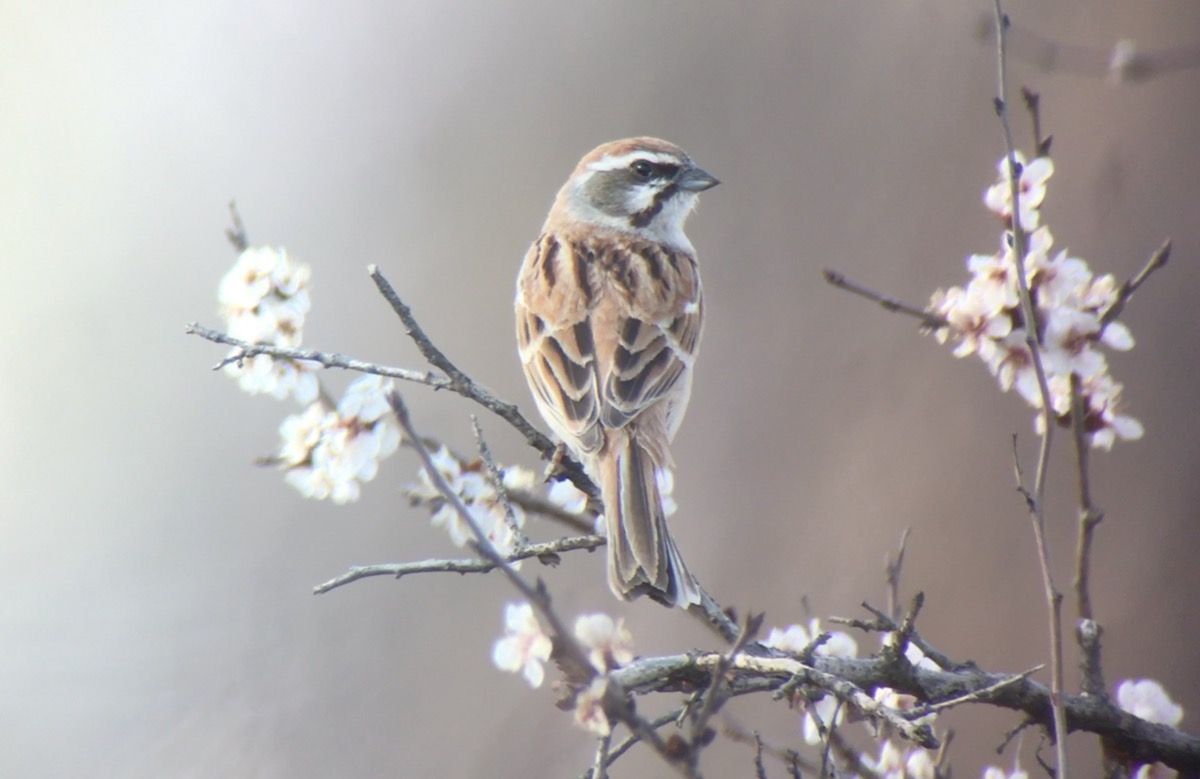
Title image: a caged Yellow-breasted Bunting positioned as a lure adjacent to an illegally set mist net in Hebei Province (photo by Terry Townshend)