Tag: yeyahu

  • The Beijing Cuckoo Project: Class of 2017

    The Beijing Cuckoo Project: Class of 2017

    It’s been an eventful ten days for the Beijing Cuckoo Project Team.  After the elation of Flappy’s and Meng’s return to the breeding grounds, following monumental journeys of 32,000 and 26,000km respectively, there was little time to take a breath before beginning phase two of the Beijing Cuckoo Project.  The plan for this year was based on two aims.  First, to increase the sample of tagged cuckoos from Beijing and NE China to strengthen the dataset which would enable scientists to make more informed conclusions about the migration of cuckoos from East Asia.  And second, to build on the public engagement to reach more people in China and overseas about the wonders of bird migration.

    It’s fair to say that this year has been challenging.  Over the last ten days or so the Beijing Cuckoo Team has been valiantly navigating all manner of unfortunate incidents including Chinese visa issues, the British Airways IT shutdown, a major forest fire in Inner Mongolia (where we had hoped to tag some of the larger ‘canorus‘ cuckoos) and a hospital visit for one team member, Dick Newell (thankfully, not serious)..

    Dick Newell being sewn up at the local hospital in Yanqing after cutting his head on a low doorway.

    Despite this, three Common Cuckoos (two females and one male) were fitted with tags at Yeyahu in Beijing.  They are all of the bakeri subspecies and all were fitted with the tiny new 2g tags from Microwave Telemetry.

    The Beijing birds have been given names and are already famous..

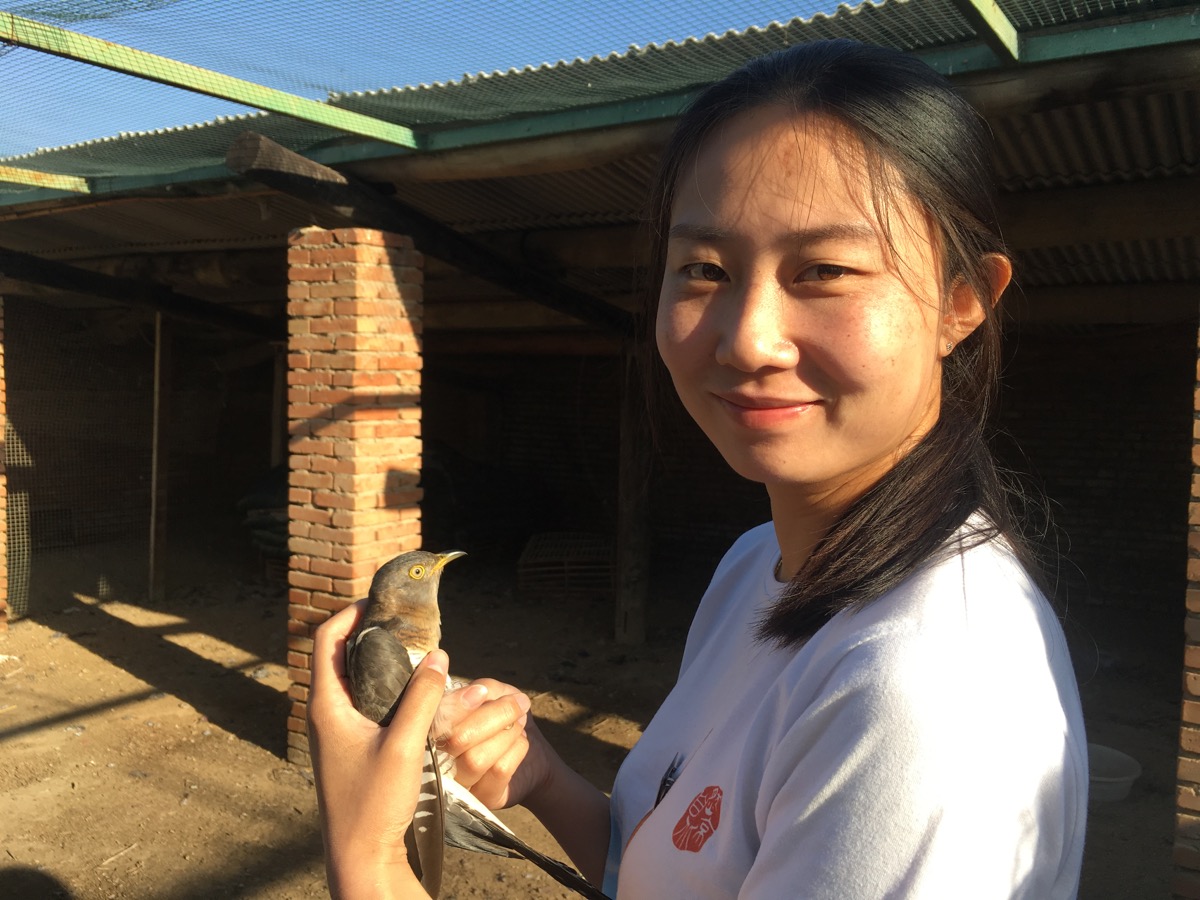
    The first, a female, was named by the students from the International School of Beijing (ISB). Three students from ISB, along with two teachers, came to Yeyahu and witnessed the setting up of the nets, the capture, tagging and release of the bird.  After a vote at school last week involving the whole year, the bird has been named 玉琳 (Yu-Lin). This means “precious jade in the forest”.

    玉琳 (YuLin), a female, was the first Beijing Cuckoo to be fitted with a tag in 2017.
    Students from ISB helped put up the nets ahead of the catching operation

    The release of Yu-Lin was filmed by Chinese national television (CCTV) as part of a documentary on Beijing’s wildlife. The CCTV crew also managed to secure some fantastic footage of 梦之鹃 (Meng Zhi Juan) calling close by..!

    The documentary will be shown on national television later this year and we’ll publish a link as soon as the programme is available online.

    The second cuckoo, a male, was named by staff at Yeyahu Wetland Reserve. The name given is 小松 (XiaoSong) which means “small pine tree”.

    小松 (XiaoSong), a male, was named by staff at Yeyahu Wetland Reserve.
    Yeyahu Wetland Reserve is a wonderful setting. When here, it’s hard to believe one is in Beijing.

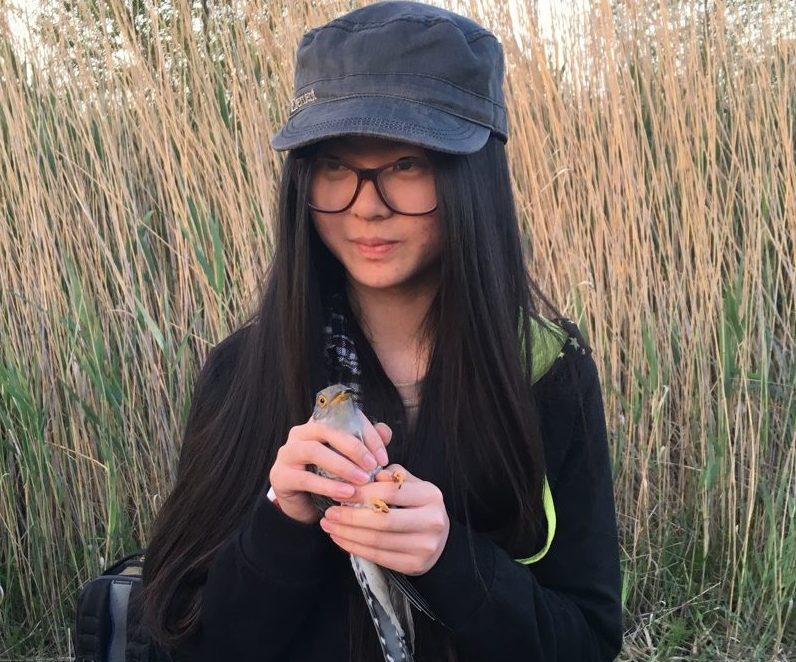
    The third cuckoo, another female, was named by the Beijing Wildlife Rescue and Rehabilitation Centre after an online public vote. After thousands of votes from members of the public, the name chosen was 六月 (LiuYue) meaning “June”.

    六月 (LiuYue), the third Beijing Cuckoo to be fitted with a tag in 2017.

    Of course, being at Yeyahu, we were all hoping to catch a glimpse of 梦之鹃 (Meng Zhi Juan), one of the Beijing Cuckoos fitted with a tag in 2016.  After his marathon journey of more than 26,000km to Mozambique and back, Meng was photographed at Yeyahu on 20 May.  And, on 31st May, as we were catching the first Beijing Cuckoos of 2017, we were treated to several close encounters, including a magnificent fly-by just metres away in front of the students and teachers from ISB.

    A wonderful moment: teacher Wayne Winkelman and students from ISB watch as Meng flies by.. Photo by Allison Wise.

    It was wonderful to see and hear so many Cuckoos on the reserve and Meng looked fit and healthy as he interacted aggressively with other males and chased females in all directions.

    Each of the three members of the Class of 2017 has its own webpage and their journeys will be added to the map on the dedicated Beijing Cuckoo Project webpage.

    What will the next 12 months bring?  One thing is for sure – they will entertain, educate, surprise and inspire us…

    Huge thanks to my fellow Beijing Cuckoo Project Team members, including Chris Hewson, Dick Newell, Lyndon Kearsley, Wu Lan and Robert and Robin Jolliffe.   The Beijing Cuckoo Project Team is extremely grateful to all the staff at Yeyahu Nature Reserve and the Beijing Wildlife Rescue and Rehabilitation Centre, especially Shi Yang, Wu Mengwei, Aodan Zhula, Zhang Yaqiong and Wang Bojun for their fantastic support and wonderful hospitality.

    2017-06-01 Chris local transport
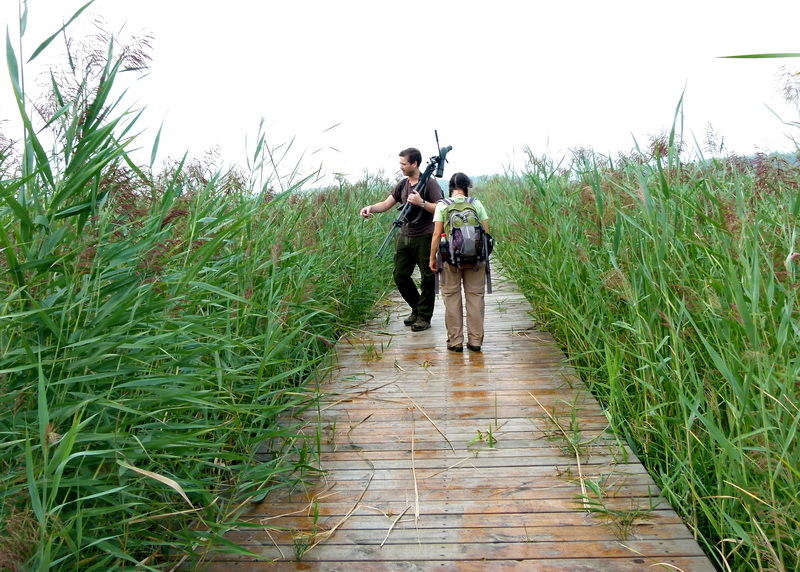
    The BTO’s Chris Hewson enjoying the local transport.


  • The Famous Five: The Beijing Cuckoo Project Off To A Flyer!

    The Famous Five: The Beijing Cuckoo Project Off To A Flyer!

    I have just spent a week ‘in the field’ with “Team Cuckoo” and I am elated.  After five days of exhausting 0300 starts, we’ve fitted satellite tags to a total of five Beijing Cuckoos, two females and three males, caught at three different sites – Cuihu, Hanshiqiao and Yeyahu Nature Reserve.  All tags appear to be transmitting normally and we hope, very soon, to be able to receive data about their locations.  All being well, in a few months we will know, for the first time, the location of the wintering grounds of Beijing Cuckoos and the route they take to get there.  Exciting indeed!

    2016-05-24 Fitting tag to 1st cuckoo, Cuihu
    Chris Hewson and Lyndon Kearsley demonstrating how to fit a satellite tag to the first cuckoo at Cuihu
    Tagged Cuckoo 1, Cuihu, 24 May 2016 close up
    Cuckoo 1 (female) tagged at Cuihu
    Tagged Cuckoo 2, Hanshiqiao, 25 May 2016 close up
    Cuckoo 2 (male) tagged at Hanshiqiao.
    Tagged Cuckoo 3, Yeyahu, 26 May 2016 close up
    Cuckoo 3 (male) tagged at Yeyahu
    Tagged Cuckoo 4, Yeyahu, 26 May 2016 close up
    Cuckoo 4 (male) tagged at Yeyahu
    Tagged Cuckoo 5, Yeyahu, 26 May 2016 close up
    Cuckoo 5 (female) tagged at Yeyahu

    Here is a short video giving a flavour of the last few days..

    Next week we will begin the naming process with local schools who will follow the cuckoos’ progress and learn about their migration and habitat requirements as part of a special environmental curriculum.

    Very soon we’ll have a website up and running that will enable the public to follow their progress, too.  Watch this space!  In the meantime, I have set up a dedicated page on the Birding Beijing website where regular updates will be posted in English.  See here.

    The project is a partnership between the Beijing Wildlife Rescue and Rehabilitation Centre (BWRRC), the China Birdwatching Society (CBWS), the British Trust for Ornithology (BTO) and Birding Beijing and kindly supported by the Zoological Society of London, the Oriental Bird Club and the British Birds Charitable Foundation.

    It’s a project that has everything – scientific discovery, public engagement, enthusing young people, collaboration between organisations in China and Europe and cultural exchange.  I am hugely grateful to Chris Hewson from the BTO for travelling to Beijing to share his expertise and oversee the catching operation.  He is a superb ambassador for the BTO and for UK science in China.

    Chris Hewson (BTO) and Shi Yang (BWRRC) sign agreement to cooperate with the Beijing Cuckoo Project, share the data and work on joint scientific papers.
    Chris Hewson (BTO) and Shi Yang (BWRRC) sign an agreement at Beijing airport to cooperate with the Beijing Cuckoo Project, share the data and work on joint scientific papers.

    We still need to raise funds to pay for the “satellite services” that will enable us to receive the data…  A dedicated JustGiving page has been set up to receive any donations.  All contributions, no matter how big or small, are very welcome!

  • STOP PRESS: Spoon-billed Sandpiper in Beijing!

    Some stunning news has just reached me of a juvenile SPOON-BILLED SANDPIPER that was photographed at Yeyahu, Beijing, on 31 August by Zhang Minhao, a junior high school student.  Big thanks to Huang Hanchen and Guan Xiangyu for the heads-up.  Here is the photo:

    Juvenile SPOON-BILLED SANDPIPER, Ma Chang, Yeyahu, Beijing, 31 August 2014.  Photo by Zhang Minhao.
    Juvenile SPOON-BILLED SANDPIPER, Ma Chang, Yeyahu, Beijing, 31 August 2014. Photo by Zhang Minhao.

    And here is Zhang Minhao’s personal account:

    A Brief Account for the Record of a Juvenile Spoonbill Sandpiper in Beijing
    by Zhang Minhao, October 16, 2014.

    “The Spoon-billed Sandpiper was photographed at Machang, Yeyahu, Yanqing County, Beijing, on August 31, 2014.

    At around 09:45am on 31 August 2014 I was observing Red-necked Stints, Long-toed Stints, and Long-billed Plovers near a large area of water on the edge of Guanting Reservoir.  This area is known as Ma Chang, Wild Duck Lake.  In order to avoid missing the distant shorebirds, I checked the areas where the Red-necked Stints were located by looking through my camera, and took pictures of the birds I could see.

    When reviewing my photographs I recognised something distinctive, a juvenile Spoon-billed Sandpiper. The time of the photograph was 09:49am.

    The single Spoon-billed Sandpiper foraged and preened alone, without mixing with other species. And there were no other Spoon-billed Sandpipers around it.  About 3 minutes later 3 Red-necked Stints flew to its vicinity causing the Spoon-billed Sandpiper to fly and it alighted further away on the mudflat. But when I got there the Spoon-billed Sandpiper was not to be seen and it was never seen again.”

    (Thanks to Guan Xiangyu for contacting Zhang Minhao about this account and to Huang Hanchen for the translation).

    There are several brilliant things about this record.  First, it’s a SPOON-BILLED SANDPIPER, one of the world’s most endangered birds (see here to read about just how few remain and for details of the international effort to try to save this species).  Second, it’s of a juvenile, one of very few sightings of a Spoon-billed Sandpiper of this age in the world, giving hope to the conservation effort.  Third, it was found in Beijing, one of the world’s major capital cities, more than 150km from the coast.  And finally, the finder was a young Chinese birder.

    It’s a truly remarkable record. And I hope this sighting by Zhang Minhao inspires other young people in Beijing and beyond to take up birding and to become part of an ever-louder voice to help conserve the amazing biodiversity with which China is blessed.

    Well done Zhang Minhao!

  • First for Beijing: White Wagtail ssp personata

    On Saturday I visited Wild Duck Lake (Ma Chang and Yeyahu) with Jesper Hornskov, Hui Ying (James) and his friend ‘Leila’.  We enjoyed another fantastic spring day and recorded some excellent species including 31 Oriental Plovers, single Short-toed and Greater Spotted Eagles and some spectacular views of Baikal Teal.  But the star of the show for me was a White Wagtail of the subspecies ‘personata‘ which spent some time around the yurts to the west of Ma Chang.  As far as I am aware, this is the first record of this subspecies in Beijing and, indeed, anywhere in north-east China.  According to Alstrom and Mild (authors of “Pipits and Wagtails”) the ‘personata’ subspecies breeds in Central Asia from the Russian Altay, Kuznetsk Ala Tau and Western Sayan Mountains, southwest through east &  south Kazakhstan, the Tian Shan Mountains, west Mongolia, northwest and western Xinjiang, parts of northwest Kashmir, north Pakistan, Afghanistan, northern Iran, Turkmenistan and Uzbekistan. It is a rare vagrant to Cyprus, Egypt, Israel, Bahrain, N Burma & Hong Kong.

    White Wagtail ssp personata. The first record of this subspecies in Beijing.

    The subspecies of White Wagtail we usually see in Beijing are ‘leucopsis‘ and ‘ocularis‘.  Some recent images of males of these subspecies are below for comparison.

    White Wagtail ssp leucopsis (adult male), Beijing, 15 April 2012. Note black back and nape and ‘clean’ white face.
    White Wagtail ssp ocularis (adult male), Beijing, 15 April 2012. Note grey back, black nape and black eyestripe on white face.

    As well as the wagtail there were plenty of other birds to enjoy all day: the flocks of Greater Short-toed Larks, the small party of Relict Gulls, the Oriental Plovers (which unfortunately flew off strongly north before we saw them on the ground), the fantastic late afternoon display of Baikal Teal (easily my best ever views), the first Oriental Pratincoles of the year,  displaying Eastern Marsh Harriers, the newly arrived Chinese Penduline Tits, the list goes on.  Fantastic birding….

    Eastern Marsh Harrier (male), Yeyahu, 14 April 2012
    Eastern Marsh Harrier (male), Yeyahu, 14 April 2012
    Eastern Marsh Harrier (male), Yeyahu, 14 April 2012
    Oriental Pratincole, Ma Chang, 14 April 2012
    Baikal Teal, Yeyahu. We enjoyed spectacular views of this special duck in the later afternoon sun as they were repeatedly spooked by the patrolling Eastern Marsh Harriers.
    Eurasian Spoonbills, Ma Chang, 14 April 2012

    A big thanks to Hui Ying, Leila and Jesper for their company – a thoroughly enjoyable day!

    Hui Ying (James) and Leila at the viewing tower, Yeyahu.
    Leila checking out an Eastern Marsh Harrier, Yeyahu, 14 April 2012

    Full species list (courtesy of Jesper):

    Common Pheasant  Phasanius colchicus  – nine

    Swan Goose  Anser cygnoides  – two

    Bewick’s Swan  Cygnus columbianus  – nine

    Ruddy Shelduck  Tadorna ferruginea  – 63

    Gadwall  Anas strepera  – 200

    Falcated Duck  Anas falcate  – 70

    Eurasian Wigeon  Anas Penelope  – three

    Mallard  Anas platyrhynchos  – 100+

    Chinese Spotbill  Anas zonorhyncha  – 13+ 

    Northern Shoveler  Anas clypeata  – six

    Garganey  Anas querquedula  – one male

    Baikal Teal  Anas Formosa  – 85+ (at most 100)

    Common Teal  Anas crecca  – 20

    Red-crested Pochard  Netta rufina  – one pair

    Common Pochard  Aythya ferina  – five

    Ferruginous Duck  Aythya nyroca  – two in flight over River at YYH

    Tufted Duck  Aythya fuligula  – four

    Common Goldeneye  Bucephala clangula  – three

    Smew  Mergellus albellus  – 11+

    Goosander  Mergus merganser  – six

    Little Grebe  Tachybaptus ruficollis  – 20+

    Great Crested Grebe  Podiceps cristatus  – 38+

    Eurasian Spoonbill  Platalea leucorodia  – seven (one strictly speaking a Spoonbill sp, heading off W     determinedly over the the main body of water, and six migr right by us)

    Eurasian Bittern  Botaurus stellaris  – 4+

    Grey Heron  Ardea cinerea  – one

    Purple Heron  Ardea purpurea  – three

    Great Egret   Ardea alba  – two

    Great Cormorant  Phalacrocorax carbo  – three

    Common Kestrel  Falco tinnunculus  – three (incl two on ground in newly ploughed ‘field’)

    Osprey  Pandion haliaetus  – one at Machang (& possibly the same again at YYH, carrying a freshly     caught fish & mobbed by two 2nd c-y mongolicus)

    Black Kite  Milvus migrans lineatus  – two

    Short-toed Eagle  Circaetus gallicus  – one ‘soared up, turned to hover a couple of times, then ->N 15h01

    Eastern Marsh Harrier  Circus spilonotus  – 11+

    Eurasian Sparrowhawk  Accipiter nisus  – three

    Common Buzzard  Buteo buteo japonicus  – 7+ (incl at least one not migr)

    Greater Spotted Eagle  Aquila clanga  – one 3rd+ c-y migr at 11h30

    ***Eagle sp   – one ‘coming down’ 17h15 at YYH (probably Greater Spotted, but Eastern Imp ‘not eliminated’)

    Common Coot  Fulica atra  – 90

    Black-winged Stilt  Himantopus himantopus  – 40+

    Northern Lapwing  Vanellus vanellus – 35+

    Little Ringed Plover  Charadrius dubius  – c10

    Kentish Plover  Charadrius alexandrinus  – 35+

    Oriental Plover  Charadrius veredus  – 31 flew off (of their own volition!) before we found them on the     ground but decent views in flight as they passed @ overhead after a few turns orientating.

    Temminck’s Stint  Calidris temminckii  – three

    Oriental Pratincole  Glareola maldivarum  – four

    ‘Yellow-legged’ Gull  Larus (cachinnans) mongolicus – eight (single adult & 3rd c-y, and six 2nd c-y)

    Common Black-headed Gull  Larus ridibundus  – 170+

    Relict Gull  Larus relictus  – c5 on main body of water ‘disappeared’

    Oriental Turtle Dove  Streptopelia orientalis  – one

    Eurasian Collared Dove  Streptopelia decaocto  – 6+

    Common Kingfisher  Alcedo atthis  – six

    Hoopoe  Upupa epops  – one

    Great Spotted Woodpecker  Dendrocopos major  – two

    Grey-headed Woodpecker  Picus canus  – one

    Azure-winged Magpie  Cyanopica cyanus  – ten

    Common Magpie  Pica pica  – too many

    Carrion Crow  Corvus corone  – one

    Large-billed Crow  Corvus macrorhynchos  – one

    Eastern Great Tit  Parus minor  – one

    Marsh Tit  Parus palustris  – one w/ nest material at YYH

    Chinese Penduline Tit  Remiz (pendulinus) consobrinus  – ten

    Sand Martin  Riparia riparia  – one at YYH

    Barn Swallow  Hirundo rustica  – 20

    Greater Short-toed Lark  Calandrella brachydactyla  – 230+

    Asian Short-toed Lark  Calandrella cheleensis  – eight

    Eurasian Skylark  Alauda arvensis  – ten

    Fan-tailed Warbler  Cisticola juncidis  – one heard

    Chinese Hill Warbler  Rhopophilus pekinensis  – three at YYH

    Vinous-throated Parrotbill  Paradoxornis webbianus  – 30+

    White-cheeked Starling  Sturnus cineraceus  – 15

    Black-throated Thrush  Turdus atrogularis  – one female-type ‘scoped

    Red-throated Thrush  Turdus ruficollis  – 2+ (‘scope views of a yawning, confiding bird)

    Naumann’s Thrush  Turdus naumanni   – 4+ en route S of Badaling

    Daurian Redstart  Phoenicurus auroreus  – four

    Eurasian Tree Sparrow  Passer montanus  – lots

    Citrine Wagtail  Motacilla citreola  – one male

    White Wagtail  Motacilla alba  – 10+ (incl 2+ ocularis, three baicalensis & one personata – last of     particular interest*: seen repeatedly on ground at Yurts & photographed)

    Buff-bellied Pipit  Anthus rubescens japonicus  – 22+

    Water Pipit  Anthus spinoletta blakistoni  – 8+

    Oriental Greenfinch  Carduelis sinica  – one (+ one en route N of Badaling)

    Little Bunting  Emberiza pusilla  – three

    Yellow-throated Bunting  Emberiza elegans  – one male

    Pallas’s Reed Bunting  Emberiza pallasi  – 55+ (many superb looks…)  

    Mammals

    Hare sp  – one ‘scoped (should be Tolai Hare but ears looked short, @ length of head only)  


  • Oriental Plover and Pallas’s Gulls

    This weekend has been something of a bonanza for me in Beijing.  The weather had been very windy on Friday which cleared away all the smog and set up the weekend to be sunny, clear and (on Sunday at least) warm.  I had planned to visit Wild Duck Lake for the first time in a while and was looking forward to seeing the cranes and anything else that might be about.  In the back of my mind I knew that it was the beginning of the Oriental Plover season in Beijing and so I hoped, with a bit of luck, I might see one.  I did, which was special in itself, but the day, and the weekend, just got better and better.  I will limit this post to Saturday’s events and then follow up with another one about today (Sunday).

    I hired a car for the weekend with Avis and set off early saturday morning to be at Wild Duck Lake around dawn.  I went to Ma Chang first as, later in the day, this area is disturbed by horse-riders and motorised buggies, so if an Oriental Plover does happen to drop in, it probably won’t stay there for long.  Along the entrance track I could see a huge flock of cranes, so I stopped to scan them with the telescope.  Soon I picked up a single Hooded Crane in the group but despite searching through over a thousand Common Cranes, there were no other species there..  I had expected a few White-naped, having seen over 250 at Miyun last week, but I didn’t see a single one all day.  This was all the more surprising when I received a SMS from Jan-erik Nilsen (who was at Miyun) to say that he had counted over 900 White-naped Cranes!  Incredible.. That count easily smashes the highest known count in Beijing of 500 and eclipses the count of 256 by Paul Holt and me last week.  There must be something about Miyun that attracts White-napes…

    Common Cranes at dawn, Wild Duck Lake, 24 March 2012


    Common Cranes against the mountains north of Wild Duck Lake, Beijing, 24 March 2012

    I moved on from the cranes and scanned the ‘desert’ area, the usual favoured place for Oriental Plover, but turned up a blank.  I then walked to the lake edge and scanned the wildfowl.  There were lots of duck, geese and swans but, frustratingly, they were very distant.  Most of the ice had melted but there remained a few patches on the reservoir. Of course, of all the large areas of open water, the birds had chosen the one most difficult to view!  Nevertheless, I counted 217 Swan Geese (a very good count), 224 Whooper Swans, 128 Ruddy Shelduck and good numbers of diving duck, including 83 Common Pochard.

    The only real visible migration consisted of some corvids, including only my second record of Rook at Wild Duck Lake, and larks (mostly Skylarks).

    I walked back to the car across the desert area just as the budding horsemen and women were starting to gallop around..  suddenly, I spotted what looked like a largish plover..  it had to be!  And yes, it was one – an Oriental Plover!  With patience and care, and despite being disturbed by curious horseriders a couple of times, I was able to get reasonably close to take a few photographs of this special bird.

    Oriental Plover, Ma Chang, Wild Duck Lake, Beijing, 24 March 2012


    Oriental Plover.. a stunner.
    Oriental Plover after being disturbed by a horserider.. It was not seen in the afternoon by some Beijing birders who looked for it.. the disturbance at this site after early morning is too much for most birds to take.

    I spent around an hour with the bird, watching it feed and, occasionally, interact with some nearby Lapwings.  The wind was still gusty and, at times, it crouched down to shelter from the dust blowing across Ma Chang.  Some of the horseriders felt the full force!

    A dust storm at Ma Chang..


    It was late morning when I decided to head off to Yeyahu and, instead of walking as I usually do, I took the hire car and drove to the reserve.  Here I walked around the southern perimeter for the first time and, when I reached the far end of the lake, I scanned the group of large gulls that was assembled in the middle of the water.  Large gulls are scarce at Wild Duck Lake for most of the year, so I was interested to see which species were involved.  Mongolian Gull is by far the most common large gull on passage as they migrate from their coastal wintering grounds to their breeding grounds in Mongolia and Russia.  Sure enough, the vast majority were Mongolian Gulls and I counted 85 adults and 2 immatures.  The scan through the flock also revealed two interlopers – stunning breeding-plumaged Pallas’s Gulls!  Wow..  Pallas’s Gull was a bird I was hoping to see when I moved to China and I saw my first at Jinzhou Bay in Dalian last winter..  but that bird was in winter plumage.   These two beauties were something else.. Most of the time they sat on the water about as far away from any viewing point as was possible. But occasionally they would take off, do a circuit of the lake, and then land again..  it was during these flights that it was possible to gain some pretty special views..

    Pallas’s Gull, Yeyahu, Beijing, 24 March 2012
    Pallas’s Gull, Yeyahu, Beijing, 24 March 2012.. surely the King of Gulls…!


    It was cool to watch one of the birds as it circled with the Great Wall in the background!

    Pallas’s Gull with the Great Wall in the background, Yeyahu, Beijing, 24 March 2012


    The walk down to the reservoir viewing tower was uneventful and did not produce any unusual raptors..  however, Merlin, Kestrel, Sparrowhawk, Peregrine and (Eastern) Buzzard were all appreciated.  I returned to the lake to see the gulls again and I enjoyed these birds for my last half an hour on site before I began the drive back home, elated.

    What a day!  Little did I know what I was to find the following day….


  • Wild Duck Lake with Phil and Jesper, 25 November 2011

    In between leading tours to see Giant Panda in the wild in China (successful) and Tiger in India (fingers crossed), Sweden-based Phil Benstead dropped in on Beijing.  Phil is a good friend from my time in Copenhagen: we hooked up for a few birding trips in 2009 and 2010, including around Phil’s local patch in Båstad Kommune, Falsterbo in Skåne and the island of Oland.

    Phil arrived on Thursday with the Townshend household in something of a crisis.  We were supposed to be cooking a turkey for 9, including two American friends, for Thanksgiving and Libby, who had planned to take the afternoon off work to prepare, was stuck at work…  I was frantically looking on the internet, in between work conference calls to London – to discover precisely how long a 9kg turkey – at that time defrosting in the laundry room – would take to cook….  Phil stepped in magnificently and, after peeling and chopping I don’t know how many potatoes, carrots and green beans, he had certainly earned his supper by the time guests arrived for the 7pm start…  And boy was that turkey good…  (after months of Chinese food, you can’t imagine how good a roast turkey with all the trimmings tasted…!).

    After following this blog since I moved to China, Phil wanted to visit my regular patch at Wild Duck Lake and so I had hired a car and we had arranged to leave at 0530 the following morning (tough after a post-midnight dinner party).  We picked up Jesper Hornskov at 0600 and, after some all-too-common traffic issues on the G6 Badaling Expressway (broken down lorries), we arrived at Ma Chang around 0745, around 30 minutes after first light.

    The first thing that struck me was that the reservoir was almost completely frozen over.  The weather had turned cold mid-week and it had taken just a couple of cold nights for the water to freeze.  After giving it some time at the spit by the yurts, we checked the island to the north of the ‘desert’ area, lucking in on 2 Daurian Partridges (my first of the winter) on the way, and enjoyed a flock of several hundred Ruddy Shelduck and a rather late Ferruginous Duck.  A couple of inquisitive Chinese Hill Warblers was a bonus.  A very showy Baikal Teal looked a bit lost walking on the ice in a frozen dyke and we enjoyed a couple of Chinese Grey Shrikes hunting over the grassland.  After combing the area for larks – we counted a few Eurasian Skylark and up to 12 Asian Short-toed Larks  plus a bonus Japanese Reed Bunting – we made our way to Yeyahu.  Officially, Yeyahu closed last week but we were able to use the ‘secret entrance’ to gain entry and it was here that we heard (but sadly for Phil didn’t see) a Chinese Penduline Tit,  a few Pallas’s Reed Buntings and a Great Egret.  However, the most exciting sighting of the day was a very uniformly dark medium-sized bittern that flew from the west to east end of the lake.  It was clearly smaller than Eurasian Bittern but larger than Yellow Bittern.  Initially against the light it looked uniformly very dark with longish legs and big feet.  As it flew into better light, it still looked uniformly very dark..  Phil managed to view it through his telescope and saw a pale line below and behind the eye, beginning at the base of the bill…  There were some pale fringes to the wing coverts, indicating a first winter bird.  It dropped in to a reedbed on the far side of the lake and we hurried over to see if we could see it again..  what could it be?  Little Green Heron (Striated) and Black Bittern (a bird that I have never seen) entered our minds..  Jesper didn’t think it looked right for Little Green Heron – the jizz and colour were wrong and the leg length – with clearly protruding legs – wasn’t right for Little Green.  Could it really be a Black Bittern in Beijing in late November??  That would be a very strange record.  Unfortunately, despite spending some time near to where it went down, we did not see it again.

    Edit: After looking at many images on the internet, including Oriental Bird Images, Jesper’s view is that it could only have been a Black Bittern.

    After seeing a Common Kingfisher literally die in front of our eyes on the ice at the edge of the lake (it was heartbreaking), we walked down to ‘eagle field’ and, on the way, enjoyed my best ever views of Pine Bunting (two birds) and watched a young Upland Buzzard soaring.  Most pleasing were two Great Bustards flying west along the reservoir.

    Several decapitated Common Pheasants were a clear sign of a large predator.. possibly Goshawk but more likely an Eagle Owl…  it’s the same area where I saw an Eagle Owl last winter.

    We made our way back to the car and, with Naumann’s Thrush the last bird of the day, we headed back to Beijing for dinner with Jesper and his wife, Aiqin.

    Saturday morning I visited the Botanical Gardens with Phil and Nick (a friend and non-birder), where Phil scored a few new birds – Chinese Grosbeak, Pere David’s Laughingthrush and Chinese Nuthatch – before he had to make his way to the airport to catch his flight to Delhi.

    It was a great couple of days and we saw some good birds.  Phil was a big hit with our friends – as illustrated by the number of offers he had for accommodation in Beijing when he returns next year to lead a similar panda trip in October – and we wish him all the best for the forthcoming trip to India for tigers..  we can’t wait to hear how he gets on.
    Full species list for Wild Duck Lake below:


    Ma Chang and Yeyahu NR 0745-1600.


    Temp -5 at 0745 increasing to +2 or +3 by early afternoon; very light N wind increasing to force 2-3 by midday; visibility 2-3km.
    Reservoir almost completely frozen with just a few small patches of open water.  Yeyahu completely frozen.


    Highlights: 1 juv/first winter BLACK BITTERN; 2 Great Bustards, Upland Buzzard, 2 Daurian Partridges, 550+ Bean Geese, 200+ Common Cranes, Japanese Reed Bunting


    Full species list:


    Daurian Partridge – 2 at Ma Chang
    Common Pheasant – 25
    Bean Goose – at least 870, probably more.  Most in flight along the north edge of the reservoir with some on the ice itself
    Whooper Swan – 42 on the ice, swimming on the open patches of water and in flight
    Ruddy Shelduck – 550 at least, mostly on the ice and on the northern side of the reservoir
    Eurasian Wigeon – 3
    Mallard – 850
    Chinese Spot-billed Duck – 12
    Baikal Teal – 4-5 seen, including one drake incredibly well in a frozen dyke; probably many more in the distant tight flocks of duck on the patches of open water
    Ferruginous Duck – 1 seen from the island north of Ma Chang, possibly with injured wing
    Common Goldeneye – 3 seen from Ma Chang but probably many more
    Smew – 5-6 seen but probably many more
    Goosander – 40 seen
    Great Bittern – 3 seen well, including one walking on the open ice
    BLACK BITTERN – one juvenile/first winter seen in flight through binoculars for around 30 seconds over the lake at Yeyahu at around 150-200m range.  Initially seen against the light but gradually into better light, this bird was clearly larger than Yellow Bittern but smaller than Great Bittern and uniformly very dark.  Phil managed to see it through the telescope and saw a pale line starting at the base of the bill running back below and behind the eye; streaking below not seen.  Legs were relatively long with large feet.  Slight pale margins seen on the wing coverts, indicating a first winter.  Little Green Heron ruled out on size, colour and leg length; Cinnamon Bittern ruled out on colour and size.
    Grey Heron – 1
    Great Egret – 1
    Kestrel – 1
    Merlin – 1 at Ma Chang
    Hen Harrier – 3 (two ‘ringtails’ and one imm male)
    Eurasian Sparrowhawk – 1
    Northern Goshawk – 1 (Phil only)
    Upland Buzzard – 1
    Great Bustard – 2 in flight from ‘eagle field’ heading west
    Common Crane – 200+
    Large White-headed Gull sp – 1 seen by Phil at Ma Chang
    Black-headed Gull – 3 at Yeyahu
    Oriental Turtle Dove – 3
    Eurasian Collared Dove – 31
    Common Kingfisher – 1.  Seen sitting forlornly on the edge of the ice at the base of some reeds.  After a few minutes, its head dropped onto the ice and, after a brief flapping of its wings, it sat motionless and appeared to die – an early victim of the winter.
    Great Spotted Woodpecker – 2
    Grey-headed Woodpecker – 2
    Chinese Grey Shrike – 3
    Azure-winged Magpie – 6
    Common Magpie – lots
    Rook – 8
    Carrion Crow – 6
    Large-billed Crow – 1
    Great Tit – 4
    Marsh Tit – 3
    Chinese Penduline Tit  – 1 (heard only)
    Asian Short-toed Lark – 13 at Ma Chang
    Eurasian Skylark – 6
    Chinese Hill Warbler – 4, including 2 on the island north of Ma Chang
    Vinous-throated Parrotbill – 40+
    Naumann’s Thrush – 1 ssp naumanni at Yeyahu
    Tree Sparrow – many
    Pine Bunting – 4, including 2 showing exceptionally well at Yeyahu
    Pallas’s Reed Bunting – 30+
    Japanese Reed Bunting – 1 at Ma Chang.  Flushed from short grass 2-3 times and seen only in flight.  (Very bad) photo attached.
    Japanese Reed Bunting, Ma Chang, 25 November 2011: wildlife photograph of the year?
    Chinese Grey Shrike hunting at Ma Chang, 25 November 2011
  • Another First for Beijing!

    When Jan-Erik Nilsen contacted me to say he had seen a first winter Glaucous Gull at Yeyahu last Saturday, I knew it was an excellent inland record.  What I didn’t know – before consulting Paul Holt – was that it was a first for Beijing.  Congratulations Jan-Erik!  This record represents the second new gull for Beijing this year, following my first winter Little Gull at the same site in September.

    I did not expect the GG to still be there on Friday – the first day I could make it to Wild Duck Lake – but fortunately, after scanning the gulls and duck and just before I decided to walk away, the Gluacous Gull flew in and settled in the middle of the lake.  Fantastic.  A real brute of a gull sporting classic uniformly pale ground colour plumage and the typical pinkish bill with an obvious black tip.  Nice.  There can’t be many images of Glaucous Gulls with poplar trees and a smoking chimney stack in the background!  Yeyahu is never a great site for gulls but it does occasionally pull in the odd unlikely individual.  The most common gull by far is Black-headed but Common Gull, Mongolian Gull, Relict Gull, Brown-headed Gull, Heuglin’s Gull, Little Gull and now Glaucous Gull have all been recorded.

    First winter Glaucous Gull, Yeyahu Lake, Beijing, 18 November 2011
    First winter Glaucous Gull, Yeyahu Lake, Beijing, 18 November 2011

    Another highlight was my first Crested Lark in China.  I found this bird along a track that I don’t usually inspect.  It’s a little further west than I usually walk and, subsequently, the site could possibly be in Hebei Province rather than Beijing Municipality.  A close look at Google Earth required..!  In any case, it’s now a quality bird in the Beijing area..  formerly quite common, its numbers have crashed in the last 20 years and it’s now a difficult bird to find.

    Crested Lark, Wild Duck Lake, 18 November 2011

    Coming third in my list of highlights (usually these would be much higher but there was stiff competition this week!) included two flocks of Baikal Teal totalling 73 birds, including some stunning drakes, and a roost of 3 Long-eared Owls.

    Baikal Teal, Yeyahu, Beijing, 18 November 2011
    Long-eared Owl, Yeyahu, 18 November 2011
    Long-eared Owl, Yeyahu, 18 November 2011. LEOs' camouflage is very effective. If it wasn't for the orange eyes, they would be very difficult to pick up against the branches….

    Full species list:

    Common Pheasant (18)

    Bean Goose (246)

    Whooper Swan (12)

    Mandarin (1)

    Gadwall (72)

    Falcated Duck (2)

    Wigeon (4)

    Mallard (18)

    Chinese Spot-billed Duck (6)

    Baikal Teal (67)

    Goldeneye (3)

    Smew (12)

    Goosander (57)

    Little Grebe (8)

    Grey Heron (8)

    Kestrel (2)

    Peregrine (1)

    Hen Harrier (2)

    Eurasian Sparrowhawk (2)

    Common (Eastern) Buzzard (1)

    Upland Buzzard (2)

    Coot (2)

    Common Crane (267)

    Common Greenshank (1)

    Common Gull (3) – two first winters and one second winter

    Glaucous Gull (1) – a first winter, probably for its 7th day (first reported by Jan-Erik Nilson on Saturday 12 November

    Mongolian Gull (2) – both first winters

    Black-headed Gull (75)

    Collared Dove (6)

    Long-eared Owl (3) – roosting together at Yeyahu

    Great Spotted Woodpecker (2)

    Grey-headed Woodpecker (1)

    Chinese Grey Shrike (2)

    Azure-winged Magpie – 12

    Common Magpie – lots

    Carrion Crow (5)

    Great Tit (3)

    Chinese Penduline Tit (2) – both presumed first winters (very pale and washed out)

    Asian Short-toed Lark (4)

    Crested Lark (1) – along the track west of Ma Chang

    Eurasian Skylark (8)

    Vinous-throated Parrotbill (40)

    Tree Sparrow – lots

    Siberian Accentor (1)

    Pine Bunting (4)

    Pallas’s Bunting (46)

    Japanese Reed Bunting (1 possible) – not seen well enough to be sure.

  • First for Beijing!

    On Saturday I made my first visit to Ma Chang/Yeyahu for a few weeks and boy, was it worth it?!  The autumn migration is now in full swing.  The highlight was undoubtedly the juvenile/first winter Little Gull that I found feeding on the reservoir before it gained height and flew strongly east.  Despite being almost annual on the Bohai coast, I believe this is the first record for the Beijing municipality.   Coming a close second was a stunning Short-toed Eagle that drifted right overhead near Yeyahu lake.  Wow.

    Record shot of Beijing's first Little Gull at Yeyahu NR, 17 September 2011
    Short-toed Eagle, Yeyahu, 17 September 2011
    Short-toed Eagle, Yeyahu, 17 September 2011

    Other good birds include a very early crane sp that was soaring very distantly over the mountains to the north.  I initially assumed this must have been a Common Crane but I noticed dark secondaries and this is more consistent with Demoiselle Crane.  Common Cranes are very scarce at this time of year, in fact I don’t think any have been recorded in September, whereas Demoiselle should be leaving its breeding grounds in Inner Mongolia about now.  It’ll have to go down in the book as a crane sp.  Also seen were 5 Chinese Grey Shrikes, including a very instructive juvenile that superficially looked a little like ssp pallidirostris (Steppe Grey Shrike), a heavily leucistic Black-tailed Godwit, a Ruff (very scarce in Beijing, possibly the 4th record for the municipality) as well as many passerine migrants – Little Buntings, Eurasian Skylarks, Yellow Wagtails, Richard’s Pipits and so on…

    Leucistic Black-tailed Godwit with Spotted Redshank and Common Greenshank, Ma Chang, 17 September 2011
    Leucistic Black-tailed Godwit, Ma Chang, 17 September 2011
    Grey and Pacific Golden Plovers
    Juvenile Chinese Grey Shrike, Ma Chang, 17 September 2011
    Juvenile Chinese Grey Shrike, Ma Chang, 17 September 2011

    Full species list in systematic order:

    Japanese Quail (Coturnix japonica) – my first two of the autumn, flushed between Ma Chang and Yeyahu.
    Ring-necked Pheasant (Phasaianus colchicus) – 6
    Mallard (Anas platyrhynchos) – 24
    Eastern Spot-billed Duck (Anas zonorhyncha) – 3
    Eurasian Teal (Anas crecca) – 1
    Red-crested Pochard (Netta rufina) – 3 (possibly relating to feral birds from Yeyahu)
    Common Pochard (Aythya ferina) – 10 in one flock flying strongly west
    Little Grebe (Tachybaptus ruficollis) – at least 75
    Great Crested Grebe (Podiceps cristatus) – 6
    Black-crowned Night Heron (Nycticorax nycticorax) – 4
    Chinese Pond Heron (Ardeola bacchus) – 6
    Grey Heron (Ardea cinerea) – 2
    Purple Heron (Ardea purpurea) – 3
    Great Egret (Casmerodius albus) – 3 flying south early morning
    Little Egret (Egretta garzetta) – a flock of 13 feeding together on the edge of the reservoir at Ma Chang
    Eurasian Kestrel (Falco tinnunculus) – 5
    Amur Falcon (Falco amurensis) – just one, an adult male
    Northern Hobby (Falco subbuteo) – at least 6, including 3 juveniles
    Peregrine (Falco peregrinus) – one at Ma Chang soaring
    Osprey (Pandion haliaetus) – one fishing at Ma Chang early morning then flew west
    Black-eared Kite (Milvus lineatus) – 10; one on the ground at Ma Chang followed by a group of 7 kettling mid-morning and two other singles.
    Short-toed Eagle (Circaetus gallicus) – one low overhead at Yeyahu mid-afternoon
    Eastern Marsh Harrier (Circus spilonotus) – 4 (an adult female and 3 juveniles)
    Pied Harrier (Circus melanoleucos) – 2 (both juveniles)
    Eurasian Sparrowhawk (Accipiter nisus) – 6 (light passage throughout the day)
    Common Moorhen (Gallinula chloropus) – c25 including several family parties
    Common Coot (Fulica atra) – 6
    Common Crane (Grus grus) – 1 scoped circling distantly over the mountains to the north.
    Black-winged Stilt (Himantopus himantopus) – one juvenile at Ma Chang
    Northern Lapwing (Vanellus vanellus) – 8
    Pacific Golden Plover (Pluvialis fulva) – 12 (all juveniles)
    Grey Plover (Pluvialis squatarola) – 1
    Common Snipe (Gallinago megala) – 3
    Eastern Black-tailed Godwit (Limosa melanuroides) – 2, including one white bird (heavily leucistic or albino)
    Spotted Redshank (Tringa erythropus) – 6
    Common Greenshank (Tringa nebularia) – 8
    Wood Sandpiper (Tringa glareola) – 3
    Ruff (Philomachus pugnax) – 1, seen well in flight and appeared to go down on the edge of the reservoir between Ma Chang and Yeyahu
    Black-headed Gull (Chroicocephalus ridibundus) – 27
    Little Gull (Hydrocoloeus minutus) – 1, a juvenile/first winter seen well but briefly over the reservoir at the east end of Ma Chang.  After ‘dip-feeding’ a couple of times, gained height and flew strongly east.
    Whiskered Tern (Chilidonias hybrida) – at least 12
    Oriental Turtle Dove (Streptopelia orientalis) – 4
    Common Kingfisher (Alcedo atthis) – 3
    Grey-headed Woodpecker (Picus canus) – 1
    Brown Shrike (Lanius cristatus) – 1
    Chinese Grey Shrike (Lanius sphenocercus) – 5 seen, one of which I originally thought could be a ssp of Great Grey (see photos).
    Black Drongo (Dicrurus macrocercus) – 2
    Common Magpie (Pica pica) – many
    Crow sp (Corvus sp) – a group of 6 soaring around mid-day were probably Carrion Crows
    Chinese Penduline Tit (Remiz consobrinus) – two heard
    Barn Swallow (Hirundo rustica) – only 3 seen
    Eurasian Skylark (Alauda arvensis) – at least 60 ssw early morning and small groups encountered between Ma Chang and Yeyahu
    Zitting Cisticola (Cisticola juncidis) – just 4 seen
    Locustella sp – one flushed 3 times appeared quite rusty, probably Pallas’s Grasshopper Warbler
    Yellow-browed Warbler (Phylloscopus inornatus) – encountered in every group of bushes or trees.  At least 40 seen or heard.
    Arctic Warbler (Phylloscopus borealis) – one in a hedge at the east end of Ma Chang
    Two-barred Greenish Warbler (Phylloscopus trochiloides plumbeitarsus) – one on the walk to the viewing tower at Yeyahu
    Vinous-throated Parrotbill (Paradoxornis webbianus) – at least 40 seen and heard
    White-cheeked Starling (Sturnus cineraceus) – 22
    Siberian Rubythroat (Luscinia calliope) – 1, an adult male, seen in shrubs at the east end of Ma Chang
    Siberian Stonechat (Saxicola maurus) – at least 25 seen
    Taiga Flycatcher (Ficedula albicilla) – 3
    Tree Sparrow (Passer montanus) – many
    Eastern Yellow Wagtail (Motacilla tschutschensis) – at least 200 ssw early morning, followed by the odd small group thereafter.  c250 in total.
    White Wagtail (Motacilla alba) – 34 (mostly migrating ssw early morning)
    Richard’s Pipit (Anthus richardi) – 26 migrating ssw early morning with an additional 16 encountered during the day
    Olive-backed Pipit (Anthus hodgsoni) – c25 migrating ssw early morning with several others seen and heard during the day.  c40 in total
    Little Bunting (Emberiza pusilla) – many buntings, probably this species, migrating ssw early morning and c30 seen during the day.
    Black-faced Bunting (Emberiza spodocephala) – one seen well
    bunting sp – many hundreds of buntings migrating between 0600 and 0730; most probably Little Bunting but some looked slightly larger.
  • Yeyahu

    A few days ago I accompanied visiting birder, Claus Holzapfel, and his wife to Yeyahu.  After an early start and navigating the broken down trucks on the hill past Badaling Great Wall, we arrived on site around 0730.  It was a very pleasant temperature early morning and visibility gradually improved throughout the morning.  Passerine migration was in evidence with singles of Two-barred Greenish and Arctic Warbler along the entrance track in the company of Grey-streaked and Asian Brown Flycatchers and local breeding was also in evidence with three young Grey-headed Woodpeckers crossing our path on the way to the lake.  As we made our way along the boardwalk, a Common Kingfisher perched ahead of us and we encountered a family of Yellow Bitterns, including 4 juveniles looking like sulking teenagers as their parents hurried backwards and forwards with food.

    Juvenile Yellow Bittern, Yeyahu. "Come on muummm, I'm hungry"

    A few Night Herons and Chinese Pond Herons flopped over the lake and several juvenile Purple Herons commuted back and forth to the reservoir.

    The first of what turned out to be many Black Drongos appeared from the gloom and headed north and a few Oriental Reed Warblers revealed themselves with their chattering.  It was good to see the nests of Chinese Penduline Tit at the north-west corner of the lake and we heard a couple of these birds calling from the reeds.  Terns were present in the form of at least 4 Common (ssp longipennis) and 4 Whiskered.

    We took a short break at a gap in the trees to overlook the grassland and shrubs towards Ma Chang and it was here that we enjoyed a magic couple of minutes.  First, a juvenile Pied Harrier floated in from the west, soon followed by a male Eastern Marsh Harrier (both new birds for Claus).  Then, almost immediately, a Chinese Grey Shrike (another new bird for Claus) alighted on the top of a poplar and a female Pied Harrier flew in from the north.  Brilliant stuff..  and, as happens frequently in birding, two minutes later all of the birds had gone…!

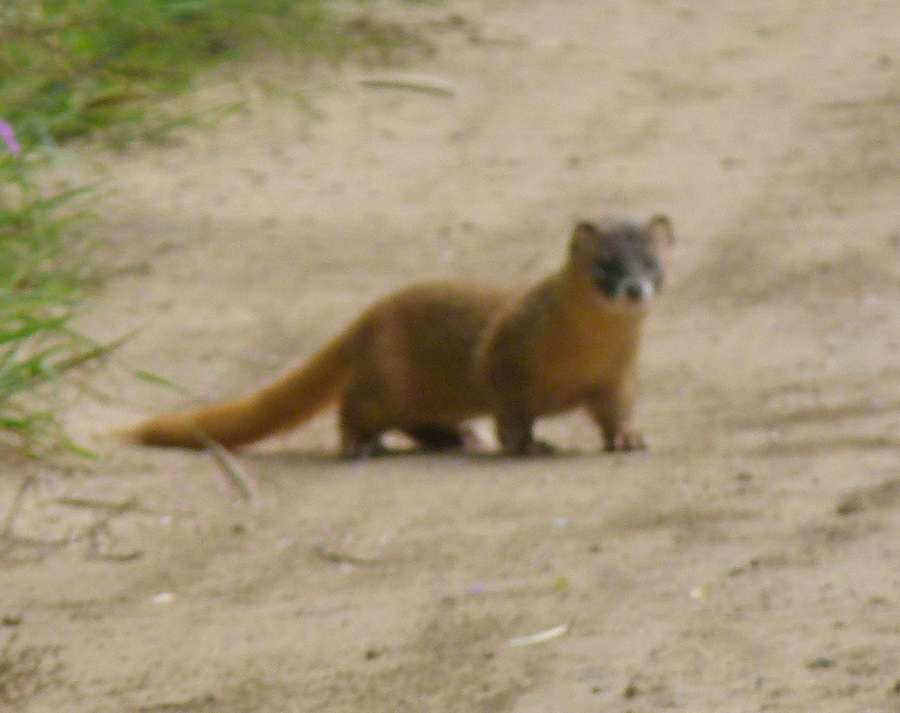
    We slowly made our way along the wooded edge of the lake picking up at least 4 Wood Sandpipers, both Barn and Red-rumped Swallow and a stunning male Black-naped Oriole.  But the highlight along here was a lovely encounter with a mammal, which we first suspected was a Yellow-throated Marten.  However, I have been reliably informed that it is not this species (EDIT: after a bit of detective work – Claus visited the Zoological Museum of Beijing – we believe it is a Siberian Weasel.  These are the elusive creatures that inhabit the hutongs of Beijing and are believed by locals to hold the power to capture and return human souls…!  We gave it a wide berth just in case…)

    Siberian Weasel, Yeyahu. Photo by Claus Holzapfel

    After enjoying this lovely animal as it made its way along the path towards us before scurrying into the vegetation, we made our way down to the viewing tower overlooking the reservoir.  Again, as on my most recent visit, hundreds of blue butterflies were congregating on the path and I couldn’t resist taking a few more photos of this spectacle.

    Rhapsody in Blue
    Close-up

    Claus captured me getting up close and personal with these butterflies.. not the most flattering photo!

    Me getting down and dirty… Photo: Claus Holzapfel

    At the reservoir we added more species to our day list including Mandarin Duck, Eastern Spot-billed Duck, Caspian Tern, Little Egret, White-winged Tern, Great Spotted Woodpecker and, best of all, a Eurasian Crag Martin that passed south in the company of some Barn Swallows.  Picked up by its size, lack of breast band and white spots on the tail, this was my first record of this species at Yeyahu.

    After enjoying our packed lunches we slowly made our way back, where we flushed a Snipe sp for the second time (it was in exactly the same place on the way out to the tower).  It was clearly not a Common Snipe, lacking an obvious white trailing edge to the secondaries and with a call that was harsher than Common Snipe (almost Corncrake-like in quality).  Photos below.  Comments welcome!

    Snipe sp, Yeyahu. Note lack of white trailing edge to secondaries.
    Snipe sp. This image shows the rather 'pot-bellied' appearance of this bird.
    Snipe sp. Note feet projection beyond tail. Suggests Pin-tailed?

    Claus and his wife are both interested in botany and I thoroughly enjoyed them pointing out interesting plants, including various grasses, flowers and shrubs.  Perhaps the most surprising was the discovery of the plant below growing ‘wild’ on the edge of the marsh…  there must have been at least 20-30 of these plants, of various ages, growing among the other vegetation and it certainly didn’t look like manmade cultivation.

    Cannabis plant, Yeyahu

    A thoroughly enjoyable day and many thanks to Claus and his wife for their company and for adding a new dimension to my knowledge of the natural environment at Yeyahu.

    It’s not very often I have pictures of myself to post on this blog, so here is one more from Claus, taken on the boardwalk at Yeyahu.  You can see more of Claus’s photos here.

    "Up on the boardwalk". I am sure there is a song about that…

    Full Species List (in chronological order of first sighting):

    Tree Sparrow (many)

    Common Magpie (many)

    Grey Heron (2)

    Common Pheasant (4)

    Grey-headed Woodpecker (4)

    Arctic Warbler (2)

    Two-barred Greenish Warbler (1)

    Asian Brown Flycatcher (2)

    Grey-streaked Flycatcher (1)

    Yellow Bittern (9)

    Night Heron (18)

    Great Crested Grebe (6)

    Marsh Tit (2)

    Oriental Turtle Dove (1)

    Chinese Pond Heron (4)

    Common Kingfisher (3)

    Grey Wagtail (2)

    Hobby (5)

    Oriental Reed Warbler (5)

    Vinous-throated Parrotbill (50+)

    Moorhen (5)

    Snipe sp (2)

    Common Tern (4)

    Chinese Penduline Tit (3)

    Black Drongo (c45)

    Whiskered Tern (18)

    Purple Heron (3)

    Chinese Grey Shrike (1)

    Pied Harrier (2)

    Eastern Marsh Harrier (2)

    Coot (8)

    Wood Sandpiper (4)

    Kestrel (2)

    Barn Swallow (26)

    Red-rumped Swallow (6)

    Mallard (2)

    Zitting Cisticola (12)

    Black-naped Oriole (1)

    Richard’s Pipit (3)

    Mandarin (4)

    Eurasian Crag Martin (1)

    Gull-billed Tern (2)

    Little Egret (1)

    Spot-billed Duck (5)

    Caspian Tern (2) – one ad and one juv

    White-winged Tern (2) – adults

    Great Spotted Woodpecker (1)

  • Hog Badger

    This weekend I visited Ma Chang and did the usual walk from there to Yeyahu.  I hadn’t walked this route for a while – Ma Chang is very disturbed by recreational activities in summer and the humidity makes a long walk very uncomfortable – so I was very interested to see what birds were around and whether any migration was taking place.  On arrival at 5.30am, the weather was perfect – a lovely fresh 16-17 degrees C with no wind and a little mist.  Already, by 7.30am, the sun was strengthening and gradually burned off the mist to reveal a sunny, clear day.

    Migration was in evidence early on with a reasonable passage of Yellow Wagtails plus a couple of Grey Wagtails mixed in.  A few juvenile Yellow Bitterns commuted between the reedbeds and a good number of Little Grebes (the race here in China has pale eyes – a potential split?) were loitering along the edge of the reeds.

    An adult female Pied Harrier was a nice sight – these birds pass through in spring and autumn – and it was nice to see it, momentarily, alongside a juvenile Eastern Marsh Harrier, showing the obvious size difference.

    The walk to Yeyahu was hot and sticky and, in places, was quite hard work due to the massive growth in vegetation that has occurred over the last few weeks.  Along one trail I noticed some mammal tracks (see photo below).  I suspected these were some sort of badger and, after making some enquiries, it seems that they belong to the Hog Badger, a creature that looks superficially like our European Badger but with a pig’s snout, hence the name.

    Hog Badger track, Yeyahu


    A few months ago, Spike Millington and I discovered a set of burrows not far from where I saw these tracks.  I suspect that they may belong to the Hog Badger, too.  I will try to stakeout this site on a moonlit night sometime soon to see if I can catch a glimpse of these nocturnal mammals.  I might have to take along some irresistable treats to tempt them…

    At the Yeyahu reserve, there had clearly been an explosion of butterflies, mostly these small blue butterflies.. they were everywhere and many were congregating in large groups around small puddles.  A real spectacle.

    Blue Butterflies, Yeyahu
    Blue Butterflies, Yeyahu. There were hundreds, if not thousands, along the tracks at Yeyahu on Sunday.


    Blue Butterflies, Yeyahu. Watching these insects drinking at close range was fascinating – the proboscis reminded me of an elephant's trunk!

    This grasshopper made a brief appearance when it landed near the butterflies..  amazing camouflage.

    Grasshopper sp, Yeyahu

    Other migrant birds on show here included 5 Black-naped Orioles, 39 Black Drongos (a record count for me), a single Fork-tailed (Pacific) Swift and a couple of snipe sp.  I have seen a few snipe recently that are not Common Snipe and I suspected Pin-tailed. However, after a discussion with Paul Holt, it seems that Pin-tailed and the very similar Swinhoe’s are extremely difficult to tell apart and it is not safe to identify them in the field without seeing the individual tail feathers… There is an article in British Birds from a few years ago which I will have to dig out.   Sunday’s birds will have to go down in my book as “Swintail Snipe”..!


    Full species list (in chronological order of first sighting):

    Tree Sparrow and Common Magpie – lots
    Great Bittern (1)
    Common Snipe (1)
    Whiskered Tern (18)
    Chinese Pond Heron (12)
    Bunting sp (one of the ‘tick’ buntings but not identified) (1)
    Little Egret (9)
    Amur Falcon (1)
    Little Grebe (20)
    Night Heron (12)
    Common Kingfisher (2)
    Asian Short-toed Lark (2)
    Zitting Cisticola (34)
    White-cheeked Starling (6)
    Yellow Bittern (6), all juveniles.
    Grey Heron (2)
    Northern Lapwing (1)
    Coot (8)
    Moorhen (16)
    Common Sandpiper (3)
    ‘Swin-tailed’ Snipe (2) – both flushed from dry-ish habitat, ‘dumpy birds’, if anything slightly smaller than Common Snipe, no obvious white trailing edge to secondaries, feet projected beyond tail and wingbeats slightly slower than Common Snipe.  Call was similar but slightly less ‘squelchy’ if that makes sense!
    Grey Wagtail (2)
    Eastern Yellow Wagtail (24), all migrating south-west
    Purple Heron (5)
    Wood Sandpiper (3)
    Eastern Marsh Harrier (4), 1 adult male, 1 adult female and 2 juveniles
    Black-winged Stilt (10)
    Great Egret (2)
    Brown Shrike (2)
    Richard’s Pipit (12)
    Hoopoe (1)
    Black Drongo (39), my highest count of this species so far
    Chinese Grey Shrike (1)
    Wryneck (1)
    Vinous-throated Parrotbill (40+)
    Arctic Warbler (2)
    Hobby (2)
    Pied Harrier (1)
    Barn Swallow (18)
    Red-rumped Swallow (12)
    Black-headed Gull (3)
    Common Pheasant (6)
    Sand Martin (1)
    Chinese Penduline Tit (2) – at least 2, possibly 3 active nests this year at Yeyahu but, if still around, difficult to see.
    Oriental Reed Warbler (3)
    Black-naped Oriole (5)
    Chinese Hill Warbler (2)
    Mandarin (4)
    Spot-billed Duck (4)
    Great Crested Grebe (8)
    Fork-tailed (Pacific) Swift (1)
    Von Schrenck’s Bittern (1 probable): a juvenile seen in flight only, much darker ground colour than the juvenile yellow bitterns with heavy dark streaking on the breast.
    Kestrel (1)
    Azure-winged Magpie (1)
    Great Tit (3)
    Grey-headed Woodpecker (1)
  • A Tale of Two Eagles

    In June many birders think the marvels of spring migration are over and thoughts turn to butterflies, dragonflies, family holidays or even moths (I kid you not!).  But, here in the Beijing area, early June can be a very good time for the late migrating locustella and acrocephalus warblers, as well as other reedbed-dwelling birds such as crakes and rails.

    One of the birds that I wanted to catch up with when I moved to Beijing was the Pallas’s Grasshopper Warbler, a bird on many a ‘most-wanted’ list back in the UK and, unless you go to Fair Isle in mid-September, your chances of seeing one in the UK are pretty slim.  I have been lucky enough to see over 20 of these birds here in Beijing, nearly all of which I have seen in the last 7-10 days!  On Saturday, during a visit to Yeyahu Nature Reserve, we counted 10 of these super-skulkers, at least 3 of which provided us with more than a just a fleeting glimpse of a shape disappearing into a dense reedbed after being flushed from the path!

    Yayahu Nature Reserve officially opens at 0830 in the morning and is very popular for Beijingers at the weekend to get away from the stress and heat of the city.  So if you want to see birds, it’s important to arrive early, before the masses.  Ideally you want to be first onto the boardwalk to see any lurking crakes, rails or bitterns before they are flushed deep into the reeds by the noisy hordes.

    On Saturday, despite arriving at 0520 and finding the gates open (sometimes we have to use the ‘alternative entrance’), we were a little disappointed to see 3 people already on the boardwalk..  nevertheless, we had the place to ourselves for the next 2 hours with some success whilst enjoying the cacophony of reed warblers – mostly Oriental Reed but with the odd Black-browed Reed mixed in.

    We took our time doing a circular walk around the lake, trying to distinguish any other birds’ songs from the rasping Oriental Reeds, and were rewarded with a single Spotted (David’s) Bush Warbler that was singing intermittently from a patch of young willows, a Baillon’s Crake that we disturbed from the boardwalk and gave us fleeting flight views before it dived into deep cover, a handful of Zitting Cisticolas as well as a good number of the enigmatic Pallas’s Grasshopper Warblers.

    A pair of Caspian Terns represented a good June record.  They came in high from the north and began to hunt over the lake but, by the time we left the site, they had already moved on..  early return migrants?  failed breeders?  who knows?

    On the second circuit we found a relatively small plain reed warbler (smaller than the resident Oriental Reeds).  Our thoughts turned to Manchurian Reed and, fortunately, I had just uploaded the song of Manchurian Reed Warbler onto my smartphone!  So I gave it a blast and it reacted strongly, flying closer and proceeding to sing.  Nice!  I took a few notes and photos before we moved on to eagle field.

    The walk down to eagle field was hot – the sun had burned off the clouds and there was only a light breeze just about taking the edge off the heat.  A circling flock of 17 falcons turned out to be a mixed flock of Amur Falcon and Hobby, giving us hope that a larger raptor would likely get up if there was one around…   We reached the tower and, after a brief scan, began to have our packed lunches.  It was quiet on the reservoir with just a few Night Herons, a couple of Purple Herons, some Mallard and a pair of Spot-billed Ducks.  I said to Spike that I would do a thorough scan for any eagles before heading back and, almost immediately, I picked up a large bird of prey heading straight for us from the north-east.  It was large, dark and displayed several ‘fingers’ on each hand – it had to be an eagle.  I was pretty confident it was a Greater Spotted Eagle but with just head-on views, I wasn’t certain.  We watched it as it came closer and, just as it reached the northern edge of the reservoir, it dropped, stone-like, with legs akimbo into the edge of the reedbed…  …wow – that was some dive!  We couldn’t see it on the ground but, after only a couple of minutes, it took off and headed low over the reservoir towards us, providing excellent views, at head height, as it attempted to avoid the attentions of one of the local magpies.

    It was now pretty obvious that it was a Greater Spotted Eagle and, when it reached ‘eagle field’, it began to circle, gained height quickly and headed off south-west.  Certainly my best ever views of Greater Spotted Eagle.

    Any day you see an eagle is a good day.  We began the walk back having already had a good day.  Then, half way back, we got onto a large bird of prey heading north and away from us..  a quick view through the binoculars revealed it to be a Short-toed Eagle. Almost certainly the same bird that Paul Holt, Chris Gooddie and I saw last week.  A good day just got better.

    A calling Two-barred Greenish Warbler on the entrance track on the way out was our last species of the day and we reflected on another excellent day at this productive site as we met our driver for the short journey back to Yanqing bus station.

    Edit: on looking at the photographs of the presumed Manchurian Reed Warbler, I am now thinking it may be the very similar Blunt-winged Warbler.  The supercilium does not reach far behind the eye and lacks the dark upper border that is a characteristic of Manchurian Reed.  Even though the bird reacted to the song of Manchurian, I am not sure how reliably this behaviour indicates the species.  The two very similar species may well react to each others’ songs – I don’t know!  I don’t have any experience of either bird, so comments very welcome..

    Manchurian Reed Warbler or Blunt-winged Warbler? Answers on a postcard…
    The tail on Blunt-winged is supposed to be 'blackish with brown edges"… this image does not show that feature. On the other hand, Manchurian should show a strong white supercilium that extends behind the eye and that has a blackish upper border. Hmm…
    Greater Spotted Eagle (prob 2 cal yr)
    Greater Spotted Eagle attracting the attention of a local magpie, Yeyahu, 4 June 2011
    Close-up.. that Magpie had a tug at the eagle's tail before it left it alone

    Full species list (in chronological order of first sighting):

    Common Magpie (many)

    Tree Sparrow (many)

    Collared Dove (2)

    Common Pheasant (4)

    Indian Cuckoo (2)

    Chinese (Light-vented) Bulbul (2)

    Black-naped Oriole (3)

    Eurasian Cuckoo (8)

    Great Bittern (2-3 heard)

    Oriental Reed Warbler (30+)

    Red-crested Pochard (3) – a little unsure of the provenance of these regularly seen birds (sometimes seen near the feral ducks and geese but certainly a lot more rangey than the remainder of the feral birds).

    Great Crested Grebe (6) – one of the pairs had young

    Little Grebe (4) – one pair had young

    Chinese Pond Heron (6)

    Mandarin (2)

    Common Coot (6) – some with young

    Zitting Cisticola (9)

    Black-crowned Night Heron (18)

    Black-winged Stilt (6)

    Hobby (9)

    Yellow Bittern (1)

    Vinous-throated Parrotbill (18)

    Grey Heron (2)

    Common Tern (4)

    Black-faced Bunting (3)

    Black Drongo (4)

    Eastern Marsh Harrier (3)

    Amur Falcon (10) – at least 3 adult males and 4 adult females plus some immature birds.

    Baillon’s Crake (1) – one flushed from the boardwalk and seen briefly in flight only

    Black-browed Reed Warbler (6)

    Pallas’s Grasshopper Warbler (10) – good number seen from the boardwalk and the north side of the lake

    Grey-headed Lapwing (4)

    Purple Heron (10) – at least this number.  Several pairs breeding in the reedbed in the south-west corner of the lake

    Little Egret (1)

    Little Tern (1)

    David’s (Spotted) Bush Warbler (2-3) – one heard only and one seen only (in different locations).  One other possible heard briefly.

    Garganey (1) – a flyover drake

    Marsh Sandpiper (1) – flyover

    Northern Lapwing (2)

    Richard’s Pipit (4) – displaying

    Chinese Penduline Tit (4) – at least two active nests

    Common Kingfisher (2)

    Caspian Tern (2) – flew in high from the north and began feeding.  Not seen later on return.

    Blunt-winged Reed Warbler (1) – one probably this species.  Seen well and heard singing in the reed-fringed dyke to the west of the main lake (just south of the point where the boardwalk ends).  Responded well to playback of Manchurian Reed Warbler (Blunt-winged not played) and we initially identified it as this species.  However, photos suggest to me that it is a Blunt-winged Warbler (supercilium very weak behind eye, lacking the black upper edge).  I suspect that both species would react to each others’ songs? Comments welcome.

    Chinese Blackbird (1) – my first at this site

    White-cheeked Starling (3)

    Barn Swallow (6)

    Ferruginous Duck (1)

    Greater Spotted Eagle (1) – came in from the north-east at around 1315.  Subsequently dropped like a stone, legs akimbo, into the edge of the reedbed on the north side of the reservoir (opposite the viewing tower).  About 2-3 minutes later, took off again and flew low, in the company of one of the local magpies, across the reservoir and past the tower to the grassy field where it circled, gained height and headed south-west.  A probable 2cy bird.  See photos.

    Chinese Spot-billed Duck (6)

    Mallard (15)

    Short-toed Eagle (1) – seen on the walk back to the car park.  Flew from area east of eagle field and then seen soaring north-east of eagle field close to mountain ridge.

    Two-barred Greenish Warbler (1) – one heard on entrance track to reserve

  • Siberian Bush Warbler

    On Saturday I joined leading China expert, Paul Holt, and visiting Chris Gooddie (of “The Jewel Hunter” fame) for a visit to Yeyahu Nature Reserve.  We were hoping to see some late migrants – birds such as Pallas’s Grasshopper Warbler – and of course had in the back of our minds the chance of seeing the rare Streaked Reed Warbler, a possible of which I saw on Thursday at the same site.

    After a 4am start and a predictably tortuous journey over the mountains past Badaling Great Wall (this route is notorious for breaking down lorries!), we arrived at the site by around 0615.  After seeing Two-barred Greenish Warbler, Yellow-throated Bunting and Chinese Pond Heron along the entrance track, we took the boardwalk through the reedbed.  The first stretch produced a high density of singing Oriental (Great) Reed Warblers along with a few Black-browed Reed Warblers, Pallas’s Grasshopper Warblers (most of which were picked up by Paul on call or a brief burst of song), a calling Yellow Bittern, a few Zitting Cisticolas and several Purple Herons (breeding in the reedbed in the south-west corner of the lake).  But the highlight was undoubtedly the Siberian Bush Warbler Bradypterus davidi (a split from Spotted Bush Warbler Bradypterus thoracicus) that was expertly identified by Paul after a very brief burst of song…  I have to say I would have almost certainly walked straight past it and, if I had heard it, I would probably have passed it off as an insect!  After a bit of patience and ‘pishing’, this bird showed well at very close range, albeit briefly… A very difficult bird to see and a scarce, albeit regular, migrant in the Beijing area (almost certainly overlooked due to its extreme skulky nature).  This experience reinforced to me the need to get learning all of the calls and songs of some of the more irregular and difficult to see birds in the Beijing area.  Unless one is familiar with the calls, identifying and seeing many of these “difficult enough at the best of times” birds becomes almost impossible.

    The walk along the grove of trees alongside the lake produced a good variety of phylloscopus warblers including Arctic, Two-barred Greenish, Pallas’s, Dusky and Radde’s plus a female Siberian Blue Robin, Asian Brown Flycatcher, Black-faced Bunting, a pair of Chinese Hill Warblers and a pair of nest-building Chinese Penduline Tits.  On our second circuit we paused at a gap in the trees to scan the area of reedbeds and scrub to the north.  After watching a pair of Eastern Marsh Harriers, a handful of Amur Falcons, displaying Richard’s Pipits, Siberian Stonechat, Hobby and Kestrel, the surprise of the day emerged, in the form of a Short-toed Eagle that appeared from nowhere and dropped into a field a few hundred metres away..  Short-toed Eagle is a pretty rare bird in northern China, although records from recent years suggest that it is probably a scarce passage migrant with multiple annual records in Spring and, particularly, Autumn.

    With the visibility shockingly poor (due to the air pollution mist), our chances of seeing more large raptors were pretty low, so we decided to make a brief visit to Ma Chang to check the reservoir before heading back to Beijing.  Ma Chang was a bit of a disappointment, largely due to the heavy disturbance involving cars, motorised buggies, horses, even coaches, driving all over the area adjacent to the reservoir… We did see a few Common Terns, Night Herons, Black-headed Gulls, the local Black-winged Stilts and a few Asian Short-toed Larks but there was little else on offer, so we knocked it on the head and headed back.  On the journey back, Chris regaled us with tales of various leech encounters during his Pitta quest..  the one that took the biscuit had to be the case of the leech on the eyeball (thankfully for him, not his!)…  OMG.

    A very good day out and it’s always a pleasure to go birding with people as knowledgeable as Paul and Chris – I learned a lot.  Thanks guys!

    You can see a short video of Chris tracking the Bush Warbler here…  The Bush Warbler’s call is very difficult to make out on the video (an up-slurred raspy sound), so you can hear a much clearer one on Xeno-Canto.

  • Eagles

    May in Beijing has been gorgeous so far..  cool, fresh mornings which warm up fast as the sun burns off any lingering mist and with a cool breeze to keep the heat bearable in the hottest part of the day.  And, as the trees and shrubs burst into leaf, the birds that feed on the insect life they harbour are arriving in numbers.  Even in the ‘garden’ in Central Park I have seen singing Pallas’s Warbler, Yellow-throated Bunting, Yellow-bellied Tit and a couple of migrating Common Buzzards.

    A visit by the in-laws has meant that I have not been able to visit Wild Duck Lake as much as I would have liked but, in a way, the absence in between makes each visit that much more special and one really notices the difference in terms of the birds present – there is a high turnover with each visit producing several new species for the year.

    My most recent visit this week followed a day of heavy rain and wind which, I was hoping, might have downed a few migrants.  With a clear day forecast, I hoped that it might also produce a few migrating raptors.  The day started at Ma Chang at 0530 in heavy mist and with visibility reduced to just a few hundred metres.  The first surprise of the day was finding 10 Greater Sand Plovers on the ‘desert’, by no means common at this inland site.  A party of 8 Eurasian Spoonbills was relaxing and preening on the edge of the reservoir as I carefully checked for a rare Black-faced Spoonbill.  There was no Black-faced this time and, at around 0620, all 8 suddenly alighted and flew west into the mist, not to be seen again.

    Greater Sand Plover (male)
    Greater Sand Plover (female)

    The walk out to the island produced good numbers of Eastern Yellow Wagtails, probably of the subspecies macronyx, together with several stunning adult male Citrine Wagtails and a few Buff-bellied Pipits.  A Purple Heron lazily made its way east and Night Herons were mooching around in good numbers.

    Wildfowl was thin on the ground with just a few Mallard, Spot-billed Ducks, Gadwall and a single Goldeneye on view from the island’s north shore.  It was at this point that the wind began to increase and, slowly, the mist began to clear.  By 0830 the sun was out, the visibility had increased to at least a kilometre and was improving fast.

    Amur Falcons began to appear and there was a thin but steady passage throughout the day..  I do love Amurs – masters of flight – and the adult males, in particular, are just gorgeous.

    Adult male Amur Falcon in flight… beautiful
    Amur Falcon (female). These stunning falcons breed in Manchuria and eastern Russia and winter in southern and eastern Africa. An epic journey.

    After checking the area around the yurts which produced some Whiskered and Little Terns, I began to walk to Yeyahu.  By this time the wind was fierce and my expectations for raptors began to wane..  surely it was too windy for much to be on the wing.  Thankfully, as I reached Yeyahu Reserve, the wind suddenly dropped by half and was reduced to a stiff breeze.  As I walked the perimeter of the lake, I flushed a large bird of prey from a poplar which immediately attracted the attention of the local pair of Eastern Marsh Harriers.  Greater Spotted Eagle!  I enjoyed great views of this bird as it began to circle and gain height, in the company of the male Eastern Marsh (the female kept her distance but gave encouraging cries as the male saw off this intruder).  Another male Amur then screamed in from the east, briefly tussling with both the Eastern Marsh Harrier and the eagle before disappearing as fast as it had appeared.  Wow…

    Greater Spotted Eagle (2 cal yr), Yeyahu NR
    Greater Spotted Eagle being mobbed by male Eastern Marsh Harrier

    As the eagle drifted west, struggling in the wind, I continued my walk east and, almost immediately picked up another 2 large birds of prey, this time quite high.  Two more Greater Spotted Eagles!  At this point I knew I should head for ‘eagle field’, the open area bordering the western part of the reservoir.  As I walked I kept watch on the skies and picked up 2 (possibly the same) Greater Spotted Eagles hanging in the wind..

    Greater Spotted Eagle, Yeyahu NR
    Greater Spotted Eagle, Yeyahu NR (same bird as above)
    Greater Spotted Eagle, Yeyahu NR

    When I reached the viewing tower, I laid down and watched the skies..  2 Greater Spotted Eagles, then a third all in view at the same time..   They drifted west into the wind before swinging back east and going down somewhere on the far side of the wood.  As I lay there snacking at my lunch while watching Greater Spotted Eagles, Amur Falcons and Black-eared Kites pass overhead, I was overcome with a real sense of privilege to be watching these magnificent birds on their incredible migrations..  Perhaps the greatest journey  is that of the Amur Falcons which winter in southern and eastern Africa and return to north-eastern China and eastern Russia each Spring.  It’s an arduous journey and yet here they were, full of energy, wheeling in the sky, catching insects on the wing and seemingly enjoying the onset of Spring.

    I enjoyed 2 hours of observation at this spot as the eagles made several passes.  At one point there were 6 Greater Spotted Eagles in the air together…  a stunning sight.

    As I reluctantly made my way back, I was left bemoaning the fact that this would probably be my last visit to Wild Duck Lake for at least 2 weeks as I am travelling to Dalian (Tom Beeke-land!) to bird the point at Laotieshan from 11-19 May – I believe the first time this peninsula will have been systematically covered for any length of time in Spring.   I can only imagine what I will be missing at Wild Duck Lake during this time!  Best not think about it…..

    Full species list (Magpie and Tree Sparrow too numerous to count):

    Japanese Quail (2 – flushed from the path at Yeyahu)

    Common Pheasant (6)

    Gadwall (22 – most on the reservoir seen from the viewing tower at Yeyahu)

    Falcated Duck (6 – numbers well down from my previous visit and only now present on the eastern part of the reservoir at Yeyahu)

    Wigeon (4)

    Mallard (8)

    Eastern Spot-billed Duck (8)

    Shoveler (4)

    Garganey (6)

    Eurasian Teal (68)

    Red-crested Pochard (2)

    Ferruginous Duck (4)

    Goldeneye (1)

    Little Grebe (20)

    Great Crested Grebe (14)

    Eurasian Spoonbill (8) – on the edge of the reservoir at Ma Chang until 0620 when flew west into the mist.

    Bittern (at least 4 heard)

    Black-crowned Night Heron (40+)

    Chinese Pond Heron (1)

    Cattle Egret (1)

    Grey Heron (2)

    Purple Heron (4)

    Great Cormorant (1)

    Kestrel (2)

    Amur Falcon (30+ light but steady passage throughout the day)

    Black-eared Kite (8)

    Eastern Marsh Harrier (at least 6)

    Japanese Sparrowhawk (1)

    Eurasian Sparrowhawk (2)

    Common Buzzard (2)

    Greater Spotted Eagle (over 10 sightings involving at least 6 different birds; 6 in the air together between 1510-1530)

    Coot – at least 40

    Black-winged Stilt (16)

    Northern Lapwing (14)

    Little Ringed Plover (16)

    Kentish Plover (4)

    Greater Sand Plover (10) – all at Ma Chang including two adult summer males.

    Common Snipe (6)

    Redshank (4)

    Greenshank (4)

    Green Sandpiper (1)

    Common Sandpiper (1)

    Temminck’s Stint (2)

    Oriental Pratincole (6)

    Black-headed Gull (50+)

    Common Tern (12 of the dark-billed race longipennis)

    Little Tern (4)

    Whiskered Tern (4)

    Oriental Turtle Dove (2)

    Collared Dove (6)

    Common Swift (8)

    Fork-tailed (Pacific) Swift (18)

    Common Kingfisher (5)

    Great Spotted Woodpecker (1)

    Chinese Penduline Tit (4)

    Sand Martin (2)

    Barn Swallow (80+)

    Red-rumped Swallow (16)

    Greater Short-toed Lark (12) – including one with an abnormal upper mandible

    Greater Short-toed Lark with abnormally long upper mandible. It's amazing how this bird manages to feed..

    Asian Short-toed Lark (2)

    Eurasian Skylark (2)

    Chinese Hill Warbler (2) – 2 possibly with a nest at Yeyahu

    Chinese Bulbul – (2) including one singing at the plantation on the island

    Pallas’s Warbler (2) singing in the plantation on the island

    Eastern Crowned Warbler (1) singing in the plantation on the island

    Vinous-throated Parrotbill (12)

    White-cheeked Starling (10)

    Red-throated Thrush (3)

    Naumann’s Thrush (1)

    Dusky Thrush (1)

    Dusky/Naumann’s intergrades (1)

    Bluethroat (1) at Yeyahu

    Siberian Stonechat (8)

    Taiga Flycatcher (12)

    Yellow Wagtail (80+ most looked liked Western Yellow Wagtail ssp thunbergi but I am not sure whether that occurs here.  ssp macronyx of Eastern Yellow Wagtail looks a good match, too)

    Citrine Wagtail (10)

    White Wagtail (2 of the ssp ocularis)

    Richard’s Pipit (6)

    Olive-backed Pipit (37)

    Buff-bellied Pipit (60+)

    Little Bunting (400+ everywhere)

    Yellow-throated Bunting (1)

    Black-faced Bunting (12)

    Pallas’s Reed Bunting (30+)

  • Lightning Strikes Twice at Wild Duck Lake!

    Ok, I know it sounds as if I am making this up but on Saturday I found another pelican at Wild Duck Lake.  Only this time, it was a DALMATIAN PELICAN.  A stunning end to another fantastic day of birding at this site that included a Short-toed Eagle (rare in northern China), two Greater Spotted Eagles and my largest total of species in one day at this prime location (79).

    I had a feeling it might be a good day when I travelled to Yanqing on Friday evening.  The afternoon had been very showery with some thunderstorms, one of which hit Beijing with its full force.  This meant that the pollution mist had been cleared, reminding everyone that Beijing is surrounded on three sides by fantastic mountains, a fact easy to forget given the majority of days are afflicted with at least some level of smog.

    On arrival at the site at 0530, it was a chilly 5 degrees C with a moderate NNW wind which felt distinctly wintry again (gloves most definitely required).  However, the visibility was fantastic and I could see, uninterrupted, the mountains stretching into the distance on both the northern and southern sides of the reservoir.

    Ma Chang, shortly after dawn
    The 'desert' at Ma Chang

    I began by checking the ‘desert’ area for Oriental Plovers but no sign. Just a few Kentish Plovers and a handful of Greater Short-toed Larks.  The reservoir shore here produced a single female Ruff associating with half a dozen Black-winged Stilts.  And evidence that one Chinese bird photographer had been a little overeager to secure that frame-filling shot…..

    This bird photographer, despite having a 4wd, got well and truly stuck!

    Barn Swallows were already moving overhead with the odd group of buntings and pipits.  I decided to check the spit for wildfowl (the scene of the Great White Pelican last week) and, on the short walk, I flushed a Short-eared Owl that immediately took offence to the mobbing by the local magpies, climbed quickly and then flew high south.   Sorry!

    On arrival at the spit, my scan of the reservoir revealed very few birds, probably due to the presence of 3 fishing boats.

    Fishermen at Ma Chang, 23 April 2011

    One tightly-packed group of birds on the far side of the reservoir revealed themselves to be breeding plumaged Black-necked Grebes and I counted 32 in this ‘flotilla’.  A single Daurian Jackdaw, a few Eastern Marsh Harriers, some Buff-bellied Pipits and the occasional ‘boom’ of a Bittern were my further rewards before I decided to head off to try the island (offering views of another part of the reservoir).

    Just as I was leaving the spit I could hear the rasping call of terns and I looked up to see two Common Terns (of the dark-billed ssp longipennis) arriving from the south.  Then, I spotted a group of raptors lazily flapping across Ma Chang… 9 Black-eared Kites!

    I reached the island at Ma Chang a few minutes later and I began to check for wildfowl.  A group of over 180 Falcated Duck was the highlight with the supporting role going to an Osprey sitting on a far post.  Then I began to notice swifts moving overhead and, before long I had counted the first of what would prove to be a movement of over 350 Fork-tailed (Pacific) Swifts migrating north-west.  A few Oriental Pratincoles began to drift in and, as with the swifts, they kept coming.  I counted over 85 altogether.

    I began the walk to Yeyahu with my heart sinking as I experienced the disturbance that is commonplace here.  First, three local guys were chasing about in a speedboat with shotguns targeting the Common Teal.  Unfortunately they were too distant to photograph but I will report this activity to the police (it is illegal both to own a gun and to shoot wild birds).  And second, the ‘buggies’ were out and about on the ‘desert’.. they often start around 0800 and any plovers or larks are moved off immediately.

    The buggies that disturb the 'desert' area from around 0800, especially at weekends, in all seasons with the exception of winter

    Almost as soon as I had retraced my steps from the island to Ma Chang, I spotted a raptor hovering over the area between Ma Chang and Yeyahu.  It looked long-winged and it didn’t take long to realise it was a Short-toed Eagle.  Fantastic.  I watched as it hunted and was able to capture a few images before it drifted off east to hunt over Yeyahu.  It is at least the fourth STE I have seen at WDL, having seen three in the autumn.

    Short-toed Eagle, Ma Chang, 23 April 2011

    A few minutes later I spotted another two large raptors in the same area.  With the bins I could see they were large eagles and, through the telescope I could see they were Greater Spotted – a regular but uncommon visitor during migration.  Very nice!  They drifted east and seemed to go down in a small wood to the east of Yeyahu.

    Greater Spotted Eagles, Ma Chang, 23 April 2011

    At this point I was thinking how lucky I was to have experienced an excellent day but, little did I know, the icing on the cake was to come.  As the weather looked increasingly threatening, with showers in the mountains looking as if they were thinking about exploring the valley, I made my way to Yeyahu and, specifically, to ‘eagle field’ where I hoped to see the Greater Spotted and Short-toed Eagles again.  On the way I was entertained by at least 5 Eastern Marsh Harriers displaying over the reedbeds at Yeyahu – a real treat of aerobatic skill.  Then I picked up the Greater Spotted Eagles again – this time closer – and, as with the previous sighting, they gained height and drifted west before gliding back east and settling in the wood.  Just a few minutes later, ahead of an approaching thunderstorm, they were up again and this time they again gained height and worked their way slowly west into the wind and the approaching shower.  At this point they obviously felt the rain and they quickly turned.  One of the eagles drifted high east and I lost it to view.  The second clearly wasn’t allergic to rain and just dropped back into the wood.  At this point I got a drenching.  As I had been concentrating on the eagles, the shower had sneaked up on me and I ran for the cover of a hedgerow.  Thankfully the rain lasted no more than 5-10 minutes and I made my way to the viewing tower at ‘eagle field’ to have my packed lunch.

    A heavy rain shower at Yeyahu (a rare occurence in itself!)
    The view north from Yeyahu, 23 April 2011

    From here I enjoyed another sighting of the Greater Spotted Eagle as well as counting the wildfowl on the eastern part of the reservoir.  There were good numbers of Shoveler, Gadwall and Common Teal as well as a few Great Crested Grebes, Falcated Duck and 4 Smew.

    Greater Spotted Eagle, Yeyahu, 23 April 2011

    At about 1345 I began the walk back to the reserve entrance, where I had arranged to meet my taxi driver, looking over my shoulder every now and then to check for birds of prey.  About half-way to the entrance, during one of my glances, I spotted a large bird circling.. I thought it must be the eagle and set up the telescope.  To my surprise, it was not an eagle but a Pelican!  Unbelievable…   I immediately began to take notes on the plumage.  It was a much duskier bird than the brilliant white plumage of last week’s Great White Pelican and the secondaries were brown, not black.  The underwing was rather dusky without noticeable contrast between the primaries and secondaries.  It had to be a Dalmatian Pelican!  I grabbed the camera and fired off a few record images as it made its way west along the reservoir.  It looked majestic against the mountain backdrop as it slowly flapped its way across to Ma Chang.  Wow.

    Dalmatian Pelican arriving at Wild Duck Lake from the east, Yeyahu, 23 April 2011
    Dalmatian Pelican showing underwing pattern, Yeyahu, 23 April 2011
    Dalmatian Pelican, Yeyahu, 23 April 2011

    I met my driver and caught the bus back to Beijing feeling very elated after an excellent day in the field.  What will this site turn up next??

  • Guest Post 3: Brian Jones – The Magic of Yeyahu NR and Ma Chang (Wild Duck Lake)

    The third in the series of guest posts on Birding Beijing is from Brian Jones. Brian was kind enough to take me on my first visit to Wild Duck Lake (covering the areas of Ma Chang and Yeyahu Nature Reserve) soon after I arrived in Beijing and his enthusiasm for the place, as well as the great birds, made it a fantastic introduction to birding in China. That enthusiasm was infectious and I have since made regular visits to what is surely the premier birding site in the Beijing area. Brian visited WDL almost every week over a period of three years and thus has an unrivalled understanding of the birding in all seasons at this site and he has racked up an impressive list of records, including an amazing sighting of a Leopard Cat (with photo!). And so, with that short introduction, it’s over to Brian to tell you more about this wonderful place….

    The Magic of Yeyahu Nature Reserve and Its Environs of Ma Chang

    The viewing tower at "Eagle Field", Yeyahu Nature Reserve

    This is my spiritual birdwatching home and somewhere I would recommend to any birder visiting Beijing.  It is good at all times of the year but perhaps marginally less so during June and July.

    Yeyahu NR and neighbouring Ma Chang are, to my mind, the premier birdwatching sites in the Beijing area. Surprisingly the area is grossly under-birded and in the three years that I lived in Beijing having visited the site more than 160 times, apart from regulars like Jesper Hornskov, the highly respected China guide and his parties, I have probably seen no more than 30-40 birders.

    The reserve lies approximately 80kms to the NW of Beijing and is reached by the Badaling expressway. The trip, depending on delays caused by trucks breaking down, normally takes about one and a half hours. But this can become over two and a half hours with delays so I got into the habit of busing out on Friday evening and staying overnight in Yanqing. My ever-reliable taxi driver Li Yan would look after me like a surrogate mother and pick me up at all hours.

    My regular birdwatching companion Spike Millington and I would normally start at Ma Chang which is an open sandy desert-like area surrounded by crop fields mostly Maize and Peanuts.This is a haven for Cranes (Common, White-naped, Hooded, occasionally Demoiselle and Siberian) as well as the elusive Oriental Plover in the Spring (end of March-beginning of May and very occasionally in the Autumn), Great Bustard and raptors.

    Demoiselle Crane, Wild Duck Lake

    This is a wonderful location for raptors and it is not unusual to reach double figures of species during a day’s birdwatching. Larks are also plentiful including the much sought-after Mongolian Lark which, in the very cold winter of 2009/10, could be found in flocks of 200 birds. That particular winter also produced an irruption of Pallas’s Sandgrouse – one day I counted over 300 birds – and the extraordinary record of a dark variant Gyr Falcon. It is worthwhile exploring the area surrounding the wind turbines to the west of Ma Chang for Great Bustard, which are normally seen during the Autumn and late winter.

    Mongolian Lark, Wild Duck Lake
    Great Spotted Eagle ssp fulvescens, Wild Duck Lake
    Pallass Sandgrouse, Wild Duck Lake, winter 2009/10

    You can walk from Ma Chang to Yeyahu NR either through or round the fence that divides the two areas and it is certainly more worthwhile to do so as you will see far more birds than taxi cabbing from one to the other. Daurian Partridge are present in small numbers as well as Japanese Quail. During Winter and Spring time, the walk produces many Buntings, including the occasional irruption of Pine Buntings (one flock of 300 seen in 2010). I have also recorded the rare Streaked Reed Warbler along the edge of the reservoir.

    Yeyahu NR produces a remarkable number of species considering the lack of any forested areas. If you want to find large raptors then head for the area we call Eagle field which lies between the lake and the reservoir to the north. Late morning in the Spring and Autumn will normally produce something special. Short-toed Eagle, which is a scarce bird in north China, is easily found here as well as Greater Spotted Eagles. During the winter White-tailed Eagles are commonly seen but, surprisingly, Golden Eagles are rare at Yeyahu. We have also found Booted and Terry Townshend this year saw an Imperial Eagle. I recorded Himalayan Griffon (2010) at this location. I believe it is the only Beijing record and I am quite sure a Steppe Eagle and Lammergeier will one day put in an appearance. Accipiters and Falcons are plentiful depending on the time of year with Saker Falcons being more common than Peregrines and an occasional Siberian Goshawk amongst the Northern Goshawks, being found. During migration it is not unusual to see migrating flocks of 50+ Amur falcons sometimes with small parties of Lesser Kestrel (best location at the bottom of Ma Chang). I found a flock of over 30 Lesser Kestrels one morning.

    All the Harriers can be found with good numbers of Eastern Marsh (which breed both at Ma Chang and on the lake), Hen, Pied and on four occasions I have seen Pallid Harriers. Relict Gulls in the Spring and occasionally a Pallas’s Gull will show. Bitterns are common, I estimate there maybe as many as 30 breeding pairs of Great Bitterns in the area as well as good numbers of Von Schrenck’s, a rare bird in most areas of China, and the ubiquitous Yellow Bittern. If you walk along the boardwalk at Yeyahu early in the morning in May you will probably find Crakes or Water Rail. The reedbeds also hold breeding Chinese Penduline Tits, one of the very few places where they breed in the Beijing area, perhaps the only location and last year we recorded the first breeding pair of Chinese Grey Shrikes at Yeyahu for the area. Chinese Grey Shrikes, which are uncommon elsewhere, are common at Yeyahu during the winter.

    One of my birdwatching friends Richard Carden from Singapore who has visited the site with me on several occasions has a habit of setting me lists of target birds to find. There have only been two glaring misses to the “list”, Great Bustard and Eagle Owl neither of which is normally that hard to locate at the appropriate time of the year. However Yeyahu made up for these deficiencies by producing an extralimital male Desert Wheatear and a Baird’s Sandpiper (yet to be ratified but the id of which we are both quite certain is correct) as well as a female Pallid Harrier. Peter Ericsson, the well-known guide from Bangkok was also present on one of the red-letter days. I would happily take an oath, that there is no such thing as a bad day during a visit to Yeyahu/Ma Chang. You can always count on the “Yeyahu surprise”.

    Yeyahu also supports a considerable bio-diversity especially for lepidoptera, diurnal moths, amphibians and flora. Unfortunately to study lepidoptera you need to look down while birdwatching you are looking up so a choice must be made. I was also very lucky one morning to find myself walking down a track undetected behind a Leopard Cat which are rare now and usually strictly nocturnal.

    Leopard Cat, Wild Duck Lake

    There are of course aspects which are less favourable not least the “cavalry and dune buggies” who are out all year except during winter in the Ma Chang area.These are riders who charge hither and thither, yelling like cowboys, but falling off with great regularity. It is quite common to see riderless horses heading back to the corral followed some minutes later by a limping vacquero. Dune buggies have a nice habit of getting bogged down as do the cars full of photgraphers who spend much of their time chasing Lapwings. This is why it is worthwhile arriving at Ma Chang by 0700hrs before the Oriental Plovers etc. have been disturbed by the “Charge of the Light Brigade”. There used to be a problem with boatloads of shooting parties, mist netters, snare trappers and long-doggers, all illegal activities in China. But many of these activities have been curtailed because we took a very pro-active stance and “destroyed” all that crossed our path. You can never entirely limit poaching in China because there is a lack of understanding and caring amongst the local population but you can keep it under control by making a big fuss whenever you catch somebody setting up nets etc.
    Finally I would recommend to any birder that they walk and not drive round the area. It will prove to be so much more rewarding. If you consider that the area has practically no trees and is mostly flat grassland, the 260 odd species that we have recorded in the reserve is, by China’s birdwatching standards, quite remarkable. I have rarely exceeded 60 species in a day at Yeyahu, but the list will always be full of unusual and exciting birds.

    Brian Jones is a 66 years-old Art & Financial consultant who worked at Sothebys for ten years. He has spent three years in China, mostly in Beijing but now based in Shenzhen, working as an independent consultant with a Chinese metals information board and industrial re-cycling group as well as a Chinese investment company.  Brian has a great interest in all aspects of the environment, is a keen ornithologist and entomologist and an avid Scuba diver. He is also an ex-falconer, hence his excitement anytime something with a hooked beak flies past!.

  • Eastern Imperial Eagle

    Another trip to Wild Duck Lake gave rewards but not in the way we had expected!  A big target bird was Baer’s Pochard, a rare duck that breeds in NE China and the S Russian Far East and winters in south-eastern China. They *must* pass through Wild Duck Lake in Spring, we think.. it’s just a case of finding one! With conflicting forecasts, we had gambled on the wind being slack and, on arrival at Yanqing at 0715, it seemed the gamble had paid off. Hardly a breath of wind and a glorious sunny day.  However, when we arrived at Ma Chang 20 minutes later, we could see the wind turbines rattling around at a fair pace and, as soon as we got out of the car, we were stood facing into a moderate to strong north-westerly – exactly the direction in which we needed to look to see the wildfowl.

    Wind can be a real downer at this very open site – apart from the fact that it can be uncomfortable (and very cold) with icy winds from Siberia and Mongolia whipping into your face, it makes viewing the birds that much more difficult, especially using a lightweight tripod and telescope.  To add to this, the wildfowl were all keeping their heads low at the relatively sheltered far side of the lake, and amongst the reeds, making viewing very difficult indeed on the choppy water.

    Still, we persevered, and reached some reasonable counts of Common Crane (c200), Swan Goose (c100), Bean Goose (c250), c450 Ruddy Shelduck, c150 each of Whooper and Bewick’s Swans, Falcated Duck, Eurasian Teal, Gadwall, c350 Smew and a nice flock of 8 White-naped Cranes feeding nearby in a field.  But there was no sign of the first Garganey of spring or the rare Baer’s Pochard.  Never mind.  Not this time.

    We began the walk to Yeyahu, with the wind on our backs, and enjoyed sightings of 3 Hen Harriers (two ringtails and a beautiful adult male), 2 Kentish Plovers, a single Eurasian Curlew (first of the year), a Grey-headed Lapwing, 100s of Pallas’s Reed Buntings and 100s of Eurasian Skylarks with a few Asian Short-toed Larks mixed in (no Mongolian this time).  As we reached Yeyahu, the wind suddenly seemed to drop and, almost immediately, we began to see a few raptors – first another Hen Harrier, then an Upland Buzzard, then a second Upland.  At this point we had reached the long line of trees that runs south to north from Yeyahu lake to the reservoir.  Here, we usually split up with one of us doing the east side, the other the west.  I took the east side and, by the time I had reached almost half way down, I had seen only single Meadow and Little Buntings plus a few Tree Sparrows.  Then I heard some corvids calling overhead and I looked up to see a flock of around 20 Carrion Crows very high up in the sky flying south..  they deviated slightly to intercept a much larger bird gliding east… it had to be an eagle!  I could immediately see it was large and, after quickly narrowing down the possibilities in my head to Great Spotted/Imperial or Steppe, I called Spike to get him onto the bird.  As I was speaking to him, it began to head north towards the mountains and I quickly gave Spike directions before focusing the telescope on it as it drifted away.  In the strong light, the only colouration I could make out was that it looked mostly dark with paler undertail coverts.  I counted 7 ‘fingers’ on its broad and long wings before it became just a ‘dark bird of prey’ at distance.  Frustratingly, I didn’t get enough detail to confirm the identification. I made my way north towards the viewing tower that is well-situated on the south-eastern end of the reservoir in the hope that it might reappear.

    Spike joined me there, unfortunately having not seen the bird.  We took the opportunity to take lunch and waited, scanning the skies.  It’s quite usual for large birds of prey to turn up in this area and often, with a little patience, they return.  So we were hopeful.  Then, about half an hour later, I got on to a large bird of prey heading our way.  Large eagle.  This time Spike saw it and we both enjoyed views through the telescope.  We began to note the features.  Great Spotted Eagle was probably the most likely species but it didn’t ‘feel’ like one.  This bird had long, broad wings, black primary tips and a dark trailing edge to the wings, but with a paler panel on the inner primaries that reached the tip.  The underwing coverts looked paler and the body was mottled.  The head appeared dark from underneath but looked slightly paler from above.  The tail was relatively long and almost two-toned.  It glided on slightly bowed wings.  It was clearly not an adult of any of the candidate species and immatures can be very variable. Neither of us had much experience with large eagles, so we decided to take as many notes as possible and also try to grab a few photographs.  The bird stayed quite distant, so photographing it was not easy but I was able to capture a few images which, after being heavily cropped, show some of the distinctive features.

    On arriving home and looking at the literature, we both independently suspected it was an immature Eastern Imperial Eagle and this was also the view of Jesper Hornskov, to whom I had sent the photographs and description.  I have never seen Eastern Imperial Eagle before and it’s quite a scarce bird in the Beijing area, so we were pretty pleased with the record.  The images are below.


    Eastern Imperial Eagle, Yeyahu

    Eastern Imperial Eagle, Yeyahu, nr Yanqing, China

    Eastern Imperial Eagle, Yeyahu, nr Yanqing, China

    Eastern Imperial Eagle, Yeyahu, nr Yanqing, China

    Eastern Imperial Eagle, Yeyahu, nr Yanqing, China

  • Wild Goose Chase

    This week, Birding Beijing is brought to you by the letter “M” and the number “2”.

    “M” because there was a distinctly Mongolian feel to Saturday’s birding, and “2” because I saw two new birds!

    Spike and I visited Wild Duck Lake (Ma Chang to Yeyahu) again on Saturday. We were buoyed by last week’s hints of Spring and, on the bus to Yanqing, our conversation revolved around the possibility of seeing early migrants – would there be a first Little Ringed Plover, or even an Oriental Plover? A Mongolian Lark or Great Bustard? Or something rarer like a Pallas’s Sandgrouse? As usual, speculation about just what might be was pretty outrageous..!

    In the end, the reality was much better than I could have reasonably expected with two new birds for me – a single Mongolian Lark (yess!) and 2 White-naped Cranes that were seen cohorting with the local Common Crane flock – whilst the rarest bird must be the all-too-brief probable Lesser White-fronted Goose that was associating with around 3,000 Bean Geese (mostly of the subspecies serrirostris but with a few middendorffii mixed in).

    The supporting cast included c400 Swan Geese, 2 Hooded Cranes, the first Shoveler and Wigeon of the year, a stunning drake Baikal Teal, 9 Kentish Plovers, a single Grey-headed Lapwing, my first 3 White Wagtails (ssp leucopsis) of the year, 20 Mongolian Gulls (18 of which were migrating west), 10 Black-headed Gulls, c300 Smew, 2 Upland Buzzards, 2 ‘ringtail’ Hen Harriers, 2 Siberian Accentors, 4 Chinese Grey Shrikes and 3 White-cheeked Starlings.

    The day started at Ma Chang at around 0645 and we were greeted by a big flock of Common Cranes by the side of the track. Amongst them were 2 Hooded Cranes, spotted as they took flight. A good start! Then, just as I had set up my telescope to go through the flocks of wildfowl on the far side of the reservoir, everything took flight. This had to mean one thing – a major raptor. Sure enough, a White-tailed Eagle lumbered low over the reeds and settled on the ice. Looking at the sky revealed the sheer scale of the wildfowl present – the sky was full of birds. Bean Geese were everywhere… The sight and sound of the geese in flight shortly after dawn was something to behold. I tried to capture some of the atmosphere on video and you can view a short clip of the Bean Geese here. We just stood and marvelled at the sight for a couple of minutes and then I thought it would probably be a good idea to go through the flocks to see if there were any other geese mixed in.

    I began to check the flying flocks with my telescope and, in the third flock I checked, I saw a significantly smaller ‘white-fronted’ goose in a flock of serrirostris Bean Geese. I watched it for about 10 seconds in flight before the flock landed on the ice. I could see the relatively small size (at the time, I estimated it was 20 per cent smaller than the serrirostris Bean Geese), dark belly markings, the white base to the bill and I could just make out an eye-ring. I called out “I think I have a Lesser White-front!”. After a scan of the flock on the ground I picked it up at about 200-300m distance, and was again struck by the noticeably smaller size, relatively small head and very peaked forehead. Unfortunately many other serrirostris Bean Geese landed in the same area and several birds walked in front of the LWFG and it was lost to view. I couldn’t get Spike onto the bird… very frustrating! After several minutes of waiting to see if it would reveal itself, we decided to walk to another vantage point to try to view the flock from a different angle. This proved fruitless when the flock flew up to join another flock of Bean Geese heading west and was lost to view.

    I have seen LWFG in Copenhagen in Spring 2010 (a flock of 50+) and I am confident that the bird was that species, although I would have liked to have studied it for longer to rule out hybrids, taken more notes and, ideally, photographed it.. a little frustrating but hopefully it will hang around and be seen by others.

    It was shortly after this sighting that we began the walk towards Yeyahu and it was on the shore of the reservoir that we encountered a large flock of larks feeding out in the open. A Kentish Plover called and we soon picked up two, three, then four of these dainty plovers. I set up the telescope to go through the flock with the main aim of counting the KPs (9 in total) when I suddenly got onto a very striking lark mixed in with the Eurasian Skylarks. Slightly larger than the Skylarks and with a black mark at the top of the breast bordered with a rusty wash on the sides of the upper breast, rusty colouration to the median and lesser coverts and a rusty stripe on the head, this could only be one thing – a Mongolian Lark! This is a bird I had hoped to see around Beijing in winter and I was beginning to think my luck was out. To see one in mid- to late March was a nice surprise! After only about a minute it took flight on its own and, with its very distinctive ‘floppy’ flight, it looped over to a more shrubby area and dropped to the ground. Despite a brief search of the area, it never showed again.

    We walked round to the east side of the reservoir to try to view the flocks of wildfowl that were congregating on the northern shore. Lots of Whooper and Bewick’s Swans, Swan Geese and masses of duck. Most surprising of all was the sight of 4 cormorant fishermen who paddled out into the middle of the reservoir and released their cormorants to begin fishing. I thought this practice had all but died out so was surprised to see it being used less than 90 minutes from the capital… (and there wasn’t a tourist in sight!).

    The onward walk was relatively quiet with just a couple of Upland Buzzards, a few Japanese Quail, 3 Meadow Buntings, 2 Siberian Accentors and lots more Pallas’s Reed Buntings. We were met by our driver at Yeyahu and began the journey home, tired but exhilarated. That first 3 to 4 hours at the reservoir on Saturday morning will stay with me for a long time – fantastic birding.

    This site has bags of potential in Spring and I can’t wait to return.

    Mixed flock of Bean Geese and Swan Geese, Ma Chang, 19 March 2011
    Cormorant fisherman with wildfowl flock in background, Ma Chang, 19 March 2011
  • Death at the Lake

    With Spring in the air, Spike Millington and I decided to pay a visit to Wild Duck Lake to see whether birds were on the move. We caught the first bus from Beijing at 6am and arrived in Yanqing at 0715, after seeing several small flocks of Waxwings totalling about 30 birds, during the journey. Here we met our driver for the onward 20-minute journey to Ma Chang/Yeyahu (Wild Duck Lake). On arrival it was beautifully still and we were pleased to see patches of open water on the reservoir on which were congregating good numbers of wildfowl. 150 swans (mostly Whooper with perhaps 50 Bewick’s) were providing a great soundtrack in the still morning air while we scanned through the flocks. We counted 250 Bean Geese, 10 Swan Geese, over 50 Goosander, c200 Smew, a female Red-crested Pochard, 2 Ferruginous Ducks, 8 Pintail, a handful of Common Pochard, 150+ Ruddy Shelduck, 4 Gadwall and good numbers of Falcated Duck, Mallard and Common Teal. Nearby over 170 Common Cranes fed around the edges of the lake and a single Lapwing (the first of the spring) flew overhead. A lone White-tailed Eagle sat watchfully on the ice.

    After scanning (more in hope than expectation) the open grassland for Great Bustard, we began the walk from Ma Chang to Yeyahu. The open grassy areas produced 4 Chinese Grey Shrikes, good numbers of Asian Short-toed Larks and Skylarks (some singing), 200-300 Pallas’s Reed Buntings, a single Lapland Bunting, 2 flocks of Daurian Partridges (totalling 11 birds), 4 Japanese Quails and a single Upland Buzzard. Sadly, it was in this area that we also found a dead Eagle Owl. A superficial examination revealed no obvious cause of death and we speculated about the possibility of starvation or, given that we hardly saw any raptors all day (single White-tailed Eagle and Upland Buzzards were the only birds of prey of the day), the possibility of poisoning taking place nearby.. who knows? In any case, it is probably the same Eagle Owl that we saw here in the first part of the winter and that which, in January, was responsible for the killing of a Long-eared Owl whose remains we found next to a huge pellet. Coincidentally, Brian Jones found a dead Eagle Owl in a similar area two winters ago.

    The dead Eagle Owl found at Ma Chang/Yeyahu (Wild Duck Lake), near Yanqing

    The walk along the boardwalk at Yeyahu produced at least 10 Chinese Penduline Tits and more Pallas’s Reed Buntings but it was a little further on where Spike dug out the surprise bird of the day – a superb adult summer male Long-tailed Rosefinch. It was pretty elusive and I only enjoyed brief views before it seemed to just disappear into thin air.. and there was no sign an hour later when we returned for a second look. This is apparently the first record of Long-tailed Rosefinch at this site.

    The walk down to the observation towers produced a few Siberian Accentors, 2 Oriental Turtle Doves, 2 Grey-capped Woodpeckers, 2 Grey-headed Woodpeckers and 3 Marsh Tits. A single Daurian Jackdaw by the exit track was an uncommon sight at Yeyahu as we made our way out of the reserve for the journey back to Beijing.

    With the weather warming up and the ice cover retreating, the next few weeks could be very good at Wild Duck Lake. Late March is a good time for Oriental Plover and it’s possible that other early migrants such as Mongolian Lark, Great Bustard and even the now rare Baer’s Pochard may pass through. One of us at least will try to visit once a week for the spring period… Watch this space!

  • Owl eats Owl

    On Saturday I accompanied visiting Swedish birder, Anders Magnusson, to Wild Duck Lake (Ma Chang/Yeyahu Nature Reserve) for a day’s birding. Thankfully the forecast strong winds were absent as we were dropped off at Ma Chang at 0730 in -12 degrees C. My ‘michelin man’ outfit including ‘man tights’ (and they are very manly, honest), thermal underwear, 4 layers of t-shirts and fleece plus a long, down-filled coat, two pairs of gloves, woolly hat and thermal snow boots meant I was snug as a bug with only my nose really feeling the cold.

    A few Common Cranes were a good start, including one that seemed to completely retract its legs when flying (either that or it had no legs at all – unlikely given that it had obviously been able to take off). Soon we were enjoying a ringtail Hen Harrier and over 200 Bean Geese. A scan of the reservoir revealed a small patch of open water near the far bank, on which swam 20-30 more Bean Geese and around 10 Goosander. Asian Short-toed Larks and Lapland Buntings occasionally flew overhead and, as we began the walk towards Yeyahu a Peregrine engaged in a (unsuccessful) hunt for a feral pigeon. Shortly afterwards, an immature White-tailed Eagle appeared from the west and spooked a flock of around 250 Ruddy Shelducks that were standing on the far side of the ice. Nice.

    We worked our way across the open area, enjoying 2 Upland Buzzards (one of which flew alongside a Hen Harrier and looked absolutely huge in comparison) and Pallas’s Reed Buntings seemed to be in every shrub. We flushed a few Common Skylarks as they fed on the ground and, as we approached Yeyahu, 2 male Hen Harriers (one adult and one sub-adult) quartered the reeds. Here we also heard and saw briefly the first of two Chinese Hill Warblers. After a welcome coffee stop (which tasted soooo good) we pushed on towards the lake and, in an area of only a few square metres, we flushed 16 Japanese Quail which scattered in different directions (clearly a deliberate strategy to confuse predators). The reedbed held good numbers of Pallas’s Reed Buntings and, after a bit of work, we managed to identify a single ‘tik’-ing Rustic Bunting in amongst them and then, after a bit of persistence, were treated to good but brief views of the second Chinese Hill Warbler after we heard it calling several times. A fly-by Saker was a bonus.

    By now it was 11am and, as is usual at this site, suddenly the wind got up, making the temperature feel another 5-10 degrees colder (wind chill was probably around -20 to -25). At the lake, the brief search for Chinese Penduline Tit proved fruitless, probably due to the fresh wind, but we did see one of the eastern races of Common Reed Bunting (with distinctly pale mantle stripes compared with the nominate race).  After scrutinising it for a while (ruling out Japanese Reed Bunting) we headed north to the lookout tower, choosing the more sheltered side of the trees. Here we discovered a fresh eagle owl kill – of another owl (probably a Short-eared Owl but comments welcome on the feathers below). There were owl feathers covering an area of a couple of square metres with a huge pellet alongside. The site was within 100 metres of where we saw an Eagle Owl in December, so this is probably evidence of the same bird wintering here.

    A bit further along Anders spotted a Siberian Accentor (a new bird for him) and, on close examination, there proved to be 2 birds foraging in the lee of the bank. Nice. Before we entered the open area towards the tower we flushed a Grey-headed Woodpecker which flew a long way and out of sight and stumbled across a small flock of Meadow Buntings which showed very well for a few minutes before disappearing over the bank. The walk to the tower produced another 4 Japanese Quails. A scan of the open area from the tower did not produce the hoped for Great Bustard (one was reported two weeks ago) and, given the cold wind, we did not stay up there very long – just long enough to take a couple of images of the ice fishermen. Clearly they are now more confident about the ice thickness given they are driving their vehicles onto the lake…

    The walk back to the entrance to the reserve was uneventful and we were met by our driver who took us to the bus station for the journey back to Beijing. A thoroughly enjoyable day out!

    Hen Harrier at Yeyahu, 22 January 2011
    The scene of the Eagle Owl kill
    Eagle Owl pellet
    One of the victim's (primary?) feathers – Short-eared Owl?
    Ice fishing at Yeyahu
    Ice fishing – a cold and lonely pursuit!
  • Ice fishing

    A few images from my most recent visit to Ma Chang/Yeyahu (Wild Duck Lake) just before Christmas.  The reservoir is well and truly frozen over now and the locals are taking advantage to engage in a spot of ice-fishing.

    Ice fishing at Ma Chang/Yayahu with the spectacular mountain backdrop
    Ice fishing

    Brian Jones recalled an incident last year when he saw a White-tailed Eagle catch a Ruddy Shelduck on the same reservoir, only to see one of the locals race onto the ice and steal the prey before the eagle could take off with its quarry. Not sure what Ruddy Shelducks taste like but that eagle must have been seriously peeved!

    Here are a couple more images of the juvenile Upland Buzzard that proved so confiding. I am hoping to get out there again in the next couple of weeks – will be interesting to see if it is still around.

    Juvenile Upland Buzzard, Yeyahu, 18 December 2010
    Juvenile Upland Buzzard, Yeyahu, 18 December 2010
    Upland Buzzard, Yeyahu, 18 December 2010. Note the white flashes on the upperwing.

    and one of the Japanese Quails.. trying to capture on film one of these birds as it darts away low and fast is a skill I have yet to master..!

    Typical view of a Japanese Quail…