
On Monday 29 September 2025 I was honoured to be invited to witness the signature of a bilateral cooperation agreement between China (Li Yunqing, Vice Administrator of the National Forest and Grassland Administration) and New Zealand (Ambassador Jonathan Austin) on migratory birds. Specifically, the agreement covers cooperation between Yalu Jiang in Liaoning Province and Pukorokoro Miranda in the Firth of Thames, North Island. These two sites share thousands of Bar-tailed Godwits (Limosa lapponica, 斑尾塍鹬 Bānwěi chéng yù, Kuaka) that migrate from non-breeding grounds in New Zealand to breeding grounds in Alaska. For many, Yalu Jiang is their only stop. Incredibly, in autumn, these birds migrate non-stop from Alaska to New Zealand, completing a triangular migration that spans hemispheres. To protect migratory birds, it’s not enough to protect the breeding grounds.. it’s also vital to protect the non-breeding grounds and the important stopover sites in between. Congratulations to China and New Zealand for their leadership in elevating the importance of migratory birds and committing to collaborate to protect shared natural heritage. I very much hope this is an example that will be followed by other countries.
Tag: New Zealand
-

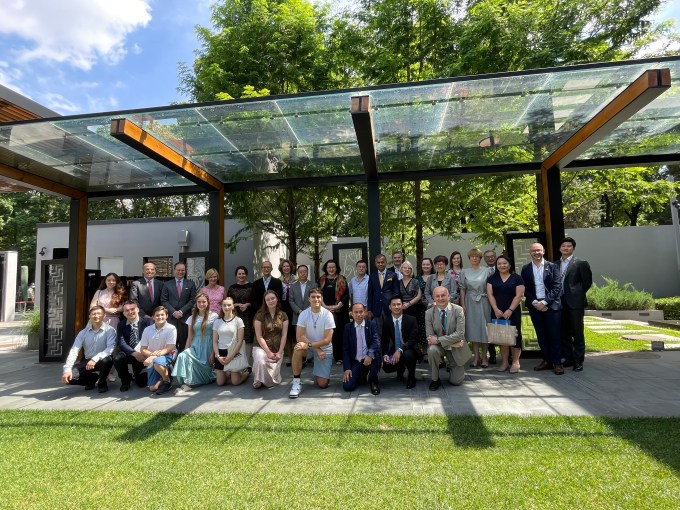
New Zealand Embassy in Beijing hosts “Friends of the Flyway”
On Thursday 15 August 2024, to celebrate National Ecology Day, the New Zealand Ambassador in Beijing, Grahame Morton, hosted a ‘friends of the flyway’ event to celebrate the migratory shorebirds that connect New Zealand with Siberia and Alaska via China’s Yellow Sea.
Just last month, Yalu Jiang Estuary in Liaoning Province was inscribed as a World Heritage Site in recognition of its importance to migratory shorebirds, and the Deputy Mayor of Dandong, the city that administers these vital inter-tidal mudflats, participated in the NZ Embassy’s event alongside senior government officials from China’s Ministry of Ecology and Environment, senior diplomats from flyway countries and the Ambassadors for Nature initiative and international organisations such as the UN and Asian Development Bank.

It was an opportunity to celebrate the biodiversity that connects communities, cities, countries and even continents. The story of one particular shorebird – the Bar-tailed Godwit 斑尾塍鹬 Bān wěi chéng yù (Limosa lapponica baueri) is hard to comprehend. Each spring these birds, known as the “kuaka” by Maoris, set off from non-breeding grounds in New Zealand and head to China’s Yellow Sea, where they take a break and feed up on the rich inter-tidal mudflats, before the second part of their journey from China to Alaska to breed.
Incredibly, after breeding, these birds make a non-stop c11,000km flight from Alaska direct to New Zealand. Scientists used to think it was impossible for a bird of its size to make such a non-stop journey and when satellite tracking proved that was the case, they were baffled. Studies in Alaska revealed something remarkable. Before setting off, these birds are effectively an eating machine. They double their bodyweight to put on fat, the fuel for their journey. But even more remarkable is that, just before leaving, they shrink their digestive organs as they won’t need them for 7 days and 7 nights (excess weight) and their heart and pectoral muscles almost double in size to power their flight. They literally transform themselves from an eating machine to a flying machine. Then, on arrival after their 11,000km journey, they regenerate their digestive organs, their heart and pectoral muscles shrink back to normal size, transforming themselves back to an eating machine.

Migratory shorebirds are not only incredible athletes; they inspire us, they fill us with awe and connect people and places. Protecting them requires coordinated action on the breeding grounds, non-breeding grounds and all the places they need along the way. That is why, in the context of the global biodiversity crisis, the New Zealand Embassy should be congratulated for elevating biodiversity and, in particular migratory birds, as a pillar of their bilateral and multilateral relationships.
There are long-standing bilateral agreements between New Zealand and China on migratory shorebirds and, on Thursday evening, there was some discussion about the potential to build on that work to begin formal trilateral cooperation between New Zealand (non-breeding grounds), China (stopover sites) and the United States (breeding grounds) based on the Bar-tailed Godwit migration. Such cooperation could promote joint scientific projects through academic institutions, building international co-stewardship programs (e.g. including partnering with existing ranger programs), connecting schools and twinning towns and cities in the three countries.
More broadly, trialteral cooperation could support multiple objectives, including:
- Demonstrating how international cooperation is vital to manage the risks of global
biodiversity loss and to implement the goals of the Kunming-Montreal Global Biodiversity Framework - Building bridges between countries, communities and local people across continents
that create the foundation for scientific, cultural and political cooperation - Setting a leadership example for other countries to follow
- Elevating biodiversity and bio-cultural conservation to the level of leaders and attracting international media coverage
Congratulations to the New Zealand Ambassador for the successful event and, let’s hope the seeds of trilateral cooperation sowed at the event will flourish into groundbreaking NZ-China-US cooperation!
All photos courtesy of the New Zealand Embassy in Beijing.
- Demonstrating how international cooperation is vital to manage the risks of global
-
“Ambassadors for Nature” initiative kicks off in Beijing
Last September Clare Fearnley, the New Zealand Ambassador to China, hosted a fantastic event called “Friends of the Flyway“, inviting Beijing-based ambassadors from the East Asian-Australasian Flyway countries to celebrate their shared natural heritage. It was a wonderful way to raise the profile of the Flyway and put migratory birds on the foreign policy agenda.
At that event there was a discussion about how embassies could do more to promote migratory birds and biodiversity in general. Recognising that diplomatic premises are important green spaces, one idea was to start an initiative to encourage embassies in Beijing to manage their green spaces in a more friendly way for nature. Clare loved the idea and with her usual enthusiasm and drive, pulled together a few contacts and experts to develop some draft terms of reference:
Embassies and their grounds can be important refuges for urban wildlife. In recognition of the global biodiversity crisis, the Global Biodiversity Framework due to be agreed at COP15 in 2022, and the importance of contributions from all sectors of society we, as ambassadors in Beijing, intend to support nature. Our Embassies will make choices that advance biodiversity. For example, we will seek to:
– Undertake an audit of the wildlife in the grounds of the embassy and other diplomatic premises at least once in each season of the year (this can take as little as one hour per season, ideally on the same date and at the same time to enable comparisons over time);
– Keep records of wildlife sightings by staff
– When planting, choose native species of tree, shrubs and other plants. We will also assess the plant species already on the embassy grounds and, where practical, over time remove non-native species
– Take at least two of the following measures to support wildlife:
o Reduce and, as far as possible, eliminate the use of pesticides;
o Allocate an area (for example, 10% of the overall area) that can be kept ‘wild’ with minimal management and erect signage explaining this to residents and visitors;
o Make and erect nest boxes for birds and/or insect hotels;
o Help to reduce the risk of bird collisions with glass by using bird-safe glass, ultraviolet patterns or other mitigation measures.
– Promote awareness among diplomatic staff about biodiversity, including information about urban wildlife that can be found in Beijing, and the actions the embassy is taking to support nature.
– Nominate a point of contact responsible for this initiative who can report to the network on the actions of the embassy, arrange the audits and report records of wildlife.Fast forward to Wednesday 6 July and the New Zealand embassy hosted the first meeting of the “Ambassadors for Nature” initiative. Ambassadors and senior diplomats participated from Belgium, Cambodia, Canada, Croatia, Finland, Indonesia, Ireland, Japan, Latvia, Norway, Peru, Romania, Singapore, Slovenia, UK and the United Nations, alongside the Deputy Head of Beijing’s Forest and Parks Bureau (responsible for managing 70% of Beijing’s land), Professor Lu Zhi of Peking University and Professor Yolanda Van Heezik of Otago University and a group of young people from diplomatic families.

The energy in the room was palpable with wholehearted support for the initiative and a raft of positive suggestions about how to take it forward. Already sessions are being planned to provide training on how to conduct surveys of wildlife, tailored resources about the wildlife to be expected in Beijing city centre, and lists of native plant and tree species to guide diplomatic gardeners. The Beijing Municipal government offered to host a field trip for ambassadors to showcase Beijing’s biodiversity and WeChat groups have been set up to bring together contact points from each embassy, as well as plans to outreach to more embassies to encourage them to join.
There was even a suggestion that, once up and running, ambassadors could promote the initiative with their capitals to encourage ALL embassies and other diplomatic representations overseas to follow suit. Just imagine, for example, if all of the UK’s 160 embassies and high commissions overseas (as well as 186 consulates) committed to do the same. That would add up to quite a significant area of land!
It’s heartening to see this initiative getting off the ground and huge kudos must go to the New Zealand Embassy, especially Ambassador Clare Fearnley and Svar Barrington, for ensuring an idea discussed over coffee last year is coming to fruition – it is a terrific way for Ministries of Foreign Affairs to make a practical contribution towards the goals of the forthcoming Global Biodiversity Framework, due to be agreed by more than 190 countries at the UN Convention on Biological Diversity meeting (COP15) in Montreal in December.
-

New Zealand Ambassador to China hosts “Friends of the Flyway”
It’s easy to get caught up in the doom and gloom that seems to be prevalent right now. But every now and then, something happens that provides a shot in the arm.. an event or moment that inspires and provides hope.
16 September at the New Zealand Embassy in Beijing was one of those moments. Clare Fearnley, the brilliant New Zealand Ambassador to China, hosted the inaugural ‘Friends of the Flyway’ to celebrate the migratory birds of the East Asian-Australasian Flyway, bringing together ambassadors and senior diplomats from the 22 countries that make up the East Asian-Australasian Flyway Partnership, the secretariat of the EAAFP, senior Chinese government officials, including the Deputy Administrator of the National Forestry and Grassland Administration, the Ministry of Foreign Affairs, the Deputy Mayor of Dandong (stewards of Yalu Jiang, dubbed a “five-star” service station on the shorebird expressway), academics and ‘friends’.
Not only did the event provide an opportunity to celebrate and raise awareness of the flyway among ambassadors and senior diplomats, elevating migratory birds as a foreign policy issue, but it also stimulated ideas and discussions, resulting in a few potential new initiatives, such as managing embassy grounds as ‘wildlife areas’ with embassies signing up to commitments to monitor birds and other wildlife, and to make changes to management practices to improve the habitat for resident and migratory birds. A birding trip to the coast next May, for Ambassadors to experience the spring migration, is on the cards, and ‘bird-friendly’ glass, painted with ultraviolet patterns, was showcased by local artists as part of the solution to bird collisions (thought to cause the deaths of up to a billion birds in North America annually, with a new research project now starting in China to assess the scale of the issue here).
In her opening, Clare told the story of the ‘Kuaka’, the Māori name for the Bar-tailed Godwit, that has such a special place in their culture. The Kuaka is considered to be the link between the northern and southern hemispheres, a carrier of knowledge and the bringer of positive messages. For Māoris they were birds of mystery, (‘Kua kite te kohanga kuaka? Who has seen the nest of the kuaka?’).

Clare Fearnley, New Zealand Ambassador to China, delivering her welcome remarks to the “Friends of the Flyway” on 16 September. Nearly all New Zealand Bar-tailed Godwits are from the baueri subspecies and breed in western Alaska. Their incredible migration forms a triangle. Following the breeding season, these birds make an almost incomprehensible non-stop eight or nine day flight of more than 11,000km to New Zealand, only recently discovered through the tracking of “E7” in 2007. After spending the non-breeding season in New Zealand, they begin their northern migration from early March, heading for refuelling sites around the Yellow Sea, many to the Yalu Jiang in Dandong, where they fatten up at this five-star service station for the last leg of the journey to Alaska.

Professor Lei Guangchun of Beijing Forestry University tells the story of “E7”, the Bar-tailed Godwit that flew non-stop from Alaska to New Zealand revealing the incredible migration of this species for the first time. Migratory birds do not respect international borders and, over a calendar year, many will visit multiple countries as they move from breeding grounds to non-breeding grounds via stopover sites. It follows, therefore, that no single country can secure the future of these birds on its own. With shared natural heritage comes a shared responsibility and, as we are in the midst of one of the greatest extinction events on Earth, and the first to be driven by humans, it is vital that the international response must go beyond national actions to protect key habitats and species, important though these actions are, to involve sustained and coordinated international cooperation.

Tan Guangming, Deputy Director of the National Forestry and Grassland Administration, delivering his remarks at the “Friends of the Flyway” event on 16 September. The East Asian-Australasian Flyway is a bird ‘superhighway’ for more than 50 million waterbirds, including 35 globally threatened species, many of which commute between breeding grounds in the far north, some inside the Arctic Circle, and non-breeding grounds in the southern hemisphere. Many travel as far as Australia and New Zealand. However, it is not only the ‘ends of the flyway’ – the breeding grounds in Artic Russia and the non-breeding grounds in Australia and New Zealand that are important. The commute relies on stopover sites, particularly those in the Yellow Sea.
That is why this initiative – bringing together ambassadors from flyway countries with senior Chinese government officials – was so important. It is now hoped (expected?) that ambassadors from other Flyway countries will host similar events, celebrating particular aspects of the Flyway or specific species and sites, whilst helping to nurture and strengthen international cooperation along this important route for migratory birds.
Huge kudos to Clare and her team, especially Svar Barrington and Hayley Anderson, for initiating this event and for the New Zealand embassy’s ongoing leadership in putting biodiversity high up on the agenda for foreign policy and diplomacy.
Header photo: Clare Fearnley, New Zealand Ambassador to China, welcoming Tan Guangming, Deputy Director of the National Forestry and Grassland Administration.