Spring is when nature puts its foot on the gas. Plants and insects emerge, migratory birds race to their breeding grounds, and mammals take advantage of the bounty to raise the next generation. Amphibians are no different — and this spring I put some effort into learning more about Beijing’s eight species of frog and toad, six native and two introduced.
Of the native species, the most common are the Dark-spotted Frog Pelophylax nigromaculatus 黑斑侧褶蛙 and the Asiatic Toad Bufo gargarizans 中华大蟾蜍, both widely seen in urban Beijing, including in many city parks.
Frogs encountered in the mountains and hills — Huairou, Miyun, Mentougou — will most likely be the Taihang Brown Frog Rana taihangensis 太行林蛙, a species commonly found along mountain streams.
The Beijing Gold-striped Frog Pelophylax plancyi 金线侧褶蛙 is much less common but turns up in some of the larger parks, such as Yuanmingyuan (the Old Summer Palace).
The charismatic Boreal Digging Frog Kaloula borealis 北方狭口蛙 is closely tied to the summer monsoon, emerging en masse after the first heavy rains — usually in July — to breed in temporary pools before they dry up in late summer.
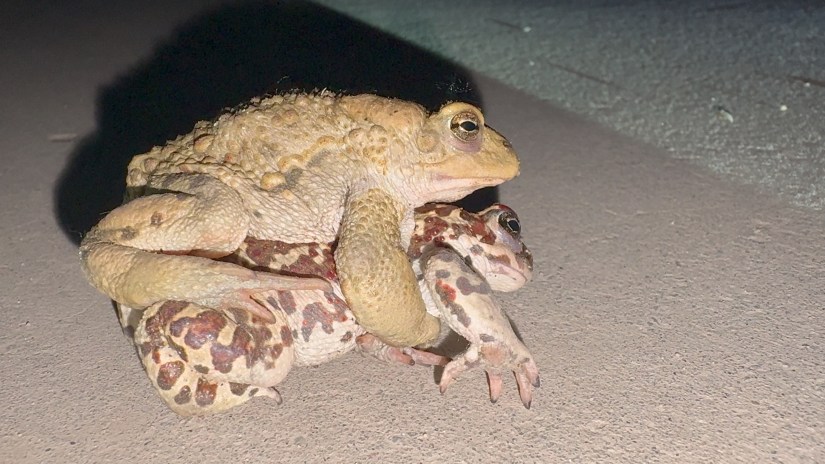
The Mongolian Toad Strauchbufo raddei 花背蟾蜍 is found at only a few sites in the capital. It prefers drier, sandy habitats and is most frequently encountered in Yanqing District.
Beijing also has two introduced amphibian species. The American Bullfrog Rana catesbeiana 美洲牛蛙 turns up occasionally in the city — I’ve heard its unmistakeable loud, vibrating call several times along the Wenyu River.
Audio: American Bullfrog calling, Wenyu River, June 2020.
The Oriental Fire-bellied Toad Bombina orientalis 东方铃蟾 has a more interesting backstory. Native to Korea, far northeast China, southeast Russia, and Shandong Province, it was introduced to Beijing in 1927 by the herpetologist Liu Chengzhao, who collected around 200 individuals from Yantai in Shandong and released them at Peking University and the Botanical Gardens. Their descendants are thriving today at the Beijing Botanical Garden, Baiwangshan, and the Fragrant Hills (Xiangshan) area.
This spring I spent time getting to know two of the scarcer species — the Mongolian Toad in Yanqing District and the Oriental Fire-bellied Toad at Xishan Forest Park — and recorded their distinctive calls.
Audio: Mongolian Toad, Yanqing District
Audio: Oriental Fire-bellied Toad, Xishan Forest Park
I’m particularly fond of the soft calls of the Oriental Fire-bellied Toad. Its Chinese name, 东方铃蟾, translates literally as “Oriental Bell Toad” — and while the call may not quite resemble a chime, it’s certainly easy on the ears.
For more on Beijing’s amphibians, visit A Guide to the Amphibians of Beijing and consider picking up Scott Lupien’s recently published field guide to the Reptiles and Amphibians of Beijing.
Title image: Mongolian Toad Strauchbufo raddei 花背蟾蜍 Huā bèi chánchú in amplex, Yanqing District, April 2026.
Leave a Reply