Local dragonfly reserve established in Beijing

On Monday this week I received a message from the Shunyi Forest and Parks Bureau asking when I had some time to meet.  They said they had something to show me.

We arranged to meet on Thursday morning and I was a little intrigued.  They collected me from my apartment and drove me to a small park close by, a place that I had highlighted to them some time ago as a good place for dragonflies and that provided a potential opportunity to set up a community dragonfly reserve.

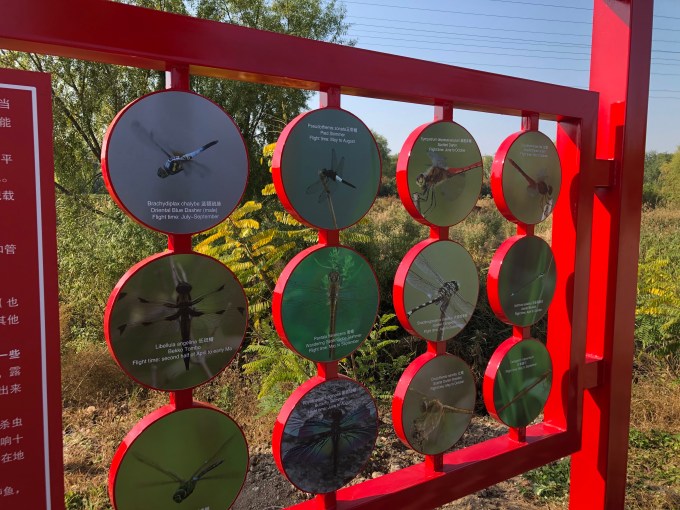
As we parked up and walked in, I could immediately see a new addition to this small green space – a large information board with pictures of 24 dragonfly and damselfly species that have been recorded there, with text about dragonflies’ life-cycle and why they are important.  Wow!

The information board with photos of the 24 species of dragonfly and damselfly recorded at the site, including a special emphasis on the critically endangered Libellula angelina, 24 October 2024.

This small green space, about 20 minutes walk from my apartment, is a place I visit every month. Two years ago, I was fortunate to discover a small breeding population of the critically endangered Libellula angelina 低斑蜻  Dī bān qīng.  There are only a handful of known sites for this species in the capital and it has clearly declined significantly over the last few decades.  Given that the species is on the wing only in April and early May, it is easily overlooked.  The following summer I discovered a small population of Brachydiplax chalybea 蓝额疏脉蜻 Lán é shū mài qīng (Oriental Blue Dasher) at the same site, a species that historically was found only to the south of Beijing and with only very few records in the capital.  Together with a good variety of more common resident species, it was clear that this site was an exceptionally good place for dragonflies and damselflies (Odonata).

The discoveries inspired me to draft a short proposal to make this small urban wetland a dedicated dragonfly reserve, with suggestions on how to manage the habitat effectively to protect these fantastic insects. I submitted it to the local government with low expectations but I took the view that it was worth the effort to try to raise awareness about the special wildlife we have around us in a relatively urban part of the city.

I am overjoyed that the local government has decided to take up the recommendations.

In the proposal, I listed the species I had recorded, illustrated with photos taken at the site, and highlighted the two rare species, especially the critically endangered Libellula angelina.  They used the images to illustrate the information board and have included background about Libellula angelina to help raise awareness that this community has something special in their backyard.

Internationally, there is a lot of emphasis on officially protected areas to help protect biodiversity and, under the new Global Biodiversity Framework, there is a headline global target to protect at least 30 per cent of terrestrial and inland water areas, and at least 30 per cent of marine and coastal areas by 2030, but it is arguably equally as important to manage non-protected areas in a way that is more friendly for biodiversity, and I hope that this example from Shunyi District in Beijing will inspire other districts and towns to follow suit.  As far as we know, it is the first local dragonfly reserve in Beijing and, possibly, in all of China.

Big thanks to the local government in Houshayu, Shunyi District, and to friends at Shandong University for their help with the habitat recommendations.
 

The Dragonflies and Damselflies of Beijing

Summer is a good time to experience the wealth of Odonata (dragonflies and damselflies) that grace our local patches and, given the birding is usually relatively quiet at this season, the number of insect enthusiasts is often swelled by birders for a couple of months of the year.

It’s overdue to include information on Birding Beijing about these flying insects and so I am pleased to finally publish a dedicated page, accessible from the main menu.  The page includes a downloadable PDF of the 60 species of dragonfly and damselfly to be found in Beijing, including scientific, Chinese (including pinyin) and English common names where available. 

I am planning to supplement the list with images taken in the capital, slowly building up a library of images showing the different sexes and ages.  The image gallery currently has only eight species, so there is much room for expansion!  If you have any images of Odonata from Beijing that you are willing to share, particularly of species not yet illustrated, please contact me using the form on the dedicated page.

Special thanks you to Yue Ying who provided a list of species found in Beijing.  


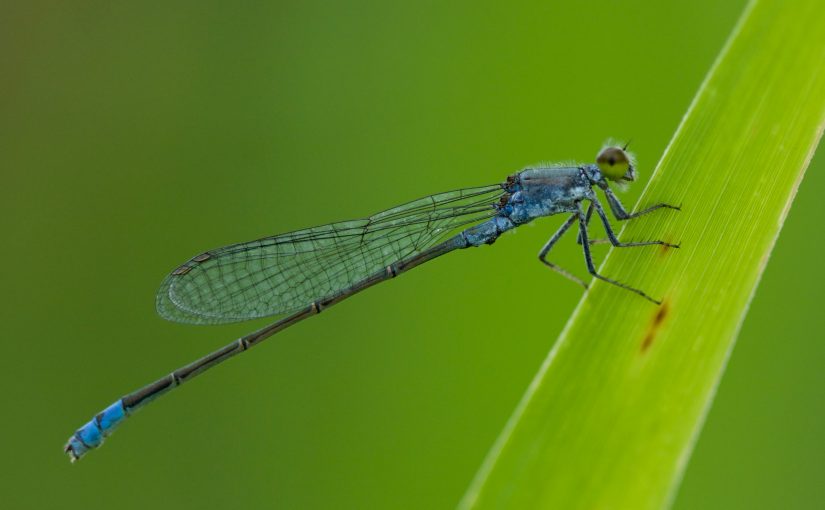
Title image: a Dusky Lilysquatter, Paracercion calamorum dyeri,  苇尾蟌, in the Olympic Forest Park, 26 June 2020 (Terry Townshend)


Summer lovin’

With summer upon us, Beijing is now hot and humid.  As well as the heat, July and August are also the months that see the highest rainfall in the capital, mostly from the frequent spectacular thunderstorms.  Air conditioning units are humming all over the city and one can sense the pace of life slowing, just a little, as its people cope with the energy-sapping heat.   It is uncomfortable to be in the field for any length of time now and this, coupled with the relative quiet birding around the capital at this time of year, has meant that I have not been out as much as normal.

On Sunday, I decided to change that by checking out Yeyahu to see how the breeding birds were doing and to look for butterflies and dragonflies.  It was a murky day but as the bus from Beijing made its way over the mountains near Badaling Great Wall, it began to clear a little..  Liyan, my trusty driver, met me at Yanqing and, 15 minutes later, I was at Yeyahu Nature Reserve.  My plan was to spend the afternoon and evening on site and catch the last bus back to Beijing..  but that was immediately scuppered when I discovered that the last bus back was at the very early time of 1830.  Instead I decided to catch the last train at 2130, so I arranged for Liyan to pick me up at 8.30pm, giving me 5 hours on site.

There was a constant threat of thunderstorms – distant rumbles were a feature of the day – but thankfully I managed to avoid the main storms that seemed to keep to the mountains.  And, despite the heat and humidity, I enjoyed the walk around the reserve.  As usual, there were a lot of Beijing’s city-dwellers enjoying the boardwalk on the lake but, true to form, none of them took the trails around the wider reserve, leaving me to enjoy the greater part of the reserve on my own.  Activity was generally slow, as expected, but it was very cool to see evidence of breeding Amur Falcons and Eastern Marsh Harriers.  I saw two adult male Amurs taking food to a small copse to the north of the reserve and there were two recently-fledged juvenile Eastern Marsh Harriers wheeling around waiting for the parents to bring food.  I watched two food passes by the adult male harrier; both juveniles became very excited, calling constantly as the male approached, before the male rose, waited for the juveniles to take up position below and then dropped the catch.  The first, possibly a small rodent, was expertly caught in mid-air by one of the young birds but the second, what looked like a young Moorhen, was missed and fell into the reedbed, whereby both juveniles swooped in, squabbling over their evening meal.  Fun to watch.  Chinese Penduline Tits were feeding young in their spectacular nest and young Great Crested and Little Grebes were begging from their parents on the lake.  A pair of Common Terns (of the subspecies longipennis) patrolled the ponds and they were joined briefly by a Whiskered Tern and then a White-winged Tern, before the latter disappeared off to the west towards the reservoir.

The reedbeds were noticeably quieter than in June with just a handful of Oriental Reed Warblers making half-hearted efforts at singing; the constant to-ing and fro-ing of the adults carrying food was clearly the priority now.  At least 4 pairs of Purple Herons appeared to be feeding young in the large reedbed to the west and I encountered a family party of Chinese Hill Warblers to the north.  Several pairs of Richard’s Pipits were feeding young in the grassland to the north of the lake and a few Zitting Cisticolas called frequently.  A pair of Black Drongos chirped and made forays to catch flying insects from their base in a willow hedgerow and both Night and Chinese Pond Herons busied themselves carrying food back and forth.

There were good numbers of butterflies, dragonflies and damselflies on the wing.  I had deliberately taken my macro lens to try to photograph some of them but, being a complete novice with these insects, I cannot identify any of them!  There isn’t a field guide for this part of the world, so putting a name to these beasts isn’t easy.  There is a good website – Asia Dragonfly – with a comprehensive library of photographs.  But it’s still very difficult!

Here are a few photos of the local specialties…  any help with identification much appreciated…

Photo 1: possibly Orthetrum albistylum specisum
Photo 2: same as above
Photo 3: a beautiful dragonfly... Possibly Crocothemis servilia?
Photo 4: probably a Sympetrum sp?
Photo 5: Cercion plagiosum
Photo 6: probably a female Cercion plagiosum?
Photo 7: some sort of chaser.. maybe Deilia phaon?
Photo 8: Antlion sp
Photo 9: beetle sp. I couldn't resist taking a photo of this impressive little bug. You can even see my reflection is his shiny body armour!

I hung around until dusk, hoping for a calling crake or watercock but no luck…  probably a bit late in the season for them to be calling frequently.  My last birds of the day were a calling Eurasian Cuckoo and a Grey-headed Woodpecker that I flushed from the path.  As the mosquitos began to bite, I made my way to the entrance of the reserve to rendez-vous with Liyan.  The last train was delayed so I did not get back to Beijing until after midnight but for only 7 Yuan (70 pence), I couldn’t really complain too much about the journey!