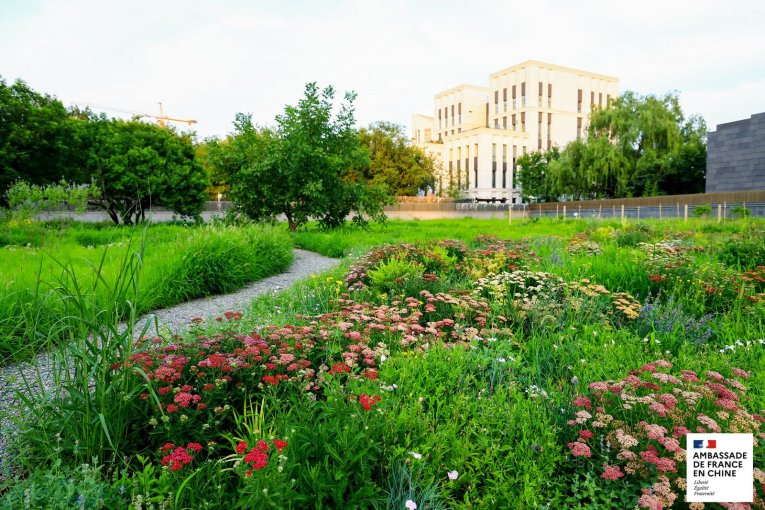
French Embassy Launches Biodiversity Garden

Some great news from Beijing!

The French Embassy in China has officially opened its Biodiversity Garden, a 3,600m² urban green space created to enhance ecological resilience and environmental awareness within the city. Launched under France’s Green Embassy initiative — a program driven by the Ministry for Europe and Foreign Affairs to reduce the environmental footprint of French diplomatic missions —  the project transforms a former unused land lot into a biodiversity sanctuary for over 100 plant species, many of them native or endangered.

The project, developed in partnership with the Institute of Botany of the Chinese Academy of Sciences, not only fosters biodiversity in an urban setting but also provides a model for nature-based solutions to climate challenges, including urban cooling, improved air quality, and water retention. It also highlights the importance of international scientific cooperation – in this case between France and China – to tackle global challenges such as climate change and the protection of biodiversity.

The initiative also forms an integral part of the Ambassadors for Nature pledge, reaffirming the Embassy’s commitment to biodiversity protection and sustainable urban living. Through this garden, France further seeks to carry forward the commitments successfully achieved in 2015 with the Paris Agreement on Climate Change, whose tenth anniversary is being marked this year as well as the upcoming COP 30 taking place in Belem. By joining this collective diplomatic effort in Beijing, the French Embassy underscores the importance of international cooperation in addressing environmental challenges.

Together, these initiatives reflect a shared ambition to accelerate the ecological transition, promote science-driven solutions, and contribute meaningfully to the protection of our planet’s biodiversity.

H.E. Bertrand Lortholary, French Ambassador to China, inspects the new biodiversity garden.

Big congratulations to the French Embassy and, in particular H.E. Ambassador Bertrand Lortholary, for the leadership.  The project demonstrates how we can all do something to support nature in our own communities, and I am certain it will inspire others to act!

Click on the link to read more about the Ambassadors for Nature initiative.
Local dragonfly reserve established in Beijing

On Monday this week I received a message from the Shunyi Forest and Parks Bureau asking when I had some time to meet.  They said they had something to show me.

We arranged to meet on Thursday morning and I was a little intrigued.  They collected me from my apartment and drove me to a small park close by, a place that I had highlighted to them some time ago as a good place for dragonflies and that provided a potential opportunity to set up a community dragonfly reserve.

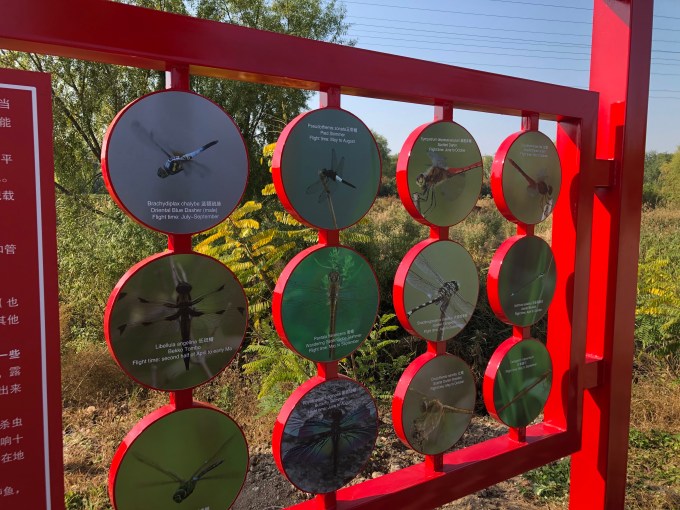
As we parked up and walked in, I could immediately see a new addition to this small green space – a large information board with pictures of 24 dragonfly and damselfly species that have been recorded there, with text about dragonflies’ life-cycle and why they are important.  Wow!

The information board with photos of the 24 species of dragonfly and damselfly recorded at the site, including a special emphasis on the critically endangered Libellula angelina, 24 October 2024.

This small green space, about 20 minutes walk from my apartment, is a place I visit every month. Two years ago, I was fortunate to discover a small breeding population of the critically endangered Libellula angelina 低斑蜻  Dī bān qīng.  There are only a handful of known sites for this species in the capital and it has clearly declined significantly over the last few decades.  Given that the species is on the wing only in April and early May, it is easily overlooked.  The following summer I discovered a small population of Brachydiplax chalybea 蓝额疏脉蜻 Lán é shū mài qīng (Oriental Blue Dasher) at the same site, a species that historically was found only to the south of Beijing and with only very few records in the capital.  Together with a good variety of more common resident species, it was clear that this site was an exceptionally good place for dragonflies and damselflies (Odonata).

The discoveries inspired me to draft a short proposal to make this small urban wetland a dedicated dragonfly reserve, with suggestions on how to manage the habitat effectively to protect these fantastic insects. I submitted it to the local government with low expectations but I took the view that it was worth the effort to try to raise awareness about the special wildlife we have around us in a relatively urban part of the city.

I am overjoyed that the local government has decided to take up the recommendations.

In the proposal, I listed the species I had recorded, illustrated with photos taken at the site, and highlighted the two rare species, especially the critically endangered Libellula angelina.  They used the images to illustrate the information board and have included background about Libellula angelina to help raise awareness that this community has something special in their backyard.

Internationally, there is a lot of emphasis on officially protected areas to help protect biodiversity and, under the new Global Biodiversity Framework, there is a headline global target to protect at least 30 per cent of terrestrial and inland water areas, and at least 30 per cent of marine and coastal areas by 2030, but it is arguably equally as important to manage non-protected areas in a way that is more friendly for biodiversity, and I hope that this example from Shunyi District in Beijing will inspire other districts and towns to follow suit.  As far as we know, it is the first local dragonfly reserve in Beijing and, possibly, in all of China.

Big thanks to the local government in Houshayu, Shunyi District, and to friends at Shandong University for their help with the habitat recommendations.