Winter thrushes in Beijing

This winter (2024-2025) is a poor one for some species we consider to be staple winter visitors in Beijing.  Thrush numbers are well down, waxwings are scarce and there are almost no high-elevation redstarts in their usual mountain haunts.  Certainly at Lingshan the sea buckthorn crop, which usually sustains good numbers of thrushes and redstarts, is the worst I have seen.  Not only have few shrubs produced berries this year but those fruit that were gleaming orange at the beginning of autumn are now anaemic and shrivelled.  This is most likely due to the fact that the autumn was wetter and milder than usual which seems to have resulted in most of the fruit succumbing to rot and fungi.

Sea buckthorn berries at Lingshan this winter (January 2025).  Most seem to have rotted in the late autumn period, which was unusually mild and wet.

The best ‘thrush-watching’ this winter has been in the city parks, especially at drinking spots.  Beijing is generally cold and very dry in winter, so after any juicy berries have been exhausted, winter birds tend to feed more on the drier fruits of cypress trees or similar, requiring them to drink frequently.  Finding a spot close to a food source with running water and some cover is the best way to secure good views.

Of the four regular ‘winter thrushes’ in Beijing, Naumann’s (Turdus naumanni 红尾鸫 Hóng wěi dōng) is the most common in lowland Beijing, followed by Red-throated (Turdus ruficollis 赤颈鸫 Chì jǐng dōng), Dusky (Turdus eunomus 斑鸫 Bān dōng) and the scarce Black-throated (Turdus atrogularis 黑颈鸫 Hēi jǐng dōng) in order of abundance.  In the mountains, the top two are reversed, with Red-throated the most abundant, followed by Naumann’s, Dusky and Black-throated.

This winter I have spent a bit of time at two regular spots for winter thrushes – Beihai Park and the Botanical Gardens.  Although numbers have been relatively low, there has still been a reasonable variety, with some interesting mixes of genes on display.  In Beijing it is common to see intergrades, most often between Naumann’s and Dusky and occasionally with the other species.  However, as Beijing is a wintering area for these thrushes, we have no way of knowing the true parentage of any individual bird and thus we can only make educated guesses as to the origins based on visible plumage details.

Here are a few images, mostly from this winter, with some comments.  As always, comments and corrections are welcome.

First up, some standard Naumann’s Thrushes (Turdus naumanni 红尾鸫 Hóng wěi dōng) 

Naumann’s Thrush Turdus naumanni 红尾鸫 Hóng wěi dōng

8 January 2025, Beihai Park

28 January 2025, Botanical Gardens

28 January 2025, Botanical Gardens

These birds show the classic strongly marked underparts, including undertail coverts and golden-orange fringes to the wing coverts and mantle.  I speculate that the bird in the second image is likely a female based on off-white supercilium and dark spotting on throat sides.


Red-throated Thrush Turdus ruficollis 赤颈鸫 Chì jǐng dōng

28 January 2025, Botanical Gardens

8 January 2025, Beihai Park

8 January 2025, Beihai Park

Note the much plainer upperparts, lacking the golden fringes, plainer face and relatively plain underparts, including the undertail coverts.  


Dusky Thrush Turdus eunomus 斑鸫 Bān dōng

8 January 2025, Beihai Park

8 January 2025, Beihai Park

8 January 2025, Beihai Park

Note black crescents on the underparts, as well as rufous on the wings, dark tail and broad, long white supercilium.


Black-throated Thrush Turdus atrogularis 黑颈鸫 Hēi jǐng dōng

I have very few images of Black-throated Thrush Turdus atrogularis 黑颈鸫 Hēi jǐng dōng from Beijing, reflecting the relative scarcity of this species in the capital. 

This one from Peking University campus in January 2013.


Intergrades

The following images are of birds that show signs of intergradation.  I have added some comments to each and welcome opinions.

Dusky x Naumann’s

By far the most common intergrade in Beijing.

8 January 2025, Beihai Park

This bird is presumably a Dusky x Naumann’s intergrade, showing a mixture of blackish and reddish underpart markings, a long, broad dusky-like supercilium and Naumann’s-like mantle and scapulars.

28 January 2025, Botanical Gardens

This bird looks Dusky-like on first glance but on closer inspection shows prominent reddish markings on the underparts and undertail coverts, most likely evidence of some Naumann’s genes.

5 February 2025, Botanical Gardens

5 February 2025, Botanical Gardens

The two above could easily pass for Dusky Thrushes on first glance but, again, close inspection in particular of the second image, reveals reddish markings on the undertail coverts.

Black-throated x Red-throated

5 February 2025, Botanical Gardens

With a mixture of red and black feathers on the upper breast, this is presumably a Red-throated x Black-throated.  

5 February 2025, Botanical Gardens

Whilst some dark markings on the throat and upper breast can be indicative of young or female birds, this bird shows some black feathers mixed with red on the lower part of the gorget, suggesting intergradation.

5 February 2025, Botanical Gardens

This bird shows darker red feathers than usual.  Is this an intergrade with Black-throated or just a variation in Red-throated?

5 February 2025

This bird shows predominantly blackish feathers on the gorget but the undertail and undertail coverts are reddish, ruling out a pure Black-throated.  The rather heavy marks on the undertail coverts may be indicative of Naumann’s genes.

Black-throated x Naumann’s?

28 January 2025, Botanical Gardens

This striking bird is wintering in the Botanical Gardens and is presumably a Black-throated x Naumann’s intergrade.  The obvious black upper breast pattern combined with the Naumann’s like flanks and tail suggest this combination.  

5 February 2025, Botanical Gardens

5 February 2025, Botanical Gardens

Two more images of the same bird showing the flank pattern and undertail coverts.


Red-throated x Naumann’s?

25 December 2021, Botanical Gardens

The denisty of red on the upper breast of this bird, combined with the relatively plain head pattern, may indicate Red-throated genes, while the flanks and reddish panel on the wing suggest Naumann’s.  


Red-throated x Dusky?

The images below are from Beihai Park in January 2021. If only the head and breast pattern are considered, my best guess would be a Red-throated x Black-throated Thrush but the rufous wings suggest Dusky or Naumann’s influence.  A Red-throated x Dusky may make most sense here. 

18 January, 2021, Beihai Park

18 January 2021, Beihai Park


First generation intergrades are probably, in most cases, relatively easy to work out but there must be all sorts of combinations of second and third generation birds, and beyond, out there.

Watching winter thrushes in Beijing is always rewarding.  Whether pure or intergrades, the majority are striking birds and a joy to spend time with, even if sometimes we can’t know for sure what we are looking at!
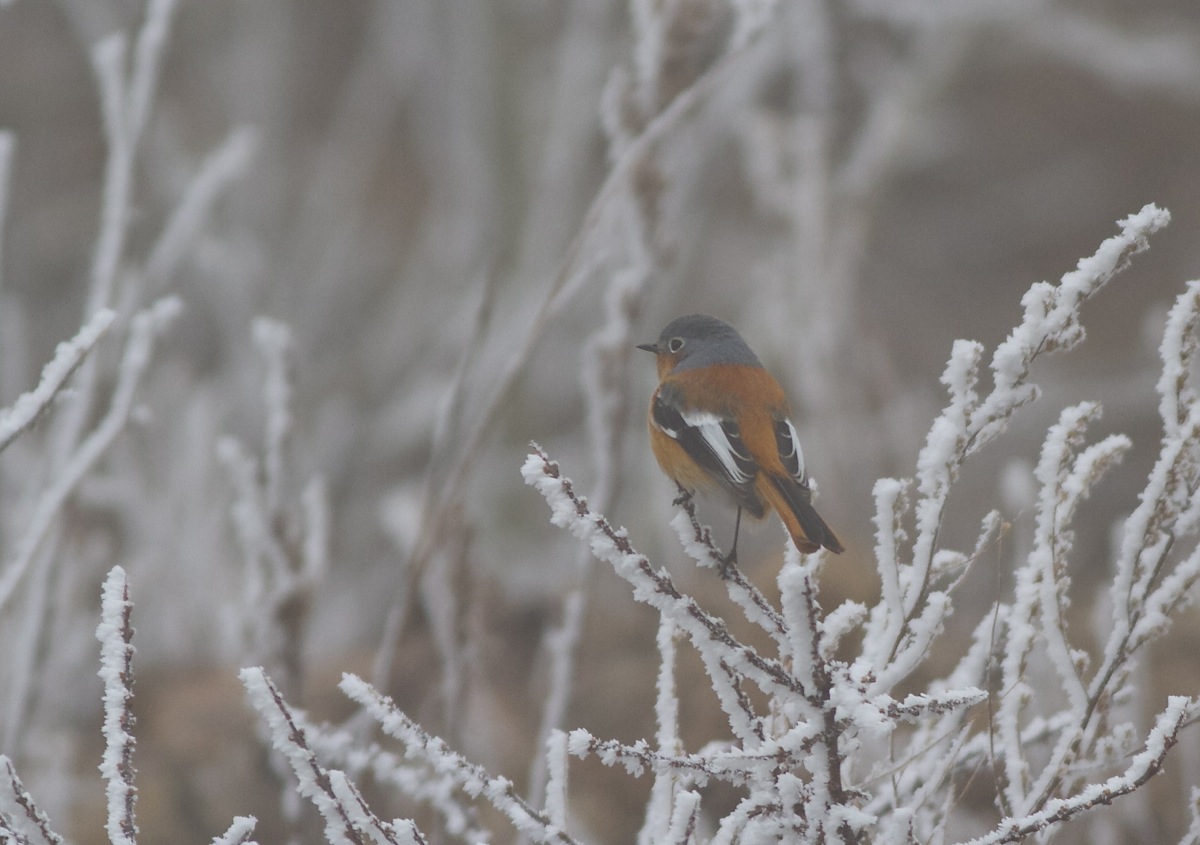


Winter is coming…

It’s that time of year again.  As temperatures plummet and the days shorten, many people might think it’s time to stay indoors with a real fire, put on that favourite woolly jumper and sip a warm cup of (green) tea.  However, for birders, it’s worth putting on the thermal underwear and braving those icy temperatures – winter can be a brilliant time.

Here are five reasons why winter is a good time for birding in Beijing:

  • First, with the leaves down, birds are easier to observe
  • Second, winter is the only time we can see certain species (for example, those that breed to the north of Beijing, including as far north as Mongolia and Russian Siberia, and spend the winter here). These species include: Ruddy Shelduck, Common Crane, White-tailed Eagle, Rough-legged Buzzard, Merlin, Mongolian Lark, the winter thrushes (Naumann’s. Dusky, Red-throated and Black-throated), Goldcrest, Guldenstadt’s Redstart, Siberian Accentor, Brambling, Pallas’s Rosefinch, Japanese Reed Bunting, Lapland Bunting and Pine Bunting.
  • Third, many mountain dwelling species will move lower into the valleys and even into cities in the winter, making them easier to see. For example: Winter Wren, Beijing Babbler, Plain Laughingthrush and Yellow-throated Bunting.
  • Fourth, depending on the seed crops and weather, especially the extent of snowfall, some species ‘irrupt’ in large numbers to areas where they would normally not occur in significant numbers. Pallas’s Sandgrouse, Japanese and Bohemian Waxwings and Redpolls are examples of species that sometimes ‘irrupt’ into Beijing.
  • Finally, there is always a chance of finding something special. The discovery of wintering Jankowski’s Buntings in winter 2015/2016 by Xing Chao and Huang Mujiao was exceptional.  Who knows what else might occur – maybe a Snowy Owl at Lingshan?  Or a Gyrfalcon at Ma Chang?
2016-03-07 Jankowski's Bunting, Miyun5
One of the wintering JANKOWSKI’S BUNTINGS at Miyun Reservoir in winter 2015/2016.

The best winter sites?

Most good birding sites in the capital (e.g. Yeyahu, Lingshan, Huairou, Miyun and Shahe Reservoirs (if accessible)) are worth visiting all year round.  And, within the city itself, the Botanical Gardens, with its berry-laden shrubs, is often one of the first sites to host groups of Japanese or Bohemian Waxwings during a ‘waxwing year’.  The Olympic Forest Park can host Beijing Babbler in winter and is often a good place to see Brown-cheeked Rails and Great Bittern.  It has also played host to some very scarce winter visitors such as ‘caudatus’ Northern Long-tailed Tit and Chiffchaff.  For me, personally, two of the best winter birding sites are Donglingshan and Shidu.

Donglingshan (东灵山)

2015-11-01 Red-throated Thrush male in flight, Lingshan2
Red-throated Thrush usually winters in good numbers at Lingshan.

The site of Beijing’s highest peak (2,303m), around 110km west of the city along the G109, Donglingshan is a superb winter birding site.  It is the only reliable site in Beijing to see the high-altitude specialist, Guldenstadt’s Redstart, and the scarce Pallas’s Rosefinch.  In most winters, tens of the former spend the winter feeding on the sea buckthorn berries in the many gullies and valleys below the peak and small flocks of the latter can be found foraging under stands of silver birch.  Other reliable species here include Chinese Beautiful and Long-tailed Rosefinches (interestingly, the latter are of the subspecies lepidus from central China and not the more northerly ussuriensis that has occurred in other parts of Beijing), not to mention Siberian and Alpine Accentors, good numbers of thrushes, Cinereous Vulture, Golden Eagle and, in some years, Asian Rosy Finch.  Rarities at this time of year have included Lesser Spotted Woodpecker and Black and Przewalski’s (Alashan) Redstarts.

At around 2,000m, a visit to Donglingshan in winter can be bitterly cold, especially if the wind is blowing.  However, if you time your visit on a day with light winds and sunshine, it can be surprisingly pleasant and hugely rewarding.

A downloadable PDF guide for Donglingshan (Lingshan) can be found here.


Shidu (十渡)

A spectacular gorge worthy of a visit in its own right, even without any birds, Shidu is an excellent winter birding destination, offering species that can be hard to see in other parts of the capital.  A road runs through the gorge, crossing several bridges and it’s a good tactic to stop close to the bridges to scan the area.  Shidu is perhaps most famous in birding circles for its Black Storks, a handful of which can be seen feeding alongside the river.  However, many more interesting species are possible.  For the last few years, at least one, sometimes two, Wallcreepers have been reliable near bridge 6.  And Long-billed Plover, Brown Dipper, Crested Kingfisher, Plumbeous Water Redstart, White-capped Water Redstart and Cinereous Vulture are all regular in winter.  Even the spectacular Ibisbill, a species that is increasingly difficult to see in the capital, is possible.  And Solitary Snipe, another difficult-to-see species has also been recorded.

2013-11-23 Wallcreeper, Shidu
Shidu is the best place in Beijing to see Wallcreeper.


Ten Species To Look Out For This Winter

Beijing has many special birds in the colder months and here are a few to look out for.

1.     Merlin This small, compact, falcon can often be seen hunting flocks of small passerines, including buntings and larks.  Open spaces such as Ma Chang (Yanqing) and the edges of reservoirs are good places to look.


2.     Cinereous Vulture  With a wingspan of c3m, this huge bird of prey can be seen in the mountains around Beijing from November to March.  Feeding on carrion, they can often be seen patrolling the ridges of mountainous areas on sunny days, especially when there is a breeze, providing them with lift.


3.     Goldcrest This tiny bird is insectivorous and, somehow, it can find enough food in Beijing in winter.  The larger parks, such as the Botanical Gardens and the Olympic Forest Park, are good places to look.  Focus your search on areas with conifers and listen for their high-pitched calls.
4.     Siberian Accentor This beautiful sparrow-sized bird likes scrubby areas with lots of good undergrowth.  They can be shy but with patience and knowledge of their high-pitched call, searching in the right areas should be successful.  The Botanical Gardens and Donglingshan are two good places to look.


5.     Naumann’s Thrush  Naumann’s is the most common of the four classic ‘winter thrushes’ in Beijing (the others are Dusky, Red-throated and Black-throated).  With its orange-coloured tones, Naumann’s Thrush is a very pretty bird and can often be seen feeding on berries or on the ground in Beijing’s parks.
6.     Japanese Waxwing The beautiful Japanese Waxwing is an annual winter visitor to Beijing in varying numbers.  Sometimes in large flocks, they can strip berries from a bush in minutes.  Listen for their ‘ringing’ calls and look for flocks of birds that have similar silhouettes to starlings.  Can most easily be told from the very similar Bohemian Waxwing by the pinkish, not yellow, tip to the tail.
7.     Winter Wren The charismatic Winter Wren breeds in the mountains around Beijing and, in winter, it moves to lower elevations to escape the harshest winter temperatures.  In winter it can be found in the Botanical Gardens and other large parks, often near water.  The distinctive cocked tail means that it’s unmistakeable.
8.     Brambling The Brambling is a common winter visitor to Beijing.  A sociable bird, it can often be found in flocks feeding on seeds (often beech mast) at the base of trees.  Listen for its upslurred call as flocks wheel around over wooded areas.
9.     Pallas’s Rosefinch A real gem of the Beijing winter, the Pallas’s Rosefinch is one of the most sought after species by foreign birders visiting the capital.  A winter visitor in varying numbers, usually to relatively high elevations, it is most reliably found at Donglingshan in winter.  The ridge above the Botanical Gardens and sites around the Great Wall can also produce this species.  A favourite food is birch mast, so look for stands of silver birch and check the ground around the bases of the trees.
10.  Pallas’s Bunting  A winter visitor in good numbers, the Pallas’s Bunting is one of Beijing’s signature winter birds.  Found in reedbeds and any areas of rank grass and/or scrub, it can be skittish but will sometimes sit on the top of vegetation and utter its sparrow-like call, quite different to that of the similar, but scarcer, Common Reed Bunting and Japanese Reed Bunting.

Of course, the most important thing about going birding is not where you go or what you see but that you enjoy it.  Wishing everyone a wonderful winter’s birding.


Title image: Przewalski’s (Alashan) Redstart, Lingshan, February 2014.

This article has been translated into Chinese and appeared in the Winter edition of the China Birdwatching Society magazine.

Red-throated x Black-throated Thrush

In Beijing in winter we are blessed with good numbers of East Asian thrushes…  In my experience NAUMANN’S (Turdus naumanni) is the most common, followed by RED-THROATED (Turdus ruficollis) and DUSKY (Turdus eunomus) with BLACK-THROATED (Turdus atrogularis) being the most scarce.  It is not uncommon to encounter intergrades, and birds exhibiting features of both NAUMANN’S and DUSKY are frequently encountered (see images at the end of this post).  It is much less common to find birds showing features of both Red-throated and Black-throated.  However, that is exactly what I found on Sunday at Lingshan.

An apparent adult RED-THROATED x BLACK-THROATED THRUSH, Lingshan, 1 March 2015
An apparent adult RED-THROATED x BLACK-THROATED THRUSH, Lingshan, 1 March 2015.  Note the presence of both black and reddish feathers on the throat/upper breast.

Unfortunately I wasn’t able to capture many (any!) good quality photographs but the two I did manage (above) show the unusually-marked throat and upper breast.  A ‘pure’ Red-throated should show reddish orange marks only on the throat and breast with no black.  And Black-throated should show only black or grey markings here, lacking any reddish tones.  This bird clearly shows a mixture, with black dominating the lower part of the throat-patch and red dominating the upper part and the neck surrounds.  I have never seen a bird like this before but it seems reasonable to assume that this is an intergrade between RED-THROATED and BLACK-THROATED.  Although Red x Black-throated Thrushes are rare in Beijing, they are fairly frequent in Central Asia – see here for some information from Kazakhstan.

Vagrant East Asian thrushes, especially first year birds, still cause some identification problems in Europe (e.g. the 2013 Dusky Thrush at Margate in the UK and the recent putative Red-throated Thrush in Finland).  This is because we don’t know for sure the variability of ‘pure’ birds, complicated by the fact that we know they interbreed.  If we are to improve our knowledge, studies must be made on the breeding grounds, away from areas of potential interbreeding, so that we can better understand natural variation of pure species and pin down the tell-tale signs of intergradation. Although birders in Beijing and East Asia have a lot of experience of these thrushes, because we see these birds on the wintering grounds, in some cases we cannot be certain whether or not we are looking at pure birds or intergrades.. This means we are not best-placed to provide anything other than opinions about what we *think* are signs of intergradation based on seeing hundreds, and in some cases, thousands of these beautiful thrushes.

That said, I think we can all agree that the Lingshan bird is an intergrade.  And what a cracker it was!

Just for interest, here are a couple of apparent DUSKY x NAUMANN’S THRUSHES from Beijing.

2013-12-11 Dusky x Naumann's Thrush intergrade, Peking University
Superficially this bird resembles DUSKY THRUSH but look at those red markings on the breast and flanks… a good indicator of NAUMANN’S influence. Peking University, December 2013


2010-11-30 Dusky-Naumann's intergrade
Another bird showing characters of both DUSKY and NAUMANN’S with many reddish marks on the breast and flanks. Botanical Gardens, November 2011.


Jingshan Park

Just north of the Forbidden City lies a very popular park with an artificial hill (sometimes known as Coal Hill). The hill was constructed in the Ming Dynasty entirely from soil excavated in forming the moats of the Imperial Palace and nearby canals. Why was it built? According to the dictates of Feng Shui, it is favourable to site a residence to the south of a nearby hill (and it is also practical, gaining protection from chilly northern winds). The imperial palaces in the other capitals of previous dynasties were situated to the south of a hill. When the capital was moved to Beijing, no such hill existed north of the Forbidden City, so one was constructed. Typical China!

The hill is especially impressive when one considers that all of this material was moved only by manual labour and animal power. Apparently, in 1644, the last emperor of the Ming Dynasty hanged himself here…

Anyway, on that cheery note, about the birds. Earlier this week I received a tip-off that there was a ‘very large’ flock of Waxwings present. So on Friday morning I spent an hour there. As usual in any Chinese public park, there were lots of people – shouting, singing, dancing, exercising, doing Tai Chi, running backwards, playing musical instruments and playing “keepy-uppy” with a sort of large shuttlecock. After wandering around the perimeter I stumbled across the Waxwing flock feeding on junipers and regularly going down to drink from a leaky hosepipe. Given the hosepipes were spraying water everywhere, there was, unusually, a small area without people. I risked a drenching to get a closer look and it soon became apparent that there were at least 50 Waxwings in the group, including some Japanese. Twice a Sparrowhawk wreaked havoc by appearing out of nowhere in its attempts to catch one (unsuccessfully) and each time this happened, the whole flock took to the air, where it became apparent that my estimate was most definitely an underestimate! In the air, I guessed at around 250 birds. Soon they returned and I enjoyed good views as these very vocal birds began to feed again.

The water also attracted other birds in the park including a nice Dusky Thrush, several Naumann’s Thrushes and a Red-throated Thrush as well as Oriental Greenfinches and a couple of Large-billed Crows. A pleasant, if slightly wet, hour…

I quite like this 'arty' image of waxwings in formation...

Two Bohemian Waxwings in 'bomber formation'

Japanese Waxwing, Jingshan Park, 8 April 2011

One of the charismatic and curious Large-billed Crows in Jingshan Park

Waxwings

A Sunday afternoon walk in Ritan Park produced an unexpected flock of at least 35 Waxwings. Unfortunately I didn’t have my binoculars with me but those that I could identify with the naked eye seemed to be of the Bohemian variety. Will try to get another look tomorrow morning to see if there are any Japanese amongst them. Libby also spotted a nice Red-throated Thrush (I’ll make a birder of her yet…!).