Since autumn 2021, in partnership with Peking University and the Asian Infrastructure Investment Bank, Wild Beijing has been involved in a study of nocturnal migration from the roof of the Asian Infrastructure Investment Bank (AIIB) in Beijing.
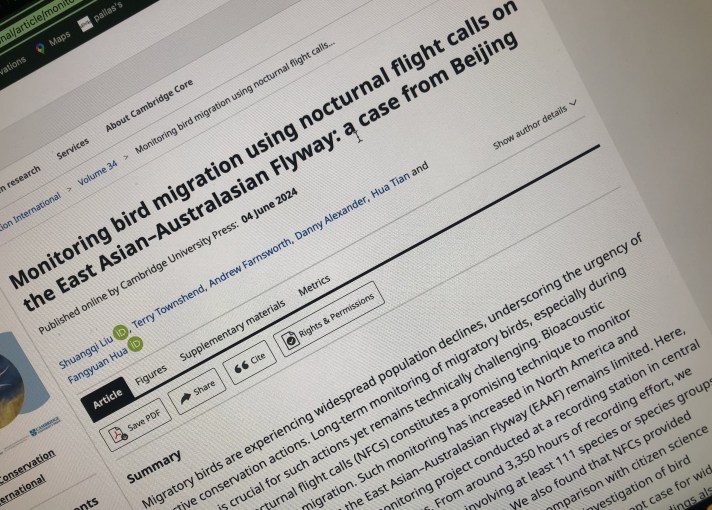
A summary of the findings over four full seasons (autumn 2021, spring 2022, autumn 2022 and spring 2023) has now been published in Bird Conservation International. The article is Open Access and can be viewed or downloaded here.
An extract from the abstract reads:
“From around 3,350 hours of recording effort, we manually extracted and identified 84,135 nocturnal flight calls (NFCs), involving at least 111 species or species groups that are associated with a wide range of habitat types. To our knowledge, this study is the first formal investigation of bird migration using NFC monitoring in the EAAF, serving as a proof-of-concept case for wider, long-term monitoring efforts in this traditionally understudied region. Our findings also highlight the significance of incorporating migratory bird conservation into urban planning and land management practices.”
The study, which is ongoing, has helped to raise awareness of the scale of bird migration over China’s capital city as its residents sleep at night and, in particular, demonstrates that if Beijing is to fulfil its responsibility to migratory birds – to facilitate safe passage – it must incorporate the diverse habitat requirements of migratory birds into urban planning, including the design and management of green spaces.
Mortality of migratory birds in major cities is high. In the United States it is estimated that up to a billion birds are killed every year through bird collisions with buildings, caused by a combination of light pollution and reflective glass, with the risk being particularly acute around the first few floors of a building.
Fortunately, through tackling light pollution and adjusting building regulations to require buildings to be ‘bird-safe’, there is much that cities can do to mitigate this risk and, through appropriate habitat management, to support safe passage of migratory birds.
For cities on a major migratory flyway, integrating the needs of migratory birds into urban planning should be a key pillar of becoming a ‘sustainable city’.
Work is underway in China through the “Anti-Bird Collision Action Alliance”, a network of volunteers and academics coordinated by Duke Kunshan University, to gather data about the scale of the risk of bird collisions in China and to promote solutions. Already, several major buildings – for example the headquarters of TenCent (Asia’s largest tech company) in Shenzhen – has been retrofitted with bird-safe measures and major real-estate companies, such as Vanke, are planning pilots to trial bird-safe glass.
The Beijing Municipal Government Forest and Parks Bureau, a partner in the nocturnal migration project, manages more than 70% of Beijing’s land and, at a special seminar at AIIB to present the findings, committed to integrate the findings of this study into land management guidelines.
A huge thanks to partners and colleagues at Peking University, including Hua Fangyuan and Liu Shuangqi, and at Cornell Lab of Ornithology, Andrew Fransworth and Benjamin Van Doren. We also owe a special thanks to Sir Danny Alexander, Vice President of AIIB, and his team, especially Alberto Ninio, Zeyu Li, Yaying Du, and Bo Yan, for all their support to the project and to all the birders and wildlife recordists who have helped with call identifications, including Jonas Buddemeier, Geoff Carey, David Darrell-Lambert, James Eaton, Paul Holt, Juefei Li, James Lidster, Magnus Robb, Seán Ronayne, Joost van Bruggen, and Stanislas Wroza. Finally, we would like to thank the Beijing Municipal Government Forest and Parks Bureau for their terrific support and positive engagement.
And for more detail about the project, see here:
Leave a Reply