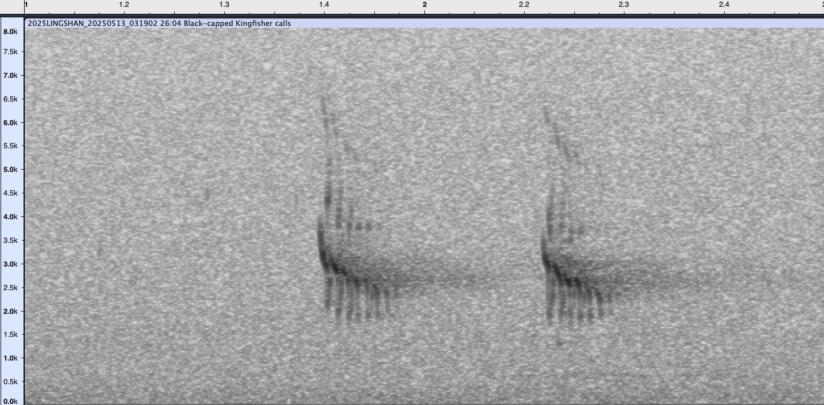
Beijing Nocturnal Flight Call Library

Following the nocturnal bird migration study conducted in partnership with the Asian Infrastructure Investment Bank, Peking University and the Beijing Municipal Government, we have built up a store of tens of thousands of calls.  To help support anyone wanting to study nocturnal migration in Beijing or indeed anywhere in north and east China, we have put together what we are calling a “Beijing Nocturnal Flight Call Library”.  

The library, including most of the species we have recorded, can be found here.  It is also available via the drop down menu under “Nocturnal Bird Migration in Beijing” in the menu bar.

The page provides examples of nocturnal flight calls (NFCs), including spectograms and audio files, all of which have been recorded in Beijing. Dates and recording location are given for each file.

Nocturnal recording is in its infancy in Beijing, so it is possible some of the identifications are incorrect. If you believe a call is incorrectly identified, please contact Wild Beijing via the contact form on the “Welcome to Wild Beijing” page. Thank you.

Some of the calls are of poor quality and will be replaced by better quality recordings as and when available.

Information provided about some of the species has been drawn from the following excellent websites from Europe:

The Sound Approach ; and

nocmig.com.

My heartfelt gratitude goes to colleagues at Peking University, including Professor Hua Fangyuan, Liu Shuangqi and Ren Xiaotong for their help and support.

First Large-scale Assessment of Snow Leopard Population in China

In early January an important paper was published in the international journal, Biodiversity and Conservation.  The paper presented the results of the first large-scale assessment of snow leopard population in China.  Led by scientists at ShanShui Conservation Center and Peking University’s College of Life Sciences, in partnership with other Chinese and international organisations, the paper used data from camera traps collected from 12 sites between 2015-2021 to estimate the snow leopard population at 1,002 individuals in an area of 360,000 km2 on the Tibetan Plateau (a density of 0.9 animals per 100km2).

The abstract of the paper is below:

“Abundance estimation of large carnivores is essential for their effective conservation plan- ning, yet estimating population size is challenging due to their elusive and wide-ranging nature. China is estimated to encompass 60% of the snow leopard Panthera uncia habitat, making it a crucial pillar for global snow leopard conservation. However, no large-scale population assessment has been conducted despite scattered survey effort accumulating rapidly in recent years. This study combined and standardized existing camera trap survey data from 12 sites collected by four organizations during 2015 ~ 2021 to estimate snow leopard population in an area of 360,000 km2 on the Tibetan Plateau, China. The representativeness of existing survey was evaluated based on two habitat stratification approaches to achieve less biased population assessment. Spatially explicit capture-recapture (SECR) models were applied for snow leopard density estimation and the top-ranked model showed a significant positive correlation between conservation priority strata and density. An average snow leopard density of 0.90 /100 km2 (95% CI: 0.68~1.21 /100 km2) and a population size of 1,002 (95% CI: 755~1,341) individuals was estimated for the defined snow leopard habitat. Two more conservative estimates of 971 (95% CI: 732~1,287) and 978 (95% CI: 737~1,267) individuals were generated within two defined survey regions, in which our data had higher representativity. This study presents a practical approach to synthesize existing population survey data for large-scale population assessments of individually identifiable species. The estimated number represents 11~21% of the global snow leopard population, indicating high conservation value of this region.”

The snow leopard is a flagship species in the mountains of Central and South Asia and understanding their population status is crucial for conservation planning.  In China’s Sanjiangyuan National Park (similar in size to England), the snow leopard is the jewel in the crown.

Importantly, much of the data used in this population assessment came from infrared cameras set up and maintained by local people, such as the community in the Valley of the Cats. 

Setting up an infrared camera in the Valley of the Cats.  Footage courtesy of ShanShui Conservation Center.

It is heartening to see how their local knowledge, combined with their collaboration with scientists at ShanShui Conservation Center and Peking University, has played an important part in building the first large-scale picture of the snow leopard population in China.  

Huge congratulations to the brilliant authors – it is wonderful to see so many familiar names – and to everyone who has contributed to this study.  It is an important milestone in the conservation of this magnificent big cat.

The full paper is available at: https://doi.org/10.1007/s10531-024-03007-4 


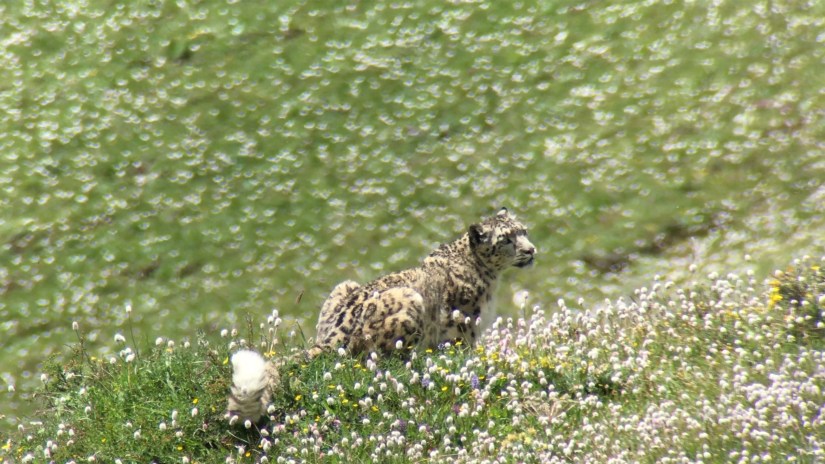
Title image: a female Snow Leopard in the Valley of the Cats, July 2019 (Terry Townshend)

The Beijing Nocturnal Migration Project – results published in Bird Conservation International

Since autumn 2021, in partnership with Peking University and the Asian Infrastructure Investment Bank, Wild Beijing has been involved in a study of nocturnal migration from the roof of the Asian Infrastructure Investment Bank (AIIB) in Beijing.

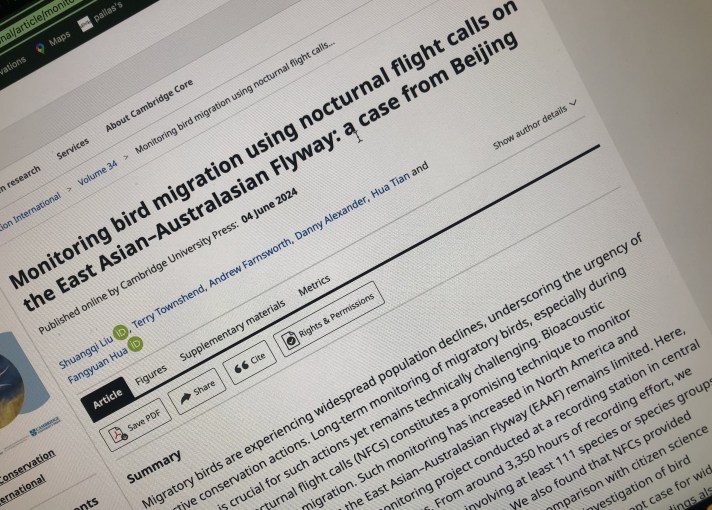
A summary of the findings over four full seasons (autumn 2021, spring 2022, autumn 2022 and spring 2023) has now been published in Bird Conservation International.  The article is Open Access and can be viewed or downloaded here.

An extract from the abstract reads:

From around 3,350 hours of recording effort, we manually extracted and identified 84,135 nocturnal flight calls (NFCs), involving at least 111 species or species groups that are associated with a wide range of habitat types. To our knowledge, this study is the first formal investigation of bird migration using NFC monitoring in the EAAF, serving as a proof-of-concept case for wider, long-term monitoring efforts in this traditionally understudied region. Our findings also highlight the significance of incorporating migratory bird conservation into urban planning and land management practices.”

The study, which is ongoing, has helped to raise awareness of the scale of bird migration over China’s capital city as its residents sleep at night and, in particular, demonstrates that if Beijing is to fulfil its responsibility to migratory birds – to facilitate safe passage – it must incorporate the diverse habitat requirements of migratory birds into urban planning, including the design and management of green spaces.  

Mortality of migratory birds in major cities is high.  In the United States it is estimated that up to a billion birds are killed every year through bird collisions with buildings, caused by a combination of light pollution and reflective glass, with the risk being particularly acute around the first few floors of a building.  

Fortunately, through tackling light pollution and adjusting building regulations to require buildings to be ‘bird-safe’, there is much that cities can do to mitigate this risk and, through appropriate habitat management, to support safe passage of migratory birds. 

For cities on a major migratory flyway, integrating the needs of migratory birds into urban planning should be a key pillar of becoming a ‘sustainable city’.  

Work is underway in China through the “Anti-Bird Collision Action Alliance”, a network of volunteers and academics coordinated by Duke Kunshan University, to gather data about the scale of the risk of bird collisions in China and to promote solutions.  Already, several major buildings – for example the headquarters of TenCent (Asia’s largest tech company) in Shenzhen – has been retrofitted with bird-safe measures and major real-estate companies, such as Vanke, are planning pilots to trial bird-safe glass.

The Beijing Municipal Government Forest and Parks Bureau, a partner in the nocturnal migration project, manages more than 70% of Beijing’s land and, at a special seminar at AIIB to present the findings, committed to integrate the findings of this study into land management guidelines.  

A huge thanks to partners and colleagues at Peking University, including Hua Fangyuan and Liu Shuangqi, and at Cornell Lab of Ornithology, Andrew Fransworth and Benjamin Van Doren.  We also owe a special thanks to Sir Danny Alexander, Vice President of AIIB, and his team, especially Alberto Ninio, Zeyu Li, Yaying Du, and Bo Yan, for all their support to the project and to all the birders and wildlife recordists who have helped with call identifications, including Jonas Buddemeier, Geoff Carey, David Darrell-Lambert, James Eaton, Paul Holt, Juefei Li, James Lidster, Magnus Robb, Seán Ronayne, Joost van Bruggen, and Stanislas Wroza.  Finally, we would like to thank the Beijing Municipal Government Forest and Parks Bureau for their terrific support and positive engagement.

Access the paper here: https://www.cambridge.org/core/journals/bird-conservation-international/article/monitoring-bird-migration-using-nocturnal-flight-calls-on-the-east-asianaustralasian-flyway-a-case-from-beijing/69FA53F1F503641666E7AD25EEA310DB# 

And for more detail about the project, see here


Leopard Cat Research Field Trip with Peking University

Earlier this week I was invited to join Peking University’s Leopard Cat research team on a field trip to their study site.  Led by Professor Luo Shu-Jin, the team has been studying the capital’s wild cats for three years, and has recently stepped up its research by fitting tracking collars.  The collars, so far fitted to three females, are showing for the first time the movements of these secretive felines.  Early results have revealed that the three females are primarily nocturnal, have rather distinct territories and swim often.  The closest relative to the Leopard Cat is the Fishing Cat of South Asia, so perhaps we should not be surprised they are not averse to taking a dip.

This week’s trip to the field site was to check and maintain infrared cameras and to set up a trap with the hope of catching and collaring a male.  In large cats such as the Snow Leopard, it is the male that has a relatively large territory within which several females may hold smaller territories.  It will be fascinating to see whether this is the case for Beijing’s Leopard Cats.

Checking the trap before installation at the study site.

The trap includes a trigger that, via the phone network, will inform the team as soon as the trap is sprung.  The team is on call 24 hours per day so that they can react quickly and minimise the time that any captured animal is in captivity.  

Professor Luo and her team setting up the trap at the study site. The aim is to catch and collar a male, following the fitting of collars to three females, in order to compare movements and territories.
The trap after it has been ‘camouflaged’.

It was an honour for me to join the team for the day and to learn so much about their work.  Beijing is one of the few major capital cities that supports a population of wild cats, so understanding better their ecology, including their habitat requirements, will help to inform land management policies in Beijing with a view to securing the future of this special animal in the Chinese capital.  

To keep up to date with the research team’s progress, please check this dedicated page.

Title image: the Peking University Leopard Cat Research Team.

Leopard Cat in Beijing 北京豹猫

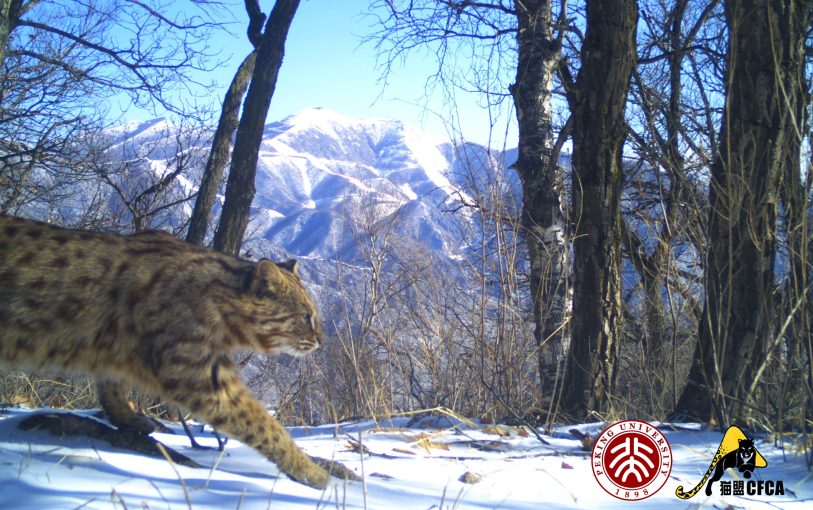
Not many capital cities can boast populations of wild cats and some may be surprised to learn that Beijing is one.  I am delighted to publish a new page dedicated to Leopard Cats in Beijing.  This page provides information and updates from an exciting new project about this poorly known species, led by Peking University’s Professor Luo Shu-Jin in collaboration with the China Felid Conservation Alliance (CFCA).  The project has already made some exciting discoveries, revealing just how little we know about biodiversity, even in one of the world’s major capital cities.  The page can be found here and includes some fantastic images of Leopard Cat from Beijing.  Check back regularly for updates!

Huge credit to Luo Shu-Jin and her team for her work on what must be one of the jewels in the crown of Beijing’s biodiversity.  

Schools for Snow Leopards

This week will see the start of an exciting new initiative involving schools and scientists from the ShanShui Conservation Center at Peking University with the aim of supporting Snow Leopard conservation.

In recent years, ShanShui Conservation Center has been running a community-based conservation project in the Valley of the Cats, whereby local yak herder families are involved in collecting data for the scientists based at Peking University in Beijing.  The local people set up, and monitor, a series of camera traps, the data from which is contributing a huge amount of knowledge about the distribution, population and ecology of apex predators including Snow Leopard, Common Leopard, Asian Brown Bear, Wolf and Lynx.

Here is a short video showing some of the local people setting up a camera trap.

Earlier this year, two teachers from the International School of Beijing (ISB) – Wayne and Jenny Winkelman – visited the Valley of the Cats, experiencing the local culture, hearing about the conservation project and even enjoying their very own Snow Leopard sighting.  We discussed how schools might be able to contribute and quickly came up with the idea of schools ‘sponsoring’ camera traps.  The idea was that schools would raise money for ShanShui Conservation Center to pay for camera traps.  The schools would then receive the photos from ‘their’ cameras and learn about the wildlife and people of the Tibetan Plateau.

Fast forward a few months and the students at ISB, inspired by Wayne and Jenny, have been raising money by selling cuddly Snow Leopards and thanks to their efforts they now have enough to purchase their first camera trap!

On Friday this week, a scientist from ShanShui Conservation Center will visit ISB to explain about the project, show some pictures and videos, answer questions from the students and take receipt of the donation from ISB.  A camera, allocated to ISB, will then be placed on the Tibetan Plateau as part of the ongoing conservation programme.  A local family will be responsible for deciding the location and for monitoring the camera.  Every two to three months the school will receive the photos from ‘their’ camera, which will form the basis for learning about the Tibetan Plateau ecosystem.

Schools will thus be contributing to community-based scientific and conservation projects whilst gaining great material to support learning about the Tibetan Plateau and the animals and people that live there.

If successful, we hope this programme can be expanded with other schools sponsoring their own cameras.

Huge thanks to Wayne and Jenny Winkelman for their initiative in starting this exciting new programme, to ShanShui Conservation Center for engaging schools and especially to the students at ISB for so enthusiastically raising money to support Snow Leopard conservation.  I can’t wait to see the first photos from their camera and to see how this initiative develops.

If you are a teacher at a school in Beijing interested in sponsoring a camera trap or two, please get in touch!