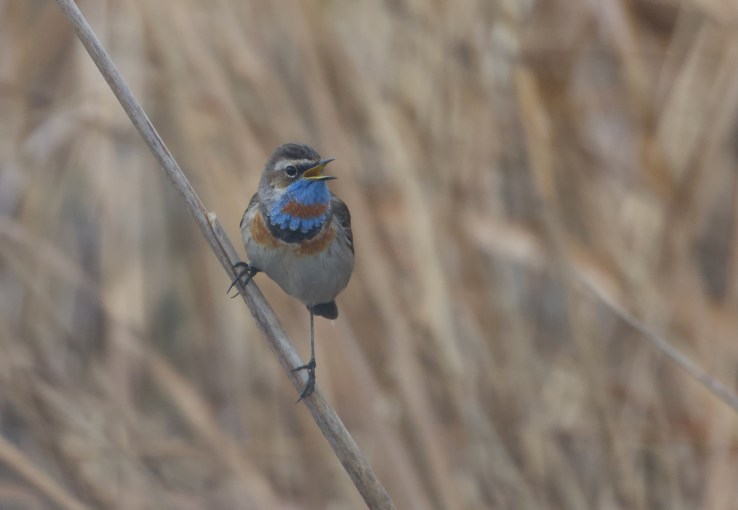
Early to mid-May sees peak passage of Bluethroat (Luscinia svecica 蓝喉歌鸲 Lán hóu gē qú) through Beijing. In suitable habitat it’s not unusual to see multiple birds at a single site during this time. On 6 May I visited ShaCheng wetlands, west of Guanting Reservoir, just over the border in Hebei Province. That morning, in one 500m stretch of reedbed and wet grassland, there were over 20 Bluethroats, the majority males, with a few singing.

One of the male Bluethroats (Luscinia svecica 蓝喉歌鸲 Lán hóu gē qú) at ShaCheng Wetlands, Hebei Province, on 6 May 2025.
It’s a long time since I have heard a Bluethroat singing and I was immediately struck by the incredible mimicry. Several times I thought I had heard a Spotted Redshank (Tringa erythropus 鹤鹬 Hè yù) and looked around frantically to see it only to realise it was a Bluethroat! I began to listen carefully to one male that was singing close by and logged the mimicry of other species I could recognise:
Spotted Redshank (Tringa erythropus 鹤鹬 Hè yù)
Common Tern (Sterna hirundo 普通燕鸥 Pǔ tōng yàn ōu)
Zitting Cisticola (Cisticola juncidis 棕扇尾莺 Zōng shàn wěi yīng)
Ashy Minivet (Pericrocotus divaricatus 灰山椒鸟 Huī shān jiāo niǎo)
Arctic Warbler (Phylloscopus borealis 极北柳莺 Jí běi liǔ yīng)
Eastern Yellow Wagtail (Motacilla tschutschensis 黄鹡鸰 Huáng jí líng)
White Wagtail (Motacilla alba 白鹡鸰 Bái jí líng)
Oriental Greenfinch (Carduelis sinica 金翅雀 Jīn chì què)
Brambling (Fringilla montifringilla 燕雀 Yàn què)
I am sure there were more!
I recorded a few minutes of song – three bursts of around four minutes in total (with a background chorus of Dark-spotted Frogs) – have a listen and let me know what species you can hear!
In Bent, A. C. (1949)’s “Life histories of North American thrushes, kinglets, and their allies”, published in the U. S. National Museum Bulletin 196, the species account for Bluethroat reads: “The delightful song of the bluethroat has charmed all naturalists who have heard it in its northern haunts and has earned for it among the Lapps of its native country a name meaning “a hundred tongues.”
Header image: a singing male Bluethroat (Luscinia svecica 蓝喉歌鸲 Lán hóu gē qú) at ShaCheng Wetlands, Hebei Province, 6 May 2025.
Leave a Reply