At the Beijing birders meet-up we arranged for a group trip to Nanpu, near Tangshan in Hebei Province. In total, 15 of us – both ex-pats and locals – spent the weekend at this world-class site and it was a superb trip – great fun with lots of birds!
The backdrop may not be pretty but the birding is spectacular at Nanpu.
Perhaps the best single bird in terms of rarity was an ORIENTAL STORK that came in off the sea. And amongst the other highlights were impressive numbers of shorebirds with 4,700 SHARP-TAILED SANDPIPERS and 2,325 DUNLIN, a single RUFF (rare here), five juvenile RED-NECKED PHALAROPES, at least six first-year SAUNDERS’S and up to 80 RELICT GULLS and decent numbers of passerines moving down the coast. High counts included 54 BLACK-NAPED ORIOLES (including a single flock of 23 birds!), 100 DUSKY WARBLERS, 300 SIBERIAN STONECHATS, up to 150 RICHARD’S PIPITS, two BLYTH’S PIPITS, two PECHORA PIPITS and six YELLOW-BROWED BUNTINGS.
Per checking out the waders on a roadside pond at Nanpu.This is “EVA” the Bar-tailed Godwit. Colour-flagging of migratory shorebirds helps researchers to better understand the routes these birds take and the stopover sites they use which, in turn informs conservation measures. You can read about EVA’s history in the trip report.Juvenile Red-necked Stint. Beautiful birds!Gull-billed Tern.
It was hot at Nanpu and, fortunately, there is a small village where one can purchase ice creams! I can thoroughly recommend the ‘traditional flavour’ ice lollies.. delicious (even though I am not sure of what exactly they taste!). The locals here make their living from the mudflats, where they harvest the shellfish and shrimps. Here are a few maintaining their nets.
Local ladies maintaining the shrimp nets
And in the early mornings, our 0500 starts were made (slightly) easier by the delicious bao zi (steamed dumplings) that were on sale for the equivalent of 5p each…
Jan-Erik and Andrew browsing the local bao zi stall.
At the coast, where passerine migration was most impressive, we unfortunately encountered more illegal bird trapping activity. From the car, Paul heard a Yellow-breasted Bunting singing and we stopped to investigate. We very quickly saw a line of mist nets in the grass close by. The poacher had set up an elaborate line of nets accompanied by caged songbirds, clearly designed to lure in wild birds. The caged birds included Common Rosefinch, Yellow-breasted and Yellow-browed Buntings – three species that were clearly moving at this time of year.
A male Common Rosefinch strategically placed to lure in wild birds.A distressed-looking male Yellow-breasted Bunting, now officially an endangered species after years of persecution.
In the nets we found alive 2 Common Rosefinches plus Yellow-browed, Arctic and Dusky Warblers, which we promptly released. But it was too late for 4 Brown Shrikes which had fallen victim to this cruel practice.
The poacher soon arrived (claiming that the nets were his friend’s and not his – yeah right). We told him firmly that this was illegal and that we would be taking photos and reporting him to the Hebei Forestry Administration. He did not protest and actually helped us to dismantle and destroy the nets, snap the poles, release the caged birds and destroy the cages. On return to Beijing I posted the photos on Sina Weibo (Chinese “Twitter”) asking for help in reporting this illegal activity. Within 10 minutes, users on the microblogging service had translated my report into mandarin and submitted it to the Hebei Forestry Administration… wow! The power of social media. Thanks guys!
Ironically, the next day we were ejected from this area by local security guards from the nearby oil terminal and police who claimed that it was a “nature reserve”. So it’s ok to drill for oil and trap wild birds in a nature reserve but birding is a step too far…! A big thank you to Lei Ming and friends for following up on my behalf with the Hebei Forestry Administration.
The trapper was surprisingly cooperative as we dismantled the nets and freed the trapped birds. Here he frees a first year/ female Common Rosefinch
September and October are probably my favourite months in Beijing. The excessive heat of the summer diminishes and, given the autumnal breeze, combined with regular rain, the air quality is good, resulting in some fantastic clear days with superb visibility. It’s a reminder that Beijing is a beautiful city and if ever an extra incentive was needed to clean up the capital’s air, being outside on autumnal days and seeing the mountains, with the ever-impressive Great Wall running along the spine of the northern ranges, must be it.
Of course September and October are also superb months for birding with migration in full swing. Taking advantage of Dalian-based Tom Beeke’s presence in the capital for an ice-hockey tournament, Paul Holt and I took Tom for a day’s birding at Miyun Reservoir on Sunday. And what a beautiful day it was. With the temperature a fresh 14 degrees C early on (rising to 32 degrees C later), a stunning clear blue sky and visibility of at least 30-40km, it was a great day to be in the field.
We visited three sites around the reservoir and recorded an impressive 91 species, including two new birds for me in Beijing – LITTLE CURLEW (小杓鹬) and RUSSET SPARROW (山麻雀) – plus 2 SHORT-TOED EAGLES (短趾雕), several PIED HARRIERS (鹊鹞) and, best of all, a PEREGRINE (游隼) of the subspecies peregrinator – a resident of India, Pakistan, Sri Lanka and southern China. We believe this is the first record of this subspecies in Beijing and the most northerly record in China – unless you know better?
Some images from the day and a full species list (courtesy of Paul Holt) below.
Paul Holt (left) and Tom Beeke scanning Miyun Reservoir, 1 September 2013One of two Short-toed Eagles seen at Miyun on 1 September. This species is a regular passage migrant in Spring and Autumn in Beijing.Little Curlew, Miyun Reservoir, 1 September 2013. This bird made two great fly-bys, calling frequently.Peregrine of the subspecies peregrinator. Note the rufous underparts contrasting with the pale throat and upper breast. In the field this bird was small and sported a very dark cap, all features consistent with this southern subspecies. The first record for Beijing and, probably, the most northerly record in China.Another image of the “peregrinator” Peregrine. Photo by Tom Beeke.
Full Species List
Japanese Quail – 6 around Miyun reservoir
Common Pheasant- 5
Mandarin Duck – 3 around Miyun reservoir
Falcated Duck – 4, including an eclipse adult male, at Miyun reservoir. Apparently the earliest autumn records from Beijing. The previous earliest were 25 and 36 birds at Miyun reservoir on the 11 and 12 September 2004 respectively (PH pers. obs.). These dates seem unusually late however and it’s likely that limited observer coverage of Miyun reservoir & WDL in late August is responsible as birds are regularly encountered on the Hebei and Tianjin coasts at that time.
Mallard – 8
Chinese Spot-billed Duck – 10
Garganey – 5
Eurasian Teal – 3
Little Grebe – 16
Great Crested Grebe – 54
Black Stork – 3 flew north over the Jingcheng expressway near Miyun town (kilometre post 62) at about 05h45.
Black-crowned Night Heron – 3
Little Heron – 2
Chinese Pond Heron – 11
Eastern Cattle Egret – 4
Grey Heron – 10
Purple Heron – 2 juveniles
Great Egret – 3
Little Egret – 17
Osprey – 1. Probably the earliest autumn date for Beijing.
Crested (Oriental) Honey-buzzard – 1 flew south high over in the Yongle cun, Miyun reservoir.
Black Kite – 2 juveniles
Short-toed Snake Eagle – 2. Both were photographed.
Eastern Marsh Harrier – 4
Pied Harrier – 6, including two adult males, an adult female and three juveniles
Eurasian Sparrowhawk – 10
Common Kestrel – 1
Amur Falcon – 81. 66 of these were seen from the Jingcheng expressway between Miyun town & Taishitun. Surprisingly today’s total was one of the highest autumn bird-days totals for the whole of Beijing. The majority of Amur Falcons apparently move through Beijing during a short and intense autumn passage. Most years it’s the second week of September before there’s any significant movement and birds are widely encountered just one week later (by the middle of September) with peak migration apparently occurring in the third week. Note that this is significantly earlier than the peak occurs in coastal Tianjin and at Laotie Shan, southernmost Liaoning where the, significantly larger passage, doesn’t peak until mid-October. Note that significantly larger numbers have been seen in neighbouring Tianjin municipality during autumn passage (with 1350 counted at Beidagang, Dagang on 10 October 2007)
Peregrine Falcon – 2 juveniles near Yongle cun, Miyun reservoir on the 1/9/2013. The first bird that we saw was a ‘Shaheen’ Falcon Falco peregrinus peregrinator as it was slightly small and compact, even for a male, had a strong rufous suffusion to its lower underparts and underwing coverts that contrasted well with its whiter breast and cheeks. It was quite dark above with rather little contrast with the paler rump and had an extensive dark hood. In China peregrinator is a bird of the south and can be found, albeit locally, in Sichuan. The most northerly record in China until today had been an adult at Yangxian, Shaanxi on the 1 July 2013 (PH pers. obs.).
Common Moorhen – 5
Eurasian Coot – 8
Black-winged Stilt – 2
Snipe sp. – 3
Little Curlew – 1 was seen several times in flight, and photographed, near Yongle cun, Miyun reservoir. Little Curlew is rare in Beijing with perhaps just four or five previous reports – ‘present’ at Wild Duck Lake on the 22/3/2003 (赵欣如老师 黄伟 竹 cyan 以及另外三人 via BirdTalker). This report was accompanied by the statement that ‘needs to be affirmed since the time is too early’. Subsequently one was seen at Huairou Reservoir on 11/5/2004 [JHa in the 2004 CBR] and this sighting was noted as being the first record for the Capital by the bird report editors who apparently discounted the 2003 report above; one at Miyun reservoir on the 18/10/2007 – it flew purposefully south, out and over the reservoir south of the Bulaotun Satellite Tracking Station at 15:25hrs (PH pers. obs.); three at Bulaotun, Miyun reservoir on the 4/5/2008 (PH pers. obs.) & one in Yuanmingyuan during the 14-17/8/2012 (see http:/www.birdnet.cn/showtopic-381567.aspx )
Green Sandpiper – 1
Wood Sandpiper – 2
Temminck’s Stint – 1
Black-headed Gull – 160
Mongolian Gull – 3, two adults and a second-calendar year, flew north at Hou Ba Jia Zhuang, Miyun reservoir. Apparently the earliest ever autumn record from Beijing
Gull-billed Tern – 4, two adults and two first-winters. One of only five autumn records from Beijing!
Common Tern – 3 adults. Two were minusensis & the other longipennis.
White-winged Black Tern – 1 juvenile
Oriental Turtle Dove – 11
Eurasian Collared Dove – 50
Spotted Dove – 2
Asian Koel – 1 singing bird was heard near Yongle cun, Miyun reservoir on the 1/9/2013. 2013 has been a record year for this species in Beijing – and today’s was the first ever September encounter.
Common Cuckoo – 3 around Miyun reservoir
Common Kingfisher – 3
Grey-capped Pygmy Woodpecker – 1 flew over the Jingcheng expressway near kilometre 62
Great Spotted Woodpecker – 1
Brown Shrike – 6
Chinese Grey Shrike – 3
Black-naped Oriole – 3
Black Drongo – 218. Apparently a record day-count from the Capital. The only previous three-figure counts that I’m aware of from Beijing have been 200 at Wild Duck Lake on 21/8/2005 (LHT in the 2005 CBR) & 150 at Wild Duck Lake during 26-27/8/2010 (Brian Ivon Jones via BirdTalker)
Azure-winged Magpie – 1
Red-billed Blue Magpie – 1 was heard
Marsh Tit – 2 calling birds were heard near Yongle cun
Japanese Tit – 1 was heard
Chinese Penduline Tit – 1 heard near Yongle cun
Light-vented Bulbul – 22
Sand Martin – 28 flew south
Barn Swallow – 35 around Miyun reservoir. Five of these, including one tytleri, were near Yongle cun with the other 30 in & around Hou Ba Jia Zhuang village.
Red-rumped Swallow – 150
Dusky Warbler – 7
Yellow-browed Warbler – 7
Oriental Reed Warbler – 2
Black-browed Reed Warbler – 2
Thick-billed Warbler – 5
Lanceolated Warbler – 3 separate birds were heard near Yongle cun
Zitting Cisticola – 21
Plain Laughingthrush – 2, a presumed pair, near Yongle cun
Vinous-throated Parrotbill – 52
Chinese Hill Babbler – 4, presumably a family party
Common Stonechat – 14
Asian Brown Flycatcher – 2
Taiga Flycatcher – 2
Russet Sparrow – 17 in a mixed flock with Eurasian Tree Sparrows near Yongle cun, Miyun reservoir. One of very few double-figure day counts from Beijing and perhaps the first record for Miyun county? The number of Russet Sparrows being reported in Beijing appears to have declined in recent years (from high counts that included 50 at the Jumahe, Fangshan on the 4/12/2004 [QYX in 2004 CBR], 30 at Shidu, Fangshan on 30/12/2007 (蛐蛐儿黑鹳辛夷拙石 via BirdTalker) and 20 at Juili cun, Jiuduhe zhen, Huairou on the 11/9/2010 [dianchi via BirdTalker]). Note that Beijing has been the northern limit of this species’ Chinese breeding range for over a decade – this is despite recent records at Laotie Shan, Liaoning in May 2011 (Townshend and Millington 2011) & May 2013 (Terry Townshend pers. comm to PH) and on the Hebei coast suggest that the species is continuing to slowly expand its range.
Eurasian Tree Sparrow – 100
Eastern Yellow Wagtail – 50
Grey Wagtail – 2 singles flew south
White Wagtail – 9, including four leucopsis
Richard’s Pipit – 18
Olive-backed Pipit – 1
Red-throated Pipit – 1. Apparently the joint earliest autumn record from Beijing – equalling the sighting of five at Shahe Reservoir, Changping on 1/9/2008 (红嘴蓝鹊, 鹰之舞 via BirdTalker).
Grey-capped Greenfinch – 30
Common Rosefinch – 112. 17 of these were near Yongle cun with the other 95, including a single flock of about 80 birds, were near Hou Ba Jia Zhuang. Apparently a record autumn count for Beijing.
Chinese Grosbeak – 3
Meadow Bunting – 1 was heard near Yongle cun
Yellow-breasted Bunting – 2 near Hou Ba Jia Zhuang
In Beijing we are blessed with a small, but excellent, group of active birders. There is a growing band of locals, including friends Zhu Lei, Lei Ming, Zhang Shen, Chen Liang, Fu Jianping and more… plus some ex-pat birders from the UK, Ireland, Canada, Denmark, Hong Kong (should we count Jennifer as an ex-pat?!), South Africa, Sweden and the US.
Although we have been sharing sightings and corresponding on email for some time, many of us had never met, so on Saturday we arranged a meet-up in central Beijing over the traditional birders’ diet of beer and pizza. Guest appearances by Dalian-based Tom Beeke (complete with ice-hockey kit) and Shanghai-based Craig Brelsford added a bit of “Greater China” spice.
It was very cool to put faces to names, catch up with friends old and new, and speculate over the next addition to the Beijing list.
Thanks to Jennifer Leung for the photos below.
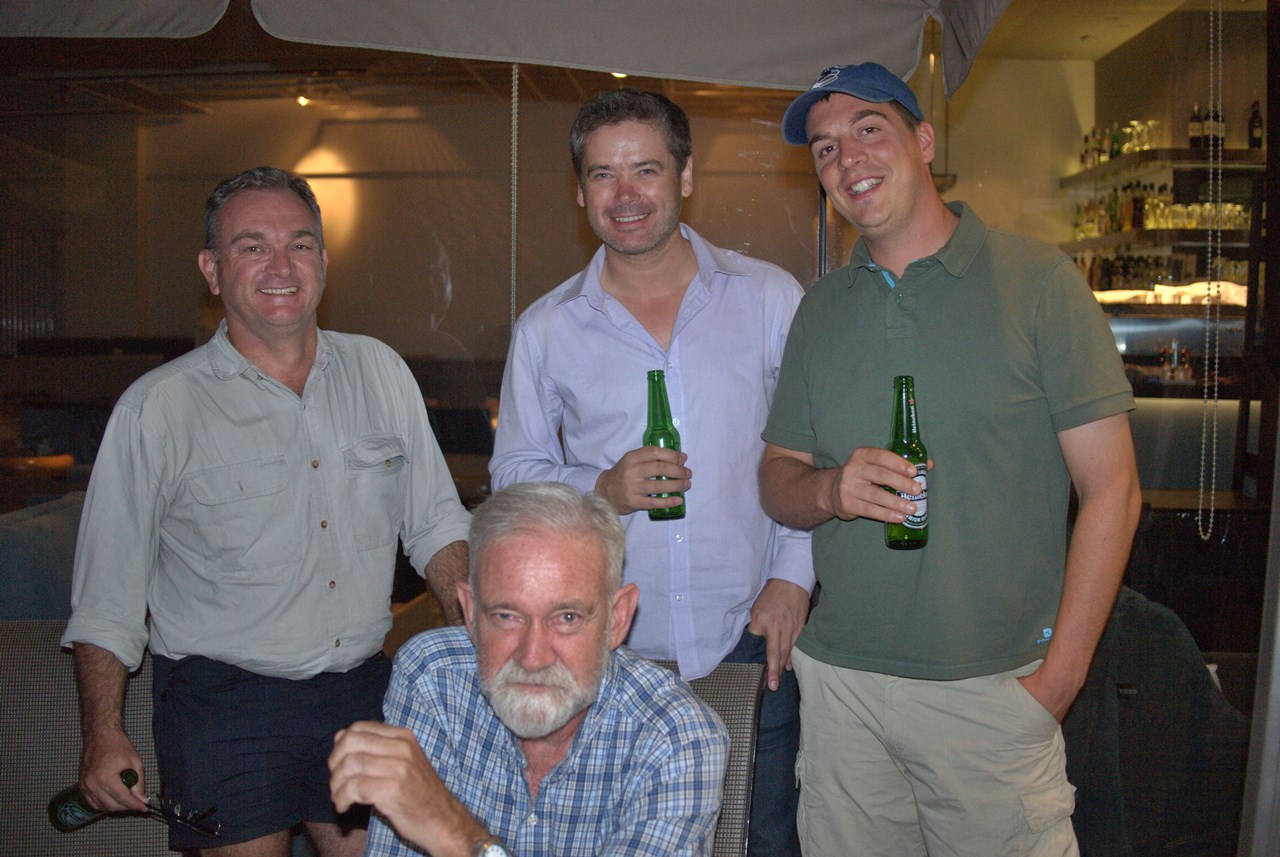
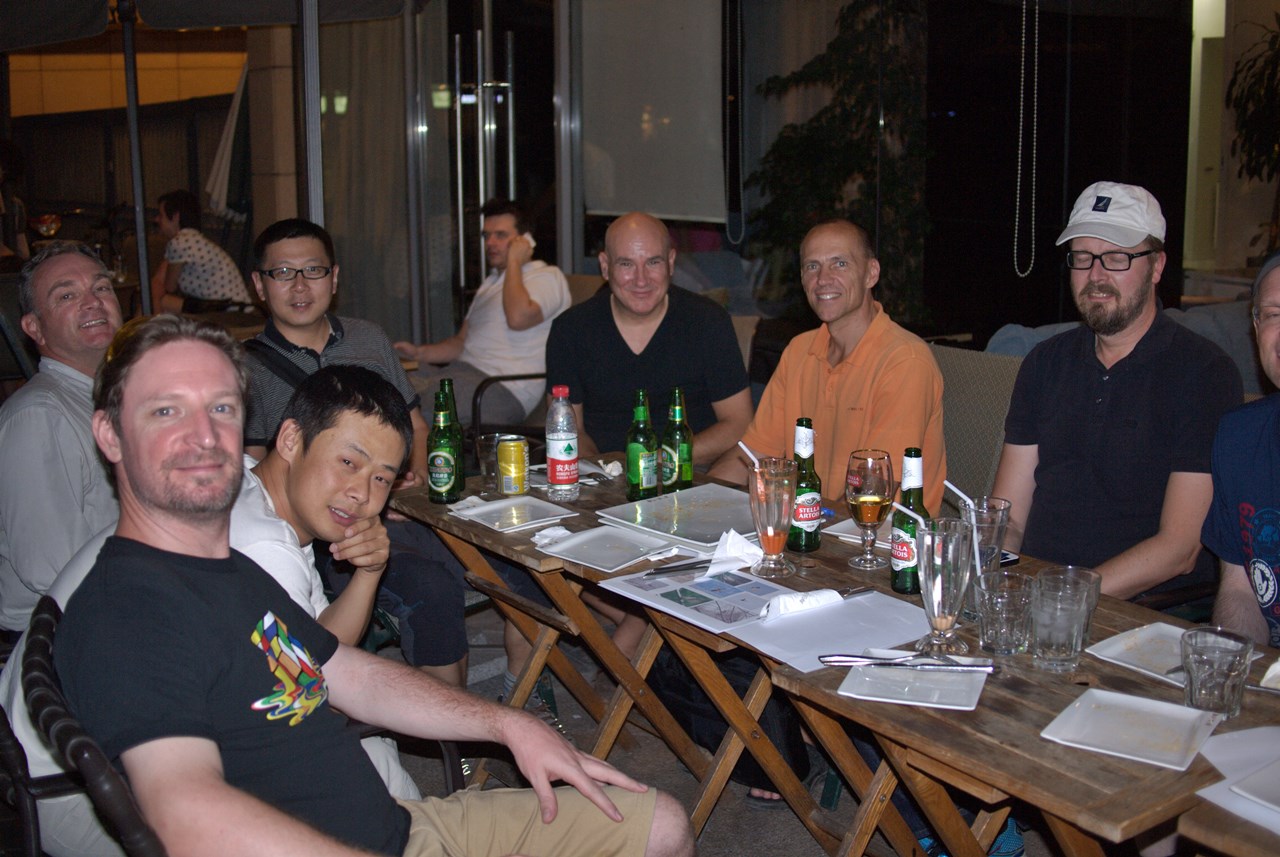
From left to right: Paul Holt (UK), Colm Moore (front, representing Ireland), Terry Townshend (UK) and Tom Beeke (Canada, making a special guest appearance from Dalian).Clockwise from left to right: Andrew Morrissey (South Africa), Zhu Lei (China), Paul Holt (UK), Chen Liang (China), Steve Bale (UK), Per Alström (Sweden), Jan-Erik Nilsen (Sweden) and (the right side of) Craig Brelsford (US).
RELICT GULL (Larus relictus, 遗鸥) is a relatively poorly known species. Until the early 1970s it was thought to be a race of Mediterranean Gull and some even thought it a hybrid between Mediterranean Gull x Common Gull….
It breeds inland at colonies in Kazakhstan, Mongolia and China and winters almost exclusively on the mudflats of the Bohai Bay in eastern China. It is classified as “Vulnerable” by BirdLife International, partly because of its susceptibility to changes in climate but also because almost the entire population is reliant on the tidal mudflats of the Bohai Bay in winter, a habitat that is rapidly diminishing as land reclamation intensifies – threatening not just Relict Gull but a host of East Asian flyway species, including of course the Spoon-billed Sandpiper.
Relict Gull is a bird I am always pleased to see and, occasionally, in late March and early April, these birds can be seen in Beijing – for example at Wild Duck Lake or Miyun Reservoir – as they begin their migration to the breeding grounds. Autumn records in the capital are much scarcer which made Saturday’s sighting of an adult at Yeyahu NR with visiting Professor Steven Marsh all the more pleasing. However, it is a trip to the Hebei coast, particularly south of Tangshan at Nanpu, that will enable any birder to get to grips with good numbers of Relict Gull at almost any time of the year… Numbers in winter can be in the 1000s, which makes for quite a spectacle, but even in summer a few immature birds and non-breeders remain. There is still much to learn about this gull, including its distribution – in 2012 Paul Holt discovered a wintering population of over 1,000 near Zuanghe in Liaoning Province (see image below).
Last week, in the company of Per Alstrom and Lei Ming, I visited the coast at Nanpu and we were treated to more than 100, most probably recent arrivals from the breeding grounds, patrolling the mudflats amongst the local shellfish pickers.. They feed on the local crabs, a delicacy that seems to be in plentiful supply! Below are some images of moulting adults, second calendar year and first year birds.
Local shellfish collectorsRelict Gulls, near Zuanghe, Liaoning Province, January 2012 (image by Paul Holt).Adult and 2cy RELICT GULLS, Nanpu Hebei Province, August 2013Adult RELICT GULL, Nanpu, Hebei Province, August 20132cy RELICT GULL, Nanpu, Hebei Province, August 2013Relict Gull (first calendar year). Note, in particular, the dark centres to the tertials, darkish legs and bill.Relict Gull (first calendar year) in flight.
And here is a short video of an adult at Nanpu in August.
Having not been birding much recently, Paul Holt and I visited Miyun Reservoir on Saturday in the hope of finding some inland shorebirds. Due to the exceptionally high water levels (we have ‘enjoyed’ a wetter than usual spring and summer this year) we did not find any muddy fringes attractive to waders. Thus, we hardly saw any (just two Black-winged Stilts, one Wood Sandpiper heard only, and 3 Pintail or Swinhoe’s Snipe). However, the day was not without good birds…
Shortly after our arrival, and in fantastically still conditions, we heard this:
A Yellow-legged Buttonquail singing (if you can call it singing!). This is a very difficult to see species and I have only recorded it once before in Beijing – in late May 2012 when I inadvertently flushed one along the Wenyu River. After one burst of song, it fell silent and we didn’t try to see it by walking through the long grass… As it happened we would see another Yellow-legged Buttonquail later that day on the other side of the reservoir, this time a juvenile… Fortunately I managed a (poor) record image before it disappeared into the maize crops.
However, the undoubted highlight was when Paul heard what he immediately thought was a LESSER COUCAL… we investigated and, sure enough, sitting atop a shrub about 200 metres away was a singing male… wow! The first record for Beijing. It proceeded to sing almost continuously for the next hour or so, roaming across a fairly wide area around the reservoir. Although photos were difficult to secure, I was able to obtain this record image.
Lesser Coucal (Centropus bengalensis), Miyun Reservoir, Beijing, 27 July 2013. The first record for Beijing!
Separating Greater and Lesser Coucal is not necessarily straightforward, especially from photographs, so in order to properly document this record it was important to secure a sound recording (song is a good way to distinguish this pair). Using the video facility of our Canon EOS7Ds we made this recording which is of surprisingly good quality!
At one point we could hear the Coucal singing with an Asian Koel calling in the background. Asian Koel, until very recently, was a rare bird in Beijing. It was first recorded in the capital as recently as 1983 and has been occurring with increasing frequency. This year there have been at least 17 sightings!
So, not many shorebirds but the experience of Saturday just goes to show that we should expect the unexpected!
======
Lesser Coucal status (courtesy of Paul Holt):
This is the first record for Beijing. There are at least five reports of single Lesser Coucals from coastal Hebei – three from Beidaihe, Qinhuangdao (with sightings at the Heng He Reservoir on the 23 May 2000, Radar marsh on the 23 May 2003 and again at the Heng He Reservoir on the 23 June 2007) and at least two reports from Happy Island, Leting (one on 22/5/2001 & the only autumn record – a single on the 30 September 2007). Interestingly Greater Coucal has also been seen twice at Beidaihe – with one during the 6-8/8/1994 with two from the 9-11/8/1994 (Dierschke and Heintzenberg 1994 & Williams 2000
EDIT: It has been brought to my attention (many thanks to “虚弱人类” on Sina Weibo) that a LESSER COUCAL was photographed in the Olympic Forest Park, Beijing, on 27 June 2012. Images can be seen here. Our record at Miyun, therefore, becomes the second record for Beijing.
Long-tailed Skua, Shahe Reservoir, Beijing, 22 June 2013 (Photo by Zhao Qi). The first documented record of a skua – of any species – in the capital.
When Beijing-based Colm Moore sent me an email saying that he had seen a Long-tailed Skua at the capital’s Shahe reservoir on 22 June, I was impressed. Skuas of any species are very scarce in China, especially inland. What I didn’t know at the time was that Colm’s sighting was the first ever documented record of a skua – any skua – in the capital. Wow!
I shouldn’t have been surprised. Over the last 18 months or so, Colm has consistently been finding interesting birds at this reservoir, situated between the 5th and 6th ring roads in northern Beijing, demonstrating the benefits of patch birding. This year alone he has found a feldeggi Black-headed Wagtail (the first record in China away from the far western Province of Xinjiang), Dalmatian Pelican, Beijing’s second record of Bar-tailed Godwit (a group of 7 on the same day as the skua!), Oriental White Stork, Watercock, Manchurian Reed Warbler and many more… It just goes to show what can be found by combining skill and effort, even in a relatively uninspiring urban location.
Here are a couple more images of the skua taken by Zhao Qi.
Long-tailed Skua, Shahe Reservoir, Beijing, 22 June 2013. Another brilliant find by Colm Moore. Photograph by Zhao Qi.Long-tailed Skua, Shahe Reservoir, Beijing, 22 June 2013 (Photograph by Zhao Qi)
On the status of Long-tailed Skua in China, Paul Holt offered this response:
“..there are very few reports of any species of skua/jaeger from anywhere in China. …….. I saw one Long-tailed at Laotieshan, Lushun, Liaoning last September (the first record for Liaoning) – plus several unidentifed distant jaegers, another Long-tailed in Shandong on 13 Oct. 2010 (the first for Shandong) & ………… Jesper [Hornskov]’s also seen a Long-tailed in Qinghai. Long-tailed’s reasonably common/regular off Taiwan in April & is the commonest of the skuas/jaegers there.”
Paul’s comments help to put into perspective just how good is Colm’s record… and, on a lighter note, as Colm commented, it’s also the first skua seen by an Irishman anywhere in China…!
Northern Boobok, Beijing, 4 June 2013. Taken using my Canon EOS 7D and 400mm lens on ISO 6400 and handheld!
After a tip-off, Paul Holt, Alice Carfrae and I spent yesterday evening looking for an owl… not just any owl but a Northern Boobook (formerly known as Brown Hawk Owl but now ‘split’ into a species in its own right). We arrived on site at 6pm and, after a short walk, we soon heard and saw, spectacularly well, this lovely owl: the first time I have ever seen this uncommon species. Unfortunately it was an overcast evening, meaning the light was poor for photography, but it was also very still, enabling us to hear it well.
Although we only saw one bird, it was clear that there were two birds present, probably a pair, with the other bird (a female?) calling at a slightly different pitch.
We were then told about a nearby breeding pair of Oriental Scops Owl and, sure enough, after a 5-minute walk, we were watching and listening to one of these small owls in the company of a few uncomfortably large, low flying bats. Although Oriental Scops Owl is a migrant in good numbers through Beijing, we didn’t know it bred….
There is so little we know about the birds in the capital, let alone the rest of China….!
The last week of May and first week of June is THE best time for seeing acrocephalus warblers in Beijing. These birds arrive relatively late in the spring migration to allow the reedbeds and vegetation, on which they depend, to grow sufficiently. This Spring I have been hoping to see two specific acrocephalus warblers that I have never seen before – the Streaked Reed Warbler (Acrocephalus sorghophilus) and the Manchurian Reed Warbler (Acrocephalus tangorum). The chances of seeing the former are slim – there have been no records anywhere since 2011, when one was well-described from the Olympic Forest Park, Beijing, by a visiting birder and before that one must look back to 2009 when one was trapped in winter at Candaba Marshes, Philippines (unsure of date) and another was found by Paul Holt at the Summer Palace, Beijing, on 6 June. As far as I am aware, there have been no sightings at the well-covered migration hotspot of Beidaihe since 1999 and the breeding grounds, although thought to be in northeast China and southwest Russia, have never been discovered. This is a bird I am seriously worried about and its decline since the days of La Touche (who described it as “swarming” at Beidaihe in late August and early September in the early 20th century) has been catastrophic. Perhaps not surprisingly, I have not yet found a Streaked Reed Warbler. However, yesterday (1 June) I saw my first Manchurian Reed Warbler at Huairou Reservoir, Beijing.
It is always rewarding to go birding with someone who knows a lot more than yourself – it’s one of the best ways to learn. And to go birding with a real China expert – is a treat. So when Paul Holt asked me if I wanted to accompany him for a day’s birding around the northeastern reservoirs of Huairou and Miyun, I jumped at the opportunity. Paul had spent the previous day in the area and had found two special birds – Manchurian Reed Warbler and Chinese Bush Warbler – both, especially the latter, very difficult to see in the capital.
Our first stop was an area of superb habitat on the eastern fringe of Huairou Reservoir. Sure enough, after a few minutes, we were listening to, and watching, a splendid Manchurian Reed Warbler…. I had wondered how straightforward separation from the similar Black-browed and Blunt-winged Warblers would be. I was a little surprised at how different they are. With a prominent, but not as broad as Black-browed, white supercilium with a limited black upper border, long bill, prominent white throat bordering buffy underparts and an almost speckled crown, this warbler, given reasonable views, is distinctive. And the song, although resembling other ‘acros‘ lacks the fast pace or repetition of Black-browed.
Manchurian Reed Warbler, Huairou Reservoir, Beijing, 1 June 2013. A typical view of this reed-dwelling species!Manchurian Reed Warbler, Huairou Reservoir, Beijing, 1 June 2013. Note the dark flecking in the crown – a good feature of Manchurian Reed.
We enjoyed this bird for as long as 15 minutes as it made its way along a patch of reeds before moving back into a larger reedbed. Although reed warblers definitely fit into the “little brown job” of birds, the subtle differences in appearance and vocalisations make them a rewarding challenge for birders. And Manchurian Reed Warbler is a difficult bird to see anywhere. With a very restricted breeding range in northeast China (and southwest Russia), as its name suggests, the breeding grounds are relatively inaccessible and I imagine non-vocalising winter birds to be hard to find in large areas of wetland habitat.
Big thanks to Paul for finding, and taking me to see, one of my most-wanted Beijing birds. Now, where’s that Streaked Reed…..?
Black-throated Blue Robin (Luscinia obscura), Changqing National Nature Reserve, Shaanxi Province, China, 8 May 2013. Photo by Rob Holmes.
The Black-throated Blue Robin (Blackthroat) was, until very recently, an almost mythical bird. Known only from the odd scattered record in the Chinese Provinces of Sichuan, Shaanxi and Gansu, with presumed wintering records in southern China and Thailand, it has been “the Holy Grail” of China birding.
The chances of seeing one were as close to zero as one could get until June 2011 when Per Alström and a team of Chinese scientists discovered a total of 14 males at two sites – Foping and Changqing – in Shaanxi Province.
I had long been planning a trip to neighbouring Sichuan Province in May this year with friends Rob Holmes and Jonathan Price and, after consulting our local guide – Sid Francis – we decided to tag on a couple of extra days to visit Changqing and try to see Blackthroat. It was a gamble. We knew that, in 2012, the first birds were seen in Foping and Changqing on 4 and 18 May respectively. So it was by no means certain that they would have arrived and be on territory on 8 May, the day we had planned to visit. And even if they had arrived, would we be able to find one?
Per had kindly uploaded some sound recordings of the Blackthroat’s song, so we knew what to listen for. And on our arrival at Changqing we met with our guide for the day – Zhang Yongwen – who was part of the team that made the discovery in 2011. We were as prepared as we could be, and in good hands.
Yongwen told us that we had “a chance”. This Spring had been a little warmer than usual. His visit with us would be the first time he had looked for the birds this year. If successful, we would be the first people to see Blackthroat in 2013.
Our day began as a typical Spring day in Shaanxi – overcast with the threat of rain and a little chilly in a brisk breeze. Not ideal conditions to look for a skulking robin but not terrible either – it is not uncommon for rain to last days in this part of the world in Spring.
We drove from our hotel in the “ancient” town of Huayang (which looked about 5 years old!) into the core reserve area. The ‘road’ was an old logging track that took us into the heart of some superb habitat. The forest in the reserve is mostly mature secondary growth with generous areas of bamboo. In addition to Blackthroat, the reserve hosts around 100 Giant Pandas as well as Takin, Goral, Serow, Wild Boar and Tufted Deer. The chances of seeing Giant Panda in the wild at this time of year are slim, with the trees in full leaf, but we did see evidence – panda poo!
Giant Panda poo… our closest encounter with this special mammal.
After an hour’s drive, including seeing a couple of Golden Pheasants by the side of the road, we stopped at the edge of a small valley – “Wo Wo Dian” at an altitude of 2,200-2,400 metres. It was along this valley that Blackthroat was found in 2011 and seen subsequently in 2012. Fortunately the rain was holding off and we began the short walk to the prime area. The sense of excitement among the group was palpable.
Blackthroat habitat
The search was focused on areas of dense bamboo alongside a small stream. The constant sound of running water muffled any birdsong, making it difficult to hear and identify any birds along the way… At the first patch of bamboo, just a few hundred metres along the valley, we had a frustrating glimpse of a robin running along the ground.. but it was so deep in the bamboo that it just looked like a black shape and, after waiting patiently for 20 minutes or so, Yongwen said that the best area was further up, so we moved on…
The next stand of bamboo looked good – it was relatively open and, with a low vantage point gained by standing in the rocky stream, it was easier to see any movement. We soon heard a robin singing… and it sounded similar, if not identical, to the sound recordings we had of Blackthroat… our hearts jumped. It wasn’t long before we spotted a robin at the base of the bamboo, deep inside the thicket, and after a frustrating few minutes of half-glimpses and flight views, it finally sat up and sang from a rock – FIRETHROAT! A robin, and a fantastic bird at that, but not the bird we were looking for… Although disappointing that it wasn’t a Blackthroat, we were encouraged that this bird was on territory… would this sighting suggest that the related Blackthroat was also back?
Firethroat (Luscinia pectardens), Changqing National Nature Reserve, Shaanxi Province. We felt bad at being disappointed to see this stunning bird! We later learned that this could be the most northerly record of Firethroat ever recorded.
Onwards we walked to the next area… constantly alert to listen for any song. After no joy at the next couple of stands of bamboo, I began to feel a little deflated… had we arrived just a day or two too early?
The deflated feeling didn’t last long… as we turned a corner, Sid heard what he thought was a short burst of Blackthroat song and, standing absolutely still and turning our heads to one side, we all heard what sounded like the beginning of Blackthroat song… but it was distant and barely audible above the sound of the running water… could it be one? Or was it another mimicking Firethroat? We daren’t presume anything but one could sense the excitement among the group. We edged down a bank towards the location of the sound and, sure enough, we began to hear more of the song above the sound of the stream… it matched very closely the recording we had. The song was clearly coming from the opposite side of the stream, so we edged to the bank and sat quietly, hoping that the bird would reveal itself… First, there was a fleeting glimpse of a dark shape in the bamboo… it was a robin. Then a second glimpse.. but both times it was gone before we could get onto it with binoculars.. A few seconds later it flew to a moss-covered rock and sang, just for a second, before diving into cover again.. There was stunned silence.. we looked at each other and smiled… we had all seen a male BLACKTHROAT! Wow…(or maybe I should say “BOOM!”). For the next couple of minutes, we sat in awe as the Blackthroat moved to several different song posts, delivered a short burst of song and then dived back into cover…
The scene of our first sighting of Blackthroat.
Whilst my attempts at photographing Blackthroat resulted in blurred twigs and images of the space where the bird had been just a split-second before, Rob managed to secure the image at the beginning of this post. It’s an image that captures the essence of our experience – fleeting glimpses of an enigmatic and elusive bird in thick bamboo in poor light… Sharp, in-focus, full-frame photographs are over-rated!
I also made a short recording of the song using my Canon 7D’s video facility:
After enjoying this bird for some time, we continued up the valley and encountered several more birds.. all were elusive and, although we heard at least 5 individuals, we only saw one more definite Blackthroat. Mr Zhang also pointed out an old nest from 2012 – possibly the only nest ever discovered.
A Blackthroat nest from 2012. Situated on a steep bank.
The elusiveness of this bird surprised me a little. I had expected newly arrived Blackthroat males to be more obvious… maybe it was the weather conditions (overcast and a little breezy) that suppressed their activity or maybe they are louder and more obvious when the females arrive.. I don’t know..
In any case, I am very grateful to Sid for picking up the faint song of the first Blackthroat we saw and to Mr Zhang for his expert company throughout the day. I am also grateful to Per Alström and Paul Holt who provided information about Blackthroat ahead of our visit. Finally, a big thank you to Jonathan and Rob for their company on what was an outstanding trip to Sichuan and Shaanxi that ended on this magnificent high.
If anyone is heading this way and wants to explore the option of visiting Changqing National Nature Reserve to see this bird, please feel free to contact me or Sid Francis for advice.
Paul Holt has just finished his report from Laotieshan this autumn, covering the period 5-26 September. For a few of those days, towards the end, he was joined by Per Alström and me, but he generously credited us a joint authors. The full report can be downloaded here: Birding in Liaoning 5-26 Sept. 2012 (Holt, Townshend & Alstrom) but, for the busy reader, highlights included:
Five new species for Liaoning:
• 14 bird-days with up to 11 Short-tailed Shearwaters being noted on four dates between 12-19 September;
• seven bird-days for skuas/jaegers between 12-18 September – most were unidentified but a Long-tailed Jaeger was identified on the 12th as was a single Pomarine on the 18th;
• a Swinhoe’s Minivet on the 14 September;
• a Chestnut-cheeked Starling on 6 September.
High counts included:
• 3,274 bird-days for Streaked Shearwater with a count of 1,605 during the 4.5 hour sea watch off the point at Laotie Shan, Lushun on the 13 September possibly being a Chinese record;
• 4,313 bird-days of Oriental Honey-buzzard with 1,181 south on the 23 September;
• 938 bird-days of Japanese Sparrowhawk with 446 (possibly a Chinese record) south on the 6 September;
• 16,000 Black-tailed Gulls and 5,000 Mongolian Gulls west off the point on the 18 September (possibly both Chinese records);
• 20,959 bird-days of Ashy Minivet with 10,380 on the 21 September (a Chinese record);
• 270 bird-days for Black-naped Oriole with 72 on the 6th & 62 on the 9 September;
• 20,600 bird-days for Barn Swallow with 7,500 south on 14 September;
• 56 bird-days for Asian House Martin with 37 south on 6 September;
• 90 Forest Wagtails south on 11 September;
• 3,160 bird-days for White Wagtail with 1,134 on the 11 September;
• 196 bird-days for Pechora Pipit with exactly half this number, 98 birds, on the 12 September possibly being a Chinese record
Local rarities included:
• single adult Black-legged Kittiwakes on the 12th & 18 September
• one juvenile Pallas’s Gull during a seawatch on the 18 September – perhaps only the sixth record for Liaoning;
• 1 Spotted Nutcracker on the 24 September;
I suspect that, with irruption species such as Varied Tit, ‘Northern’ Great Tit, Rosefinches etc on the move this autumn, October might have been exciting, too… but there have been no birders there to find out!
Big hat tip to Paul Holt, not only for finding the star bird of the trip – a Common Ringed Plover – but also for somehow recording every single bird we saw or heard. Phenomenal.
Paul Holt and I have just returned from a weekend at Nanpu, near Tangshan, in Hebei Province. Nanpu is a vast area of fish ponds, salt works, reclaimed mudflats and even a prison. During migration season the area hosts tens of thousands of shorebirds. Being on the Hebei coastline, not so far from the migration hot-spot of Beidaihe, it is also on the flyway for birds hugging the coast on their journey south. So, in addition to the waders, visible migration can be superb.
I’ll post fuller details of the trip in due course, including about the resident Reed Parrotbills, the visible migration and the astonishing numbers of Brown Shrikes but this post is about the star bird of the trip – a Common Ringed Plover (Charadrius hiaticula).
Common Ringed Plover, Hebei Province, 26 August 2012
Picked out by Paul, this wader is rarer than Spoon-billed Sandpiper in eastern China. With fewer than 30 records away from Xinjiang in the far west, it was a great find. Of course, when finding a ‘Common Ringed Plover’-type, it’s important to rule out the very similar North American species, Semipalmated Plover (Charadrius semipalmatus). Call is a great way to separate the two (Semipalmated Plover has a more Spotted Redshank-like call) but, in the absence of a calling bird, there are some subtle plumage differences that allow identification if views are sufficient.
First, one of the most reliable features on Semipalmated Plover (SPP) is that the lower dark mask in the loral area meets the bill above the gape line, whereas in Common Ringed Plover (CRP) it meets at the gapeline, or slightly below. This seems to be a trustworthy feature, provided that the birds are not in active moult.
Second, the eye-ring. SPP usually shows a clearly visible pale-yellow eye-ring.
Third, the breast-band. SPP usually shows a relatively narrow breast band compared with CRP.
Additionally, SPP usually shows a slightly shorter bill and a very small (sometimes absent) white patch to the rear of the eye.
As its name suggests, SPP has some webbing between the toes but this is extremely difficult to see in the field, especially when clinging mud or wet sand can create a similar appearance.
We were fortunate with this bird in that it called several times before we were able to sneak close enough to confirm the plumage features. Incredibly, the next day, we saw and heard a flying Common Ringed Plover some 7km from the site of the original sighting. It was probably the same bird but who knows whether this species is under-recorded in this under-watched part of the world…?
Common Ringed Plover, Nanpu, near Tangshan, Hebei Province, 26 August 2012.
Common Ringed Plover breeds on the beach close to my parents’ home in Norfolk, England, and it is a bird with which I am very familiar. Seeing one as a “rarity” was a little weird… but that’s birding!
After a superb juvenile Little Curlew was seen and photographed at the Old Summer Palace in Beijing last week, and a report of a male Narcissus Flycatcher in the grounds of the Xiyuan Hotel, I was motivated to get out this weekend to check a local park for early migrants. And so on Sunday, in the excellent company of Paul Holt and Wang Qingyu, I headed for the Olympic Forest Park, one of the best parks in Beijing for birds. After cycling up to the park, I met Paul and Qingyu at the southern gate at around 0645 and spent the next 7-8 hours birding both the southern and northern sections on a gorgeous sunny (but hot and humid) day.
In total we logged 35 species, not a bad haul in August in central Beijing.
Full species list (courtesy of Paul):
Mallard 22 in Olympic FP on 19/8/2012. 19 of these (86%) were adult males with just one definite female
Yellow Bittern 7, including two juveniles being fed by a parent
Black-crowned Night Heron 6, including at least three juveniles & one adult
Chinese Pond Heron 5, including at least two juveniles and one second calendar year
Grey Heron 1 juvenile
Great Egret 4, at least one of which was an adult.
Little Egret 5
Amur Falcon 1 adult female flew south. Apparently a record early date for a bird in the process of migrating. Migrants are often difficult to distinguish from breeding birds but the location, well away from known breeding sites, and the bird’s behaviour are both strongly indicative of this bird being a migrant. Note that another bird, suspected at the time to have been an early autumn migrant was seen at Wild Duck Lake on this same date in 2003 (an unattributed record in the 2003 CBR). Note however that WDL is now known to hold breeding birds – and possibly did so back in 2003.
Common Moorhen 3 adults
Green Sandpiper 1 adult.
Common Sandpiper 1 was heard
Spotted Dove 4 singles
Large Hawk-cuckoo 1. Known predominantly as an uncommon, rather local breeding summer visitor in Beijing it’s always scarce away from breeding sites. What’s more this often unobtrusive species apparently stops singing before the middle of July and there are remarkably few encounters in Beijing after then. Note however that specimens were procured at Liangxiang on 5 September 1961 & Baihua Shan on 23 September 1976 (both Cai 1987) and an exceptionally late bird was reported at Baiwang Shan on 17/10/2009. (aiyuanyang wanggangge via BirdTalker)
cuckoo sp. 1 bird, probably either a Common or Indian Cuckoo, was seen briefly & in flight.
Common Kingfisher 1
[Grey-capped Pygmy Woodpecker 1 bird, possibly this species, was seen poorly]
Great Spotted Woodpecker 3, including an adult female
Grey-headed Woodpecker 1
Brown Shrike 8, including one presumed family group of five birds
Black-naped Oriole 1.
Black Drongo 5
Azure-winged Magpie 20, including several locally fledged juveniles
Common Magpie 25, including several locally fledged juveniles
Light-vented (Chinese) Bulbul 32, including several locally fledged juveniles
Barn Swallow 40, including several presumably locally fledged juveniles
Red-rumped Swallow 5
Yellow-browed Warbler 2 singles (one seen & the other only heard). These are apparently the earliest of the very few August reports from Beijing.
Oriental Reed Warbler 11, including several locally fledged juveniles
Vinous-throated Parrotbill 12 together
Crested Myna 3, two adults and a juvenile together
Eurasian Tree Sparrow 50
Yellow Wagtail 2 separate juveniles, one apparently macronyx & the other apparently simillima.
Grey Wagtail 1
[White Wagtail 1 bird, possibly this species, was glimpsed in flight]
Richard’s Pipit 1 was heard flying high to the south. Richard’s Pipit is one of the first passerine migrants of the autumn in Beijing with birds that are definite migrants i.e. birds away from breeding sites starting to be seen towards the end of the the first week of August (the earliest autumn records involve one near Hou Ba Jia Zhuang, Miyun reservoir on the 6/8/2009 & two singles that flew south there on the 7/8/2010 [both PIH]). However it’s at least towards the end of the third week of August before sightings become anything close to being regular.
Olive-backed Pipit 1 was heard over. There is perhaps only one other August record of this species from Beijing – an exceptionally early bird near the Xin Zhuang bridge over the Chaohe, Miyun on the 7/8/2010 (PIH).
Grey-capped Greenfinch 5, including at least one presumably locally fledged juvenile
Bunting sp. 1 was heard.
[Escape: Scaly-breasted Munia 2 in the reed bed just to the north of the ‘Underground Corridor’.]
It is clear that autumn migration is underway. And whilst passerines are only just beginning to move, shorebird migration is now in full swing. Next weekend, Paul and I will be heading for the coast to check out a site in the north of the Bohai Bay. Watch this space!
Paul Holt has just finished his detailed trip report from his visit to Liaoning in May. Bai Qingquan, Tom Beeke and I were lucky enough to accompany him for parts of his trip that included two firsts for the Province – Kamchatka Leaf Warbler and Black-winged Cuckooshrike – plus some impressive counts of waders, including a high count of up to 19 Nordmann’s Greenshanks, Bar-tailed Godwits (10,000), Eastern Curlew (4000), Great Knot (4600), Dunlin (10,400) and Broad-billed Sandpiper (1117). You can download the full report here:
Another highlight from the trip to Dandong was the remarkable total of Nordmann’s Greenshanks (Tringa guttifer) that we observed at a high-tide roost. Totals of 17, 17 and 16 were recorded on my three visits and, on one of the days, local birder Bai Qingquan recorded at least a further 7 from a different location at the same time, making a minimum count of 24 at this important stopover site. Nordmann’s Greenshank is officially “endangered” with a population estimate of around 500-1,000 individuals. It breeds in eastern Siberia along the western and northern coasts of the Sea of Okhotsk and also on Sakhalin Island, wintering in south-east Asia (Bangladesh, Thailand, Malaysia etc) and is encountered on migration along coastal China from Hong Kong north to Liaoning Province. It’s population is declining, almost certainly related to habitat destruction primarily on its wintering grounds and stopover sites.
We did not try to get close to these birds for fear of flushing them from their roost but the occasional pass by the local Peregrine and even the odd Black-tailed Gull kept them on their toes and, on several occasions, the flocks took to the air, allowing us to hear the air through their wings as they wheeled around in front of us.. a spectacular sight and sound. It was interesting that the Nordmann’s seemed to associate with the Grey Plover.
Grey Plovers, Donggang, Dandong, Liaoning Province. The wheeling flocks were a lovely sight.Nordmann’s Greenshank in flight (with Grey Plover), Donggang, Dandong, Laioning Province. Nordmann’s seem to like Grey Plovers!Nordmann’s Greenshanks with Grey Plovers.
Having North Korea as a backdrop added human interest to the birding here.
A shellfish picker works the low tide with North Korea just the other side of the Yalu river.A list of what not to do on the North Korean border. Needless to say, we did as we were told..
And other waders, most in splendid breeding plumage, were a sight to behold.
Two Asian Dowitchers (the small orangey blobs in this awful photo) were a welcome addition to the high tide roost.“Eastern” Black-tailed Godwits. Beautiful birds.Our search for Spoon-billed Sandpiper proved fruitless (a little early) but breeding plumaged Red-necked Stints were a joy to watch.
Now, you’ve all heard of the “Magic Woods” at Beidaihe…. well, not to be outdone, Donggang has its own ‘not of this Earth’ site. Here’s introducing the “Harry Potter Hedge”!
The “Harry Potter Hedge”… every day it would wow us with magical appearances.
Out of thin air it produced a Black-winged Cuckooshrike, Rufous-tailed Robin, Siberian Blue Robin, Siberian Thrush, Eyebrowed Thrush, Mugimaki Flycatcher, Pechora Pipit, Siberian Rubythroat, Oriental Scops Owl and much much more..
Finally, just for fun, here are a couple of photos of wader flocks… Photo 1 is beginner level. It has four wader species.. can you identify them? Photo 2 is a little tougher… it contains 6 species. A *glittering prize* awaits the first person to list them all correctly.
Photo 1 (Beginners Level). There are 4 wader species in this image. Can you name them?Photo 2 (Advanced Level). There are 6 species in this photo. Can you name them?
I am still wading (no pun intended) through my sightings and images from a shorebirding trip to Donggang, Dandong, last weekend with Paul Holt and local birder, Bai Qingquan. The highlights were many. One of the surprises was the amount of passerine migrants that we saw along the newly planted trees that lined the sea wall.. every day we saw buntings, pipits, flycatchers, thrushes and robins which made the walk to the wader high tide roost a real treat. And it was here that we found the bird of the trip – a Kamchatka Warbler (see previous post). Another, more mature, hedgerow to the north of the wader high tide roost produced another very special bird and the second highlight of the trip – a Black-winged Cuckoo Shrike. This is the first record of this species in Liaoning Province and possibly the most northerly record in mainland China.
We had just seen a Brown-eared Bulbul making its way south, noisily, along the sea wall and just a few minutes later a similar-sized bird flew north along the landward side of the hedge. Bai Qingquan picked it up and both he and I saw it briefly as it flashed by.. what was it? Paul was on the other side of the hedge and missed it. Both Bai and I had never seen this bird before.. sort of cuckoo-shaped but we had seen some white on the wing. Luckily it perched up in a tree a 100 metres or so to the north. Although it was mostly obscured, we could just see its tail which looked cuckoo-like and we speculated that it could be some sort of cuckoo or hawk cuckoo.. but the white in the wing didn’t tally.. We crept forward and then it flew, luckily just a few metres, and this time sat up in full view. Paul very quickly identified it as a Black-winged Cuckooshrike. We were able to secure some pretty good views for about 30 minutes as it fed along the hedgerow. Bai “high-fived” us.. a new Liaoning bird!
Black-winged Cuckooshrike, Donggang, Dandong, 11 May 2012. The first record in Liaoning Province and, possibly, the most northerly record of this species in China.Black-winged Cuckooshrike, Donggang, Dandong, 11 May 2012. The white panels in the wings were not always as obvious as shown here.
The cuckooshrike clearly liked the area as we saw it again the following day and again on our last morning.. Isn’t migration brilliant!
The outstanding bird, among many highlights of a trip to Donggang, Dandong in Liaoning Province, was a Kamchatka Leaf Warbler (Phylloscopus examinandus). This bird is one of the newly recognised Arctic Warbler splits. See here for the paper by Per Alström et al that presents the rationale behind the taxonomic decision. The conclusion of the paper states that:
“..the species from continental Eurasia and Alaska should be called Phylloscopus borealis (Arctic Warbler), the one from Kamchatka, Sakhalin and Hokkaido Phylloscopus examinandus (Kamchatka Leaf Warbler) and the one from the rest of Japan Phylloscopus xanthodryas (Japanese Leaf Warbler).”
It appears that this is only the 2nd record of examinandus for China, the first being a specimen collected from Fujian Province, referred to in an article in the Journal of The Asiatic Society of Bengal (29: 265) by Swinhoe in 1860.
The bird was discovered along a relatively new sea wall lined with young trees (a result of recent reclamation work). Paul Holt and I were checking the shorebirds on the mudflats along a 2-3 km stretch of the coast road (Binhai Lu) alongside the Yalu River, right on the border between China and North Korea. Every few minutes we would walk upstream and begin to check the next group of birds. We were enjoying splendid views of Red-necked Stint, Terek Sandpiper, Broad-billed Sandpiper, Far Eastern Curlew, Saunders’ Gulls and many more species – a real spectacle on the falling tide. As we were walking between watchpoints, we heard an unfamiliar call… I thought it sounded a little like a flycatcher – a series of rapid low to mid-pitched notes – and thought nothing else of it (we had been seeing several Asian Brown, Yellow-rumped and Red-throated Flycatchers along that stretch of road). However, Paul knew immediately it was different and might be something interesting. We scanned the area of trees from where the call came from and soon picked up an ‘Arctic Warbler’.. it called repeatedly for about 20 seconds but no sooner as I had grabbed my video camera to record the call, the bird fell silent and did not call again. We watched the bird for a few minutes as it flitted from tree to tree. It appeared quite yellow and buff for a standard Arctic Warbler with a yellowish wash on the throat and upper breast and a buffy supercilium. Neither of us had seen an Arctic Warbler like this before. Luckily, our driver was parked nearby and Paul’s laptop was in the car, on which were the calls of the three ‘Arctic Warbler’ species. We listened to the calls and immediately knew that the call we had heard was of Phylloscopus examinandus (Kamchatka Leaf Warbler). We quickly walked back to where the bird had been and, after a few minutes of searching, we relocated it along a roadside bank, just inland from the original location. With a bit of patience it showed quite well, even though the light was bad (heavily overcast). We took some images that captured the features of the bird as we were seeing it in the field. After about an hour, and with the light fading, we eventually left the site having secured lots of images but, unfortunately, without a sound recording of the call; it didn’t call a single time after that initial burst when we first saw it.
Paul knew it would be a good record and certainly a first record for Liaoning Province. What we didn’t know was that it would be the first record (that we are aware of) for China since that 19th century specimen referred to by Swinhoe!
Of course, this species has almost certainly been overlooked and birders will only have been looking for these new species since Per Alström’s paper was published in 2010, so I am sure there will be more records to come… As a bird that breeds in Kamchatka, it must pass through eastern China on migration. Even so, it’s pretty cool to be involved with a first record for China for over 100 years! It’s a fantastic tribute to Paul’s birding skill that he picked up the unusual call and nailed the record..
Images below.
Kamchatka Warbler (Phylloscopus examinandus), Donggang, Dandong, Liaoning Province, 12 May 2012. Probably the first record for China since a specimen was collected in the 1800s. Note the buffy supercilium and yellow wash on the underparts, both clearly seen in the field.Kamchatka Warbler (Phylloscopus examinandus), Donggang, Dandong, 12 May 2012. The yellowish wash down the centre of the breast can be see clearly on this image.Kamchatka Warbler (Phylloscopus examinandus), Donggang, Dandong, Liaoning Province, 12 May 2012. Although out of focus, a yellowish wash on the vent can be seen clearly in this image.
The calls and songs of the three species of “Arctic Warbler” can be found here. It should be noted that, at present, vocalisations are the only way to definitively identify these three species. However, given the plumage features noted on this bird, it may not be too long before a suite of features allows non-calling/singing birds to be separated in the field.
Now you know what to look for, I hope you find one for yourself…!
On Tuesday I spent the day at Miyun Reservoir with Paul Holt (fresh back from leading tours to Bhutan and Taiwan). We started at Houbajia Zhuangcun on the eastern side (the best place to view any cranes lingering in the area) and then visited the north-west side near Bulaotun where the water levels are providing some good habitat for waders.
Our first surprise was on the walk down to the reservoir from the village at Houbajia Zhuangcun as every field seemed to be full of pipits. It was immediately obvious that there were many Richard’s Pipits around along with good numbers of Buff-bellied and Red-throated with the occasional Olive-backed flying overhead. No sooner as Paul said he thought there must be a Blyth’s on site, we turned a corner and flushed four largish pipits that called as they took to the air revealing themselves to be Blyth’s! They circled and landed again, allowing us to secure some wonderful views of these scarce pipits on the deck. Seeing them alongside Richard’s Pipits was very instructive and, although I would hesitate to identify a silent Blyth’s unless I had extremely good views, Paul was able to give me some very good insights into how to separate Blyth’s from Richard’s on the ground. The shorter bill, more heavily streaked mantle, shorter tail and, of course, the shape of the dark centres to the tertials if seen well enough, are all features to look for but, for me, the most obvious difference is structural, particularly noticeable in flight. Blyth’s look noticeably shorter-tailed in flight and can even recall a smaller pipit at times. We spent a long time watching these pipits and it probably took us an hour and a half to get to the reservoir, a walk that usually takes about 10 minutes!
I only managed a couple of images of Blyth’s in flight… I won’t apologise for spending most of my time studying them through my telescope rather than stalking them for photographs! Below is a comparison of Blyth’s and Richard’s.
Blyth’s (upper) and Richard’s (lower) Pipits in flight. In this direct comparison, one can see the slightly shorter tail and shorter bill of Blyth’s. The much-superior Richard’s Pipit image is by Graham Catley.
Of course, call is one of the ways to separate these two; you can hear the calls of Blyth’s and Richard’s Pipits on Xeno Canto Asia. The Pipit frenzy also included good numbers of Red-throated and Buff-bellied and I was able to capture these images of these good-looking species.
Buff-bellied Pipit ssp japonicus in breeding plumage, Miyun Reservoir, 1 May 2012Red-throated Pipit, Miyun Reservoir, 1 May 2012
In the damper fields near to the reservoir we encountered several Eastern Yellow Wagtails, mostly of the subspecies macronyx, and a few stunning Citrine Wagtails, including one with a very dark back (on close inspection it was a very dark grey back with some black speckling), recalling the subspecies calcarata. Possibly an intergrade? A male Bluethroat then appeared and began to sing from an exposed perch in a small reedbed.
As we were enjoying the pipits and wagtails, a corvid flew by us and headed south.. with the naked eye it looked as if it had a pale neck and a quick lift of the binoculars confirmed it was a Collared Crow! This species is now rare in Beijing and yet, after seeing my first only two days before, here I was watching a second! It was Paul’s first sighting in the capital for around 10 years… It is almost certainly a different individual to that seen by Colm Moore and me at the Ming Tombs, so maybe there has been a mini-influx. It reappeared a few minutes later in the company of a pair of Carrion Crows.
Collared Crow, Miyun Reservoir, 1 May 2012Collared Crow with Carrion Crow, Miyun Reservoir, 1 May 2012.
When we eventually reached the reservoir, we checked the stubbly area frequented by cranes this winter and counted 5 White-naped Cranes and 4 Common Cranes but there was no sign of the single immature Siberian Crane that had been present from mid-March. After an hour or so watching from here we moved on to the north-western side to check out the wader site near Bulaotun. As we arrived, we were greeted with huge numbers of Little Buntings… they were everywhere: in the fields, in the bushes, on the tracks and, occasionally, if spooked by a raptor or a local farmer, the air would be filled with clouds of Little Buntings.. an awesome sight. Many were singing, providing a wonderful soundtrack as we scanned through the flocks. A single male Yellow-breasted Bunting was with the group and it, too, sang on occasion. We estimated around 700 Little Buntings along one hedgerow but the real number on site was certainly much higher – many were hidden feeding in the crops.
A short recording of the cacophony can be heard here:
Waders on site included over 150 Black-winged Stilts, 80+ Wood Sandpipers, 30+ Common Snipe, a few Marsh Sandpipers, a couple of Spotted Redshank, a single Common Redshank, 10 Common Sandpipers, 6 Black-tailed Godwits and 30 Little Ringed Plovers. 2 Eurasian Spoonbills, 6 Great Egrets and 2 Little Egrets added a splash of white and an Osprey, several Eastern Marsh Harriers, a couple of Common Kestrels and a handful of Amur Falcons provided the raptor interest.
A quick look at another site at Bulaotun rewarded us with a stunning male Pied Harrier, a single Hobby (chasing Little Buntings), 5 Greater Short-toed Larks, 14 Siberian Stonechats and 20 Oriental Pratincoles.
Oriental Pratincole, Miyun Reservoir, 1 May 2012. Note lack of a white trailing edge to the wing (the best feature with which to distinguish Oriental from Collared Pratincole).
It was another fantastic day’s birding in the Chinese capital and I am indebted to Paul for his pipit masterclass…!
Today was one of those amazing days that makes birding such an enthralling hobby. I accompanied Paul Holt on a visit to Huairou and Miyun Reservoirs, sites that I had not – for some unknown reason – visited before. The highlights were undoubtedly the cranes. Top of the list comes the 3 Siberian Cranes (2 adults and an immature) that we believe constitute only the second record for Beijing. But perhaps more significant was the count of 256 White-naped Cranes, around 10 per cent of the known wintering population in China at one location on Spring passage. Add in 620 Common Cranes and it was a real crane bonanza. The other unexpected bird of the day was a single Oriental Stork, a real rarity in Beijing.
Highlights:
– second record of Siberian Crane in Beijing (2 adults and an immature)
– second highest (possibly highest) count of White-naped Cranes in Beijing
– seventh record of Oriental Stork in Beijing
– earliest Garganey and Common Shelduck in Beijing
– second earliest Fork-tailed Swift in Beijing
Siberian Cranes, Miyun Reservoir, 19 March 2012White-naped Crane, Miyun Reservoir, 19 March 2012. We saw around 10 per cent of the Chinese wintering population today at this important staging post.Common Cranes, Miyun Reservoir, 19 March 2012Oriental Stork, Miyun Reservoir, 19 March 2012
Detailed species list from Miyun Reservoir (courtesy of Paul Holt):
Xin Zhuang Qiao (bridge over the Chao He), Miyun. (40°35.11’N., 117°07.95’E.). Alt. 115 metres. (11h30-12h50)
Miyun Reservoir – south of Bulaotun satellite tracking station, Miyun. (40°31.75’N., 116°57.77’E.). Alt. 75 metres. (13h20-17h05)
Japanese Quail 2 at Bulaotun, Miyun reservoir on the 19/3/2012.
Common Pheasant 7 around Miyun reservoir on the 19/3/2012.
Swan Goose 20 at Hou Ba Jia Zhuang, Miyun reservoir on the 19/3/2012.
Tundra Bean Goose 10 at Hou Ba Jia Zhuang, Miyun reservoir on the 19/3/2012.
Taiga or Tundra Bean Goose ca.400 at Hou Ba Jia Zhuang, Miyun reservoir on the 19/3/2012.
Tundra Swan 4 adults at Hou Ba Jia Zhuang, Miyun reservoir on the 19/3/2012.
Whooper Swan 168 at Hou Ba Jia Zhuang, Miyun reservoir on the 19/3/2012. 146 birds were also counted at Bulaotun in the late afternoon – but some or possibly even all of these could have been among those seen at HBJZ earlier in the day.
Ruddy Shelduck 796 at Miyun reservoir on the 19/3/2012. Most of these (780 birds) were at Hou Ba Jia Zhuang with just one being seen on the Chaohe near Taishitun & 15 at Bulaotun.
Gadwall 5 at Hou Ba Jia Zhuang, Miyun reservoir on the 19/3/2012.
Falcated Duck 12 at Hou Ba Jia Zhuang, Miyun reservoir on the 19/3/2012.
Mallard ca.600 around Miyun reservoir on the 19/3/2012. Almost all of these were at Hou Ba Jia Zhuang.
Chinese Spot-billed Duck 14 around Miyun reservoir on the 19/3/2012. Almost all of these were at Hou Ba Jia Zhuang.
Northern Pintail 5 at Hou Ba Jia Zhuang, Miyun reservoir on the 19/3/2012.
Baikal Teal 20 at Hou Ba Jia Zhuang, Miyun reservoir on the 19/3/2012.
Eurasian Teal 150 at Hou Ba Jia Zhuang, Miyun reservoir on the 19/3/2012.
Common Pochard 20 at Hou Ba Jia Zhuang, Miyun reservoir on the 19/3/2012.
Ferruginous Pochard 2 at Hou Ba Jia Zhuang, Miyun reservoir on the 19/3/2012.
Tufted Duck 2 males at Hou Ba Jia Zhuang, Miyun reservoir on the 19/3/2012.
Common Goldeneye 13 at Hou Ba Jia Zhuang, Miyun reservoir on the 19/3/2012.
Smew 51 at Hou Ba Jia Zhuang, Miyun reservoir on the 19/3/2012.
Common Merganser 80 around Miyun reservoir on the 19/3/2012. These involved 65 at Hou Ba Jia Zhuang, three in the Chaohe near the Xin Zhuang bridge, Taishitun & 12 at Bulaotun.
Little Grebe 7 at Miyun reservoir on the 19/3/2012. Two of these were at Hou Ba Jia Zhuang & the other five in the Chaohe near Taishitun.
Great Crested Grebe 18 at Hou Ba Jia Zhuang, Miyun reservoir on the 19/3/2012.
Black Stork 1 flew high near Hou Ba Jia Zhuang, Miyun reservoir on the 19/3/2012.
Oriental Stork 1 at Hou Ba Jia Zhuang, Miyun reservoir on the 19/3/2012.
Oriental Stork is rare in Beijing – the other records that I’m aware of are –
1875
A small flock was seen near the city in summer 1875 (Wilder and Hubbard 1924, Wilder 1940b)
1924
1 collected in April 1924, probably south of the city in Nanhaizi (Nan Hai Tzu) hunting park (Wilder and Hubbard 1924, Wilder 1940b).
1955
1 specimen from Tongxian county on 8 June 1955 (Cai 1987). Mid-summer records must be exceptional!
1964
1 specimen from Niulanshan, Shunyi on 22 January 1964 (Cai 1987). Mid-winter records are probably also exceptional.
1999
14 on a flooded area in Shunyi, January 1999 (Qian Fawen in litt. 1999 to BirdLife International [2001]
2004
1 at Hou Ba Jia Zhuang Miyun reservoir on the 1/10/2004. It was circling high up with a party of 5 Black Storks and would have been an early date even on the Hebei coast.
2009
3 at WDL on 21/3/2009 (Brian Ivon Jones, Spike Millington & Richard Carden – BIJ in litt. to PH on 20 March 2012)
Grey Heron 12 at Miyun reservoir on the 19/3/2012. Seven of these were at Hou Ba Jia Zhuang, one besides the Chaohe near Taishitun & the other four near Bulaotun.
Great Egret 2 besides the Chaohe when viewed from the Xin Zhuang bridge near Taishitun, Miyun on the 19/3/2012.
Great Cormorant 1 at Hou Ba Jia Zhuang, Miyun reservoir on the 19/3/2012.
White-tailed Eagle 1 juvenile at Hou Ba Jia Zhuang, Miyun reservoir on the 19/3/2012.
Eurasian Sparrowhawk 2 singles near Miyun reservoir on the 19/3/2012.
Common Kestrel 3 near Miyun reservoir on the 19/3/2012. Two were seen just south of Miyun reservoir dam while the third was at Hou Ba Jia Zhuang.
Great Bustard 3 distant birds at Hou Ba Jia Zhuang, Miyun reservoir on the 19/3/2012.
Eurasian Coot 108 at Hou Ba Jia Zhuang, Miyun reservoir on the 19/3/2012.
Siberian Crane 3, a family party with two adults and a first year, at Miyun reservoir on the 19/3/2012. First seen at Hou Ba Jia Zhuang in the late morning what were undoubtedly these same three birds were later seen at Bulaotun. Rare in Beijing – the only previous sighting from Beijing was of a bird at Wild Duck Lake in March 2008. Terry suggested that the easterly winds of the previous weekend might have drifted this bird, and the White-naped Cranes, inland from the Hebei coast.
White-naped Crane 256 at Bulaotun, Miyun reservoir on the 19/3/2012. 240 had been counted at Hou Ba Jia Zhuang earlier in the day but these were probably part of the group later seen at Bulaotun. Possibly only the second three figure count for Beijing – but not the largest as 500 birds were reported at Miyun reservoir one day later that our sighting in 2011 (fide “Xiaoming” in a BirdForum posting of 20 March 2011)
Common Crane 620 at Bulaotun, Miyun reservoir on the 19/3/2012. 100 had been estimated at Hou Ba Jia Zhuang earlier in the day but these were probably part of the group later seen at Bulaotun.
Northern Lapwing 6 around Miyun reservoir (four at Hou Ba Jia Zhuang & two at Bulaotun) on the 19/3/2012.
Long-billed Plover 1 besides the Chao river when viewed from the Xin Zhuang bridge near Taishitun, Miyun on the 19/3/2012.
Kentish Plover 2 at Hou Ba Jia Zhuang, Miyun reservoir on the 19/3/2012.
Black-headed Gull 61 at Hou Ba Jia Zhuang, Miyun reservoir on the 19/3/2012.
Mongolian Gull 2 at Hou Ba Jia Zhuang, Miyun reservoir on the 19/3/2012.
Oriental Turtle Dove 2 around Miyun reservoir on the 19/3/2012.
Eurasian Collared Dove 1 near Bulaotun, Miyun reservoir on the 19/3/2012.
Chinese Grey Shrike 1 at Bulaotun, Miyun reservoir on the 19/3/2012.
Black-billed Magpie 80 around Miyun reservoir & Miyun town on the 19/3/2012.
Carrion Crow 4 flew north high over Bulaotun, Miyun reservoir at 16h45 on the 19/3/2012.
Eurasian Skylark 2 singles at Hou Ba Jia Zhuang, Miyun reservoir on the 19/3/2012.
White-cheeked Starling 2 in Hou Ba Jia Zhuang village, Miyun reservoir on the 19/3/2012.
Common Starling 1 at Hou Ba Jia Zhuang, Miyun reservoir on the 19/3/2012.
Eurasian Tree Sparrow Present but not counted around Miyun reservoir on the 19/3/2012.
White Wagtail 14 around Miyun reservoir on the 19/3/2012. These included 12 besides the Chaohe when viewed from the Xin Zhuang Bridge. Seven birds were seen well enough to racially assign & they were all leucopsis.
Meadow Bunting 3 around Miyun reservoir on the 19/3/2012.
Pallas’s Bunting 8 around Miyun reservoir on the 19/3/2012.
Many birders, being obsessive types, like to keep lists of the birds they have seen. This could be a “life list” (a list of the total number of species seen in one’s life), a “year list”, the total seen in a given year etc. Many people keep national lists, for example a UK or China list. I have to confess that I don’t know how many species I have seen in the UK (I know it’s roughly 400) and I have been lax recently at keeping my China list up to date (somewhere between 500 and 520). However, I can proudly say that I know exactly the number of bird species I have seen in North Korea – 7!
Under the listing ‘rules’ it matters not that I haven’t actually been to North Korea as all have been seen over N Korean airspace from the China side of the border…
I have just returned from a few days in Liaoning Province with Paul Holt, Tom Beeke and Dandong-based birder Bai Qingquan – the perfect opportunity to boost my North Korea list! We visited some sites in Dalian, southern Liaoning, before driving north to visit the area in and around Dandong, including the Yalu River, the waterway marking the border between China and North Korea. In stunning weather, and temperatures approaching -20 at times, we saw some pretty special birds with the constant backdrop of North Korea providing a fascinating distraction.
Birding highlights from the trip north included Brown-eared Bulbul, Japanese Pygmy Woodpecker, White-backed Woodpecker, Varied Tit, Hazel Grouse, Cinereous (Black) Vulture, Alpine Accentor, Relict Gull (at Zhuanghe) and Slaty-backed Gull. Another spectacle was the sight of 25 White-tailed Eagles at Jinzhou Bay, near Dalian, in the company of over 4,000 gulls, attracted by a landfill tip. Birding takes us to some glamourous places.
Brown-eared Bulbul, Hushan (Tiger Mountain) Great Wall, Liaoning ProvinceJapanese Pygmy Woodpecker, Feng Huang Shan, north-west of Dandong, Liaoning ProvinceVaried Tit. A common resident at Feng Huang Shan.Eurasian Nuthatch ssp amurensis, Feng Huang Shan, Liaoning Province
I began my visit by meeting up with Paul Holt at Dalian airport and heading to Dalian and Jinzhou Bays. Dalian Bay, on the eastern side of the peninsula, was largely ice-free and produced an adult Glaucous Gull, Vega, Mongolian and Black-tailed Gulls, Goosander, Red-breasted Merganser, Great Crested and Little Grebes, Mallard, Falcated and Chinese Spot-billed Duck. After an hour or so we crossed to the west coast to visit Jinzhou Bay. Here the sea was frozen as far as the eye could see and an impressive group of around 4,000 gulls was loafing on the ice. They were attracted by the large landfill site bordering the bay and this food source is clearly the reason why Jinzhou Bay must be one of the best gull-watching sites in northern China.
The vast majority of the gulls were Mongolian, with a sprinkling of Vega (a few hundred), Heuglin’s (up to 100), Common (20-30), Slaty-backed (3-5), Glaucous (2-3), Black-headed (2) and Black-tailed (2). Paul Holt also saw a first winter Pallas’s Gull at this site before I arrived. Searching through the Mongolian Gulls, recalling my sighting of 3 wing-tagged birds in February 2011 at this site, we were able to find a total of 5 wing-tagged birds during our visit (2 of which Paul and I both saw, 3 of which Paul found before I arrived and one after I left). These birds were ringed by Andreas Buchheim and colleagues under a ringing scheme operated in Mongolia and Russia’s Lake Baikal.
The gulls were not the only scavengers attracted to the tip. Each day we were there, a group of locals sifted through the rubbish and collected anything recyclable – bottles, cardboard, paper, metal etc.. It has to be one of the dirtiest jobs – they were black with grime – but despite the working conditions, they were a jolly bunch, laughing and joking with each other and they seemed thoroughly bemused that a couple of foreigners were joining them on the tip looking at gulls…. We showed them eagles through our telescopes and they showed us sacks of scrap paper.. 🙂
One of the locals collecting recyclable wasteIt's a dirty job…The constant flow of trucks provided a high turnover of rubbish through which to look for recyclables..Despite their working conditions, these people were very jolly, friendly and more than a little bemused that two foreigners were looking at gulls!
Just north of the landfill, a still unfrozen stream flowed into the bay, attracting some duck – mostly Mallard but also some Chinese Spot-billed Duck, Ruddy and Common Shelduck. In turn, these attracted the attention of birds of prey and we counted 25 White-tailed Eagles in the bay on Sunday morning – an impressive count for anywhere in China. The stream also proved popular with the Common Gulls and we saw both henei and kamtschatschensis subspecies here. I’ll follow up this post with a dedicated gull post soon.
One of the 25 White-tailed Eagles at Jinzhou Bay. The vast majority were immature birds and they caused havoc during their occasional forays over the bay.When one eagle found something to eat, it would soon be harrassed by the others trying to steal its find.
And this Merlin flashed through, surprisingly putting up most of the gulls as it did so..
Merlin, Jinzhou Bay, Dalian.
From the landfill at Dalian, we drove north to meet with Tom Beeke at Jinshitan and set off to Dandong, a city of 2.5 million people on the North Korean border. Here we met up with local birder (possibly the only birder in northern Liaoning!), Bai Qingquan, a great guy who was not only a talented birder but also excellent company and extremely knowledgeable about the sites in this special province.
The gang in Dandong. From left to right: Mr Zhang (our driver), Tom Beeke, Paul Holt and Bai Qingquan
We started birding along the promenade in Dandong, just a few hundred metres from North Korea which we could see clearly just across the Yalu river. Dandong is an interesting city. It is home to the “Sino-Korean Friendship Bridge”, one of the few crossings between the two countries and, immediately next to this is another bridge – the “Short Bridge” – that was partially destroyed by a US bombing raid during the Korean War. The town also hosts a museum dedicated to the “War to Resist US Aggression”… We didn’t have time to visit but next time I am in town, I fancy a look in there!
We tried several sites along the river from Dandong and to the north looking for Scaly-sided Merganser. This rare bird is regular along this stretch of river in spring and autumn, breeding a little further north and wintering in central and southern China. This winter had been unusually mild with no snow and Bai had seen the Mergansers in December, so we thought we’d try our luck. Unfortunately, despite 4 pairs of eyes scanning the river, we drew a blank. Next we visited the Hushan (Tiger Mountain) Great Wall, catching up with Brown-eared Bulbul, Alpine Accentor and enjoying panoramic views of North Korea.
North Korea, as viewed from the Great Wall, north of Dandong.
The next day was spent at Feng Huang Shan, a mountain roughly an hour north-west of Dandong. It was a bitter -18 here but, after driving up almost to the summit, the birding was spectacular. Almost immediately we encountered a Varied Tit, followed by a couple of White-backed Woodpeckers and then at least 3 Japanese Pygmy Woodpeckers, all within a few minutes of getting out of the car… Superb! We wandered up and down the track and, after hearing at least two Hazel Grouse calling, a careful 30-minute stalk was eventually rewarded with views of a male perched on a rock on a hillside.. fantastic.
Hazel Grouse, Feng Huang Shan, Liaoning Province
On the way back south, we stopped at Zhuanghe, a port town between Dandong and Dalian, to look for Relict Gulls, a large flock of which Paul found a few days before. We saw only a handful, probably due to the high tide, but with a little time on our hands we decided to look at the deep-water harbour for sea duck. As we arrived, a ferry was about to leave to some of the outlying islands and, with a bit of negotiation from Qingquan, we were soon on board and sailing through an almost Antarctic-esque ice-filled sea. It was bone-chillingly cold on deck but we were rewarded with over 60 Long-tailed Duck as well as good China species such as Pelagic Cormorant, Slaty-backed Gull and Red-breasted Merganser.
From left to right: Tom Beeke, Bai Qingquan and Paul Holt. On the ferry from Zhuanghe to outlying islands.Our first stop.The sea was almost Antarctica-esque..!
After returning to Zhuanghe around dusk, we headed into town to find Qingquan a taxi back to Dandong and to warm up with some hot food before heading south to Dalian. A thoroughly enjoyable trip…
So, after all that, what are the seven species on my North Korea list? They are, in chronological order, Saunders’ Gull (from Sep 2011), White-tailed Eagle, Mongolian Gull, Kestrel, Goldeneye, Goosander and Mallard. Anyone beat that?