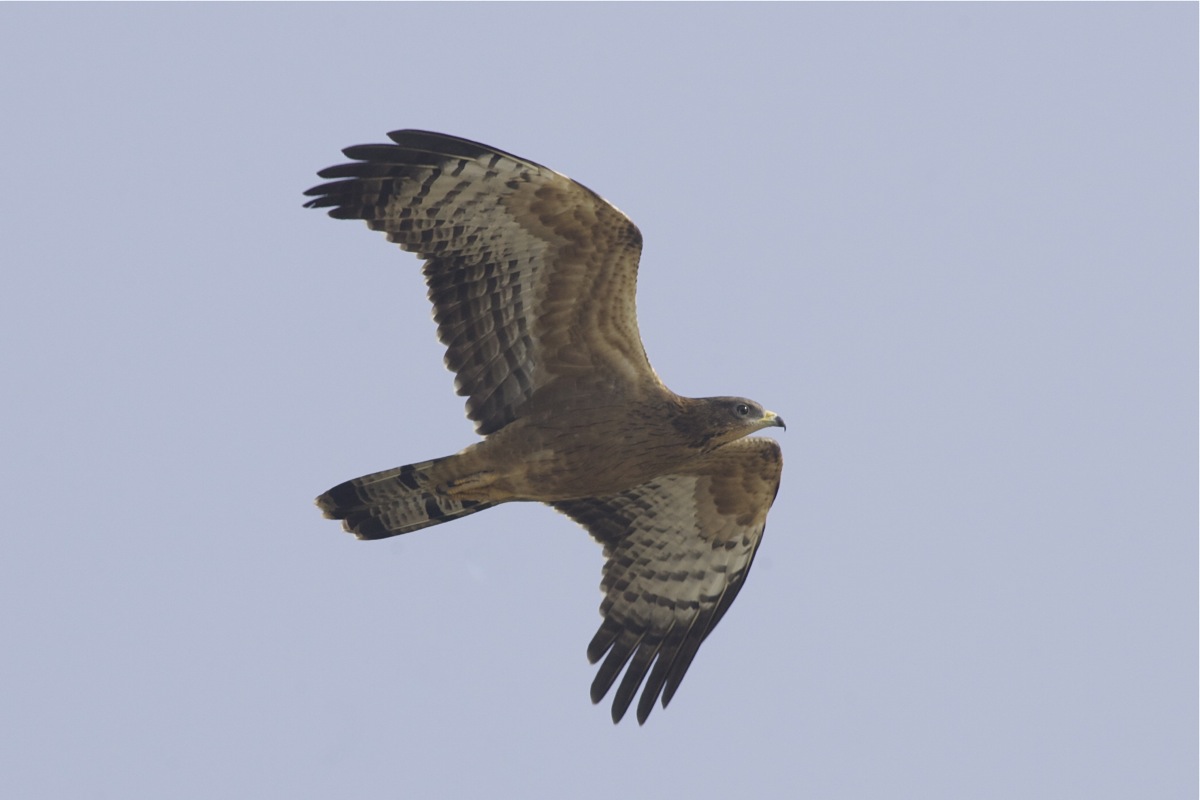
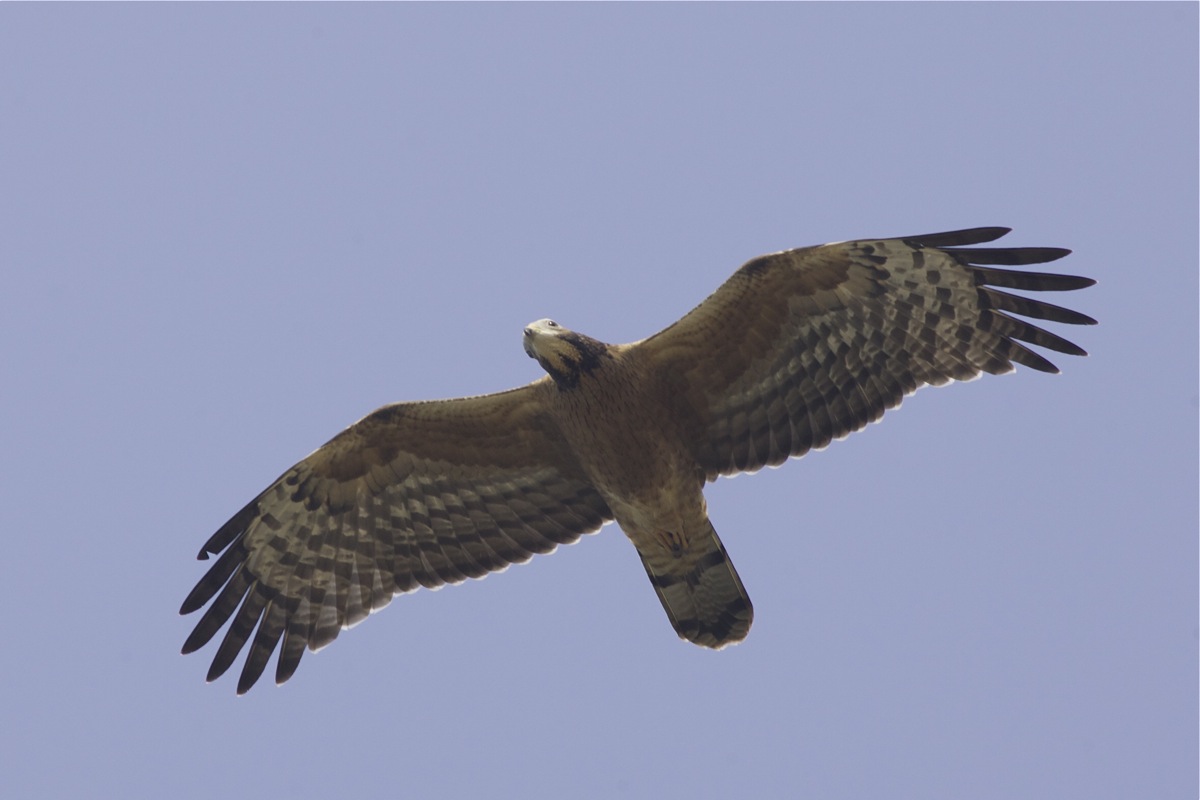
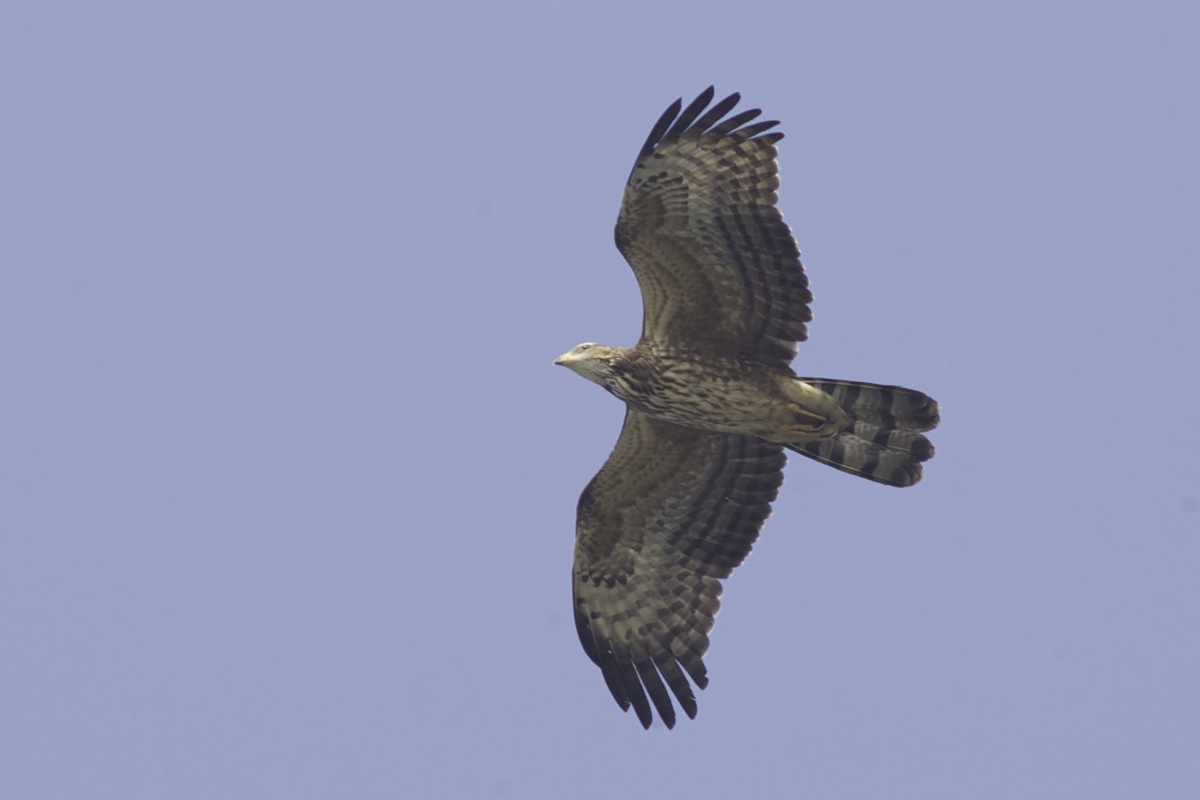
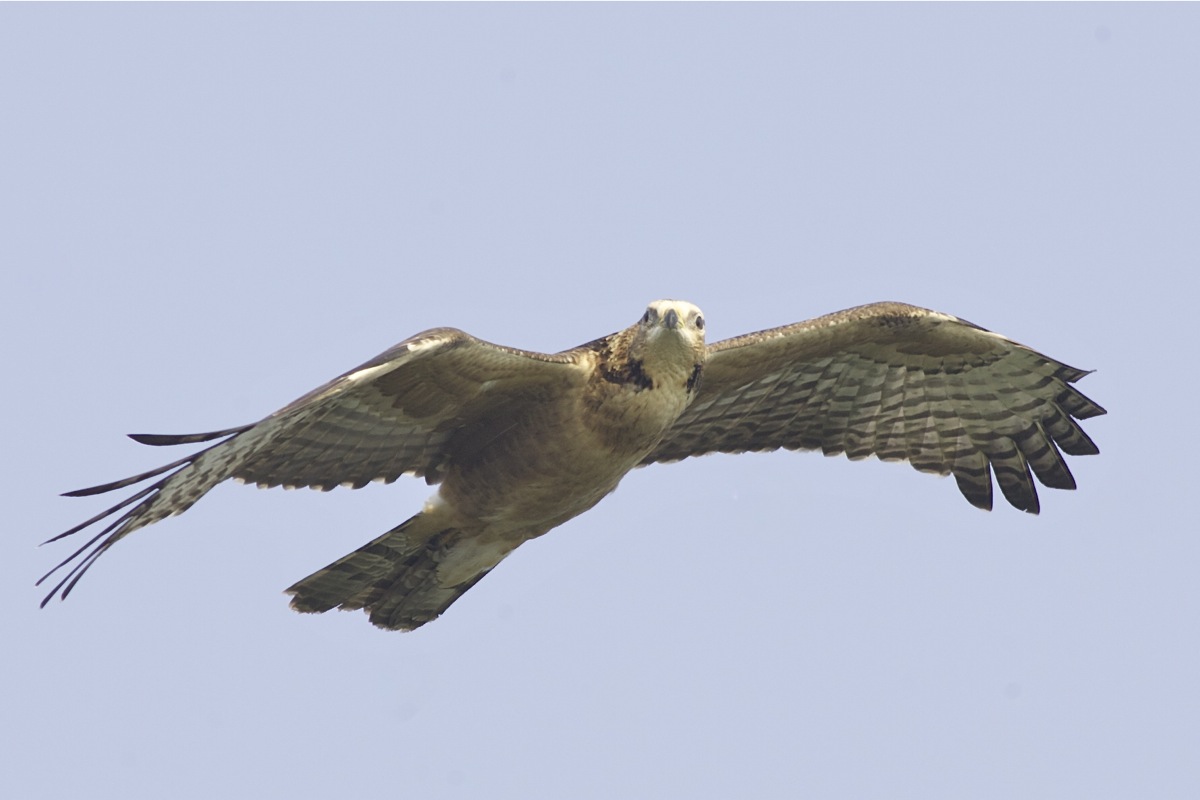
After the success of the 1st China International Birding Festival, it was with some sadness that I received a call from the Dalian Lushun Wild Bird Protection Association on Thursday evening. Volunteers had been out that day and found more than 800 metres of illegal mist nets at Laotieshan, the site of the festival. They sent me these shocking images.
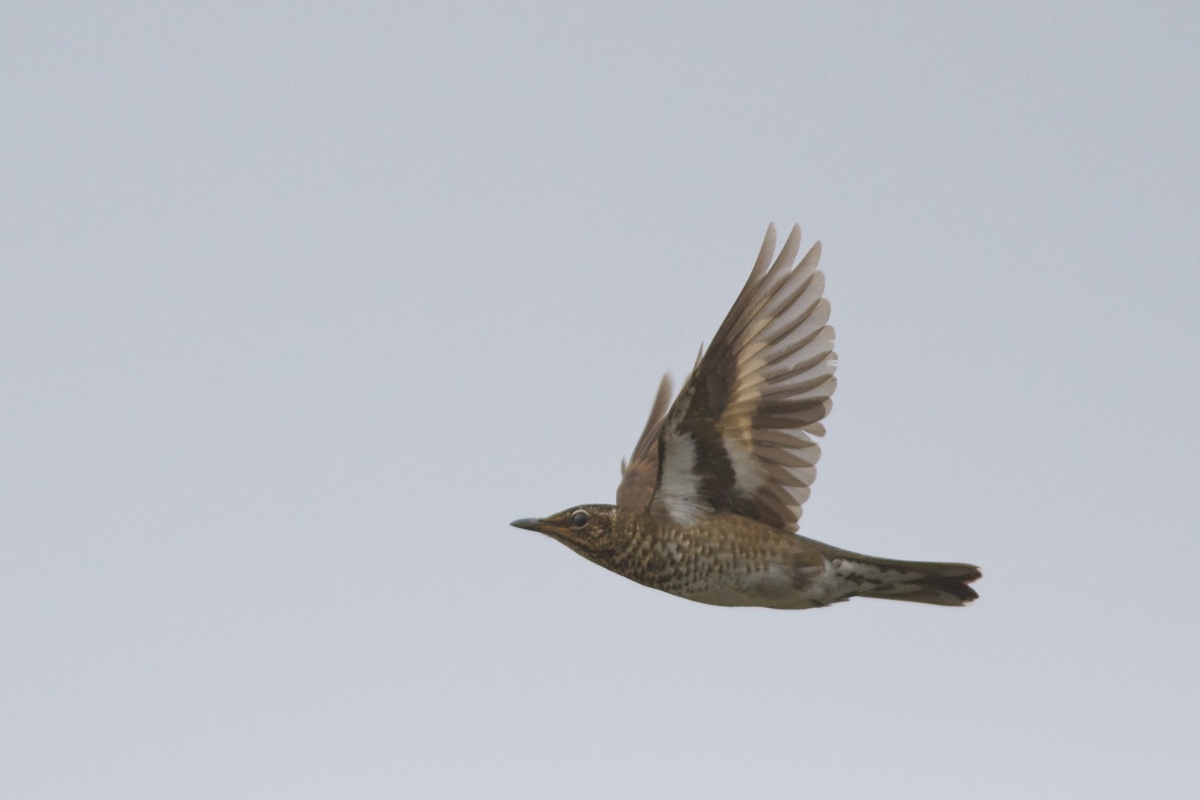
Volunteers from the Dalian Lushun Wild Bird Protection Association, Laotieshan Nature Reserve staff and Forestry Police taking down illegal nets at Laotieshan on Thursday.The removal of the illegal nets came too late for this Woodcock.However, this NORTHERN BOOBOOK was lucky. After untangling this beautiful bird from the net, the volunteers released it unharmed.Stressed but unharmed. Hopefully this NORTHERN BOOBOOK will have an uneventful migration to south-east Asia.
The group’s leader explained that, when the festival was in progress, the poachers had lain low, knowing that the discovery of mist nets during the event would have embarrassed the local government and almost certainly led to severe punishment. However, now, with the spotlight turned away, the poachers were back in force. Apparently 7-8 poachers regularly haunt the Laotieshan area and every autumn there is a running battle between the criminals and the local wild bird society, Laotieshan nature reserve staff and forestry police.
One piece of good news is that the local bird group has been engaging with the poachers to try to persuade them away from catching birds to becoming bird protectors. One of them has already given up his nets and is now paid a small amount to look for, and take down, illegal nets. Discussions with a second poacher are ongoing.
As is well-known, poachers make the best gamekeepers, so I have my fingers crossed that they are successful. Whatever the result, it’s important to highlight the brilliant work of the Dalian Lushun Wild Bird Protection Group. Heroes.
After a whirlwind 48 hours, and the participation of almost 200 birders from all over China and overseas, the 1st China International Birding Festival has officially closed. And what a success it was.
The centrepiece was a 24-hour “bird race” during which 49 teams of 4 (age range 10 to 71) competed to record as many species of bird as possible by visiting 5 pre-determined sites in the Laotieshan area. Each team was allocated a volunteer student from the Dalian University of Foreign Languages, a local State Forestry Fire Prevention officer and provided with a car and driver. And, after the opening ceremony in which the Vice Mayor of Dalian and other senior government officials participated, the race began at 4pm on Friday.
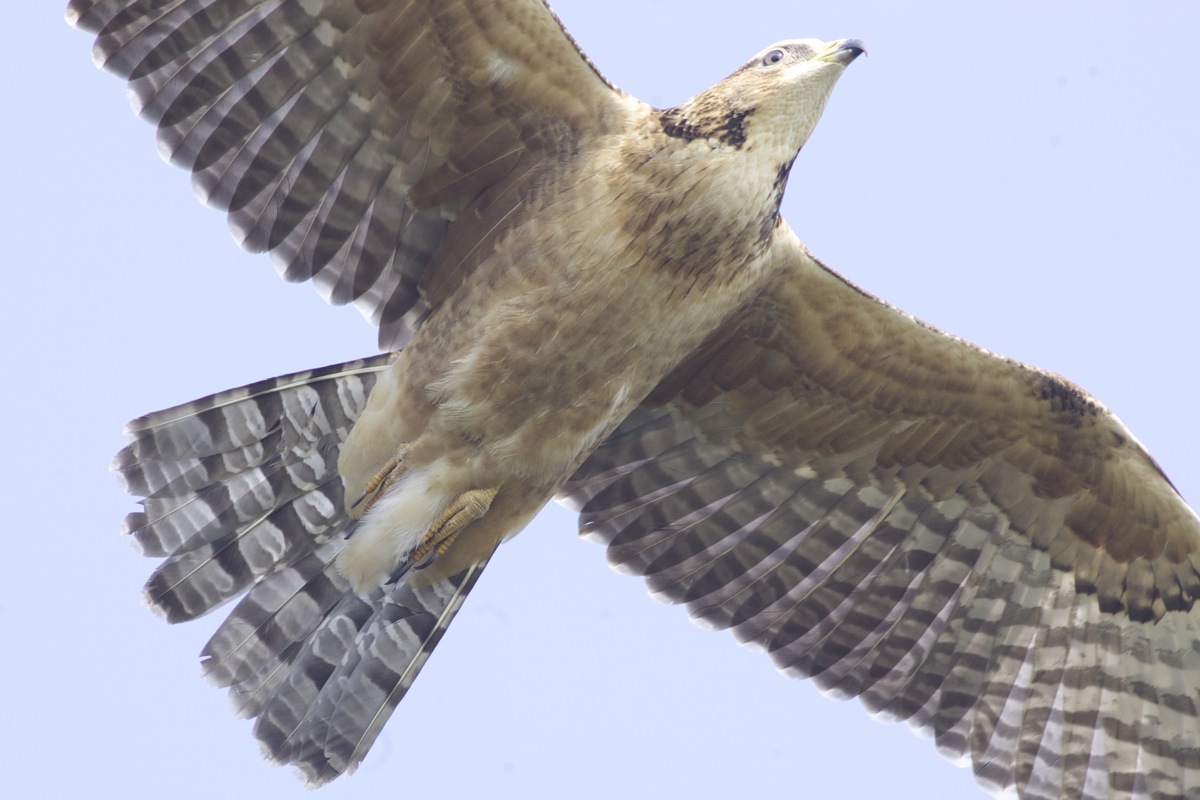
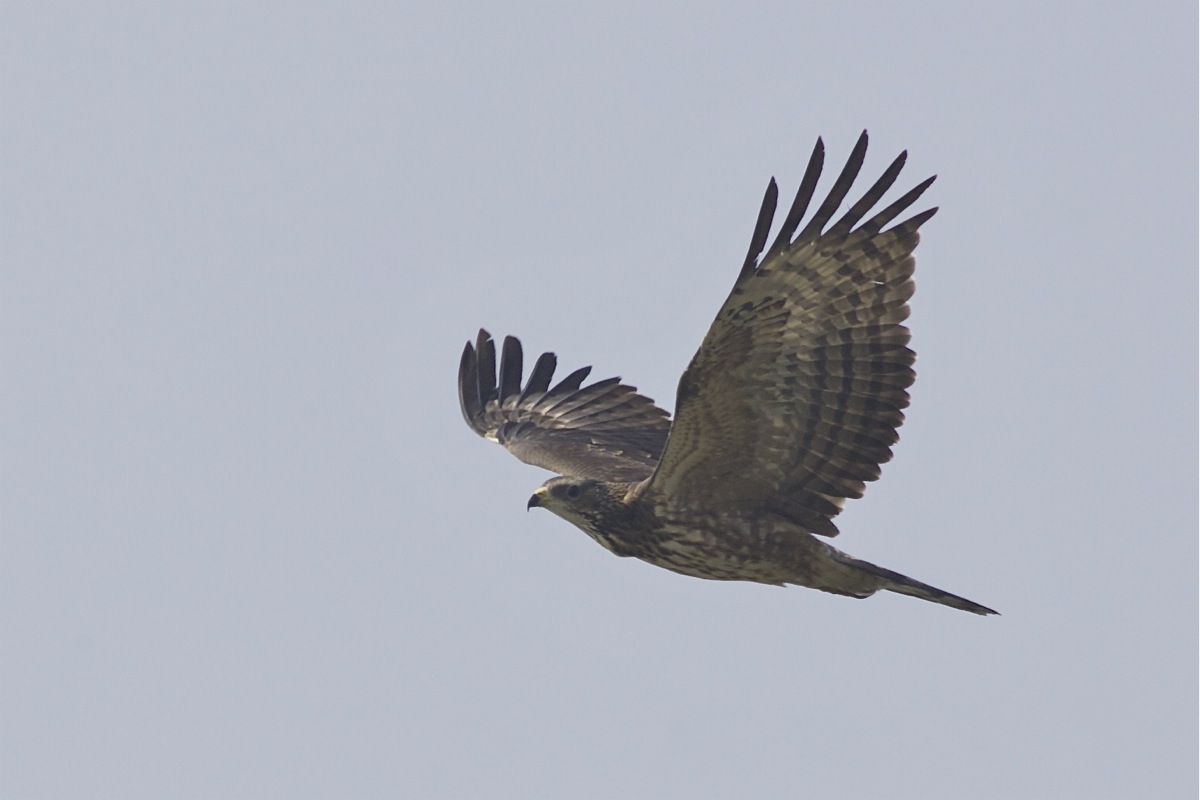
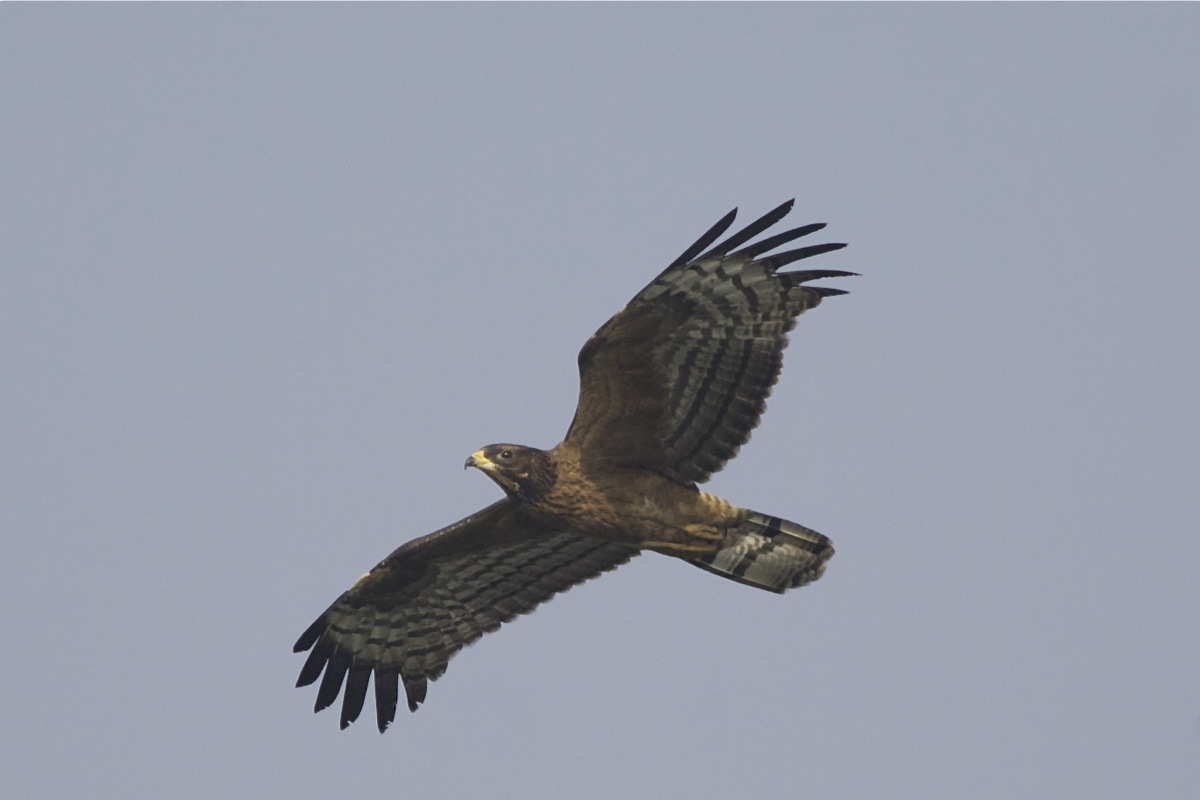
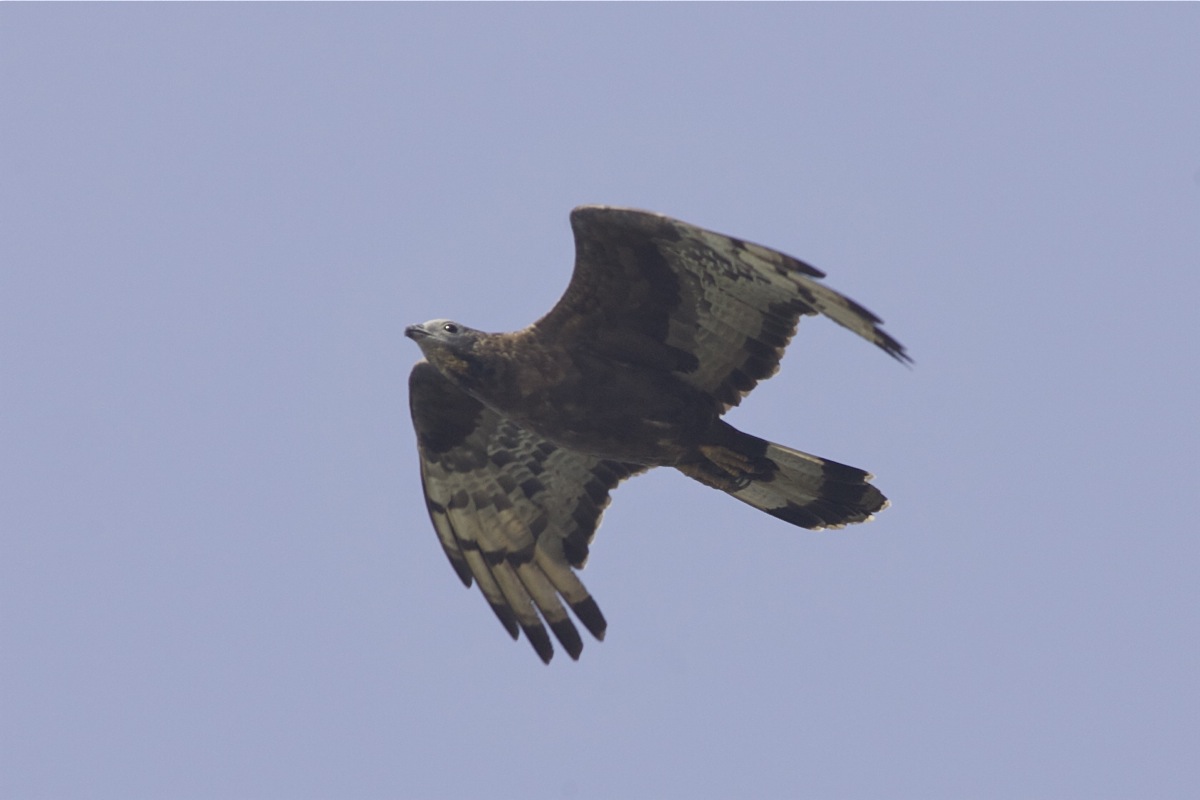
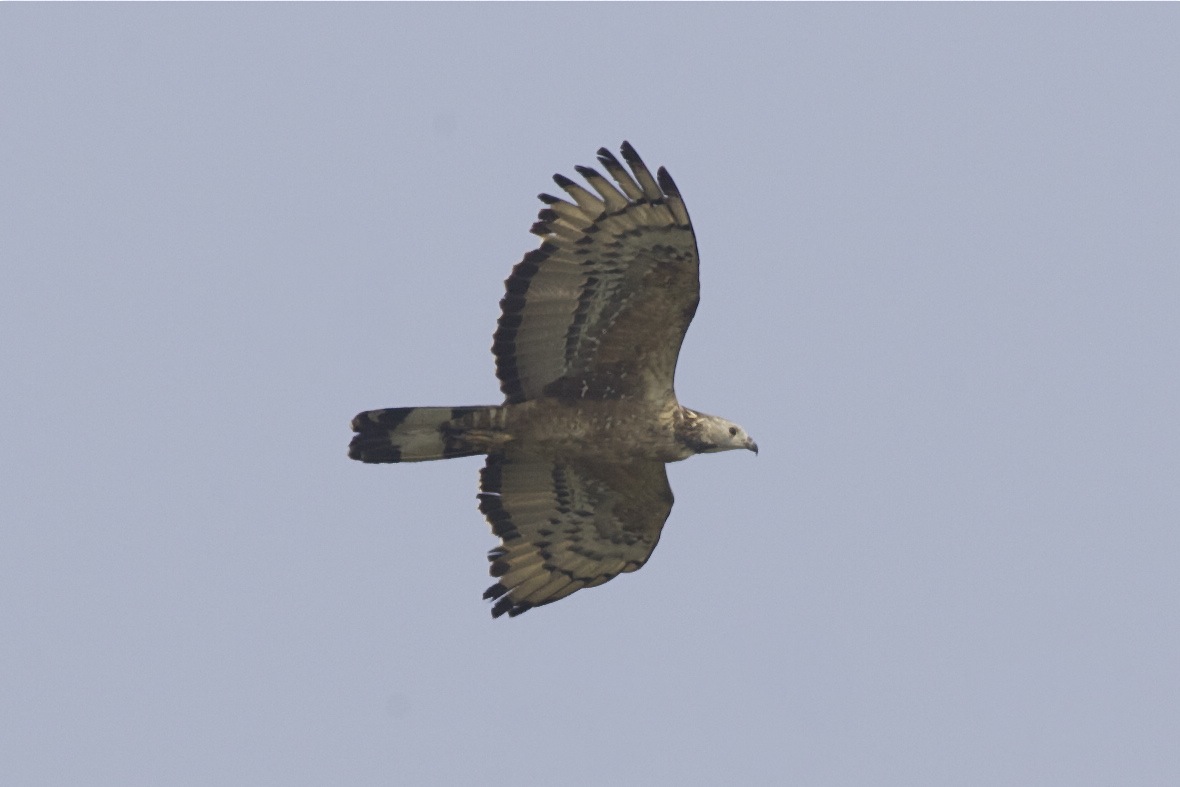
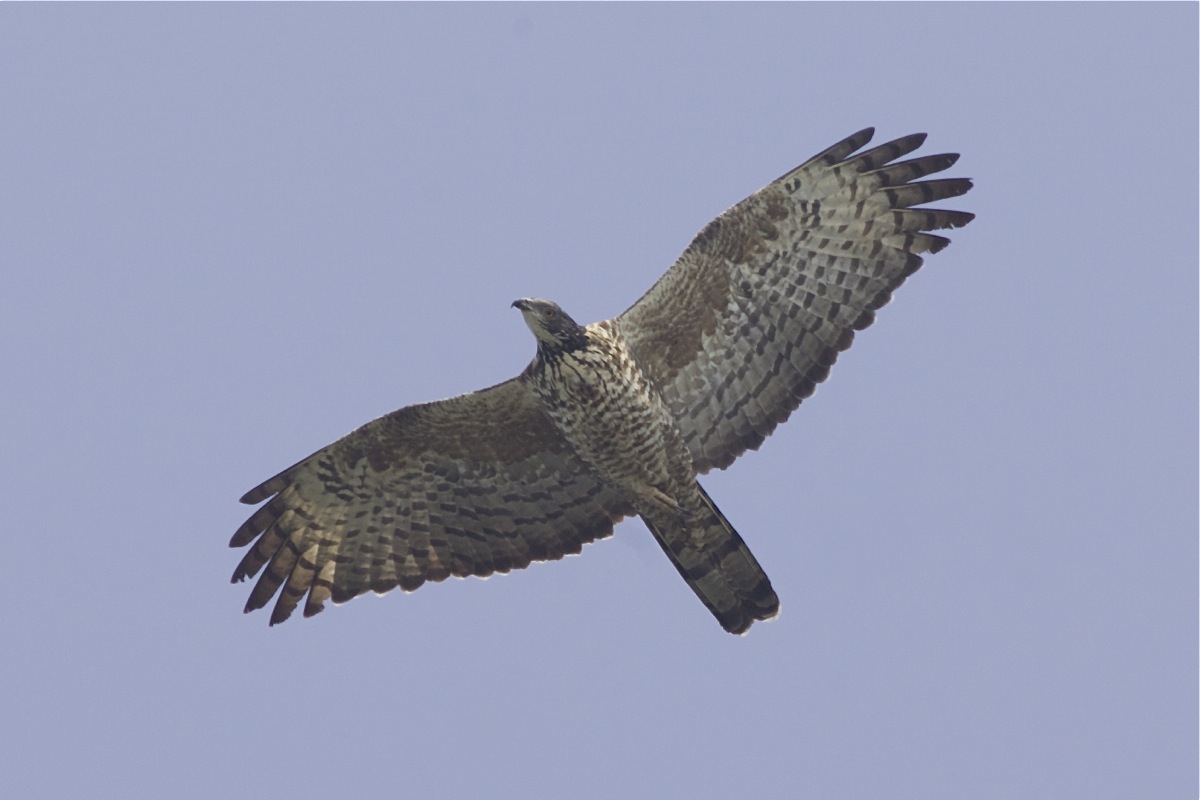
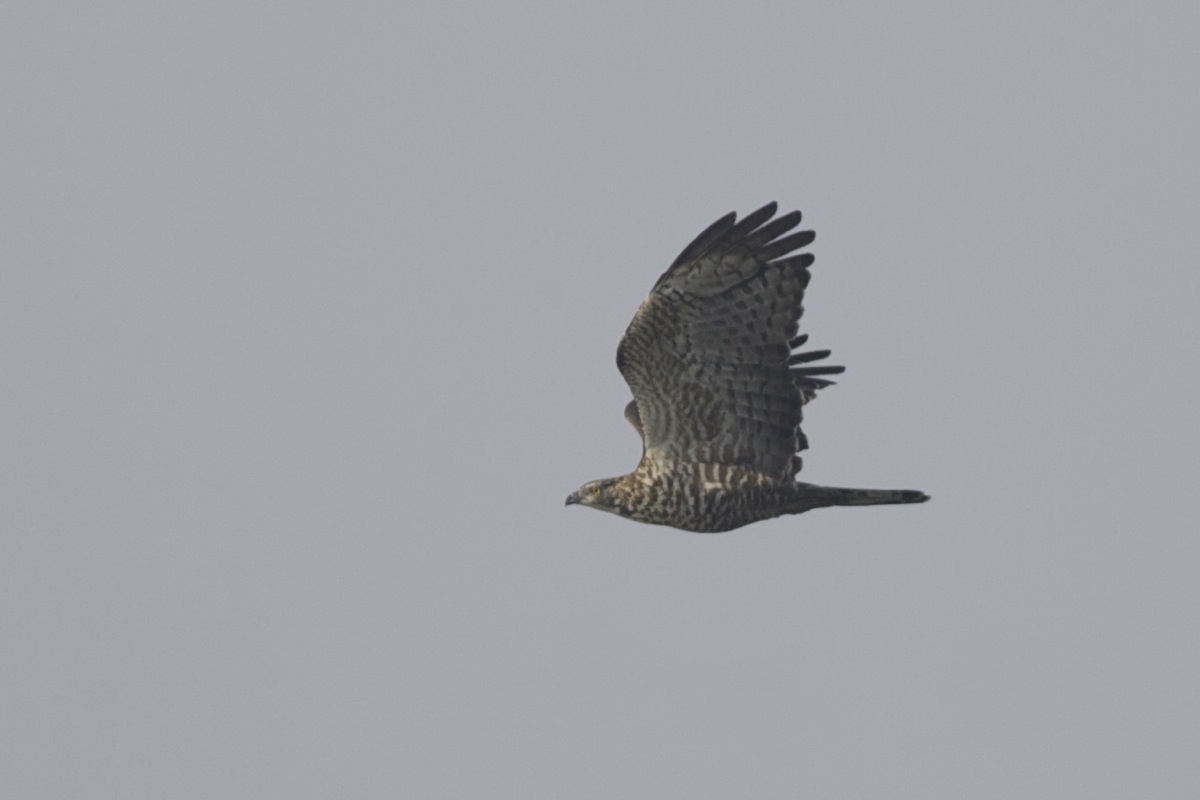
The formal opening ceremony of the 1st China International Birding Festival. A grand affair!However, some were briefly distracted from the speeches when an ORIENTAL HONEY BUZZARD drifted overhead..The map of the birding locations for the 24-hour “bird race”. The birding sites are marked in red, A to E. The accommodation and event sites marked in green, F to H.
With China birding guru, Paul Holt, honourably serving as one of the team of judges, suddenly everyone else was in with a chance of victory!
Our team, including Marie Louise and two fabulous and enthusiastic young birders, Zhao Tianhao and Cheng Xi, decided to spend the first two hours of the race, and the last two hours of daylight, visiting the “Tiger Tail mudflats” where we connected with, among others, Chinese Egret, Osprey, Black-tailed and Black-headed Gull as well as Red-throated Pipit, Lanceolated Warbler and a stunning adult male Yellow-breasted Bunting in the scrub.
The “Ibisbill” team (from left to right): Zhao Tianhao, our forestry minder, TT, Marie Louise and Cheng Xi)
After the formal dinner in the evening, we arranged to meet at 0500 (half an our before dawn and the earliest the driver and forestry officer could start) to continue the race..
We first visited the saltpans from where we hoped to be lucky with Streaked Shearwater (possible, with luck, from the sea wall). We did not see one but we did connect with some shorebirds, including Red-necked and Temminck’s Stints, Dunlin, Kentish and Little Ringed Plovers, Marsh Sandpiper, Greenshank, Wood Sandpiper and Pacific Golden Plover. It was shortly after sifting through the waders that we finally saw something ‘streaked’, only it was not ‘shearing’ over the sea but hiding in a small reedbed. Astonishingly, we connected with a STREAKED REED WARBLER, an almost mythical and now almost certainly extremely rare bird. See here for some background about this species and the story of this observation.
After the excitement of the Streaked Reed Warbler sighting, we continued to increase our species list as we visited the other sites, including a wooded mountainside and a tidal estuary. An encounter with two NORTHERN HOUSE MARTINS (scarce in NE China) was a nice bonus during our last hour.
Zhao Tianhao suffered from an allergic reaction to the local scrub and took an emergency soaking to calm the itchiness!
As time wore on, our ‘guide’ slowly increased the pressure on us to get back to base – any team that was late, even by a minute, would be disqualified. So, at 1520 we left the last site and headed back for the 20 minute journey to hand in our scoresheet. In the car we made a final count – 71 species. Not bad. At the beginning of the race I had thought that 70 species would be a good score, so we were pretty pleased, even though we had, alarmingly, missed some common birds; we had seen no woodpeckers, no owls, no harriers, no Little Bunting (how did that happen?), no pheasant or quail and ‘Japanese’ was the only Tit species!
After handing in the entries the judges got to work and, following a late evening, the results were ready to be announced at the closing ceremony the following morning.
On arrival, we were ushered to a row of seats close to the front so we knew we had won an award. We were delighted to receive two – “The Black-faced Spoonbill Award” for the rarest bird seen (the Streaked Reed Warbler was always going to be a shoe-in for that) and also the 3rd place team award (our 71 species was just 3 behind the winners – Tong Menxiu’s “China Wild Tour” team.
The “Ibisbills” team receiving the 3rd place award.The China Wild Tour team receiving their award for 1st place.
In addition, I was humbled and honoured to receive the judges’ “Birding Master” award…
It was a big surprise, and a huge honour, to be presented with the “Birding Master” award.
It was hugely encouraging to see big numbers of young Chinese birders participating and, during the 24-hour race we met with teams from as far afield as Yunnan, Guangdong and Fujian, as well as several teams from host province, Liaoning and the capital, Beijing. Even better was the gender balance – there were just as many young women as men (it was never like that in the UK when I was a young birder!).
Huge thanks to the organisers, including the China Birdwatching Society, the Dalian local government, the Dalian University of Foreign Languages and all of the other volunteers… And a special thanks to my team mates – Marie Louise, Zhao Tianhao and Cheng Xi.
With participation from the highest levels of the Dalian government, including generous financial support for the event, I sensed a genuine enthusiasm for birding and an appreciation for wild birds, the scale of which I have never before witnessed in China. All around were banners stating “Protect our birds” and “Dalian – honoured to be hosting the 1st China International Birding Festival”. During the race, many of the 49 teams took the time to explain to interested passers-by what they were doing and to show them wild birds.. And the bird race was covered by national and local TV as well as print media, including the most popular Chinese language newspaper, the People’s Daily. So the event has helped to raise awareness among the general public, as well as enthusing a new generation of Chinese birders. I was heartened when one young Chinese student volunteer approached me at the closing ceremony and said “This event has made me want to be a birder”.
Forget all the trophies handed out, the most important winner of all was Birding in China.
The 1st China International Birding Festival will take place at the superb migration hotspot of Laotieshan, Liaoning Province on 25-27 September 2015.
The event, sponsored by the China Biodiversity Conservation and Green Development Foundation (CBCGDF), China Birdwatching Society and the Dalian Wildlife Conservation Society, has been designed to promote birding and wildlife conservation in China.
The 3-day event will include a 24-hr ‘bird race’ and teams of up to 4 people from around the world are welcome to test their birding skills against the locals. China birding legend, Paul Holt, will be one of the judges.
The generosity of the hosts means that accommodation will be provided but travel to and from Laotieshan is at the expense of the participants.
Readers of this website will know that Laotieshan is a special place. You can read about it here. The Festival has been timed to coincide with peak raptor migration and, in the right conditions, it’s possible to see more than 1,000 ORIENTAL HONEY BUZZARDS in a day, as well as many other species (we recorded more than 200 species during an autumn visit in 2013). In the early morning passerine migration is impressive and, offshore, rafts of STREAKED SHEARWATERS will add to the mix. I can’t wait!
More details, including an application form, can be found here. Although the deadline on the flyer for entering teams is 8 August, this is flexible. But hurry – it’s likely to be very popular!
More importantly, the Festival should serve as a boost to the fledgling (but growing fast) birding community in China. Be there or be sqaure!
EDIT: As at 10 August more than 30 teams have entered! And, as the deadline for applications has been extended to 15 August, you still have time to get together that team to challenge for title! Each team will be allocated an english-speaking member of the China Birdwatching Society to help with any logistical or language challenges over the course of the festival. So there’s no excuse not to be there!
Ok, they aren’t birds, but FINLESS PORPOISES are one of the features of Laotieshan. On calm days it is not unusual to see more than 10 of these cetaceans loafing around. Here’s a short video of these mammals hanging around a local fishing boat…
I have just returned from a few days with Paul Holt and Marie Louise at the brilliant visible migration watchpoint that is Laotieshan in Liaoning Province. Learned lots, as we always do when we visit this superb place. Paul is staying on for a few days and a full report will be available soon but I’ll blog about a few of my highlights over the next few days. First up is a video compilation of a few of the 15+ STEJNEGER’S STONECHATS that frequented the point on 9 September. Remarkably different from the stonechats with which I recently re-acquainted myself at Winterton-on-Sea in Norfolk….!
Paul Holt has just finished his report from Laotieshan this autumn, covering the period 5-26 September. For a few of those days, towards the end, he was joined by Per Alström and me, but he generously credited us a joint authors. The full report can be downloaded here: Birding in Liaoning 5-26 Sept. 2012 (Holt, Townshend & Alstrom) but, for the busy reader, highlights included:
Five new species for Liaoning:
• 14 bird-days with up to 11 Short-tailed Shearwaters being noted on four dates between 12-19 September;
• seven bird-days for skuas/jaegers between 12-18 September – most were unidentified but a Long-tailed Jaeger was identified on the 12th as was a single Pomarine on the 18th;
• a Swinhoe’s Minivet on the 14 September;
• a Chestnut-cheeked Starling on 6 September.
High counts included:
• 3,274 bird-days for Streaked Shearwater with a count of 1,605 during the 4.5 hour sea watch off the point at Laotie Shan, Lushun on the 13 September possibly being a Chinese record;
• 4,313 bird-days of Oriental Honey-buzzard with 1,181 south on the 23 September;
• 938 bird-days of Japanese Sparrowhawk with 446 (possibly a Chinese record) south on the 6 September;
• 16,000 Black-tailed Gulls and 5,000 Mongolian Gulls west off the point on the 18 September (possibly both Chinese records);
• 20,959 bird-days of Ashy Minivet with 10,380 on the 21 September (a Chinese record);
• 270 bird-days for Black-naped Oriole with 72 on the 6th & 62 on the 9 September;
• 20,600 bird-days for Barn Swallow with 7,500 south on 14 September;
• 56 bird-days for Asian House Martin with 37 south on 6 September;
• 90 Forest Wagtails south on 11 September;
• 3,160 bird-days for White Wagtail with 1,134 on the 11 September;
• 196 bird-days for Pechora Pipit with exactly half this number, 98 birds, on the 12 September possibly being a Chinese record
Local rarities included:
• single adult Black-legged Kittiwakes on the 12th & 18 September
• one juvenile Pallas’s Gull during a seawatch on the 18 September – perhaps only the sixth record for Liaoning;
• 1 Spotted Nutcracker on the 24 September;
I suspect that, with irruption species such as Varied Tit, ‘Northern’ Great Tit, Rosefinches etc on the move this autumn, October might have been exciting, too… but there have been no birders there to find out!
I saw my first Pacific Swift in Copenhagen, Denmark, in June 2010 just a few weeks before moving to China. Since then I have seen many more in north-east China – it is a common migrant through Beijing in spring and autumn. Last year, a thorough assessment of four Pacific Swift subspecies by Paul Leader (Leader, P J. 2011. Taxonomy of the Pacific Swift Apus pacificus Latham, 1802, complex. Bulletin of the British Ornithologists’ Club 131: 81-93) found that they may deserve species status. This is an extract from an article in Birdwatch magazine by David Callahan in June 2011:
“Four subspecies of Pacific Swift are generally recognised, and the species as it is known traditionally has a wide breeding distribution throughout the eastern Palearctic. It is a long distance migrant, wintering south to Indonesia and Australasia.
Leader (2011) measured and assessed the plumage of 146 specimens of Pacific Swift from four different museums across Eurasia, as befits a species with pan-Palearctic records. The four forms were found to differ in wing and tail measurements, as well as the size and shape of their distinctive white rump patch, white throat patch, pale underpart fringes and the colour of the underwing coverts.
The new prospective species are as follows:
Pacific SwiftApus pacificus: cleaner white throat patch, a slightly longer tail fork and tail length, and the broadest rump patch by a margin; breeds from Siberia through to Japan, winters from Indonesia south and east to Tasmania (incorporating the subspecies A p pacificus and A p kurodae – other subspecies were found to be invalid).
Sàlim Ali’s SwiftA salimali: five to 10 mm longer tail but with similar wing length to A pacificus, throat patch forming a thin white strip half the width of the other three forms, thinnest at the bill end, and very little white to the underpart feathers; breeds at high altitude on the east Tibetan Plateau and west Sichuan, China, but its winter range is unknown.
Blyth’s SwiftA leuconyx: the smallest of the four forms, with the rump patch consistently narrow, brown-tinged crown and nape contrasting with the glossy black mantle, broad white thoat patch with black shaft streaks extending onto the upper breast, hardly any pale underpart fringing; mid- to high-altitude breeder across the Himalayan part of the Indian subcontinent into Bhutan and Nepal.
Cook’s SwiftA cooki: shallowest tail fork, first primary the longest (the other three have P2 as the longest), narrow white rump patch with dark, club-shaped shaft streaking, overall black upper- and underpart-coloration (brownish tinge in the other three), broad well-defined fringes to the underpart feathers, throat patch off-white with broad black shaft streaks, black contrasting underwing coverts, and green iridescence to upperparts with some white fringed scapulars; restricted range in limestone caves in northern south-east Asia, and a short distance migrant to then south.”
During my recent trip to Jiuzhaigou, I enjoyed watching a flock of “Fork-tailed” Swifts wheeling around the mountain tops at around 3,000m altitude. A (poor quality) image of one of them is below.
Fork-tailed Swift, Jiuzhaigou, 27 June 2012. Is this a Salim Ali’s Swift?
Compare this image with a couple of Pacific Swifts taken at Laotieshan in May 2011:
Pacific Swift, Laotieshan, Liaoning Province, May 2011Pacific Swift, Laotieshan, Liaoning Province, May 2011.
To my eyes at least the bird from Jiuzhaigou appears longer tailed and with a narrower white patch on the rump. I don’t have access to the article by Paul Leader so I am not sure on precise range but I think there is a good chance this is a Salim Ali’s Swift. Comments welcome!
Asian House Martin (Delichon dasypus) must be a candidate for vagrancy to Western Europe. At least one of the three subspecies is a strong and long distance migrant. However, looking very similar to Northern House Martin, its common European sister-species, how many people would be able to identify one?
The nominate subspecies of Asian House Martin is perhaps the most likely to wander. It breeds in southeast Russia, the Kuril Islands, Japan and Korea and migrates through eastern China to winter in the Malay Peninsula, Borneo, the Philippines, Java and Sumatra.
Ssp cashmeriensis breeds in the Himalayas from Afghanistan east to Sikkim and northwards into Tibet and western and central China. It is a short-range migrant, mainly wintering at lower altitudes in the foothills of the Himalayas.
The third race, ssp nigrimentalis, breeds in southeastern China and southern Siberia. Its wintering grounds are unknown, but birds in Taiwan apparently just move to lower altitudes in winter.
In eastern China any sighting of a House Martin is notable. I have seen a handful of both Asian (presumably the nominate subspecies) and Northern House Martins at Laotieshan in Liaoning Province but, in a sign of just how scarce they are in this region, I have still not seen one of either species in Beijing (they are passage migrants and seen in small numbers each spring and autumn – clearly I just haven’t been trying hard enough!).
My recent visit to Chang Bai Shan in Jilin Province provided an opportunity to get to grips with Asian House Martin as several pairs were nest-building on our hotel, allowing some fantastic views. Capturing any hirundine in flight with a camera is never easy, and the images below won’t win any prizes, but they do show some of the features to look out for in separating Asian House Martin from Northern House Martin. To the European readers of this blog, it’ll be worth making a mental note of these features when checking out those late autumn migrants….!
Asian House Martin, Laotieshan, 27 September 2011. A typical view of a migrant. Note the dark underwing coverts – a good feature of Asian House Martin – as well as the dusky-looking underparts and dark neck ‘collar’.Asian House Martin, Chang Bai Shan, 3 June 2012. A closer view. This image was taken in heavily overcast conditions but still shows the contrasting dark underwing coverts and dusky underparts with white throat.
There are several differences between Asian and Northern House Martin that should make identification relatively straightforward if seen well.
Structurally, Asian House Martin is smaller, more compact and squarer-tailed than Northern but these features aren’t necessarily easy to ascertain on a single bird.
Perhaps the best feature, and one that I have found very helpful in the field, is the colour of the underwing coverts. In the images above, taken in sunny and dull conditions respectively, one can see the relatively dark underwing coverts, a consistent feature of Asian House Martin. Compare with this image of a Northern House Martin. The paler underwing coverts of Northern are not usually as prominent as shown in this linked image (taken in strong light) and can often appear concolourous with the rest of the underwing but a House Martin with obviously dark underwing coverts should be Asian.
Asian House Martin, Chang Bai Shan, 3 June 2012
Another subtle feature to distinguish these two species is the amount of black on the face. Compare the image above of Asian with this image of Northern. The black on the face generally extends a little lower on Asian.
Asian House Martin, 3 June 2012
Another feature is the rump. On Asian House Martin the white rump is usually relatively small and can appear ‘flecked’ with dark streaks, as in the above image. On Northern the white rump is larger (due to more of the uppertail coverts being white) and is usually clean white.
Finally, check out these images from John Holmes in Hong Kong. Asian House Martin often shows ‘dusky’ flanks and belly, whereas Northern usually shows bright white underparts.
In summary, the combination of a smallish white rump (sometimes flecked), dark underwing coverts, ‘dirty’ flanks, a squarer tail and a darker ‘face’ are all characteristics associated with Asian House Martin. Maybe one will turn up at your migration watchpoint this autumn…?
EDIT: I have added this image of an Asian House Martin taken at Chang Bai Shan that shows the dark feathering on the upper chin (ie just below the lower mandible). In Northern House Martin, the chin is white.
Asian House Martin, Chang Bai Shan, 3 June 2012. This image shows the dark feathering immediately below the lower mandible, a good feature of Asian House Martin. Not so easy to see in the field, however!
Paul Holt has just completed his detailed trip report for the autumn migration trip to Laotieshan in Liaoning Province, China. It will come as no surprise to anyone who knows him (and me!) that Paul is responsible for the incredibly detailed daily counts of the species included in the report.
It was an awesome trip with some stunning counts (including some China records).
Highlights:
We recorded 202 species in total
High counts included 2155 bird-days of Oriental Honey-buzzard with 1035 on our very first day on site, the 24 September;
1150 bird-days of Black Kite with birds being seen almost every day with a peak count of 209 on the 7 October;
1255 Eurasian Sparrowhawks and a peak count of 283 on the 10 October;
248 bird-days of Northern Goshawk with a peak of 64 also on the 10 October;
6944 bird-days of Eastern Buzzard with a peak of 3490 on the 12 October;
7971 bird-days of Amur Falcon with a peak of 1830 on the 10 October;
Over 20,000 bird-days of Ashy Minivet with a peak of 7549 on the 28 September;
456 bird-days of Yellow-bellied Tit with birds being noted on 20 of the 23 days we were in Liaoning and a peak of 160 on the 5 October;
Nearly 60,000 bird-days of Red-rumped Swallow with 10,000 being estimated on the 27 September;
Over 14,000 white-eyes with up to 4500 birds being noted daily while we were in the province;
Over 1600 bird-days of Black-faced Bunting with a peak of 700 on the 8 October.
Local rarities included:
14-bird-days of Black Stork with between 1 and 4 birds on five dates;
A juvenile Steppe Eagle on the 2 October;
2 juvenile Golden Eagles on the 11 October;
An adult male Lesser Kestrel on the 6 October;
70 osculans Eurasian Oystercatchers, a moulting juvenile Pallas’s Gull (only the third for Liaoning) and a first year Glaucous Gull at the Biliu river, Pulandian and a single Little Curlew near Pikou, Pulandian all on the 3 October;
Surprising numbers of both Northern and Asian House Martins;
Two and one Red-billed Starlings on the 7th & 14 October respectively
Several early Alpine Accentors with sightings on three dates after the 11 October.
My visit to Laotieshan in Liaoning Province provided an excellent opportunity to get to grips with one of China’s most numerous raptors – the Oriental (Crested) Honey Buzzard. We saw well over 1,500 of these birds during the first few days of our visit from 24 September, but clearly the bulk of these relatively early migrants had already passed through… Numbers tailed off pretty quickly at the end of Sep/early Oct, just as the number of Common Buzzards (a later migrant) began to increase. The 4th October was the first day that Common Buzzards outnumbered Oriental Honeys. I suspect that a survey from late August at Laotieshan would reveal several thousand Oriental Honey Buzzards (OHB) passing through (one local birdwatcher told us that the first OHBs of the autumn passed through on 2 September at Laotieshan).
The OHBs we saw were mostly juveniles but there were a few late adults mixed in (adults tend to migrate earlier). The variation, as with European Honey Buzzard (EHB), is astonishing.
The main differences between OHB and EHB are as follows:
Size: OHB is larger with broader wings and 6 ‘fingers’ (vs 5 in EHB), sometimes recalling an Aquila eagle in silhouette.
Plumage: OHBs, as with EHBs, are highly variable, especially in juvenile plumages. One of the main plumage differences between the two are that OHBs do not usually have a contrasting carpal patch and have a relatively shorter and fuller tail than EHBs.
In this post I am including some images of the birds we saw, with some comments about age and sex. Please feel free to contact me if you think I have any wrongly labelled!
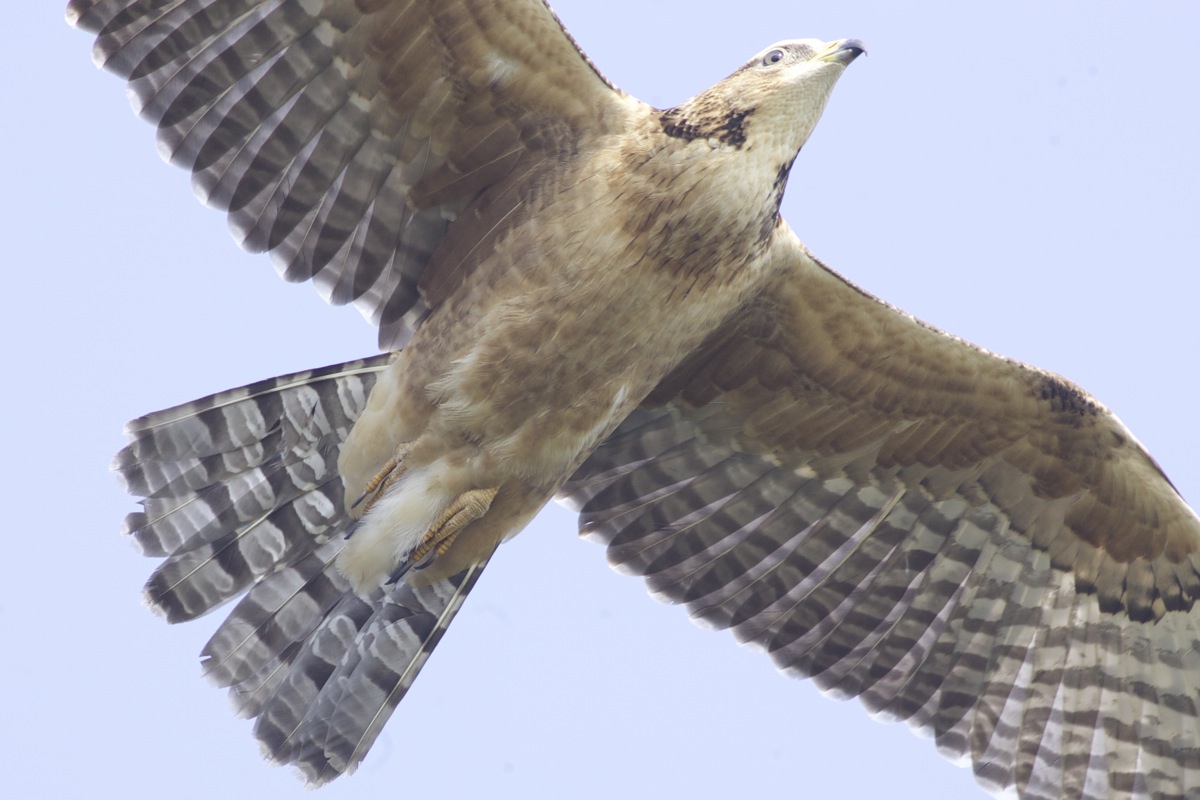
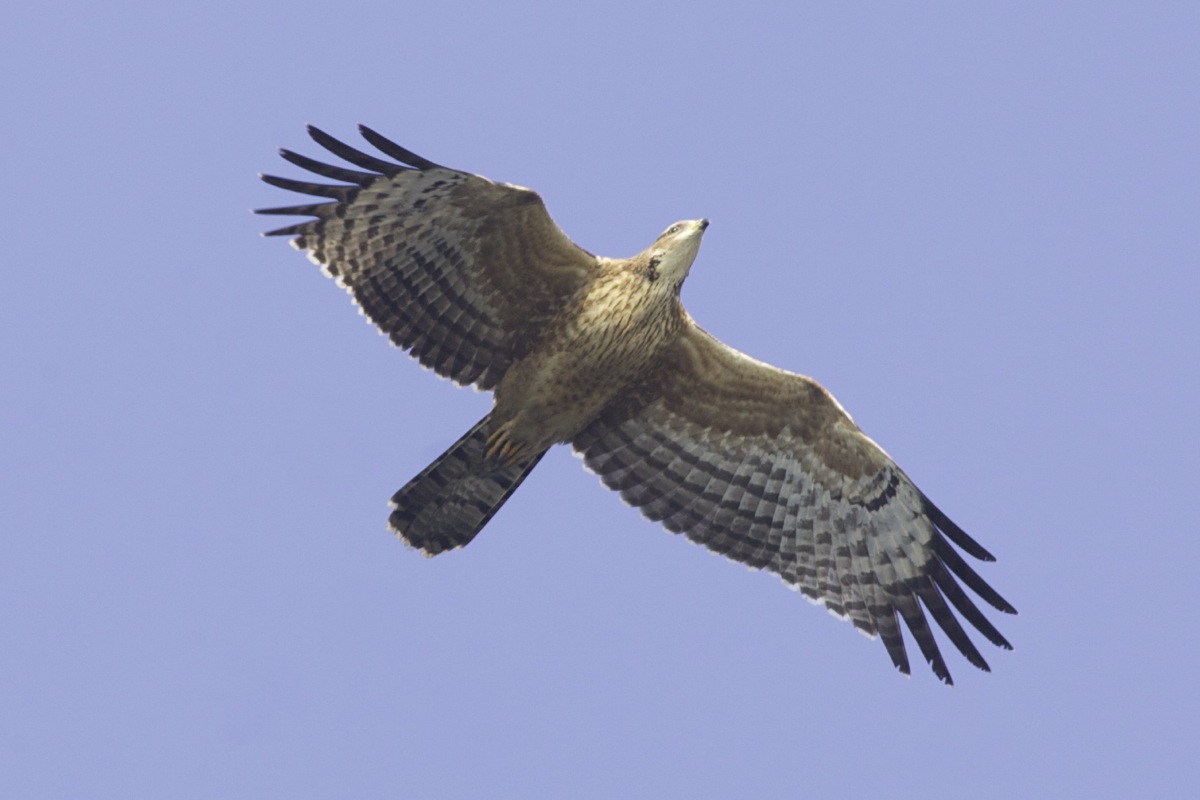
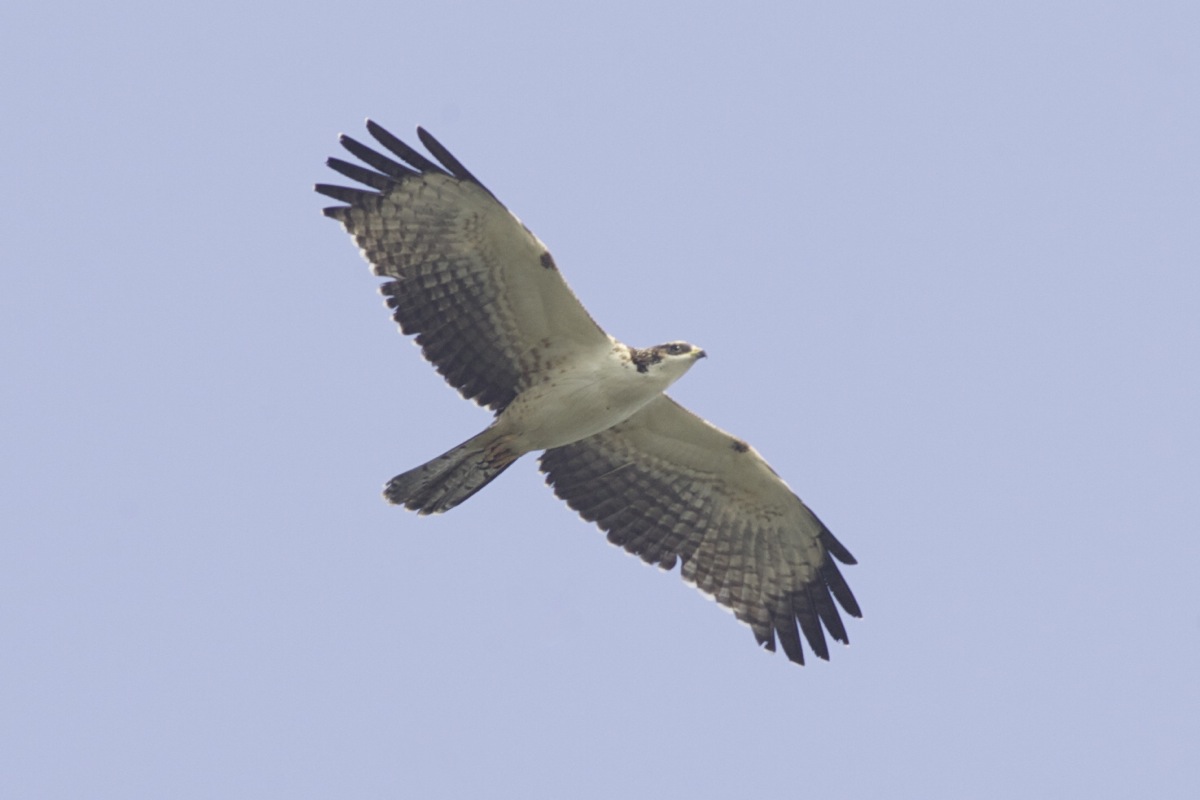
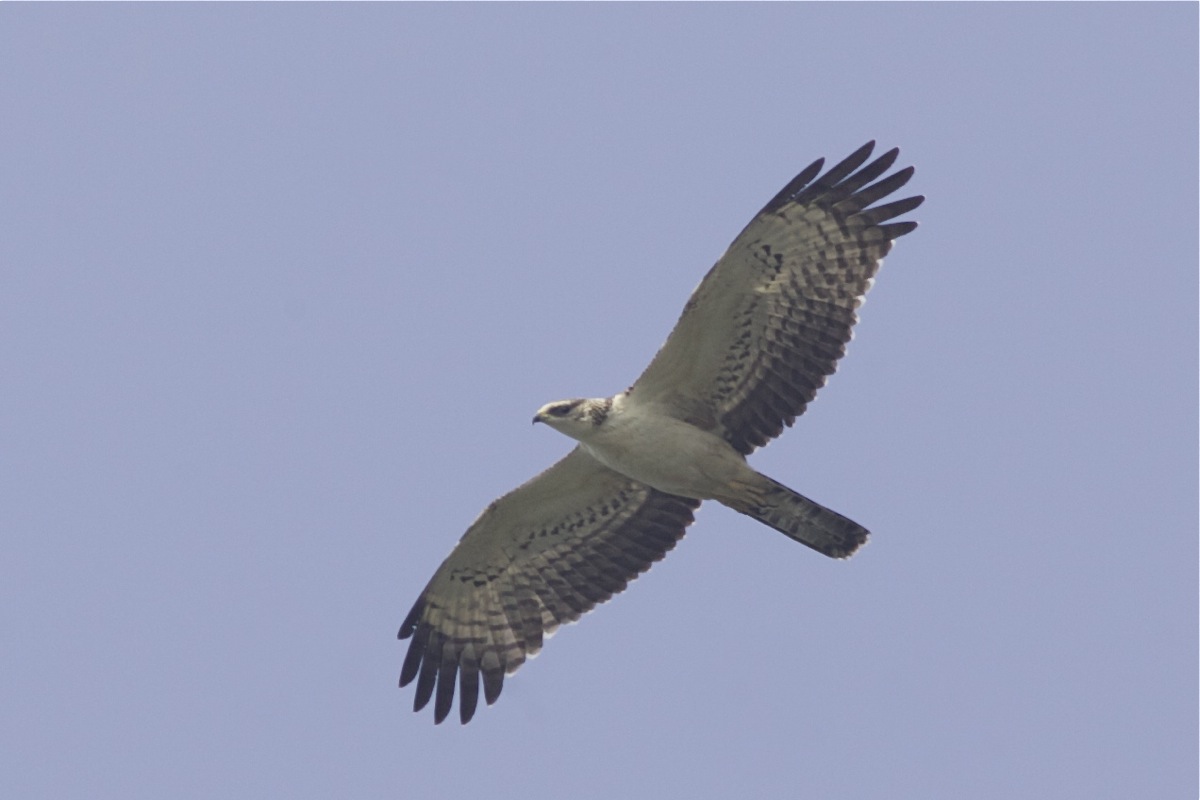
Oriental Honey Buzzard, Laotieshan. This is a juvenile, probably a male. Note the yellow base to the bill, the dark eye and the relatively neat and fresh plumage. A hint of grey on the head indicates this is probably a male.Another juvenile. This one is very dark. Again, note the yellow base to the bill, the dark eye and the fresh plumage. This bird is also probably a male given the hint of grey on the head and the relatively well-marked bands on the underwing and tail.Juvenile male. Juvenile due to the yellow base to the bill and fresh plumage. A male due to the grey wash to the head and the thick dark tail bands.Juvenile male. 'Rufous' juveniles like this seemed to be the dominant form. Again, note the yellow base to the bill and fresh plumage indicating a juvenile. Also note the 2 strong tailbands, indicating a probably male (females generally have multiple narrower bands on the tail).Juvenile, probable female. Aged as a juvenile given the yellow base to the bill and fresh plumage. Probably a female given multiple relatively thin tailbands.Juvenile female. Note the multiple, relatively thin, tailbands.Juvenile female. Note pale-ish iris (males retain a dark iris) and multiple tail bands.Same bird as above.Juvenile female. Again, note the hint of a pale iris and multiple tail bands.Juvenile (pale form). Superficially recalls Booted Eagle or Osprey. Not sure about sexing this bird.Another pale juvenile.Adult male. Note the all dark bill (indicating adult), grey head, prominent dark trailing edge to the wing, thick tail bands and relatively thick barring on the underwing (all characteristics of a male).Adult male. Dark bill and prominent trailing edge to the wing indicates adult. Grey on head and two thick bands on the tail indicate male.Adult male. Thick dark tail-bands, prominent dark trailing edge to wing.Adult female? Pale iris and three tail-bands suggest female.Adult female. Pale iris and lack of grey on head suggest female.
Paul Holt continues to enjoy his birding at Laotieshan. Yesterday (Tuesday) he saw two Golden Eagles (in addition to seven Greater Spotted Eagles) plus both Siberian and Alpine Accentors. A Marsh Grassbird (Japanese Swamp Warbler) was also something of a surprise.
As an aside, check out this beast photographed at Wild Duck Lake on Sunday… any ideas as to identification?
Heard from Paul Holt and Tom Beeke at Laotieshan this evening. Highlights today included at least 5 Greater Spotted Eagles and new birds for the trip – one juvenile Oriental White Stork, Manchurian Bush Warbler, Red-billed Starling, Yellow-throated Bunting and Daurian Jackdaw. The ringing station has received the dreaded phone call asking them not to allow foreigners up to the ridge unless they are accompanied by a member of staff… so viewing options for raptor migration are becoming increasingly limited. Peter heads back to Beijing tonight and I’m meeting him at the airport in a couple of hours. He’s had quite an introduction to birding in China..!
After the disappointment of being kicked off one of the prime raptor migration watchpoints on Tuesday, we took up the invitation from the local reserve officials, introduced to us by the Beijing Birdwatching Society, to visit a ringing station at Laotieshan. Our hosts, Mr Wang (Head of Research) and Mr Zhang (a researcher and ringer) met us near the lighthouse car park at 0630 and drove us to the ringing station where we met with two more staff. At this site (one of 8 ringing stations in the area), they operate four mist nets, three of which are targeted at passerines and one at raptors. It wasn’t long before the resident bird-catcher, Mr Sun, appeared with some birds and we were pleased to see Grey-backed Thrush and Tristram’s Bunting in the hand.
Grey-backed Thrush, Laotieshan, 5 October 2011
These birds were ringed and released promptly and soon we were discussing the birds of Laotieshan and the various species they had ringed. They gave us each a book that covered the birds of the Laotieshan peninsula and the nearby Snake Island (the island featured in the BBC series, Wild China, where the Pallas’s Pit Vipers have evolved to climb trees to wait for unsuspecting migrant birds). The list makes for very interesting reading, giving the status of each bird at Laotieshan – resident, summer visitor, winter visitor or passage migrant. I’ll post a translation of it on here at some point.
During this discussion Mr Sun disappeared, then reappeared with a Mugimaki Flycatcher.. a nice trick! Unfortunately this bird had lost its tail, either in the net or in the bag, but nevertheless, it was a smart bird.
Mugimaki Flycatcher, Laotieshan, 5 October 2011
We asked about access to Snake Island. Officially there was no access unless one had a permit (a familiar story in China!). Mr Wang was due to go out there later that day and stay for a week, part of the rolling wardening duties on the island. Mr Zhang told us that Mr Wang was once bitten on the finger by a Pallas’s Pit Viper and spent the next three months recovering in hospital.. ouch.
Mr Sun appeared again, accompanied by gasps from the audience.. this time he held single Tristram’s and Black-faced Buntings.
Black-faced Bunting, Laotieshan, 5 October 2011Mr Sun proudly showing off a very smart Tristram's Bunting. I was impressed with the professionalism of these ringers, especially after some of the horror stories I had heard about ringing stations at other locations in China.
The volume of birds being caught here was not high – they said that, on average at this time of year, about 30 birds were caught each day – but the quality and variety was good. We accompanied Mr Zhang on a walk around the nets and discovered over 20 Chestnut-flanked White-eyes together with a single Radde’s Warbler and another Tristram’s Bunting. It took us some time to help retrieve these birds from the nets but they were promptly ringed and released. White-eyes have been a big feature of our time at Laotieshan with thousands passing through… they are full of character and it was interesting to see some in the hand.
Chestnut-flanked White-eye. One of over 20 caught and ringed on 5 October at Laotieshan.Radde's Warbler, Laotieshan, 5 October 2011
A major part of the work of the ringing station is to try to stop illegal bird trapping. This is a traditional activity at Laotieshan that has been ongoing for many years and, therefore, is not easy to eradicate. Every day the staff explore the ridges for illegal nets, cut down any they find and also report any individuals they see to the police. One guy told us that the illegal bird trappers used to catch around 4,000 raptors each year at Laotieshan (!). This has significantly decreased due to the work of the reserve staff but they told us that it is still common to find illegal mist nets. One event that they are proud of ,and that they hope will act as a major deterrent to others, is the fact that, last year, one guy was apprehended with a haul of Oriental Scops Owls and was given a 10-year custodial sentence! I had read about this story in the China Daily last autumn and it seems as if this has acted as a warning to the locals.. Mr Zhang said that the illegal bird catchers were now extremely nervous and, if they saw anyone near their nets, they would run away quickly.. I am not surprised with punishments like that!
Mr Sun returned and his latest bit of magic produced a Red-flanked Bluetail..
Red-flanked Bluetail, Laotieshan, 5 October 2011. These birds are just beginning to arrive at Laotieshan.Paul Holt photographs the Red-flanked Bluetail being held by Peter Cawley immediately prior to release.
Shortly after, Mr Wang drove up in his 4×4 and opened the boot to reveal a Short-eared Owl he had found in an illegal net.. Unfortunately it had a broken wing, so could not be released.. very sad to see the fate of such a beautiful bird. No doubt many more birds or prey and passerines suffer a similar fate every autumn in the hills around this special site.
Short-eared Owl. This bird was recovered from an illegal mist net. The net was destroyed by the wardens but it was too late for this particular bird.
As the early morning migration slowed, Peter and I took the opportunity to hike up the hill to a raptor watchpoint above the ringing station. Mr Zhang showed us the way and, after a steep ascent lasting around 40 minutes, we emerged on the ridge to a spectacular view of the hills. The lighthouse could be seen to the south-west and, to the east, there was a stunning view of a valley and hills stretching north towards Lushun. In a 90-minute count from here we saw a flock of 28 Black-eared Kites, 4 Goshawks, a Peregrine, at least 30 Amur Falcons, 9 Common Buzzards, 2 Hobbies, a single House Martin sp (probably Northern) and a good passage of around 350 Swallows (75 per cent Red-rumped and 25 per cent Barn). On the walk down we encountered a spectacular spider whose web was reminiscent of one of the mist nets! If I was a small bird I’d be wary of this particular spider..
A stunning spider (unidentified), Laotieshan, 5 October 2011.
We did a further round of the nets and birded the woods around the station before saying our goodbyes to the crew. They had made us feel very welcome and we are exremely grateful to Mr Wang, Mr Zhang and Mr Sun for their hospitality, including the fantastic lunch of fried fish and rice – delicious!
The visit to the ringing station represented the end of my stay in Laotieshan this autumn. To see in the hand some of the migrant birds we had been seeing over the last few days was a fitting end to my stay at this special place. Mr Wang kindly drove us back to our hotel in Lushun and, after a typically delicious meal at a local restaurant, I picked up my bags, said my goodbyes to Paul and Peter and made my way to the airport for the short flight back to Beijing. It was a real wrench to tear myself away from this globally significant site and, in particular, the company of Paul Holt and Peter Cawley. It was a real privilege for me to spend 10 days birding with these guys. Paul is simply one of the best birders I have ever met – his knowledge of China’s birds and his identification skills are second to none. I know I would have missed many birds – such as the flyover Pechora Pipits and Pine Bunting – if I was on my own. So, a big thanks Paul! I owe you a few beers when you are back in Beijing…
Peter Cawley, a friend from my old local patch at Winterton-on-Sea in Norfolk, is staying on for a couple of days and will return to Beijing on Friday. I’ll be taking him to Wild Duck Lake at the weekend and he’ll spend a couple of days doing the tourist sites of Beijing before returning to the UK.
Paul is going to stay on at Laotieshan for a while yet, building yet more knowledge about this important site. I suspect he will see good numbers of the large eagles in the next few weeks – mostly Greater Spotted but hopefully with more Steppe and possibly an Imperial thrown in. During my short time there we think we have recorded some record numbers of birds in the Chinese context. The counts of Ashy Minivets, Amur Falcons and many other birds have been simply outstanding and, in many cases, are much higher than those recorded at the traditional well-watched migration site at Beidaihe. It is clear that Laotieshan is globally significant and the good news is that, due to the proximity of the military and the geographic make-up, it is likely to remain undeveloped. Clearly, access to the best areas is still sensitive but hopefully, in time, this will improve as birding becomes more popular in China and there is a better understanding of the contribution birders can make to the increase in knowledge about China’s birds. Even so, there are still many areas that are accessible now and the birding is simply spectacular. I am sure I will be back!
I’ll post some detailed species accounts and a full report soon, once we have collated all the data. There is so much to put down on paper that it may take a while. In the meantime, if I hear about more significant counts from Paul, I will post them here.
Finally, I’d like to say a massive thank you to Tom Beeke whose reports from Laotieshan last year were the inspiration for our visit. Tom has been birding Liaoning Province, largely on his own, for the last few years and has made a major contribution to the knowledge of the birds to be found in and around Dalian. His book – “The Birds of Dalian” – is an excellent piece of work for which he deserves enormous credit. I am sure it will inspire a new generation of Chinese birdwatchers…
Next stop Wild Duck Lake at the weekend! In the meantime, here are a few more images from the last few days…
Mr Zhang (left) and Mr Sun ringing and logging a Black-faced Bunting.A motley crew… Paul and I with some members of the Beijing Birdwatching Society and some of the local bird photographers. Taken on the 'helipad' at Laotieshan shortly before Paul and I were asked to leave by the military.Checking the gulls at Lushun with the Beijing Birdwatching SocietyPaul and Peter discussing the possibility of visiting the ringing station at Laotieshan with Mr Wang and Tian Yang (in the light blue top) of the Beijing Birdwatching SocietyTom Beeke (Dong Bei) at the wader site north of Pikou.. A top man!Friendly local fishermen at Pikou..A local couple having their wedding photographs taken along the promenade at Lushun while we watched the local gulls.A page from the log at one of the ringing stations at Laotieshan.Amur Falcon (female); one of thousands seen over the last 10 days at Laotieshan, including a flock of over 600 and a count of over 1,100 migrating birds on Wednesday morning in just 90 minutes.Amur Falcon (juvenile), Laotieshan, 5 October 2011. The passage of these birds was a highlight of our stay.
Frustration was the word of the day. Anyone who has been birding in China will know that frustration is something that you just have to get used to. Today we were chucked off one of the prime viewing areas for raptor migration simply because we were foreigners. The area is close to a military base and so, understandably, it’s a sensitive site. But the irony is that we can see more Chinese military sites from our hotel room (including submarines, frigates and other naval support vessels) than we can from the raptor viewpoint. Nevertheless, at 1100 today we were told in no uncertain terms that we shouldn’t be there and that we would have to leave…. this was after one of the most impressive early morning raptor sessions of our visit so far with a Greater Spotted Eagle at 0630 (!), Common Buzzards passing at a rate of 250 per hour and a good number of Black-eared Kites, Goshawks and Eurasian Sparrowhawks.
However, every cloud has a silver lining and, earlier in the day, we met up with a group from the Beijing Birdwatching Society (including Zhong Jia and Tian Yang) who were visiting Laotieshan for a few days. They told us about another place, open to foreigners, from where the raptors can be viewed and they helpfully arranged for us to meet the head of research at the Laotieshan nature reserve and secure an invitation to the ringing station nearby. So tomorrow we will be taken up to the ringing station and from there we can walk up to the ridge without the threat of military intervention.. The ringing station itself sounds intriguing.. they told us that they had caught a Swinhoe’s Rail a couple of days ago! Wow…
The ringing station is apparently near to the area where locals traditionally put up mist nets to capture migrating birds (mostly for the bird trade). One Chinese contact we met said that they used to catch around 4,000 raptors a year at Laotieshan until improved wardening severely curtailed illegal mist-netting. Even now many nets are put up by locals and it’s a continuing process to try to reduce the number of illegal nets at this time of year…
Zhong Jia and Tian Yang also told us about a new hotel that had recently opened much nearer to Laotieshan than our base in Lushun. The rooms looked good, the prices reasonable and the bonus is that one can watch raptors from the garden…. in a short visit this afternoon we enjoyed views of 6 Grey-faced Buzzards right overhead plus an astonishing movement of Amur Falcons involving around 600 birds in a single flock… wow.
Tomorrow is my last day at Laotieshan. I will have a full day there before making my way to the airport for the short flight back to Beijing. It’s going to be very tough to tear myself away but Peter will be staying until Friday and Paul hopes to stay for several weeks, access permitting. Let’s hope tomorrow is a bumper day!
It’s been an eventful 2 days. Sunday was spent, as usual, at Laotieshan. The fresh wind was from the north-west and, with the temperature around 10 degrees C at dawn, it felt cold (I had 5 layers on at one point!). After the passerine migration slowed at around 7.30am, Paul decided to walk up to the raptor watchpoint and Peter and I took the track below the lighthouse. We began well with at least 2 Red-flanked Bluetails, a Mugimaki Flycatcher and an Asian Stubtail. Then, just as we reached the sheltered gully at the bottom of the track, Paul radioed us to say that there was a juvenile Steppe Eagle coming in low along the ridge.. We hurried up the track to a point from which we could view the ridge and enjoyed spectacular views as it slowly made its way inland, battling against the increasing wind.. Steppe Eagle is a scarce bird in eastern China, so it was a very good record. The odd thing is that this eagle occurred during the quietest raptor passage we have experience so far! Migration works in mysterious ways.
Sunday afternoon we drove up to Jinshitan to meet up with Tom Beeke for a day of wader watching… After a fabulous meal with Tom’s family (he and his wife, Hannah, are amazing hosts!), we had a fantastic day up the coast with 108 species seen including such goodies as Blue Rock Thrush, Great Knot, Baillon’s Crake and Chinese Grey Shrike. Probably the best bird of the day was a stunning and confiding Little Whimbrel which initially flew in front of the car, causing us to stop rather abruptly on the main road outside Pikou. After a brief search, we saw it again in flight and it settled in a narrow patch of rough grass very close to the road. Stunning. After catching up with the waders between Pikou and Zhuanghe (Dunlin, Great Knot, Red Knot, Far Eastern Curlew, Eurasian Curlew, Lesser Sand Plover, Grey Plover, Terek Sandpiper etc) we turned our attention to gulls and it was here that Paul H excelled himself. First he picked out a first winter Glaucous Gull at about a mile range (ok, a slight exaggeration but it was a long way out) and then, within a couple of minutes of that piece of magic, he pulled out a first winter Pallas’s Gull – top class!
I only have two more days left at Laotieshan before flying back to Beijing. Peter will stay an extra couple of days and Paul will be staying for a while longer.. it’s going to be hard to wrench myself away from this world-class migration site but I feel very lucky to have been able to experience over a week of incredible birding, particularly as it has been in the company of such distinguished companions.
Little Whimbrel, Pikou, Liaoning Province, 3 October 2011
Little Whimbrel, Pikou, Liaoning Province, 3 October 2011
Far Eastern Curlew, Pikou, Liaoning Province, 3 October 2011
10 degrees Celsius at dawn, with some cloud cover and light westerly winds. After a slow start, the passerine migration really got going around 0600 and at times there were huge numbers of birds in the sky. The dominant species was the Chestnut-flanked White-eye and their siskin-like calls were a constant background accompaniment to the morning. Other prominent species, typical of recent days, were Ashy Minivet and Olive-backed Pipit but there were also signs of new movements with reasonable numbers of Oriental Turtle Doves and White-cheeked Starling. A Siberian Rubythroat showed briefly in the nearby bushes, which it shared with good numbers of Radde’s and Dusky Warblers plus the occasional Lanceolated Warbler, and a cracking Bull-headed Shrike perched prominently as it scanned for prey in a crop field. At around 0715 we were joined by Tom Beeke and friends who had driven down from Dalian to join us for the day. (It was great to see you Tom! And thanks again for ‘discovering’ Laotieshan as a visible migration hotspot last autumn.. the inspiration for our visit this year).
As the sun began to burn off the cloud and heat up the air, raptors began to move and we enjoyed groups of Black-eared Kites, Amur Falcons, Oriental Honey and Common Buzzards. Singles of Grey-headed Lapwing and Grey-backed Thrush were nice additions to our species list before we made our way up to the ridge. On the way we flushed a Woodcock and two White’s Thrushes from the same gully! When we reached the top, raptors were moving – Eurasian and Japanese Sparrowhawks, Common Buzzards, Black-eared Kites, Kestrel, Hobby, Amur Falcon and Goshawk were all seen in the first couple of hours. A total of 4 Greater Spotted Eagles was a good tally but the real spectacle was over 180 Grey-faced Buzzards, many of which passed in large groups of 10 or more… Magnificent. Grey-faced Buzzards are strange birds. Sometimes they remind me of a harrier or an accipiter and, when they are flapping hard, to me they are reminiscent of Short-eared Owls..! Bizarre, I know.. but if you have seen one, hopefully you know what I mean..
Bull-headed Shrike, Laotieshan, 1 October. A stunner.Grey-faced Buzzards, Laotieshan, 1 October. Part of a flock of over 20.Grey-faced Buzzard, Laotieshan, 1 OctoberCommon (Eastern) Buzzard ssp japonicus, Laotieshan, 1 October
Tomorrow is forecast to be cool with northerly winds but clear and sunny. We suspect, having been here for a week, that the best wind for migrant raptors is south-west, so we don’t expect too much for Sunday but you never know…
Thanks very much to Ken and Spike for the comments on the bush warbler in the last post. We also think it’s most likely a first winter Spotted (David’s) Bush Warbler but we need to check literature on our return to Beijing.
Much colder today with the temperature down to 10 degrees Celsius at 0530. A brisk north-east wind kept it cool all day but, on the plus side, visibility was the best I have seen in China and it was sunny all day.
A hawking Grey Nightjar was a nice welcome as we arrived at the car park at dawn and other highlights included 2 Greater Spotted Eagles (one of which we watched migrate out to see towards Shandong Province – something like 60+ kilometres away), over 20 Grey-faced Buzzards and this…..
Bush Warbler sp, Laotieshan…
We think we know what it is but do you?
There was a significant fall of phylloscopus warblers today, especially Radde’s and Dusky warblers.. but the number of birds moving was definitely down on the last few days. The forecast for Saturday is for moderate westerlies and mostly clear skies with the temperature increasing slightly. It’ll be interesting to see whether the volume of migrating birds increases again… and with Tom Beeke and his crew arriving for the day tomorrow, we’ll have more pairs of eyes watching the skies.. it promises to be a good day whatever we see.
The lighthouse at Laotieshan viewed from the ridge.Raptor watching from the 'helipad' on the ridge at Laotieshan
Thursday started wet, warm and still and ended dry, windy and cold! The weather front passed through overnight but unfortunately the rain started a little early (well before midnight), perhaps meaning that not so many migrants were on the move when the rain hit. First thing, as the rain petered out, passerine migration was relatively thin by recent standards and, although there had not been a ‘fall’, there were new birds around.
Highlights included 2 Baikal Teal that came in off the sea and headed strongly east, a late Eastern Crowned Warbler (on Peter’s most-wanted list), a couple of Yellow-browed Buntings, a single Greater Spotted Eagle, 3 Black Storks and, dramatically, a Eurasian Sparrowhawk attacking a White’s Thrush! At one point the Sparrowhawk grabbed the White’s Thrush with one talon, causing a few feathers to fly, but it couldn’t hold on and the thrush temporarily got away. The sparrowhawk came screaming back but both birds disappeared behind some trees before the final drama was played out, so we’ll never know the outcome. I have to say I feared for the thrush.. the sparrowhawk looked as if it was locked on like a guided missile.
Peter’s shrike-finding abilities, honed after many years of discovering Red-backed Shrikes at Winterton, came into their own today when he found a Tiger Shrike along the track below the lighthouse. Tiger Shrikes are scarce birds in this part of the world, so it was a great find.
Tiger Shrike, Laotieshan. A quality find by Peter C.
It was another brilliant day and it’s a real privilege to be spending so much time in the field with one of the world’s top birders.
I am copying below the list of birds seen on Wednesday, taken from Paul Holt’s master list. Wednesday’s count of Ashy Minivets came in at an astonishing 7,549!
Laotieshan continues to astound. This morning between just 0530 and 0645 we recorded 1,257 Ashy Minivets and 3,000 Red-rumped Swallows.. not to mention good numbers of Olive-backed Pipits, Richard’s Pipits, Black-faced Buntings… astonishing. After the passerine migration began to slow, we took the track below the lighthouse to look for migrants. A Bull-headed Shrike was a nice start and this was soon followed by two Siberian Blue Robins, 5 Radde’s Warblers and at least 4 Spotted (David’s) Bush Warblers. The lowlight here was when Paul almost stepped on what we think was a Pallas’s Pit Viper.. The locals had warned us about snakes but in most areas of China, any that are venomous – especially near human habitation – have largely been wiped out. During my spring visit I saw no snakes at all.. not even the fairly common Rat Snake. Today’s encounter was a sobering moment and, in a sign of the seriousness of the event, Paul has said he may consider swapping his ever-present shorts for long trousers!
The weather is clearly changing. Today was overcast with a light southerly wind. The forecast for tomorrow is for showers, with winds veering to the north-west and, on Friday, the temperature is predicted to drop by 10 degrees Celsius. That could mean Thursday and Friday are big days…. let’s hope so!
Some more images from the trip…
Oriental Honey Buzzard. This individual showed beautifully.Oriental Honey Buzzard: extreme close upJapanese Sparrowhawk, Laotieshan, Liaoning Province, ChinaProbable Pallas's Pit Viper: not a snake to be messed with. The locals say "if you get bitten, you die"… gulp.Scanning from the beach with Paul Holt (left) and Peter Cawley. We were rewarded with a single Streaked Shearwater, several Black-tailed and a few Vega/Mongolian Gulls.Birding is contagious – a couple of the local girls studying the finer points of aging Oriental Honey Buzzard in the field.
To give the reader a sense of the species we are seeing, I am including below our list of species and counts from 0530-0645 only this morning. Other species seen later today include Asian House Martin, Bean Goose, White-throated Needletail and Streaked Shearwater. I will publish the full species list and counts on my return to Beijing – there is simply too much to summarise!
Grey Heron – 1
Purple Heron – 4
Kestrel – 3
Amur Falcon – 7
Hobby – 2
Peregrine – 2
Oriental Honey Buzzard – 5
Black-eared Kite – 5
Eurasian Sparrowhawk – 6
Ashy Minivet – 1,257
Grey Nightjar – One hawking over the car park at 0530
Laotieshan is continuing to exceed expectations. Highlight today was probably the 10,000+ Red-rumped Swallows that moved through the point. Simply staggering. Supporting cast included a Hair-crested Drongo, a total of 19 House Martins (13 Northern, 3 Asian and 3 unidentified to species level), a single Black Stork and 8 White-throated Needletails. Also very good numbers of Richard’s Pipits, Black-faced Buntings, Olive-backed Pipits and Chestnut-flanked White-eyes. Raptors continue to impress with Oriental Honey Buzzards, Japanese Sparrowhawks, Goshawks, Black-eared Kites and Pied Harriers the highlights. All of this is happening during benign weather. We are expecting a cold front to pass on Thursday with the temperature due to drop by around 10 degrees. If that happens, Friday could be a big day. It’s been so good that I haven’t had time to put together detailed notes – that will probably have to wait until I get home.. In the meantime, here are a few more images of the day…
Peregrine, Laotieshan, 27 September 2011. A pair of these magnificent falcons is in residence at Laotieshan.
Ashy Minivets, Laotieshan. Over 1,000 of these stunning birds were seen on Monday and one flock on Tuesday numbered at least 180 birds.
A record image of one of the Asian House Martins at Laotieshan today. Note the dark underwing coverts.