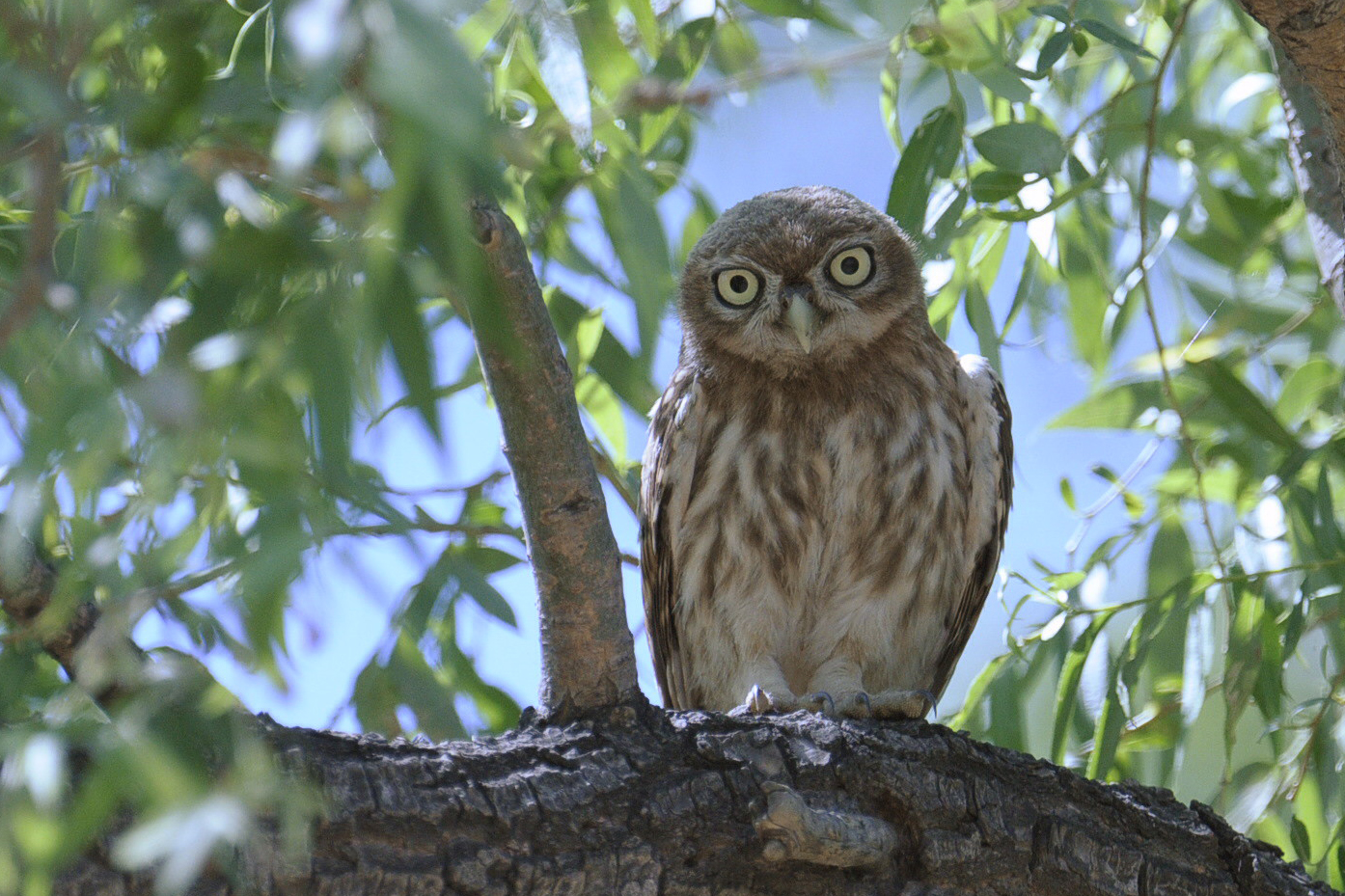
Following my most recent blog post on the Swinhoe’s Owlet, I received the images below from Mike Parker from Suffolk, UK and Chong Yih Yeong, based in Beijing. The first was taken in Beidaihe in October 2004 and the second is one of the birds at Wenyu He. Note the feet.. and compare with this image of Little Owl from the UK.
Swinhoe’s Owlet, Beidaihe, October 2004 (image copyright Mike Parker)
When I visited Wenyu He in Beijing a couple of weeks ago, I stumbled across a pair of breeding Little Owls (Athene noctua). On a return visit I captured the image below of a young bird. Shi Jin, a regular on Birdforum, posted an image of one of these birds on his excellent China 2010 thread. Richard Klim, always up to date on the latest taxonomic issues, pointed out that north-east China’s subspecies – Athene [noctua] plumipes – has been suggested as a separate species with Swinhoe’s Owlet being the suggested new name (Wink 2011). König & Weick’s “Owls of the World” (2008) mooted it as a potential split back in 2008, saying “Toes more densely covered with plumes rather than bristles. …Perhaps specifically distinct.”
That’s good enough for me…!
Swinhoe’s Owlet, a cool name for north-east China’s Little Owl.
Twice in the last few days, inspired by the reports from this site by Shi Jin on Birdforum, I visited the Wenyu River in the Chaoyang District of Beijing. It is a fantastic area of paddies, weedy fields and even a disused golf course. Brian Jones and Spike Millington, both former Beijing residents, used to visit this site regularly and I can see why.
Habitat along the Wenyu River in Chaoyang District, Beijing. Perfect for Waterhens and locustellas!
Frustrating habitat at the Wenyu River paddies. When a locustella goes down in this lot, the chances of seeing it again are slim..!
On my first visit, late one evening, I arrived at the paddies just half an hour before dusk and yet I saw 4 new birds for me in Beijing – Chestnut-eared Bunting, White-breasted Waterhen, Yellow-legged Buttonquail and Little Owl.. Not bad. My second visit, early morning on Thursday, was just as rewarding. A singing David’s Bush Warbler was a nice start, soon followed by the White-breasted Waterhen, singing Lanceolated Warbler, several Pallas’s Grasshopper Warblers, two Schrenck’s Bitterns, Yellow Bittern, Pechora Pipit on the deck and a Black-naped Oriole calling from the willows. Wow. I walked the narrow pathways between the paddies and enjoyed several encounters, albeit brief, with Pallas’s Grasshopper Warblers, Black-browed Reed Warblers and the odd Zitting Cisticola. A couple of Oriental Reed Warblers were much more obliging, singing purposefully from prominent perches in the reeds. It was a cacophony of birdsong.
Oriental Reed Warbler singing its heart out early morning in the paddyfields at Wenyu River.Schrenck’s Bittern (female), Wenyu River, Beijing. One of two seen in the paddies.Pechora Pipit. Seeing one on the ground in Beijing is not easy!
After reaching the western end of the paddies, I decided to head back and return across the maze of paths. It was along one such narrow weedy path between two paddies that I experienced one of those moments in birding that makes it such an exciting (and sometimes frustrating!) hobby. I knew that Shi Jin had seen a large locustella warbler, possibly Middendorff’s, a day or two before and so I was on the lookout for large locustellas. I had also listened to the songs of the three possible large locustellas – Gray’s, Pleske’s and Middendorff’s – on Xeno Canto Asia just in case. Suddenly, I flushed a bird from the path that zipped into the paddy and down into the vegetation before I even had a chance to lift my binoculars. It was clearly interesting – my sense was that it looked larger than the Pallas’s Grasshopper Warblers I had been seeing, but still looked like a locustella in shape and structure.. ..it was plain looking, greyish, without much, if any, contrast on the upperparts… Hmmm… could it be one of the large locustellas I had been thinking about? I knew that there was a very good chance that I would never see it again… they are notorious skulkers and it was a large paddy. However, I decided to wait to see whether anything emerged from the area in which it had gone down. To my surprise, just a few seconds later, a bird began to sing and the sound appeared to be coming from the same area… I remembered the songs from Xeno Canto and immediately ruled out Gray’s and Middendorff’s. It reminded me of the Pleske’s song… I put two and two together – large locustella, song like a Pleske’s – and in my mind a big neon sign lit up flashing “Pleske’s Warbler!!”. But could it really be a Pleske’s Warbler? In Beijing?? The bird sang for a few minutes and I quickly took out my handheld video camera to record the song, knowing that I would need that to have any chance of identifying this bird for certain in the absence of a good sight view. I recorded a few seconds of the song and then concentrated on trying to see it. Only once in the next 20-30 mins did I see a bird in that area, an incredibly brief view as a largish bird flitted across a small gap in the vegetation. Again, I got nothing on it other than it was largish and plain looking.. Frustrating to say the least.
At this point, I was excited.. I really thought that there was a singing Pleske’s Warbler just a few metres away from me. I sent a SMS to Shi Jin to tell him. A few minutes later, after no sign of the bird, I began to walk back to the metro station as I didn’t want to be too late back in town. And I wanted to download that sound file and check it against Xeno Canto! I then received a reply from Shi Jin to say he was on his way. He only lives 10 minutes away by car, so I headed back to the site to meet him and show him the precise spot. There was no song now and no sign of the bird. We waited a few minutes and after providing sustenance for the local mosquito population and with the day heating up fast, we decided that probably the best chance of seeing/hearing the bird would be to come back in the evening or the next morning. Neither of us could make it that evening but Shi Jin was hoping to try for it the next day. After a brief stop at the Little Owl nest site I discovered a few days before, Shi Jin kindly dropped me at the metro station for the return journey home.
On arriving home, the first thing I did was download the sound file from the video camera and check out Xeno Canto. There is one recording on Xeno Canto of Pleske’s. For comparison, my recording can be heard below:
Hmm… on listening to them both, now I wasn’t so sure.. there were elements of the song that were similar but there were also differences… Doubt began to creep into my mind. Was the singing bird a Pleske’s? And, in any case, could I say that the singing bird was definitely the large locustella I saw? I began to think that maybe the song was a different species. I listened to Pallas’s Grasshopper Warbler (the other locustella species seen that morning in the same area) on Xeno Canto but the few recordings of this species on the site sounded different).
So, the bottom line is I don’t know. I have a recording that I can’t identify and a brief sighting of a largish locustella that isn’t necessarily the same bird that I recorded singing anyway…! Arrggghhhh….
If anyone can help with the recording, please let me know. I have sent it to Paul Holt (who is currently away) and to Peter Kennerley, so hopefully the mystery will be resolved soon. In my head, I am expecting my song to be identified as a variation of Pallas’s Grashopper Warbler but my heart is hoping that it’s a Pleske’s. Watch this space!
Whatever the outcome of this experience, one of the highlights of the day was meeting Shi Jin, a top birder with a lot of China experience!
Visiting birders generally don’t pay much attention to the humble Little Grebe (Tachybaptus ruficollis). But the observant birder will notice that the subspecies found here – poggei – has a pale eye and has been mooted as a potential future ‘split’. Whatever its taxonomic status, the Little Grebe is a charismatic bird and, in the parks of Beijing, can be relatively confiding. Visiting birders who care about their lists will be wise to take note for ‘insurance’….!
Little Grebe (ssp poggei). A common resident and breeder in the capital. This individual is half of a breeding pair in the Olympic Forest Park.
On Sunday I visited Miyun Reservoir with a few friends from the embassy, a language student and a Dutch birder visiting Beijing. We enjoyed a good day and recorded 71 species. The most significant record was the immature SIBERIAN CRANE that is still on site in company with a dwindling group of White-naped and Common Cranes. It is now over a month since Paul Holt and I first discovered this bird, originally in the company of 2 adults.
A single Short-toed Eagle, a stunning male Pied Harrier, a fishing Osprey and excellent views of Japanese Quail were other highlights of another good day at this site. With sunny weather and very light winds, it was a lovely day to be out and about… and great fun to be in the company of such a wonderful group of people!!
They will all become birders – it’s inevitable. Resistance is futile.
Aron, John and Sarah behaving completely naturally…John, Sarah, Eva and Aron taking the ‘chilled approach’ to birding.. while Nick wonders if his count of Great Crested Grebe is statistically significant.Ben and the girls scanning for cranes at Miyun Reservoir as Nick looks on.
Full species list:
1. Japanese Quail – 3
2. Common Pheasant – 7
3. Swan Goose – 1
4. Bean Goose – 5
5. Ruddy Shelduck – 29
6. Gadwall – 8
7. Mallard – 12
8. Chinese Spot-billed Duck – 14
9. Shoveler – 18
10. Eurasian Teal – 12
11. Common Pochard – 2
12. Little Grebe – 4
13. Great Crested Grebe – 10
14. Black Stork – 1
15. Spoonbill sp – 7
16. Eurasian Bittern (heard only)
17. Grey Heron – 8
18. Great Egret – 6
19. Little Egret – 7
20. Kestrel – 2
21. Merlin – 1 adult male whizzed past us at the second site
22. Osprey – seen very well; hovered and caught a fish
23. Short-toed Eagle – 1
24. Eastern Marsh Harrier – 3
25. Pied Harrier – 2 (including one adult male)
26. Eurasian Sparrowhawk – 1
27. Goshawk – 1
28. Coot – 12
29. SIBERIAN CRANE – 1 (immature)
30. White-naped Crane – 4
31. Common Crane – 3
32. Black-winged Stilt – 78
33. Avocet – 2
34. Northern Lapwing – 34
35. Little Ringed Plover – 22 (including some spectacular close views of 3 birds interacting)
36. Common Snipe – 8 (using their characteristic ‘drilling’ feeding technique)
37. Black-tailed Godwit – 7
38. Common Redshank – 4
39. Wood Sandpiper – 12
40. Oriental Pratincole – 42
41. Mongolian Gull – 1 2cy probably this species
42. Black-headed Gull – 57
43. Common Tern – 4
44. Little Tern – 2
45. Oriental Turtle Dove – 4
46. Collared Dove – 3
47. Common Kingfisher – 2
48. Hoopoe – 1
49. Great Spotted Woodpecker – 1 seen from the car between the first and second sites
50. Grey-headed Woodpecker – 2 heard from the car
51. Azure-winged Magpie – several seen from the car
52. Red-billed Blue Magpie – 5 (including two that flew right overhead calling near the parking spot at the first site)
53. Common Magpie – too many
54. Carrion Crow – 2
55. Large-billed Crow – 1
56. Great Tit – several heard from the car
57. Barn Swallow – 6
58. Red-rumped Swallow – 4 seen from the car
59. Zitting Cisticola – 1 heard
60. Chinese Bulbul – 1 heard near the parking spot at the first site
61. Vinous-throated Parrotbill – several heard at the first and second sites
62. White-cheeked Starling – c10 seen from the car
63. Daurian Redstart – 3
64. Tree Sparrow – lots
65. Eastern Yellow Wagtail – 3
66. White Wagtail – 3 (subspecies ‘leucopsis’)
67. Olive-backed Pipit – 1
68. Red-throated Pipit – 1 possible heard
69. Buff-bellied Pipit – c100 (in a mixed flock that included some Water Pipits)
On Sunday, I visited Miyun Reservoir, north-east of Beijing city. After a murky start, the weather just got better and better and the views of the mountains by mid-morning were spectacular. The birding was pretty good, too.
Highlights:
– a single immature SIBERIAN CRANE (with 17 White-naped and 9 Common Cranes)
– Short-toed Eagle
– Osprey
– Saker
– A late afternoon movement of at least 13 Eastern Marsh Harriers all heading northwest.
– 19 Spoonbills (17 were definite Eurasian)
– 21 Oriental Pratincoles
– Black Stork
Some images from the day:
Miyun Reservoir viewed from the north-west.Eastern Marsh Harrier (adult male), Miyun Reservoir, 15 April 2012Eastern Marsh Harrier (immature female?), Miyun Reservoir, 15 April 2012Grey-headed Lapwing, Miyun, 15 April 2012Saker (adult), Miyun, 15 April 2012
Saker – a pale individual (see photo). The head pattern, lack of barring underneath and wing shape are all typical Saker. Made one pass before heading west.
Osprey – 1
Short-toed Eagle – 1 (over the reservoir, flushing everything – even the cranes – and then continued north)
Eastern Marsh Harrier – at least 13 passed through mid- to late afternoon, all on a north-westerly heading.
Eurasian Sparrowhawk – 2
Common (Eastern) Buzzard – 1
Upland Buzzard – 1
Coot – 35
Siberian Crane – 1 immature remaining, loosely associating with the White-naped and Common Cranes
White-naped Crane – 17
Common Crane – 9
Black-winged Stilt – 10
Grey-headed Lapwing – 1
Northern Lapwing – 51
Plover sp (Pacific Golden or Oriental) – one high north
Little Ringed Plover – 4
Eurasian Curlew – 1
Green Sandpiper – 2
Temminck’s Stint – 2
Oriental Pratincole – 21 flew through west in one noisy flock
Mongolian Gull – 6 (2 adults and 4 2cy)
Black-headed Gull – 58
Oriental Turtle Dove – 6
Collared Dove – 4
Common Kingfisher – 2
Hoopoe – 2
Grey-headed Woodpecker – 2
Azure-winged Magpie – 31
Red-billed Blue Magpie – 1
Common Magpie – too many
Corvid sp – 2 circled very high (probably Carrion Crow)
The Spring keeps getting better. A few days ago I got wind of a pair of Two-barred Crossbills in Jingshan Park (immediately north of the Forbidden City). After a bit of investigating I was able to get directions and, on Monday, Libby and I popped up there to see whether we could see it.. [Jingshan Park is a great place to visit for non-birders – it’s often full of Beijingers exercising, singing, dancing, and doing all manner of other social activities – some of the best people watching to be had in the capital]. On arrival it was not difficult to find the right spot as there were about 40 photographers lined up and surrounding a hosepipe stand. It was to here that the Two-barred Crossbills were coming down to drink. They had not been seen all morning and, after an hour or so, I wasn’t hopeful. I went for a walk around the park to see if I could find them feeding, to no avail. But just as I returned to the original site, the female flew in and gradually made her way down to the water.. showing exceptionally well to the delight of the paparazzi.
Two-barred Crossbill (female), Jingshan Park, Beijing, 9 April 2012
Some of the photographers had been there several days and said that the male had not been seen since Saturday.
I believe that this is the first record of this species in Beijing for at least 25 years and comes hot on the heels of a record in Jinshitan, Dalian, Liaoning Province, found by Tom Beeke. Two-barred Crossbill is an irruptive species but irruptions (movements outside of the normal range) usually happen in early autumn.. Maybe these are birds moving back north after irrupting south last autumn? Who knows..?!
Other birds coming down to drink included two magnificent Red-billed Blue Magpies. These birds, common in the Beijing area, are rarely this bold. Often they remain hidden in the trees and shrubs with only tantalising glimpses or distant views being gained, so this was a real treat.
Red-billed Blue Magpie, Jingshan Park, Beijing, 9 April 2012Red-billed Blue Magpie, Jingshan Park, Beijing, 9 April 2012. These magnificent birds are common in Beijing but seeing them this well isn’t easy…
Finally, a pair of Red-billed Starlings, fairly recent colonists of Beijing, were prospecting a hole in one of the trees. Not bad for a city centre park!
Red-billed Starling, Jingshan Park, Beijing, 9 April 2012
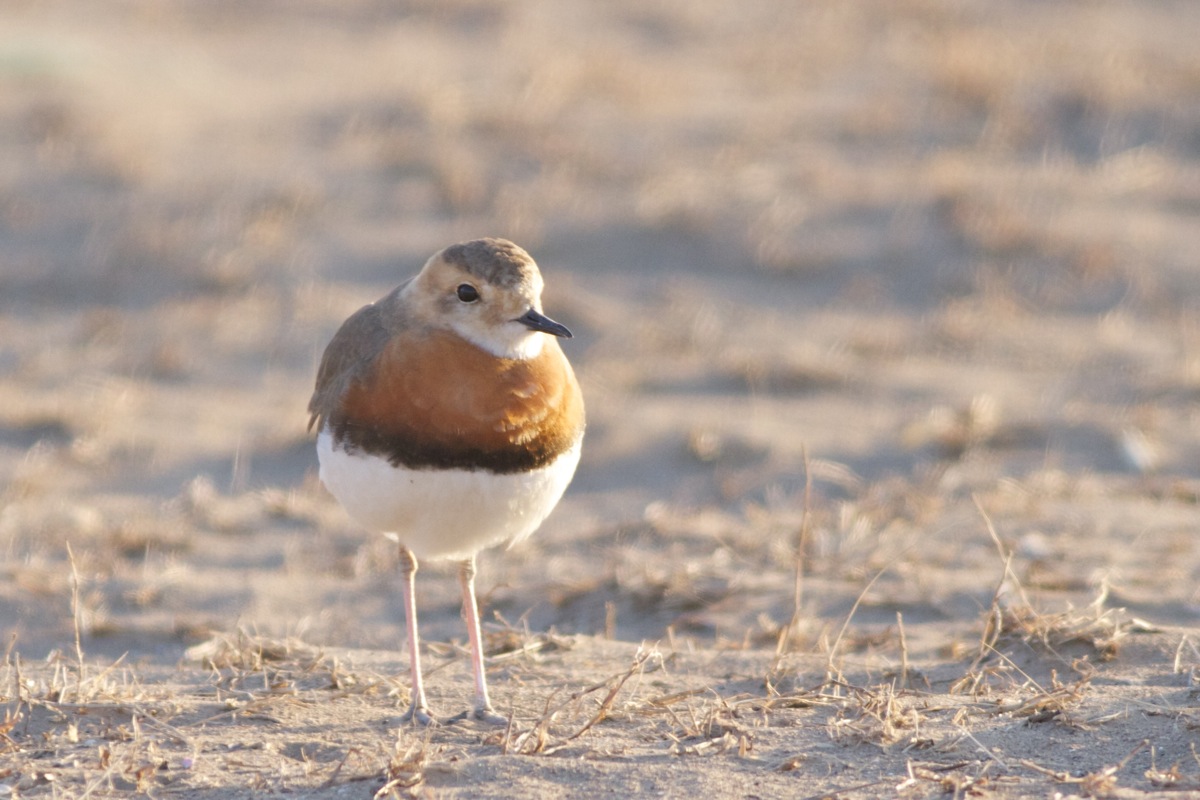
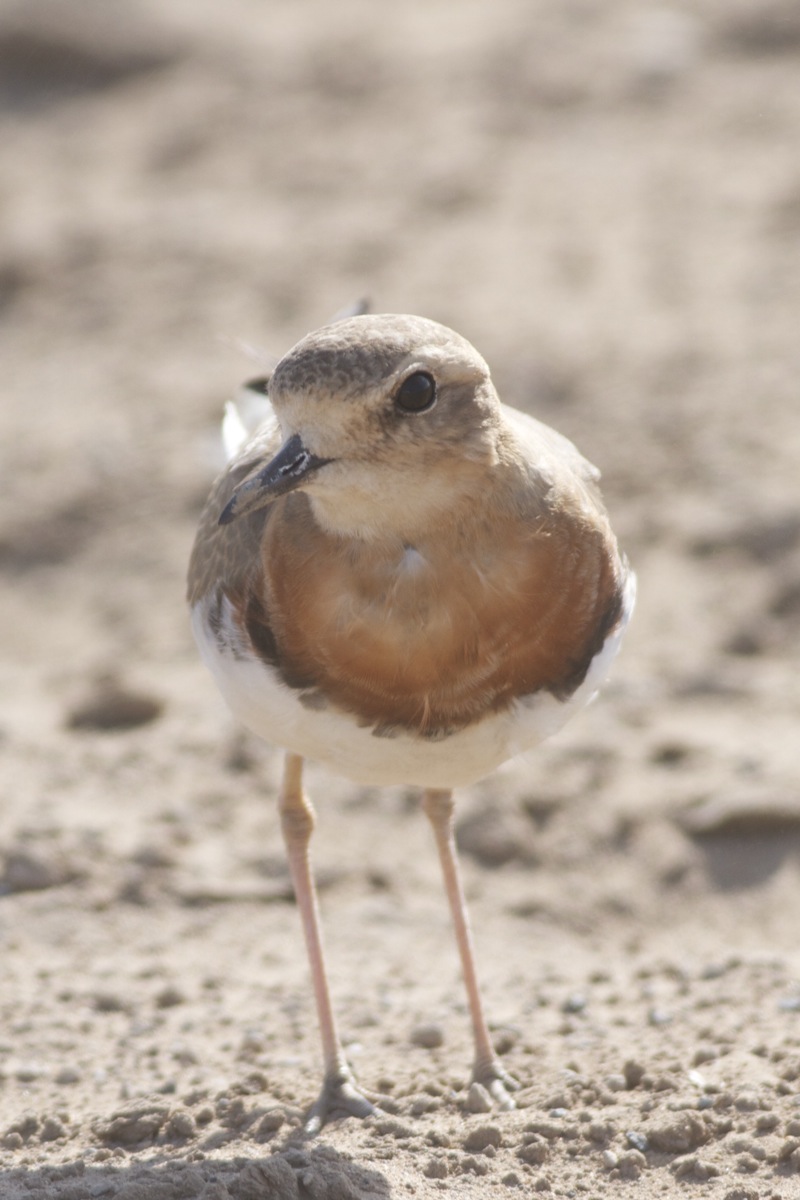
This Spring I have been fortunate enough to enjoy two encounters with Oriental Plovers, surely one of the best looking birds in China..! These charismatic waders breed in north eastern China and south eastern Russia with the majority of the population wintering in north-west Australia. The population is estimated to be around 160,000 individuals.
These birds pass through the Beijing area on passage at the end of March and early April and Wild Duck Lake (Ma Chang in particular) is a regular site. They can be very confiding and, this year, I have been able to capture some pleasing images and a short video. On 5 April I counted 19 of these stunning birds at Ma Chang in a variety of plumages.
Part of the flock of 19 Oriental Plovers at Ma Chang, 5 April 2012One of the white-faced birds.A bird still in moult.Presumed female.A very smart-plumaged individual but lacking white head (still moulting?).This individual was very curious!The same individual facing into a dust storm..Same individual sheltering from the wind by ‘kneeling’..
I took this video handholding my Canon EOS7D with 400mm f5.6 lens. Image has been ‘stabilised’ using iMovie.
This morning I found what I believe is the 2nd Beijing record of Desert Wheatear. It was the highlight on a special day that included 19 stunning Oriental Plovers, 12 Relict Gulls anda Mongolian Lark.
Early April is a great time in Beijing with migration stepping up a gear as the winter visitors (e.g. cranes, geese etc) begin to move on and birds from further south take their place. Swan Geese are now moving through in good numbers and I counted 67 first thing. An over-eager bird photographer in his 4×4 saw I was looking at this group, drove directly to the water’s edge at pace and, not surprisingly, the birds took flight. The silver lining was that I was able to capture this image of the flock rising against the mountains in the early morning sun..
Swan Geese, Ma Chang, 5 April 2012
A check of the ‘desert’ area for Oriental Plover initially drew a blank but, as I was watching a group of Little Ringed Plovers, 9 Oriental Plovers dropped in, closely followed by 2 more, then another 4 and then, amazingly, another 4, totalling 19 birds… Wow! The birds were in a variety of plumages with most in full breeding attire. Oriental Plover is a jewel among waders and its inaccessible breeding and wintering sites make it a difficult bird to see. I will post some more images and video of the Oriental Plovers separately but here is a portrait of one of the smarter birds in the group.
Oriental Plover, Ma Chang, 5 April 2012. A wonderful bird.
I watched these birds for about 20 minutes before heading towards the yurts on the edge of the reservoir to the west. It was on the way that I caught sight of a small bird perching on a stone. Through the binoculars I could see it was a Wheatear. Any wheatear is scarce in eastern China, so I knew it was a good record. I walked around so that I had the sun behind me and slowly edged closer. It was very confiding and, after grabbing a few images, I was pretty happy that it must be a Desert Wheatear. I knew one had been seen at the same site in 2010 (the first Beijing record). But then I began to have doubts.. I had never seen Pied or Isabelline (the other two possibilities).. and unfortunately I didn’t see the tail pattern well at all.. which I knew would be very instructive. Shortly after I took the images below, the wheatear was flushed by a Merlin and flew high west until out of view. On returning home, I checked images on Oriental Bird Club image database and worked out that it could only be a Desert. Jesper Hornskov kindly confirmed the id.
Desert Wheatear (female), Wild Duck Lake, Beijing, 5 April 2012. Thought to be only the 2nd record of this species in Beijing.Desert Wheatear, Wild Duck Lake, Beijing, 5 April 2012. The only other Beijing record I am aware of is of a male at the same site in April 2010.
I had only been on site a couple of hours and already I had seen some special birds.. it was one of those mornings that makes you so happy to be alive!
Just a few metres from the Desert Wheatear I stumbled across a Mongolian Lark, a regular but scarce passage migrant.
Mongolian Lark, Ma Chang, 5 April 2012
After enjoying 2 Avocets (my first in Beijing) on the edge of the reservoir, I headed to the ‘island’ to scan the duck.. Here there was a good selection of wildfowl but the highlights were a flock of 10 Relict Gulls in stunning breeding plumage, soon joined by a further 2 birds, and a single Red-billed Starling that flew in from the east, settled briefly on a nearby tree and then headed off west again.. another first for me in Beijing.
It was about this time that the wind began to increase and, within a few minutes, there were some large dust clouds being whipped up, making Ma Chang an uncomfortable place to be… These winds are quite common at this time of year and, after the very dry winter, the ground is very dusty, making dust storms fairly frequent occurrences in Spring.
Yeyahu didn’t produce any major surprises and it wasn’t long before I headed home having had another great day at Wild Duck Lake.
Grey-headed Lapwings at Yeyahu NR, 5 April 2012.
Full Species List:
Common Pheasant – 3
Swan Goose – 67
Bean Goose – 13
Whooper Swan – 30
Bewick’s Swan – 27
Common Shelduck – 5
Ruddy Shelduck – 38
Gadwall – 10
Falcated Duck – 146
Eurasian Wigeon – 4
Mallard – 290
Spot-billed Duck – 8
Northern Pintail – 21
Garganey – 2
Baikal Teal – 16
Eurasian Teal – 12
Red-crested Pochard – 7
Common Pochard – 1
Ferruginous Duck – 4
Common Goldeneye – 67
Goosander – 44
Little Grebe – 5
Great Crested Grebe – 71
Black Stork – 2
Bittern – 2 (heard booming at 2 different sites)
Grey Heron – 13
Little Egret – 1
Great Cormorant – 75
Kestrel – 1
Merlin – 1
Black-eared Kite – 1
Eastern Marsh Harrier – 3
Hen Harrier – 1
Eurasian Sparrowhawk – 1
Goshawk – 1
Common (Eastern) Buzzard – 4
Common Coot – 38
Common Crane – 6
Black-winged Stilt – 15
Pied Avocet – 2 at Ma Chang; my first record of this species at Wild Duck Lake
Grey-headed Lapwing – 5
Northern Lapwing – 18
Little Ringed Plover – 21
Kentish Plover – 8
Oriental Plover – at least 19 (another flock of 10+ plovers in flight could have been this species)
Mongolian Gull – 31 at Yeyahu, including 3 immatures
Relict Gull – 12
Black-headed Gull – 88
Oriental Turtle Dove – 1
Eurasian Collared Dove – 3
Common Swift – 1
Fork-tailed Swift – 32
Hoopoe – 2
Grey-headed Woodpecker – 1
Chinese Grey Shrike – 1
Common Magpie – too many
Daurian Jackdaw – 26
Rook – 2
Carrion Crow – 4
Great Tit – 4
Barn Swallow – 11
Red-rumped Swallow – 1
Mongolian Lark – 1; within a few metres of the Desert Wheatear
Asian Short-toed Lark – 28
Eurasian Skylark – 18
Vinous-throated Parrotbill – 8
Red-billed Starling – 1; my first record at Wild Duck Lake; flew in from the east, rested briefly on the island to the north of Ma Chang and then continued West.
White-cheeked Starling – 2
Red-throated Thrush – 1
Red-flanked Bluetail – 2
Daurian Redstart – 2
Desert Wheatear – 1 (fem); very confiding until spooked by a Merlin and then flew high west and lost to view. Had not returned an hour later when I re-scanned.
Tree Sparrow – lots
White Wagtail – 22
Buff-bellied Pipit – 12
Oriental Greenfinch – 4
Godlewski’s Bunting – 1
Little Bunting – 2
Yellow-throated Bunting – 1
Pallas’s Reed Bunting – 18 (some males now coming into breeding plumage)
Yesterday morning I spent a couple of hours at Shahe Reservoir. No sign of the Baer’s Pochard from 25 March but there was a nice cross-section of wildfowl on site and some light raptor passage. Buff-bellied Pipits are beginning to come through now and, here in Beijing, we see the subspecies japonicus. One smart individual – albeit not so buff-bellied – dropped in as I was scanning the duck on the reservoir and proceeded to jerk its way along the edge of the reservoir, providing a good opportunity to study it closely.
Buff-bellied Pipit ssp japonicus, Shahe Reservoir, 3 April 2012.Buff-bellied Pipit ssp japonicus, Shahe Reservoir, Beijing, 3 April 2012. Note the relatively heavy streaking on the underparts reaching the flanks, the relatively long, thin bill, plain face and fleshy-coloured legs.Buff-bellied Pipit ssp japonicus, Shahe Reservoir, Beijing, 3 April 2012.
The call of this bird reminded me of Meadow Pipits from back home in the UK.
As I was watching this pipit, a small flock of White Wagtails dropped in, mostly of the ssp leucopsis but including this smart male of the ocularis subspecies.
Adult male White Wagtail ssp ocularis. Note the black cap/nape contrasting with the grey back and the thin black eye-stripe extending in front of, and behind, the eye. Apologies for the dead fish backdrop!
Along the reedy edges of the reservoir there were a few Pallas’s Reed Buntings. This individual caused me some confusion at first, being much brighter and more rufous than the very pale and frosty Pallas’s I have been used to seeing all winter. I suspected Japanese Reed Bunting. But after looking at images on the Oriental Bird Club image database and consulting with my bunting guru, Tom Beeke, I realised that this is indeed a Pallas’s. Japanese should show a much darker cap and darker ear coverts. Always learning!
Pallas’s Reed Bunting (female?), Shahe Reservoir, Beijing, 3 April 2012. Looking quite smart now it’s spring..
Full species list:
Swan Goose – 2 (asleep on the island)
Ruddy Shelduck – 4
Gadwall – 8
Falcated Duck – 28
Mallard – 345
Spot-billed Duck – 12
Shoveler – 16
Garganey – 3
Eurasian Teal – 33
Common Pochard – 13
Goldeneye – 64
Little Grebe – 40
Great Crested Grebe – 32
Grey Heron – 29
Little Egret – 3
Great Cormorant – 6
Black-eared Kite – 2 migr north-east
Eurasian Sparrowhawk – 2
Eastern Buzzard – 15 (12 migr north-east and 3 hunting on the southern shore of the reservoir)
Upland Buzzard – 2 migr north-east
Common Coot – 4
Mongolian Gull – 23 (18 migrating west, 5 on the water)
Black-headed Gull – 10 on the reservoir
Common Magpie – lots
Daurian Jackdaw – 235 (in 4 groups, migrating north – apparently mostly immature birds)
Carrion Crow – 8
Corvid sp (Carrion/Large-billed Crow/Rook) – 23
Barn Swallow – 1
Dusky Thrush – 1
Tree Sparrow – 28
Grey Wagtail – 2
White Wagtail – 22 (20 of the ssp leucopsis and 2 ocularis)
I checked out a ‘new’ site at the Sun River (Sun He) this morning for a couple of hours. The walk, along the southern bank of the river, was pleasant by Beijing city standards and meandered past a disused golf course, a few paddies, an apparent landfill tip and some recycling plants. It produced some birds, highlights being 4 Long-billed Plovers, 4 Grey-headed Lapwings, 2 Little Ringed Plovers, 4 Black-winged Stilts, 3 Hoopoes, 8 Buff-bellied Pipits and 18 White Wagtails, mostly of the subspecies leucopsis but including one adult male ocularis.
Grey-headed Lapwing. One of 4 seen today.
White Wagtail ssp leucopsis. One of 18 White Wagtails seen today. Most were leucopsis with only one being of the ssp ocularis.
Common Snipe
Full Species List
Mallard 12
Pintail 2
Eurasian Teal 41
Grey Heron 14
Little Egret 5
Kestrel 1
Common (Eastern) Buzzard 3
Black-winged Stilt 4
Grey-headed Lapwing 4
Long-billed Plover 4
Little Ringed Plover 2
Common Snipe 8
Green Sandpiper 6
Oriental Turtle Dove 2
Hoopoe 3
Grey-capped Pygmy Woodpecker 2
Grey-headed Woodpecker 2
Rook 3
Carrion Crow 10
Great Tit 2
Barn Swallow 22
Skylark 4
Chinese Bulbul 4
Vinous-throated Parrotbill 4
Crested Myna 6
White-cheeked Starling 22
Naumann’s Thrush 5
Daurian Redstart 2
White Wagtail 18 (17 ssp leucopsis, 1 ssp ocularis)
Saturday was an awesome day at Wild Duck Lake but little did I know that I would discover possibly my best ever find on Sunday. Given that I had the hire car until 4pm on Sunday, I decided to try a site in northern Beijing, between the 5th and 6th ring roads – the Shahe river. It was Jan-erik Nilsen who first told me about, and showed me, this place last autumn (thanks Jan-erik – I owe you one!). There is some open water – Shahe Reservoir – some reedbeds and some nice reedy fringes to the river banks.. It looks like a great site for crakes and rails, as well as duck. On arrival this morning, I immediately found a flock of around 60 diving ducks but unfortunately I was on the north side of the river looking south on a very sunny day, so it was not easy to make out anything other than silhouettes… I hadn’t visited the southern side but with a bit of trial and error, I found a bridge and a track that followed the southern bank. I drove to the spot where I had seen the diving duck and parked up.. I crept slowly over the earth bank to see whether the duck were still there.. They were, so I had a quick scan with the bins and immediately spotted a darker duck in the group. It appeared to have lightish flanks and a greenish head and my heart started to race – could it be? As the birds were fairly distant, I nipped back to the car, grabbed my ‘scope and started to scan the flock. They were feeding very actively and my instinct suggested they had recently arrived. The first few birds were all Common Pochards but I soon got onto the much darker bird and, immediately, I could see that it was a drake BAER’S POCHARD!! After swearing in my mind several times and pinching myself, I uttered a sort of “whoop” and did a victory dance – a la Jack Black in “The Big Year”… Fortunately, as is not often the case in China, there was nobody around, so I avoided any strange stares and comments under the breath about a strange foreigner etc.. I zoomed in to 60x on the ‘scope and enjoyed fantastic views, albeit quite distant, for the next 30 minutes as I took some notes on its plumage. Although it was in the middle of a flock Common Pochard when I first saw it, the Baer’s only loosely associated with them.. at times it was several metres away from the flock and seemed to do its own thing, only occasionally joining the Common Pochard flock, usually when there was some disturbance on the far bank (fisherman, walkers etc). I grabbed a few record images with the camera and then sent a few SMSs to Beijing-based birders.. Although I received a few ‘thank you’ messages, as far as I know, nobody went to see it! Welcome to birding in China!
Baer’s Pochard is now, sadly, a very rare bird and declining fast. This text was recently posted on Birdforum by Alan Lewis (who famously ‘twitched’ a Baer’s Pochard in Japan this winter):
“Wang Xin, Cao Lei, Lei Jinyu, Tony Fox says: February 12, 2012 at 1:31 pm Based on recent compilation and collation of counts and observations from a wide array of available information, we are deeply concerned to find a drastic decline in wintering numbers and range contraction of Baer’s Pochard. The results of the exercise have been gathered in a database and analyses have been prepared for formal reporting, but given the urgency of the situation, we feel the very pressing need to report preliminary findings here. Because of lack of consistent and regular counts from many wintering sites, it is difficult to present count data in any logical way that provides a clear indication of true population trajectory.
However, it is our impression from counts and speaking directly to national experts that the species has now functionally ceased to winter in regular numbers at any site outside of mainland China as of winter 2010/11. Within China, the sum of maximum annual winter counts (November to March) from each province fell from 16,792 during 1987-1993 to 2,131 in 2002-2011. There was a marked contraction of range within China over this period, with no records from many provinces in recent years, despite increases in birdwatching activity. Clearly using maximum counts over a series of years likely over-estimates the true numbers actually present in any one year, but the relative values indicate the magnitude of the decline and the geographical contraction in range which is very evident throughout the winter quarters.
The Chinese State Forest Agency and WWF-China recently coordinated coverage of winter resorts in the middle and lower Yangtze River Floodplain (now considered the core wintering area for the species) but found less than 200 Baer’s Pochard in January 2011. Perhaps far worse, a special survey by Wuhan Birdwatching Society this winter (2011/12) did not find any Baer’s Pochard at all, even at Liangzi Lake (where the survey had found c. 130 individuals last year). Birdwatchers have also been to the upper part of Wuchang Lake in Anhui this winter where Cao Lei’s group have been finding more than 200 in recent years and found none there as well. In the Baiquan wetlands, in Wuhan, where the species was often found in the past, there are only reports of poisoned swans and geese because the water levels in winter 2011/12 are so low and people can get near to the waterbirds as never before.
Based on improved counts from very recent years, we fear that the global population of the species is now less than 1000 individuals and are deeply concerned that the true world total could be very much lower than this. Since we find very little information about current breeding and staging areas, there is an immediate need to better understand the breeding distribution and biology of Baer’s Pochard. Given the widespread and rapid decline, it seems unlikely that factors on all the non-breeding areas have simultaneously contributed to its demise alone, although we cannot rule out the effects very heavy mortality at a key staging site (such as hunting) where a large proportion of the population passes each year. Nevertheless, there is an urgent need to determine the food supply and conditions for the species on the last few remaining lakes used on the winter quarters to secure their sympathetic management in winter, if it is not already too late. There is no denying the very urgent need for rapid and coordinated actions to protect the Baer’s Pochard throughout its remaining range and recommend suitable re-grading of its current status as soon as possible.”
It is tragic to think that this bird could disappear within the next few years. With so little known about it and so few recent sightings, the future is not bright for this attractive duck. Fortunately there are several in captivity. It is a bird I have wanted to see since I moved to China in 2010 and I was beginning to think I had left it too late… so I was overjoyed to find this male today.
If anyone is interested in directions to look for this bird, please send me a message. I suspect it won’t stay for long but there must be a reasonable chance it will stay a few days.
Whilst on site I also counted two Hoopoes and a very high migrating Black-eared Kite (my first of the year). But it is due to the Baer’s that I will forever remember today!
The Baer’s Pochard on the Shahe river, Beijing, 25 March 2012Baer’s Pochard, showing its aversion to fraternising too closely with the commoners…
Baer’s Pochard giving the locals a wide berth. With Common Pochard and Little Grebes.
Today was one of those amazing days that makes birding such an enthralling hobby. I accompanied Paul Holt on a visit to Huairou and Miyun Reservoirs, sites that I had not – for some unknown reason – visited before. The highlights were undoubtedly the cranes. Top of the list comes the 3 Siberian Cranes (2 adults and an immature) that we believe constitute only the second record for Beijing. But perhaps more significant was the count of 256 White-naped Cranes, around 10 per cent of the known wintering population in China at one location on Spring passage. Add in 620 Common Cranes and it was a real crane bonanza. The other unexpected bird of the day was a single Oriental Stork, a real rarity in Beijing.
Highlights:
– second record of Siberian Crane in Beijing (2 adults and an immature)
– second highest (possibly highest) count of White-naped Cranes in Beijing
– seventh record of Oriental Stork in Beijing
– earliest Garganey and Common Shelduck in Beijing
– second earliest Fork-tailed Swift in Beijing
Siberian Cranes, Miyun Reservoir, 19 March 2012White-naped Crane, Miyun Reservoir, 19 March 2012. We saw around 10 per cent of the Chinese wintering population today at this important staging post.Common Cranes, Miyun Reservoir, 19 March 2012Oriental Stork, Miyun Reservoir, 19 March 2012
Detailed species list from Miyun Reservoir (courtesy of Paul Holt):
Xin Zhuang Qiao (bridge over the Chao He), Miyun. (40°35.11’N., 117°07.95’E.). Alt. 115 metres. (11h30-12h50)
Miyun Reservoir – south of Bulaotun satellite tracking station, Miyun. (40°31.75’N., 116°57.77’E.). Alt. 75 metres. (13h20-17h05)
Japanese Quail 2 at Bulaotun, Miyun reservoir on the 19/3/2012.
Common Pheasant 7 around Miyun reservoir on the 19/3/2012.
Swan Goose 20 at Hou Ba Jia Zhuang, Miyun reservoir on the 19/3/2012.
Tundra Bean Goose 10 at Hou Ba Jia Zhuang, Miyun reservoir on the 19/3/2012.
Taiga or Tundra Bean Goose ca.400 at Hou Ba Jia Zhuang, Miyun reservoir on the 19/3/2012.
Tundra Swan 4 adults at Hou Ba Jia Zhuang, Miyun reservoir on the 19/3/2012.
Whooper Swan 168 at Hou Ba Jia Zhuang, Miyun reservoir on the 19/3/2012. 146 birds were also counted at Bulaotun in the late afternoon – but some or possibly even all of these could have been among those seen at HBJZ earlier in the day.
Ruddy Shelduck 796 at Miyun reservoir on the 19/3/2012. Most of these (780 birds) were at Hou Ba Jia Zhuang with just one being seen on the Chaohe near Taishitun & 15 at Bulaotun.
Gadwall 5 at Hou Ba Jia Zhuang, Miyun reservoir on the 19/3/2012.
Falcated Duck 12 at Hou Ba Jia Zhuang, Miyun reservoir on the 19/3/2012.
Mallard ca.600 around Miyun reservoir on the 19/3/2012. Almost all of these were at Hou Ba Jia Zhuang.
Chinese Spot-billed Duck 14 around Miyun reservoir on the 19/3/2012. Almost all of these were at Hou Ba Jia Zhuang.
Northern Pintail 5 at Hou Ba Jia Zhuang, Miyun reservoir on the 19/3/2012.
Baikal Teal 20 at Hou Ba Jia Zhuang, Miyun reservoir on the 19/3/2012.
Eurasian Teal 150 at Hou Ba Jia Zhuang, Miyun reservoir on the 19/3/2012.
Common Pochard 20 at Hou Ba Jia Zhuang, Miyun reservoir on the 19/3/2012.
Ferruginous Pochard 2 at Hou Ba Jia Zhuang, Miyun reservoir on the 19/3/2012.
Tufted Duck 2 males at Hou Ba Jia Zhuang, Miyun reservoir on the 19/3/2012.
Common Goldeneye 13 at Hou Ba Jia Zhuang, Miyun reservoir on the 19/3/2012.
Smew 51 at Hou Ba Jia Zhuang, Miyun reservoir on the 19/3/2012.
Common Merganser 80 around Miyun reservoir on the 19/3/2012. These involved 65 at Hou Ba Jia Zhuang, three in the Chaohe near the Xin Zhuang bridge, Taishitun & 12 at Bulaotun.
Little Grebe 7 at Miyun reservoir on the 19/3/2012. Two of these were at Hou Ba Jia Zhuang & the other five in the Chaohe near Taishitun.
Great Crested Grebe 18 at Hou Ba Jia Zhuang, Miyun reservoir on the 19/3/2012.
Black Stork 1 flew high near Hou Ba Jia Zhuang, Miyun reservoir on the 19/3/2012.
Oriental Stork 1 at Hou Ba Jia Zhuang, Miyun reservoir on the 19/3/2012.
Oriental Stork is rare in Beijing – the other records that I’m aware of are –
1875
A small flock was seen near the city in summer 1875 (Wilder and Hubbard 1924, Wilder 1940b)
1924
1 collected in April 1924, probably south of the city in Nanhaizi (Nan Hai Tzu) hunting park (Wilder and Hubbard 1924, Wilder 1940b).
1955
1 specimen from Tongxian county on 8 June 1955 (Cai 1987). Mid-summer records must be exceptional!
1964
1 specimen from Niulanshan, Shunyi on 22 January 1964 (Cai 1987). Mid-winter records are probably also exceptional.
1999
14 on a flooded area in Shunyi, January 1999 (Qian Fawen in litt. 1999 to BirdLife International [2001]
2004
1 at Hou Ba Jia Zhuang Miyun reservoir on the 1/10/2004. It was circling high up with a party of 5 Black Storks and would have been an early date even on the Hebei coast.
2009
3 at WDL on 21/3/2009 (Brian Ivon Jones, Spike Millington & Richard Carden – BIJ in litt. to PH on 20 March 2012)
Grey Heron 12 at Miyun reservoir on the 19/3/2012. Seven of these were at Hou Ba Jia Zhuang, one besides the Chaohe near Taishitun & the other four near Bulaotun.
Great Egret 2 besides the Chaohe when viewed from the Xin Zhuang bridge near Taishitun, Miyun on the 19/3/2012.
Great Cormorant 1 at Hou Ba Jia Zhuang, Miyun reservoir on the 19/3/2012.
White-tailed Eagle 1 juvenile at Hou Ba Jia Zhuang, Miyun reservoir on the 19/3/2012.
Eurasian Sparrowhawk 2 singles near Miyun reservoir on the 19/3/2012.
Common Kestrel 3 near Miyun reservoir on the 19/3/2012. Two were seen just south of Miyun reservoir dam while the third was at Hou Ba Jia Zhuang.
Great Bustard 3 distant birds at Hou Ba Jia Zhuang, Miyun reservoir on the 19/3/2012.
Eurasian Coot 108 at Hou Ba Jia Zhuang, Miyun reservoir on the 19/3/2012.
Siberian Crane 3, a family party with two adults and a first year, at Miyun reservoir on the 19/3/2012. First seen at Hou Ba Jia Zhuang in the late morning what were undoubtedly these same three birds were later seen at Bulaotun. Rare in Beijing – the only previous sighting from Beijing was of a bird at Wild Duck Lake in March 2008. Terry suggested that the easterly winds of the previous weekend might have drifted this bird, and the White-naped Cranes, inland from the Hebei coast.
White-naped Crane 256 at Bulaotun, Miyun reservoir on the 19/3/2012. 240 had been counted at Hou Ba Jia Zhuang earlier in the day but these were probably part of the group later seen at Bulaotun. Possibly only the second three figure count for Beijing – but not the largest as 500 birds were reported at Miyun reservoir one day later that our sighting in 2011 (fide “Xiaoming” in a BirdForum posting of 20 March 2011)
Common Crane 620 at Bulaotun, Miyun reservoir on the 19/3/2012. 100 had been estimated at Hou Ba Jia Zhuang earlier in the day but these were probably part of the group later seen at Bulaotun.
Northern Lapwing 6 around Miyun reservoir (four at Hou Ba Jia Zhuang & two at Bulaotun) on the 19/3/2012.
Long-billed Plover 1 besides the Chao river when viewed from the Xin Zhuang bridge near Taishitun, Miyun on the 19/3/2012.
Kentish Plover 2 at Hou Ba Jia Zhuang, Miyun reservoir on the 19/3/2012.
Black-headed Gull 61 at Hou Ba Jia Zhuang, Miyun reservoir on the 19/3/2012.
Mongolian Gull 2 at Hou Ba Jia Zhuang, Miyun reservoir on the 19/3/2012.
Oriental Turtle Dove 2 around Miyun reservoir on the 19/3/2012.
Eurasian Collared Dove 1 near Bulaotun, Miyun reservoir on the 19/3/2012.
Chinese Grey Shrike 1 at Bulaotun, Miyun reservoir on the 19/3/2012.
Black-billed Magpie 80 around Miyun reservoir & Miyun town on the 19/3/2012.
Carrion Crow 4 flew north high over Bulaotun, Miyun reservoir at 16h45 on the 19/3/2012.
Eurasian Skylark 2 singles at Hou Ba Jia Zhuang, Miyun reservoir on the 19/3/2012.
White-cheeked Starling 2 in Hou Ba Jia Zhuang village, Miyun reservoir on the 19/3/2012.
Common Starling 1 at Hou Ba Jia Zhuang, Miyun reservoir on the 19/3/2012.
Eurasian Tree Sparrow Present but not counted around Miyun reservoir on the 19/3/2012.
White Wagtail 14 around Miyun reservoir on the 19/3/2012. These included 12 besides the Chaohe when viewed from the Xin Zhuang Bridge. Seven birds were seen well enough to racially assign & they were all leucopsis.
Meadow Bunting 3 around Miyun reservoir on the 19/3/2012.
Pallas’s Bunting 8 around Miyun reservoir on the 19/3/2012.
Apologies for the lack of updates in recent weeks – work has been rather all-consuming! To be honest, it’s not been so bad to be indoors – a persistent high pressure system, combined with very slack winds, have seen a blanket of smog covering Beijing with poor visibility and, at times, appalling air quality. The US Embassy ‘twitter feed’ is updated hourly and rates the pollution levels of PM2.5 (a particulate pollutant) and ozone.
This is the US Environment Protection Agency’s definition of PM2.5:
“Particulate matter, or PM, is the term for particles found in the air, including dust, dirt, soot, smoke, and liquid droplets. Particles can be suspended in the air for long periods of time. Some particles are large or dark enough to be seen as soot or smoke. Others are so small that individually they can only be detected with an electron microscope.
Many manmade and natural sources emit PM directly or emit other pollutants that react in the atmosphere to form PM. These solid and liquid particles come in a wide range of sizes.
Particles less than 10 micrometers in diameter (PM10) pose a health concern because they can be inhaled into and accumulate in the respiratory system. Particles less than 2.5 micrometers in diameter (PM2.5) are referred to as “fine” particles and are believed to pose the greatest health risks. Because of their small size (approximately 1/30th the average width of a human hair), fine particles can lodge deeply into the lungs.”
Sounds nice, eh?
There is a scale of descriptors ranging from “Good” to “Hazardous”. Last week saw several days with the pollution at “hazardous” levels. I am not exactly sure what “hazardous” means but at these levels, you can taste and smell the pollution when you step outside. Not pleasant.
Of course, the Chinese media describes the smog as “fog” and on one dark day last week, it was laughable that the media was saying that there were “boundless blue skies over Beijing”… Of course….
Fortunately, this smoggy period seems to be breaking now and on Sunday I visited Ma Chang/Wild Duck Lake with Libby and a couple of UK friends John and Sarah Gallagher. They have been keen to accompany me on one of my birding trips for some time and so, with a window of decent weather and visibility, we grabbed the chance before the winter sets in. We enjoyed a very good day.
The visibility was above average and, when the cloud broke in the afternoon, it turned into a gorgeous late autumn day….
0645-1530, 6 November 2011.
Cloud 8/8 and 5 degrees C at 0640 with very light north-easterly wind. 13 degrees C, cloud 3/8 and light north-easterly at 1500. Visibility above average all day.
The highlight was my first Great Bustard in China (a flyover), 2 Black Storks, 6 White-naped Cranes, 58 Common Cranes, Upland Buzzard, 2 Short-eared Owls, 2Common Starlings.
Full species list (52 in total):
Common Pheasant 12
Bean Goose 115
Whooper Swan 1
Gadwall 5
Falcated Duck 4
Eurasian Wigeon 2
Mallard 48
Chinese Spot-billed Duck 10
Northern Pintail 42
Eurasian Teal 25
Tufted Duck 8
Common Goldeneye 2
Smew 10
Goosander 12
Little Grebe 23
Great Crested Grebe 8
Black-necked Grebe 2
Black Stork 2 (high west @ 1455)
Eurasian Bittern 1
Grey Heron 3
Eurasian Kestrel 2
Peregrine 2
Hen Harrier 4 (1 adult male, 1 immature male, and 2 females)
Eurasian Sparrowhawk 3
Common (Eastern) Buzzard 1
Upland Buzzard 1
Great Bustard 1 in flight (flew west over Ma Chang @ 0910)
Common Coot 4
White-naped Crane 6
Common Crane 58, including 2 groups arriving from the mountains to the north (9 @1445 and 35 @1440)
Mongolian Gull 2
Black-headed Gull 68
Eurasian Collared Dove 14
Short-eared Owl 2
Common Kingfisher 1
Great Spotted Woodpecker 2
Grey-headed Woodpecker 1
Chinese Grey Shrike 5
Azure-winged Magpie 1
Common Magpie lots
Carrion Crow 11
Great Tit 2
Asian Short-toed Lark 12
Eurasian Skylark 7
Chinese Bulbul 2
Vinous-throated Parrotbill 100+ in a single flock
Common Starling 2
Eurasian Tree Sparrow lots
Buff-bellied Pipit 3
Pine Bunting 2
Little Bunting 2
Pallas’s Reed Bunting 23
Finally, we enjoyed excellent views of this yellow butterfly, the only butterfly we saw. It was a little sluggish, allowing close photography, in contrast to the many times when I have tried to photograph this species in the spring/summer.. I am not sure what the specific species is but it’s pretty common in the area. EDIT: Thanks to John Furse for identifying the butterfly as a Clouded Yellow.
Yellow butterfly sp, Yeyahu, 6 November 2011Close up… I love those eyes!
A walk around the Olympic Forest Park on Tuesday evening revealed that autumn passerine migration is beginning to get going… First, I flushed a Richard’s Pipit from a path near the ‘underwater corridor’, then a Pallas’s Grasshopper Warbler flew across the path and dived into deep cover, showing the white tips to the outer tail feathers. Just before dusk a snipe circled a couple of times before dropping like a stone into the edge of a reedbed. I grabbed a few very poor images and I suspect it was a Pin-tailed Snipe or Swinhoe’s. Its flight was subtly slower than Common Snipe, it lacked an obvious white trailing edge to the secondaries and the legs appeared to protrude relatively far beyond the tail. Images below and opinions welcome. Swinhoe’s and Pin-tailed Snipe are notoriously difficult to separate so best to go down in the book as a “Swintail”…!
"Swintail" Snipe, Olympic Forest Park"Swintail" Snipe, Olympic Forest Park
There were also some dragonflies on the wing. In addition to the usual Sympetrum kunckeli, these presumed Deielia phaonwere patrolling the edge of the reedbed.
Deielia phaon (I think), Olympic Forest ParkDeielia phaon (I think), Olympic Forest Park, Beijing
The trickle of passerine migration certainly whets the appetite for what will be, I am sure, another brilliant autumn of migration here in north-eastern China. I have just booked my flight to Dalian for late September, where we will have a group of birders covering the Laotieshan area for at least a couple of weeks this autumn. After the fantastic Spring experience, I can’t wait to return to see if the autumn migration matches my expectations.
On the way back from the Olympic Park to the metro station, I enjoyed watching the local Beijingers using the public spaces built for the Olympics. Great stuff!
Apologies to those of you expecting a post about the 80s pop sensation led by Marti Pello (whatever happened to him?).
Anyway, yesterday afternoon, in the midst of some of the worst smog, I mean mist (you don’t get smog in Beijing, cough) since I have been in Beijing, I decided to spend a couple of hours at the Olympic Forest Park… it was a decision I regretted almost as soon as I arrived on site.. Within about 15 minutes, and just as I had reached the more open area of the park, the skies darkened and the rumble of thunder began to reverberate all around.. The brief highlight, as I rounded the first lake, was this Kingfisher atop a pink lotus flower as it scanned for vulnerable fish below…
Common Kingfisher, Olympic Forest Park, Beijing
I rattled off a few images before the heavens opened.. and boy did they open. Two hours later I was still sheltering under the overhang of a roof of a refreshments kiosk watching the floodwater rush by and Wishing I was Lucky. As dusk approached there was no sign of any respite, so I made a run for the metro.. Needless to say, by the time I got to the station, I was soaked to the skin…! At least the rain has cleared away much of the smog.. today is classified as “Unhealthy for Sensitive Groups” rather than yesterday’s “Hazardous” by the US Embassy’s air quality Twitter feed (@BeijingAir)….
First thing this morning I made my first visit to the Olympic Forest Park in Beijing. This relatively new park, as its name suggests, was created for the 2008 Olympic Games and has won awards for its design. I was pleasantly surprised by how ‘bird-friendly’ it is. There is some great habitat, including some large reedbeds, lakes, mature (ish) woodland and open areas, all of which are attracting birds.
Today, I explored the southern section prompted by a visiting birder, Claus Holzapfel, who had seen a Streaked Reed Warbler a few days ago. I didn’t see any of these rare ‘acro‘ warblers but I chalked up an impressive list of species for a central Beijing location (see below).
The highlight for me was an enjoyable encounter with a confiding Yellow Bittern as it hunted in one of the lily-filled lakes. It’s ungainly stance belied the effectiveness with which it stalked small fish and frogs.
Oriental Reed Warblers filled the air with their chattering and there were also a few Black-browed Reed Warblers competing to be heard and a few Pallas’s Grasshopper Warblers skulking at the base of the reeds. Indian and Eurasian Cuckoos were calling frequently and the song of the Black-naped Oriole was an occasional accompaniement.
In the more mature trees on the eastern side, a singing male Yellow-rumped Flycatcher was a nice sight but I failed to find the Green-backed (Elisae’s) Flycatcher that Paul Holt had seen the previous day.
The Olympic Park is situated just north of the 4th ring road, north of the “Bird’s Nest” Olympic Stadium and is served by metro stops as well as several bus routes, so it is easy to get to. It opens at 6am and, this morning, there were relatively few people around and it was very easy to find quiet spots – not to be taken for granted in Beijing where most city parks are full of early morning exercisers for the first few hours of daylight. For me, it’s the best birding site I’ve seen so far in Beijing city. I’ll definitely be back!
Map of Beijing Olympic Forest ParkYellow Bittern, Beijing Olympic Forest Park, 2 June 2011Comical as it made its way across the lillies… would definitely qualify as a Monty Python 'silly walk'Watching you watching me..I enjoyed half an hour with this confiding bird today in the Olympic Forest Park, Beijing
Species List (in chronological order of first sighting):
Collared Dove (1)
Common Magpie (many)
Tree Sparrow (many)
Grey-capped Woodpecker (3)
Eastern Crowned Warbler (2)
Indian Cuckoo (4)
Chinese (Light-vented) Bulbul (7)
Oriental Reed Warbler (at least 30)
Eurasian Cuckoo (5)
Oriental Greenfinch (3)
Pallas’s Grasshopper Warbler (3)
Night Heron (7)
Red-rumped Swallow (4)
Black-browed Reed Warbler (4)
Black Drongo (1)
Common Moorhen (6)
Common Swift (12)
Yellow Bittern (7)
Goldeneye (1) – a drake on the lake near the ‘underwater corridor’
Barn Swallow (3)
Little Egret (1) – flyover
Yellow-rumped Flycatcher (1) – singing just north-east of Wali Lake
Marsh Tit (2)
Black-naped Oriole (3)
Dark-sided Flycatcher (1) – northeast of Wali Lake
Just north of the Forbidden City lies a very popular park with an artificial hill (sometimes known as Coal Hill). The hill was constructed in the Ming Dynasty entirely from soil excavated in forming the moats of the Imperial Palace and nearby canals. Why was it built? According to the dictates of Feng Shui, it is favourable to site a residence to the south of a nearby hill (and it is also practical, gaining protection from chilly northern winds). The imperial palaces in the other capitals of previous dynasties were situated to the south of a hill. When the capital was moved to Beijing, no such hill existed north of the Forbidden City, so one was constructed. Typical China!
The hill is especially impressive when one considers that all of this material was moved only by manual labour and animal power. Apparently, in 1644, the last emperor of the Ming Dynasty hanged himself here…
Anyway, on that cheery note, about the birds. Earlier this week I received a tip-off that there was a ‘very large’ flock of Waxwings present. So on Friday morning I spent an hour there. As usual in any Chinese public park, there were lots of people – shouting, singing, dancing, exercising, doing Tai Chi, running backwards, playing musical instruments and playing “keepy-uppy” with a sort of large shuttlecock. After wandering around the perimeter I stumbled across the Waxwing flock feeding on junipers and regularly going down to drink from a leaky hosepipe. Given the hosepipes were spraying water everywhere, there was, unusually, a small area without people. I risked a drenching to get a closer look and it soon became apparent that there were at least 50 Waxwings in the group, including some Japanese. Twice a Sparrowhawk wreaked havoc by appearing out of nowhere in its attempts to catch one (unsuccessfully) and each time this happened, the whole flock took to the air, where it became apparent that my estimate was most definitely an underestimate! In the air, I guessed at around 250 birds. Soon they returned and I enjoyed good views as these very vocal birds began to feed again.
The water also attracted other birds in the park including a nice Dusky Thrush, several Naumann’s Thrushes and a Red-throated Thrush as well as Oriental Greenfinches and a couple of Large-billed Crows. A pleasant, if slightly wet, hour…
I quite like this 'arty' image of waxwings in formation… Two Bohemian Waxwings in 'bomber formation' Japanese Waxwing, Jingshan Park, 8 April 2011 One of the charismatic and curious Large-billed Crows in Jingshan Park
Now I know many people in the UK have had their fill of Red-flanked Bluetails in the last few months, with the unprecedented influx last autumn. But I bet none of them looked like this…!
Red-flanked Bluetail – smart, eh?
RFBs are beginning to arrive in the Beijing area now and the adult males are absolute stunners. Forgive me for posting a few more images….
STOP PRESS: Jesper Hornskov just sent me a SMS to say he has just seen a GREAT BUSTARD flying over the Summer Palace.. A great record. Spring is here.. let the big migration commence…
A newly arrived RFBNote the white brow (which the Himalayan form lacks)
After a tip-off from Jesper about some Japanese Waxwings in the Summer Palace, I spent a couple of hours there on Saturday afternoon. Eventually, after dodging the crowds to get to the north-west corner of the park, I discovered a mixed flock of Waxwings in a quiet corner. Unusually, Japanese outnumbered Bohemian by about 4 to 1. They were very loyal to a couple of ‘leylandii’-type trees, to which they frequently flew down to feed before flying up to some tall poplars to preen, rest and eat a little of the snow that had fallen overnight.
Despite the very overcast conditions, I was able to capture a few pleasing images.
Japanese Waxwings, Summer Palace, Beijing, 26 February 2011. Note the pale belly, bright pink tip to the tail and fiery-orange undertail coverts.The black on the back of the crest can be seen well on the bottom left bird.
Japanese Waxwing take-off
Japanese Waxwing: close up of the wing and tail patterns