One click on the link on the right showing the latest weather in Beijing reveals that winter is well and truly upon us here in northern China. Temperatures are now routinely well below zero with the brisk breeze making the windchill a bone-numbing -15 to -20 degrees C. The positive side is that recently it has been consistently clear and sunny, providing some gorgeous winter days. With migration pretty much over, the ‘garden’ is now devoid of birds with the exception of a few resident Tree Sparrows and the occasional roving troupe of Azure-winged Magpies. Over the next few days, I am planning to get out birding at the botanical gardens and also to Wild Duck Lake to check for unusual winter visitors. I have my thermals, thick winter coat, fur-lined boots and my thermos at the ready – gonna be a cold one! Next week, Libby and I head for Thailand (Chiang Rai, Chiang Mai and Khao Yai) for a Christmas break.. can’t wait!
Meanwhile, check out these tasty dishes on offer at Beijing South Railway Station… Mmm…
A brisk 2 hours at Yuanmingyuan Park (the Old Summer Palace) this morning in beautiful but cold weather produced a single Dusky Thrush, 5 Naumann’s Thrushes, 1 intergrade Dusky/Naumann’s, a Eurasian Sparrowhawk, a single Common Kingfisher, one Grey-headed Woodpecker, 8 White-cheeked Starlings, 14 Willow Tits, 2 Great Tits, 18 Bramblings, 12 Goldcrests and, best of all, 4 late Pallas’s Warblers.
Edit: thanks to Spike Millington and Jesper Hornskov, it seems that my ‘Williow Tits’ were more likely Marsh Tits! Even in the UK, I have never been confident about separating these two in the field, given the variability and capacity to mimic each other. Forever learning!
One of the late Pallas's Warblers at Yuanmingyuan Park
After a tip-off from Brian Jones and Jesper Hornskov, I spent two hours at the Botanical Gardens early this morning. My target was Japanese Waxwing, a small flock of which had been seen cohorting with a similar number of Bohemian Waxwings. On arrival at 0730 I could see and hear a flock of Waxwings just a few metres from the entrance gate. As I approached I could see at least 10 Chinese photographers lined up waiting for the birds to fly down from their lofty perch to feed on the ornamental berry bushes. There is a fast-growing middle class in China and they have money, lots of it. A few of them have taken up bird photography (it is more common to see a photographer than a birder) and, consequently, there are some serious lenses around. However, as with the cars (20,000 new ones on the streets of Beijing every week), most of the ‘drivers’ are new and have yet to do their apprenticeship…
So, as soon as a Waxwing dropped into one of the berry bushes, they all strode forward competing with each other to get the best shot and, without exception, flushed the birds back up to their treetop perch…! After a few attempts at feeding, the Waxwings clearly got the message and flew off to another part of the gardens. I decided to have a walk around and look for thrushes and it wasn’t long before I came across a hosepipe that had been set down to water some newly planted trees. Given the freezing overnight temperatures, this was the only running water around, and there were good numbers of birds coming down to drink.. Bramblings, Chinese Bulbuls, White-cheeked Starlings, Dusky and Naumann’s Thrushes, the odd Red- and Black-throated Thrush plus, to my delight, the Waxwings. I sat quietly for about half an hour and enjoyed excellent views before the troupe of Chinese photographers discovered the spot and, with the subtlety of a Sumo wrestler doing a pirouette, scared everything in sight! With the light deteriorating, I called it a day and was back in the flat and working by 1030.
Several of the thrushes looked like intergrades between Dusky and Naumann’s – see the last photo below for a good example.
The biggest Chinese twitch I have seenJapanese Waxwing, one of at least 8 seen this morningJapanese Waxwing (with Bramblings) – a very striking birdWhite-cheeked StarlingsNaumann's ThrushNaumann's ThrushDusky ThrushDusky/Naumann's intergrade – note the mixture of red and black markings on the underside
I guess it started when I ordered the BBC series “Wild China” on DVD ahead of our impending move to China. One episode was almost exclusively devoted to Yunnan, a place I had vaguely heard of but knew nothing about. I was stunned by what I saw – not the images of China I had in my head of urban sprawl, agricultural landscapes and deserts but instead lush forests, untouched mountains and, most notably of all, amazing wildlife.
Then came an email from Jesper Hornskov, a China-based Dane and freelance bird tour leader, advertising his schedule for 2010/2011. Top of the list – 3 weeks in Yunnan Province in November. I read the blurb with eager anticipation. There were temptations like Barbets, Forktails, Hornbills, Bulbuls and Wren-Babblers. Wow.. I knew I had to take the opportunity to go while I was in China, and who better to go with than Jesper, a guide who has 20 years experience in China, has probably seen more birds in China than anyone and describes Yunnan as his local patch!
As it turned out, I was only able to participate for the middle two weeks – work commitments meant I had to arrive late and leave early – but even so I had a fantastic time and saw over 300 species, most of which I had never seen before.
Before I describe the trip, here is some background on Yunnan:
Yunnan is a Province of China located in the far south-west of the country. It covers an area of 394,000 square kilometres and has international borders with Burma, Laos and Vietnam and domestic borders with the Tibetan and Guangxi Zhuang Autonomous Regions and Sichuan and Guizhou Provinces.
Yunnan is China’s most diverse province, biologically as well as culturally. It contains snow-capped mountains and true tropical environments, supporting an unusual array of species and vegetation types. During summer, the Great Plateau of Tibet acts as a barrier to the monsoon winds, trapping moisture in the province. This gives the alpine flora an unusual lushness.
The topographic range and tropical moisture combine to sustain extremely high biodiversity and high degrees of endemism, probably the richest botanically in the world’s temperate regions. Over 15,000 species of higher plants, of which perhaps 2,500 are endemic, can be found in the province. The fauna is nearly as diverse – Yunnan Province covers less than 4 per cent of the land in China, yet contains about half of China’s birds and animals.
And so, it was with eager anticipation that I boarded my internal flight from Beijing to Kunming and then on to Mangshi to join up with Jesper and the other participants – Geoff Bowen, Philip Duffus and Richard Robinson. On arrival at the hotel at 1130pm I was greeted by Jesper and told to be ready and in reception by 0500 the next day for the drive to the next (my first) birding destination of Longchuan. Ouch! After the pre-dawn drive we walked up a trail through fantastic forest and caught up with super birds such as Great, Blue-throated and Golden-throated Barbets, Rusty-fronted Barwing, (Eastern) Lemon-rumped Warbler, Golden Babbler and, best of all, Wedge-billed Wren Babbler, a species only relatively recently discovered in China.
Our next stop was the Yingjiang Forest Reserve. On arrival pre-dawn we could hear a Collared Owlet calling and enjoyed our first encounters with species such as the Stripe-breasted Woodpecker, Striated Yuhina, Pin-tailed Green Pigeon, Mountain Imperial Pigeon, Maroon Oriole, Collared Treepie and Speckled Piculet as well as jamming in on a nice flock of Spot-winged Grosbeaks. The drive down towards Nabang produced our first (and excellent) views of Mountain Hawk Eagle, Oriental Honey Buzzard and, at a bridge over a fast stream, our first Forktails of the trip – both Slaty- and Black-backed.
Nabang is situated right on the border with Burma and we spent 4 full days here with alternating visits to the forest trails and river valleys. Highlights here included a magnificent Pallas’s Fish Eagle that flew right over our heads, Crested Serpent Eagle, Ibisbill, Collared and White-vented Mynas, Plain Flowerpecker, Crested Tree Swift, Jerdon’s Baza, River Lapwing, Black Eagle, Crested Kingfisher, Blue-bearded Bee-eater, Barred Buttonquail, Lesser Necklaced Laughingthrush, Velvet-fronted Nuthatch, Greater Flameback, Nepal Fulvetta and both Black-hooded and Maroon Orioles. Wow! A surprise was bumping into Paul Holt, well-known China specialist and guide for Sunbird, on a remote trail, complete with full sound recording equipment (he was recording Pittas). In fact Paul was the only westerner we saw in the two weeks, illustrating the fact that Yunnan really is not yet on the international tourist map. Only a matter of time, I am sure.
Only downer at this site was getting a leech on my lower back that caused me to bleed and bleed, wrecking my t-shirt in the process..
The next location saw us trying a traditional site for River Tern but without success. The site appears to be heavily disturbed and it is very likely now an ex-site for these struggling terns. Nevertheless, we did pick up 25 Common Cranes (not so common here) as well as new birds such as Paddyfield and Rosy Pipits, Long-billed Plover, White-browed Laughingthrush, Black-winged Kite and Tickell’s Warbler.
The drive to Tengchong produced the hoped for Black-collared Starling as well as Plain Prinia, Common Magpie (a good record), Bluethroat and Chinese Pond Heron.
The next day in Tengchong proved to be stunning. After an inauspicious start when we were accompanied by several Chinese early morning exercisers who seemed intent on shouting and hawking up to scare away every bird within a 10-mile radius, we were soon off the beaten track and seeing some excellent birds including the fantastic Red-faced Liocichla. A few showers also livened up proceedings in the middle of the day with a significant increase in activity post-rain. Forest birding typically involves trying to find bird flocks – species tend to move around in mixed flocks or ‘waves’ with relatively little activity in between. On this day, we were in luck. We enjoyed exceptionally close and prolonged views of gorgeous species such as Red-tailed and Blue-winged Minlas, several species of phyllosc including Ashy-throated, Buff-barred, White-tailed, Lemon-rumped and Blyth’s Leaf Warblers, Slender-billed Oriole, Spot-breasted Scimitar Babbler, Large Cuckoo Shrike, Chestnut-bellied Rock Thrush and Brown-winged Parrotbill as well as good views of more skulky species such as Chinese Babax and Green Cochoa. After the dodgy start, this site delivered on a massive scale.
Next up was the Gaoligongshan reserve, a stunning range of mountains and forests requiring special permission to visit. Another early start meant we were on top for dawn, and what a dawn it was – simply outstanding. Looking down on broken cloud with the orangey-pink glow of sunrise was awesome. A passing Black Eagle below us was the icing on the cake. The walk up the trail was surprisingly easy and, although the vegetation was thick – a mixture of bamboo and deciduous forest – we began to see birds early on with a particularly good show by the sunbirds. We saw Fire-tailed, Green-tailed and Mrs Gould’s in quick succession (Jesper was the first to discover the sunbird migration over these mountains some 15 years ago). After enjoying these gems we began to look for the frustratingly skulking laughingthrushes. They seemed to be pretty common, calling from almost every stretch of forest, but seeing them was a different story. Often the closest we came was a moving branch.. VERY frustrating. We moved on to a wonderful clearing where, as the cloud rolled in and hid the wonderful views of the mountains, we encountered several good birds, including Rufous-browed Accentor, Ashy-throated Leaf Warbler, Himalayan Bluetail and Manipur Fulvetta before I jammed in on a stunning Golden Bush Robin which unfortunately dived into deep cover before the others could see it.. despite a 10-15 minute vigil, it never reappeared. On the trek out, after seeing a stunning Maroon-backed Accentor and just when we thought we would never see those damn laughingthrushes, we encountered two feeding out in the open at the beginning of the track… bonus! There they were, bold as brass, feeding on berries without a care in the world in the full view of any passer by. At last… Chestnut-crowned Laughingthrush. The rest of the day was spent birding lower down, under the cloud cover, and produced a few good birds such as Beautiful Sibia, a very confiding Golden-throated Barbet, Grey Treepie, Black-throated Tits (gorgeous little birds) and Spot-breasted Scimitar Babbler.
Next day was spent in a different part of the Gaoligongshan. With a recent landslide blocking the track for vehicles, we had a longer hike to reach the viewing area and so, with torches in hand, we set off an hour and a half before dawn to reach the clearing for first light. We made good time and were in place just as the sun was rising. Our first bird was an early rising Large Hawk Cuckoo that made a close pass as we were taking up position and from then on we were treated to a succession of good birds, interspersed with time to take in the stunning panoramic views all around. Highlight here must go to the 19+ Yellow-bellied Flowerpeckers that were in view at the same time – an amazing record. These birds were clearly migrating and, at the top of the pass, found the mistletoe flowers to be a welcome food source ahead of the onward journey. A single Besra, a Greater Yellow-naped Woodpecker and a handful of Black-eared Shrike Babblers were the best of the rest. Later in the morning when the movement seemed to have slowed, we headed off further up the track with Jesper picking out both Scaly-breasted and Pygmy Wren Babblers and Yellow-browed Tit. A bit further along at a clearing, we stopped for a short break during which Geoff excelled himself by first picking out a White-tailed Nuthatch and then spotting a Collared Owlet sitting out in the relative open being mobbed by phylloscopus warblers. Nice!
My final day was spent lower down in the Gaoligongshang. Here was a reliable site for Forktails and, despite the presence of a young couple having their wedding photos taken, we were lucky enough to see both Slaty-backed and Little Forktail (a magic little bird). The walk down also produced Vinaceous Rosefinch, Brown-throated Treecreeper and a wonderful flock of Nepal House Martins that hung around overhead for several minutes. Later on we were to be treated to a smaller flock of Asian House Martins that joined the Nepal flock further up the mountainside, enabling us to compare the two species side by side. Two Black Storks flying over the mountains provided a nice interlude during a water break.
And so, it was with a heavy heart that I caught my taxi that evening to Baoshan, from where I would fly back to Beijing via Kunming. I said my goodbyes to the team – whose company I had enjoyed immensely over the two weeks – and wished I could have stayed longer to enjoy the final part of the trip at Lijiang. The journey back was uneventful and I was back home in Beijing the following evening with about 1,000 images to process! A sample below…. Full species list (and video) to follow.
Typical Yunnan forestGrey TreepieLong-tailed (Grey-bellied) Wren BabblerBlack Bulbuls (white-headed race), Yunnan, ChinaNepal House Martins, Gaoligongshan, Yunnan, ChinaBuff-barred Leaf Warbler, Yunnan, ChinaLemon-rumped Leaf Warbler, Yunnan, ChinaRed-tailed and Blue-winged Minlas at Tengchong – super little birdsJerdon's Baza, one of a group of 3 seen at TengchongCollared Owlet, Gaoligongshan, Yunnan, ChinaIbisbill – one of the highlights for most of the team
Gaoligongshan forests – awesome
The team. From left to right – Richard Robinson, Geoff Bowen, Mr Zhao (our superb driver), Jesper Hornskov (leader), Philip Duffus (aka Gandalf) and me.Meeting Paul Holt, complete with sound recording equipment, on a remote forest track near Nabang, Yunnan (the only other westerner we saw in two weeks)Me in the Gaoligongshan – stunning views and great birdsWedding photos being taken at the prime Forktail site. Despite the disturbance, we saw Slaty-backed and Little Forktail here…
Just back from two weeks in Yunnan Province on the OBC fundraiser trip led by Jesper Hornskov. Some fantastic forests and river valleys, many of which are not easily accessible and rarely visited. Subsequently we saw some top birds including Pallas’s Fish Eagle, Nepal House Martin, Wedge-billed Wren Babbler, four species of Forktail (Slaty-backed, Black-backed, Spotted and Little), Wire-tailed Swallow, Ibisbill, Collared Treepie, Spot-winged Grosbeak, Vinaceous Rosefinch and many many more. Total species list was over 300. Some early images below. More to follow.
Forest habitat in YunnanDawn at Gaoligongshan, Yunnan Province, ChinaPallas's Fish Eagle, Nabang, Yunnan Province, ChinaOriental Honey Buzzard, Nabang, Yunnan Province, ChinaLemon-rumped Warbler, Tongcheng, Yunnan Province, ChinaFire-tailed Sunbird, Gaoligongshan, Yunnan Province, China
After a busy work period I am now looking forward to almost two weeks in Yunnan Province, beginning on Thursday this week. I’ll be participating in the Oriental Bird Club fundraiser trip led by Jesper Hornskov. Promises to be a veritable feast of birding in this remote and beautiful part of China. Watch this space….
On Sunday, Libby and I visited the Great Wall at Jinshanling. The stretch between there and Simatai is walkable and offers stunning views of the surrounding countryside as well as a real sense of history. The Wall, including all its branches, covers an astonishing 8,800 km and consists of sections built between the 5th Century BC and the 16th Century. Originally erected to keep out the nomadic tribes of Mongolia, nowadays it is probably China’s greatest tourist attraction.
On Sunday’s visit, birds were few and far between. The calls of Chinese Hill Warbler and Pere David’s Laughingthrush were frequently heard and the occasional Red-billed Blue Magpie seen. A Kestrel made a brief appearance but the star of the show went to a new species for me in China – Alpine Accentor – one of which alighted on the wall as we were enjoying our picnic lunch.
View from one of the Watch Towers, Great Wall, JinshanlingGreat Wall, Jinshanling
On Saturday I paid my third visit to Wild Duck Lake in the company of Jesper Hornskov, his wife Aiqin, and a visiting Danish bio-chemist, Max. It was a glorious but coolish day, about the fourth consecutive day of good weather. We arrive in good time, at about 0715 and were immediately greeted with good numbers of Asian Short-toed Larks, several hundred Bean Geese, a few flyover Lapland Buntings and a smaller flock of geese that included 2 Bar-headed Geese (my first) and some Swan Geese. A juvenile mongolicus Herring Gull was loafing at the edge of the lake and, on the water, were 120+ Ruddy Shelducks, a single drake Pintail, good numbers of Smew and a few Goosander. On a small island, several juvenile heinei Common Gulls congregated, along with a couple of Spotted Redshank and 2 Grey Plover.
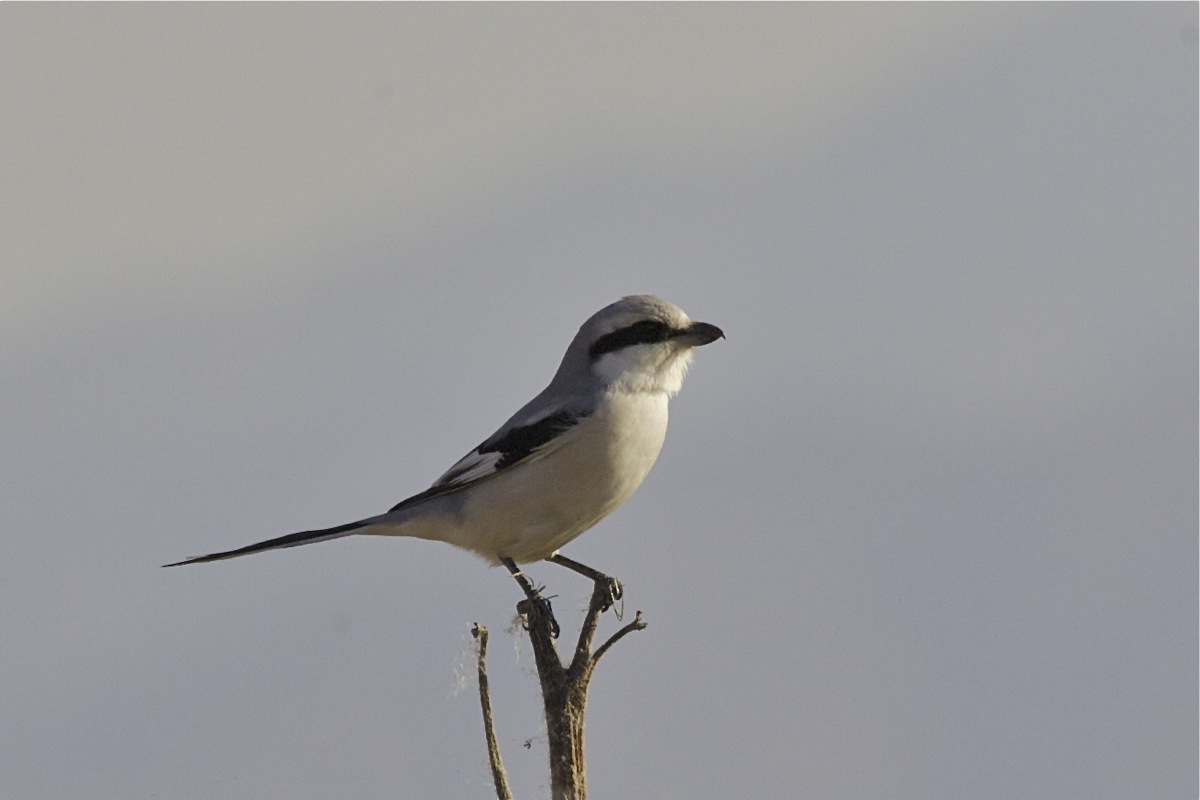
The very pleasant walk around produced 2 Short-eared Owls, 80+ Common Cranes (most of which arrived in the afternoon, clearly fresh in), several Buff-bellied Pipits, a single Water Pipit, 3 Chinese Grey Shrikes, 2 (possibly 3) Upland Buzzards, a single Peregrine (probably of the form peregrinator), a handful of Black-headed Gulls, double figures of Chinese Spot-billed Duck, 6 Common Pochard, good numbers of Little and Great Crested Grebe, one or two Reed Buntings and 20+ Pallas’s Reed Buntings.
Ruddy Shelduck against a mountain backdrop, Wild Duck Lake, north-west of Beijing, 30 October 2010Chinese Grey Shrike, one of three seen at Wild Duck Lake, 30 October 2010
Today was the first day since arriving in Beijing that my walk around the garden produced not a single phylloscopus warbler. Everything seems to have cleared out with the cold front that passed through at the weekend. Just 2 Daurian Redstarts remain. It’s beautiful weather in Beijing right now with excellent visibility and clear skies with that fresh late autumnal feel… magic.
I should have spotted the omens… After a weekend of pretty grotty weather (misty, smoggy and generally pretty foul), the forecast was for a cool, fresh and breezy day on Monday in Beijing. Amazingly, I bumped into Jesper Hornskov at the opera on Sunday night (you didn’t realise we were so cultured did you?) – a Chinese production of Handel’s ‘Semele’. And quite exquisite it was too…
Before the opera started, Jesper said he was going to go to the ridge above the Botanical Gardens in the morning for visible migration. I knew that it would be a good day – the first clear and fresh day after the passage of a cold front in October would almost certainly be a big migration day. The devil on my shoulder was telling me to go with him. But the angel on my other shoulder reminded me of my workload. The devil tempted me with thoughts of Pallas’s Rosefinches, Imperial Eagles and Upland Buzzards. I was about to give in when the angel reminded me that I had to get a draft press article to my Chinese contacts by lunchtime (which I hadn’t even started drafting!). Even if I went out for the morning and worked all afternoon and evening I would miss the deadline. Having listened to both the devil and the angel make their equally persuasive cases, I (stupidly, as it turned out) went with the angel and decided I just couldn’t go…
When I hadn’t heard from Jesper by 4pm I knew he must have been having a good day and was probably still on the ridge (mysteriously, there is no mobile signal on the ridge). Then, at 17:30, came the text message. Now, let me just say that I was prepared for him to have seen some good stuff, and I steeled myself that I would probably have missed a few birds of prey, maybe a few Buzzards, and the odd flock of passerines but I wasn’t prepared for this: 27 Greater Spotted Eagles, 1+ Imperial Eagle, 2-3 Golden Eagles, 35 Goshawks, 81 Common and 2 Upland Buzzards, 117 Sparrowhawks, Chinese Leaf Warbler, 4 Pallas’s Rosefinches, 44 Pine Buntings and 4800 Brambling.. Gulp.
A walk around the garden this morning (my first for a few days) revealed a large fall of Pallas’s Warblers. There were at least 50 with 10 in one relatively small bush! The light was pretty poor but I was able to capture the image below, using ISO 1000.
Pallas's Warbler about to enjoy lunch
I was pretty pleased with myself and fancied myself as a bit of an Arthur Morris until I saw these.. simply stunning!
An early morning trip with Jesper to the Botanical Gardens and walk up to the ridge produced a few good birds, despite the mist and low cloud that enveloped the hills. One of the best birds for me was Chinese Hill Warbler, often heard but a lot more difficult to see. Jesper used his cunning Chinese Hill Warbler imitation call to lure this one out of dense cover for a few seconds as it came to investigate.
Chinese Hill Warbler, above Beijing Botanical Gardens
Other birds included Pere David’s Laughingthrush, at least 5 Pine Buntings,Eastern Rock Bunting, Tristram’s Bunting, Rustic Bunting (a pair feeding on the track), several Yellow-throated Buntings (stunning birds), many Little Buntings, some cracking Siberian Accentors, a single Water Pipit (flyover), Yellow-bellied, Great and Long-tailed Tits, Eurasian Siskin, Oriental Greenfinch, Chinese Blackbird, Red-flanked Bluetail, Daurian Redstart, Common Rosefinch,Common Buzzard, Eurasian Sparrowhawk, lots and lots of Pallas’s Warblersand several Naumann’s Thrushes.
Thrushes and buntings are certainly on the move now, with many small flocks of the former flying over which, unfortunately due to the poor visibility, remained unidentified (although Jesper picked out a Red-throated in one of the closer flocks). It’s getting steadily colder with the first frost predicted for next week. Will be interesting to see what is on the move after that…
A cold front passed Beijing today… cold and rainy all day. A quick 10-minute walk through the garden produced at least 5 Red-flanked Bluetails which, together with the 12 I saw in Ritan Park yesterday, almost (but not quite) equals the total number of Bluetails seen in the UK this autumn! Alan Tilmouth posted an interesting piece about the increase in UK records this year – worth a read.
Red-flanked Bluetail, Central Park, Beijing, 19 October 2010
When I first arrived in Beijing, I was fooled a couple of times by high-flying kites (the manmade kind) that I thought might be raptors.. I was amazed at how high these kites were flying over the city centre and wondered who was flying them and from where.. Today, during a walk in Ritan Park, I found the answer when I spotted an unidentified swallow soaring above China’s capital city…..
It was noticeably colder this morning on my walk around Central Park in Beijing.. probably down to around 6 degrees C and I could have done with my gloves. Good numbers of Pallas’s Warblers today (I counted 12 and there could have been more) plus a single Daurian Redstart. The forecast is for a cold front to pass through on Monday, followed by more settled weather for a few days.. the cold snap might prompt some more birds to fly south – I am hoping for Siberian Accentor and some Thrushes in the garden!
I made my second visit to Yeyahu (known as Wild Duck Lake) on Wednesday. Fantastic day – almost no wind early morning and fantastic blue skies. Highlights were undoubtedly the raptors – 2 Great Spotted Eagles that came from the east, circled a bit and then wet back east, clearly not liking what they saw… also, 2 Short-toed Eagles, a Peregrine, at least 12 japonicusCommon Buzzards, 3 Hen Harriers, 2 Japanese Sparrowhawks, 4 Eurasian Sparrowhawks, 3 Goshawks, 2 Hobby and a Kestrel. Other sightings included c50 Bean Geese, a cracking adult male Yellow-throated Bunting, 100s of Little Buntings (I lost count when I reached 3 figures but there were clearly several hundred on site), c20 Buff-bellied Pipits, several Greater Short-toed Lark and a possible Asian Short-toed Lark (looked short-tailed and pale but not clinched).
Not too much wildfowl around – a few Spot-billed Duck, a couple of Ruddy Shelduck, some Common Teal, a few Gadwall, Mallard and Wigeon but no sign of any Baikal Teal.
Meanwhile, in the garden, one Red-flanked Bluetail remained with at least 6 Pallas’s Warblers, a single Daurian Redstart and half a dozen Yellow-bellied Tits.
Greater Spotted Eagle, Yeyahu, 13 October 20101 cal yr Common Buzzard ssp japonicusShort-toed Eagle, Yeyahu, 13 October 2010Short-toed Eagle, Yeyahu, 13 October 2010 – can you see the Great Wall in the background? Chinese birding at its best…
The garden keeps producing. Today there were two Red-flanked Bluetails foraging low down in the shade of some small shrubs, right by a major walkway. Stunning birds, often wagging their tails downwards as they eyed up their next insect meal. One even began to eat a few of the berries, precariously balancing on the outer branches…. Only other birds of note were 4 Pallas’s Warblers and a single Brambling (new China bird for me) that called, perched briefly on top of one of the trees and then flew off south.
Red-flanked Bluetail, Central Park, 12 October 2010Red-flanked Bluetail, Central Park, 12 October 2010
After seeing my first Radde’s Warbler in the garden yesterday, today I saw a minimum of 5! Three were in the same shrub which also included a Dusky Warbler, a male Daurian Redstart and a Two-barred Greenish Warbler! One of the Radde’s performed well, breaking the dense cover and showing quite well in the upper branches of a young tree for a few minutes.
Radde's Warbler, Central Park, Beijing, 9 October 2010. Note the shortish, stubby bill, compared with Dusky (below)
Radde's Warbler, Central Park, Beijing, 9 October 2010. This photo shows the characteristic 'peachy' undertail coverts.
This Dusky Warbler popped out briefly, called and then dived back into cover. Note the thinner, more pointed bill, the more concolourous body and the darker legs.
Two-barred Greenish Warbler, Central Park, Beijing, 9 October 2010
A Two-barred Greenish Warbler came to see what all the fuss was about and posed nicely, albeit briefly, before moving on with a small party of Pallas’s Warblers.
Finally, the male Daurian Redstart that was bombing around doing what Redstarts do…
I checked the patch where the Stubtail was yesterday. No sign. But there was another Radde’s in the same spot, skulking around in the grass..
As I started my morning walk around the garden this morning, I didn’t expect much. It was pretty smoggy and fairly still and, after several days of settled weather, I didn’t expect there to be any new grounded migrants.
In some longish grass I caught a glimpse of a warbler probing around at the bases of the stems.. and it didn’t take long to realise it was a Radde’s Warbler – my first in the garden. It hopped around, rarely fully in view – typical of a Radde’s – before flying a short way into dense cover. A nice start.
A bit further along I flushed a Taiga Flycatcher – the first I have seen for a while (they were pretty common in early September but most seem to have gone through by now) and a female Daurian Redstart (possibly the same bird that has been present since Tuesday) darted out and then back into cover. Several Pallas’s Warblers foraged in the tallest shrubs but, with lots of dog walkers around and Chinese people doing their morning shouty shouty stuff, I decided to call it a morning and go back to the flat for breakfast.
A nagging feeling that there might be more birds around caused me to take another stroll around after lunch. Almost immediately, in the same spot as the Radde’s earlier that day, I caught sight of some movement on the ground. Probably the Radde’s, I thought… This time I had my camera with me so I thought I would try to get an image or too.. I crept up the steps so that I was at eye-level with the bird.. suddenly it called a very sharp ‘tick’ and sat up on a stem. The bird had plain brownish upperparts and a very marked supercilium that grew stronger behind the eye. It turned and I could see it had a very short tail – it was clearly an Asian Stubtail! Wow! I grabbed my camera and it flew up onto a branch momentarily before flying off round the corner and out of sight. I managed a few dark record images…
Asian Stubtail, Central Park, Beijing, 8 October 2010
Almost immediately, two Pallas’s Warblers came down to some low branches nearby and performed very well… I do love these bright little gems!
Pallas's Warbler, Central Park, 8 October 2010
Pallas's Warbler, Central Park, 8 October 2010
I enjoyed watching one of the Pallas’s as it repeatedly picked off insects from an infested stem and, in so doing, I realised that I may have achieved a photographic first – a Pallas’s Warbler pooing. He must have felt embarrassed as, no sooner had he relieved himself, he flew off in a hurry…
Pallas's Warbler pooing, Central Park, 8 October 2010