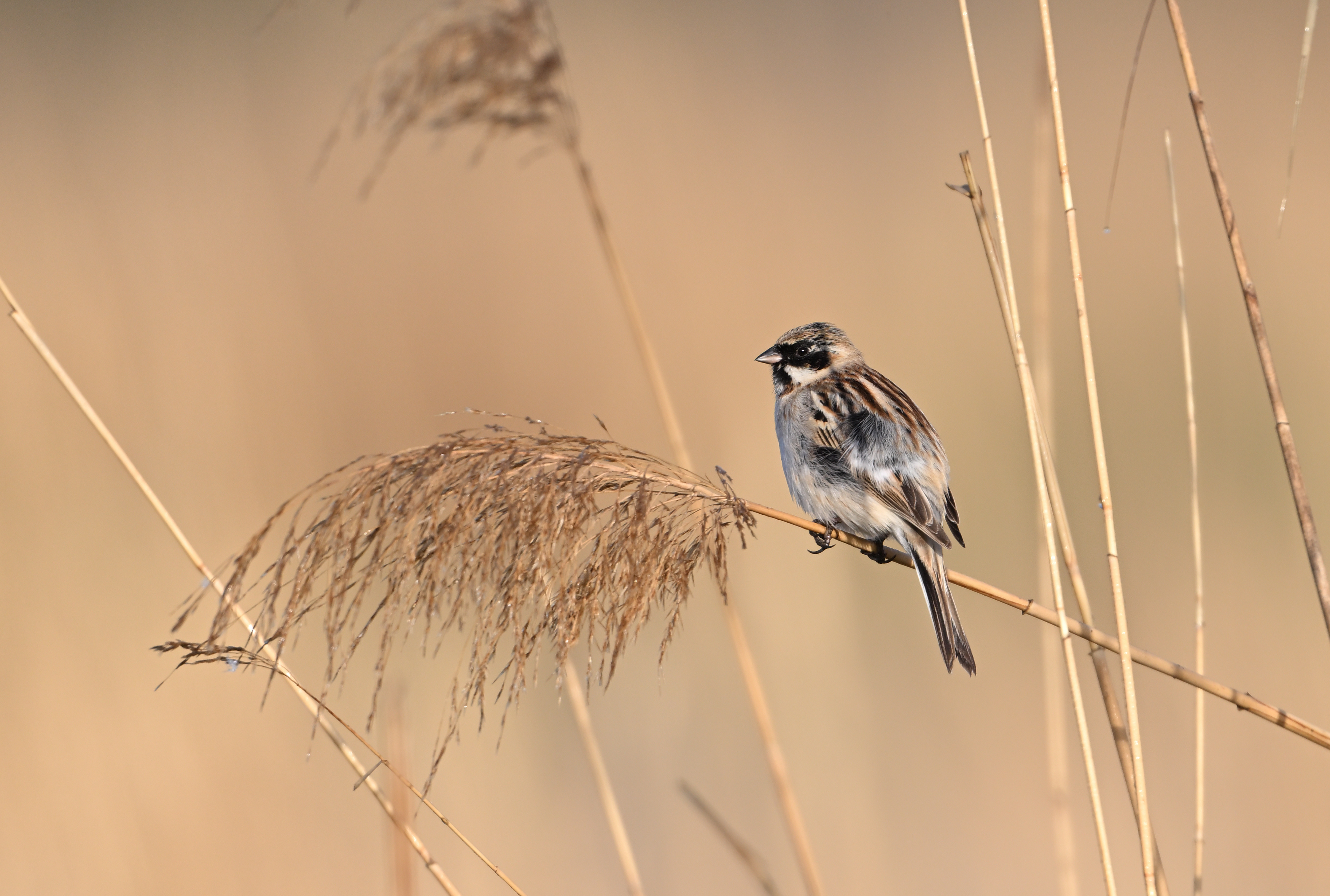
An important paper on the taxonomy of Pallas’s Reed Bunting has just been published in Avian Research: Buchheim, Franke, Dumont de Chassart et al. (2026), “Taxonomy of Pallas’s Reed Bunting (Emberiza pallasi): An integrative approach” (doi.org/10.1016/j.avrs.2026.100444). It’s open access and, for anyone with an interest in East Asia’s birds, well worth reading. The authors drew on genetics, morphometrics, vocalisations and playback experiments, and concluded that lydiae is a separate species. They propose the names Mongolian Reed Bunting (E. lydiae) and Siberian Reed Bunting (E. pallasi, which includes pallasi, polaris and minor).
Two years ago, I did a small study in of Pallas’s Buntings in Beijing, where Pallas’s Bunting is a passage migrant and winter visitor. See here.
The new paper has a bearing on my results in two ways.
First, what holds up. Separating lydiae by call is strongly supported. The paper found the lydiae call consistently distinct, referring to its consistent buzzy quality, with every lydiae recording correctly classified in its analysis. So the 6,985 lydiae calls in my study can now be read as Mongolian Reed Buntings, peaking in October and April with smaller numbers in winter. My tentative observations that lydiae has a shorter primary projection and less contrasting plumage are also confirmed by the paper’s measurements.
Second, what needs revising. I split the remaining calls into polaris (13,252) and pallasi (1,336) by spectrogram shape. The paper found no consistent vocal or genetic differences between pallasi, polaris and minor. The one exception is a population of pallasi in the Altai Mountains, whose calls differ slightly from the rest. The recordings I used as my pallasi reference were made in western Mongolia and could well be of this “Altai” type. So my “pallasi” category may be better read as putative Altai-type Siberian Reed Buntings, and my “polaris” category as Siberian Reed Buntings in general. The distinct peak of Altai-type calls in late April and May is intriguing, because the paper notes that this call type may occur beyond the Altai and its full range is unknown.
In short, around two-thirds of the Pallas’s Reed Buntings calling at the ChaoBai River were Siberian Reed Buntings and around one-third were Mongolian Reed Buntings. The original text in the linked post is unchanged, so please read the pallasi/polaris sections with this new information in mind.
Hopefully this new paper will encourage more interest in these birds in Beijing and the status of the various taxa will become clearer.
Leave a Reply