As we tracked the Beijing Cuckoos from the Chinese capital all the way to Africa, we learned that they take a remarkably similar route to another long-distance migrant: the Amur Falcon (Falco amurensis).
The Amur Falcon is one of the most beautiful and agile of all birds of prey — a spectacular aerial hunter that often makes you gasp as it wheels in the sky, chasing dragonflies and other flying insects. It breeds across eastern Russia and northern China, and each autumn undertakes an extraordinary journey across Asia, over the Indian Ocean, to winter in southern Africa.
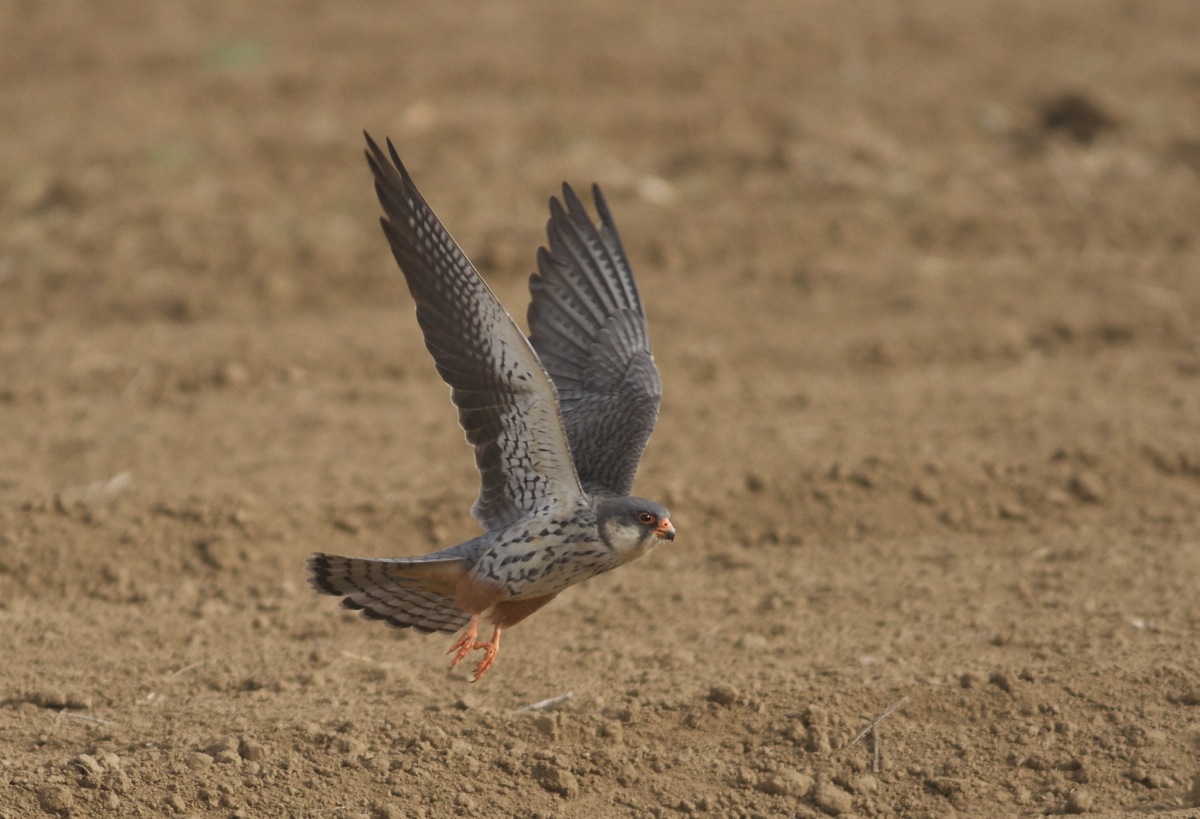
A female Amur Falcon takes to the air — a spectacular aerial hunter that breeds across northern China, including near Beijing.
Nagaland
A million falcons — and a crisis
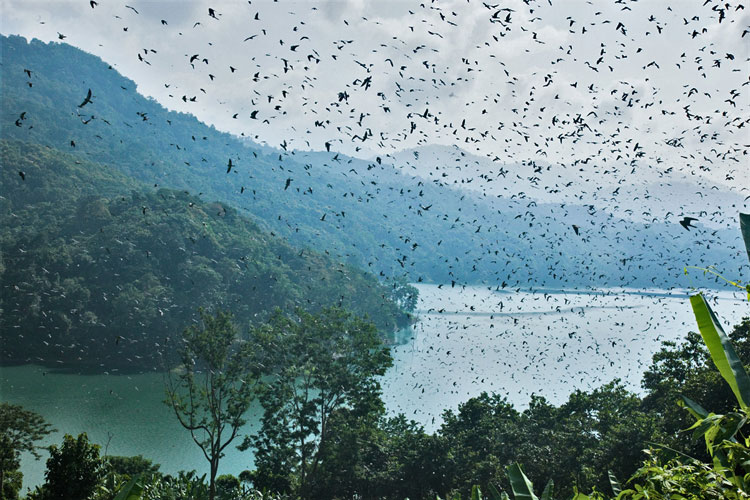
A few years ago, it came to light that on their way to Africa each autumn, Amur Falcons congregate in Nagaland, in north-east India, on a staggering scale — an estimated one million birds gathering at roosts around the Doyang reservoir.
Up to a million Amur Falcons gather at their stopover roosts in Nagaland, India. Photo by Ramki Sreenivasan.
But in 2012, it emerged that the hunting of these falcons was also on a huge scale. Conservationists discovered that tens of thousands of migrating Amur Falcons were being illegally trapped on the roost at Doyang and taken to local markets — alive, or killed and smoked, for sale as food. It was one of the largest known slaughters of a bird of prey anywhere in the world.
What happened next became one of conservation's great success stories.
The Turnaround
From 100,000 to zero
India acted swiftly. Forest protection teams seized nets and released captured birds, and — crucially — conservationists and the Nagaland Forest Department worked with community and religious leaders to change hearts and minds.
The results were almost unbelievable. In 2013, Dr Asad Rahmani, then Director of the Bombay Natural History Society, reported that from an estimated 100,000 falcons killed the previous year, none had been trapped that season. As he put it, the transformation was extraordinary and the change had come very quickly — but the challenge was to make it last.
From an estimated 100,000 falcons killed one year, to zero the next.
Sustaining that change meant engaging local communities and providing alternative livelihoods. A key part of the awareness campaign was a project to satellite-track Amur Falcons, with individual birds named after local villages in Nagaland — turning the falcons from quarry into a source of local pride.
The Beijing Connection
Why Beijing wanted to say thank you
Two of the Amur Falcons originally tagged in 2013 visited an area just a few hundred kilometres north of Beijing to breed. Though the species nests in the capital in small numbers, it is in spring and autumn — at stopover sites like Yeyahu and Miyun Reservoir — that Beijing's birders are lucky enough to see flocks of these beautiful falcons. In Beijing, we feel a strong affinity with this bird.
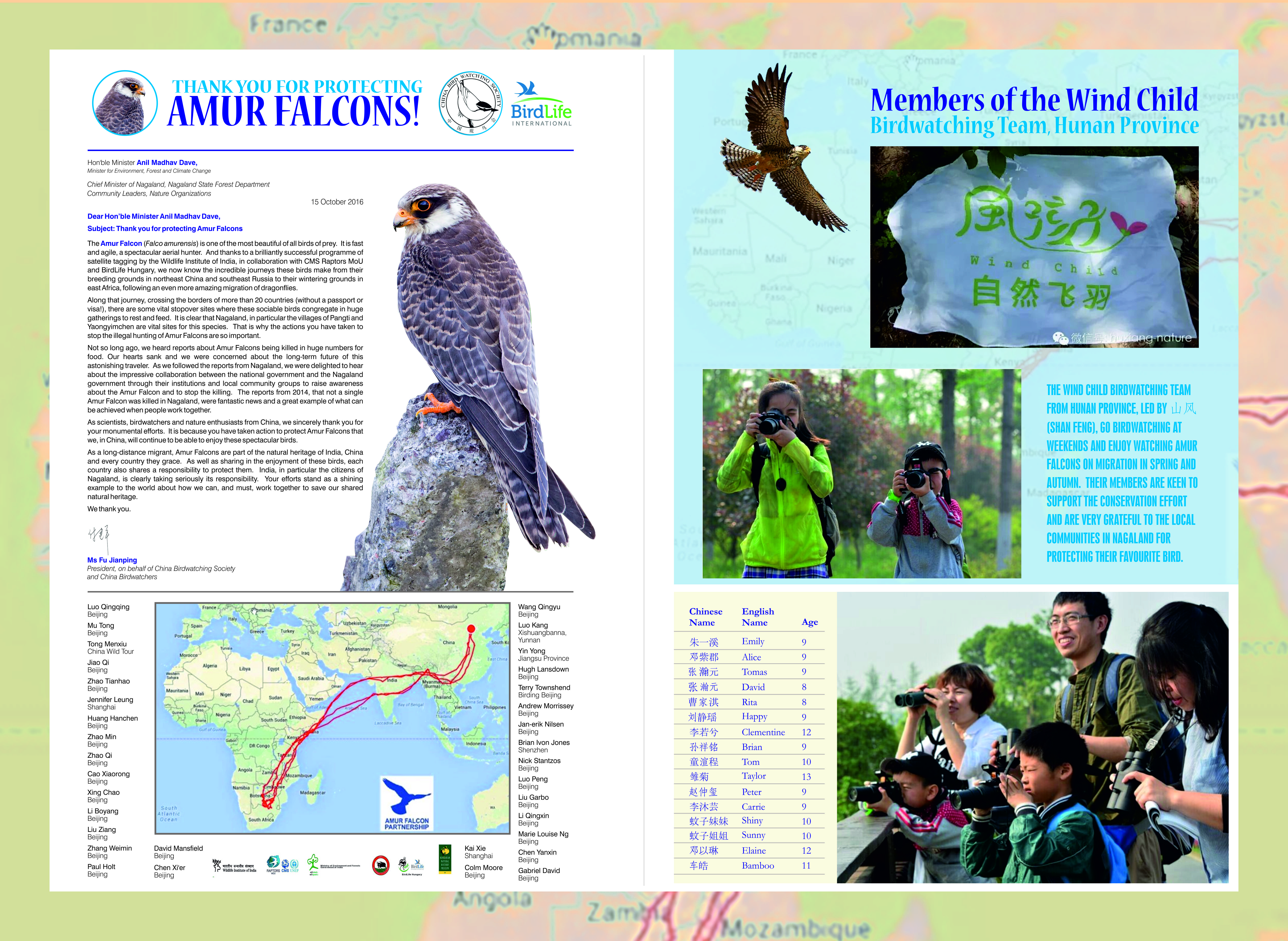
Recognising that it was the conservation effort in India that allowed birders in north-east China to keep enjoying these falcons, Beijing's birders wanted to thank the Indian government and, above all, the local people of Nagaland for protecting them. Birding Beijing facilitated a letter of thanks, signed by Ms Fu Jianping, President of the China Birdwatching Society, on behalf of its members, and by many individual birders across China.
As the signatures were collected, the "Wind Child" young birders' group in Hunan Province — who had seen Amur Falcons on their very first field trip and adopted the species as their favourite — asked to add their voices too.
The letter of thanks, signed by the President of the China Birdwatching Society and birders across China.
Thanks to Suresh Kumar of the Wildlife Institute of India, the letter was made into a poster, framed, and handed over to local community leaders during the annual gathering of Amur Falcons.
The framed letter handed over to the local community in Nagaland, by the Wildlife Institute of India.
Birds Without Borders
Shared by all the countries they grace
Just as with the Beijing Cuckoos, the Amur Falcon reminds us that birds have no borders — they are shared by every country they pass through. It is only by working together that these incredible travellers, and the habitats they depend on, can be protected.
Maybe the Amur Falcons from Nagaland mingle with Beijing Cuckoos somewhere in Africa.
Since Then
A success that has lasted
This story was written in 2016. The good news is that the protection has endured. Nagaland — now widely known as the "Falcon Capital of the World" — has marked more than a decade of community-led conservation, with major roost villages reporting near-zero hunting.
The success has spread beyond Nagaland to neighbouring Manipur and elsewhere in north-east India, and an annual Amur Falcon Festival now celebrates the birds' return each autumn. Satellite-tracking continues too, following individual falcons on their astonishing journeys across the Arabian Sea to Africa and back. For current news, see the Convention on Migratory Species and the Wildlife Institute of India.
Thanks
To the people who made it possible
Our thanks to Suresh Kumar of the Wildlife Institute of India for arranging the design, framing and handover of the letter; to Patricia Zurita, then CEO of BirdLife International, for supporting the initiative; and to all the signatories. Above all, our deepest thanks to the local people of Nagaland, whose extraordinary work turned a place of slaughter into a place of protection — for the Amur Falcons, and for everyone who marvels at them along their journey.
The Amur Falcon's story shows what is possible when people choose to protect the wildlife that passes through their lives — and that a single letter, like a single bird, can cross a continent.