Tag: Nocturnal Flight Calls

  • Nocturnal bioacoustic survey in the mountains of Beijing, spring 2026

    Nocturnal bioacoustic survey in the mountains of Beijing, spring 2026

    Every spring in Beijing, the hills are alive with the sound of music!

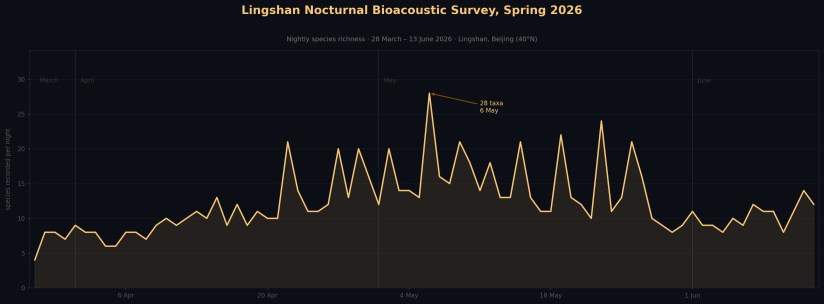
    This year I set up a sound recorder on a forested hillside in Mentougou District at an elevation of c1,700m asl.  The idea was to capture the sounds of spring, including nocturnal spring migrants and summer breeders.  It was also a chance to gain insights into the arrival dates of some of the breeding species and to explore how the species richness evolves through the spring.

    The Wildlife Acoustics Song Meter Mini digital recorder was active from 28 March to 13 June and recorded from sunset to one hour after sunrise (automatically adjusted).   

    Key Information:

    • From 903 recordings over 78 nights, 84 bird species and 4 mammal species were recorded, with a few additional vocalisations not assigned to species level. 
    • The night of 6 May was the peak in terms of species richness, with 28 taxa recorded that night/early morning.
    • Perhaps unexpectedly, several shorebird species were recorded, including Black-winged Stilt (Himantopus himantopus 黑翅长脚鹬 Hēi chì cháng jiǎo yù), Pied Avocet (Recurvirostra avosetta 反嘴鹬 Fǎn zuǐ yù), Greater Sand Plover (Anarhynchus leschenaultii 铁嘴沙鸻 Tiě zuǐ shā héng) – see below – and Whimbrel (Numenius phaeopus 中杓鹬 Zhōng biāo yù)
    • Lesser Cuckoo (Cuculus poliocephalus 小杜鹃 Xiǎo dù juān) recorded on 8 and 12 June
    • Japanese Scops Owl (Otus semitorques 北领角鸮 Běi lǐng jiǎo xiāo) recorded on five nights between 7 April and 18 May – see below
    • Grey-backed Thrush (Turdus hortulorum 灰背鸫 Huī bèi dōng) recorded singing between 7 and 12 May – listen out for it in the dawn chorus recording below
    • Brown Eared-Pheasant (Crossoptilon mantchuricum, 褐马鸡 Hè mǎ jī) 
      recorded on 31 March and 22 April

    Below you can explore the results via an interactive graphic.  For example, if you would like to know when Asian Stubtail (Urosphena squameiceps 鳞头树莺 Lín tóu shù yīng) was first detected, simply click on the species and you will be able to see the first and last dates detected, the number of detections and also the peak hour for that species.

    Some selected highlights

    The recording of several waterbird species at a mountain location may reflect the relatively close proximity of Guanting Reservoir – it is possible that nocturnal migrants begin to vocalise when they see the reflection of this large water body?

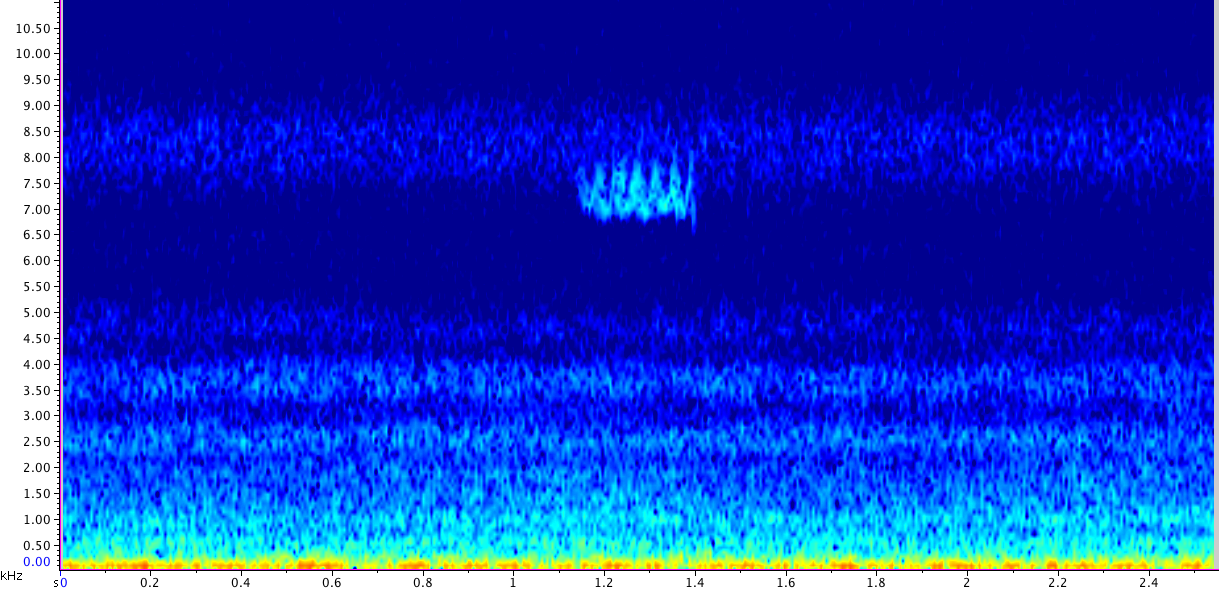
    The recording of Greater Sand Plover (Anarhynchus leschenaultii 铁嘴沙鸻 Tiě zuǐ shā héng) was a bit of a surprise.  It is even possible to hear a song element in the recording below.


     Another surprise was Gull-billed Tern (Gelochelidon nilotica 鸥嘴噪鸥 Ōu zuǐ zào ōu).  Recorded on 3 May 2026.

     Japanese Scops Owl (Otus semitorques 北领角鸮 Běi lǐng jiǎo xiāo) is a species that remains a bit of an enigma in Beijing and is only rarely recorded.  In the clip below are three examples of one of the more common vocalisations – a downward-inflected series of hoots – recorded on two separate dates (30 April and 16 May) but merged into one clip.  No song was recorded this spring at the survey site.


    Oriental Scops Owl (Otus sunia 红角鸮 Hóng jiǎo xiāo) was recorded an impressive 222 times over 45 nights, with the peak coming just after dusk.  On several occasions, I heard an unfamiliar shrill call immediately after a burst of familiar song.  Initially baffled, I realised after reading this article from The Sound Approach about European Scops Owl that it was a copulation call.  Listen to the example below with two birds singing (a pair?), gradually becoming more strident before the copulation call at the end.


    Additionally, there was one intriguing pulsed vocalisation that is reminiscent of Asian Barred Owlet (Glaucidium cuculoides 斑头鸺鹠 Bān tóu xiū liú).  Have a listen below.  Although superficially similar to this species, there are some anomalies, including the pulse rate and frequency structure, that make it atypical and lead me to leave it unidentified.  Comments and suggestions about the identity of the vocaliser are welcome!

    Edit: Thanks to Liu Shuangqi, it seems possible that this pulsed vocalisation originates from an amphibian and, specifically, Bombina orientalis (Oriental Fire-bellied Toad).  Although audio recordings of this species are few, there is a YouTube video including the so-called ‘release call’ of a similar species – Bombina variegata – that is a close match.    


    The Dawn Chorus

    Below is a 5-minute compilation of the dawn chorus, including roughly thirty seconds from each of several dates through the spring.  It begins with an atmospheric calling Red Fox (Vulpes vulpes  赤狐 Chi Hu) in the dark of night, followed by snippets from 30 March, 15 April, 30 April, some selected highlights from three thrush species in early May, followed by more clips from 21 May, 1 June and ending with one of the latest species to arrive – the Lesser Cuckoo (Cuculus poliocephalus 小杜鹃 Xiǎo dù juān) – on 12 June.  The recording illustrates how the dawn chorus evolves as spring progresses.


    I hope you enjoy the recording and also delving into the data below.  By clicking on a species, more data will be revealed, including first and last dates recorded and peak hour.


    Summary of spring 2026 


  • The Invisible Miracle Happening Over Our Heads As We Sleep

    The Invisible Miracle Happening Over Our Heads As We Sleep

    On Tuesday 27 September 2022, the Asian Infrastructure Investment Bank (AIIB) hosted a special seminar to publicise the results of the pilot Beijing Nocturnal Bird Migration Project.  

    Hosted by AIIB’s Vice President for Policy and Strategy, Sir Danny Alexander, and moderated by Tian Hua, the seminar included speakers from Peking University, the Beijing Municipal Government, Cornell Lab of Ornithology and embassies along the flyway, including Australia, New Zealand and Indonesia.  It was a wonderful opportunity to raise awareness of the miracle of bird migration that happens over Beijing as its residents sleep at night.  

    AIIB’s Vice President for Policy and Operations, Sir Danny Alexander, opened the seminar.
    AIIB’s Tian Hua was the moderator for the morning.
    Dr Wang Xiaoping from Beijing’s Forest and Parks Bureau said Beijing was moving towards an ‘ecosystem approach’ to land management, recognising the value of wetlands, grassland and scrubland as well as trees.

    Every spring and autumn millions of birds fly over China’s capital city between breeding grounds in Siberia, Mongolia and north China and non-breeding grounds in south China, S & SE Asia, Australasia and even, in the case of Beijing’s Swifts and Common Cuckoos, to Africa.  Some of these birds migrate during the day – for example, the larger soaring birds, such as birds of prey, cranes, storks etc that rely on thermals to assist their flight.  However, the majority of birds (around 80%) – especially the smaller species – migrate at night.  This is because there are fewer predators active during the dark hours, the weather tends to be cooler and more stable and some birds navigate using the night sky.

    Many of these birds vocalise as they migrate – to keep in touch with each other as they fly and, towards the end of the night, attempting to initiate responses from their own kind on the ground, which could indicate a safe place to stop for the day.  Using a simple sound recorder, it’s possible to gain an insight into the volume and diversity of birds flying over at night.

    In autumn 2021, Birding Beijing, in collaboration with AIIB and Peking University, began a pilot project to record bird sounds at night from the roof of the Asian Infrastructure Investment Bank.  AIIB’s building is ideal – it’s 15 storeys high, not close to any major roads, free from aircraft noise and close to one of Beijing’s largest urban green spaces, the Olympic Forest Park.  During the period 25 August to 2 November 2021 we programmed the recorder to record every night from sunset to sunrise, resulting in over 700 hours of recordings.

    The digital sound recorder from Wildlife Acoustics fixed to the roof of AIIB’s headquarters in Beijing, close to the Olympic Forest Park.

    Key findings:

    • 34,713 bird calls recorded
    • Around 95% of calls identified to species or, in the case of buntings, flycatchers and thrushes, to family, with more than 60 species identified so far
    • Most common calls were Olive-backed Pipit (12,411), Black-crowned Night Heron (5,358) and Eurasian Skylark (2,611).
    • Five nights recorded over 2,000 calls (in order of volume`)
      • 27/28 September (2,703 calls)
      • 28/29 September (2,405 calls)
      • 14/15 October (2,270 calls)
      • 9/10 September (2,233 calls)
      • 22/23 September (2,025 calls)
    • The busiest hour-long file was 0502-0602 on 29 September with 1,012 calls

    Rarities included possibly only Beijing’s 8th Grey-tailed Tattler Tringa brevipes 灰尾漂鹬 Huī wěi (piào) yù and at least two Little Curlew Numenius minutus 小杓鹬 Xiǎo biāo yù (not annually recorded in Beijing). 

    The graph below shows the volume of bird calls recorded by date.

    More detail about the results, including the species recorded, volume per species and date ranges, as well as example calls, can be found here.

    Terry briefed the seminar on the key findings of the Autumn 2021 pilot nocturnal bird migration project.

    Liu Shuangqi from Peking University briefed how the project is now expanding to six recording locations across the city in spring 2022 covering areas with varying light pollution to gain a insight into whether artificial light affects the calling rate of migratory birds. 

    Liu Shuangqi of Peking University spoke about the impact of artificial light on migratory birds and how the project is expanding to cover more recording sites.

    Assistant Professor Hua Fangyuan provided some important context about the loss of 3 billion birds in North America since 1970, something scientists can estimate with some confidence given the strong datasets in the continent (13 datasets were used for the North American study, some of which stretch back more than 50 years).  Those data are lacking in East Asia – in particular for migratory land birds – but what we do know, for example about shorebirds, is that bird populations here are likely to be on a similar trend.  Long-term, standardised, monitoring is key.

    Assistant Professor Hua Fangyuan provided important context about the decline or birds in N America and the lack of data in East Asia, emphasising the value of continuing the nocturnal migration project.

    So, what do the results of Beijing’s pilot project tell us?

    First, that there is a high volume and diversity of birds migrating over Beijing, confirming that it is on a major ‘flyway’ or expressway for birds. 

    Second, that most of these migratory birds are species that pass through several countries, reinforcing that migratory birds do not belong to any single country – they are shared natural heritage and, with that, comes a shared responsibility to protect them and the places they need.

    And third, if Beijing is to fulfil its responsibility to the flyway – to facilitate safe passage, the city must manage urban spaces in a way that helps birds to cross the hostile urban environment.  Given the diversity of species migrating over Beijing (the top three by volume are a woodland bird, a wetland bird and a grassland bird), that means providing a diversity of habitats including natural forest, wetland and grassland. 

    After interventions from Peking University’s Professor Lu Zhi, embassies from flyway countries, a video message from Dr. Andrew Farnsworth of the Cornell Lab of Ornithology, and a lively Q&A with AIIB staff and invited guests, the event was wrapped up by AIIB’s General Counsel, Alberto Ninio, and culminated in the signing of a ‘letter of intent’ between AIIB and the Beijing Municipal Government. 

    Peking University’s Professor Lu Zhi, China’s most well-known conservationist, delivered some wonderful and inspiring remarks to the audience.
    Cornell’s Dr. Andrew Farnsworth recorded an inspirational video message about the North American experience, providing food for thought for the Q&A session.
    Svar Barrington from the New Zealand Embassy in Beijing gave a perspective from the southern end of the flyway and spoke eloquently about how biodiversity, in particular migratory birds, was now high up New Zealand’s list of foreign policy priorities.
    The audience was captivated by the sound of a flock of Bean Geese (Anser serrirostris 短嘴豆雁 Duǎn zuǐ dòu yàn) that flew over the AIIB building at 0354hrs on 16 March 2022.
    AIIB’s General Counsel and environmental lawyer, Alberto Ninio, closed the seminar ahead of the signing of the letter of intent.

    AIIB and the Beijing Municipal Government agreed to cooperate on the nocturnal migration project and biodiversity conservation more broadly, including a commitment to use the data about the diversity and volume of migratory birds flying over China’s capital to inform land management policies in Beijing.  This would ensure they help the city fulfil its role in the flyway – to facilitate safe passage of these migratory birds that are shared by so many countries.

    AIIB and the Beijing Municipal Government signing the letter of intent at the end of the seminar.

    After having trawled through 700 hours of recordings, to see the energy and commitment of the participants at this special seminar made it all worthwhile!

    I was struck by the openness and willingness of the Beijing Municipal Government to take into account the data from this project in their land management policies.  This is a big deal when one considers that the Beijing Forest and Parks Bureau manages around 75% of the capital’s landmass.

    Huge thanks to AIIB, in particular Sir Danny Alexander, Alberto Ninio, Erik Berglof, Tian Hua, Li Zeyu and Yan Bo for allowing use of their roof and for their incredible support since the beginning of the project.  It has been a delight to work with friends and colleagues from Peking University, especially Assistant Professor Hua Fangyuan, Professor Lu Zhi, Liu Shuangqi, Zhang Shen, Ren Xiaotong and Yang Xiaotong.  The team at the Beijing Forest and Parks Bureau are a joy to work with and wonderful advocates for biodiversity in Beijing.  Dr. Andrew Farnsworth and Benjamin Van Doren from Cornell Lab of Ornithology have been a great source of inspiration and encouragement. Finally, a thank you to the many birders who have helped with identifications of some of the calls, including Jonas Buddemeier, Geoff Carey, David Darrell-Lambert, James Eaton, Paul Holt, James Lidster, Magnus Robb, Seán Ronayne and Joost Van Bruggen, to whom we owe a debt of gratitude.

    More detail on the Beijing Nocturnal Migration Project, including results of the spring 2022 and the ongoing autumn 2022 projects, can be found here.


    All photos here provided by AIIB.


  • Discovering nocturnal bird migration in Beijing

    Discovering nocturnal bird migration in Beijing

    Have you ever wondered what birds are flying over your home at night?  If you are on any sort of flyway, during the migration season it is possible that many hundreds, even thousands, of birds fly over your home in a single night. Recording sound during the dark hours can help to shed light on the number of birds and the diversity of species that are flying overhead as we sleep.

    The practice of recording nocturnal flight calls (NFC) is gaining in popularity in Europe and the US (and elsewhere?) but is still in its relative infancy. Even with little knowledge of individual species’ calls, it is possible to gain an insight into the volume of birds that call as they pass overhead.

    Of course most birders are also interested in identifying the species, but identification of the calls can be a challenge.  Not only does successful ID require a strong knowledge of the vocalisations of many of the resident and migratory species in the area but it appears that some species use different calls at night to those with which we are familiar, thus adding to the difficulty.  Lots of work is underway, including at Cornell Lab, to use AI to help scan recordings to identify the species but, for now at least, in East Asia that is a long way off.

    With Beijing situated on a major flyway for birds commuting between Siberian breeding grounds and non-breeding grounds in China, SE Asia, Australasia and even Africa, there simply *must* be lots of nocturnal migration over the capital so, back in autumn 2017, living on the 13th floor of an apartment building at the time, I made my first attempts at nocturnal recording from my window.  Using a simple digital recorder, I was able to record species such as Olive-backed Pipit (Anthus hodgsoni 树鹨 Shù liù), Eurasian Skylark (Alauda arvensis 云雀 Yúnquè), Great Bittern (Botaurus stellaris 大麻鳽 Dà má jiān) and Siberian Rubythroat (Luscinia calliope 红喉歌鸲 Hóng hóu gē qú).  That experiment gave me a tantalising glimpse into the nocturnal migration over my apartment but a subsequent move to an apartment much less suitable for recording meant that the potential remained unfulfilled.  

    Fast forward to summer 2021 and, in a conversation with Sir Danny Alexander, Vice President of the Asian Infrastructure Investment Bank (AIIB), we hatched an idea to begin a recording project on the roof of AIIB’s headquarters.  The building, 15 storeys high, is in a great location for such a project.  It is immediately south of the Olympic Forest Park in the north of the city, not close to any major roads, suffers very little from aircraft noise and with almost no tall buildings close by.  

    The headquarters of the Asian Infrastructure Investment Bank (AIIB) in Beijing.

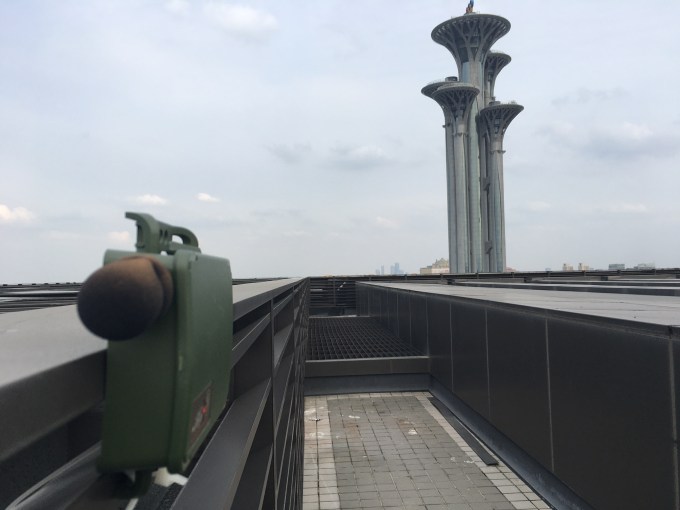
    We purchased a Wildlife Acoustics Song Meter Mini (weatherproof and programmable), and set it up on the roof, programming it to begin recording from 24 August until mid-November.  The recorder is perfect for this project as the only maintenance needed is a change of batteries every two weeks or so.  The recorder automatically adjusts the recording time to allow for the changing sunset and sunset times and a 512GB memory card is capable of storing all the files for the whole period.

    The Wildlife Acoustics Song Meter Mini digital recorder.

    The primary objective of this project is to gain an insight into the volume of birds flying over central Beijing at night.  With identification of most calls straightforward, we hope to be able to gain an improved understanding of the timings, including peaks, of individual species and potentially also the relationship between weather patterns and the extent of migration.  Given the impressive volume of calls, we are already building up a large file of “unidentified calls” and, with the help of birders in the region and experienced ‘nocmiggers’ elsewhere, we hope to identify as many of the unknowns as possible.

    The files from the first few weeks of recording have been downloaded and we are beginning to analyse them.  It’s a time-consuming process to go through them all but using the excellent free sound analysis software, “Audacity“, to produce spectograms in order to ‘visualise’ the files means it’s relatively easy to find the bird calls and skip through periods of silence. 

    A typical sonogram, in this case showing a visualisation of the calls of Eurasian Skylark (Alauda arvensis 云雀 Yúnquè).

    More than 4,000 calls have been identified so far.  Perhaps not surprisingly, in late August and September, the most dominant species have been Common Rosefinch (Carpodacus erythrinus 普通朱雀 Pǔtōng zhūquè), Olive-backed Pipit (Anthus hodgsoni 树鹨 Shù liù) and Eurasian Skylark (Alauda arvensis 云雀 Yúnquè) but these have been supported by a good selection of other species including Black-crowned Night Heron (Nycticorax nycticorax 夜鹭 Yè lù), Striated Heron (Butorides striata 绿鹭 Lǜ lù), Great Bittern (Botaurus stellaris 大麻鳽 Dà má jiān), Green Sandpiper (Tringa ochropus 白腰草鹬 Bái yāo cǎo yù), Common Sandpiper (Actitis hypoleucos 矶鹬 Jī yù), Wood Sandpiper (Tringa glareola 林鹬 Lín yù), Common Redshank (Tringa totanus 红脚鹬 Hóng jiǎo yù), Eurasian Curlew (Numenius arquata 白腰杓鹬 Bái yāo biāo yù), Forest Wagtail (Dendronanthus indicus 山鹡鸰 Shān jí líng), white-eye sp. (Zosterops sp., 绣眼鸟 xiù yǎn niǎo), Yellow-bellied Tit (Periparus venustulus 黄腹山雀 Huáng fù shānquè), and lots of thrushes and Muscicapa flycatchers (still to be identified to species).

    You can follow the progress of the project at this dedicated page, where we will upload good examples of calls, a batch of unidentified calls (on which we welcome suggestions!) and, in due course, some statistics about the volume of birds each night and a full species list.  Analysis of all the files probably won’t be completed until well into 2022 but we are already excited about what this project will reveal about nocturnal bird migration in Beijing.

    Huge thanks to the AIIB team, in particular Sir Danny Alexander, Alberto Ninio and Li Zeyu, for their support for this project and for their ongoing help and assistance.  And thank you to David Darrell-Lambert for initial advice about NocMig and to Geoff Carey and Paul Holt for advice and assistance with identifications.  Thanks also to all the birders in the East Asian Bird Vocalisation WeChat group and the NocMig WhatsApp group for help and assistance.

    For the latest news about this project, to hear some of the calls we are recording and for a list of unidentified sounds, please see this dedicated page.


    Header image: The Wildlife Acoustics Song Meter Mini in place on the roof of the Asian Infrastructure Investment Bank (AIIB) in Beijing.

  • Nocturnal Flight Calls in Beijing

    Nocturnal Flight Calls in Beijing

    Have you ever wondered what birds are flying over your home?  During the migration season it is possible that many hundreds, even thousands, of birds fly over one’s home in a single night and recording sound during the dark hours can help to shed light on the number of birds and the diversity of species that are flying overhead as we sleep.

    The practice of recording nocturnal flight calls (NFC) is gaining in popularity in Europe and the US (and elsewhere?) but is still in its relative infancy.  Thus, identification of the calls recorded is a major challenge.  Not only does successful ID require a strong knowledge of the vocalisations of many of the resident and migratory species in the area but it appears that some birds use different calls at night to those with which we are familiar, thus adding to the difficulty.

    For some time, I’ve been thinking that I really should try to record nocturnal flight calls in Beijing.  After all, although I live close to one of the world’s busiest airports (a source of ‘noise’ for around 20 hours per day), my apartment is on the 13th (top) floor and, from sightings in the capital, we know that Beijing is on a major flyway.  There simply *must* be lots of migrants flying over my apartment as I sleep…

    And so, after some helpful advice from David Darrell-Lambert in London, who has been recording night flight calls for some time in an urban environment, I took the plunge and ordered a digital sound recorder and set to work!  I made my first recording on the night of 29/30 August and have been recording every night that I have been at home ever since.

    So what have I discovered?  A resident LITTLE OWL that I never knew I had, some BLACK-CROWNED NIGHT HERONS, MOORHEN, GREY NIGHTJAR, brown flycatcher sp, a probable EYEBROWED THRUSH, YELLOW-BROWED WARBLER, OLIVE-BACKED and RICHARD’S PIPITS, LITTLE BUNTINGS and many many many calls that remain unidentified!

    Here are the spectograms and recordings of MOORHEN and the presumed EYEBROWED THRUSH.  Note the “noise” of the local crickets, particularly in the first recording.


    That’s not a bad list of species for a major capital city and I am confident I will record many more species as the autumn wears on.  What price a first record for Beijing?

    So how does it work?

    The digital recorder records to a HCSD memory card.  Depending on the quality, a 16GB memory card can record around 20 hours of sound.  I simply place the recorder on my window ledge (or on the roof), pointing roughly in a northerly direction, and leave it there until early morning.  When I wake I have around 8-10 hours of recording.

    Fortunately, one doesn’t need to listen to all 8-10 hours to find the birds.  There is some great free software out there to help.  Audacity and Cornell Lab’s RavenLite are both superb pieces of software that help to “visualise” the sounds using a spectogram.  I upload the sound file from the memory card to RavenLite and set the programme to display 10 seconds at a time…  then I scroll through the file, spending a fraction of a second on each page, until I see an obvious bird call.  For my urban environment, I very quickly became accustomed to identifying barking dogs, car horns and people shouting, enabling me to scan the files with ever greater efficiency.  I perhaps spend around an hour going through each night’s recording and saving all the relevant snippets.  So far, on average, I have recorded around 30 calls per night, around two thirds of which remain unidentified.

    To help with identification, the great resources at Xeno-canto Asia are a big help.  However, even this resource is generally limited to diurnal calls and may not include calls given exclusively at night.

    It is clear there is a huge amount to learn, and discover, by recording nocturnal flight calls and I am sure that I am going to find out an immense amount over the autumn migration period.

    A dedicated page has been set up here where all the latest news about this exciting new project will be posted.  Please check regularly and help if you can!

    Title image: a spectogram of EYEBROWED THRUSH recorded from my apartment.