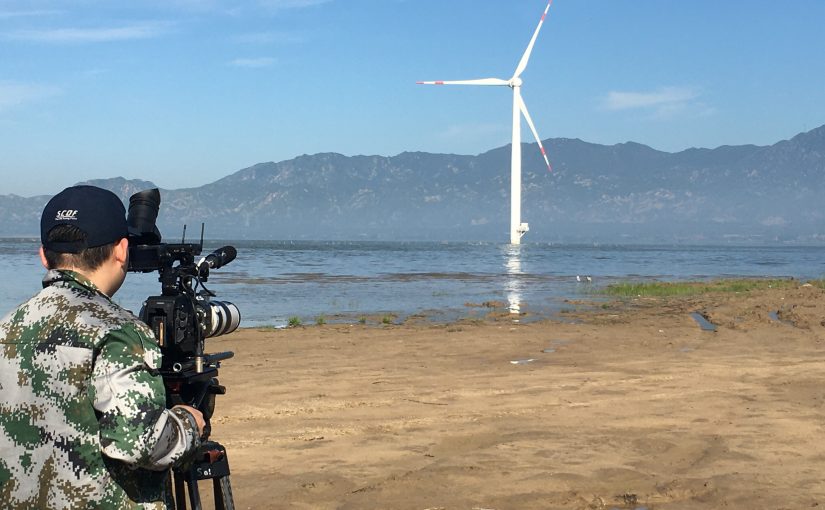
Spreading the word about the birds and other wildlife of Beijing is so important if we are to build support for policies and measures to protect the capital’s wildlife and the places it needs. So I didn’t hesitate to agree when CCTV, China’s national broadcaster, contacted me and asked me to take them birding as part of a feature on the birds of Beijing to be broadcast later this autumn.
Although it’s only mid-August, autumn migration is already in full swing with shorebirds and passerines such as pipits, wagtails and some of the early buntings passing through Beijing. At this time of year, there is no better site in Beijing than Ma Chang, on the shores of Guanting Reservoir in Yanqing County.
Given the heat of Beijing in August, I recommended an early start and, to their credit, the CCTV crew agreed to collect me at 0430 for the one and a half hour drive to Ma Chang. On site shortly after sunrise, we were treated to a beautiful, still early morning and a good variety of birds.
The wind turbines dominate the skyline at Ma Chang and can play havoc with any attempts at sound recording. Fortunately we enjoyed still conditions for the first few hours.
Most obvious were the noisy breeding Black-winged Stilts with several well-grown young joining their parents in the shallows and one relatively young bird waiting to be fed and just looking cute.
Six Relict Gulls, including one carrying a transmitter, provided an opportunity to discuss how scientists are learning about the incredible journeys of migratory birds and, in particular, how the whole population of the Relict Gull, a bird described to science as recently as the 1970s, relies on the Bohai Bay/Yellow Sea in winter.
This moulting adult Relict Gull, on its way to the Bohai Bay from breeding grounds in Inner Mongolia, Mongolia or Russia, posed nicely for the cameras.This Relict Gull was carrying a transmitter and we are working to find out the history of this bird from Chinese researchers.
A few Red-necked Stints, a Temminck’s Stint, several Long-toed Stints and a cracking juvenile Broad-billed Sandpiper brought us onto the subject of the East Asian-Australasian Flyway and the incredible journeys of these tiny shorebirds from Arctic breeding grounds to non-breeding grounds in the southern hemisphere, including the importance of stopover sites or ‘service stations’ on this bird ‘superhighway’.
This juvenile Broad-billed Sandpiper dropped in right on cue as we were discussing the East Asian-Australasian Flyway.
Flyover Richard’s Pipits and Eastern Yellow Wagtails, many of which were calling, gave a glimpse of migration in action and we spoke about how, although some birds migrate during the day, many pass over the city at night, undetected, as we sleep. In total we recorded 50 species by late morning and the crew secured some high quality footage of some of the stars of the show. As we began to pack up, a few Globe Skimmer dragonflies mating and ovipositing in a pool next to the car reminded us that it’s not only birds that migrate incredible distances.. some individuals of this species have been known to travel 6,000km.
Globe Skimmers (Pantala flavescens) mating at Ma Chang.Globe Skimmers (Pantala flavescens) ‘ovipositing’ at Ma Chang
The reporter was overwhelmed with what she saw and experienced at Ma Chang and, as we returned to the city, she spoke of her hopes to do much more to cover ‘Wild Beijing’… so fingers crossed we can work together more to help promote awareness of just how special the Chinese capital is for birds and other wildlife.
In the meantime, the CCTV/CGTN feature on migratory birds in Beijing will be shown sometime in the autumn.
Title image: CCTV/CGTN capturing Relict Gulls on film at Ma Chang
As the passage of White Wagtails begins to slow, the passage of the closely related Citrine Wagtail is hitting its peak in the capital. One silver lining to the ongoing restrictions on leisure activities in Beijing is that places that would usually be busy with tourists are currently much quieter. One such place is Ma Chang, on the margins of Guanting Reservoir in Yanqing District. At this time of year, especially at weekends, this area of land would, in normal times, be busy with horse riders and motorised buggy drivers, meaning that from around 0730 many of the migrant birds that had stopped at this site would be pushed off.
This spring, with the absence of human activity beyond a handful of local fishermen, the site is a paradise for migrant birds, attracting large numbers of many different species. On Sunday, perhaps the biggest highlight, among many, was the large flocks of Citrine Wagtail feeding along the edge of the reservoir. The short video below shows a fraction of the 250+ birds on site.
Wagtails are busy birds, pursuing insects as they fatten up for the next leg of their journey to breeding grounds further north, and in perfectly still and sunny conditions, it was quite a sight to behold.
How to describe this group of bright yellow birds? “A bunch of agitated Lemons” was what we came up with…
I have always struggled to separate Little Stint (Calidris minuta) and Red-necked Stint (Calidris ruficollis). One of the reasons is that the former is rarely seen (or at least rarely identified) in Beijing, meaning that the opportunities to study Little Stint are few. But perhaps the main reason is that, without excellent views, they are hard to separate!
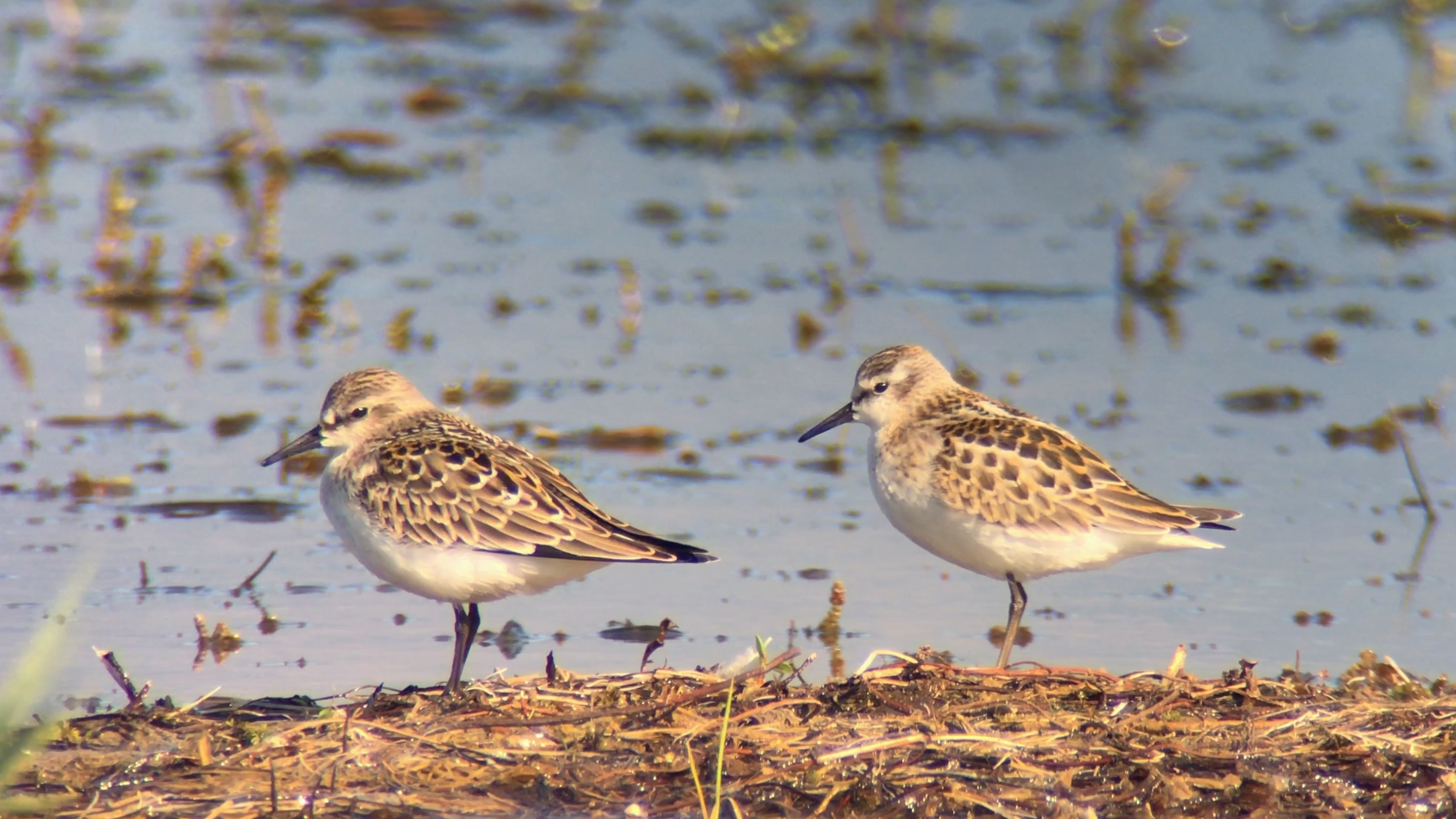
Last week I was fortunate to enjoy prolonged views of a group of juvenile stints at Ma Chang, on the shores of Guanting Reservoir, Yanqing County in the northwest of the capital. In the early morning light, everything looked good.. and, as I was scanning the shoreline for migrants, picking up a juvenile Far Eastern Curlew (Numenius madagascariensis), a first calendar year Relict Gull (Ichthyaetus relictus), several Eastern Yellow Wagtail (Motacilla tschutschensis) and 13 Avocet (Recurvirostra avosetta), a small group of stints flew in and landed just a few metres in front of me. Through binoculars I could see that the group consisted of mostly juvenile Red-necked Stints and one Temminck’s Stint (Calidris temminckii). Scanning carefully I saw two individuals that appeared brighter than the majority of the Red-necked Stints, more contrasting and with apparently slightly longer legs. Having my telescope with me, I lowered it, crouched down and began to look closely at these two brighter birds. I could see obvious ‘tramlines’ down the back, a more contrasting head pattern with a dark central crown and very dark centres to the lower scapulars and coverts. Could these be Little Stints? Shortly after, I took some video using my iPhone attached to my Swarovski ATX telescope, and some still photographs. As I was watching, one of the brighter birds joined a lone Red-necked Stint and, remarkably, the pair stood side by side for several seconds, allowing me to capture some video and still photographs of the two together in the same pose.
Juvenile RED-NECKED (Calidris ruficollis, left) and LITTLE STINT (Calidris minuta), Ma Chang, 27 August 2019. Note the more elongated profile of Red-necked, slightly blunter bill, less contrasting crown, slightly shorter legs and less contrasting ‘tramlines’.
It seemed like several minutes that I was able to enjoy these birds at close quarters before a juvenile Peregrine flew along the shoreline, flushing the whole group.
After I returned home and looked at the images on my laptop, I was hopeful but cautious that I may have seen two juvenile Little Stints, potentially the first I have seen in Beijing. However, I was far from sure and wanted a second opinion. I sent a selection of images to Dave Bakewell in Malaysia who is an authority on shorebirds and has written extensively about identifying this tricky pair.
Dave responded very quickly to say that all of the images I had sent were of Little Stint and gave a detailed explanation as to why. These are the features of juvenile Little Stint:
Overall less elongated profile
Dark centres to the lower scapulars and coverts with clearly demarcated fringes;
Well-streaked neck sides;
Dark central crown;
Fine-tipped bill;
Relatively contrasting ‘tramlines’ on mantle
Long tibia and tarsi;
“Ball-shaped” body and small head
I’ve edited the video clips and compiled the short video below, showing the two side by side. I hope it’s instructive.
RED-NECKED (Calidris ruficollis) and LITTLE STINT (Calidris minuta) together at Ma Chang, Beijing, 27 August 2019. Note Little Stint is on the right in the first segment and on the left in the second.
Big thanks to Dave Bakewell for sharing his knowledge of this tricky pair. Anyone interested in the identification of stints should see his excellent website and videos on YouTube.
Title image: Red-necked (left) and Little Stint side by side at Ma Chang, 27 August 2019 (Terry Townshend)
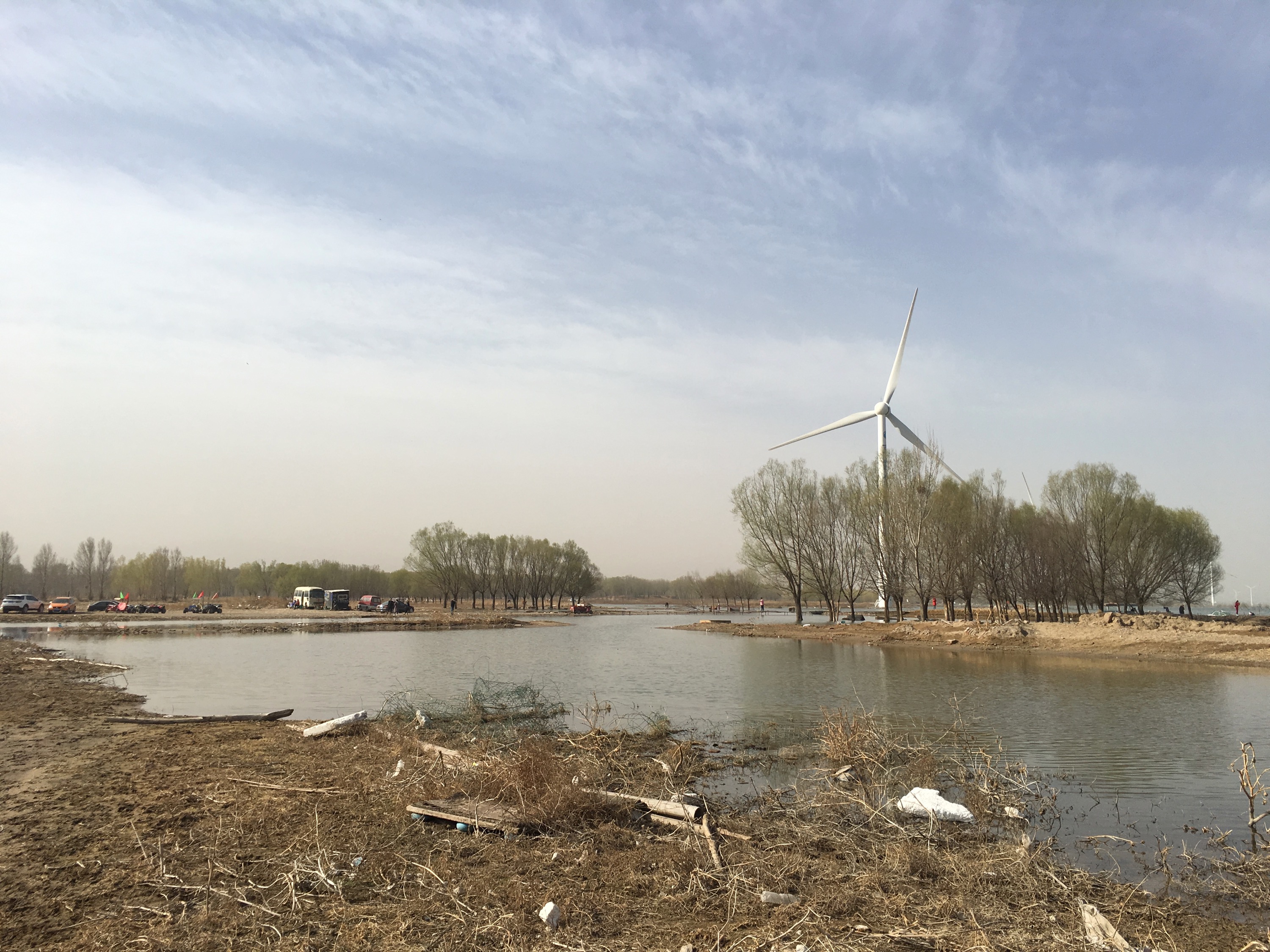
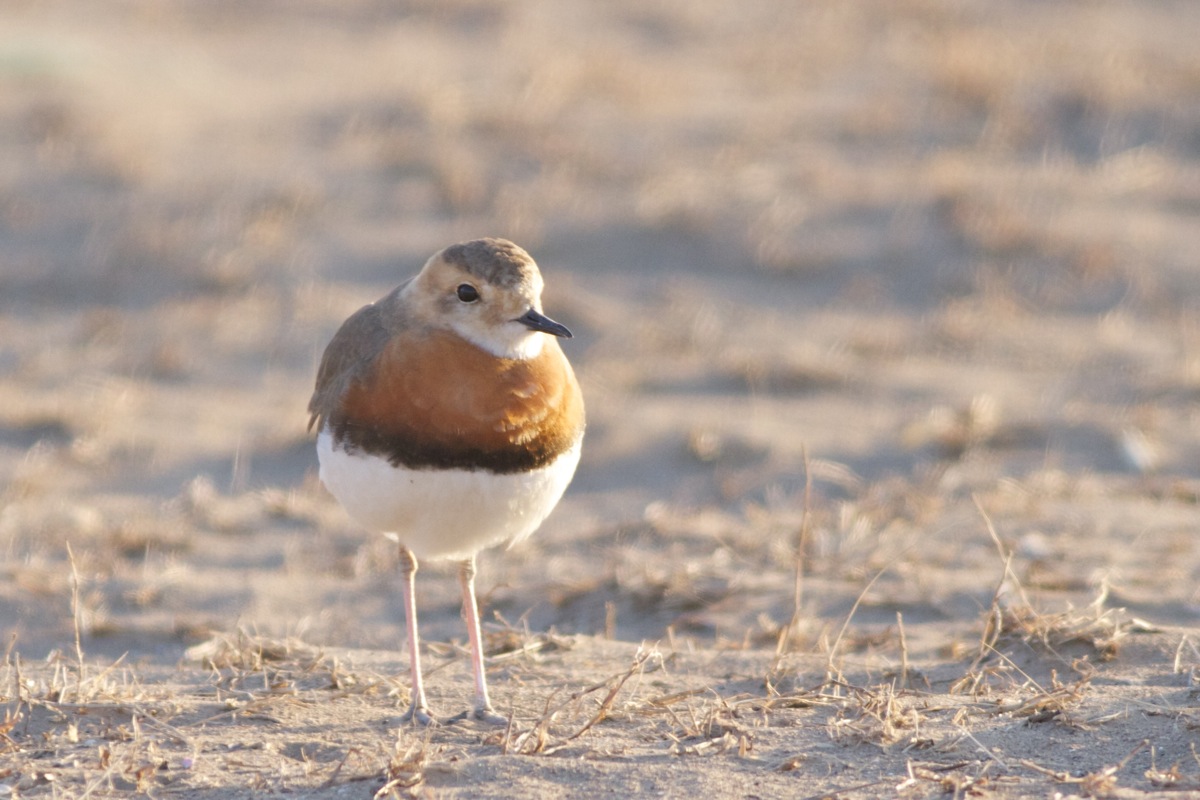
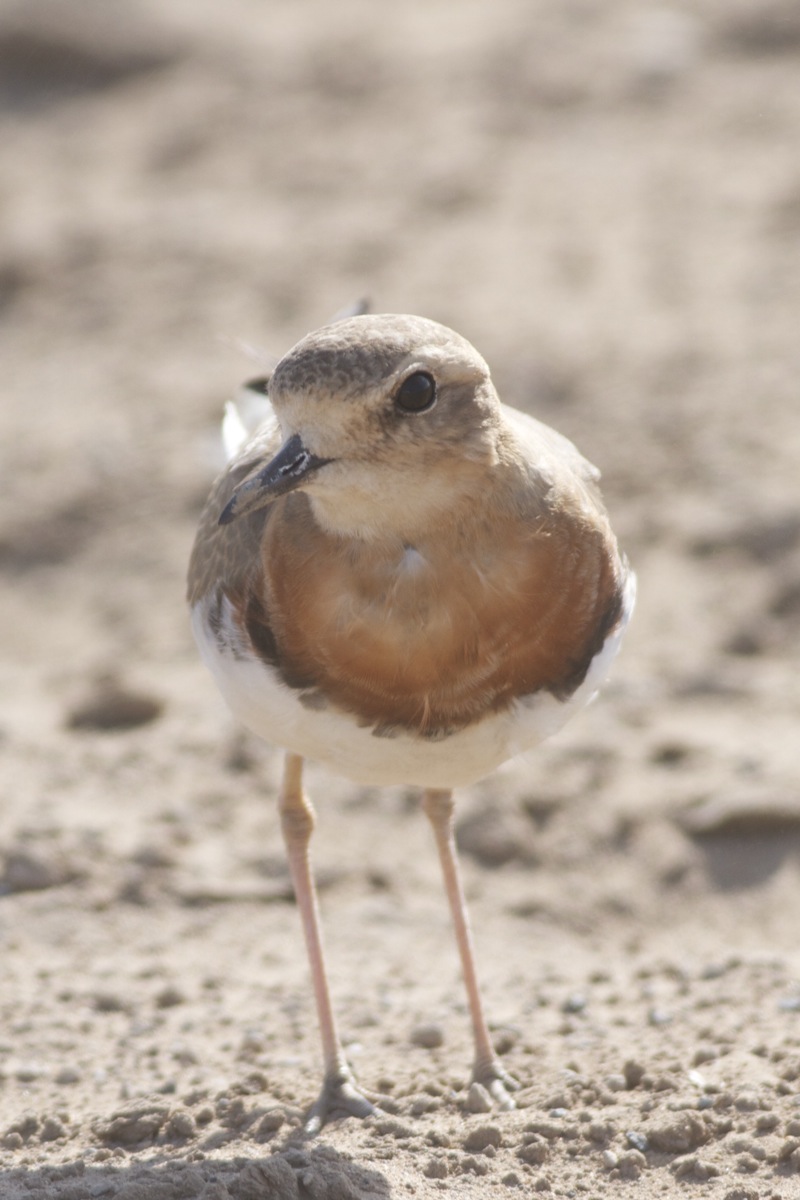
Ma Chang, in Yanqing County, northwest Beijing, is my absolute favourite birding site in April. Although not particularly glamourous with a series of wind turbines, small-scale agriculture and lots of litter left by the tourists who visit to ride horses or drive beach buggies, its geography – on the southeastern shore of Guanting Reservoir – makes it a wonderful place for migration. Early in the month there is a good chance of spotting the spectacular ORIENTAL PLOVER on its way from wintering grounds in Australia to breeding grounds in Inner and Outer Mongolia, and it’s a brilliant place to experience good numbers of pipits and wagtails as they make their way north. WHITE WAGTAILS lead the charge and five of the six subspecies recorded in Beijing have been seen here – leucopsis, ocularis, baicalensis, ‘eastern alba‘ and personata. I am sure it is only a matter of time before the sixth subspecies – lugens – is recorded at this site.
Oriental Plover at Ma Chang, 7 April 2019 (Zhang Weimin)
White Wagtail ssp baicalensis, Ma Chang (Terry Townshend)
White Wagtail ssp ocularis (Terry Townshend)
Groups of Citrine Wagtails pass through and it’s not uncommon to see flocks of 20+. Water Pipits are gradually eclipsed by Buff-bellied Pipits as the month progresses and several hundred of the latter can be seen in the middle of the month, with Red-throated, Richard’s and Blyth’s joining the fray a little later. The vagrant Meadow Pipit has also been recorded here several times in early April.
Citrine Wagtail (Terry Townshend)
Buff-bellied Pipit (Terry Townshend)
Last Monday I spent a few hours at Ma Chang at the end of the day. There were some tourists riding horses, a few buggies being driven around, it was windy and my expectations were not high. Nevertheless, I found a lovely mixed group of White and Citrine Wagtails on the foreshore and was enjoying watching them feed on the flying insects close to the water.
The White Wagtails were dominated by ocularis (“Siberian Wagtail”) with a few leucopsis (“Chinese Wagtail”) and a couple of baicalensis (“Baikal Wagtail”). As I was observing these birds, I heard a faint sound that reminded me of SWINHOE’S RAIL. It was a vocalisation I had first heard at Wuerqihan in Inner Mongolia in June 2018. I immediately dismissed the thought – a singing SWINHOE’S RAIL in Beijing would be ridiculous, surely! But as soon as I had re-trained my concentration on the wagtails, I heard it again… and again. The sound was faint, coming towards me from a small inaccessible island of grass and a few small trees, against the wind, and was competing to be heard amongst the din of revolving wind turbines, the wind itself and calling Black-headed Gulls and Black-winged Stilts.
The SWINHOE’S RAIL was singing from the island with dry vegetation and a handful of trees.
I moved as close to the sound as I could and listened, intently. There it was again, this time a fraction clearer. Fortunately I had my sound recording kit with me and I scrambled to retrieve it from my backpack whilst hoping that the vocalisations would continue.
They did, and I managed to record a few snippets before the source fell silent, coinciding with a low pass by a hunting Eurasian Sparrowhawk.
A few minutes later I heard the sound again, three maybe four times before again it fell silent.
I was fairly sure the sound was of a SWINHOE’S RAIL but given the magnitude of the record, I had to consider the possibility of it being a frog or a cricket.
I was planning to stay overnight close by and hoped that, in the early morning with less wind and much reduced background noise, I may be able to hear the vocalisation more clearly if the bird was still there. At the guest house, I looked at the sonogram of the sound I had recorded and compared it with that from my recordings of Swinhoe’s Rail from Inner Mongolia last June. The sonogram of the sound from Ma Chang looked good on the screen – 6 or 7 notes in each vocalisation at a frequency of 2kHz. Wow.
A sonogram of Swinhoe’s Rail recorded at very close distance in Inner Mongolia, June 2018.
A sonogram of the Swinhoe’s Rail at Ma Chang, Beijing, on 15 April 2019. Much fainter, due to the distance, but the same 6-7 notes at 2kHz, with similar spacing.
The following morning I was on site before dawn and it was wonderfully still – perfect conditions to listen and record sounds. Sadly, I never heard it again. Despite the sonogram looking very good for SWINHOE’S RAIL, I was keen on a second opinion. I sent the recording to a few local birders and most thought it sounded good but cautioned about their lack of experience with the species. Then Paul Holt replied, agreeing that it was indeed a SWINHOE’S RAIL. That gave me the confidence to put out the news – thanks Paul!
Swinhoe’s Rail (Coturnicops exquisitus) is one of east Asia’s least known birds. Traditionally, the most reliable place to encounter it was in the wet grass around Poyang Lake, Jiangxi Province, in winter but sightings from there have become increasingly scarce.. and due to its secretive behaviour, it is encountered only infrequently on migration, even in relatively well-watched areas such as Happy Island and Beidaihe in coastal China.
It was only three years ago that Wieland Heim, Tom Wulf and Alex Thomas (of the Amur Birding Project) first recorded the ‘song’ of this secretive bird at Muraviovka Park in southeastern Russia. And in July 2017, armed with this new knowledge, Paul Holt was the first to discover singing birds in China at Wuerqihan in northern Inner Mongolia. I was fortunate to visit Wuerqihan in June 2018 and recorded its song and trill.
Some stunning news has just reached me of a juvenile SPOON-BILLED SANDPIPER that was photographed at Yeyahu, Beijing, on 31 August by Zhang Minhao, a junior high school student. Big thanks to Huang Hanchen and Guan Xiangyu for the heads-up. Here is the photo:
Juvenile SPOON-BILLED SANDPIPER, Ma Chang, Yeyahu, Beijing, 31 August 2014. Photo by Zhang Minhao.
And here is Zhang Minhao’s personal account:
A Brief Account for the Record of a Juvenile Spoonbill Sandpiper in Beijing by Zhang Minhao, October 16, 2014.
“The Spoon-billed Sandpiper was photographed at Machang, Yeyahu, Yanqing County, Beijing, on August 31, 2014.
At around 09:45am on 31 August 2014 I was observing Red-necked Stints, Long-toed Stints, and Long-billed Plovers near a large area of water on the edge of Guanting Reservoir. This area is known as Ma Chang, Wild Duck Lake. In order to avoid missing the distant shorebirds, I checked the areas where the Red-necked Stints were located by looking through my camera, and took pictures of the birds I could see.
When reviewing my photographs I recognised something distinctive, a juvenile Spoon-billed Sandpiper. The time of the photograph was 09:49am.
The single Spoon-billed Sandpiper foraged and preened alone, without mixing with other species. And there were no other Spoon-billed Sandpipers around it. About 3 minutes later 3 Red-necked Stints flew to its vicinity causing the Spoon-billed Sandpiper to fly and it alighted further away on the mudflat. But when I got there the Spoon-billed Sandpiper was not to be seen and it was never seen again.”
(Thanks to Guan Xiangyu for contacting Zhang Minhao about this account and to Huang Hanchen for the translation).
There are several brilliant things about this record. First, it’s a SPOON-BILLED SANDPIPER, one of the world’s most endangered birds (see here to read about just how few remain and for details of the international effort to try to save this species). Second, it’s of a juvenile, one of very few sightings of a Spoon-billed Sandpiper of this age in the world, giving hope to the conservation effort. Third, it was found in Beijing, one of the world’s major capital cities, more than 150km from the coast. And finally, the finder was a young Chinese birder.
It’s a truly remarkable record. And I hope this sighting by Zhang Minhao inspires other young people in Beijing and beyond to take up birding and to become part of an ever-louder voice to help conserve the amazing biodiversity with which China is blessed.
On Friday I visited Ma Chang with Global Times journalist Jiang Yuxia (writing an article about birding in Beijing) and Jennifer Leung. After a few days of cold and windy weather, the forecast was for a change in the wind from a cold northerly to a light southerly and for temperatures to soar from the recent chilly highs of 10-12 degrees Celsius to over 20 degrees C.
After a 0500 start we reached Ma Chang at around 0630. It was a stunning morning with good visibility, clear skies and almost no wind, disguising the -2 early morning temperature. Along the entrance track we encountered Jesper Hornskov with a couple of clients. They were watching a party of Bohemian Waxwings feeding on the buds of some large trees – a nice start to the day. At Ma Chang, as expected at this time of year, we soon spotted a group of ORIENTAL PLOVERS and a count revealed over 60 birds present – a fantastic total.
Oriental Plover, Ma Chang. Getting bored of these yet?? The flock now exceeds 60 birds.
We moved on to the spit and settled in alongside the local fishing folk for a little visible migration.
Yuxia speaks to the local fishermen about life at Ma Chang…
A few Buff-bellied and Water Pipits, with the odd White Wagtail, flew overhead and a couple of tightly packed flocks of Greater Short-toed Larks wheeled around the remnants of last year’s maize stubble. A Black (eared) Kite lumbered past and two female Eastern Marsh Harriers caused havoc among the flocks of Eurasian Teal.
With not much happening we decided to move on and, after a short stop at a flooded field to admire two stunning BAIKAL TEAL, we headed to the ‘island’ to the north of the desert area to look for duck… Jesper and his clients were already in situ and, although quite distant, it was clear that there were lots of duck present. Two relatively close (but distant to photograph!) Red-breasted Mergansers represented bird species number 299 for me in Beijing… result!
Red-breasted Mergansers, Ma Chang. A scarce bird in the capital. Looks as if this pair has had a quarrel…
With the duck distant, I knew that moving to the location from where I had seen the Baer’s Pochard last Sunday would again be a good vantage point. We headed to the spot and, sure enough, we were treated to stunning views of a large mixed raft of duck with the sun behind us and no wind… perfect, and very unusual, conditions at Wild Duck Lake.
We quickly found a drake BAER’S and, almost immediately, spotted another drake. There were two!
The two BAER’S POCHARDS at Ma Chang on Friday. With Ferruginous Duck, Gadwall and Common Pochard.
As on Sunday with the single drake, the two Baer’s were consorting with Ferruginous Duck and both were seen displaying… fabulous! It was from here that we also enjoyed some stunning views of Falcated Duck (including one very unusually marked male which sported a yellow mark on its lower cheek), Tufted Duck, Common Pochard, Smew, Shoveler, Gadwall, Mallard, Common Teal, Spot-billed Duck, Coot and Little and Great Crested Grebes. It was a great morning’s birding!
The gang at Ma Chang after seeing the two Baer’s Pochards…
A short time later, a couple of Black Kites appeared and, as our eyes began to be distracted from the duck to the skies, it wasn’t long before I spotted an aquila eagle some distance away… My instinct was that it was probably a Greater Spotted Eagle, the most common aquila eagle at this site at this time of year. However, as it soared, Jesper immediately suspected it was an IMPERIAL EAGLE… and he was right!
It circled distantly and was soon joined by a second, but smaller, eagle.. This second bird had a notably square tail, pale markings on the upperwing coverts and mantle and, as it turned, it was even possible to glimpse the ‘landing lights’… wow.. A BOOTED EAGLE! Two very good eagle records for Beijing in the same scope view!
Both appeared to drift away and were lost from view without allowing me to capture any photographic record. However, fortunately, the Imperial soon re-appeared, this time closer, and I grabbed the camera to capture a few record images before it drifted into the mountains to the north. The bulging secondaries, typical of immature Imperial Eagle, can be seen very well, as well as the pale markings on the under- and upperwing. The ‘jizz’ was slightly different to Greater Spotted, too. A useful lesson for me (I have only ever seen one Eastern Imperial Eagle before).
Immature Eastern Imperial Eagle, Ma Chang.
Eastern Imperial Eagle (upperparts).
Unfortunately the BOOTED EAGLE didn’t return but maybe it will linger in the area.. it’s a fabulous Beijing record with only a handful of previous sightings in eastern China. It also represented my 300th species in Beijing [NB Stop Press: Booted Eagle seen at Miyun Reservoir on Saturday by Jan-Erik Nilsen – the same bird?] It’s hard for me to see new birds in the capital now, so to see two new species in one day was pretty special..
The infamous NW Wild Duck Lake wind suddenly got up at around 1130 and Jesper and his clients decided to head off to check Yeyahu NR. We decided to stay and enjoy the Baer’s Pochards a little longer. We gave it another hour or so before calling it a day and heading back to Beijing.. another cracking day at this world class site.
An adult drake BAER’S POCHARD at Ma Chang. A welcome sighting of this now Critically Endangered species.
On Sunday I visited Ma Chang, Wild Duck Lake. April and May are superb months to visit this special Beijing site. With migration in full swing, it’s fascinating to see the departure of the winter visitors, the arrival of summer visitors and the passage of migrants on their way to breeding grounds further north… Already many of the winter birds have departed – I didn’t see a single crane of any species on Sunday – but many others are just beginning to arrive. Oriental Plovers – a Ma Chang speciality – are coming through in good numbers now and it’s a great time, too, for wildfowl and some of the early raptors.
The excitement of my visit on Sunday was heightened by the news that a BAER’S POCHARD was found on Friday by local birders Zhu Lei and Zhang Shen (thanks guys!). This bird is classified as “Critically Endangered” and, I understand, a survey of its traditional wintering grounds in China produced fewer than 50 birds this winter. Look out for a forthcoming article in Birding Asia about the dramatic decline of this species.
On arrival I was delighted to see some ORIENTAL PLOVERS on site. I counted 14 and, after watching them briefly, I made my way to the first site for checking duck. Viewing wildfowl is not straightforward at Ma Chang; there are many areas that are not viewable and the precise location of the birds depends on many factors, such as the wind direction and speed and the activity on the lake of the local fishermen. I have two favourite locations – one at the spit by some yurts (also a good place for visible migration) and one on the ‘island’ to the north. On Sunday, both sites were notably empty of duck. I was beginning to think that it wasn’t going to be my day and that the duck must be hiding somewhere out of sight. Then I saw a small flock of Tufted Duck (not a common bird in Beijing) fly in and go down behind some reeds. I could see that there was a track that ran close by, so I made my way to the general area and found a good place to view the duck.
Unusually, there was no northwesterly wind blowing into my face, so the conditions were good. I soon realised that it wasn’t just the Tufted Duck present. There were some Ferruginous Duck (a species with which BAER’S POCHARD often associates), Shoveler, Common Pochard, Smew, Falcated Duck, Gadwall, Wigeon and Mallard all present. A careful scan revealed no sign of the Baer’s but I knew there were some duck asleep in the reeds, including some Ferruginous Duck and some others that were obscured.. I settled in, hoping that one of the sleeping duck out of sight might be the Baer’s.
After 45 minutes of enjoyable birding, including a nice flock of passing Swan Geese, a small passage of Buff-bellied Pipits and an early male Citrine Wagtail, I began another scan and, sure enough, in amongst the Ferruginous Duck was a stunning drake BAER’S POCHARD.
I watched the BAER’S for the next hour as it proceeded to display. Unfortunately there were no female BAER’S but that didn’t seem to matter.. this lonely male threw its head back, stretched its neck high and bowed to several female Ferruginous Ducks and a slightly startled-looking female Common Pochard… I guess when your situation is as desperate as the Baer’s Pochard, you can’t afford to be fussy!
The drake BAER’S POCHARD (left) with Falcated Duck, Coot, Gadwall and Tufted Duck
It was heartening to see this bird but, at the same time, sobering to think that it is likely to make its way north alone and, when it arrives at its favoured lake, there may be no females with which to breed. The situation for this bird is precarious. Encouragingly I have heard of two separate sightings from Liaoning Province in the last few days – one male and one female. Let’s hope it’s a good breeding season for this species.
After an hour or so, I reluctantly pulled myself away to explore the rest of Ma Chang. The Oriental Plover flock had increased to an astonishing 55 birds, with 4-5 adult males sporting gleaming white heads.
Oriental Plover (male), Ma Chang.
Oriental Plover, Ma Chang.
Flocks of Little Ringed and Kentish Plovers were mixed in, many of which were displaying and calling frequently.
Little Ringed Plover, Ma Chang
Kentish Plover, Ma Chang
At one point, as I was watching the flock, all of the birds suddenly took flight. I suspected a raptor and, sure enough, a quick scan with the binoculars revealed a superb male LESSER KESTREL.. wow! A nice way to end a brilliant birding session at Ma Chang.
Lesser Kestrel (male), Ma Chang.
Full Species List (62 species):
Japanese Quail – 2
Common Pheasant – 12
Swan Goose – 28
Bean Goose – 6
Ruddy Shelduck – 42
Gadwall – 78
Falcated Duck – 225
Eurasian Wigeon – 19
Mallard – 67
Spot-billed Duck – 6
Northern Shoveler – 4
Eurasian Teal – 18
Common Pochard – 12
BAER’S POCHARD – 1 drake displaying to both female Ferruginous Duck and Common Pochard. Employed three ‘displays’ – one involved stretching the neck high, the second throwing the head back and the third leaning the head forward and ‘puffing up’ the back of the neck.
Ferruginous Duck – 17
Tufted Duck – 7
Goldeneye – 5
Smew – 12
Goosander – 4
Little Grebe – 8
Great Crested Grebe – 14
Great Bittern – 1 booming
Grey Heron – 7
Great Cormorant – 1
LESSER KESTREL – 1 male drifted northwest with occasional hovering spells (flushed the Oriental Plovers at one point)
Eurasian Kestrel – 1
Eastern Marsh Harrier – 3 (one adult male and two adult females)
Eurasian Sparrowhawk – 1
Northern Goshawk – 3
Common (Eastern) Buzzard – 2
Common Coot – 32
Black-winged Stilt – 16
Northern Lapwing – 63
Little Ringed Plover – 14
Kentish Plover – 33
Oriental Plover – 55 – the number seemed to increase as the day wore on with just 14 present early morning. Some disturbance from bird photographers and horses but they were not unduly perturbed.
Common Snipe – 1
Common Gull – 11
Mongolian Gull – 2 adults flew high west calling
Black-headed Gull – 18
Oriental Turtle Dove – 4
Collared Dove – 3
Common Kingfisher – 2
Hoopoe – 4
Grey-headed Woodpecker – 1
Chinese Grey Shrike – 2
Azure-winged Magpie – 6
Common Magpie – lots
Daurian Jackdaw – 10
Corvid sp – 15
Carrion Crow – 3
Bohemian Waxwing – 4 flew south
Asian Short-toed Lark – 5
Eurasian Skylark – 4
White-cheeked Starling – 5
Daurian Redstart – 4
Tree Sparrow – lots
Citrine Wagtail – one male
White Wagtail – 4
Buff-bellied Pipit – 26
Water Pipit – 9
Pallas’s Bunting – 28
Mammals:
Oriental Plover, Ma Chang, Friday 29 March 2013. The arrival of these birds symobolises the beginning of Spring at Wild Duck Lake.
On Good Friday, I visited Wild Duck Lake (Ma Chang and Yeyahu NR) with visiting Ed Drewitt and Beijing-based student Alice Carfrae. The weather was good, if a little cold, and the birding a superb example of an early Spring day in Beijing. The highlights for me were the 6 stunning Oriental Plovers at Ma Chang early morning and the excellent views of Baikal Teal at Yeyahu NR.
I collected Ed and Alice around 0530 for the drive to Ma Chang. After a clear run we were on site and birding by 0720 and, within just a few minutes, a hopeful scan of the ‘desert area’ at Ma Chang produced 6 beautiful Oriental Plovers. Ma Chang is THE place in Beijing to see this species in early Spring and, for me, these birds are the symbol of the beginning of Spring in the capital. We enjoyed these birds for around 20 minutes, watching them preen and, occasionally, feed in the early morning light. After seeing them this time I think this bird is my personal favourite, among so many other great species to be found here.
These birds are well on their way from their wintering grounds in Australia to their breeding grounds in Manchuria and Siberia.
Oriental Plover, Ma Chang, 29 March 2013. I don’t know anything about ageing or sexing OPs. Do the pale fringes to the feathers on the upperparts and the buffy face indicate immaturity? Or is this an adult female?
We moved on to the spit by the yurts, where the local fisherman have already returned to set their nets for the summer season. This location proved to be a good one for visible migration with White Wagtails (ssp leucopsis) dropping in, a stunning close fly-by from a male Goshawk, a couple of Eastern Marsh Harriers, a steady trickle of Eurasian Skylarks and several flocks of cranes, including a few small groups of White-naped in amongst the more numerous Common.
At the next site we secured views, albeit distantly, of some of the duck present, including Falcated Duck, Common Pochard, Pintail, Ferruginous Duck, Mallard, Spot-billed Duck, Gadwall and Common Teal. A very distant group of swans were probably Whoopers but we couldn’t be sure.
As the day began to warm up from a chilly -4 first thing to about 3-4 degrees C, some raptors began to move, beginning with a few Common (Eastern) Buzzards of the ssp japonicus, a trickle of Goshawks, a couple of Sparrowhawks and a Kestrel. At about 1030 we were discussing the potential for an eagle and, sure enough, a Greater Spotted Eagle duly appeared against the backdrop of the mountains to the north, followed shortly after by another, then another.. superb!
After enjoying the raptor migration for an hour or so we decided to visit Yeyahu NR to check whether it was open (it usually opens at “the end of March” but an exact date is always difficult to pin down!). Fortunately it was open and we were pleased when we saw a large flock of wild duck on the lake. Scanning through them produced some stunning Baikal Teal, viewable in excellent light, together with good numbers of Common Pochard, Falcated Duck, Pintail, Common Teal, single pairs of Red-crested Pochard and Ferruginous Duck and several groups of Smew. Not bad!
After watching a drumming Grey-headed Woodpecker and a confiding male Daurian Redstart we set off back to Beijing having had a typical early Spring day at Wild Duck Lake.
Many thanks to Alice and Ed for their company.
Full Species List (70 in total):
Common Pheasant – 3
Bean Goose – 67
Whooper/Bewick’s Swan – 27
Ruddy Shelduck – 15
Gadwall – 11
Falcated Duck – 82
Eurasian Wigeon – 2
Mallard – 150+
Chinese Spot-billed Duck – 18
Northern Pintail – 23
Baikal Teal – 14
Eurasian Teal – 80
Red-crested Pochard – 2
Common Pochard – 64
Ferruginous Duck – 7
Common Goldeneye – 26
Smew – 49
Goosander – 12
Little Grebe – 12
Great Crested Grebe – 18
Great Bittern – at least 1 booming
Grey Heron – 16
Great Cormorant – 17
Eurasian Kestrel – 3
Saker – 1
Black-eared Kite – 13
Eastern Marsh Harrier – 3 (1 ad male, 2 ad fems)
Hen Harrier – 1 imm male
Eurasian Sparrowhawk – 2
Northern Goshawk – 7, including a fly-past by a stunning adult male
Common (Eastern) Buzzard – 47; good passage between 1030-1300
Greater Spotted Eagle – 3
Common Coot – 9
White-naped Crane – 41
Common Crane – 130
Black-winged Stilt – 12
Grey-headed Lapwing – 2 distant birds in flight
Northern Lapwing – 46
Little Ringed Plover – 8
Kentish Plover – 47
ORIENTAL PLOVER – 6 – superb views early morning; always a star bird!
Dunlin – 4
Black-headed Gull – 18
Oriental Turtle Dove – 1
Spotted Dove – 1
Collared Dove – 4
Fork-tailed Swift – 10 flying south (!)
Common Kingfisher – 1
Hoopoe – 5
Grey-capped Pygmy Woodpecker – 1
Great Spotted Woodpecker – 1
Grey-headed Woodpecker – 3
Chinese Grey Shrike – at least 1, possibly 2
Azure-winged Magpie – 8
Common Magpie – lots
Carrion Crow – 6
Large-billed Crow – 2
Eastern Great (Japanese) Tit – 1
Barn Swallow – 1
Asian Short-toed Lark – 18
Skylark – 39
Vinous-throated Parrotbill – 40+
White-cheeked Starling – 4
Common Starling – 46; a good number
Daurian Redstart – 2 (1 male, 1 female)
Thrush sp – 4 flew across the road on the way to Ma Chang.
Building knowledge about the movements of migratory birds is vital if we are to put in place effective conservation measures. Traditionally, in an attempt to understand better migration, birds have been trapped by ornithologists using mist nets and ‘ringed’ or ‘banded’ with small light-weight metal rings. This means that if they are re-trapped by another ornithologist in another location, re-trapped the following year in the same or a different place, or found dead by a member of the public, information can be gained about the migration routes, wintering and breeding grounds and the importance of specific stopover sites. The recovery rate varies but roughly one in a thousand small birds are recovered in this way. In recent years a number of new methods have been used (e.g. wing tags, combinations of coloured leg rings on shorebirds or neck collars on swans and geese), all designed to allow birders in the field to identify individual birds and thus increase the likelihood of a given bird being ‘tracked’.
Looking for colour rings, wing tags or collars adds a new dimension to birding and it is rewarding to see a marked bird, note the colour and letter/number combination, report it to the relevant authority – see here for East Asia and here for Europe – and then receive the “life history” of the bird you saw.
On 15 November at Wild Duck Lake I encountered a Whooper Swan with a neck collar amongst a flock of over 30 swans. The flock consisted of mostly Whoopers but with a few Mutes mixed in (Mute Swans are rare in Beijing and these were my first in the capital). The flock was distant but, with my telescope, I was able to read the number/letter combination on the collar. It was dark blue with white letters/numbers reading “1T86”. I contacted the ringer directly by email and, a few weeks later, I received the following information about this bird:
“1T86″ was captured and marked on 14 July 2012 at Terkhiin Tsagaan Lake (N48° 9’20.98″, E99°40’16.39”), Arkhangai Province, Mongolia. We did not check its sex, but the weight was 9.95 kg at the time of capture.
I put these coordinates into Google Earth and created the map below showing the distance and direction this bird has travelled. Wild Duck Lake was only a stopover site – the swans had moved on when I visited again in December – so I can only guess where this individual is now – very likely somewhere further south where at least some water bodies remain unfrozen.
The journey of Whooper Swan “1T86” between 14 July 2012 and 15 November 2012. A distance of just over 1,500km.
Data like this helps ornithologists to understand migratory movements and is invaluable in informing conservation planning. So reporting birds like this makes a genuine difference to our collective knowledge of birds and directly supports those trying to conserve our birds. For me, as a mere birder, it also reinforces a sense of wonder at the journeys our birds undertake each spring and autumn and is a reminder that Wild Duck Lake is a vital stopover site for many migratory birds.
The cold winter (it’s forecast to get down to -26 degrees C in Beijing on Christmas Eve), combined with the above average snowfall, has meant that many birds that are usually scarce winter visitors to the capital, are here in greater numbers. The Horned Lark (Eremophila alpestris) is a good example. These pretty birds are one of the most widespread of larks, breeding across much of North America, northernmost Europe and Asia and in the mountains of southeast Europe. There is even an isolated population on a plateau in Colombia. In summer the breeding males have tufts of feathers on each side of the head that resemble small ‘horns’ which gives rise to the English name.
There are two subspecies of Horned Lark on the Beijing list. The most common is the ssp brandti. According to Birds of the Western Palearctic (Vol 5) the distribution of brandti is ‘steppes of lower Volga river and northern Transcaspia, E through plains of Kazakhstan to N Mongolia and W Manchuria; Altai, Tarbagatay, and E Tian Shan’; it is a ‘partial migrant. Flocks regularly occur S of breeding range in winter (e.g. in Turkmeniya, Mongolia, N China)’.
The ssp brandti is striking due to its white face and complete lack of yellow markings.
Horned Lark (ssp brandti), Wild Duck Lake, 18 December 2012. Note the lack of yellow on the face and the warm flanks.
Horned Lark ssp brandti (with Asian Short-toed Lark in the background). Sporting whitish ‘horns’.
Horned Lark ssp brandti.
Prior to Tuesday, all of the HORNED LARKS reported in Beijing this winter were of the ssp brandti. However, on Tuesday morning, Jesper Hornskov and I made a visit to Wild Duck Lake and, to our delight, we not only encountered several brandti HORNED LARKS but also four stunning yellow-faced birds. These are the less common ssp flava which breed much further north (across northern Europe, northern Asia, east to Chukotka). They showed spectacularly well, allowing us to capture some good images. Compare the brandti birds above with the flava below.
Horned Lark ssp flava, Wild Duck Lake, 18 December 2012
Horned Lark ssp flava, Wild Duck Lake, 18 December 2012.
Horned Lark ssp flava, Wild Duck Lake, 18 December 2012.
With a supporting cast of 10 Mongolian Larks, a handful of Eurasian Skylarks, 30+ Asian Short-toed Larks, over 900 Lapland Buntings, a single White-tailed Eagle, Upland and Rough-legged Buzzards and 2 Hen Harriers, it was a good day to be out, despite the -13 temperatures! Thanks to Jesper for the information from BWP included in this post.
With apologies to my mum, that’s exactly what went through my head as I scanned a group of diving duck at Wild Duck Lake on Wednesday morning and came across a bird with a green-tinged head and pale flanks… It immediately turned away so that I could only see it’s backside and there were agonising seconds of self-doubt before it turned side-on again to show me that it was, without a doubt, most definitely, a drake BAER’S POCHARD…. Wow.
Wednesday morning started off badly. For more than half an hour I was stuck in traffic on the G6 caused by broken down lorries that failed to make the steep ascent over the Badaling Great Wall pass, meaning that I arrived at Ma Chang around 0645, about half an hour after dawn. Already, many bird photographers were driving around in 4x4s searching for something to photograph.. and there were no birds on the ‘desert area’. As usual, I went to the more isolated western end of the track, near a ‘spit’ of land on which several fishermen’s ‘tents’ or yurts are situated in the summer months. I set up my telescope here and began to watch. Visible migration was relatively slow with just Buff-bellied and a few Water Pipits accompanied by some Little Buntings and a few Skylarks. An immature male Hen Harrier and a Saker both came through in the first half an hour (the latter with prey). Initially, there were no duck to be seen but, later on, a large mixed flock flew in, presumably flushed by fishermen. They settled some distance away but were viewable with a telescope from my position. I began to scan through them and there were almost 300 Mallard, 82 Gadwall and 79 Spot-billed Duck dabbling against the far reedbed. A little closer, in a line, was a large group of diving duck. In this flock was a good number of Ferruginous Duck and, as I began to count them, I stumbled across a diving duck with pale flanks and a greenish tinge to the head.. However, just as I got onto it, it turned away. I immediately thought ” ****! That looked like a Baer’s Pochard”… At this point I lost count of the Ferruginous Duck.. I watched the BAER’S POCHARD for a couple of minutes as it fed – with short dives – amongst the Ferruginous Ducks. I then remembered that I was counting Ferruginous Ducks and, being someone who likes to finish what they have started, I began to count them again.. I got to about 12 before I saw the BAER’S POCHARD again.. and after lingering a few seconds, continued with the count.. I was working from left to right and, as I approached the far right of the flock, I saw a drake BAER’S POCHARD. Thinking that it must have been the same one that had simply moved across unseen, I scanned back to the original position and, to my amazement, the original bird was still there! So there were two drake BAER’S..!! Gulp..
The second BAER’S was the last viewable bird in the flock – the rest were behind the reeds. I realised that the angle from which I was observing the birds wasn’t great and that if I moved a little further west along the spit, I would be able to see more of the flock. I moved the car and, sitting on the back seat with the back door open, I was able to use it as a wind break to help minimise wind shake. Again, I went through the flock, this time a little closer and with much less wind shake. I counted 38 Ferruginous Ducks, 18 Common Pochard, 3 Smew and an incredible 4 BAER’S POCHARD (the same two males, the latter of which enjoyed the company of two females). This total is a minimum as there were still more birds in the flock that were not viewable.. I sent SMSs to a few people before settling down and just enjoying observing these birds.. Unfortunately they were too distant to photograph with my 400mm lens. The picture below was taken with my 400mm lens to illustrate just how distant they were.
On 17 October 2012, there were at least 4 Baer’s Pochards here (beyond the 3rd set of nets)!
My telescope was on 40-50x during the observation but the light was excellent, with the sun directly behind me.
The BAER’S POCHARD is in a perilous state. It’s status was recently amended to “Critically Endangered” reflecting the dramatic decline of this species. In a worrying sign, the surveys by Chinese ornithologists on some of its traditional wintering grounds yielded no birds in winter 2011/12. This is an extract from an internet posting by Wang Xin, Cao Lei, Lei Jinyu and Tony Fox:
“a special survey by Wuhan Birdwatching Society this winter (2011/12) did not find any Baer’s Pochard at all, even at Liangzi Lake (where the survey had found c. 130 individuals last year). Birdwatchers have also been to the upper part of Wuchang Lake in Anhui this winter where Cao Lei’s group have been finding more than 200 in recent years and found none there as well. In the Baiquan wetlands, in Wuhan, where the species was often found in the past, there are only reports of poisoned swans and geese because the water levels in winter 2011/12 are so low and people can get near to the waterbirds as never before.”
I also understand that a (partial) summer survey of its traditional breeding ground this year resulted in no confirmed sightings at all. Amongst all this gloom, one positive development has been the discovery of two breeding sites, both holding very few pairs, a long way south of the known traditional breeding range. Whether these birds represent a previously undiscovered population or whether breeding at these sites reflects an adaptation strategy to the deterioration of their preferred habitat further north is a question to which I don’t know the answer… Whatever, it is clear that this bird is in serious trouble. I hope to write something more in-depth on the plight of the Baer’s Pochard very soon. Watch this space.
PS. The four-letter word I used was “Gosh”.. 🙂
Full species list below.
Common Pheasant – 8
Bean Goose – 7
Ruddy Shelduck – 4
Gadwall – 82 @ Ma Chang plus 16 @ Yeyahu
Mallard – 280
Chinese Spot-billed Duck – 88
Eurasian Teal – 12
Common Pochard – 18 BAER’S POCHARD – 4 (two males, two females)
Ferruginous Duck – 39 (38 @ Ma Chang plus 1 @ Yeyahu) – possibly a record Beijing count.
Common Goldeneye – 6
Smew – 5 (2 @ Ma Chang, 3 @ Yeyahu)
Goosander – 3
Little Grebe – 18
Great Crested Grebe – 6
Black Stork – 2 over Yeyahu
Grey Heron – 1
Great Cormorant – 1
Common Kestrel – 1
Saker – 2
Hen Harrier – 2 (one imm male and one first winter)
Northern Goshawk – 2
Common (Eastern) Buzzard – 3
Coot – 76
Common Crane – 15
Northern Lapwing – 1
Snipe sp (Swinhoe’s or Pin-tailed) – 1
Spotted Redshank – 2
Black-headed Gull – 93
Chinese Grey Shrike – 2
Azure-winged Magpie – 7
Common Magpie – lots
Daurian Jackdaw – 431
Carrion Crow – 1
Corvid sp (Rook/Carrion/Long-billed Crow) – 28
Great Tit – 1
Marsh Tit – 2
Skylark – 8
Chinese Hill Babbler – 2
Pallas’s Leaf Warbler – 7
Yellow-browed Warbler – 1
Vinous-throated Parrotbill – 6
White-cheeked Starling – 4
Red-flanked Bluetail – 1
Daurian Redstart – 1
Tree Sparrow – lots
Buff-bellied Pipit – 44
Water Pipit – 4
Brambling – 14
Oriental Greenfinch – 1
Pine Bunting – 3
Little Bunting – 21
Pallas’s Reed Bunting – 8
The Japanese Swamp Warbler, or Marsh Grassbird as it is sometimes known, is only found in east Asia and has a restricted and local distribution. BirdLife classifies it as “Near Threatened”. I saw and heard my first one in a reedy field at Dandong, Liaoning Province, this May and it was the memory of the song that came flooding back this morning when, on arrival at Wild Duck Lake, I could hear a bird singing from the reedbed close to the yurts at the western end of Ma Chang.
I was surprised that it was singing, not just because it is now mid-October (some warblers do sing occasionally on autumn migration) but because it was -2 degrees Celsius!
Nevertheless, it sang for over half an hour, just after sunrise, allowing me to make a recording of its song with my Canon EOS 7D. This bird won’t win any awards for its vocal repertoire, the song being rather repetitive, but it’s a distinctive sound and a joy to hear on a stunningly beautiful, still autumnal dawn at Wild Duck Lake.
Occasionally, it also clambered to the top of a reed, allowing me to capture an image. At the time I thought it must be a good Beijing record. After speaking to a couple of locals, it turns out that it is either the second or third record for the capital. Cool.
Japanese Swamp Warbler (Marsh Grassbird), Locustella pryeri, Ma Chang, Wild Duck Lake, Beijing, 11 October 2012.
On Saturday I made my usual visit to Wild Duck Lake. Starting at Ma Chang, it was soon obvious that there were no Oriental Plovers on site.. It’s been an incredible spring for this bird and a joy to see so many pass through Ma Chang but I guess the run of seeing these birds had to end sometime. After daydreaming a bit about where they are now and wishing them well for a successful breeding season, I focused on the birds that were here – a few Richard’s Pipits, singing Asian Short-toed Larks, Little Ringed Plovers and flock after flock of Little Buntings… many of which were singing. A great sight and sound.
Little Bunting singing. Flocks of these gorgeous birds were a feature of Saturday at Ma Chang.
The excursion out to the yurts, as on Tuesday, produced lots of pipits and wagtails, with Eastern Yellow Wagtail the most numerous. I saw both macronyx and tschutschensis subspecies.
Eastern Yellow Wagtail ssp tschutschensis, Ma Chang, 5 May 2012
There were a few Citrine Wagtails around, including this stunning male which posed on a fence post..
Citrine Wagtail (male), Ma Chang, 5 May 2012
The pipits were mostly Red-throated and one, in particular, was very red – almost a Red-breasted Pipit!
Red-throated Pipit (presumed male), Ma Chang, 5 May 2012
A few Little Terns were patrolling the reservoir with many Common Terns (of the ssp longipennis) and a pair of Whiskered Terns but wildfowl was very thin on the ground (no Ruddy Shelduck for the first time this year). The walk back produced a ‘Swintailed” Snipe which I flushed from a dry-ish verge. The call was very distinctive – dryer and less ‘squelchy’ than Common Snipe – and the bird lacked the warm tones of Common Snipe in flight. Swinhoe’s and Pin-tailed Snipe are currently unidentifiable in the field unless one can see well and count the tail feathers.. hence the term “Swin-tailed” Snipe.
A check of the reservoir proper produced single pairs of Ferruginous Duck and Garganey and a group of Oriental Pratincoles arrived noisily from the east. A male Eastern Marsh Harrier spooked both the few remaining Pallas’s Reed Buntings and the newly arrived Siberian Stonechats. The walk back produced a splendid singing male Black-faced Bunting, Chinese Blackbird (my first at this site), several Pallas’s Warblers and a handful of Red-throated Flycatchers.
As the day warmed up, I sensed it was going to be a good raptor day and, as I arrived at Yeyahu, it was with anticipation that I headed out to ‘eagle field’. Sure enough, after only a few minutes, I caught sight of an eagle and, setting up the telescope, I was able to confirm its identity as a Greater Spotted. Nice. Then a second bird appeared and the two interacted for a while before heading east. As I watched them fly purposefully towards the mountains, I saw a group of white, long-necked birds soaring high… spoonbills! There was no chance of identifying them to species but they were probably Eurasian (Black-faced is extremely rare in Beijing).
As I continued to walk towards the reservoir, I was constantly flushing groups of Little Buntings.. they were everywhere. I was frequently scanning the skies for more raptors and very soon I was watching another Greater Spotted Eagle.. this time quite a ragged older bird. Setting up the telescope, I soon found a large bird through the eyepiece but, as it banked, I realised it was rather white and was clearly a different bird – Oriental Stork!! That’s a rare bird in Beijing, especially in May. As I was watching it, the Greater Spotted Eagle came into the same ‘scope view and, although distant, I watched these two birds soaring on the same thermal for a couple of minutes before the stork headed east.
Oriental Stork with Greater Spotted Eagle, Yeyahu NR, 5 May 2012
One of the three Greater Spotted Eagles, Yeyahu NR, 5 May 2012
Greater Spotted Eagle with apparent pale leading edge to the underwing. I haven’t seen this plumage characteristic on Gtr Spotted Eagles before. Yeyahu NR, 5 May 2012
Not long after these sightings, I looked up again (my neck was beginning to ache at this point!) and saw another bird soaring high.. this time a Black Stork..! It followed the same line as the Oriental White Stork from before and soon disappeared to the east… next stop Beidaihe!
A couple of Japanese Quails were singing as I approached the tower at the reservoir edge and it was here that I was surprised to find a group of 10 Ferruginous Ducks… this duck used to be rare in Beijing but in recent years numbers have increased.. this flock could represent the highest Beijing count.
On the walk back I took a water break (it was hot) and sat overlooking the fields. After a couple of minutes, three Tolai Hares appeared and started to chase each other around.. sometimes leaping into the air.. it was a spectacular show. Then an Eastern Marsh Harrier appeared and the hares went crazy.. they kept leaping vertically into the air! I though that they may have young in the fields and wanted to distract the harrier but I’m not sure.. Just as the harrier drifted away, the hares resumed their chasing and it was then that I noticed a Greater Spotted Eagle hanging in the air high above them. Suddenly it dropped like a stone…. For a second I thought I would witness the eagle taking a hare right in front of me but, around 10-15 metres from the ground, the eagle pulled out of the dive and banked away.. maybe it saw me? Even so, it was a spectacular dive and the hares didn’t suspect a thing! I think the hares’ eyesight must be quite poor.. they frequently ran close to me and, only when I moved or made a noise did they notice me..
Tolai Hare checking me out, Yeyahu NR, 5 May 2012.
At this point, time was getting on, so I reluctantly left the hares to it and made my way back to the car for the drive back to Beijing. Yet another good day.
Total species list (85 in total):
Japanese Quail – 3 (2 heard singing and 1 seen in flight)
Common Pheasant – 8
Mandarin – 1
Gadwall – 4
Falcated Duck – 2 on the reservoir north of Yeyahu NR
Mallard – 4
Spot-billed Duck – 6
Garganey – 2 at Ma Chang
Eurasian Teal – 6
Ferruginous Duck – 12, including one group of 10 on the reservoir north of Yeyahu NR
Little Grebe – 10
Great Crested Grebe – 12
Black Stork – 1 circling and then headed east at 1315
Oriental Stork – 1 circling with Greater Spotted Eagle at 1130 before heading east
Spoonbill sp – 5 circling high over Yeyahu NR at 1115
Great Bittern – 3 heard booming
Night Heron – 8
Chinese Pond Heron – 2
Grey Heron – 1
Purple Heron – 4
Common Kestrel – 2
Amur Falcon – 3
Hobby – 3
Black-eared Kite – 2
Eastern Marsh Harrier – 5
Common (Eastern) Buzzard – 2
Greater Spotted Eagle – 3 (all photographed)
Moorhen – 3
Coot – 8
Black-winged Stilt – 39
Northern Lapwing – 14
Grey-headed Lapwing – 5
Little Ringed Plover – 12
‘Swintailed’ Snipe – 2
Common Snipe – 1
Whimbrel – 1
Common Greenshank – 2
Wood Sandpiper – 18
Common Sandpiper – 8
Oriental Pratincole – 6
Black-headed Gull – 78
Common Tern – 44
Little Tern – 8
Whiskered Tern – 2
Collared Dove – 4
Common Kingfisher – 6
Hoopoe – 2
Grey-capped Pygmy Woodpecker – 1
Great Spotted Woodpecker – 1
Azure-winged Magpie – 6
Common Magpie – too many
Corvid sp – 23 (probably Carrion Crow)
Great Tit – 2
Marsh Tit – 2
Chinese Penduline Tit – 6
Barn Swallow – 6
Red-rumped Swallow – 6
Asian Short-toed Lark – 8
Eurasian Skylark – 2
Zitting Cisticola – 14
Chinese Bulbul – 4
Dusky Warbler – 3
Radde’s Warbler – 1
Pallas’s Leaf Warbler – 4 (singing)
Yellow-browed Warbler – 8 (singing)
Vinous-throated Parrotbill – 14
White-cheeked Starling – 7
Chinese Blackbird – 1 male singing in the plantation north of Ma Chang.
Bluethroat – 2 (1 at Ma Chang, 1 at Yeyahu NR)
Siberian Rubythroat – 1 in the small bushes at Ma Chang
Siberian Stonechat – 20
Taiga Flycatcher – 15
Eurasian Tree Sparrow – lots
Forest Wagtail – 1 singing along the entrance track to Ma Chang
Eastern Yellow Wagtail – 242 (mostly tschutschensis and macronyx)
Citrine Wagtail – 5
White Wagtail – 4 (leucopsis)
Richard’s Pipit – 8
Blyth’s Pipit – 1 probably this species
Olive-backed Pipit – 2
Red-throated Pipit – 5 (including one with a red breast!)
Yesterday I accompanied visiting British birder John Gerson and Dutch birder Ben Wielstra to Wild Duck Lake. We started at Ma Chang where we were lucky enough to find 2 Oriental Plovers, 5 Greater Sand Plovers and a Mongolian Lark before the Genghis Khan wannabees began to gallop all over the area. A flyover Merlin was a nice bonus.
Greater Sand Plover, Ma Chang, 27 April 2012. This bird showed a hint of a black border to the upper breast band, a feature more associated with Lesser Sand Plover, but structurally (especially the bill shape) it fitted Greater. Also, I believe the rusty markings on the mantle/scapulars are a good feature of Greater.
Oriental Plover (presumed female), Ma Chang, 27 April 2012
After enjoying these birds we moved to the edge of the reservoir and, alongside the track, we enjoyed spectacular views of Citrine and ‘Eastern’ Yellow Wagtails, Buff-belled Pipits and Pallas’s Buntings. One of the ‘Eastern’ Yellow Wags looked to me like it might have been of the ssp tschutschensis. What do you think?
Citrine Wagtail, Ma Chang, 27 April 2012. Males of this species are simply stunning.
‘Eastern’ Yellow Wagtail… is this of the ssp tschutschensis? I really need to invest in that "Pipits and Wagtails" book!
Fly-by Pied Harriers and Oriental Pratincoles were nice additions to our day list before we headed to the ‘island’ to check out the wildfowl that was sheltering from the increasingly strong wind. Keeping the telescope steady was a challenge but, with perseverance, we made out some Falcated Duck bobbing up and down.
Some passing Fork-tailed (Pacific) Swifts, a group of 5 Spoonbills (probably Eurasian) and our first Purple Heron added to our tally before we headed off to Yeyahu, as much to find a little shelter from the dust clouds than anything else!
At Yeyahu we were treated to sensational views of Eastern Marsh Harrier and enjoyed prolonged views of a Greater Spotted Eagle as it hung in the air over the southern boundary of the reserve. A Black-eared Kite flushed the heron-infested reedbed in the south-west corner to reveal at least 17 Purple Herons with a sprinkling of Greys mixed in. A lunch stop here also produced a Chinese Penduline Tit (heard only), Zitting Cisticola and a few Siberian Stonechats as well as a now almost expected Short-toed Eagle hunting over the scrubby area between Ma Chang and Yeyahu.
Perhaps the star bird of the day revealed itself on the walk down to the observation tower at Yeyahu. As we walked the sheltered side of the treeline we encountered a large flock of Little Buntings – at least 70 birds – and, as were checking them for any other buntings, we caught sight of a larger bird flit ahead of us and land in a dense thicket. After a little maneovering, we were able to see it was a shrike and, a very striking one at that. It sported a beautifully rich orange cap and showed a dark grey tail without any rufous at all. It also showed some nice scaling on the breast. It could only be one species – Bull-headed Shrike. This was a new bird for John and Ben and also my first record of this species in Beijing (I have seen it in Liaoning, at Laotieshan, and also at Rudong, near Shanghai). We enjoyed prolonged, if partly obscured views, and I was able to capture a couple of record images before we left it to resume its presumed hunting of the Little Buntings.. Very nice!
Bull-headed Shrike, Yeyahu NR, 27 April 2012
Bull-headed Shrike, Yeyahu NR. It’s a mean, lean Little Bunting hunting machine…
Ben recorded this cool video of the shrike using a compact camera through my telescope!
After frustratingly tantalising views of a Chinese Hill Warbler (a bird that Ben, in particular, wanted to see), and contrastingly stunning views of an Osprey, we headed to the small reedy pools to try for Baikal Teal. Unfortunately they seemed to have moved on but we did see nice groups of Garganey and added Red-crested Pochard to our species list for the day.
Osprey, Yeyahu NR.
Garganey and Eurasian Teal, Yeyahu NR, 27 April 2012
Big thanks to John and Ben for their excellent company throughout the day. It was a lot of fun to be in the field with these guys.
A humourous interlude at the end was provided by one of the reserve staff who was rounding up domesticated ducks using his motorcyle. He was soon joined by another local on his bicycle and, after a few mishaps that saw a few stragglers make a break for it across the next field, they eventually managed to herd them all onto a freshly dug lake…
Rounding up ducks.. with a motorbike.
It’s not often one’s progress is held up by crossing ducks!
Full species list (not including domestic duck):
Common Pheasant – 7
Bean Goose – 6
Common Shelduck – 6
Ruddy Shelduck – 23
Mandarin – 3
Gadwall – 18
Falcated Duck – 4
Eurasian Wigeon – 4
Mallard – 14
Chinese Spot-billed Duck – 16
Shoveler – 2
Pintail – 4
Garganey – 11
Eurasian Teal – 16
Red-crested Pochard – 2
Common Pochard – 8
Ferruginous Duck – 2
Tufted Duck – 9
Smew – 16
Goosander – 4
Little Grebe – 18
Great Crested Grebe – 16
Spoonbill sp – 6
Eurasian Bittern – 1 seen plus 2-3 heard
Grey Heron – 12
Purple Heron – 19
Great Egret – 2
Eurasian Kestrel – 2
Merlin – 1
Hobby – 2 (plus one on the drive home)
Osprey – 2
Black-eared Kite – 4 to 6
Short-toed Eagle – 1
Eastern Marsh Harrier – 5
Pied Harrier – 3
Common (Eastern) Buzzard – 3
Greater Spotted Eagle – 1 (poss 2)
Common Moorhen – 1 (heard)
Common Coot – 12
Black-winged Stilt – 47
Lapwing – 14
Little Ringed Plover – 9
Kentish Plover – 6
Greater Sand Plover – 5
Oriental Plover – 2
Common Greenshank – 2
Common Sandpiper – 3
Oriental Pratincole – 19
Black-headed Gull – 69
Common Tern – 12
Little Tern – 2
Oriental Turtle Dove – 2
Eurasian Collared Dove – 4 (from car)
Fork-tailed (Pacific) Swift – 10
Common Swift – 1
Common Kingfisher – 8
Hoopoe – 2
Bull-headed Shrike – 1
Azure-winged Magpie – 8
Common Magpie – too many
Rook – 1 (from car)
Large-billed Crow – 1 (from car)
Great Tit – 2
Marsh Tit – 2
Chinese Penduline Tit – 1 (heard)
Sand Martin – 3
Barn Swallow – 22
Red-rumped Swallow – 5
Mongolian Lark – 1
Greater Short-toed Lark – 63
Asian Short-toed Lark – 10
Eurasian Skylark – 1
Zitting Cisticola – 3
Chinese Hill Warbler – 1
Vinous-thraoted Parrotbill – c50
White-cheeked Starling – 6
Daurian Redstart – 1
Siberian Stonechat – 7
Tree Sparrow – lots
Eastern Yellow Wagtail – 12 (including ssp taivana and tschutschensis)
On Saturday I visited Wild Duck Lake (Ma Chang and Yeyahu) with Jesper Hornskov, Hui Ying (James) and his friend ‘Leila’. We enjoyed another fantastic spring day and recorded some excellent species including 31 Oriental Plovers, single Short-toed and Greater Spotted Eagles and some spectacular views of Baikal Teal. But the star of the show for me was a White Wagtail of the subspecies ‘personata‘ which spent some time around the yurts to the west of Ma Chang. As far as I am aware, this is the first record of this subspecies in Beijing and, indeed, anywhere in north-east China. According to Alstrom and Mild (authors of “Pipits and Wagtails”) the ‘personata’ subspecies breeds in Central Asia from the Russian Altay, Kuznetsk Ala Tau and Western Sayan Mountains, southwest through east & south Kazakhstan, the Tian Shan Mountains, west Mongolia, northwest and western Xinjiang, parts of northwest Kashmir, north Pakistan, Afghanistan, northern Iran, Turkmenistan and Uzbekistan. It is a rare vagrant to Cyprus, Egypt, Israel, Bahrain, N Burma & Hong Kong.
White Wagtail ssp personata. The first record of this subspecies in Beijing.
The subspecies of White Wagtail we usually see in Beijing are ‘leucopsis‘ and ‘ocularis‘. Some recent images of males of these subspecies are below for comparison.
White Wagtail ssp leucopsis (adult male), Beijing, 15 April 2012. Note black back and nape and ‘clean’ white face.
White Wagtail ssp ocularis (adult male), Beijing, 15 April 2012. Note grey back, black nape and black eyestripe on white face.
As well as the wagtail there were plenty of other birds to enjoy all day: the flocks of Greater Short-toed Larks, the small party of Relict Gulls, the Oriental Plovers (which unfortunately flew off strongly north before we saw them on the ground), the fantastic late afternoon display of Baikal Teal (easily my best ever views), the first Oriental Pratincoles of the year, displaying Eastern Marsh Harriers, the newly arrived Chinese Penduline Tits, the list goes on. Fantastic birding….
Eastern Marsh Harrier (male), Yeyahu, 14 April 2012
Eastern Marsh Harrier (male), Yeyahu, 14 April 2012
Eastern Marsh Harrier (male), Yeyahu, 14 April 2012
Oriental Pratincole, Ma Chang, 14 April 2012
Baikal Teal, Yeyahu. We enjoyed spectacular views of this special duck in the later afternoon sun as they were repeatedly spooked by the patrolling Eastern Marsh Harriers.
Eurasian Spoonbills, Ma Chang, 14 April 2012
A big thanks to Hui Ying, Leila and Jesper for their company – a thoroughly enjoyable day!
Hui Ying (James) and Leila at the viewing tower, Yeyahu.
Leila checking out an Eastern Marsh Harrier, Yeyahu, 14 April 2012
Full species list (courtesy of Jesper):
Common PheasantPhasanius colchicus – nine
Swan GooseAnser cygnoides – two
Bewick’s SwanCygnus columbianus – nine
Ruddy ShelduckTadorna ferruginea – 63
Gadwall Anas strepera – 200
Falcated DuckAnas falcate – 70
Eurasian WigeonAnas Penelope – three
Mallard Anas platyrhynchos – 100+
Chinese SpotbillAnas zonorhyncha – 13+
Northern ShovelerAnas clypeata – six
Garganey Anas querquedula – one male
Baikal TealAnas Formosa – 85+ (at most 100)
Common TealAnas crecca – 20
Red-crested PochardNetta rufina – one pair
Common PochardAythya ferina – five
Ferruginous DuckAythya nyroca – two in flight over River at YYH
Tufted DuckAythya fuligula – four
Common GoldeneyeBucephala clangula – three
Smew Mergellus albellus – 11+
Goosander Mergus merganser – six
Little GrebeTachybaptus ruficollis – 20+
Great Crested GrebePodiceps cristatus – 38+
Eurasian SpoonbillPlatalea leucorodia – seven (one strictly speaking a Spoonbill sp, heading off W determinedly over the the main body of water, and six migr right by us)
Eurasian BitternBotaurus stellaris – 4+
Grey HeronArdea cinerea – one
Purple HeronArdea purpurea – three
Great EgretArdeaalba – two
Great CormorantPhalacrocorax carbo – three
Common KestrelFalco tinnunculus – three (incl two on ground in newly ploughed ‘field’)
Osprey Pandion haliaetus – one at Machang (& possibly the same again at YYH, carrying a freshly caught fish & mobbed by two 2nd c-y mongolicus)
Black KiteMilvus migrans lineatus – two
Short-toed EagleCircaetus gallicus – one ‘soared up, turned to hover a couple of times, then ->N 15h01
Eastern Marsh HarrierCircus spilonotus – 11+
Eurasian SparrowhawkAccipiter nisus – three
Common BuzzardButeo buteo japonicus – 7+ (incl at least one not migr)
Greater Spotted EagleAquila clanga – one 3rd+ c-y migr at 11h30
***Eagle sp – one ‘coming down’ 17h15 at YYH (probably Greater Spotted, but Eastern Imp ‘not eliminated’)
Common CootFulica atra – 90
Black-winged StiltHimantopus himantopus – 40+
Northern LapwingVanellus vanellus – 35+
Little Ringed PloverCharadrius dubius – c10
Kentish PloverCharadrius alexandrinus – 35+
Oriental PloverCharadrius veredus – 31 flew off (of their own volition!) before we found them on the ground but decent views in flight as they passed @ overhead after a few turns orientating.
Temminck’s StintCalidris temminckii – three
Oriental PratincoleGlareola maldivarum – four
‘Yellow-legged’ GullLarus (cachinnans) mongolicus – eight (single adult & 3rd c-y, and six 2nd c-y)
Common Black-headed GullLarus ridibundus – 170+
Relict GullLarus relictus – c5 on main body of water ‘disappeared’
Oriental Turtle DoveStreptopelia orientalis – one
Eurasian Collared DoveStreptopelia decaocto – 6+
Common KingfisherAlcedo atthis – six
Hoopoe Upupa epops – one
Great Spotted WoodpeckerDendrocopos major – two
Grey-headed WoodpeckerPicus canus – one
Azure-winged MagpieCyanopica cyanus – ten
Common MagpiePica pica – too many
Carrion CrowCorvus corone – one
Large-billed CrowCorvus macrorhynchos – one
Eastern Great TitParus minor – one
Marsh TitParus palustris – one w/ nest material at YYH
Chinese Penduline TitRemiz (pendulinus) consobrinus – ten
Black-throated ThrushTurdus atrogularis – one female-type ‘scoped
Red-throated ThrushTurdus ruficollis – 2+ (‘scope views of a yawning, confiding bird)
Naumann’s ThrushTurdus naumanni – 4+ en route S of Badaling
Daurian RedstartPhoenicurus auroreus – four
Eurasian Tree SparrowPasser montanus – lots
Citrine WagtailMotacilla citreola – one male
White WagtailMotacilla alba – 10+ (incl 2+ ocularis, three baicalensis & one personata – last of particular interest*: seen repeatedly on ground at Yurts & photographed)
This Spring I have been fortunate enough to enjoy two encounters with Oriental Plovers, surely one of the best looking birds in China..! These charismatic waders breed in north eastern China and south eastern Russia with the majority of the population wintering in north-west Australia. The population is estimated to be around 160,000 individuals.
These birds pass through the Beijing area on passage at the end of March and early April and Wild Duck Lake (Ma Chang in particular) is a regular site. They can be very confiding and, this year, I have been able to capture some pleasing images and a short video. On 5 April I counted 19 of these stunning birds at Ma Chang in a variety of plumages.
Part of the flock of 19 Oriental Plovers at Ma Chang, 5 April 2012
One of the white-faced birds.
A bird still in moult.
Presumed female.
A very smart-plumaged individual but lacking white head (still moulting?).
This individual was very curious!
The same individual facing into a dust storm..
Same individual sheltering from the wind by ‘kneeling’..
I took this video handholding my Canon EOS7D with 400mm f5.6 lens. Image has been ‘stabilised’ using iMovie.
This morning I found what I believe is the 2nd Beijing record of Desert Wheatear. It was the highlight on a special day that included 19 stunning Oriental Plovers, 12 Relict Gulls anda Mongolian Lark.
Early April is a great time in Beijing with migration stepping up a gear as the winter visitors (e.g. cranes, geese etc) begin to move on and birds from further south take their place. Swan Geese are now moving through in good numbers and I counted 67 first thing. An over-eager bird photographer in his 4×4 saw I was looking at this group, drove directly to the water’s edge at pace and, not surprisingly, the birds took flight. The silver lining was that I was able to capture this image of the flock rising against the mountains in the early morning sun..
Swan Geese, Ma Chang, 5 April 2012
A check of the ‘desert’ area for Oriental Plover initially drew a blank but, as I was watching a group of Little Ringed Plovers, 9 Oriental Plovers dropped in, closely followed by 2 more, then another 4 and then, amazingly, another 4, totalling 19 birds… Wow! The birds were in a variety of plumages with most in full breeding attire. Oriental Plover is a jewel among waders and its inaccessible breeding and wintering sites make it a difficult bird to see. I will post some more images and video of the Oriental Plovers separately but here is a portrait of one of the smarter birds in the group.
Oriental Plover, Ma Chang, 5 April 2012. A wonderful bird.
I watched these birds for about 20 minutes before heading towards the yurts on the edge of the reservoir to the west. It was on the way that I caught sight of a small bird perching on a stone. Through the binoculars I could see it was a Wheatear. Any wheatear is scarce in eastern China, so I knew it was a good record. I walked around so that I had the sun behind me and slowly edged closer. It was very confiding and, after grabbing a few images, I was pretty happy that it must be a Desert Wheatear. I knew one had been seen at the same site in 2010 (the first Beijing record). But then I began to have doubts.. I had never seen Pied or Isabelline (the other two possibilities).. and unfortunately I didn’t see the tail pattern well at all.. which I knew would be very instructive. Shortly after I took the images below, the wheatear was flushed by a Merlin and flew high west until out of view. On returning home, I checked images on Oriental Bird Club image database and worked out that it could only be a Desert. Jesper Hornskov kindly confirmed the id.
Desert Wheatear (female), Wild Duck Lake, Beijing, 5 April 2012. Thought to be only the 2nd record of this species in Beijing.
Desert Wheatear, Wild Duck Lake, Beijing, 5 April 2012. The only other Beijing record I am aware of is of a male at the same site in April 2010.
I had only been on site a couple of hours and already I had seen some special birds.. it was one of those mornings that makes you so happy to be alive!
Just a few metres from the Desert Wheatear I stumbled across a Mongolian Lark, a regular but scarce passage migrant.
Mongolian Lark, Ma Chang, 5 April 2012
After enjoying 2 Avocets (my first in Beijing) on the edge of the reservoir, I headed to the ‘island’ to scan the duck.. Here there was a good selection of wildfowl but the highlights were a flock of 10 Relict Gulls in stunning breeding plumage, soon joined by a further 2 birds, and a single Red-billed Starling that flew in from the east, settled briefly on a nearby tree and then headed off west again.. another first for me in Beijing.
It was about this time that the wind began to increase and, within a few minutes, there were some large dust clouds being whipped up, making Ma Chang an uncomfortable place to be… These winds are quite common at this time of year and, after the very dry winter, the ground is very dusty, making dust storms fairly frequent occurrences in Spring.
Yeyahu didn’t produce any major surprises and it wasn’t long before I headed home having had another great day at Wild Duck Lake.
Grey-headed Lapwings at Yeyahu NR, 5 April 2012.
Full Species List:
Common Pheasant – 3
Swan Goose – 67
Bean Goose – 13
Whooper Swan – 30
Bewick’s Swan – 27
Common Shelduck – 5
Ruddy Shelduck – 38
Gadwall – 10
Falcated Duck – 146
Eurasian Wigeon – 4
Mallard – 290
Spot-billed Duck – 8
Northern Pintail – 21
Garganey – 2
Baikal Teal – 16
Eurasian Teal – 12
Red-crested Pochard – 7
Common Pochard – 1
Ferruginous Duck – 4
Common Goldeneye – 67
Goosander – 44
Little Grebe – 5
Great Crested Grebe – 71
Black Stork – 2
Bittern – 2 (heard booming at 2 different sites)
Grey Heron – 13
Little Egret – 1
Great Cormorant – 75
Kestrel – 1
Merlin – 1
Black-eared Kite – 1
Eastern Marsh Harrier – 3
Hen Harrier – 1
Eurasian Sparrowhawk – 1
Goshawk – 1
Common (Eastern) Buzzard – 4
Common Coot – 38
Common Crane – 6
Black-winged Stilt – 15
Pied Avocet – 2 at Ma Chang; my first record of this species at Wild Duck Lake
Grey-headed Lapwing – 5
Northern Lapwing – 18
Little Ringed Plover – 21
Kentish Plover – 8
Oriental Plover – at least 19 (another flock of 10+ plovers in flight could have been this species)
Mongolian Gull – 31 at Yeyahu, including 3 immatures
Relict Gull – 12
Black-headed Gull – 88
Oriental Turtle Dove – 1
Eurasian Collared Dove – 3
Common Swift – 1
Fork-tailed Swift – 32
Hoopoe – 2
Grey-headed Woodpecker – 1
Chinese Grey Shrike – 1
Common Magpie – too many
Daurian Jackdaw – 26
Rook – 2
Carrion Crow – 4
Great Tit – 4
Barn Swallow – 11
Red-rumped Swallow – 1
Mongolian Lark – 1; within a few metres of the Desert Wheatear
Asian Short-toed Lark – 28
Eurasian Skylark – 18
Vinous-throated Parrotbill – 8
Red-billed Starling – 1; my first record at Wild Duck Lake; flew in from the east, rested briefly on the island to the north of Ma Chang and then continued West.
White-cheeked Starling – 2
Red-throated Thrush – 1
Red-flanked Bluetail – 2
Daurian Redstart – 2
Desert Wheatear – 1 (fem); very confiding until spooked by a Merlin and then flew high west and lost to view. Had not returned an hour later when I re-scanned.
Tree Sparrow – lots
White Wagtail – 22
Buff-bellied Pipit – 12
Oriental Greenfinch – 4
Godlewski’s Bunting – 1
Little Bunting – 2
Yellow-throated Bunting – 1
Pallas’s Reed Bunting – 18 (some males now coming into breeding plumage)
This weekend has been something of a bonanza for me in Beijing. The weather had been very windy on Friday which cleared away all the smog and set up the weekend to be sunny, clear and (on Sunday at least) warm. I had planned to visit Wild Duck Lake for the first time in a while and was looking forward to seeing the cranes and anything else that might be about. In the back of my mind I knew that it was the beginning of the Oriental Plover season in Beijing and so I hoped, with a bit of luck, I might see one. I did, which was special in itself, but the day, and the weekend, just got better and better. I will limit this post to Saturday’s events and then follow up with another one about today (Sunday).
I hired a car for the weekend with Avis and set off early saturday morning to be at Wild Duck Lake around dawn. I went to Ma Chang first as, later in the day, this area is disturbed by horse-riders and motorised buggies, so if an Oriental Plover does happen to drop in, it probably won’t stay there for long. Along the entrance track I could see a huge flock of cranes, so I stopped to scan them with the telescope. Soon I picked up a single Hooded Crane in the group but despite searching through over a thousand Common Cranes, there were no other species there.. I had expected a few White-naped, having seen over 250 at Miyun last week, but I didn’t see a single one all day. This was all the more surprising when I received a SMS from Jan-erik Nilsen (who was at Miyun) to say that he had counted over 900 White-naped Cranes! Incredible.. That count easily smashes the highest known count in Beijing of 500 and eclipses the count of 256 by Paul Holt and me last week. There must be something about Miyun that attracts White-napes…
Common Cranes at dawn, Wild Duck Lake, 24 March 2012
Common Cranes against the mountains north of Wild Duck Lake, Beijing, 24 March 2012
I moved on from the cranes and scanned the ‘desert’ area, the usual favoured place for Oriental Plover, but turned up a blank. I then walked to the lake edge and scanned the wildfowl. There were lots of duck, geese and swans but, frustratingly, they were very distant. Most of the ice had melted but there remained a few patches on the reservoir. Of course, of all the large areas of open water, the birds had chosen the one most difficult to view! Nevertheless, I counted 217 Swan Geese (a very good count), 224 Whooper Swans, 128 Ruddy Shelduck and good numbers of diving duck, including 83 Common Pochard.
The only real visible migration consisted of some corvids, including only my second record of Rook at Wild Duck Lake, and larks (mostly Skylarks).
I walked back to the car across the desert area just as the budding horsemen and women were starting to gallop around.. suddenly, I spotted what looked like a largish plover.. it had to be! And yes, it was one – an Oriental Plover! With patience and care, and despite being disturbed by curious horseriders a couple of times, I was able to get reasonably close to take a few photographs of this special bird.
Oriental Plover, Ma Chang, Wild Duck Lake, Beijing, 24 March 2012
Oriental Plover.. a stunner.
Oriental Plover after being disturbed by a horserider.. It was not seen in the afternoon by some Beijing birders who looked for it.. the disturbance at this site after early morning is too much for most birds to take.
I spent around an hour with the bird, watching it feed and, occasionally, interact with some nearby Lapwings. The wind was still gusty and, at times, it crouched down to shelter from the dust blowing across Ma Chang. Some of the horseriders felt the full force!
A dust storm at Ma Chang..
It was late morning when I decided to head off to Yeyahu and, instead of walking as I usually do, I took the hire car and drove to the reserve. Here I walked around the southern perimeter for the first time and, when I reached the far end of the lake, I scanned the group of large gulls that was assembled in the middle of the water. Large gulls are scarce at Wild Duck Lake for most of the year, so I was interested to see which species were involved. Mongolian Gull is by far the most common large gull on passage as they migrate from their coastal wintering grounds to their breeding grounds in Mongolia and Russia. Sure enough, the vast majority were Mongolian Gulls and I counted 85 adults and 2 immatures. The scan through the flock also revealed two interlopers – stunning breeding-plumaged Pallas’s Gulls! Wow.. Pallas’s Gull was a bird I was hoping to see when I moved to China and I saw my first at Jinzhou Bay in Dalian last winter.. but that bird was in winter plumage. These two beauties were something else.. Most of the time they sat on the water about as far away from any viewing point as was possible. But occasionally they would take off, do a circuit of the lake, and then land again.. it was during these flights that it was possible to gain some pretty special views..
Pallas’s Gull, Yeyahu, Beijing, 24 March 2012
Pallas’s Gull, Yeyahu, Beijing, 24 March 2012.. surely the King of Gulls…!
It was cool to watch one of the birds as it circled with the Great Wall in the background!
Pallas’s Gull with the Great Wall in the background, Yeyahu, Beijing, 24 March 2012
The walk down to the reservoir viewing tower was uneventful and did not produce any unusual raptors.. however, Merlin, Kestrel, Sparrowhawk, Peregrine and (Eastern) Buzzard were all appreciated. I returned to the lake to see the gulls again and I enjoyed these birds for my last half an hour on site before I began the drive back home, elated.
What a day! Little did I know what I was to find the following day….
In between leading tours to see Giant Panda in the wild in China (successful) and Tiger in India (fingers crossed), Sweden-based Phil Benstead dropped in on Beijing. Phil is a good friend from my time in Copenhagen: we hooked up for a few birding trips in 2009 and 2010, including around Phil’s local patch in Båstad Kommune, Falsterbo in Skåne and the island of Oland.
Phil arrived on Thursday with the Townshend household in something of a crisis. We were supposed to be cooking a turkey for 9, including two American friends, for Thanksgiving and Libby, who had planned to take the afternoon off work to prepare, was stuck at work… I was frantically looking on the internet, in between work conference calls to London – to discover precisely how long a 9kg turkey – at that time defrosting in the laundry room – would take to cook…. Phil stepped in magnificently and, after peeling and chopping I don’t know how many potatoes, carrots and green beans, he had certainly earned his supper by the time guests arrived for the 7pm start… And boy was that turkey good… (after months of Chinese food, you can’t imagine how good a roast turkey with all the trimmings tasted…!).
After following this blog since I moved to China, Phil wanted to visit my regular patch at Wild Duck Lake and so I had hired a car and we had arranged to leave at 0530 the following morning (tough after a post-midnight dinner party). We picked up Jesper Hornskov at 0600 and, after some all-too-common traffic issues on the G6 Badaling Expressway (broken down lorries), we arrived at Ma Chang around 0745, around 30 minutes after first light.
The first thing that struck me was that the reservoir was almost completely frozen over. The weather had turned cold mid-week and it had taken just a couple of cold nights for the water to freeze. After giving it some time at the spit by the yurts, we checked the island to the north of the ‘desert’ area, lucking in on 2 Daurian Partridges (my first of the winter) on the way, and enjoyed a flock of several hundred Ruddy Shelduck and a rather late Ferruginous Duck. A couple of inquisitive Chinese Hill Warblers was a bonus. A very showy Baikal Teal looked a bit lost walking on the ice in a frozen dyke and we enjoyed a couple of Chinese Grey Shrikes hunting over the grassland. After combing the area for larks – we counted a few Eurasian Skylark and up to 12 Asian Short-toed Larks plus a bonus Japanese Reed Bunting – we made our way to Yeyahu. Officially, Yeyahu closed last week but we were able to use the ‘secret entrance’ to gain entry and it was here that we heard (but sadly for Phil didn’t see) a Chinese Penduline Tit, a few Pallas’s Reed Buntings and a Great Egret. However, the most exciting sighting of the day was a very uniformly dark medium-sized bittern that flew from the west to east end of the lake. It was clearly smaller than Eurasian Bittern but larger than Yellow Bittern. Initially against the light it looked uniformly very dark with longish legs and big feet. As it flew into better light, it still looked uniformly very dark.. Phil managed to view it through his telescope and saw a pale line below and behind the eye, beginning at the base of the bill… There were some pale fringes to the wing coverts, indicating a first winter bird. It dropped in to a reedbed on the far side of the lake and we hurried over to see if we could see it again.. what could it be? Little Green Heron (Striated) and Black Bittern (a bird that I have never seen) entered our minds.. Jesper didn’t think it looked right for Little Green Heron – the jizz and colour were wrong and the leg length – with clearly protruding legs – wasn’t right for Little Green. Could it really be a Black Bittern in Beijing in late November?? That would be a very strange record. Unfortunately, despite spending some time near to where it went down, we did not see it again.
Edit: After looking at many images on the internet, including Oriental Bird Images, Jesper’s view is that it could only have been a Black Bittern.
After seeing a Common Kingfisher literally die in front of our eyes on the ice at the edge of the lake (it was heartbreaking), we walked down to ‘eagle field’ and, on the way, enjoyed my best ever views of Pine Bunting (two birds) and watched a young Upland Buzzard soaring. Most pleasing were two Great Bustards flying west along the reservoir.
Several decapitated Common Pheasants were a clear sign of a large predator.. possibly Goshawk but more likely an Eagle Owl… it’s the same area where I saw an Eagle Owl last winter.
We made our way back to the car and, with Naumann’s Thrush the last bird of the day, we headed back to Beijing for dinner with Jesper and his wife, Aiqin.
Saturday morning I visited the Botanical Gardens with Phil and Nick (a friend and non-birder), where Phil scored a few new birds – Chinese Grosbeak, Pere David’s Laughingthrush and Chinese Nuthatch – before he had to make his way to the airport to catch his flight to Delhi.
It was a great couple of days and we saw some good birds. Phil was a big hit with our friends – as illustrated by the number of offers he had for accommodation in Beijing when he returns next year to lead a similar panda trip in October – and we wish him all the best for the forthcoming trip to India for tigers.. we can’t wait to hear how he gets on.
Full species list for Wild Duck Lake below:
Ma Chang and Yeyahu NR 0745-1600.
Temp -5 at 0745 increasing to +2 or +3 by early afternoon; very light N wind increasing to force 2-3 by midday; visibility 2-3km.
Reservoir almost completely frozen with just a few small patches of open water. Yeyahu completely frozen.
Highlights: 1 juv/first winter BLACK BITTERN; 2 Great Bustards, Upland Buzzard, 2 Daurian Partridges, 550+ Bean Geese, 200+ Common Cranes, Japanese Reed Bunting
Full species list:
Daurian Partridge – 2 at Ma Chang
Common Pheasant – 25
Bean Goose – at least 870, probably more. Most in flight along the north edge of the reservoir with some on the ice itself
Whooper Swan – 42 on the ice, swimming on the open patches of water and in flight
Ruddy Shelduck – 550 at least, mostly on the ice and on the northern side of the reservoir
Eurasian Wigeon – 3
Mallard – 850
Chinese Spot-billed Duck – 12
Baikal Teal – 4-5 seen, including one drake incredibly well in a frozen dyke; probably many more in the distant tight flocks of duck on the patches of open water
Ferruginous Duck – 1 seen from the island north of Ma Chang, possibly with injured wing
Common Goldeneye – 3 seen from Ma Chang but probably many more
Smew – 5-6 seen but probably many more
Goosander – 40 seen
Great Bittern – 3 seen well, including one walking on the open ice
BLACK BITTERN – one juvenile/first winter seen in flight through binoculars for around 30 seconds over the lake at Yeyahu at around 150-200m range. Initially seen against the light but gradually into better light, this bird was clearly larger than Yellow Bittern but smaller than Great Bittern and uniformly very dark. Phil managed to see it through the telescope and saw a pale line starting at the base of the bill running back below and behind the eye; streaking below not seen. Legs were relatively long with large feet. Slight pale margins seen on the wing coverts, indicating a first winter. Little Green Heron ruled out on size, colour and leg length; Cinnamon Bittern ruled out on colour and size.
Grey Heron – 1
Great Egret – 1
Kestrel – 1
Merlin – 1 at Ma Chang
Hen Harrier – 3 (two ‘ringtails’ and one imm male)
Eurasian Sparrowhawk – 1
Northern Goshawk – 1 (Phil only)
Upland Buzzard – 1
Great Bustard – 2 in flight from ‘eagle field’ heading west
Common Crane – 200+
Large White-headed Gull sp – 1 seen by Phil at Ma Chang
Black-headed Gull – 3 at Yeyahu
Oriental Turtle Dove – 3
Eurasian Collared Dove – 31
Common Kingfisher – 1. Seen sitting forlornly on the edge of the ice at the base of some reeds. After a few minutes, its head dropped onto the ice and, after a brief flapping of its wings, it sat motionless and appeared to die – an early victim of the winter.
Great Spotted Woodpecker – 2
Grey-headed Woodpecker – 2
Chinese Grey Shrike – 3
Azure-winged Magpie – 6
Common Magpie – lots
Rook – 8
Carrion Crow – 6
Large-billed Crow – 1
Great Tit – 4
Marsh Tit – 3
Chinese Penduline Tit – 1 (heard only)
Asian Short-toed Lark – 13 at Ma Chang
Eurasian Skylark – 6
Chinese Hill Warbler – 4, including 2 on the island north of Ma Chang
Vinous-throated Parrotbill – 40+
Naumann’s Thrush – 1 ssp naumanni at Yeyahu
Tree Sparrow – many
Pine Bunting – 4, including 2 showing exceptionally well at Yeyahu
Pallas’s Reed Bunting – 30+
Japanese Reed Bunting – 1 at Ma Chang. Flushed from short grass 2-3 times and seen only in flight. (Very bad) photo attached.
Japanese Reed Bunting, Ma Chang, 25 November 2011: wildlife photograph of the year?
Chinese Grey Shrike hunting at Ma Chang, 25 November 2011
Apologies for the lack of updates in recent weeks – work has been rather all-consuming! To be honest, it’s not been so bad to be indoors – a persistent high pressure system, combined with very slack winds, have seen a blanket of smog covering Beijing with poor visibility and, at times, appalling air quality. The US Embassy ‘twitter feed’ is updated hourly and rates the pollution levels of PM2.5 (a particulate pollutant) and ozone.
This is the US Environment Protection Agency’s definition of PM2.5:
“Particulate matter, or PM, is the term for particles found in the air, including dust, dirt, soot, smoke, and liquid droplets. Particles can be suspended in the air for long periods of time. Some particles are large or dark enough to be seen as soot or smoke. Others are so small that individually they can only be detected with an electron microscope.
Many manmade and natural sources emit PM directly or emit other pollutants that react in the atmosphere to form PM. These solid and liquid particles come in a wide range of sizes.
Particles less than 10 micrometers in diameter (PM10) pose a health concern because they can be inhaled into and accumulate in the respiratory system. Particles less than 2.5 micrometers in diameter (PM2.5) are referred to as “fine” particles and are believed to pose the greatest health risks. Because of their small size (approximately 1/30th the average width of a human hair), fine particles can lodge deeply into the lungs.”
Sounds nice, eh?
There is a scale of descriptors ranging from “Good” to “Hazardous”. Last week saw several days with the pollution at “hazardous” levels. I am not exactly sure what “hazardous” means but at these levels, you can taste and smell the pollution when you step outside. Not pleasant.
Of course, the Chinese media describes the smog as “fog” and on one dark day last week, it was laughable that the media was saying that there were “boundless blue skies over Beijing”… Of course….
Fortunately, this smoggy period seems to be breaking now and on Sunday I visited Ma Chang/Wild Duck Lake with Libby and a couple of UK friends John and Sarah Gallagher. They have been keen to accompany me on one of my birding trips for some time and so, with a window of decent weather and visibility, we grabbed the chance before the winter sets in. We enjoyed a very good day.
The visibility was above average and, when the cloud broke in the afternoon, it turned into a gorgeous late autumn day….
0645-1530, 6 November 2011.
Cloud 8/8 and 5 degrees C at 0640 with very light north-easterly wind. 13 degrees C, cloud 3/8 and light north-easterly at 1500. Visibility above average all day.
The highlight was my first Great Bustard in China (a flyover), 2 Black Storks, 6 White-naped Cranes, 58 Common Cranes, Upland Buzzard, 2 Short-eared Owls, 2Common Starlings.
Full species list (52 in total):
Common Pheasant 12
Bean Goose 115
Whooper Swan 1
Gadwall 5
Falcated Duck 4
Eurasian Wigeon 2
Mallard 48
Chinese Spot-billed Duck 10
Northern Pintail 42
Eurasian Teal 25
Tufted Duck 8
Common Goldeneye 2
Smew 10
Goosander 12
Little Grebe 23
Great Crested Grebe 8
Black-necked Grebe 2
Black Stork 2 (high west @ 1455)
Eurasian Bittern 1
Grey Heron 3
Eurasian Kestrel 2
Peregrine 2
Hen Harrier 4 (1 adult male, 1 immature male, and 2 females)
Eurasian Sparrowhawk 3
Common (Eastern) Buzzard 1
Upland Buzzard 1
Great Bustard 1 in flight (flew west over Ma Chang @ 0910)
Common Coot 4
White-naped Crane 6
Common Crane 58, including 2 groups arriving from the mountains to the north (9 @1445 and 35 @1440)
Mongolian Gull 2
Black-headed Gull 68
Eurasian Collared Dove 14
Short-eared Owl 2
Common Kingfisher 1
Great Spotted Woodpecker 2
Grey-headed Woodpecker 1
Chinese Grey Shrike 5
Azure-winged Magpie 1
Common Magpie lots
Carrion Crow 11
Great Tit 2
Asian Short-toed Lark 12
Eurasian Skylark 7
Chinese Bulbul 2
Vinous-throated Parrotbill 100+ in a single flock
Common Starling 2
Eurasian Tree Sparrow lots
Buff-bellied Pipit 3
Pine Bunting 2
Little Bunting 2
Pallas’s Reed Bunting 23
Finally, we enjoyed excellent views of this yellow butterfly, the only butterfly we saw. It was a little sluggish, allowing close photography, in contrast to the many times when I have tried to photograph this species in the spring/summer.. I am not sure what the specific species is but it’s pretty common in the area. EDIT: Thanks to John Furse for identifying the butterfly as a Clouded Yellow.