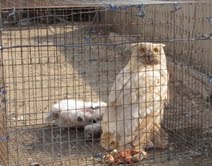
This year has seen a significant campaign, involving many governmental organisations, to crack down on illegal hunting, especially with nets. An article published this week (in Chinese) detailed several cases where the authorities have uncovered large-scale illegal hunting activities and apprehended criminals.
The first example given in this article is startling. The English translation of the text is as follows:
“Dalian Public Security Bureau in Liaoning Province cracks a series of cases involving the endangerment of precious and endangered wild animals.
Recently, the Dalian Public Security Bureau in Liaoning Province cracked a series of cases involving the endangerment of precious and endangered wild animals, arresting 13 suspects and seizing more than 12,000 Yellow-breasted Buntings, a Class I protected wild bird species, with a total value exceeding 39 million yuan. Investigation revealed that in May 2025, suspect Zhang Moubao repeatedly and illegally hunted nationally protected wild birds, then purchased these birds from others and resold them to suspect Jiang Mou, who then fattened and sold the birds.”
I understand that there will be a visit to Liaoning Province – a hotspot of illegal trapping, especially in autumn – by the central government prosecutors to investigate the organised criminal gangs behind this illegal activity. This is a hugely welcome step and builds on the recent efforts to tackle the illegal use of mist nets by Chinese authorities.
Most birders will know that the Yellow-breasted Bunting (Emberiza aureola 黄胸鹀 Huáng xiōng wú) is classified as critically endangered by BirdLife/IUCN after a catastrophic population crash – estimated at 84.3-94.7% between 1980 and 2013, as documented by Kamp et al. Illegal trapping in China is cited as the likely major cause of the decline. Following the publication of that paper, there was a big public awareness campaign led by the Hong Kong Birdwatching Society and, although it is far too early to say for sure, recent records suggest that the decline of this species may have slowed.
If the current efforts to tackle illegal trapping are successful in turning around the fortunes of one of the most threatened species in China, it will provide a huge shot in the arm and demonstrate that a combination of science, public awareness, conservation, and engagement with law enforcement, really can work!
Paul Holt has just finished his detailed trip report from his visit to Liaoning in May. Bai Qingquan, Tom Beeke and I were lucky enough to accompany him for parts of his trip that included two firsts for the Province – Kamchatka Leaf Warbler and Black-winged Cuckooshrike – plus some impressive counts of waders, including a high count of up to 19 Nordmann’s Greenshanks, Bar-tailed Godwits (10,000), Eastern Curlew (4000), Great Knot (4600), Dunlin (10,400) and Broad-billed Sandpiper (1117). You can download the full report here:
Another highlight from the trip to Dandong was the remarkable total of Nordmann’s Greenshanks (Tringa guttifer) that we observed at a high-tide roost. Totals of 17, 17 and 16 were recorded on my three visits and, on one of the days, local birder Bai Qingquan recorded at least a further 7 from a different location at the same time, making a minimum count of 24 at this important stopover site. Nordmann’s Greenshank is officially “endangered” with a population estimate of around 500-1,000 individuals. It breeds in eastern Siberia along the western and northern coasts of the Sea of Okhotsk and also on Sakhalin Island, wintering in south-east Asia (Bangladesh, Thailand, Malaysia etc) and is encountered on migration along coastal China from Hong Kong north to Liaoning Province. It’s population is declining, almost certainly related to habitat destruction primarily on its wintering grounds and stopover sites.
We did not try to get close to these birds for fear of flushing them from their roost but the occasional pass by the local Peregrine and even the odd Black-tailed Gull kept them on their toes and, on several occasions, the flocks took to the air, allowing us to hear the air through their wings as they wheeled around in front of us.. a spectacular sight and sound. It was interesting that the Nordmann’s seemed to associate with the Grey Plover.
Grey Plovers, Donggang, Dandong, Liaoning Province. The wheeling flocks were a lovely sight.Nordmann’s Greenshank in flight (with Grey Plover), Donggang, Dandong, Laioning Province. Nordmann’s seem to like Grey Plovers!Nordmann’s Greenshanks with Grey Plovers.
Having North Korea as a backdrop added human interest to the birding here.
A shellfish picker works the low tide with North Korea just the other side of the Yalu river.A list of what not to do on the North Korean border. Needless to say, we did as we were told..
And other waders, most in splendid breeding plumage, were a sight to behold.
Two Asian Dowitchers (the small orangey blobs in this awful photo) were a welcome addition to the high tide roost.“Eastern” Black-tailed Godwits. Beautiful birds.Our search for Spoon-billed Sandpiper proved fruitless (a little early) but breeding plumaged Red-necked Stints were a joy to watch.
Now, you’ve all heard of the “Magic Woods” at Beidaihe…. well, not to be outdone, Donggang has its own ‘not of this Earth’ site. Here’s introducing the “Harry Potter Hedge”!
The “Harry Potter Hedge”… every day it would wow us with magical appearances.
Out of thin air it produced a Black-winged Cuckooshrike, Rufous-tailed Robin, Siberian Blue Robin, Siberian Thrush, Eyebrowed Thrush, Mugimaki Flycatcher, Pechora Pipit, Siberian Rubythroat, Oriental Scops Owl and much much more..
Finally, just for fun, here are a couple of photos of wader flocks… Photo 1 is beginner level. It has four wader species.. can you identify them? Photo 2 is a little tougher… it contains 6 species. A *glittering prize* awaits the first person to list them all correctly.
Photo 1 (Beginners Level). There are 4 wader species in this image. Can you name them?Photo 2 (Advanced Level). There are 6 species in this photo. Can you name them?
Dandong wasn’t just a wader bonanza (17 Nordmann’s Greenshanks roosting with 2 Asian Dowitchers was really something!) but also a celebration of Siberian migrants. We encountered Siberian Rubythroats and both Siberian Blue and Rufous-tailed Robins bobbing along the sea wall, Mugimaki, Red-throated, Blue and White and Yellow-rumped Flycatchers feeding on the leeward side of the hedges and Siberian, Grey-backed and Eyebrowed Thrushes skulking in thickets. Not to mention Eastern Crowned, Arctic (Kamchatka!), Pale-legged, Yellow-browed, Dusky and Radde’s Warblers entertaining us from the boughs and Brown Shrikes seemingly on every perch. Fantastic stuff. So, in a tribute to ‘Sibes’, here are a few images.
Siberian Blue Robin (first summer male), Donggang, 12 May 2012Siberian Blue Robin, Donggang, 12 May 2012. This individual belied the species’ reputation as a skulker and posed beautifully for the camera.Siberian Rubythroat (male), Donggang, 12 May 2012. Imagine this turning up on your local headland in the UK…Siberian Rubythroat (female), Donggang, 12 May 2012.Mugimaki Flycatcher, Donggang, 12 May 2012.Pale-legged Leaf Warbler, Donggang, 13 May 2012Siberian Thrush (female), Donggang, 13 May 2012. This supreme skulker flew right by me after being flushed by a lorry along a main road. I rattled off 6 images and only this one was in focus.Rufous-tailed Robin, Donggang, 11 May 2012. An understated bird but with bags of character.Brown Shrike, Donggang, 12 May 2012
And turning around 180 degrees revealed an interesting backdrop – the border with North Korea. This boat flew the flag of the DPRK.
A North Korean (fishing?) boat heading out to sea on the falling tide. Birding along the North Korean border added extra spice to an already spicy birding trip.
I am still wading (no pun intended) through my sightings and images from a shorebirding trip to Donggang, Dandong, last weekend with Paul Holt and local birder, Bai Qingquan. The highlights were many. One of the surprises was the amount of passerine migrants that we saw along the newly planted trees that lined the sea wall.. every day we saw buntings, pipits, flycatchers, thrushes and robins which made the walk to the wader high tide roost a real treat. And it was here that we found the bird of the trip – a Kamchatka Warbler (see previous post). Another, more mature, hedgerow to the north of the wader high tide roost produced another very special bird and the second highlight of the trip – a Black-winged Cuckoo Shrike. This is the first record of this species in Liaoning Province and possibly the most northerly record in mainland China.
We had just seen a Brown-eared Bulbul making its way south, noisily, along the sea wall and just a few minutes later a similar-sized bird flew north along the landward side of the hedge. Bai Qingquan picked it up and both he and I saw it briefly as it flashed by.. what was it? Paul was on the other side of the hedge and missed it. Both Bai and I had never seen this bird before.. sort of cuckoo-shaped but we had seen some white on the wing. Luckily it perched up in a tree a 100 metres or so to the north. Although it was mostly obscured, we could just see its tail which looked cuckoo-like and we speculated that it could be some sort of cuckoo or hawk cuckoo.. but the white in the wing didn’t tally.. We crept forward and then it flew, luckily just a few metres, and this time sat up in full view. Paul very quickly identified it as a Black-winged Cuckooshrike. We were able to secure some pretty good views for about 30 minutes as it fed along the hedgerow. Bai “high-fived” us.. a new Liaoning bird!
Black-winged Cuckooshrike, Donggang, Dandong, 11 May 2012. The first record in Liaoning Province and, possibly, the most northerly record of this species in China.Black-winged Cuckooshrike, Donggang, Dandong, 11 May 2012. The white panels in the wings were not always as obvious as shown here.
The cuckooshrike clearly liked the area as we saw it again the following day and again on our last morning.. Isn’t migration brilliant!
The outstanding bird, among many highlights of a trip to Donggang, Dandong in Liaoning Province, was a Kamchatka Leaf Warbler (Phylloscopus examinandus). This bird is one of the newly recognised Arctic Warbler splits. See here for the paper by Per Alström et al that presents the rationale behind the taxonomic decision. The conclusion of the paper states that:
“..the species from continental Eurasia and Alaska should be called Phylloscopus borealis (Arctic Warbler), the one from Kamchatka, Sakhalin and Hokkaido Phylloscopus examinandus (Kamchatka Leaf Warbler) and the one from the rest of Japan Phylloscopus xanthodryas (Japanese Leaf Warbler).”
It appears that this is only the 2nd record of examinandus for China, the first being a specimen collected from Fujian Province, referred to in an article in the Journal of The Asiatic Society of Bengal (29: 265) by Swinhoe in 1860.
The bird was discovered along a relatively new sea wall lined with young trees (a result of recent reclamation work). Paul Holt and I were checking the shorebirds on the mudflats along a 2-3 km stretch of the coast road (Binhai Lu) alongside the Yalu River, right on the border between China and North Korea. Every few minutes we would walk upstream and begin to check the next group of birds. We were enjoying splendid views of Red-necked Stint, Terek Sandpiper, Broad-billed Sandpiper, Far Eastern Curlew, Saunders’ Gulls and many more species – a real spectacle on the falling tide. As we were walking between watchpoints, we heard an unfamiliar call… I thought it sounded a little like a flycatcher – a series of rapid low to mid-pitched notes – and thought nothing else of it (we had been seeing several Asian Brown, Yellow-rumped and Red-throated Flycatchers along that stretch of road). However, Paul knew immediately it was different and might be something interesting. We scanned the area of trees from where the call came from and soon picked up an ‘Arctic Warbler’.. it called repeatedly for about 20 seconds but no sooner as I had grabbed my video camera to record the call, the bird fell silent and did not call again. We watched the bird for a few minutes as it flitted from tree to tree. It appeared quite yellow and buff for a standard Arctic Warbler with a yellowish wash on the throat and upper breast and a buffy supercilium. Neither of us had seen an Arctic Warbler like this before. Luckily, our driver was parked nearby and Paul’s laptop was in the car, on which were the calls of the three ‘Arctic Warbler’ species. We listened to the calls and immediately knew that the call we had heard was of Phylloscopus examinandus (Kamchatka Leaf Warbler). We quickly walked back to where the bird had been and, after a few minutes of searching, we relocated it along a roadside bank, just inland from the original location. With a bit of patience it showed quite well, even though the light was bad (heavily overcast). We took some images that captured the features of the bird as we were seeing it in the field. After about an hour, and with the light fading, we eventually left the site having secured lots of images but, unfortunately, without a sound recording of the call; it didn’t call a single time after that initial burst when we first saw it.
Paul knew it would be a good record and certainly a first record for Liaoning Province. What we didn’t know was that it would be the first record (that we are aware of) for China since that 19th century specimen referred to by Swinhoe!
Of course, this species has almost certainly been overlooked and birders will only have been looking for these new species since Per Alström’s paper was published in 2010, so I am sure there will be more records to come… As a bird that breeds in Kamchatka, it must pass through eastern China on migration. Even so, it’s pretty cool to be involved with a first record for China for over 100 years! It’s a fantastic tribute to Paul’s birding skill that he picked up the unusual call and nailed the record..
Images below.
Kamchatka Warbler (Phylloscopus examinandus), Donggang, Dandong, Liaoning Province, 12 May 2012. Probably the first record for China since a specimen was collected in the 1800s. Note the buffy supercilium and yellow wash on the underparts, both clearly seen in the field.Kamchatka Warbler (Phylloscopus examinandus), Donggang, Dandong, 12 May 2012. The yellowish wash down the centre of the breast can be see clearly on this image.Kamchatka Warbler (Phylloscopus examinandus), Donggang, Dandong, Liaoning Province, 12 May 2012. Although out of focus, a yellowish wash on the vent can be seen clearly in this image.
The calls and songs of the three species of “Arctic Warbler” can be found here. It should be noted that, at present, vocalisations are the only way to definitively identify these three species. However, given the plumage features noted on this bird, it may not be too long before a suite of features allows non-calling/singing birds to be separated in the field.
Now you know what to look for, I hope you find one for yourself…!
Last week, together with Tom Beeke in Dalian and Tian Yang (Leyton), a Dalian-based birding friend, I received an invitation to participate in the International Siberian Crane Festival in Faku County, near Shenyang in Liaoning Province. The invitation came from Professor Zhou from Shenyang University who we had both met last autumn whilst watching waders along the Liaoning coast. Apparently my sighting of 3 Siberian Cranes in Beijing in March (the second record for the capital) qualified me as a Siberian Crane expert….
By juggling work commitments we were both able to participate and we enjoyed one of those special Chinese experiences…
Faku County hosts a network of 16 freshwater lakes which, together, form a very important stopover site for a host of wildfowl and, in particular, the ‘critically endangered’ Siberian Crane. The world population of this species is thought to be around 3,000 individuals and declining. About ten days ago, 2,000 were counted at this important site. The day before our visit on Tuesday, 821 were seen. Clearly, this is a hugely important site for the Siberian Crane but it is not currently included in the list of priority sites for this species in China (so far, five wetland sites have been identified as critical, including the Poyang Lake Basin, where up to 98% of the world’s population of Siberian Cranes over-winter; the other four sites are national level nature reserves – Zhalong, Xianghai, Keerqin, and Momoge Nature Reserves – that protect important migratory habitat used by the Siberian Crane in northeastern China).
As is often the case in rapidly developing China, the site is under threat. To help raise awareness, Professor Zhou set up an International Siberian Crane Festival and invited the most important local politicians, decision-makers and local people to attend. The deputy Mayor of Shenyang, the Party Secretary of Faku County and his deputy all participated. Professor Zhou also invited a panel of experts from Beijing including the China head of Wetlands International and a Deputy Director from the Forestry Ministry. Tom and I were invited to provide an international perspective.
Our day began at 0500 with a visit to the site to do a spot of birdwatching before the official proceedings began. Unfortunately, due to a delay in leaving the hotel (too much baijio for some?) we missed the main crane post-roost flight but, luckily (for Tom at least as he had never seen Siberian Crane!), a couple of stragglers remained and we were able to watch them feed, albeit at distance. We also saw good numbers of Greater White-fronted Geese, some Swan Geese, Bean Geese, Baikal Teal and Grey-headed Lapwing. After a tour of the main reservoir we were driven to a raised viewing area which was being prepared for the festival.
The festival began at 0930 with a formal opening ceremony at the wetland itself which, despite the weather (strong winds and dust storms) saw a hugely impressive local turnout. It appeared to be the biggest event to happen in this community for a long time with hundreds of local people present. The police were there in numbers to coordinate the crowds.
Early morning preparations for the opening ceremony of the International Siberian Crane Festival, Faku County, Liaoning ProvinceA couple of bemused locals look onSome of the local women enjoying the opening ceremony..Local girls added some glamour to proceedings but were struggling to keep smiling in the dust storms…As the time for the opening ceremony approached, the crowd began to build.The police took time out from their crowd control duties to check out Professor Zhou’s photos on the display boards.This local farmer insisted on having his photo taken and was proud to welcome foreigners to his village for the International Siberian Crane FestivalThe stage is set for the grand opening ceremony…
After the formal opening ceremony, during which Tom and I were asked to stand on the stage (!) while 4 dignitaries spoke, we were driven to the local government offices where we participated in a roundtable workshop with the Party chiefs, local residents and media. The workshop began with presentations by Wetlands International, the Forestry Ministry and Professor Zhou, all aimed at explaining the significance of this site and the potential for the local area to achieve provincial, national and international recognition (via Ramsar status) and to secure associated financing. Tom and I were then invited to provide international perspectives and we both spoke about the potential economic value of eco-tourism, the importance of valuing natural capital in economic decision-making, including the ecosystem services provided by wetlands, and the experience of our respective countries in terms of wildlife tourism. It was heartening to hear the Party Secretary (the top official in Faku County) promise, at the end of the event, to review the County’s development strategy on the basis of what he had heard and he even invited us to be formal advisers to his County (one for the CV!). After some interviews with the media (including Liaoning TV and Radio, CCTV, Tianjin News and others), we were provided with an official lunch with the obligatory toasts of the local baijio before heading back home. Tom and I were both very grateful for the warmth of the welcome we received and the memory of this event, and our visit to Faku, will stay with us for a very long time. A big thank you to Leyton for his interpretation service.
Professor Zhou is to be congratulated: he is clearly working extremely hard to try to protect this area and is making every effort to persuade the local Party chiefs that it is in their long term interest to secure the future of these wetlands and the birds that depend on them. I would like to wish him every success and, in my new capacity as environmental advisor to Faku County, I stand ready to assist in any way I can!
By the way, did you know that the oldest documented crane that ever lived was a Siberian Crane named “Wolf”, who died at the age of 83? Amazing!
Bai Qingquan, a fellow birder from Dandong, has just sent me this photo of a leucistic Eagle Owl (Bubo bubo). This bird had been terrorising a local farmer in Zhuanghe, Liaoning Province and had apprently taken two lambs and several chickens before the farmer was able to catch it. It has since been released away from the farm.. An unusual looking bird.
A leucistic Eagle Owl, Zhuanghe, Liaoning Province
One of the highlights of my recent trip to Liaoning Province was the opportunity to see so many gulls at Jinzhou Bay (we estimated over 4,000). This number must make Jinzhou Bay one of the premier gull-watching sites in northern China (if you know of a comparable site, please let me know!). The channel of running water alongside the landfill tip was a favoured haunt of Common Gulls (Larus canus) and, over the two days I spent at this site, I saw several young birds, presumably of both the subspecies found in this area – kamtschatschensis and heinei. Here are a few images and personal comments. Please let me know if you disagree with my identification or if you have more to add.
The kamtschatschensis bird, in particular, would certainly stand out if it turned up in the Western Europe!
First winter Common Gull of the subspecies kamtschatschensis, Jinzhou Bay, Dalian, Liaoning Province. Note the dark, well marked underparts and strongly barred undertail coverts.First winter Common Gull subspecies heinei, Jinzhou Bay, Dalian, Liaoning Province, 25 January 2012. Note the very clean, white underparts.First winter Common Gull ssp kamtschatschensis, Jinzhou Bay, Dalian, Liaoning Province, 25 January 2012. The upperparts are well-marked and the moult of juvenile feathers seems to be later than the heinei ssp below.First winter Common Gull ssp heinei, Jinzhou Bay, Dalian, Liaoning Province. Much cleaner, especially the uppertail, and more advanced moult, notably on the scapulars.
It’s difficult to tell from these images but, in the field, the kamtschatschensis bird appeared to be stockier with a slightly longer bill.
Second winter Common Gull, Zhuanghe, Liaoning Province, 28 January 2012. I suspect this individual is of the subspecies kamtschatschensis. Aged as a second winter due to the presence of some adult-type wing feathers, the small white 'mirror' on the outer primary (P10) and the relatively clean tail. Note the brownish fringes to some of the coverts, a good feature of second winter kamtschatschensis.Second Winter Common Gull, Zhuanghe, Liaoning Province, 28 January 2012. Probably of the ssp kamtschatschensis. Same bird as above.
Many birders, being obsessive types, like to keep lists of the birds they have seen. This could be a “life list” (a list of the total number of species seen in one’s life), a “year list”, the total seen in a given year etc. Many people keep national lists, for example a UK or China list. I have to confess that I don’t know how many species I have seen in the UK (I know it’s roughly 400) and I have been lax recently at keeping my China list up to date (somewhere between 500 and 520). However, I can proudly say that I know exactly the number of bird species I have seen in North Korea – 7!
Under the listing ‘rules’ it matters not that I haven’t actually been to North Korea as all have been seen over N Korean airspace from the China side of the border…
I have just returned from a few days in Liaoning Province with Paul Holt, Tom Beeke and Dandong-based birder Bai Qingquan – the perfect opportunity to boost my North Korea list! We visited some sites in Dalian, southern Liaoning, before driving north to visit the area in and around Dandong, including the Yalu River, the waterway marking the border between China and North Korea. In stunning weather, and temperatures approaching -20 at times, we saw some pretty special birds with the constant backdrop of North Korea providing a fascinating distraction.
Birding highlights from the trip north included Brown-eared Bulbul, Japanese Pygmy Woodpecker, White-backed Woodpecker, Varied Tit, Hazel Grouse, Cinereous (Black) Vulture, Alpine Accentor, Relict Gull (at Zhuanghe) and Slaty-backed Gull. Another spectacle was the sight of 25 White-tailed Eagles at Jinzhou Bay, near Dalian, in the company of over 4,000 gulls, attracted by a landfill tip. Birding takes us to some glamourous places.
Brown-eared Bulbul, Hushan (Tiger Mountain) Great Wall, Liaoning ProvinceJapanese Pygmy Woodpecker, Feng Huang Shan, north-west of Dandong, Liaoning ProvinceVaried Tit. A common resident at Feng Huang Shan.Eurasian Nuthatch ssp amurensis, Feng Huang Shan, Liaoning Province
I began my visit by meeting up with Paul Holt at Dalian airport and heading to Dalian and Jinzhou Bays. Dalian Bay, on the eastern side of the peninsula, was largely ice-free and produced an adult Glaucous Gull, Vega, Mongolian and Black-tailed Gulls, Goosander, Red-breasted Merganser, Great Crested and Little Grebes, Mallard, Falcated and Chinese Spot-billed Duck. After an hour or so we crossed to the west coast to visit Jinzhou Bay. Here the sea was frozen as far as the eye could see and an impressive group of around 4,000 gulls was loafing on the ice. They were attracted by the large landfill site bordering the bay and this food source is clearly the reason why Jinzhou Bay must be one of the best gull-watching sites in northern China.
The vast majority of the gulls were Mongolian, with a sprinkling of Vega (a few hundred), Heuglin’s (up to 100), Common (20-30), Slaty-backed (3-5), Glaucous (2-3), Black-headed (2) and Black-tailed (2). Paul Holt also saw a first winter Pallas’s Gull at this site before I arrived. Searching through the Mongolian Gulls, recalling my sighting of 3 wing-tagged birds in February 2011 at this site, we were able to find a total of 5 wing-tagged birds during our visit (2 of which Paul and I both saw, 3 of which Paul found before I arrived and one after I left). These birds were ringed by Andreas Buchheim and colleagues under a ringing scheme operated in Mongolia and Russia’s Lake Baikal.
The gulls were not the only scavengers attracted to the tip. Each day we were there, a group of locals sifted through the rubbish and collected anything recyclable – bottles, cardboard, paper, metal etc.. It has to be one of the dirtiest jobs – they were black with grime – but despite the working conditions, they were a jolly bunch, laughing and joking with each other and they seemed thoroughly bemused that a couple of foreigners were joining them on the tip looking at gulls…. We showed them eagles through our telescopes and they showed us sacks of scrap paper.. 🙂
One of the locals collecting recyclable wasteIt's a dirty job…The constant flow of trucks provided a high turnover of rubbish through which to look for recyclables..Despite their working conditions, these people were very jolly, friendly and more than a little bemused that two foreigners were looking at gulls!
Just north of the landfill, a still unfrozen stream flowed into the bay, attracting some duck – mostly Mallard but also some Chinese Spot-billed Duck, Ruddy and Common Shelduck. In turn, these attracted the attention of birds of prey and we counted 25 White-tailed Eagles in the bay on Sunday morning – an impressive count for anywhere in China. The stream also proved popular with the Common Gulls and we saw both henei and kamtschatschensis subspecies here. I’ll follow up this post with a dedicated gull post soon.
One of the 25 White-tailed Eagles at Jinzhou Bay. The vast majority were immature birds and they caused havoc during their occasional forays over the bay.When one eagle found something to eat, it would soon be harrassed by the others trying to steal its find.
And this Merlin flashed through, surprisingly putting up most of the gulls as it did so..
Merlin, Jinzhou Bay, Dalian.
From the landfill at Dalian, we drove north to meet with Tom Beeke at Jinshitan and set off to Dandong, a city of 2.5 million people on the North Korean border. Here we met up with local birder (possibly the only birder in northern Liaoning!), Bai Qingquan, a great guy who was not only a talented birder but also excellent company and extremely knowledgeable about the sites in this special province.
The gang in Dandong. From left to right: Mr Zhang (our driver), Tom Beeke, Paul Holt and Bai Qingquan
We started birding along the promenade in Dandong, just a few hundred metres from North Korea which we could see clearly just across the Yalu river. Dandong is an interesting city. It is home to the “Sino-Korean Friendship Bridge”, one of the few crossings between the two countries and, immediately next to this is another bridge – the “Short Bridge” – that was partially destroyed by a US bombing raid during the Korean War. The town also hosts a museum dedicated to the “War to Resist US Aggression”… We didn’t have time to visit but next time I am in town, I fancy a look in there!
We tried several sites along the river from Dandong and to the north looking for Scaly-sided Merganser. This rare bird is regular along this stretch of river in spring and autumn, breeding a little further north and wintering in central and southern China. This winter had been unusually mild with no snow and Bai had seen the Mergansers in December, so we thought we’d try our luck. Unfortunately, despite 4 pairs of eyes scanning the river, we drew a blank. Next we visited the Hushan (Tiger Mountain) Great Wall, catching up with Brown-eared Bulbul, Alpine Accentor and enjoying panoramic views of North Korea.
North Korea, as viewed from the Great Wall, north of Dandong.
The next day was spent at Feng Huang Shan, a mountain roughly an hour north-west of Dandong. It was a bitter -18 here but, after driving up almost to the summit, the birding was spectacular. Almost immediately we encountered a Varied Tit, followed by a couple of White-backed Woodpeckers and then at least 3 Japanese Pygmy Woodpeckers, all within a few minutes of getting out of the car… Superb! We wandered up and down the track and, after hearing at least two Hazel Grouse calling, a careful 30-minute stalk was eventually rewarded with views of a male perched on a rock on a hillside.. fantastic.
Hazel Grouse, Feng Huang Shan, Liaoning Province
On the way back south, we stopped at Zhuanghe, a port town between Dandong and Dalian, to look for Relict Gulls, a large flock of which Paul found a few days before. We saw only a handful, probably due to the high tide, but with a little time on our hands we decided to look at the deep-water harbour for sea duck. As we arrived, a ferry was about to leave to some of the outlying islands and, with a bit of negotiation from Qingquan, we were soon on board and sailing through an almost Antarctic-esque ice-filled sea. It was bone-chillingly cold on deck but we were rewarded with over 60 Long-tailed Duck as well as good China species such as Pelagic Cormorant, Slaty-backed Gull and Red-breasted Merganser.
From left to right: Tom Beeke, Bai Qingquan and Paul Holt. On the ferry from Zhuanghe to outlying islands.Our first stop.The sea was almost Antarctica-esque..!
After returning to Zhuanghe around dusk, we headed into town to find Qingquan a taxi back to Dandong and to warm up with some hot food before heading south to Dalian. A thoroughly enjoyable trip…
So, after all that, what are the seven species on my North Korea list? They are, in chronological order, Saunders’ Gull (from Sep 2011), White-tailed Eagle, Mongolian Gull, Kestrel, Goldeneye, Goosander and Mallard. Anyone beat that?
Paul Holt has just completed his detailed trip report for the autumn migration trip to Laotieshan in Liaoning Province, China. It will come as no surprise to anyone who knows him (and me!) that Paul is responsible for the incredibly detailed daily counts of the species included in the report.
It was an awesome trip with some stunning counts (including some China records).
Highlights:
We recorded 202 species in total
High counts included 2155 bird-days of Oriental Honey-buzzard with 1035 on our very first day on site, the 24 September;
1150 bird-days of Black Kite with birds being seen almost every day with a peak count of 209 on the 7 October;
1255 Eurasian Sparrowhawks and a peak count of 283 on the 10 October;
248 bird-days of Northern Goshawk with a peak of 64 also on the 10 October;
6944 bird-days of Eastern Buzzard with a peak of 3490 on the 12 October;
7971 bird-days of Amur Falcon with a peak of 1830 on the 10 October;
Over 20,000 bird-days of Ashy Minivet with a peak of 7549 on the 28 September;
456 bird-days of Yellow-bellied Tit with birds being noted on 20 of the 23 days we were in Liaoning and a peak of 160 on the 5 October;
Nearly 60,000 bird-days of Red-rumped Swallow with 10,000 being estimated on the 27 September;
Over 14,000 white-eyes with up to 4500 birds being noted daily while we were in the province;
Over 1600 bird-days of Black-faced Bunting with a peak of 700 on the 8 October.
Local rarities included:
14-bird-days of Black Stork with between 1 and 4 birds on five dates;
A juvenile Steppe Eagle on the 2 October;
2 juvenile Golden Eagles on the 11 October;
An adult male Lesser Kestrel on the 6 October;
70 osculans Eurasian Oystercatchers, a moulting juvenile Pallas’s Gull (only the third for Liaoning) and a first year Glaucous Gull at the Biliu river, Pulandian and a single Little Curlew near Pikou, Pulandian all on the 3 October;
Surprising numbers of both Northern and Asian House Martins;
Two and one Red-billed Starlings on the 7th & 14 October respectively
Several early Alpine Accentors with sightings on three dates after the 11 October.
Heard from Paul Holt and Tom Beeke at Laotieshan this evening. Highlights today included at least 5 Greater Spotted Eagles and new birds for the trip – one juvenile Oriental White Stork, Manchurian Bush Warbler, Red-billed Starling, Yellow-throated Bunting and Daurian Jackdaw. The ringing station has received the dreaded phone call asking them not to allow foreigners up to the ridge unless they are accompanied by a member of staff… so viewing options for raptor migration are becoming increasingly limited. Peter heads back to Beijing tonight and I’m meeting him at the airport in a couple of hours. He’s had quite an introduction to birding in China..!
After the disappointment of being kicked off one of the prime raptor migration watchpoints on Tuesday, we took up the invitation from the local reserve officials, introduced to us by the Beijing Birdwatching Society, to visit a ringing station at Laotieshan. Our hosts, Mr Wang (Head of Research) and Mr Zhang (a researcher and ringer) met us near the lighthouse car park at 0630 and drove us to the ringing station where we met with two more staff. At this site (one of 8 ringing stations in the area), they operate four mist nets, three of which are targeted at passerines and one at raptors. It wasn’t long before the resident bird-catcher, Mr Sun, appeared with some birds and we were pleased to see Grey-backed Thrush and Tristram’s Bunting in the hand.
Grey-backed Thrush, Laotieshan, 5 October 2011
These birds were ringed and released promptly and soon we were discussing the birds of Laotieshan and the various species they had ringed. They gave us each a book that covered the birds of the Laotieshan peninsula and the nearby Snake Island (the island featured in the BBC series, Wild China, where the Pallas’s Pit Vipers have evolved to climb trees to wait for unsuspecting migrant birds). The list makes for very interesting reading, giving the status of each bird at Laotieshan – resident, summer visitor, winter visitor or passage migrant. I’ll post a translation of it on here at some point.
During this discussion Mr Sun disappeared, then reappeared with a Mugimaki Flycatcher.. a nice trick! Unfortunately this bird had lost its tail, either in the net or in the bag, but nevertheless, it was a smart bird.
Mugimaki Flycatcher, Laotieshan, 5 October 2011
We asked about access to Snake Island. Officially there was no access unless one had a permit (a familiar story in China!). Mr Wang was due to go out there later that day and stay for a week, part of the rolling wardening duties on the island. Mr Zhang told us that Mr Wang was once bitten on the finger by a Pallas’s Pit Viper and spent the next three months recovering in hospital.. ouch.
Mr Sun appeared again, accompanied by gasps from the audience.. this time he held single Tristram’s and Black-faced Buntings.
Black-faced Bunting, Laotieshan, 5 October 2011Mr Sun proudly showing off a very smart Tristram's Bunting. I was impressed with the professionalism of these ringers, especially after some of the horror stories I had heard about ringing stations at other locations in China.
The volume of birds being caught here was not high – they said that, on average at this time of year, about 30 birds were caught each day – but the quality and variety was good. We accompanied Mr Zhang on a walk around the nets and discovered over 20 Chestnut-flanked White-eyes together with a single Radde’s Warbler and another Tristram’s Bunting. It took us some time to help retrieve these birds from the nets but they were promptly ringed and released. White-eyes have been a big feature of our time at Laotieshan with thousands passing through… they are full of character and it was interesting to see some in the hand.
Chestnut-flanked White-eye. One of over 20 caught and ringed on 5 October at Laotieshan.Radde's Warbler, Laotieshan, 5 October 2011
A major part of the work of the ringing station is to try to stop illegal bird trapping. This is a traditional activity at Laotieshan that has been ongoing for many years and, therefore, is not easy to eradicate. Every day the staff explore the ridges for illegal nets, cut down any they find and also report any individuals they see to the police. One guy told us that the illegal bird trappers used to catch around 4,000 raptors each year at Laotieshan (!). This has significantly decreased due to the work of the reserve staff but they told us that it is still common to find illegal mist nets. One event that they are proud of ,and that they hope will act as a major deterrent to others, is the fact that, last year, one guy was apprehended with a haul of Oriental Scops Owls and was given a 10-year custodial sentence! I had read about this story in the China Daily last autumn and it seems as if this has acted as a warning to the locals.. Mr Zhang said that the illegal bird catchers were now extremely nervous and, if they saw anyone near their nets, they would run away quickly.. I am not surprised with punishments like that!
Mr Sun returned and his latest bit of magic produced a Red-flanked Bluetail..
Red-flanked Bluetail, Laotieshan, 5 October 2011. These birds are just beginning to arrive at Laotieshan.Paul Holt photographs the Red-flanked Bluetail being held by Peter Cawley immediately prior to release.
Shortly after, Mr Wang drove up in his 4×4 and opened the boot to reveal a Short-eared Owl he had found in an illegal net.. Unfortunately it had a broken wing, so could not be released.. very sad to see the fate of such a beautiful bird. No doubt many more birds or prey and passerines suffer a similar fate every autumn in the hills around this special site.
Short-eared Owl. This bird was recovered from an illegal mist net. The net was destroyed by the wardens but it was too late for this particular bird.
As the early morning migration slowed, Peter and I took the opportunity to hike up the hill to a raptor watchpoint above the ringing station. Mr Zhang showed us the way and, after a steep ascent lasting around 40 minutes, we emerged on the ridge to a spectacular view of the hills. The lighthouse could be seen to the south-west and, to the east, there was a stunning view of a valley and hills stretching north towards Lushun. In a 90-minute count from here we saw a flock of 28 Black-eared Kites, 4 Goshawks, a Peregrine, at least 30 Amur Falcons, 9 Common Buzzards, 2 Hobbies, a single House Martin sp (probably Northern) and a good passage of around 350 Swallows (75 per cent Red-rumped and 25 per cent Barn). On the walk down we encountered a spectacular spider whose web was reminiscent of one of the mist nets! If I was a small bird I’d be wary of this particular spider..
A stunning spider (unidentified), Laotieshan, 5 October 2011.
We did a further round of the nets and birded the woods around the station before saying our goodbyes to the crew. They had made us feel very welcome and we are exremely grateful to Mr Wang, Mr Zhang and Mr Sun for their hospitality, including the fantastic lunch of fried fish and rice – delicious!
The visit to the ringing station represented the end of my stay in Laotieshan this autumn. To see in the hand some of the migrant birds we had been seeing over the last few days was a fitting end to my stay at this special place. Mr Wang kindly drove us back to our hotel in Lushun and, after a typically delicious meal at a local restaurant, I picked up my bags, said my goodbyes to Paul and Peter and made my way to the airport for the short flight back to Beijing. It was a real wrench to tear myself away from this globally significant site and, in particular, the company of Paul Holt and Peter Cawley. It was a real privilege for me to spend 10 days birding with these guys. Paul is simply one of the best birders I have ever met – his knowledge of China’s birds and his identification skills are second to none. I know I would have missed many birds – such as the flyover Pechora Pipits and Pine Bunting – if I was on my own. So, a big thanks Paul! I owe you a few beers when you are back in Beijing…
Peter Cawley, a friend from my old local patch at Winterton-on-Sea in Norfolk, is staying on for a couple of days and will return to Beijing on Friday. I’ll be taking him to Wild Duck Lake at the weekend and he’ll spend a couple of days doing the tourist sites of Beijing before returning to the UK.
Paul is going to stay on at Laotieshan for a while yet, building yet more knowledge about this important site. I suspect he will see good numbers of the large eagles in the next few weeks – mostly Greater Spotted but hopefully with more Steppe and possibly an Imperial thrown in. During my short time there we think we have recorded some record numbers of birds in the Chinese context. The counts of Ashy Minivets, Amur Falcons and many other birds have been simply outstanding and, in many cases, are much higher than those recorded at the traditional well-watched migration site at Beidaihe. It is clear that Laotieshan is globally significant and the good news is that, due to the proximity of the military and the geographic make-up, it is likely to remain undeveloped. Clearly, access to the best areas is still sensitive but hopefully, in time, this will improve as birding becomes more popular in China and there is a better understanding of the contribution birders can make to the increase in knowledge about China’s birds. Even so, there are still many areas that are accessible now and the birding is simply spectacular. I am sure I will be back!
I’ll post some detailed species accounts and a full report soon, once we have collated all the data. There is so much to put down on paper that it may take a while. In the meantime, if I hear about more significant counts from Paul, I will post them here.
Finally, I’d like to say a massive thank you to Tom Beeke whose reports from Laotieshan last year were the inspiration for our visit. Tom has been birding Liaoning Province, largely on his own, for the last few years and has made a major contribution to the knowledge of the birds to be found in and around Dalian. His book – “The Birds of Dalian” – is an excellent piece of work for which he deserves enormous credit. I am sure it will inspire a new generation of Chinese birdwatchers…
Next stop Wild Duck Lake at the weekend! In the meantime, here are a few more images from the last few days…
Mr Zhang (left) and Mr Sun ringing and logging a Black-faced Bunting.A motley crew… Paul and I with some members of the Beijing Birdwatching Society and some of the local bird photographers. Taken on the 'helipad' at Laotieshan shortly before Paul and I were asked to leave by the military.Checking the gulls at Lushun with the Beijing Birdwatching SocietyPaul and Peter discussing the possibility of visiting the ringing station at Laotieshan with Mr Wang and Tian Yang (in the light blue top) of the Beijing Birdwatching SocietyTom Beeke (Dong Bei) at the wader site north of Pikou.. A top man!Friendly local fishermen at Pikou..A local couple having their wedding photographs taken along the promenade at Lushun while we watched the local gulls.A page from the log at one of the ringing stations at Laotieshan.Amur Falcon (female); one of thousands seen over the last 10 days at Laotieshan, including a flock of over 600 and a count of over 1,100 migrating birds on Wednesday morning in just 90 minutes.Amur Falcon (juvenile), Laotieshan, 5 October 2011. The passage of these birds was a highlight of our stay.
Frustration was the word of the day. Anyone who has been birding in China will know that frustration is something that you just have to get used to. Today we were chucked off one of the prime viewing areas for raptor migration simply because we were foreigners. The area is close to a military base and so, understandably, it’s a sensitive site. But the irony is that we can see more Chinese military sites from our hotel room (including submarines, frigates and other naval support vessels) than we can from the raptor viewpoint. Nevertheless, at 1100 today we were told in no uncertain terms that we shouldn’t be there and that we would have to leave…. this was after one of the most impressive early morning raptor sessions of our visit so far with a Greater Spotted Eagle at 0630 (!), Common Buzzards passing at a rate of 250 per hour and a good number of Black-eared Kites, Goshawks and Eurasian Sparrowhawks.
However, every cloud has a silver lining and, earlier in the day, we met up with a group from the Beijing Birdwatching Society (including Zhong Jia and Tian Yang) who were visiting Laotieshan for a few days. They told us about another place, open to foreigners, from where the raptors can be viewed and they helpfully arranged for us to meet the head of research at the Laotieshan nature reserve and secure an invitation to the ringing station nearby. So tomorrow we will be taken up to the ringing station and from there we can walk up to the ridge without the threat of military intervention.. The ringing station itself sounds intriguing.. they told us that they had caught a Swinhoe’s Rail a couple of days ago! Wow…
The ringing station is apparently near to the area where locals traditionally put up mist nets to capture migrating birds (mostly for the bird trade). One Chinese contact we met said that they used to catch around 4,000 raptors a year at Laotieshan until improved wardening severely curtailed illegal mist-netting. Even now many nets are put up by locals and it’s a continuing process to try to reduce the number of illegal nets at this time of year…
Zhong Jia and Tian Yang also told us about a new hotel that had recently opened much nearer to Laotieshan than our base in Lushun. The rooms looked good, the prices reasonable and the bonus is that one can watch raptors from the garden…. in a short visit this afternoon we enjoyed views of 6 Grey-faced Buzzards right overhead plus an astonishing movement of Amur Falcons involving around 600 birds in a single flock… wow.
Tomorrow is my last day at Laotieshan. I will have a full day there before making my way to the airport for the short flight back to Beijing. It’s going to be very tough to tear myself away but Peter will be staying until Friday and Paul hopes to stay for several weeks, access permitting. Let’s hope tomorrow is a bumper day!
It’s been an eventful 2 days. Sunday was spent, as usual, at Laotieshan. The fresh wind was from the north-west and, with the temperature around 10 degrees C at dawn, it felt cold (I had 5 layers on at one point!). After the passerine migration slowed at around 7.30am, Paul decided to walk up to the raptor watchpoint and Peter and I took the track below the lighthouse. We began well with at least 2 Red-flanked Bluetails, a Mugimaki Flycatcher and an Asian Stubtail. Then, just as we reached the sheltered gully at the bottom of the track, Paul radioed us to say that there was a juvenile Steppe Eagle coming in low along the ridge.. We hurried up the track to a point from which we could view the ridge and enjoyed spectacular views as it slowly made its way inland, battling against the increasing wind.. Steppe Eagle is a scarce bird in eastern China, so it was a very good record. The odd thing is that this eagle occurred during the quietest raptor passage we have experience so far! Migration works in mysterious ways.
Sunday afternoon we drove up to Jinshitan to meet up with Tom Beeke for a day of wader watching… After a fabulous meal with Tom’s family (he and his wife, Hannah, are amazing hosts!), we had a fantastic day up the coast with 108 species seen including such goodies as Blue Rock Thrush, Great Knot, Baillon’s Crake and Chinese Grey Shrike. Probably the best bird of the day was a stunning and confiding Little Whimbrel which initially flew in front of the car, causing us to stop rather abruptly on the main road outside Pikou. After a brief search, we saw it again in flight and it settled in a narrow patch of rough grass very close to the road. Stunning. After catching up with the waders between Pikou and Zhuanghe (Dunlin, Great Knot, Red Knot, Far Eastern Curlew, Eurasian Curlew, Lesser Sand Plover, Grey Plover, Terek Sandpiper etc) we turned our attention to gulls and it was here that Paul H excelled himself. First he picked out a first winter Glaucous Gull at about a mile range (ok, a slight exaggeration but it was a long way out) and then, within a couple of minutes of that piece of magic, he pulled out a first winter Pallas’s Gull – top class!
I only have two more days left at Laotieshan before flying back to Beijing. Peter will stay an extra couple of days and Paul will be staying for a while longer.. it’s going to be hard to wrench myself away from this world-class migration site but I feel very lucky to have been able to experience over a week of incredible birding, particularly as it has been in the company of such distinguished companions.
Little Whimbrel, Pikou, Liaoning Province, 3 October 2011
Little Whimbrel, Pikou, Liaoning Province, 3 October 2011
Far Eastern Curlew, Pikou, Liaoning Province, 3 October 2011
10 degrees Celsius at dawn, with some cloud cover and light westerly winds. After a slow start, the passerine migration really got going around 0600 and at times there were huge numbers of birds in the sky. The dominant species was the Chestnut-flanked White-eye and their siskin-like calls were a constant background accompaniment to the morning. Other prominent species, typical of recent days, were Ashy Minivet and Olive-backed Pipit but there were also signs of new movements with reasonable numbers of Oriental Turtle Doves and White-cheeked Starling. A Siberian Rubythroat showed briefly in the nearby bushes, which it shared with good numbers of Radde’s and Dusky Warblers plus the occasional Lanceolated Warbler, and a cracking Bull-headed Shrike perched prominently as it scanned for prey in a crop field. At around 0715 we were joined by Tom Beeke and friends who had driven down from Dalian to join us for the day. (It was great to see you Tom! And thanks again for ‘discovering’ Laotieshan as a visible migration hotspot last autumn.. the inspiration for our visit this year).
As the sun began to burn off the cloud and heat up the air, raptors began to move and we enjoyed groups of Black-eared Kites, Amur Falcons, Oriental Honey and Common Buzzards. Singles of Grey-headed Lapwing and Grey-backed Thrush were nice additions to our species list before we made our way up to the ridge. On the way we flushed a Woodcock and two White’s Thrushes from the same gully! When we reached the top, raptors were moving – Eurasian and Japanese Sparrowhawks, Common Buzzards, Black-eared Kites, Kestrel, Hobby, Amur Falcon and Goshawk were all seen in the first couple of hours. A total of 4 Greater Spotted Eagles was a good tally but the real spectacle was over 180 Grey-faced Buzzards, many of which passed in large groups of 10 or more… Magnificent. Grey-faced Buzzards are strange birds. Sometimes they remind me of a harrier or an accipiter and, when they are flapping hard, to me they are reminiscent of Short-eared Owls..! Bizarre, I know.. but if you have seen one, hopefully you know what I mean..
Bull-headed Shrike, Laotieshan, 1 October. A stunner.Grey-faced Buzzards, Laotieshan, 1 October. Part of a flock of over 20.Grey-faced Buzzard, Laotieshan, 1 OctoberCommon (Eastern) Buzzard ssp japonicus, Laotieshan, 1 October
Tomorrow is forecast to be cool with northerly winds but clear and sunny. We suspect, having been here for a week, that the best wind for migrant raptors is south-west, so we don’t expect too much for Sunday but you never know…
Thanks very much to Ken and Spike for the comments on the bush warbler in the last post. We also think it’s most likely a first winter Spotted (David’s) Bush Warbler but we need to check literature on our return to Beijing.
Much colder today with the temperature down to 10 degrees Celsius at 0530. A brisk north-east wind kept it cool all day but, on the plus side, visibility was the best I have seen in China and it was sunny all day.
A hawking Grey Nightjar was a nice welcome as we arrived at the car park at dawn and other highlights included 2 Greater Spotted Eagles (one of which we watched migrate out to see towards Shandong Province – something like 60+ kilometres away), over 20 Grey-faced Buzzards and this…..
Bush Warbler sp, Laotieshan…
We think we know what it is but do you?
There was a significant fall of phylloscopus warblers today, especially Radde’s and Dusky warblers.. but the number of birds moving was definitely down on the last few days. The forecast for Saturday is for moderate westerlies and mostly clear skies with the temperature increasing slightly. It’ll be interesting to see whether the volume of migrating birds increases again… and with Tom Beeke and his crew arriving for the day tomorrow, we’ll have more pairs of eyes watching the skies.. it promises to be a good day whatever we see.
The lighthouse at Laotieshan viewed from the ridge.Raptor watching from the 'helipad' on the ridge at Laotieshan
Thursday started wet, warm and still and ended dry, windy and cold! The weather front passed through overnight but unfortunately the rain started a little early (well before midnight), perhaps meaning that not so many migrants were on the move when the rain hit. First thing, as the rain petered out, passerine migration was relatively thin by recent standards and, although there had not been a ‘fall’, there were new birds around.
Highlights included 2 Baikal Teal that came in off the sea and headed strongly east, a late Eastern Crowned Warbler (on Peter’s most-wanted list), a couple of Yellow-browed Buntings, a single Greater Spotted Eagle, 3 Black Storks and, dramatically, a Eurasian Sparrowhawk attacking a White’s Thrush! At one point the Sparrowhawk grabbed the White’s Thrush with one talon, causing a few feathers to fly, but it couldn’t hold on and the thrush temporarily got away. The sparrowhawk came screaming back but both birds disappeared behind some trees before the final drama was played out, so we’ll never know the outcome. I have to say I feared for the thrush.. the sparrowhawk looked as if it was locked on like a guided missile.
Peter’s shrike-finding abilities, honed after many years of discovering Red-backed Shrikes at Winterton, came into their own today when he found a Tiger Shrike along the track below the lighthouse. Tiger Shrikes are scarce birds in this part of the world, so it was a great find.
Tiger Shrike, Laotieshan. A quality find by Peter C.
It was another brilliant day and it’s a real privilege to be spending so much time in the field with one of the world’s top birders.
I am copying below the list of birds seen on Wednesday, taken from Paul Holt’s master list. Wednesday’s count of Ashy Minivets came in at an astonishing 7,549!
Laotieshan continues to astound. This morning between just 0530 and 0645 we recorded 1,257 Ashy Minivets and 3,000 Red-rumped Swallows.. not to mention good numbers of Olive-backed Pipits, Richard’s Pipits, Black-faced Buntings… astonishing. After the passerine migration began to slow, we took the track below the lighthouse to look for migrants. A Bull-headed Shrike was a nice start and this was soon followed by two Siberian Blue Robins, 5 Radde’s Warblers and at least 4 Spotted (David’s) Bush Warblers. The lowlight here was when Paul almost stepped on what we think was a Pallas’s Pit Viper.. The locals had warned us about snakes but in most areas of China, any that are venomous – especially near human habitation – have largely been wiped out. During my spring visit I saw no snakes at all.. not even the fairly common Rat Snake. Today’s encounter was a sobering moment and, in a sign of the seriousness of the event, Paul has said he may consider swapping his ever-present shorts for long trousers!
The weather is clearly changing. Today was overcast with a light southerly wind. The forecast for tomorrow is for showers, with winds veering to the north-west and, on Friday, the temperature is predicted to drop by 10 degrees Celsius. That could mean Thursday and Friday are big days…. let’s hope so!
Some more images from the trip…
Oriental Honey Buzzard. This individual showed beautifully.Oriental Honey Buzzard: extreme close upJapanese Sparrowhawk, Laotieshan, Liaoning Province, ChinaProbable Pallas's Pit Viper: not a snake to be messed with. The locals say "if you get bitten, you die"… gulp.Scanning from the beach with Paul Holt (left) and Peter Cawley. We were rewarded with a single Streaked Shearwater, several Black-tailed and a few Vega/Mongolian Gulls.Birding is contagious – a couple of the local girls studying the finer points of aging Oriental Honey Buzzard in the field.
To give the reader a sense of the species we are seeing, I am including below our list of species and counts from 0530-0645 only this morning. Other species seen later today include Asian House Martin, Bean Goose, White-throated Needletail and Streaked Shearwater. I will publish the full species list and counts on my return to Beijing – there is simply too much to summarise!
Grey Heron – 1
Purple Heron – 4
Kestrel – 3
Amur Falcon – 7
Hobby – 2
Peregrine – 2
Oriental Honey Buzzard – 5
Black-eared Kite – 5
Eurasian Sparrowhawk – 6
Ashy Minivet – 1,257
Grey Nightjar – One hawking over the car park at 0530
After a couple of visits to Liaoning Province, I have been captivated by the birding promise, including the coastal mudflats between Dalian and Dandong and the migration potential at the southern tip of the peninsula, Laotieshan. Last weekend I nipped across to Dalian, hired a car and went looking for shorebirds. I was determined to make it as far as Dandong, on the North Korean border, a place that very few birders visit. I had heard from Dalian-based Tom Beeke about the huge mudflats at the Donggang, just south of Dandong, so I knew the shorebird watching would be awesome.
The location of Dandong and Donggang on Google Earth
Sites on the coast between Dalian and Dondang.
It was great that Tom could join me for a half day and, after picking him up at Jinshitan (and seeing another old friend – see below), we spent the afternoon at the estuary north of Pikou, an excellent wader site between Dalian and Zhuange, on the way to Dandong.
"Sandy" at Jinshitan… a colourful reminder of the world volleyball championships held in Jinshitan a few years ago..
On the falling tide we set up our scopes and settled in for an excellent couple of hours watching the flocks of waders fly from their roosts to the freshly exposed mud to begin feeding. It was quality birding with groups of Great Knot (26), Red Knot (3), Bar-tailed Godwit (161), Red-necked Stint (14), Grey (60), Pacific Golden (3) and Kentish Plovers (122), Grey-tailed Tattler (1), Terek Sandpiper (11), Marsh Sandpiper (25), Broad-billed Sandpiper (6), Greenshank (3), Far Eastern (14) and Eurasian Curlew (4), Whimbrel (5), Dunlin (63), Lesser Sand Plover (1), Saunders’ Gull (2), Caspian Tern (9) and Chinese Egret (10).
Great Knot, north of Pikou, Liaoning Province
We also checked out a few sites in between Dalian and Pikou and picked up Great and Little Egrets, Mongolian, Vega, Black-tailed and Black-headed Gulls, Temminck’s Stint, Sharp-tailed Sandpiper and many Yellow Wagtails.
I then left Tom and made my way up to Zhuanghe. Here I enjoyed a healthy number (18) of Black-faced Spoonbills feeding on the estuary (a successful breeding season?), as well as good numbers of Far Eastern Curlews (57), Kentish Plover (160), Little Ringed Plover (1), Grey Plover (35), Spotted Redshank (6), Wood Sandpiper (2) and a single Blue Rock Thrush.
From here I drove up to Dandong and spent a whole day at the mudflats at Donggang. These mudflats are vast…. I estimated 10,000 birds on the mud but, unfortunately, the tides were not great during my visit.. there wasn’t really a high tide, just a low tide and a lower tide (despite trawling the internet before the visit, I couldn’t find any information about tides in this area). Hence, the waders were widely spread and, despite trudging out onto the mud with my locally bought 12 Yuan (GBP 1.20) pair of plimsoles, I was only able to scan carefully one large group of around 1,500 birds. I was convinced that there was a juvenile Spooner out there somewhere but, if there was, I didn’t find it.
Local fishing boats near DonggangShellfish collectors on the estuary at low tide… tough work.Birding the mudflats at Dongdang.. Getting muddy is a requirement here….
Despite that, there were some impressive counts… over 500 Kentish Plover, 200 Great Knot, 100 Far Eastern Curlew, 30 Eurasian Curlew, 300 Grey Plover, 120 Red-necked Stint, 75 Bar-tailed Godwit, 60 Saunders’ Gulls, 250 Black-headed Gulls, 4 Terek Sandpiper, 600 Dunlin, 3 Broad-billed Sandpiper and 23 Greenshank.
Dunlin, near Pikou, Liaoning Province
A couple of local fishermen turned up and set up their rods on the ‘jetty’ which led me to think that the tide might be coming in… I asked them about the tide and they said that at 3pm the water would be in as far as the jetty… Great, I thought… it was now 1.30pm so I settled in and waited for the birds to come to me, forced closer by the incoming tide… I waited… and waited… At 3pm the water was still a long way out (at least 500 metres) and seemed to have stopped edging closer. Then a couple of other locals arrived and started laughing with (or at?) the fishermen… they said that the water was not going to come anywhere near the jetty today.. By this time the tide had just about come to a standstill and my heart sank. It was clear that the second group of locals were right and that the ‘high tide’ simply wasn’t very high that day. I made a few final scans before leaving to check the pools inside the sea wall a little further north.
Pacific Golden Plovers
The pools were also productive with 5 Long-toed Stints, Common Snipe, 2 Ruff, 4 Temminck’s Stint and 6 Red-necked Stints along with more Far Eastern Curlew. A nice side show included 2 Grey-faced Buzzards and 4 Pied Harriers in off the sea (defecting from North Korea!).
Saunders Gull with North Korea in the background…Great Egret near Dandong, Liaoning Province
As dusk approached I made my way back south to spend the night in Zhuanghe. The following morning I birded two areas 10-15kms south of Zhuanghe. Here the high tide had pushed the birds right up to the road and I was able to sit and enjoy a fabulous few hours of birding as the tide turned and groups of birds flew in to feed on the first exposed mud.
Here I enjoyed more Great Knot, Red Knot (2 juveniles), Dunlin, Bar-tailed Godwit, Marsh Sandpiper, Greenshank (over 250), Kentish Plover, Whimbrel, Far Eastern and Eurasian Curlew, Lesser Sand Plover and Oystercatcher.
I drove on to the river estuary north of Pikou and settled in for what turned out to be another fantastic spell. On the falling tide, shellfish collectors were digging on the furthest stretch of mud forcing the birds close to me. I enjoyed spectacular views of many of the waders and counted 18 Broad-billed Sandpipers, 53 Red-necked Stints, 38 Oystercatchers, 31 Bar-tailed Godwits, 350+ Dunlin, 200+ Kentish Plovers, 4 Terek Sandpipers, Eurasian, Far Eastern Curlews, Whimbrel, Grey and Pacific Golden Plovers, Grey-tailed Tattler, Red Knot, Great Knot, Sanderling (my only one of the trip) and a good count of 24 Caspian Terns roosting on the spit.
Far Eastern Curlews
My final stop was at some salt pans just north of Pikou. Here I encountered 12 Temminck’s Stints, 14 Spotted Redshank, 4 Little Ringed Plovers and 2 Long-toed Stints.
Long-toed Stint
So, no Spooner, Nordmann’s Greenshank or Asian Dowitcher but a thoroughly enjoyable trip, nonetheless.. all the more interesting given the location and the fact that hardly any birders ever visit. I am sure if the area was covered regularly, all sorts would be found – it clearly has bags of potential and would make a fantastic local patch!