The International School of Beijing hosts Beijing Swift workshop for local schools

The incredible story of the Beijing Swift has inspired many people to do incredible things.  From the student ‘swift ambassadors’ who wrote to a real estate CEO to persuade him to incorporate the needs of the Beijing Swift into building designs, to the Belgian Ambassador who set up an international cooperation project involving China, Belgium, Botswana, Namibia and South Africa, the Beijing Swift has played a key role in raising awareness of the wonderful biodiversity we have all around us, even in one of the world’s largest capital cities.

A few months ago I was invited to deliver a lecture to students at the International School of Beijing (ISB) about ‘Wild Beijing”.  The story of the Beijing Swift always features strongly in my lectures and never fails to ‘wow’ the students when they hear about its incredible migration to southern Africa and back and how this special bird spends almost all of its life airborne – eating, drinking and even sleeping in the air.  

After the lecture, one of the students – Francesca – approached me and said that she wanted her school to make and put up some nest boxes to try to attract swifts to the ISB campus.  We discussed where to find the designs to make the boxes, tips for the best locations and how to increase the chances of swifts finding the boxes by using attraction calls.  

A few weeks later, Francesca contacted me to say that her school, ISB, was planning an “ICON” (Inspire, Passion, Open, Nurture) summit to which students from other schools would be invited.  At the summit, various workshops would be held on issues relating to sustainability.  Francesca wanted to organise one focusing on the Beijing Swift to share what she and her fellow students were planning at ISB and to encourage students from other schools to follow.

After a short meeting to discuss ideas, Francesca and her friends developed a framework for the workshop that included background about the Beijing Swift, why it was important, and how to build a ‘pitch’ to their school principal.  The ISB team also created a ‘starter pack’ for students to take away that would include some ready-made swift boxes, guidance on where to place them, and a speaker loaded with the calls of the swift to help increase the chances of successfully attracting swifts to their campus.

To help inspire the students at the beginning of the workshop, Francesca invited the famous reporter from Beijing TV, Zu Chong (known as “Swift Sister”) to open the event.  Zu Chong has a strong affinity with the Beijing Swift, recording a series of video stories about this incredible bird and was even following the swift’s migration from Beijing to southern Africa and back, with plans for a documentary about the places they pass through on their journey.

I am delighted to say that the workshop took place last weekend and was a big success.  Students from five schools have committed to making and erecting swift boxes on their campuses and are using their ‘starter packs’ to get cracking! 

The timing is perfect. Beijing Swifts will begin to arrive in mid-April, so there are 2-3 weeks to prepare for the forthcoming season.  And the next banding session at the Summer Palace is due to take place in June, involving the international team led by the Belgian Ambassador and the Beijing Academy of Forestry and Landscape Architecture.  The Ambassador is planning a workshop at his embassy to present the results of the international cooperation and is planning to invite Francesca to present the results of her work at ISB as part of the agenda.  What an opportunity for Francesca – a fitting reward for her work to celebrate and protect the Beijing Swift!

Huge thanks to Dick Newell, Lyndon Kearsley, Martine Wauters, Zhang Xiaochuan, Bruno Angelet and Nelson Castiaux for the support.

Title image: Zu Chong of Beijing TV opens the Beijing Swift workshop at ISB (Photo via Zu Chong).
 

Schools for Snow Leopards

This week will see the start of an exciting new initiative involving schools and scientists from the ShanShui Conservation Center at Peking University with the aim of supporting Snow Leopard conservation.

In recent years, ShanShui Conservation Center has been running a community-based conservation project in the Valley of the Cats, whereby local yak herder families are involved in collecting data for the scientists based at Peking University in Beijing.  The local people set up, and monitor, a series of camera traps, the data from which is contributing a huge amount of knowledge about the distribution, population and ecology of apex predators including Snow Leopard, Common Leopard, Asian Brown Bear, Wolf and Lynx.

Here is a short video showing some of the local people setting up a camera trap.

Earlier this year, two teachers from the International School of Beijing (ISB) – Wayne and Jenny Winkelman – visited the Valley of the Cats, experiencing the local culture, hearing about the conservation project and even enjoying their very own Snow Leopard sighting.  We discussed how schools might be able to contribute and quickly came up with the idea of schools ‘sponsoring’ camera traps.  The idea was that schools would raise money for ShanShui Conservation Center to pay for camera traps.  The schools would then receive the photos from ‘their’ cameras and learn about the wildlife and people of the Tibetan Plateau.

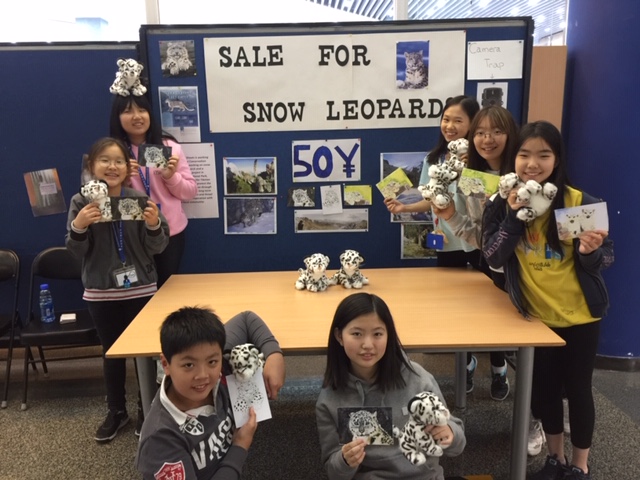
Fast forward a few months and the students at ISB, inspired by Wayne and Jenny, have been raising money by selling cuddly Snow Leopards and thanks to their efforts they now have enough to purchase their first camera trap!

On Friday this week, a scientist from ShanShui Conservation Center will visit ISB to explain about the project, show some pictures and videos, answer questions from the students and take receipt of the donation from ISB.  A camera, allocated to ISB, will then be placed on the Tibetan Plateau as part of the ongoing conservation programme.  A local family will be responsible for deciding the location and for monitoring the camera.  Every two to three months the school will receive the photos from ‘their’ camera, which will form the basis for learning about the Tibetan Plateau ecosystem.

Schools will thus be contributing to community-based scientific and conservation projects whilst gaining great material to support learning about the Tibetan Plateau and the animals and people that live there.

If successful, we hope this programme can be expanded with other schools sponsoring their own cameras.

Huge thanks to Wayne and Jenny Winkelman for their initiative in starting this exciting new programme, to ShanShui Conservation Center for engaging schools and especially to the students at ISB for so enthusiastically raising money to support Snow Leopard conservation.  I can’t wait to see the first photos from their camera and to see how this initiative develops.

If you are a teacher at a school in Beijing interested in sponsoring a camera trap or two, please get in touch!

April 2018 in the Valley of the Cats

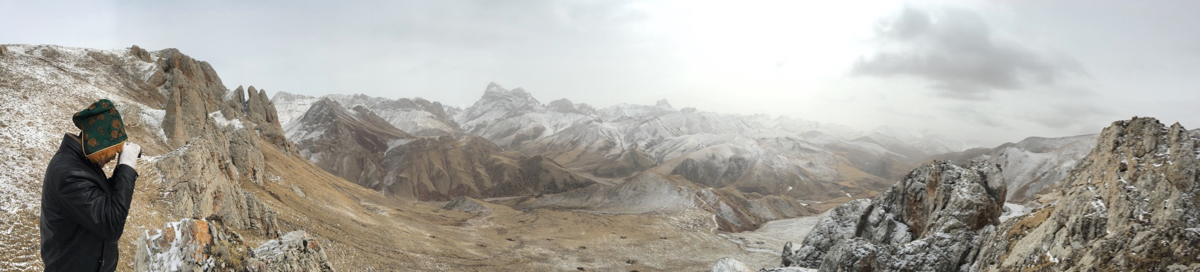
I’m just back from my first visit of the year to the “Valley of the Cats”, near Yushu in Qinghai Province.  With winter loosening its grip and daytime temperatures reaching 15 degrees Celsius, it was a good time to visit.

The purpose of the trip was to conduct the second training session for the local families about wildlife watching tourism.  And immediately before the training, I took the opportunity to accompany two teachers – Wayne and Jenny Winkelman from the International School of Beijing (ISB) – for a visit to the Valley as tourists.

Wayne and Jenny with their host family in the Valley of the Cats.

As well as seeing a Snow Leopard on day one, Wayne and Jenny were fortunate to see seven Tibetan Wolves in a day and enjoyed some spectacular encounters with species such as White-lipped Deer, Blue Sheep, Alpine Musk Deer and birds such as Tibetan Snowcock, Tibetan Babax and Lammergeier.

As well as the wildlife, they soaked up the culture with a hike to a 800-year old local temple and Jenny spent a day as a yak herder, helping to round up the yak and milking them in the morning..  Listen below to the wonderful sound of a yak grunting as it’s being milked..

After Wayne and Jenny’s experience, we’re hoping to set up a partnership between ShanShui and ISB with ISB sponsoring some camera traps in the Valley, the photos from which will be shared with the students.

Working with ShanShui Conservation Center and the local government, we conducted three days of training involving one day of ‘classroom-based’ activities followed by two days of field training.  As usual, the local families were a joy to work with and we learned as much from them as they did from us.

Day One: identifying the best sites for wildlife watching

This time, our training was focused on guiding.  We identified the best sites for wildlife watching and, splitting into two groups, visited each in turn.  Special wildlife recording sheets – in Tibetan, Chinese and English – were created and each family will now record all wildlife sightings including date, time, location, species, behaviour and any other useful information.  The data will be reported to a community focal point to help build up a picture of the wildlife in the Valley and to identify trends.  Importantly, when there are visitors in the Valley, the families will report any sightings via the walkie-talkie network, enabling the information to be passed to the host family and thus increase the chances of wildlife-watching tourists being able to enjoy the best possible experience.

The yak herders took us to some wonderful sites from where to watch the local wildlife

We were fortunate to be in the Valley at the same time as the Snow Leopard scientists from ShanShui and, with them accompanying us on the field visits, we were all educated in how to identify and collect mammal faeces.. especially Snow Leopard.  This is part of an ongoing study into the diet and behaviour of these special cats.

Snow Leopard scat on a prominent trail at an elevation of c4,700m.
An overnight dusting of snow on day two made it easy to spot mammal tracks – these were left by a pack of five Tibetan Wolves.

One of the priorities has been to try to secure some optics for the local guides..  and I am delighted to say that we are now in the advanced stages of negotiations with an optics manufacturer to provide 15 pairs of binoculars – one for each family.  Alongside a field guide to the nature of Sanjiangyuan, we’re beginning to build up the capacity of the families in the valley to be able to provide good quality guiding.

The Valley of the Cats is open to visitors, provided they obtain the necessary permits.  Look out for a dedicated website to be launched soon.  In the meantime, if you are interested in visiting, please don’t hesitate to contact me and I can help facilitate the arrangements.

Huge thanks to Li Yuhan and the team from ShanShui Conservation Center, to Wayne and Jenny Winkelman for being such great travel companions and to the local families for being such a joy to work with and for teaching us so much about their environment and culture.  I am looking forward to my return.

Below some more photos from the most recent visit, including some recent camera trap photos of Snow Leopard, Leopard and Pallas’s Cat, courtesy of ShanShui Conservation Center.

This slideshow requires JavaScript.


Beijing Schools Set Up Birding Clubs

Last Friday I visited the International School of Beijing (ISB).  On the back of their involvement with the Beijing Cuckoo Project, the three students elected as “Cuckoo Ambassadors” have set up a birding club.  Meeting on Friday afternoons, the group is planning to invite external speakers to talk about various aspects of birds and to arrange field trips to birding sites in Beijing.  I was invited to speak about the Beijing Swift.  After a short talk about the Beijing Swift Project and a great Q&A session, we discussed how ISB could help the declining population of Swifts, caused by the demolition of traditional buildings, many of which host Swift nests, and their replacement with new, shiny buildings with no nooks and crannies for Swifts.  Including ‘swift bricks’ in the designs of new buildings is one way to help and, for existing buildings, retrofitting nest boxes is another.  The students were keen to explore the idea of making nest boxes in their woodwork classes and erecting them on campus with a view to trying to attract a colony to their school and they will be discussing with their teachers this week.  If they go ahead, they’ll be the second school to commit to building and erecting swift boxes in Beijing after Harrow International School.

The first field trip, to Yeyahu, was scheduled for the following weekend.

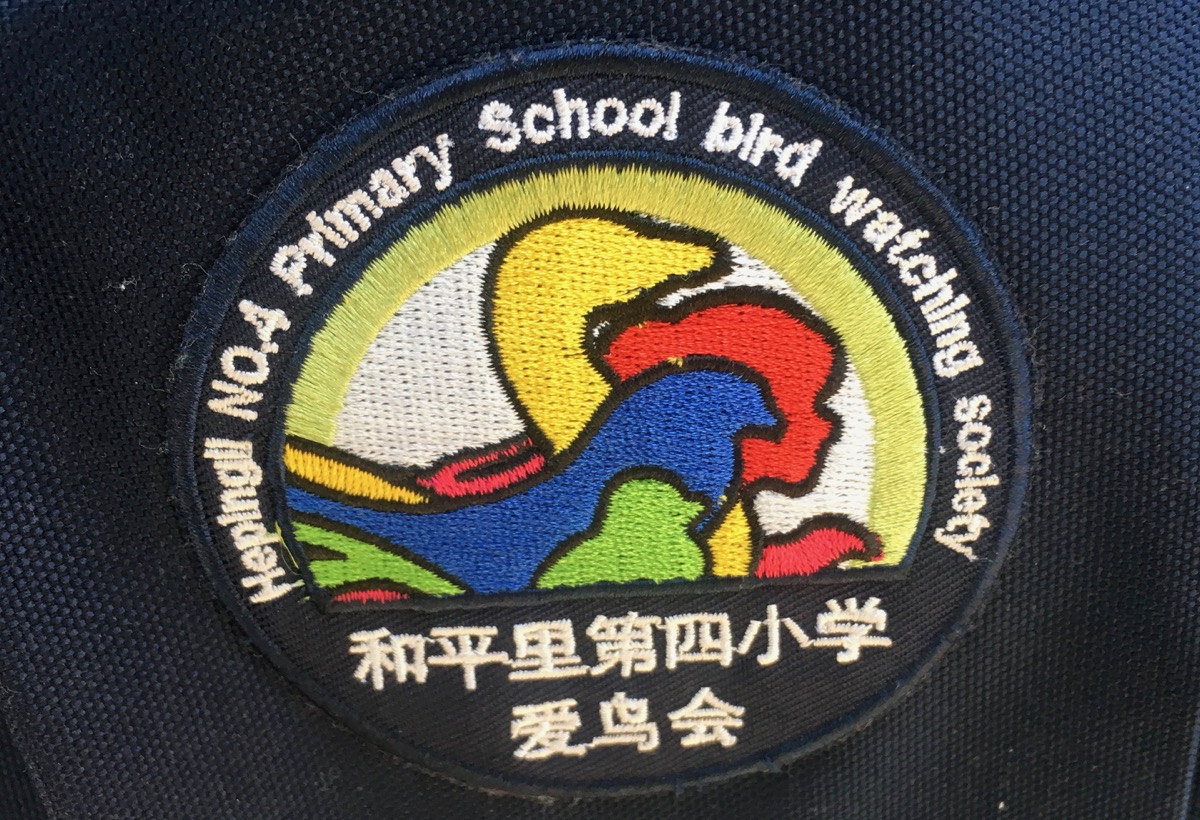
Just two days later I was at the Olympic Forest Park helping to lead a group of students from Hepingli No4 Primary School.  This school, too, has its own birding club and even has its own badge, proudly displayed on their backpacks!  On a beautiful, but cold, morning we enjoyed good views of some of the park’s residents including Grey Herons, Little Grebes and Light-vented Bulbuls.

Watching Little Grebes in the Olympic Forest Park with students from the Hepingli No4 Primary School Birdwatching Club
This group of Grey Herons was a major hit….
….as were the autumn leaves!
Li Xiaoyang was my chief apprentice!

It’s heartening to see Beijing’s schools setting up birding clubs and hopefully these two leading lights represent just the beginning of a new trend.

Update: On Monday 6 November I was informed that Kevin O’Shea, one of the teachers at the Canadian International School of Beijing (CISB), has just set up a wildlife club for students, meeting every Wednesday.  Congratulations, CISB!  

Title image: the badge of Hepingli No4 Primary School’s Birdwatching Society.


“A Bridge of Magpies”: Birds in Chinese Folklore

Over the last couple of weeks, we’ve been introducing the wonderful pupils at the International School of Beijing (ISB) to the birds of China’s capital city, including a field trip to Hanshiqiao (the wetland where Skybomb Bolt, the Beijing Cuckoo, was fitted with his tag).  As part of the classroom based material, Annie He, who is responsible for integrating Chinese culture into the ISB curriculum, created a brilliant document outlining how birds feature in Chinese folklore.  With Annie’s kind permission,  “Beyond The Legend”  is now available to download.  I love the story about the magpie’s role in Chinese Valentine’s Day:

“On the evening of the seventh day of the seventh month on the Chinese lunar calendar, don’t forget to look carefully at the summer sky.  You’ll find the Cowherd (a bright star in the constellation Aquila, west of the Milky Way) and the Weaving Maid (the star Vega, east of the Milky Way) appear closer together than at any other time of the year. Chinese believe the stars are lovers who are permitted to meet by the queen of Heaven once a year. That day falls on the double seventh (七⼣夕 in Chinese), which is China’s own Valentine’s Day. Most Chinese remember being told a romantic tragedy when they were children on the double seventh. In the legend, the cowherd and the Weaving Maid will meet on a bridge of magpies across the Milky Way once a year. Chinese grannies will remind children that they would not be able to see any magpies on that evening because all the magpies have left to form a bridge in the heavens with their wings.”