Every spring in Beijing, the hills are alive with the sound of music!
This year I set up a sound recorder on a forested hillside in Mentougou District at an elevation of c1,700m asl. The idea was to capture the sounds of spring, including nocturnal spring migrants and summer breeders. It was also a chance to gain insights into the arrival dates of some of the breeding species and to explore how the species richness evolves through the spring.
The Wildlife Acoustics Song Meter Mini digital recorder was active from 28 March to 13 June and recorded from sunset to one hour after sunrise (automatically adjusted).
Key Information:
- From 903 recordings over 78 nights, 84 bird species and 4 mammal species were recorded, with a few additional vocalisations not assigned to species level.
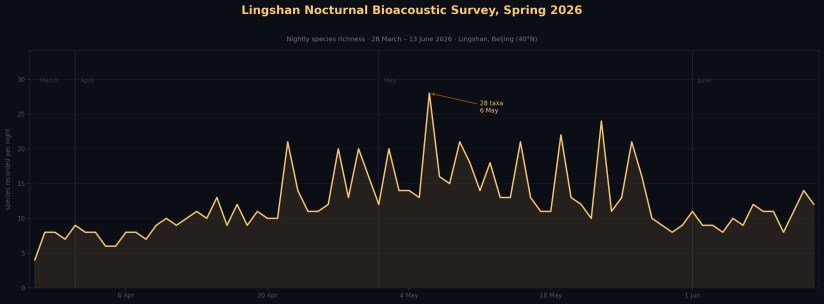
- The night of 6 May was the peak in terms of species richness, with 28 taxa recorded that night/early morning.
- Perhaps unexpectedly, several shorebird species were recorded, including Black-winged Stilt (Himantopus himantopus 黑翅长脚鹬 Hēi chì cháng jiǎo yù), Pied Avocet (Recurvirostra avosetta 反嘴鹬 Fǎn zuǐ yù), Greater Sand Plover (Anarhynchus leschenaultii 铁嘴沙鸻 Tiě zuǐ shā héng) – see below – and Whimbrel (Numenius phaeopus 中杓鹬 Zhōng biāo yù)
- Lesser Cuckoo (Cuculus poliocephalus 小杜鹃 Xiǎo dù juān) recorded on 8 and 12 June
- Japanese Scops Owl (Otus semitorques 北领角鸮 Běi lǐng jiǎo xiāo) recorded on five nights between 7 April and 18 May – see below
- Grey-backed Thrush (Turdus hortulorum 灰背鸫 Huī bèi dōng) recorded singing between 7 and 12 May – listen out for it in the dawn chorus recording below
- Brown Eared-Pheasant (Crossoptilon mantchuricum, 褐马鸡 Hè mǎ jī)
recorded on 31 March and 22 April
Below you can explore the results via an interactive graphic. For example, if you would like to know when Asian Stubtail (Urosphena squameiceps 鳞头树莺 Lín tóu shù yīng) was first detected, simply click on the species and you will be able to see the first and last dates detected, the number of detections and also the peak hour for that species.
Some selected highlights
The recording of several waterbird species at a mountain location may reflect the relatively close proximity of Guanting Reservoir – it is possible that nocturnal migrants begin to vocalise when they see the reflection of this large water body?
The recording of Greater Sand Plover (Anarhynchus leschenaultii 铁嘴沙鸻 Tiě zuǐ shā héng) was a bit of a surprise. It is even possible to hear a song element in the recording below.
Another surprise was Gull-billed Tern (Gelochelidon nilotica 鸥嘴噪鸥 Ōu zuǐ zào ōu). Recorded on 3 May 2026.
Japanese Scops Owl (Otus semitorques 北领角鸮 Běi lǐng jiǎo xiāo) is a species that remains a bit of an enigma in Beijing and is only rarely recorded. In the clip below are three examples of one of the more common vocalisations – a downward-inflected series of hoots – recorded on two separate dates (30 April and 16 May) but merged into one clip. No song was recorded this spring at the survey site.
Oriental Scops Owl (Otus sunia 红角鸮 Hóng jiǎo xiāo) was recorded an impressive 222 times over 45 nights, with the peak coming just after dusk. On several occasions, I heard an unfamiliar shrill call immediately after a burst of familiar song. Initially baffled, I realised after reading this article from The Sound Approach about European Scops Owl that it was a copulation call. Listen to the example below with two birds singing (a pair?), gradually becoming more strident before the copulation call at the end.
Additionally, there was one intriguing pulsed vocalisation that is reminiscent of Asian Barred Owlet (Glaucidium cuculoides 斑头鸺鹠 Bān tóu xiū liú). Have a listen below. Although superficially similar to this species, there are some anomalies, including the pulse rate and frequency structure, that make it atypical and lead me to leave it unidentified. Comments and suggestions about the identity of the vocaliser are welcome!
Edit: Thanks to Liu Shuangqi, it seems possible that this pulsed vocalisation originates from an amphibian and, specifically, Bombina orientalis (Oriental Fire-bellied Toad). Although audio recordings of this species are few, there is a YouTube video including the so-called ‘release call’ of a similar species – Bombina variegata – that is a close match.
The Dawn Chorus
Below is a 5-minute compilation of the dawn chorus, including roughly thirty seconds from each of several dates through the spring. It begins with an atmospheric calling Red Fox (Vulpes vulpes 赤狐 Chi Hu) in the dark of night, followed by snippets from 30 March, 15 April, 30 April, some selected highlights from three thrush species in early May, followed by more clips from 21 May, 1 June and ending with one of the latest species to arrive – the Lesser Cuckoo (Cuculus poliocephalus 小杜鹃 Xiǎo dù juān) – on 12 June. The recording illustrates how the dawn chorus evolves as spring progresses.
I hope you enjoy the recording and also delving into the data below. By clicking on a species, more data will be revealed, including first and last dates recorded and peak hour.
Summary of spring 2026