Tag: Beijing Swift Project

  • Beijing’s Nature, Including The Beijing Swift, Takes Centre Stage at COP17

    Beijing’s Nature, Including The Beijing Swift, Takes Centre Stage at COP17

    Many readers will be aware that the UN’s biodiversity conference – the 17th Conference of the Parties to the UN Convention on Biological Diversity, or COP17 – is taking place in Yerevan, Armenia this October. It is an important meeting: for the first time, countries are taking stock of the Kunming-Montreal Global Biodiversity Framework, measuring progress against its 23 targets for 2030 using the national biodiversity strategies they have submitted. It is the first real test of whether the 2022 deal is turning pledges into results, with only four years left.

    Despite progress in some areas it is clear that, collectively, the international community is not on track. The Paulson Institute’s report “Financing Nature – A Mid-Decade Update“, published in September 2026, found that the global biodiversity financing gap – the difference between what the world spends on nature and what it needs to spend to safeguard the most important ecosystems and the services they provide) has grown from USD c711 billion in 2019 to 1.3 trillion in 2025 (using data from BloombergNEF). It is a damning indictment of how we manage the global economy that, for every dollar spent on conserving nature, more than 30 are spent incentivising its destruction through harmful subsidies in agriculture, fisheries and forestry. I don’t believe the public supports such warped incentives and, with greater transparency about how public money is used, I believe there would be more pressure on politicians to ensure that it supports public goods.

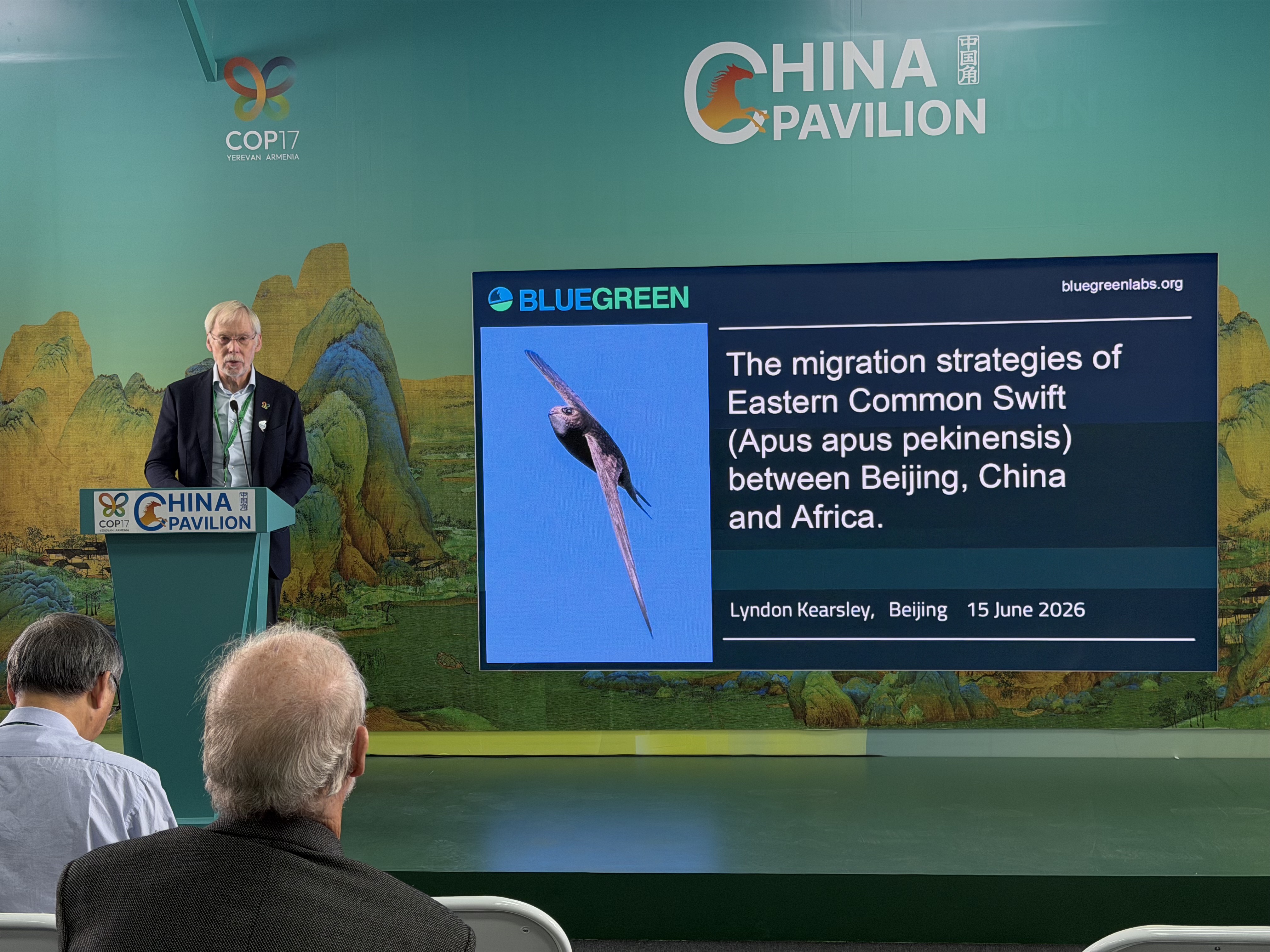
    That trajectory is why success stories matter so much. So it is heartening to report that, at the China Pavilion at COP17, a whole day was dedicated to Beijing’s biodiversity, with the Beijing Swift Project as the centrepiece. Lyndon Kearsley, a swift expert who has been an invaluable part of the project since 2014, was invited to present the results of the tracking study that has followed the swifts from the Summer Palace in Beijing to southern Africa and back. It was a big moment for the project and a celebration of all the hard work by so many people. The project has been led by the China Birdwatching Society, the Beijing Wildlife Rescue and Rehabilitation Center and the Beijing Academy of Forestry and Landscape Architecture, with the support of scientists from Europe, including from the British Trust for Ornithology. It was Dick Newell who, back in 2013, first suggested to me the potential for a collaboration between European and Chinese scientists to track the Beijing Swift and it has been one of the honours of my life to be involved in the project from the beginning, including latterly working with H.E Bruno Angelet, Ambassador of the Kingdom of Belgium to China, who has spearheaded the latest phase.

    Lyndon Kearsley presenting the results of the Beijing Swift tracking study at COP17 in Yerevan, October 2026 (Photo by Zhang Xiaochuan).

    There is no doubt that the Beijing Swift Project is a fantastic example of how countries can work together to better understand the ecology of a species that spans continents, the data from which can be used to support its conservation.

    The Beijing Swift is an iconic species that has captured the public imagination. It links China’s capital with southern Africa, via Central Asia, the Gulf and Arabia; latest data show that it flies more than 100,000km in a single year (the 30,000km often quoted is the distance between Beijing and southern Africa and back that does not take into account the birds’ every day movements); and, thanks to the latest technology, in 2026 we were able to confirm that these birds stay airborne for nine months from when they leave Beijing in late July until their return the following April – eating, drinking and even sleeping (though not sure how they do it!) in the air. All of this makes the Beijing Swift the perfect ambassador for Beijing’s and China’s biodiversity.

    As readers of Wild Beijing will know, Beijing is an incredibly rich city for nature. Located on one of the world’s major migratory bird routes – the East Asian-Australasian Flyway (EAAF) – and cradled by mountains, the capital supports a range of habitats and an incredible amount of wildlife. A staggering 7,121 species were recorded in baseline surveys between 2020-2024. This includes more than 60 species of Odonata (dragonflies and damselflies), over 180 species of butterfly, more than 60 mammals (including the leopard cat), 24 reptiles, 8 amphibians, more than 1,500 native plants and, of course, more than 550 species of bird have been recorded since records began. That is impressive for a major capital city. The graphic below, reproduced with permission, was created by 胡元瀞 (Hú YuánJìng) on behalf of the 生环局 (Beijing Bureau of Ecology and Environment) and 园林局 (Beijing Municipal Forests and Parks Bureau) to showcase this biodiversity and was used to decorate the China pavilion at COP17.

    I could not imagine such a profile for Beijing’s nature when I arrived in the city in 2010 – the progress here in terms of awareness, understanding, scientific research, media coverage and political priority for nature has been impressive. Of course there is still a long way to go to fully integrate nature into urban planning (including rebalancing the over-emphasis on tree cover) but, working on these issues, there is nowhere I would rather be.

    For more detail about the Beijing Swift Project, see here. And for more details about “Beijing Day” at COP17, click here for an article (in Chinese).

    In the meantime, enjoy the graphic!

  • Schools For Swifts: Harrow Beijing to Make and Erect Swift Boxes

    Schools For Swifts: Harrow Beijing to Make and Erect Swift Boxes

    Two years ago, after an agonising 12 months wait, the Beijing Swift Project proved, for the first time, that the capital’s Swifts migrate to southern Africa for the northern winter.  The astonishing journey, which sees them fly more than 26,000km per year (and, by the way, many of them probably don’t land at all!), has inspired not only scientists but also everyday Beijingers.  As well as the national mainstream media coverage reaching millions of Chinese, the story of the Beijing Swift has been the subject of science lessons by forward-thinking teachers and features in magazines.  One of the most important aspects of the coverage has been to shine a spotlight on the population decline of the Beijing Swift.  Although hard data is sketchy, it is clear from speaking with local ornithologists that the number of Swifts circling in the skies over Beijing has fallen dramatically.  The main culprit is the loss of nest sites caused by the destruction of traditional buildings, complete with lots of nooks and crannies, which have been replaced by modern, high-rise developments with their straight lines and smooth surfaces – not so good for the Beijing Swift.

    I’ve lost count of the number of schools I’ve visited to tell the story of the Beijing Swift and, almost without exception, the schoolchildren are very concerned when they hear about the decline and want to do something about it.  One group is planning to write to the CEO of China Soho, the largest real estate developer in Beijing, to ask that they will consider designing in Swift boxes to their new buildings to provide replacement nest sites.  And now, one school is going a step further!

    A few weeks ago I met with Paul Shelley, Head of Design and Technology at Harrow Beijing, one of the capital’s international schools.  Paul is keen for students to link their woodwork classes to conservation and, after sharing designs of Swift boxes, the woodwork students at Harrow will, this autumn, build and then erect swift boxes to the campus in Beijing with the hope of attracting Swifts to begin a new colony on site.

    The campus of Harrow Beijing. Thanks to the teachers and students, there could soon be the sound of screaming Swifts on summer evenings!

    Of course, there is no guarantee that they can attract Swifts and it will take some time, and some encouragement by way of playing Swift calls at the right time of year, to maximise the chances of success…  but what a brilliant initiative!

    It’s something I think could catch on…  school campuses offer perfect sites for Swift colonies – often they are large buildings with eaves and with large open spaces to the front, providing Swifts with plenty of access.  It’s certainly something that I’ll include in my briefings on the project in the hope that other schools follow suit.  Who knows – this could be the start of a new initiative – “Schools For Swifts”..!?

    Kudos to Harrow, and Paul in particular, for making this happen and I wish Paul and his students the best of luck when the autumn term begins in September.  Watch this space for updates!


    Title image: Swifts at the Summer Palace

  • Beijing Swifts 2017

    Beijing Swifts 2017

    I spent Saturday morning with Belgium-based Lyndon Kearsley and the Beijing team at the Summer Palace for the annual Swift banding project.  Led by Professor Zhao Xinru of the China Birdwatching Society, in collaboration with scientists from the UK, including the BTO, Sweden and Belgium, the project has recently been responsible for discovering the Beijing Swift’s wintering grounds and migration route, proving for the first time that these incredible aviators travel to southern Africa and back every year.

    This year, we are hoping to prove an even more incredible aspect of the Beijing Swift’s lifestyle.  In 2016 selected birds were fitted with a new type of technology – accelerometers – which can, in short, establish whether the birds are moving or stationary.  Having this morning recaptured seven birds fitted with accelerometers in 2016, and provided the data are good, we should be able to show whether these birds have spent the nine months away from Beijing in continuous flight, just as Susanne Åkesson and her team have recently proved with Swifts from Sweden.  Wouldn’t that be something?

    The analysis of the data will take some weeks and months to complete, so we don’t expect to have an answer quickly.  In the meantime, here is a short video of the Beijing Swifts in slow motion, taken this morning at the Summer Palace.  One striking aspect is the sound of the calls when slowed down…  my advice is don’t play this video if alone at night or at Halloween – it’s almost creepy!

    Huge credit to our Chinese colleagues, especially Professor Zhao Xinru, Wu Lan, Liu Yang and the army of volunteers who work so hard to make the project a success.  And big thanks to Dick Newell, Chris Hewson, Lyndon Kearsley, Susanne Åkesson, Rob Jolliffe, Geert De Smet and Gie Goris who have all played a key role in the Beijing Swift Project over the last few years.