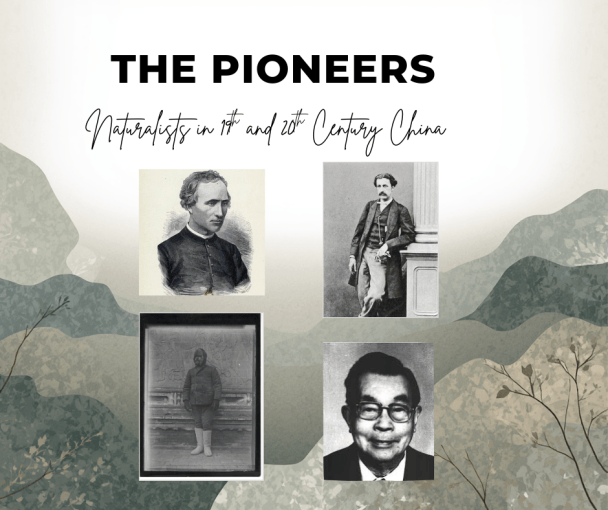
This article is part of an ongoing series about the 19th and early 20th Century ‘Pioneers’ who laid the foundation for modern Chinese natural sciences, particularly ornithology.
=====
Where Robert Swinhoe was the great pioneering systematist of coastal China, and Père David the intrepid explorer of the interior, the generation that followed had a different task: to consolidate, to observe patiently over decades, and to turn scattered discovery into a coherent body of knowledge. Few did this more thoroughly than a quiet, meticulous customs official who spent almost forty years watching the birds of China’s eastern seaboard.
So who was La Touche?
John David Digues La Touche (1861–1935) was, like Swinhoe before him, a man whose official career was merely the passport that carried him to his life’s real work. He was born on 5 June 1861 in Tours, France, into a family of Huguenot descent that had long since put down roots in Ireland — the La Touches of Marlay, near Dublin, traced their line to David Digues de la Touche, who had fled France after the Edict of Fontainebleau revoked Protestant liberties in 1685. Educated at Downside School in Somerset, the young La Touche was, in temperament and identity, thoroughly Irish, though French by birth and cosmopolitan by inheritance.
In 1882, aged twenty-one, he entered the Chinese Imperial Maritime Customs Service — the vast, foreign-staffed institution that administered China’s tariffs and, incidentally, scattered educated Europeans across the country’s treaty ports for years at a stretch. It was an ideal posting for a naturalist. Like Swinhoe’s consular career, La Touche’s customs work gave him something rarer than money: time, a fixed base, and repeated seasons in the same place, year after year. Where earlier collectors had passed through, La Touche stayed — and it was this patient continuity that would set his ornithology apart.
His heart lay in Fujian. Based for many years at Fuzhou (Foochow), he came to know the birds of the surrounding hills and coast with an intimacy that few Western naturalists in China ever achieved. His very first publication, in 1887, dealt with the birds of Fuzhou, and in 1892 he produced a substantial account of the birdlife around Fuzhou and Shantou. He was not content merely to shoot and label specimens in the manner of the “cabinet men”; like Swinhoe, he prized observation of living birds — their habits, their seasons, their voices — and it is this field-based sensibility that gives his later work its enduring value.
La Touche rarely worked alone. His most important collaborator was Charles Boughey Rickett, a fellow Englishman in China with whom he explored the breeding birds of Fujian, publishing jointly in 1905. The two men’s collecting was so closely intertwined that a genus of trapdoor spider, Latouchia, commemorates La Touche as co-collector of its Chinese type species alongside Rickett. He also worked, in the manner of his generation, with the great museum authorities back in Britain — most notably William Robert Ogilvie-Grant, curator of birds at the British Museum, with whom he collaborated in 1907 on the avifauna of Formosa (Taiwan), describing and naming birds from specimens sent home from the field.
His restless curiosity carried him well beyond Fujian. Over the decades he reported on the birds of Zhenjiang on the lower Yangtze (1906), the north-east of Zhili (Hebei) Province (1920), Hubei (1922), and, from 1923, the birds of south-eastern Yunnan. He grasped early the scientific importance of China’s coastal islands and headlands as migration watchpoints: his observations from tiny Shaweishan Island in the Yangtze estuary in 1911, and from Qinhuangdao in 1914, provided the first reliable migration data from those stations — pioneering work in a field, migration study, that was then still in its infancy. In 1913 he rediscovered the elusive Slaty Bunting, providing the first illustration of the female — a bird that would later carry his name in its genus, Latoucheornis.
The Handbook: A Monument in Ten Parts
La Touche’s official career ended with his retirement in June 1921, but his greatest achievement was still to come. Settled back in Ireland — first in Dublin, later at Newtownmountkennedy in County Wicklow — he turned nearly four decades of accumulated field notes, specimens, and correspondence to the task of a lifetime: A Handbook of the Birds of Eastern China.
Published by Taylor & Francis of London in ten parts across two volumes between 1925 and 1934, the Handbook covered the provinces of Chihli (Hebei), Shantung (Shandong), Kiangsu (Jiangsu), Anhwei (Anhui), Kiangsi (Jiangxi), Chekiang (Zhejiang), Fohkien (Fujian), and Kwangtung (Guangdong) — the whole sweep of China’s eastern seaboard. It systematically treated some 750 species and subspecies, drawing together his own observations with the scattered literature of his predecessors into the first comprehensive, region-wide reference of its kind. For the generation of ornithologists who followed — including the Chinese scientists who would soon found their own national tradition of the science — it was an indispensable foundation. It remains a landmark in the ornithological literature of China.
Fittingly, on completing the work, La Touche gave his valuable collection of Chinese birds to the Museum of Comparative Zoology at Harvard University, ensuring that the physical record behind the book would be preserved for future study.
A Legacy in Names
Like the pioneers before him, La Touche is commemorated in the names of the creatures he helped bring to science. His collecting extended well beyond birds — he gathered reptiles and amphibians too, a collection worked up by the herpetologist George Albert Boulenger in 1899 — and it is across several groups that his name survives:
- La Touche’s frog (“Hylarana” latouchii)
- La Touche’s mole (Mogera latouchei)
- La Touche’s free-tailed bat (Tadarida latouchei)
- A Chinese water snake (Opisthotropis latouchii)
- The trapdoor-spider genus Latouchia
- The Slaty Bunting, long placed in its own genus Latoucheornis in his honour – though molecular studies have since shown it to sit comfortably within the buntings proper, and it is now usually treated as Emberiza siemsseni, with the genus that bore La Touche’s name no longer in general use.
His wife, née Caroline Dawson Focken, shared in the fieldwork; the flowering plant genus Latouchea (family Gentianaceae) commemorates specimens the couple collected together.
A Quiet Ending
In the winter of 1934, with the final part of his Handbook just published, the elderly La Touche travelled to Mallorca. He died on 6 May 1935, at sea, on the voyage home to Ireland, aged 73. His obituary appeared that October in Ibis, the journal of the British Ornithologists’ Union — the same publication that had carried so much of the pioneering work on China’s birds, from Swinhoe’s day to his own.
Robert Swinhoe opened the door to the scientific study of eastern China’s birds; John David Digues La Touche walked through it and stayed for forty years, patiently filling in the map. If Swinhoe was the discoverer, La Touche was the great documenter — the naturalist who transformed a lifetime of quiet, seasonal watching along the China coast into a reference work that outlived him and served everyone who came after. So the next time you leaf through a modern field guide to the birds of China and find, quietly noted, the status of some warbler or bunting on the eastern seaboard, remember that much of that knowledge began with a customs officer in Fuzhou, notebook in hand, watching.
References:
Anonymous (1935). “Obituary: John David Digues La Touche.” Ibis 77 (4): 889–890.
Boulenger, G. A. (1899). “On a Collection of Reptiles and Batrachians made by Mr. J. D. La Touche in N.W. Fokien, China.” Proceedings of the Zoological Society of London 1899: 159–172.
La Touche, J. D. D. (1925–1934). A Handbook of the Birds of Eastern China. 2 vols., 10 parts. London: Taylor & Francis.
Rickett, C. B. & La Touche, J. D. D. (1905). On the birds of the province of Fohkien.