China is a good place to see bitterns. In addition to the Great Bittern (the one familiar to European readers), it is also possible to see Black Bittern, Cinnamon Bittern, Von Schrenck’s Bittern and Yellow Bittern. Of the smaller bitterns, the Yellow Bittern is most numerous in Beijing with Von Schrenck’s also breeding in small numbers. Cinnamon is an occasional (and increasing?) late Spring visitor (and possible breeder?) and there is just one record of Black Bittern.
Below are some images of Cinnamon, Von Schrenck’s and Yellow Bitterns, all taken in Beijing or neighbouring Hebei Province.
First, the beautiful richly coloured Cinnamon Bittern.
Cinnamon Bittern (male). No mistaking this species!Cinnamon Bittern (presumed female with streaking below and pale spotting on the upperparts).
Next up, Von Schrenck’s Bittern. The males and females look quite different.
Von Schrenck’s Bittern (male). Note the dark back, dark face and wing pattern (compared with Yellow Bittern below).Von Schrenck’s Bittern (male).Von Schrenck’s Bittern (female). Note the heavy and dark streaking.Von Schrenck’s Bittern (female). Note the white-spotted upperparts combined with the dark back and face.
Finally, the Yellow Bittern. A common breeder, including in the Olympic Forest Park and Yeyahu NR.
Yellow Bittern (male). The contrasting underwing is a good feature of Yellow Bittern).Yellow Bittern showing uppewing pattern. This individual has a particularly dark back.Yellow Bittern.Yellow Bittern from below.
On Sunday we visited the Bai He valley (about 2 hours north of Beijing city). It’s an attractive drive when the weather is good and the pollution levels low, as was the case for our visit. The Bai He valley is well known in Beijing birding circles as one of the few remaining sites in Beijing Municipality where one can see the unique Ibisbill (Ibidorhyncha struthersii). “Unique” is an overused word but, as a descriptor for the Ibisbill, it is surely appropriate. The Ibisbill belongs to the order Charadriiformes which also includes sandpipers, plovers, terns, auks, gulls, skuas and others but is sufficiently distinctive to merit its own family, Ibidorhynchidae. The species is named in honour of Dr. Struthers of Glasgow who collected specimens of the bird from the Himalayas in the 19th century.
Many people see their first Ibisbill on a vast, flowing stony river at high altitude in the Himalayas and it almost seems a little surreal to find them on a narrow river near China’s capital where it competes with sickly-looking domestic ducks and, at this time of year, tourists paddling downriver in inflatable dinghies…
Despite the disturbance, which also includes a steady flow of tourists following the completion of a wooden boardwalk along the area favoured by these special birds, the Ibisbill is hanging on, a good example of the resilience of nature.
We saw three individuals today in exactly the same spot as when I first visited this site shortly after I arrived in China in 2010.
Ibisbill, Bai He valley, Beijing, 15 July 2012. One of three seen today.One of the signs along the new boardwalk in the Bai He valley.Good advice….
The Ibisbills at Bai He have proved very popular with birders visiting Beijing over recent years. Long may that continue!
This is the latest in a series of guest posts from China-based birders. Written by Jan-Erik Nilsen, a Swedish birder who has lived in China for 3 years, it’s an account of a recent trip into the mountains around Beijing.
Haitou Shan Mountain, Hebei Province, Saturday, 23rd June 2012.
Beijing is from SW clockwise to NE surrounded by mountain ranges and several peaks reach above 2000 m. From about 1500 m to the tree line at about 1900-2000 m, a more Northern vegetation of coniferous forest and birch trees can be found. The changing vegetation zones on the mountainsides bring an interesting diversity of bird species.
With a peak reaching to 2200 m, Haitou Shan should be the second highest in the greater Beijing area and it’s located N of the Guanting Reserve (where Ma Chang is located) in Hebei province. I have climbed this mountain two times before, then with a hiking group and no time for birding. I noticed abundant numbers of Hume’s Warblers and other interesting birds and that’s why I have nursed a plan to return by myself for proper birding, a plan to be executed this day.
Driver Mr Chen picked me up in Beijing at 01.00, in the tropical hot and very early morning. We drove the 4th ring road towards the NW, not much traffic so far, but on the Badaling Expressway trucks suddenly crowded, and we hit a traffic jam even before we had entered the mountain area NW of Beijing. We found ourselves caught among big trucks, most of them for coal transport, now emptied and on the way back to the coal fields in Inner Mongolia or Shanxi. Soon the traffic slowly began to move again, the police had narrowed the road at a certain point to reduce the traffic further on. In mornings, evenings and nights, the number of trucks on the Badaling Expressway and all the way to Inner Mongolia can be enormous in both directions. Once, on a trip by car along the 500 km way to Hohhot, capitol of the Inner Mongolia autonomous region, I hit several traffic jams and the normal 5 h ride became 10 h.
We lost some 30 minutes here before we were up to full speed again, continuing the expressway until we had crossed the bridge over the Guanting Reservoir. On the other side of the reservoir we turned north and found our way to the Dahaitou village at the western foot of the mountain. I noticed the first shade of the morning light at 03.45 but, due to the overcast skies, birding was hardly possible until 04.45, and we arrived at Dahaitou at 5.00. Last time at the same mountain, the hiking guide told me Dahaitou was the name of the village where we started the climb. It was not, and I realised it could take hours to find the right village, so I just started to hike on a track up the mountain that looked good.
The peak of the mountain and some of its many subordinated peaks where disguised in mists and clouds, bringing a mysterious feeling to the peaceful morning. Later the mist gradually decreased, lower hanging clouds disappeared, and little by little revealed spectacular views of the hills and mountains.
After one hour the track still existed but looked as if it had hardly been used for a hundred years or so. I continued anyway, and soon found myself in a several hundreds meter radius bowl, three quarters surrounded by 50 or 100 m high steeps. As giving up has never been my favourite option, I found a less steep part and climbed up there, through jungle-like dense vegetation, without any sign of a decent track. I targeted a coniferous forest some 300 m higher up, I knew it would be easier to hike there. But long before, the slope became steeper, the vegetation more dense and even more difficult. I had to grab branches of trees for each step to keep my balance.
I looked at the mountain, still disguising its highest peak in clouds and mist. A Songar Tit perched in a dead tree a few meters in front of me and looked curiously at me – a behaviour I recall from their cousin Siberian Tit in Northern Scandinavia – and soon another one joined. I bet they wondered why this strange beast could be so stupid to try to climb such difficult terrain. A glimpse on the watch convinced me it would take too long to make it to the coniferous forest. I went down again, becoming very mindful of how steep and difficult the climb up had actually been, and it was even more difficult to climb down. It took a lot more than a little effort to find the right way down and avoid the steep sides bordering the ‘bowl’, but I did find a way down, and all in all I had some good birding too, during this 4,5 h hike.
A Large Hawk Cuckoo called, Yellow-bellied Tits were around, interesting Phylloscopus warblers such as Eastern Crowned, Claudia’s, Chinese Leaf and Yellow-streaked Warblers were singing. The highlight was a Chinese Beautiful Rosefinch, at only 1300-1400 m altitude. I encountered this species above the tree limit, where they normally reside, last time I climbed the mountain. That was actually only a km or so away, so it’s not a long distance flight for them.
Back at the village, a village elder approach me and pointed out a track in a more southern direction. We could drive the car up there for 15 min, from where I began a new hike. The vegetation here was a little different from the last place, higher trees and less jungle-like. After half an hour I saw something looking like a red carpet. When I came closer I found the red carpet was spread over the stairs leading to a temple. Smoke came out from the doorway, so dense I could hardly see through it. I stepped into the temple and faced three gods staring at me from an altar. Their eyes arranged so they all three stared on you just when entering the temple, and it made the three of them look very alive.
The smoke came from incense burning in a pot in front of them, and fresh fruit had been put on the altar. Someone had obviously served the altar earlier today. I nodded to the three gods to show them respect and then left. I continued the track up the mountain, the track became very bad after a while and time was running out. The climb to the top would total 3-4 hours on a good track; there was no way I could make it that quick on this way up. So I returned, was back at the car at 13.15, after a 3,25 h second hike. Two tries in a day, but never reaching higher than about 1600 m.
The birding was quite alright also at this second hike. An Oriental Cuckoo calling, a singing White-bellied Redstart, and a Yellow-throated Bunting. The same Phylloscopus species again, except the Yellow-streaked was replaced by a Hume’s Warbler. I believe there will be a lot more Hume’s Warblers higher up the mountain, as they were very abundant the two times I went up there before. An Asian Stubtail was singing, or what we shall call the insect-like noise this 9-10 cm very small bird produces. Ref. Paul Holt, Beijing is the southern limit of the species.
I recorded calling and singing birds on my iPhone and confirmed them on Xeno-Canto at home, which worked very well, except for a few calls still to be identified.
It’s difficult to compare the birding of Haitoushan with the more frequently birded Wulingshan, NE of Beijing, as I didn’t reached that high altitude here, but I guess this place can provide similar species. An advantage of Wulingshan is of course the simple access to high altitude by car.
The temple was named Long Wang Miao, Dragon King Temple, and my Chinese teacher later explained the main god here was the Dragon King, a mid-level Dao god mainly in charge of making rain.
Early morning view over Dahaitou village.Misty morning, somewhere up there is the 2200 m peak of Haitou Shan.Long Wang Miao, The Dragon King Temple.
Full species list:
Common Pheasant 4 calling
Great Spotted Woodpecker 1
Large Hawk Cuckoo 1 calling
Oriental Cuckoo 1 calling
Rock Pigeon 2
Amur Falcon 3 Dahaitou + 8 on telephone lines N of Dahaitou
Red-billed Blue Magpie 1
Black-billed Magpie 2
Spotted Nutcracker 1
Large-billed Crow 4
Euarasian Blackbird 1
Siberian Blue Robin 1 singing
Daurian Redstart 4
White-bellied Redstart 1 singing
Eurasian Nuthatch 1 calling
Winter Wren 2 singing
Marsh Tit 1
Songar Tit 5
Coal Tit 1
Yellow-bellied Tit min. 15
Eastern Great Tit 2
Long-tailed Tit ca 25
White-browed Chinese Warbler 2 calling
Asian Stubtail 1 singing
Yellow-streaked Warbler 1 singing
Chinese Leaf Warbler 2 (1 singning+1 calling)
Hume’s Leaf Warbler 1 calling
Eastern Crown Warbler 7 singing
Claudia’s Leaf Warbler 7 ca, singing and calling
Vinous-throated Parrotbill ca 5
Eurasian Tree Sparrow ca 5
Grey-capped Greenfinch 2
Chinese Beautiful Rosefinch 1 seen and calling
Godlewski’s Bunting 2
Meadow Bunting 3
Yellow-throated (Elegant) Bunting 1m
Butterflies of 3 types ca 50
Jan-Erik Nilsén is a Swedish birder who has worked in Beijing for 3 years for a Scandinavian food company. Before that he lived in Denmark for 5 years. During his spare time he very much enjoys the many interesting birding sites in the Beijing area and has found Beijing/China rarities such as Common Ringed Plover and Pallid Harrier.
I saw my first Pacific Swift in Copenhagen, Denmark, in June 2010 just a few weeks before moving to China. Since then I have seen many more in north-east China – it is a common migrant through Beijing in spring and autumn. Last year, a thorough assessment of four Pacific Swift subspecies by Paul Leader (Leader, P J. 2011. Taxonomy of the Pacific Swift Apus pacificus Latham, 1802, complex. Bulletin of the British Ornithologists’ Club 131: 81-93) found that they may deserve species status. This is an extract from an article in Birdwatch magazine by David Callahan in June 2011:
“Four subspecies of Pacific Swift are generally recognised, and the species as it is known traditionally has a wide breeding distribution throughout the eastern Palearctic. It is a long distance migrant, wintering south to Indonesia and Australasia.
Leader (2011) measured and assessed the plumage of 146 specimens of Pacific Swift from four different museums across Eurasia, as befits a species with pan-Palearctic records. The four forms were found to differ in wing and tail measurements, as well as the size and shape of their distinctive white rump patch, white throat patch, pale underpart fringes and the colour of the underwing coverts.
The new prospective species are as follows:
Pacific SwiftApus pacificus: cleaner white throat patch, a slightly longer tail fork and tail length, and the broadest rump patch by a margin; breeds from Siberia through to Japan, winters from Indonesia south and east to Tasmania (incorporating the subspecies A p pacificus and A p kurodae – other subspecies were found to be invalid).
Sàlim Ali’s SwiftA salimali: five to 10 mm longer tail but with similar wing length to A pacificus, throat patch forming a thin white strip half the width of the other three forms, thinnest at the bill end, and very little white to the underpart feathers; breeds at high altitude on the east Tibetan Plateau and west Sichuan, China, but its winter range is unknown.
Blyth’s SwiftA leuconyx: the smallest of the four forms, with the rump patch consistently narrow, brown-tinged crown and nape contrasting with the glossy black mantle, broad white thoat patch with black shaft streaks extending onto the upper breast, hardly any pale underpart fringing; mid- to high-altitude breeder across the Himalayan part of the Indian subcontinent into Bhutan and Nepal.
Cook’s SwiftA cooki: shallowest tail fork, first primary the longest (the other three have P2 as the longest), narrow white rump patch with dark, club-shaped shaft streaking, overall black upper- and underpart-coloration (brownish tinge in the other three), broad well-defined fringes to the underpart feathers, throat patch off-white with broad black shaft streaks, black contrasting underwing coverts, and green iridescence to upperparts with some white fringed scapulars; restricted range in limestone caves in northern south-east Asia, and a short distance migrant to then south.”
During my recent trip to Jiuzhaigou, I enjoyed watching a flock of “Fork-tailed” Swifts wheeling around the mountain tops at around 3,000m altitude. A (poor quality) image of one of them is below.
Fork-tailed Swift, Jiuzhaigou, 27 June 2012. Is this a Salim Ali’s Swift?
Compare this image with a couple of Pacific Swifts taken at Laotieshan in May 2011:
Pacific Swift, Laotieshan, Liaoning Province, May 2011Pacific Swift, Laotieshan, Liaoning Province, May 2011.
To my eyes at least the bird from Jiuzhaigou appears longer tailed and with a narrower white patch on the rump. I don’t have access to the article by Paul Leader so I am not sure on precise range but I think there is a good chance this is a Salim Ali’s Swift. Comments welcome!
Paul Holt has just finished his detailed trip report from his visit to Liaoning in May. Bai Qingquan, Tom Beeke and I were lucky enough to accompany him for parts of his trip that included two firsts for the Province – Kamchatka Leaf Warbler and Black-winged Cuckooshrike – plus some impressive counts of waders, including a high count of up to 19 Nordmann’s Greenshanks, Bar-tailed Godwits (10,000), Eastern Curlew (4000), Great Knot (4600), Dunlin (10,400) and Broad-billed Sandpiper (1117). You can download the full report here:
I have recently returned from the Rio+20 Summit in Brazil. I hope you forgive me for writing a short opinion piece here about the event and my assessment of the outcome.
Reading the headlines in the international media, it is easy to be depressed about the outcome of Rio+20 (officially called the UN Conference on Sustainable Development). Lacking any specific targets, timetables or new financial commitments, the Outcome Document has been described as “weak”, “unambitious” and as “a backward step”, with some even going so far as to nickname the Summit “Rio Minus 20”. Is this criticism justified?
John Vidal in The Guardian this week reminded us of the comments of prominent environmentalist Richard Sandbrook after the outcome of the original Rio Earth Summit in 1992. Those outcomes were similarly received and Richard said:
“NGOs always scream murder because it is their job to push governments, pundits exaggerate because they are controversialists, and UN conferences always disappoint because all views must be accommodated.”
Wise words and we would do well to have them in mind when assessing the outcome of any UN or intergovernmental meeting.
Judging international progress on the sustainable development agenda by reading the text of a document alone would be to ignore the substantial advances at the regional, national and local level.
There have been great strides since 1992. We now have the UN Conventions on Biological Diversity, Climate Change and Desertification and, although many will argue these Conventions have failed to deliver their desired outcomes, there is no doubt that they have helped to focus government attention on these issues and that the world would be in a much worse state without them. National legislation on climate change is emerging – beginning with the UK in 2008 and now on the statute books in Australia, the EU, Mexico, the Philippines and South Korea to name a few with climate change laws in development in China, Colombia, Chile and others.
At the societal level, there is much greater awareness of the impacts of consumption on the environment and there are now many examples of consumers demanding less environmentally damaging goods and services to which the private sector has necessarily responded. This activity is only likely to grow.
Similarly, there has been much progress in integrating the environment with the development agenda. Back in 1992 the World Bank viewed itself as a “development organization, not an environmental organisation”. Today it sees the fundamental inter-relationship between the environment and development, and tackling climate change and other environmental issues are now central to the Bank’s priorities.
Before we relax, it is clear that all of the major environmental indicators are still flashing red, many redder than in 1992. For example since 2000, just 12 years ago, forests equivalent to the landmass of Germany have been lost. Eighty per cent of the world’s fish stocks have either collapsed or are on the brink of collapse. We know that most if not all of the world’s bread baskets are shrinking rapidly. The Gobi desert is growing by roughly 10,000 sq km every year.
Despite the increasing gap between where we are and where we need to be, there were some positives at Rio+20.
For me as an economist, one of the most promising features of the Rio+20 Summit was the discussion, and greater understanding, about the concept of valuing natural capital. To me, this is the “Holy Grail” of sustainable development and fundamental to the systemic change that is required to put the world onto a sustainable path.
The current economic model, including how countries measure wealth, is woefully out of date, partial and not fit for purpose. It assumes infinite natural resources, measures only income, does not price pollution or any other ‘externality’ and, through use of a ridiculously high ‘discount rate’, vastly undervalues the importance of future generations.
GDP growth rates have become the most important aim of governments and drive almost all government activity. It’s worth remembering that GDP was first developed by the economist Simon Kuznets in 1934. He immediately said that it should not be used as a measure of welfare. And yet, after the Bretton Woods conference in 1944, GDP became the main tool for measuring countries’ economies and has remained so.
GDP is simply an aggregate of the value of all the goods and services produced in a country over a given period. These goods and services may have been produced through sustainable wealth creation but could just as easily have been produced by using capital, including natural capital, on an unsustainable basis. Clearly, using capital at a higher rate than it can be replenished is not a sustainable business model and the fact that the global economy is using up natural resources at a rate of around 150 per cent of the Earth’s capacity to replenish suggests that we are headed for a natural resource ‘credit crunch’.
Valuing natural capital is one way to make our economic model more complete. It is the extension of the traditional economic notion of capital to the natural environment. It is the stock of natural ecosystems that yields a flow of valuable ecosystem goods or services into the future.
A simple example can illustrate the importance of valuing natural capital.
Take two farmers, each with a herd of cows. Farmer A sells half his herd in year one, giving him an income of USD 50,000 and sells the rest of his herd in year two giving him another USD 50,000. Farmer B sells the milk from his herd for USD 20,000 per year. Farmer A has the greater “GDP” but this income has been at the expense of his capital. Farmer B has a lower income but has preserved his capital. The prospects in year 3 are good for Farmer B but Farmer A has an uncertain future as his business model is unsustainable and he no longer has any capital.
Many countries are in a similar position. They are using up their natural capital to generate GDP that, although giving the appearance of generating wealth, is actually making them poorer. Indonesia could be used as an example where the destruction of its rainforests to provide land for palm oil plantations (which will only be productive for a limited time) is creating the illusion of increasing wealth but in reality is making the country poorer. If a country does not measure its natural capital, it may not be aware that this is happening.
The devastation wrought by Hurricane Katrina on New Orleans in 2005 provides an example of how failure to account for natural capital can backfire. The US Congress in 1956 authorized construction of the Mississippi River Gulf Outlet (MRGO), a 76-mile shipping channel that cleared about 19,400 acres of wetlands into open water for ships. The US Army Corps of Engineers project allowed salty water to encroach on surrounding marshes, degrading a further 600,000 acres of wetlands surrounding the city. The loss of swamps destroyed a buffer for storm surges that had protected New Orleans from hurricanes. Without the MRGO, the potential for water to breach levees protecting the city would have been cut by 80 percent, according to the study, which put the total economic cost of the channel, including Katrina’s damage, at “hundreds of billions of dollars.”
The concept of valuing natural capital is part of the solution to creating a more holistic approach to measuring and managing our economies. And let’s be clear; this approach isn’t about creating some green utopia where economic progress is frowned upon, flying banned and everyone skips around happily in daisy-filled meadows. It’s about managing our economies more efficiently.
However, despite the clear advantages of valuing natural capital and incorporating that value into economic decision making, it is not without risks. Improper valuation of natural capital could be used to justify development of naturally important sites and it will be important to take into account the full range of benefits and services that ecosystems provide, ideally – but not necessarily – using an internationally agreed formula and based on credible data, in order to provide as accurate as possible accounts of a country’s natural capital.
I am excited at the interest and support that the natural capital approach is generating and I will be following developments, post-Rio+20, very closely.
Before I finish this post, I’d like to make an observation about the language associated with the sustainable agenda. Proponents often talk about the potential of “Green Growth” or the “Green Economy”. Having worked with politicians on the climate change agenda for the last 7 years, I find the use of the “Green” label an unnecessary barrier. Many politicians, particularly – but not only – those on the right side of the political spectrum, have an allergic reaction to anything described as “Green”. To some it conjures up images of a socialist utopia run by a mass of regulation, a restriction of personal freedoms and a return to the Dark Ages. This is not helpful. The real aim here is to run our economies more efficiently, to help governments have more complete information to make the right decisions about where, how and when development takes place in order to maximize the prosperity of its people. And to do so, not just for the present but for the future, too. That isn’t just a “green” agenda. It’s a prosperity agenda and one that everyone, regardless of their political views, should embrace.
If the international community can get this right, the headlines after Rio+40 might just be different.
Libby and I have just spent 3 days in the Jiuzhaigou area of Sichuan Province. “Where?”, I hear you ask.. Anyone who knows China will have heard of, and probably visited, Jiuzhaigou but to many outside, including me before I arrived in the country, it is a place name that will prompt baffled looks or shrugs of the shoulders. It deserves better. It’s a magical place – visually stunning and ornithologically a treasure trove.
Jiuzhaigou literally means “Nine Village Valley” and is named after the nine Tibetan villages scattered throughout the park. The National Park is the jewel in the crown of the spectacular Min Shan mountain range and is famous (in China at least) for its vivid blue and green lakes and spectacular waterfalls. The birding is also stupendous with original forests full of the birdsong of species difficult to find anywhere else on the planet.
The only downsides are the opening hours (7am to 6pm – ruling out dawn or dusk birding), the cost (over GBP 30 each per day) and the fact that, in high season, it attracts around 30,000 tourists every day.
Jiuzhaigou can feel a little like Disney World at times. However, with a bit of guile, it’s relatively easy to get away from the crowds and there are some rewarding trails through enchanting forest that can be explored at leisure if you know where to look. The avian prizes on offer include the almost mythical Rufous-headed Robin and an impressive supporting cast including Sichuan Treecreeper, Spectacled and Three-toed Parrotbills, several species of Laughingthrush and a host of phylloscopus warblers.
Here are a few images that will hopefully give you an impression of the place.
Looking down at Jiuzhai Valley from a deserted Tibetan village. The National Park stretches up two valleys just beyond the far hills in this image.“Many-coloured Pool”. This image has not been altered in any way – the colours are real.One of the many vivid blue and green lakes in the Rize Valley leading to the Primeval Forest.In places, the river runs through the forest, an enchanting landscape…The crystal clear waters combine with old growth forest near Long Lake.Fallen trees gather lichen underwater adding to the spectacle of the colourful lakes.The boardwalk through the Primeval Forest – altitude 2990 metres. Sichuan Treecreeper can be found here.
Serious birders will have a target list of species to see in Jiuzhaigou. Top of that list will be Rufous-headed Robin, a bird that is extremely difficult to see anywhere and Jiuzhaigou is traditionally the most reliable site. I was fortunate enough to have some up to date information on exactly where to look and yet, even with that huge advantage, I failed to see one! My excuses were that I had limited time at the specific site (45 mins in the late afternoon) and that I was on a trip to celebrate my 5th wedding anniversary, so birding was obviously NOT a priority… 🙂 I did hear three singing in the late afternoon – a beautiful short song – (whilst staring into Libby’s eyes and re-stating my vows, you understand) but the closest I came to a sighting was an indistinct shape that zipped from the canopy into a dense shrub never to be seen again.
This ‘near miss’ was just one interlude of a thoroughly enjoyable walk from Long Lake (the top of the left hand fork) down the valley to the junction at Nuo Ri Lang, a 14km stroll gently downhill along an officially ‘closed’ boardwalk.. (see map of the park here). The fact the boardwalk on this side of the valley was officially closed meant we saw just 2 other people the whole afternoon.. and no people means more birds, even though, of course, I wasn’t looking for them…. Purely by chance, and whilst absolutely not looking for them, we encountered parties of Grey-headed Bullfinches, Pere David’s and Yellow-breasted Tits, Indian Blue Robin, Red-fanked Bluetail, Chinese and Chestnut Thrushes (the latter was common all over the park), Darjeeling and White-backed Woodpeckers, Slaty-backed Flycatchers, Large-billed Leaf, Yellow-streaked, Hume’s and Bianchi’s Warblers etc etc… it was a mesmerising walk through superb forest habitat. After giving myself as much time as possible at the Rufous-headed Robin site where I frustratingly heard 3 males singing, we had to move on to cover the final 4km to the road junction from where we could catch one of the last buses out of the park (everyone must be out by 6pm). The Crag Martins breeding at the entrance to the park were a nice finale to a thoroughly enjoyable day inside Jiuzhaigou National Park.
The following day we decided against going into the park again and instead walked up a mountain trail just outside the park near the ‘helipad’. After taking a taxi 4-5km up to the helipad itself, we walked what is probably an old logging trail that took us past an abandoned Tibetan village and through some gorgeous meadows and increasingly impressive forest. A large clearing after about 4-5 kilometres was the perfect place for a picnic and, from here, we saw Vinaceous Rosefinches, Nutcrackers, Eurasian Jays, Grey-backed Shrikes (common), Long-tailed Minivets, a single Golden Eagle, a Speckled Woodpigeon and a singing Brownish-flanked Bush Warbler. It looked great for Bear but thankfully (I think) we didn’t see one.. We ambled back in time to enjoy a very civilised gin and tonic and evening meal at the “Star Cafe” in town… a wonderful retreat after a good day’s hiking.
After a good night’s sleep we were up before dawn to take a taxi to the airport (90 minutes away) for our two and a half hour flight back to Beijing. A thoroughly enjoyable birding trip anniversary break..
Full species list to follow but here are a couple of images of the more photogenic individuals we encountered.
Elliot’s Laughingthrush. Common in the park, especially around the car park at the Primeval Forest.White-capped Water Redstart. Almost every stream or river seemed to host a pair of these dazzling birds.Pere David’s Tit. We encountered family parties of these enchanting birds between the Upper and Lower Seasonal Lakes.Grey-headed Bullfinch, Jiuzhaigou. This bird is fairly common inside the park.Grey-backed Shrike (juvenile). This species is a common breeder at Jiuzhaigou.Whilst listening to Rufous-headed Robins I stumbled across this impressive fungus…
Species List:
Common Pheasant – 10-12 birds seen and heard (they appeared darker than those seen in the Beijing area – a different subspecies?)
Pheasant sp – one, possibly Golden Pheasant, heard near Long Lake
Mallard – 4 on the Lower Seasonal Pool
Darjeeling Woodpecker – 2 bickering noisily below the Upper Seasonal Pool
White-backed Woodpecker – 4 individuals seen and heard scattered in different areas of the park
Sichuan Treecreeper – one heard and seen in the Primeval Forest area
Large Hawk Cuckoo – many heard only
Oriental Cuckoo – 5 heard only
Lesser Cuckoo – 8 heard only
White-throated Needletail – a pair over the town
Fork-tailed Swift – 35+ seen
Grey Nightjar – heard every evening just after dark from our hotel room
White-bellied Dipper – 1
Speckled Woodpigeon – one above the helipad on 27 June
Raptor sp – see photo. Called like a Eurasian Curlew. Originally I thought it was an Oriental Honey Buzzard but it is actually a Mountain Hawk Eagle! (thanks Paul!)
Black-eared Kite – 1
Small accipiter sp – 1 circling distantly over the helipad
Upland Buzzard – 1 on a post near the airport (3,500m)
Golden Eagle – 1 soaring over Jiuzhaigou on 26 June
Grey-backed Shrike – very common
Eurasian Jay – 6 seen, including 4 above the helipad
Red-billed Blue Magpie – 3 seen above the helipad
Common Magpie – 1 near the airport on 27 June the only sighting
Spotted Nutcracker – 3 above the helipad on 27 June
Carrion Crow – 3 above the helipad on 27 June
Large-billed Crow – 1 near Long Lake on 26 June
Long-tailed Minivet – 3 above the helipad on 27 June, 1 near Long Lake on 26 June
Long-tailed Thrush – 1 seen well above the Pearl Shoals Waterfall
White-collared Blackbird – 1 seen from the car along road from airport to Jiuzhaigou on 25 June
Chestnut Thrush – very common all over the park
Chinese Thrush – 3 seen well, including a pair feeding young near the 2nd reservoir along the track behind Pearl Shoals waterfall
Red-flanked Bluetail – 1 feeding young below the Upper Seasonal Lake
Rufous-headed Robin – 3 heard singing late afternoon on 26 June but none seen
Indian Blue Robin – c12 individuals seen and heard
Hodgson’s Redstart – 1 male in town on 26 June
Daurian Redstart – 3 seen from the car on 25 June
White-bellied Redstart – many heard and 4 seen well
White-capped Water Redstart – 8 seen; appears common in suitable habitat
Plumbeous Redstart – 6-8 along the river through town and seen along suitable habitat in the park
Dark-sided Flycatcher – 1 seen on 26 June
Rufous-gorgeted Flycatcher – 1 seen between the Upper and Lower Seasonal Lakes on 26 June
Slaty-blue Flycatcher – 2 seen between the Upper and Lower Seasonal Lakes on 26 June
Common Stonechat – 2 seen near the airport (3,500m) on 28 June
Eurasian Nuthatch – 3 seen, 1 near the Pearl Shoals Waterfall and 2 near Long Lake.
Coal Tit – 1 seen
Yellow-bellied Tit – 3 family parties (with Pere David’s Tits)
Grey-crested Tit – a family party of 6 birds at the Primeval Forest
Great Tit – 7 seen in various parts of the park
Green-backed Tit – 2 between the Upper and Lower Seasonal Lakes
Pere David’s Tit – 6 seen between the Upper and Lower Seasonal Lakes
Eurasian Crag Martin – breeding around the entrance to Jiuzhaigiu National Park and also in the town
Barn Swallow – 1 seen above the helipad on 27 June
Asian House Martin – c15 seen hawking over the forest on 26 June
Brown-breasted Bulbul – 1 singing near the hotel
Brownish-flanked Bush Warbler – 1 singing near the helipad
Hume’s Warbler – 5-6 heard
Yellow-streaked Warbler – many heard
Lemon-rumped Warbler – 2 seen between the Upper and Lower Seasonal Lakes
Chinese Leaf Warbler – many
Greenish Warbler – one heard between the Upper and Lower Seasonal Lakes
Large-billed Leaf Warbler – many
Goldcrest – 2 seen in the Primeval Forest
Blyth’s/Claudia’s Leaf Warbler – many
Seicercus sp – one near Zechawa and 4-5 seen between the Upper and Lower seasonal lakes (see photos). The birds at the higher altitude called with a short, downward slurred “cheeup”.
Plain Laughingthrush – 4 around the helipad
Elliott’s Laughingthrush – common around Long Lake and the Primeval Forest
Winter Wren – 1 heard
White-collared Yuhina – 1 seen between the Upper and Lower Seasonal Lakes
Parrotbill sp – one seen briefly near the Rhinoceros Lake…
White-eye sp (Japanese/Oriental) – 4 seen between the Upper and Lower Seasonal Lakes
White Wagtail (ssp alboides) – several in town and around the hotel
Pipit sp (Rosy?) – 3 seen near the airport and 1 flyover at the Upper Seasonal Lake
Maroon-backed Accentor – 3-4 seen at the Primeval Forest
Beautiful/Pink-rumped Rosefinch – one seen briefly above the helipad
Vinaceous Rosefinch – a pair seen well above the helipad
White-browed Rosefinch – one singing next to the road between the airport and Jiuzhaigou
Grey-headed Bullfinch – 19 seen, including a family party of 6
Black-faced Bunting – one adult male near Zechawa
Mammals:
Woolly Hare – 1 presumably this species near the airport at 3,500m
Muntjack sp – brief view of a small, greyish muntjack-type deer between Zechawa and Long Lake
Following my most recent blog post on the Swinhoe’s Owlet, I received the images below from Mike Parker from Suffolk, UK and Chong Yih Yeong, based in Beijing. The first was taken in Beidaihe in October 2004 and the second is one of the birds at Wenyu He. Note the feet.. and compare with this image of Little Owl from the UK.
Swinhoe’s Owlet, Beidaihe, October 2004 (image copyright Mike Parker)
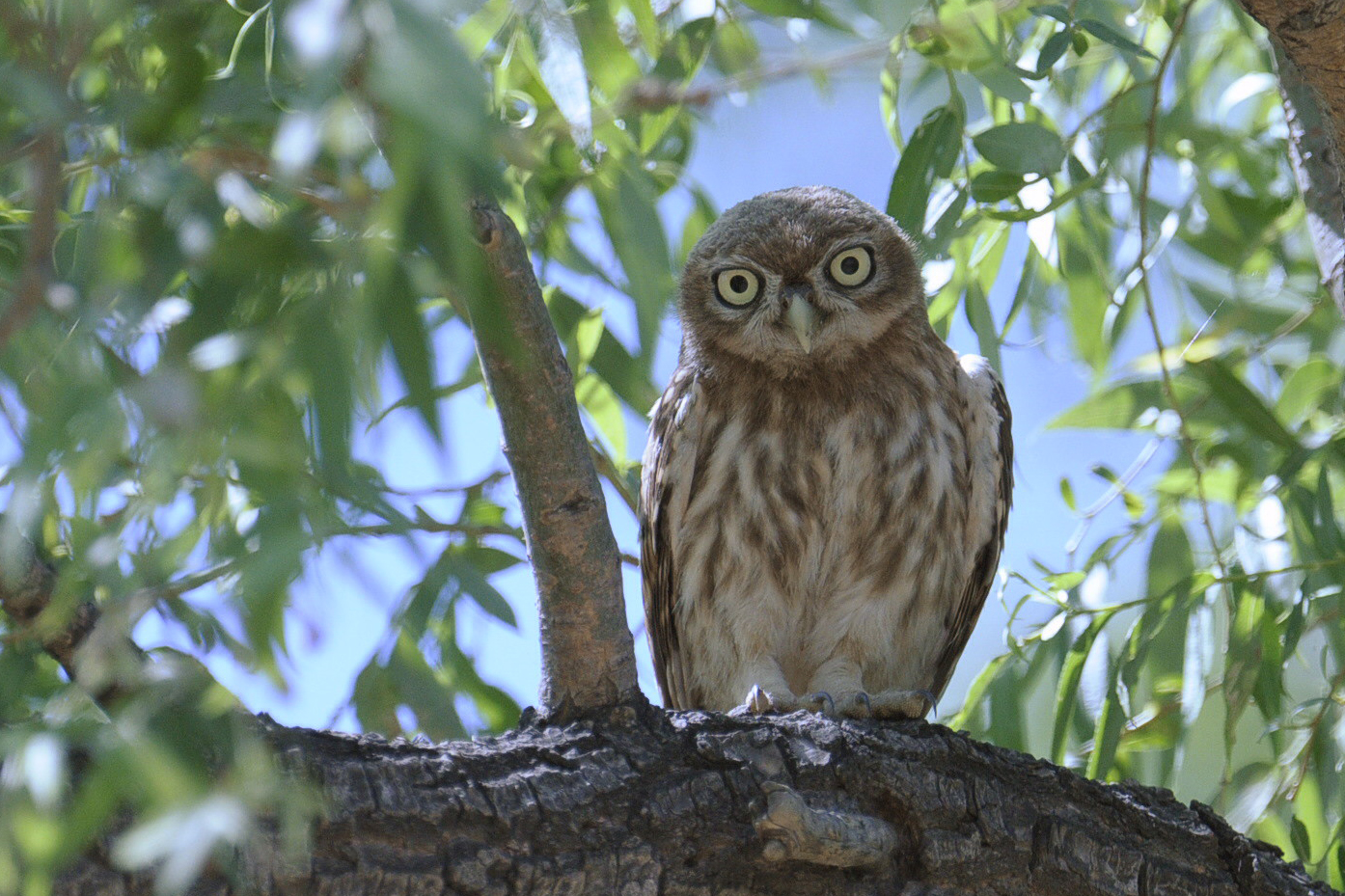
When I visited Wenyu He in Beijing a couple of weeks ago, I stumbled across a pair of breeding Little Owls (Athene noctua). On a return visit I captured the image below of a young bird. Shi Jin, a regular on Birdforum, posted an image of one of these birds on his excellent China 2010 thread. Richard Klim, always up to date on the latest taxonomic issues, pointed out that north-east China’s subspecies – Athene [noctua] plumipes – has been suggested as a separate species with Swinhoe’s Owlet being the suggested new name (Wink 2011). König & Weick’s “Owls of the World” (2008) mooted it as a potential split back in 2008, saying “Toes more densely covered with plumes rather than bristles. …Perhaps specifically distinct.”
That’s good enough for me…!
Swinhoe’s Owlet, a cool name for north-east China’s Little Owl.
Asian House Martin (Delichon dasypus) must be a candidate for vagrancy to Western Europe. At least one of the three subspecies is a strong and long distance migrant. However, looking very similar to Northern House Martin, its common European sister-species, how many people would be able to identify one?
The nominate subspecies of Asian House Martin is perhaps the most likely to wander. It breeds in southeast Russia, the Kuril Islands, Japan and Korea and migrates through eastern China to winter in the Malay Peninsula, Borneo, the Philippines, Java and Sumatra.
Ssp cashmeriensis breeds in the Himalayas from Afghanistan east to Sikkim and northwards into Tibet and western and central China. It is a short-range migrant, mainly wintering at lower altitudes in the foothills of the Himalayas.
The third race, ssp nigrimentalis, breeds in southeastern China and southern Siberia. Its wintering grounds are unknown, but birds in Taiwan apparently just move to lower altitudes in winter.
In eastern China any sighting of a House Martin is notable. I have seen a handful of both Asian (presumably the nominate subspecies) and Northern House Martins at Laotieshan in Liaoning Province but, in a sign of just how scarce they are in this region, I have still not seen one of either species in Beijing (they are passage migrants and seen in small numbers each spring and autumn – clearly I just haven’t been trying hard enough!).
My recent visit to Chang Bai Shan in Jilin Province provided an opportunity to get to grips with Asian House Martin as several pairs were nest-building on our hotel, allowing some fantastic views. Capturing any hirundine in flight with a camera is never easy, and the images below won’t win any prizes, but they do show some of the features to look out for in separating Asian House Martin from Northern House Martin. To the European readers of this blog, it’ll be worth making a mental note of these features when checking out those late autumn migrants….!
Asian House Martin, Laotieshan, 27 September 2011. A typical view of a migrant. Note the dark underwing coverts – a good feature of Asian House Martin – as well as the dusky-looking underparts and dark neck ‘collar’.Asian House Martin, Chang Bai Shan, 3 June 2012. A closer view. This image was taken in heavily overcast conditions but still shows the contrasting dark underwing coverts and dusky underparts with white throat.
There are several differences between Asian and Northern House Martin that should make identification relatively straightforward if seen well.
Structurally, Asian House Martin is smaller, more compact and squarer-tailed than Northern but these features aren’t necessarily easy to ascertain on a single bird.
Perhaps the best feature, and one that I have found very helpful in the field, is the colour of the underwing coverts. In the images above, taken in sunny and dull conditions respectively, one can see the relatively dark underwing coverts, a consistent feature of Asian House Martin. Compare with this image of a Northern House Martin. The paler underwing coverts of Northern are not usually as prominent as shown in this linked image (taken in strong light) and can often appear concolourous with the rest of the underwing but a House Martin with obviously dark underwing coverts should be Asian.
Asian House Martin, Chang Bai Shan, 3 June 2012
Another subtle feature to distinguish these two species is the amount of black on the face. Compare the image above of Asian with this image of Northern. The black on the face generally extends a little lower on Asian.
Asian House Martin, 3 June 2012
Another feature is the rump. On Asian House Martin the white rump is usually relatively small and can appear ‘flecked’ with dark streaks, as in the above image. On Northern the white rump is larger (due to more of the uppertail coverts being white) and is usually clean white.
Finally, check out these images from John Holmes in Hong Kong. Asian House Martin often shows ‘dusky’ flanks and belly, whereas Northern usually shows bright white underparts.
In summary, the combination of a smallish white rump (sometimes flecked), dark underwing coverts, ‘dirty’ flanks, a squarer tail and a darker ‘face’ are all characteristics associated with Asian House Martin. Maybe one will turn up at your migration watchpoint this autumn…?
EDIT: I have added this image of an Asian House Martin taken at Chang Bai Shan that shows the dark feathering on the upper chin (ie just below the lower mandible). In Northern House Martin, the chin is white.
Asian House Martin, Chang Bai Shan, 3 June 2012. This image shows the dark feathering immediately below the lower mandible, a good feature of Asian House Martin. Not so easy to see in the field, however!
To celebrate the Queen’s Jubilee (God bless her), Libby and I visited Chang Bai Shan in Jilin Province with friends John and Sarah Gallagher. Birders might know that Chang Bai Shan is one of the very few remaining breeding sites for the Scaly-sided Merganser. This bird is classified as “Endangered” by Birdlife International with the justification given as:
“This species has a very small population which is suspected to be undergoing a continuing and rapid decline as a result of habitat loss, illegal hunting and disturbance.”
It’s hard to believe that habitat loss is the main cause of decline in Chang Bai Shan as the area is vast and the habitat looks very good. But the latter two – illegal hunting and disturbance – are clearly local threats (more about that later).
Although the trip was not dedicated to birding (my companions, although they humour me, prefer good walking over trying to spot little brown jobs in the thick forest), the thrill of trying to see a Scaly-sided Merganser was a fun adventure for all of us, especially given that we were able to find almost no information about where to see these special birds in advance of our visit.
On arrival at the new and well-appointed spa hotel just a few minutes drive from the equally new Chang Bai Shan airport, we checked in and made arrangements to visit the national park the next day. From our room we could see Asian House Martins, Red-rumped Swallows and Barn Swallows all gathering mud and building nests on the hotel itself.. a good start.
Asian House Martin, Chang Bai Shan
For anyone who has visited a mountain in China, the following tale of our visit to the national park will be all too familiar. We were bussed to the entrance of the park where we were obliged to buy an entrance ticket for 100 Yuan (about GBP 10) and a bus ticket for 85 Yuan (GBP c8.50). After boarding allotted bus number 2, we set off for the 45 minute direct (ie no stopping) journey to the peak. The habitat looked great – broad-leaved forest, followed by birch, larch and, as the trees thinned, more open areas with stunted birch still leafless as if it was mid-winter. Part of the way up, I was fortunate enough to catch a glimpse of a Hazel Grouse as it whirred its way across the road in front of the bus. At the top we disembarked and set off on the wooden steps to the peak (2,470 metres) for a view of the lake. There were marshals and signs telling us not to wander from the well-trodden path (possibly due to the proximity of North Korea which lies on the far shore of the lake). At the top one enjoyed a spectacular view of the “Heavenly Lake” which sits inside the crater of an extinct volcano (well, at least we *think* it’s extinct – it last erupted in 1903). In a sign of how late Spring springs in Jilin at this altitude, the lake was still completely frozen. With quite a bit of low cloud around, responsible for the occasional showers, I suspect we didn’t see the lake at its best. But it was still impressive.
The visitor centre at the West Gate of Chang Bai Shan.Map of the West Gate area of Chang Bai ShanThe walk up to the “Heavenly Lake” at Chang Bai Shan. Alpine Accentors were displaying alongside the boardwalk!Sarah, John and Libby before the rather wet ‘stairway to heaven’…The view of the lake.. with North Korea on the far shore.
It was here that we enjoyed stunning views of displaying and singing Alpine Accentors.. there were at least 4 pairs around the summit.
Alpine Accentor, Chang Bai Shan, 2 June 2012
And here is a short video..
After the summit, our bus took us to the next stop on the rigid Chang Bai Shan mountain tour. The circular boardwalk (at an altitude of 1464 metres) cuts through some fantastic forest and we saw singing Mugimaki Flycatchers, Black Woodpecker, Pallas’s Warbler, Goldcrest, Hobby and Siberian Chipmunk here. Unfortunately the trail down to the waterfall was closed (for reasons unknown) so at the end of the boardwalk circular tour we were bussed back to base, missing out on some fantastic looking habitat that looked perfect for Three-toed Woodpecker and Nutcracker.
We decided to walk back from the park entrance to the hotel, a journey that I estimated would take around 30 minutes but which actually took an hour and a half. (oops, sorry guys!). But it was a good walk and we saw Grey Wagtails, White Wagtail (ssp leucopsis), Jay, Siberian Blue Robin, Eurasian Sparrowhawk, Dollarbird, Eurasian, Oriental and Indian Cuckoos, singing Yellow-throated Bunting and heard a few unidentified thrushes (one of which I subsequently identified as Pale Thrush).
With no access to suitable fast-flowing streams in the park itself, I knew that the next day we’d have to find a few tracks outside the park if we were to stand a chance of seeing Scaly-sided Merganser. We asked the staff if they knew where to see the “Zhong Hua Qiu Sha Ya” (the Chinese name for Scaly-sided Merganser). After a few polite smiles and nods, one of the girls said she would phone a friend. Soon after a young man appeared and confidently told us these birds could be found at two lakes nearby. The best place was Quan Yong Hu, north of the local town of Song Jiang He Zhen. We arranged for a taxi to take us and we were soon on our way… the taxi driver also knew that these birds could be seen at this lake, so we were quietly confident. On arrival, some 60 minutes later, we scanned the lake. There was no sign. A local who lived on the lakeside said that the birds were here (more than 10 of them) but that was in April and that now they had all moved into the mountains to breed… so it appeared that this lake was a staging post, a sort of meeting place before the birds moved up to the mountains to breed on the fast-running streams. We had a short picnic and then began the journey back, looking out for a nice trail on which to walk. We soon found a bridge over a decent stream with a muddy track along one side. We decided to have a walk and, despite the odd rain shower (the climate here was reminiscent of Scotland or the Peak District), we enjoyed a pleasant stroll and saw more Grey Wagtails, Brown Dippers, Mandarin Ducks, Blue and White Flycatchers (common), Common Sandpipers and a pair of Oriental Turtle Doves. After reaching a bit of a building site with some not so friendly dogs, we headed back. As our taxi reached the town of Song Jiang He, we crossed a small bridge over a lake and I caught sight of a distant but interesting looking bird on the water and quickly asked the driver to stop. I jumped out and, with the naked eye, I could see it was a merganser… could it be? With the binoculars, I could see the ‘funky’ hair do and the scaly markings on the flanks… A female Scaly-sided Merganser!! I quickly got the others onto the bird and gave them my binoculars to see it as I went for my camera in my backpack. I reeled off a quick record image and, as I checked it on the screen, to my horror I realised I had not altered the settings from when I had taken a couple of images of an overflying Oriental Honey Buzzard. The result was a horribly over-exposed and blurry image. I began to adjust the camera settings to enable me to get a better image but, just as I was about to move the dials, Sarah and John said “it’s flying”… so I hurriedly fired off a couple of photos with the same settings… The light was awful (it was raining hard) and all I captured was a flying blur.. but I think you can just about make out some of the distinctive features (spiky hair do, dark eye patch reaching to the bill, white panel on wing dividied by a thin black line). They won’t win any prizes but at least I had an image of a Scaly-sided Merganser…
A female Scaly-sided Merganser, Song Jiang He, Jilin Province. Over-exposed, heavily cropped.. blah blah…Scaly-sided Merganser, Song Jiang He, Jilin Province. Note the dark line that separates the broad white wing panel which distinguishes this species from Common Merganser (Goosander).
The bird flew around the bend in the lake and we thought we may be able to see it from the other side. We drove around but there was no sign. It could just as easily have flown up into the mountains. The driver seemed to be relieved (I think he felt a bit bad that we hadn’t seen it at the original lake) and we arrived back at the hotel elated.
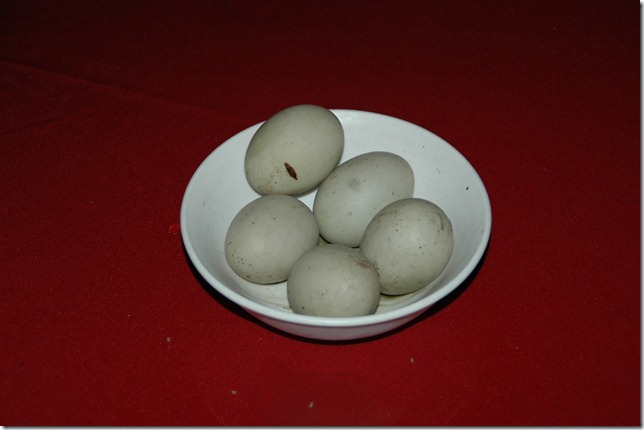
That evening, after a well-earned dip in the outdoor hot spring, we decided to try a local restaurant in the village near to the hotel. We enjoyed some delicious food, including a local trout, and toasted our good fortune with the merganser with some local “Dong Bei” beer.. The owner had a couple of stuffed birds in the restaurant and we thought it would be worth a try asking him whether he knew where to see Scaly-sided Mergansers.. he proudly said that they bred locally and then proceeded to his fridge whereupon he took out a dish full of eggs… “Zhong Hua Qiu Sha Ya” (Scaly-sided Merganser) he said with a big smile on his face….. I think my jaw dropped to the floor at this point and I didn’t know what to say. Did he really have a clutch of Scaly-sided Merganser eggs in his fridge? Oh. My. God.
John asked to take a photo of them and he duly obliged.
These eggs were supposedly taken from Scaly-sided Mergansers… I really hope they weren’t.I tried to explain to him that this was a very special bird and that there weren’t many left.. but the look on his face suggested my Chinese wasn’t understood…
The owner also showed us a photo on his digital camera taken last July from outside his restaurant (which looks across a small manmade lake). On the lake there was a very smart breeding-plumaged Black-throated Diver. He said it was there at 0500 and then flew away later that morning.
We left the restaurant a little disturbed that the local restaurateurs may be collecting the eggs of an endangered species for food. A local education scheme is much-needed, I think (WWF/RSPB – any plans?).
The next day we decided to explore the area north of our hotel and, using the same taxi driver (Mr Wang), we soon found an excellent fast-flowing river with a track running alongside. We walked upstream and, after only a few hundred metres, we encountered Brown Dippers and Grey Wagtails.. and, best of all, the river looked perfect for mergansers. A little further along, a Brown Dipper perched on an exposed rock allowing us all excellent views. Just as we were about to move on, Sarah spotted another bird on the water and asked me “what’s that?”. I looked and could immediately see it was a merganser and a quick check in the binoculars revealed it to be a Scaly-sided…!! Wow! It swam towards us with its head in the water and then dived. We all waited quietly for it to emerge but it must have surfaced some way from where we were looking as the next thing we knew it was flying upstream and was gone.. a brief but ‘better than yesterday’ view.. After ‘high-fiving’ Sarah we walked further along the track and saw a few Blue and White Flycatchers and some more Brown Dippers. After a further couple of kilometres we found an open area on the bend of the river and sat down for our lunch. It was here that we saw another female Scaly-sided, again briefly, as it flew right over us and upstream. Bird number three. A pair of White-throated Needletails kept us company as they hawked for insects overhead.
Scaly-sided Merganser woz ‘ere. The bend in the river where Sarah spotted a female.
A rarity: a photo of me on this blog! With Libby and Sarah looking for Scaly-sided Mergansers… Photo: John GallagherThe walk back was uneventful but we did hear Oriental Cuckoo, Siberian Robin, more Blue and White Flycatchers and a thrush sp.
The next day we explored more tracks around the hotel and close to the border of the national park, seeing new birds for the trip such as White-backed Woodpecker (found by Libby!), Long-tailed Rosefinch, White-throated Rock Thrush and Pale Thrush. Just as we got back to the hotel to shower and check out, the heavens opened and we thanked our lucky stars that we had enjoyed the best part of the day. We’d enjoyed a thoroughly refreshing break in this special part of China – a real tonic after the smog and oppressive heat of Beijing – and, best of all, we’d seen the near-mythical Scaly-sided Merganser!
Twice in the last few days, inspired by the reports from this site by Shi Jin on Birdforum, I visited the Wenyu River in the Chaoyang District of Beijing. It is a fantastic area of paddies, weedy fields and even a disused golf course. Brian Jones and Spike Millington, both former Beijing residents, used to visit this site regularly and I can see why.
Habitat along the Wenyu River in Chaoyang District, Beijing. Perfect for Waterhens and locustellas!
Frustrating habitat at the Wenyu River paddies. When a locustella goes down in this lot, the chances of seeing it again are slim..!
On my first visit, late one evening, I arrived at the paddies just half an hour before dusk and yet I saw 4 new birds for me in Beijing – Chestnut-eared Bunting, White-breasted Waterhen, Yellow-legged Buttonquail and Little Owl.. Not bad. My second visit, early morning on Thursday, was just as rewarding. A singing David’s Bush Warbler was a nice start, soon followed by the White-breasted Waterhen, singing Lanceolated Warbler, several Pallas’s Grasshopper Warblers, two Schrenck’s Bitterns, Yellow Bittern, Pechora Pipit on the deck and a Black-naped Oriole calling from the willows. Wow. I walked the narrow pathways between the paddies and enjoyed several encounters, albeit brief, with Pallas’s Grasshopper Warblers, Black-browed Reed Warblers and the odd Zitting Cisticola. A couple of Oriental Reed Warblers were much more obliging, singing purposefully from prominent perches in the reeds. It was a cacophony of birdsong.
Oriental Reed Warbler singing its heart out early morning in the paddyfields at Wenyu River.Schrenck’s Bittern (female), Wenyu River, Beijing. One of two seen in the paddies.Pechora Pipit. Seeing one on the ground in Beijing is not easy!
After reaching the western end of the paddies, I decided to head back and return across the maze of paths. It was along one such narrow weedy path between two paddies that I experienced one of those moments in birding that makes it such an exciting (and sometimes frustrating!) hobby. I knew that Shi Jin had seen a large locustella warbler, possibly Middendorff’s, a day or two before and so I was on the lookout for large locustellas. I had also listened to the songs of the three possible large locustellas – Gray’s, Pleske’s and Middendorff’s – on Xeno Canto Asia just in case. Suddenly, I flushed a bird from the path that zipped into the paddy and down into the vegetation before I even had a chance to lift my binoculars. It was clearly interesting – my sense was that it looked larger than the Pallas’s Grasshopper Warblers I had been seeing, but still looked like a locustella in shape and structure.. ..it was plain looking, greyish, without much, if any, contrast on the upperparts… Hmmm… could it be one of the large locustellas I had been thinking about? I knew that there was a very good chance that I would never see it again… they are notorious skulkers and it was a large paddy. However, I decided to wait to see whether anything emerged from the area in which it had gone down. To my surprise, just a few seconds later, a bird began to sing and the sound appeared to be coming from the same area… I remembered the songs from Xeno Canto and immediately ruled out Gray’s and Middendorff’s. It reminded me of the Pleske’s song… I put two and two together – large locustella, song like a Pleske’s – and in my mind a big neon sign lit up flashing “Pleske’s Warbler!!”. But could it really be a Pleske’s Warbler? In Beijing?? The bird sang for a few minutes and I quickly took out my handheld video camera to record the song, knowing that I would need that to have any chance of identifying this bird for certain in the absence of a good sight view. I recorded a few seconds of the song and then concentrated on trying to see it. Only once in the next 20-30 mins did I see a bird in that area, an incredibly brief view as a largish bird flitted across a small gap in the vegetation. Again, I got nothing on it other than it was largish and plain looking.. Frustrating to say the least.
At this point, I was excited.. I really thought that there was a singing Pleske’s Warbler just a few metres away from me. I sent a SMS to Shi Jin to tell him. A few minutes later, after no sign of the bird, I began to walk back to the metro station as I didn’t want to be too late back in town. And I wanted to download that sound file and check it against Xeno Canto! I then received a reply from Shi Jin to say he was on his way. He only lives 10 minutes away by car, so I headed back to the site to meet him and show him the precise spot. There was no song now and no sign of the bird. We waited a few minutes and after providing sustenance for the local mosquito population and with the day heating up fast, we decided that probably the best chance of seeing/hearing the bird would be to come back in the evening or the next morning. Neither of us could make it that evening but Shi Jin was hoping to try for it the next day. After a brief stop at the Little Owl nest site I discovered a few days before, Shi Jin kindly dropped me at the metro station for the return journey home.
On arriving home, the first thing I did was download the sound file from the video camera and check out Xeno Canto. There is one recording on Xeno Canto of Pleske’s. For comparison, my recording can be heard below:
Hmm… on listening to them both, now I wasn’t so sure.. there were elements of the song that were similar but there were also differences… Doubt began to creep into my mind. Was the singing bird a Pleske’s? And, in any case, could I say that the singing bird was definitely the large locustella I saw? I began to think that maybe the song was a different species. I listened to Pallas’s Grasshopper Warbler (the other locustella species seen that morning in the same area) on Xeno Canto but the few recordings of this species on the site sounded different).
So, the bottom line is I don’t know. I have a recording that I can’t identify and a brief sighting of a largish locustella that isn’t necessarily the same bird that I recorded singing anyway…! Arrggghhhh….
If anyone can help with the recording, please let me know. I have sent it to Paul Holt (who is currently away) and to Peter Kennerley, so hopefully the mystery will be resolved soon. In my head, I am expecting my song to be identified as a variation of Pallas’s Grashopper Warbler but my heart is hoping that it’s a Pleske’s. Watch this space!
Whatever the outcome of this experience, one of the highlights of the day was meeting Shi Jin, a top birder with a lot of China experience!
In the sweltering heat (it’s hit 39 degrees C this week), I visited Wild Duck Lake on Saturday. I was hoping for some bitterns (There has been a Cinnamon Bittern in the Olympic Forest Park for the last week or so and Schrenck’s Bitterns have been seen along the Wenyu River in Beijing) and maybe some locustella warblers. I saw very few of the former and none of the latter! But I did see an unexpected variety of raptors with Short-toed and Great Spotted Eagles, Saker, Amur Falcons and spectacular views of Eastern Marsh Harriers. A probable Blunt-winged Warbler was another highlight, singing frustratingly distantly from the boardwalk (dodgy photo below).
Short-toed Eagle, Yeyahu NR, 26 May 2012. This species has traditionally been considered a vagrant in north-eastern China but I have seen more than 10 individuals at Yeyahu and Miyun, almost all in April/May and September/October suggesting it is a regular passage migrant (and possibly a breeder nearby?)Greater Spotted Eagle, Yeyahu NR, 26 May 2012. A regular passage migrant in Beijing.Amur Falcon (1st summer male), Yeyahu NR. This beautiful falcon migrates through Beijing in large numbers in Spring and Autumn (part of an incredible journey from Manchuria to Africa and back each year) and a few breed in the Beijing area.Amur Falcon (female), Yeyahu NR, 26 May 2012.Eastern Marsh Harrier (adult male), Yeyahu NR, 26 May 2012. This guy is breeding in the extensive reedbeds inside the reserve.
As I was watching the spectacular Eastern Marsh Harriers, this Indian Cuckoo flew over my head calling incessantly…
Indian Cuckoo, Yeyahu NR, 26 May 2012. Looks strikingly long-billed and long-tailed in this image.
And this is the ‘acro’ that was singing in the shrubby part of the reedbed.. Blunt-winged? The supercilium ends very soon behind the eye… but can I be sure from this image? Unfortunately it was always distant.
Probable Blunt-winged Warbler, Yeyahu NR, 26 May 2012.
Finally, just for fun, here is a phylloscopus warbler in an unusual pose.. anyone want to have a go at identifying it?
A ‘pylloscopus’ warbler at Yeyahu NR. This image shows enough features for identification.. or does it? Any ideas? Answer later this week.
I also recorded a calling crake/rail that I think could be my first Ruddy-breasted Crake.. a little research needed on Xeno-Canto Asia!
Another highlight from the trip to Dandong was the remarkable total of Nordmann’s Greenshanks (Tringa guttifer) that we observed at a high-tide roost. Totals of 17, 17 and 16 were recorded on my three visits and, on one of the days, local birder Bai Qingquan recorded at least a further 7 from a different location at the same time, making a minimum count of 24 at this important stopover site. Nordmann’s Greenshank is officially “endangered” with a population estimate of around 500-1,000 individuals. It breeds in eastern Siberia along the western and northern coasts of the Sea of Okhotsk and also on Sakhalin Island, wintering in south-east Asia (Bangladesh, Thailand, Malaysia etc) and is encountered on migration along coastal China from Hong Kong north to Liaoning Province. It’s population is declining, almost certainly related to habitat destruction primarily on its wintering grounds and stopover sites.
We did not try to get close to these birds for fear of flushing them from their roost but the occasional pass by the local Peregrine and even the odd Black-tailed Gull kept them on their toes and, on several occasions, the flocks took to the air, allowing us to hear the air through their wings as they wheeled around in front of us.. a spectacular sight and sound. It was interesting that the Nordmann’s seemed to associate with the Grey Plover.
Grey Plovers, Donggang, Dandong, Liaoning Province. The wheeling flocks were a lovely sight.Nordmann’s Greenshank in flight (with Grey Plover), Donggang, Dandong, Laioning Province. Nordmann’s seem to like Grey Plovers!Nordmann’s Greenshanks with Grey Plovers.
Having North Korea as a backdrop added human interest to the birding here.
A shellfish picker works the low tide with North Korea just the other side of the Yalu river.A list of what not to do on the North Korean border. Needless to say, we did as we were told..
And other waders, most in splendid breeding plumage, were a sight to behold.
Two Asian Dowitchers (the small orangey blobs in this awful photo) were a welcome addition to the high tide roost.“Eastern” Black-tailed Godwits. Beautiful birds.Our search for Spoon-billed Sandpiper proved fruitless (a little early) but breeding plumaged Red-necked Stints were a joy to watch.
Now, you’ve all heard of the “Magic Woods” at Beidaihe…. well, not to be outdone, Donggang has its own ‘not of this Earth’ site. Here’s introducing the “Harry Potter Hedge”!
The “Harry Potter Hedge”… every day it would wow us with magical appearances.
Out of thin air it produced a Black-winged Cuckooshrike, Rufous-tailed Robin, Siberian Blue Robin, Siberian Thrush, Eyebrowed Thrush, Mugimaki Flycatcher, Pechora Pipit, Siberian Rubythroat, Oriental Scops Owl and much much more..
Finally, just for fun, here are a couple of photos of wader flocks… Photo 1 is beginner level. It has four wader species.. can you identify them? Photo 2 is a little tougher… it contains 6 species. A *glittering prize* awaits the first person to list them all correctly.
Photo 1 (Beginners Level). There are 4 wader species in this image. Can you name them?Photo 2 (Advanced Level). There are 6 species in this photo. Can you name them?
Visiting birders generally don’t pay much attention to the humble Little Grebe (Tachybaptus ruficollis). But the observant birder will notice that the subspecies found here – poggei – has a pale eye and has been mooted as a potential future ‘split’. Whatever its taxonomic status, the Little Grebe is a charismatic bird and, in the parks of Beijing, can be relatively confiding. Visiting birders who care about their lists will be wise to take note for ‘insurance’….!
Little Grebe (ssp poggei). A common resident and breeder in the capital. This individual is half of a breeding pair in the Olympic Forest Park.
Dandong wasn’t just a wader bonanza (17 Nordmann’s Greenshanks roosting with 2 Asian Dowitchers was really something!) but also a celebration of Siberian migrants. We encountered Siberian Rubythroats and both Siberian Blue and Rufous-tailed Robins bobbing along the sea wall, Mugimaki, Red-throated, Blue and White and Yellow-rumped Flycatchers feeding on the leeward side of the hedges and Siberian, Grey-backed and Eyebrowed Thrushes skulking in thickets. Not to mention Eastern Crowned, Arctic (Kamchatka!), Pale-legged, Yellow-browed, Dusky and Radde’s Warblers entertaining us from the boughs and Brown Shrikes seemingly on every perch. Fantastic stuff. So, in a tribute to ‘Sibes’, here are a few images.
Siberian Blue Robin (first summer male), Donggang, 12 May 2012Siberian Blue Robin, Donggang, 12 May 2012. This individual belied the species’ reputation as a skulker and posed beautifully for the camera.Siberian Rubythroat (male), Donggang, 12 May 2012. Imagine this turning up on your local headland in the UK…Siberian Rubythroat (female), Donggang, 12 May 2012.Mugimaki Flycatcher, Donggang, 12 May 2012.Pale-legged Leaf Warbler, Donggang, 13 May 2012Siberian Thrush (female), Donggang, 13 May 2012. This supreme skulker flew right by me after being flushed by a lorry along a main road. I rattled off 6 images and only this one was in focus.Rufous-tailed Robin, Donggang, 11 May 2012. An understated bird but with bags of character.Brown Shrike, Donggang, 12 May 2012
And turning around 180 degrees revealed an interesting backdrop – the border with North Korea. This boat flew the flag of the DPRK.
A North Korean (fishing?) boat heading out to sea on the falling tide. Birding along the North Korean border added extra spice to an already spicy birding trip.
I am still wading (no pun intended) through my sightings and images from a shorebirding trip to Donggang, Dandong, last weekend with Paul Holt and local birder, Bai Qingquan. The highlights were many. One of the surprises was the amount of passerine migrants that we saw along the newly planted trees that lined the sea wall.. every day we saw buntings, pipits, flycatchers, thrushes and robins which made the walk to the wader high tide roost a real treat. And it was here that we found the bird of the trip – a Kamchatka Warbler (see previous post). Another, more mature, hedgerow to the north of the wader high tide roost produced another very special bird and the second highlight of the trip – a Black-winged Cuckoo Shrike. This is the first record of this species in Liaoning Province and possibly the most northerly record in mainland China.
We had just seen a Brown-eared Bulbul making its way south, noisily, along the sea wall and just a few minutes later a similar-sized bird flew north along the landward side of the hedge. Bai Qingquan picked it up and both he and I saw it briefly as it flashed by.. what was it? Paul was on the other side of the hedge and missed it. Both Bai and I had never seen this bird before.. sort of cuckoo-shaped but we had seen some white on the wing. Luckily it perched up in a tree a 100 metres or so to the north. Although it was mostly obscured, we could just see its tail which looked cuckoo-like and we speculated that it could be some sort of cuckoo or hawk cuckoo.. but the white in the wing didn’t tally.. We crept forward and then it flew, luckily just a few metres, and this time sat up in full view. Paul very quickly identified it as a Black-winged Cuckooshrike. We were able to secure some pretty good views for about 30 minutes as it fed along the hedgerow. Bai “high-fived” us.. a new Liaoning bird!
Black-winged Cuckooshrike, Donggang, Dandong, 11 May 2012. The first record in Liaoning Province and, possibly, the most northerly record of this species in China.Black-winged Cuckooshrike, Donggang, Dandong, 11 May 2012. The white panels in the wings were not always as obvious as shown here.
The cuckooshrike clearly liked the area as we saw it again the following day and again on our last morning.. Isn’t migration brilliant!
The outstanding bird, among many highlights of a trip to Donggang, Dandong in Liaoning Province, was a Kamchatka Leaf Warbler (Phylloscopus examinandus). This bird is one of the newly recognised Arctic Warbler splits. See here for the paper by Per Alström et al that presents the rationale behind the taxonomic decision. The conclusion of the paper states that:
“..the species from continental Eurasia and Alaska should be called Phylloscopus borealis (Arctic Warbler), the one from Kamchatka, Sakhalin and Hokkaido Phylloscopus examinandus (Kamchatka Leaf Warbler) and the one from the rest of Japan Phylloscopus xanthodryas (Japanese Leaf Warbler).”
It appears that this is only the 2nd record of examinandus for China, the first being a specimen collected from Fujian Province, referred to in an article in the Journal of The Asiatic Society of Bengal (29: 265) by Swinhoe in 1860.
The bird was discovered along a relatively new sea wall lined with young trees (a result of recent reclamation work). Paul Holt and I were checking the shorebirds on the mudflats along a 2-3 km stretch of the coast road (Binhai Lu) alongside the Yalu River, right on the border between China and North Korea. Every few minutes we would walk upstream and begin to check the next group of birds. We were enjoying splendid views of Red-necked Stint, Terek Sandpiper, Broad-billed Sandpiper, Far Eastern Curlew, Saunders’ Gulls and many more species – a real spectacle on the falling tide. As we were walking between watchpoints, we heard an unfamiliar call… I thought it sounded a little like a flycatcher – a series of rapid low to mid-pitched notes – and thought nothing else of it (we had been seeing several Asian Brown, Yellow-rumped and Red-throated Flycatchers along that stretch of road). However, Paul knew immediately it was different and might be something interesting. We scanned the area of trees from where the call came from and soon picked up an ‘Arctic Warbler’.. it called repeatedly for about 20 seconds but no sooner as I had grabbed my video camera to record the call, the bird fell silent and did not call again. We watched the bird for a few minutes as it flitted from tree to tree. It appeared quite yellow and buff for a standard Arctic Warbler with a yellowish wash on the throat and upper breast and a buffy supercilium. Neither of us had seen an Arctic Warbler like this before. Luckily, our driver was parked nearby and Paul’s laptop was in the car, on which were the calls of the three ‘Arctic Warbler’ species. We listened to the calls and immediately knew that the call we had heard was of Phylloscopus examinandus (Kamchatka Leaf Warbler). We quickly walked back to where the bird had been and, after a few minutes of searching, we relocated it along a roadside bank, just inland from the original location. With a bit of patience it showed quite well, even though the light was bad (heavily overcast). We took some images that captured the features of the bird as we were seeing it in the field. After about an hour, and with the light fading, we eventually left the site having secured lots of images but, unfortunately, without a sound recording of the call; it didn’t call a single time after that initial burst when we first saw it.
Paul knew it would be a good record and certainly a first record for Liaoning Province. What we didn’t know was that it would be the first record (that we are aware of) for China since that 19th century specimen referred to by Swinhoe!
Of course, this species has almost certainly been overlooked and birders will only have been looking for these new species since Per Alström’s paper was published in 2010, so I am sure there will be more records to come… As a bird that breeds in Kamchatka, it must pass through eastern China on migration. Even so, it’s pretty cool to be involved with a first record for China for over 100 years! It’s a fantastic tribute to Paul’s birding skill that he picked up the unusual call and nailed the record..
Images below.
Kamchatka Warbler (Phylloscopus examinandus), Donggang, Dandong, Liaoning Province, 12 May 2012. Probably the first record for China since a specimen was collected in the 1800s. Note the buffy supercilium and yellow wash on the underparts, both clearly seen in the field.Kamchatka Warbler (Phylloscopus examinandus), Donggang, Dandong, 12 May 2012. The yellowish wash down the centre of the breast can be see clearly on this image.Kamchatka Warbler (Phylloscopus examinandus), Donggang, Dandong, Liaoning Province, 12 May 2012. Although out of focus, a yellowish wash on the vent can be seen clearly in this image.
The calls and songs of the three species of “Arctic Warbler” can be found here. It should be noted that, at present, vocalisations are the only way to definitively identify these three species. However, given the plumage features noted on this bird, it may not be too long before a suite of features allows non-calling/singing birds to be separated in the field.
Now you know what to look for, I hope you find one for yourself…!
Thank you to everyone who voted in the ‘just for fun’ pipit quiz.. and apologies for keeping you in suspense for so long with the answer.. I have been in Dandong (Liaoning Province, on the border with North Korea) for a few days of shorebirding. It was superb. More about that later.
As I write this post, the percentages of the voting came out as follows:
Blyth’s Pipit – 78.38%
Richard’s Pipit – 16.22%
Don’t Know – 5.4%
The correct answer is RICHARD’S PIPIT.. so congratulations to the 16.22% of you who voted correctly. And to those of you who voted for Blyth’s, there is absolutely no shame in getting this one wrong – it was a very difficult quiz question!
So, why is it a Richard’s Pipit? Well, first up I should say that I was confused by this individual and I would have been in the “Don’t Know” category! But after consulting with literature here and here, and some very helpful comments from Paul Holt, I am now confident that this is a Richard’s.
Separating Richard’s and Blyth’s Pipits is not easy – the differences are subtle and there is individual variation, making some individuals hard to identify, particularly if the bird does not call. It is only relatively recently that vagrants have been identified in the field in Western Europe – up until a few decades ago, first year birds were thought to be inseparable if they were not in the hand. However, after lots of field observations by some very skilled people, subtle differences have been shown to allow reliable separation in the field, even if one does not hear the bird call.
Structure. Blyth’s often appears ‘slighter’ with a shorter tail, shorter legs and ‘softer’ face, sometimes recalling a smaller pipit. It’s stance is often more horizontal than the very ‘upright’ stance typical of Richard’s.
The bill. On a Blyth’s, the bill is generally shorter, blunter and more ‘conical’ than Richard’s. This is a little subjective and of course is only useful if you can compare directly or have good experience of Richard’s Pipit. Whilst not at the longer end of Richard’s Pipit variation, the bill on this bird is more like typical Richard’s than Blyth’s.
The crown. On a Blyth’s, the crown streaking is usually dense and uniform, showing clear streaks rather than more ‘coagulated’ markings as on Richard’s. Blyth’s is therefore said to exhibit a ‘capped’ effect. Although this bird could be described as somewhat ‘capped’, the streaking is more ‘coagulated’ as is typical of Richard’s.
The mantle. The streaking on the mantle is usually stronger and more uniform on a Blyth’s. This bird shows mantle streaking typical of Richard’s.
The dark centres to the adult median coverts (perhaps the most important feature). On a Richard’s, the centres to the adult median coverts are somewhat pointed or triangular. On Blyth’s they are more prominent and squarer. On Richard’s, the margins to the median coverts are wider and buffish; on Blyth’s the margins tend to be narrower and more contrasting. This bird shows quite prominent and buffish margins to the median coverts, more typical of Richard’s.
The rear claw. If seen well, the rear claw can be a useful indicator. It is shorter on Blyth’s. Again, only really useful in the field if one has good experience of Richard’s. Claw not visible in this image.
Perhaps the most useful pointer to separate these birds in the field is the call. This bird called once and, to my ears, was typical of the strident ‘shreep’ of Richard’s. Sorry that you did not have the benefit of that!!
So, there you go… I am not sure I will always get the identification of these pipits right but I am now more informed and will have a better chance when I come across these large pipits in the future.
Always more to learn in birding, which is what makes it such a great hobby…!