The PRZEVALSKI’S REDSTART (贺兰山红尾鸲) is still at Lingshan and has been successfully ‘twitched’ by a few Chinese birders this week. I have just received the photos below from ZHANG Yong, reproduced here with his kind permission. Wow!
PRZEVALSKI’S REDSTART, Lingshan, 19 February 2014. What a stunner!PRZEVALSKI’S REDSTART, Lingshan, 19 February 2014. Must be a candidate for the most beautiful Phoenicurus species?PRZEVALSKI’S REDSTART, Lingshan. The sea buckthorn berries are a big attraction for this bird.
ZHANG Yong also saw more than 300 ASIAN ROSY FINCHES (粉红腹岭雀) at close quarters…
Some of the 300+ ASIAN ROSY FINCHES currently at Lingshan.
UPDATE: here is a short video of the redstart taken on Sunday 23 February.
And a couple more pictures taken at the weekend. On several occasions it sang!
PRZEVALSKI’S REDSTART at Lingshan, Sunday 23 February 2014.Early on Sunday Lingshan was enveloped in freezing fog, resulting in some beautifully frosted backdrops to this special bird.
Saturday started out badly. I had arranged to take visiting British birder, Alastair Henderson, and Li Xiaomai to Lingshan to look for GULDENSTADT’S REDSTARTS (红腹红尾鸲) and ASIAN ROSY FINCHES (粉红腹岭雀). As I left my apartment at 0550, the smog was awful (registering over 400 on the Air Quality Index; to put this into perspective, a reading below 25 is considered healthy by the World Health Organisation – see footnote below for a rough guide). I knew that the air would be better in the mountains but, nevertheless, I wondered whether it would be a good day to be outside at all….
I shouldn’t have worried. As we reached the base of Lingshan, the air was certainly clearer than in the city and, as we ascended the access road, it cleared further until we could see blue sky, the sun (hallelujah!) and the peak of Lingshan to the west. It was a glorious day and, even in -9 temperatures, with very little wind it didn’t feel too cold.
As usual on trips to Lingshan, my first stop was a small gully a few hundred metres from the plateau of the road. This small ‘valley’ holds a few sea buckthorn bushes and was the place I first found GULDENSTADT’S REDSTARTS (红腹红尾鸲) last winter. It usually also plays host to many other species including thrushes, tits, accentors, buntings and rosefinches.
Almost immediately a bird flashed across the road and into a sea buckthorn bush in the gully. I called out “redstart” and, with my binoculars trained on it as it began to devour some of the yellowy-orange berries, I could see it was not the expected GULDENSTADT’S (红腹红尾鸲) but instead it was a stonking male PRZEVALSKI’S REDSTART (贺兰山红尾鸲, also known as “Alashan Redstart)!! I quickly extended the legs on my tripod and trained my telescope onto the bird, and it showed magnificently, allowing us to see its beautiful mix of orange, grey, black and white plumage. Wow!
PRZEVALSKI’S REDSTART (贺兰山红尾鸲), Lingshan, Beijing, 15 February 2014. Likely to be a first-winter male due to browner and more worn remiges when compared with the tertials.PRZEVALSKI’S REDSTART (贺兰山红尾鸲), Lingshan, 15 February 2014. As one Twitter follower described its plumage is “like a redstart pretending to be a Chaffinch”.. I can see what he means…PRZEVALSKI’S REDSTART (贺兰山红尾鸲), Lingshan, 15 February 2014.Alastair and Li Xiaomai just after watching the Przevalski’s Redstart at Lingshan.
After grabbing a few record photos with my camera, I sent a message via the Birding Beijing WeChat group to put out the news. Within 10 minutes, a minibus full of Beijing Birdwatching Society members arrived…! I knew the WeChat group was an efficient way of spreading news but that was ridiculous…. Beijing city is over 2 hours away!
The BBWS gang had, of course, coincidentally pre-arranged a trip there. On the way up they saw us at the gully and stopped to say “hi”. When I told them what we were watching, their jaws dropped!
Unfortunately, the redstart had disappeared as we chatted and, after explaining where the bird had been, Alastair, Xiaomai and I decided to go further up the mountain to look for the ASIAN ROSY FINCHES (粉红腹岭雀) while the group waited for the PRZEVALSKI’S (贺兰山红尾鸲) to reappear.
We drove up the few hundred metres to the top and scanned the slopes where the finches had been last week. But to no avail. Not even an ALPINE ACCENTOR (领岩鹨).
We decided to spend some more quality time with the PRZEVALSKI’S REDSTART (贺兰山红尾鸲) and, as we descended, we passed the BBWS gang coming up.. they had connected splendidly with the redstart and several of the group delighted in showing me their fantastic photos which eclipsed mine by some margin! They carried on to look for the rosy finches as we descended.
We were preparing our lunch (of pot noodles!) at the PRZEVALSKI’S site when my phone rang. It was Zhang Shen, one of the BBWS guys. I could hear camera shutters in the background as he told me that they had found a flock of “several hundred” ASIAN ROSY FINCHES (粉红腹岭雀)… wow!! Balancing our pot noodles – now full of boiling hot water – we drove the few hundred metres to the top of the mountain to join the others. And sure enough, there was a huge flock of ASIAN ROSY FINCHES (粉红腹岭雀) wheeling around the peaks. Unfortunately they were mobile and hardly settled for more than a few seconds at a time. But they were definitely ASIAN ROSY FINCHES (粉红腹岭雀)! Thanks guys!!
After seeing the flock several times in flight but without seeing these special mountain finches on the ground, we reluctantly left to spend a little more time with the PRZEVALSKI’S REDSTART (贺兰山红尾鸲) before heading back to Beijing. As we watched the redstart at close quarters, it even began to sing – a sort of quiet subsong that reminded me a little of a EURASIAN SKYLARK (云雀)… what an awesome bird. And occasionally it interacted with one or two of the GULDENSTADT’S REDSTARTS (红腹红尾鸲), with the GULDENSTADT’s clearly dominant and chasing the PRZEVALSKI’S off the berries a few times while we were there.
A male GULDENSTADT’S REDSTART (红腹红尾鸲) chasing away the PRZEVALSKI’S REDSTART (贺兰山红尾鸲), Lingshan, 15 February 2014.
I knew the PRZEVALSKI’S (贺兰山红尾鸲) was an excellent record. It’s a China endemic that breeds in Qinghai, Gansu and Ningxia Provinces and is very rare in the east. I had a vague feeling that there had been just one previous record from the capital – a specimen collected more than 80 years ago. Some initial research has revealed the following:
One was recorded at nearby Xiaolongmen in a winter survey 1992-1994, date unspecified (per Li Ming – reference: Sun X, Wang l, “Ecological analysis and classification of forest bird communities at XiaoLongMen, Beijing”, Chinese journal of ecology, 2001, 20(5):25-31 ). However, the specimen from 20 December 1919, referred to in “The Birds of Hopei” (Shaw, 1936) was taken by Rev Wilder from the border between neighbouring Hebei Province and Shanxi Province, meaning that it is not a Beijing record. Shaw also states that Rev.Wilder observed one “in the mission of his compound of Tsung-hsien”. “A Synopsis of the Avifauna of China” (Cheng Tso-hsin, 1987) describes Przevalski’s Redstart as “Accidentally in Tongxian of Beijing Municipality”. Tongxian (which may be an alternative spelling of “Tsung-hsien”) is an area in the south-east part of Beijing Municipality. It is not mountainous and seems a strange place for one to turn up! More research needed..! The Lingshan bird is therefore possibly the third record for Beijing and the first for at least 20 years.
Many thanks to Alastair, Xiaomai and to the BBWS gang for their company on the day – and in particular, to Zhang Shen for alerting us to the ASIAN ROSY FINCHES (粉红腹岭雀)… It was great to see so many birders out and about in Beijing!
Footonote: The Air Quality Index (AQI) in Beijing and what the AQI “score” means. Yesterday the AQI was over 400…! It should be noted, though, that the AQI will vary greatly according to location and, in the mountains to the west of Beijing, the AQI will very likely be significantly better than the city.
AQI
Air Pollution
Level
Health Implications
0–50
Excellent
No health implications.
51–100
Good
Few hypersensitive individuals should reduce outdoor exercise.
101–150
Lightly Polluted
Slight irritations may occur, individuals with breathing or heart problems should reduce outdoor exercise.
151–200
Moderately Polluted
Slight irritations may occur, individuals with breathing or heart problems should reduce outdoor exercise.
201–300
Heavily Polluted
Healthy people will be noticeably affected. People with breathing or heart problems will experience reduced endurance in activities. These individuals and elders should remain indoors and restrict activities.
300+
Severely Polluted
Healthy people will experience reduced endurance in activities. There may be strong irritations and symptoms and may trigger other illnesses. Elders and the sick should remain indoors and avoid exercise. Healthy individuals should avoid out door activities.
After the snow in Beijing on Friday, my mind had been speculating as to whether new birds might turn up or, at the very least, whether the snow cover and cold snap might drive down some of the special mountain birds from the inaccessible peaks to more reachable terrain. Lingshan was the place that I was itching to try, and so off I went…
Lingshan is Beijing’s highest mountain with its peak at 2,303 metres and, unlike many of Beijing’s mountains, it is accessible in winter by car (note:many mountain roads are closed in winter, nominally due to “fire risk”, at least so say the chain-smoking guards that throw their cigarette butts onto the grass and stop any cars driving up). Getting to Lingshan is fairly straightforward by car – simply take the G109 west of Beijing and, after around the km105 post, take the right hand minor road signposted, not surprisingly, “Lingshan”. It usually takes between 2 and 3 hours from central Beijing if leaving early morning before the traffic becomes too burdensome.
The access road at Lingshan, after the snow, was a little treacherous in places but passable with care. The temperature was a nippy -6 when I left central Beijing, falling to -12 at the 6th ring road/G109 junction and falling further to -18 at Lingshan on arrival. However, with almost no wind, and stunning blue skies, it did not feel too cold.
Lingshan, on a beautiful crisp winter’s morning.Another view from Lingshan. With a dusting of snow the mountains in Beijing are stunning
On the way up the access road, I stopped several times to watch small flocks of birds, including many SIBERIAN ACCENTORS (棕眉山岩鹨), GODLEWSKI’S BUNTINGS (戈氏岩鹀) and, as I neared the top, PALLAS’S ROSEFINCHES (北朱雀). A large flock of REDPOLLS (白腰朱顶雀) was flying around but frustratingly only the odd one or two settled in view. There must be an ARCTIC REDPOLL (极北朱顶雀) or two among them! A handful (I counted 7) of GULDENSTADT’S REDSTARTS (红腹红尾鸲) were on their usual sea buckthorn bushes.
The first thing I wanted to do was to check the slopes just beyond the derelict buildings for ASIAN ROSY FINCHES (粉红腹岭雀). I stopped the car and scanned the slopes. Immediately I saw birds. My heart raced but relaxed again when I realised they were ALPINE ACCENTORS (领岩鹨). Nevertheless, a good start.
ALPINE ACCENTORS (领岩鹨) are in good supply on Lingshan this winter.
As I looked, I could see more and more and suddenly I saw a bird with a pale head. Unfortunately I was looking directly towards the sun, so I slowly got out of the car and walked around to the side of the slope to give me a better angle. And there it was – an ASIAN ROSY FINCH (粉红腹岭雀) ! feeding with the accentors. As I scanned, I found another, then another.. I counted 6. I watched, captivated, as they fed on the slope, gradually making their way up until they were feeding around my car! At this point I wistfully thought about my camera sitting on the passenger seat… Suddenly, something spooked the whole flock and they rose up, wheeled around and settled a long way down the slope… I counted almost 100 birds in flight, at least 30 of which were ASIAN ROSY FINCHES (粉红腹岭雀). I took the opportunity to quickly make my way back to the car and settled inside with camera in hand as the flock gradually made its way up the slope again and, sure enough, it wasn’t long before several were around the car and I was able to capture some photos… All too quickly they moved across the road and to the upper slope before, again, wheeling down to the lower slopes….
ASIAN ROSY FINCH (presumed male). What a bird!ASIAN ROSY FINCH (presumed female)ASIAN ROSY FINCH (presumed male and female)ASIAN ROSY FINCHES, Lingshan.“Just landed”…
Having only seen ASIAN ROSY FINCH (粉红腹岭雀) in flight once before (last winter at Lingshan), it was brilliant to see these stunning birds so well. Their plumage is beautiful with an array of purples, browns, blacks and greys.. I hope they hang around for anyone else who might be tempted to look for them. Even without the birds, Lingshan is a beautiful place, especially in winter. Definitely one of my favourite Beijing birding sites!
One of the male PALLAS’S ROSEFINCHES at Lingshan. At least 30 are scattered around the higher slopes, preferring the birch scrub.A female or young male PALLAS’S ROSEFINCH, Lingshan. I am not sure how to age/sex PALLAS’S ROSEFINCHES – any advice appreciated!
Beijing doesn’t have a rarities committee and the most recent municipality bird list was published in 2011. So keeping a handle on the birds recorded in the capital requires a combination of finding birds oneself, building as many links as possible with local birders and monitoring the websites that showcase the work of the burgeoning local community of bird photographers.
It was the latter that revealed the presence of what we initially thought was Beijing’s first CHIFFCHAFF (叽喳柳莺). Early in the new year, friend Li Xiaomai spotted some images of a CHIFFCHAFF (叽喳柳莺), taken in the Olympic Forest Park, on the www.birdnet.cn website and alerted local birders. The photographer was apparently waiting for the appearance of a WINTER WREN (鹪鹩) when a “warbler” popped into view and he, opportunistically, reeled off some photos and posted them on the Beijing section of the website. Little did he know that he had snapped a major rarity!
With a new smartphone “chat group” recently set up in Beijing to share bird sightings, news of the presence of this CHIFFCHAFF (叽喳柳莺) spread fast and, the next morning, there was a massive (by Beijing standards) “twitch” for the bird involving 8 birders, both ex-pat and Chinese.
After hearing the bird call once early morning from a dense reedbed, there was no sign for the next few hours in an extensive search of the ‘wetland’ area, in which it was reported to be feeding the previous day. Reluctantly, I decided to leave as I had lots to do, and I began to make my way out of the park to the metro station with friend, Jennifer Leung. On the way out, almost at the end of the reedbed area, I spotted a small bird feeding low down on the edge of the reeds. It looked promising and, quickly lifting my binoculars, I could see that it was the CHIFFCHAFF (叽喳柳莺). Jennifer watched it as I called and messaged the other birders on site, who had by now dispersed over a wide area. I then settled down to observe and photograph the bird as it fed, very obligingly, along the base of a small reedbed just a couple of metres away.
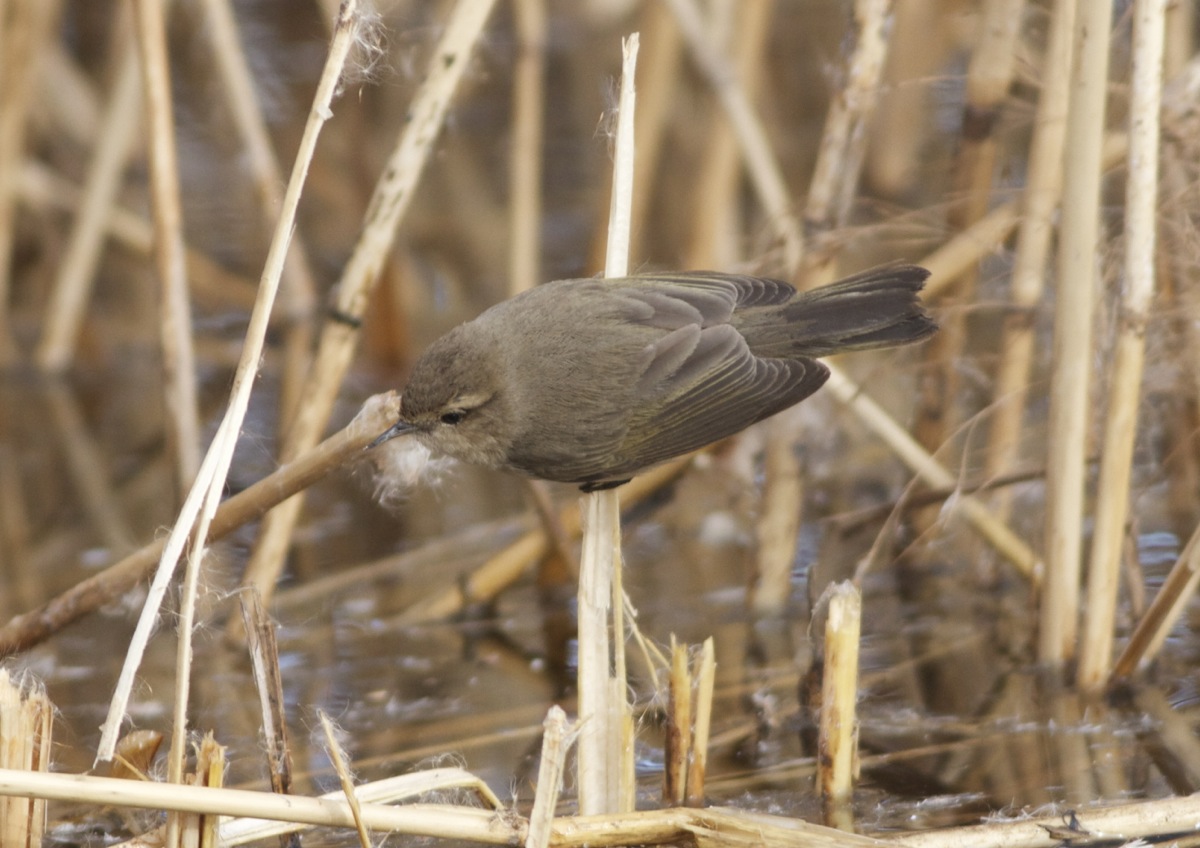
CHIFFCHAFF (叽喳柳莺, Phylloscopus collybita tristis), Olympic Forest Park, Beijing, 7 January 2014.CHIFFCHAFF (叽喳柳莺, Phylloscopus collybita tristis), Olympic Forest Park. The first documented record for Beijing.Although slightly blurred, this photo shows the greenish/yellow tinge under the shoulder.
Fortunately, two local birders Zhu Lei and Que Pinjia were on the scene quickly and secured excellent views but, disappointingly, the bird soon disappeared into a dense reedbed before the others arrived. It was seen briefly later in the afternoon and has been seen on several days since.
As expected for a vagrant CHIFFCHAFF (叽喳柳莺) in eastern China, the bird was of the ‘tristis‘ subspecies. The greyish brown plumage, jet-black legs and bill and the high-pitched and slightly down-slurred call were all typical of this race, considered by some to be a full species.
At the time we all thought that this bird was the first CHIFFCHAFF (叽喳柳莺) to be recorded in Beijing. It does not appear on the municipality list by Liu Yang from 2011 and there are no reports on the Birdtalker database. However, it has since come to light that one was seen in February 2008 at Baiwangshan (in the northwest of the city) by respected local birder, Wen Chen. So the Olympic Forest Park bird is the second record for the capital.
With thanks to Paul Holt, here is a short summary of the status of CHIFFCHAFF (叽喳柳莺) in China:
“Chiffchaff wasn’t an unexpected addition to the Beijing list as there are at least three reports from coastal Hebei (one on Happy Island on 14 May 2002; one at Lighthouse Point, Beidaihe during 16-19 May 2006 & one in the Lotus Hills, Beidaihe on 10 May 2007). Despite the timing of the Hebei records (May – when there are lots of birders in the Happy Island-Beidaihe area), winter has always been thought to be the most likely time this species would turn up in Beijing.
There’s at least one winter record from Yancheng NNR in coastal Jiangsu Province and seven (?) records from Hong Kong (including one recently in “Long Valley”). This form of Chiffchaff, Phylloscopus collybita tristis, winters in India & it’s sometimes split as Siberian Chiffchaff P. tristis. In China it’s restricted to breeding in the Altai Mountains of northern Xinjiang Province (north-west China) but is a locally common passage migrant through much of at least the western part of that province. Elsewhere it occurs as a fairly common migrant in western Qinghai where Jesper Hornskov (in an unpublished report on the Birds recorded at Golmud, Qinghai Province, China, 1980-1994) recorded 256 bird-days – just one spring record (23 March 1994) but fairly common between 25 September and 21 November, plus a late straggler on the 18 December 1990. Numbers varied year on year with 132 bird-days & a high count of 10 on the 3 November in 1991 compared to just 68 bird-days and a high count of eight on the 3 October in 1993.
There’s a record from Shandong Province in the new checklist and Common Chiffchaff has apparently also been recorded in Liaoning Province (it was included in Bai Qingquan’s unpublished List of the Birds of Liaoning, Jan. 2012), Henan Province (as it was included in an unpublished List of the Birds of Dongzhai NNR, Luoshan provided by researcher Du Zhiyong on 4 January 2010), Shaanxi Province (one at Yangxian on the 15 Dec 2003 [Phil Heath] was the first, and possibly still the only provincial record), another was photographed at Yandong Lake, Wuhan on 4 December 2009 (Zhang Shuyong in China Bird Watch 71, p32) – the first record for Hubei Province. There’s a short article on this occurrence in the same issue. The Jiangsu record is of one that was seen at Yancheng NNR by Mark Beaman & a BirdQuest group sometime in the 1990s.”
Rt Hon Ken Clarke MP and Paul Holt birding at Shidu.
One of the advantages of living in Beijing is that many prominent figures visit. Occasionally the visitors are birders and, as part of their visit, they are keen to see some of the special birds that can be found around the Chinese capital. A few weeks ago the British Ambassador informed me about the latest prominent visitor, Rt. Hon. Ken Clarke MP (Senior Cabinet Minister and former Chancellor of the Exchequer), who would be visiting on a trade mission and, on the Sunday before his official engagements began, he was keen to see some birds. Of course, I was only too delighted to accompany Ken and his wife Gillian on a birding trip and, after an exchange with the Minister’s office about possible destinations, we settled on Shidu, a spectacular gorge in the southwest of Beijing. This is one of Beijing’s prime birding sites in winter, hosting a number of special, and relatively easy to see, species including, among others, BLACK STORK (黑鹳), CINEREOUS VULTURE (秃鹫) , BROWN DIPPER (褐河乌), LONG-BILLED PLOVER (长嘴剑鴴) and WALLCREEPER (红翅旋壁雀).
I arranged for Paul Holt, who had coincidentally birded with the Rt Honourable gentleman in India several years ago, to join us and so the four of us set off from the Ambassador’s Residence at 0730 for the 2-hour drive to Shidu.
It was a gorgeous winter’s day in Beijing with clear blue skies, no wind and a relatively mild temperature of -2 degrees Celsius that soon dipped to -5 degrees Celsius as we hit the mountains.
Our first stop was the famous “bridge 6” where, for at least 3 years, a lone WALLCREEPER (红翅旋壁雀) has been in residence. This bird has learned to take advantage of the meal worms put out by the local photographers and often shows incredibly well. Before we made the short walk to the Wallcreeper site we stood on the bridge to scan the river. Immediately we saw two BLACK STORKS (黑鹳) at the top of a cliff, basking in the early morning sunlight. Not a bad start! Then I caught sight of two BROWN DIPPERS (褐河乌) which zipped through and were gone before our esteemed guest could see them. And it was then, whilst scanning for the dippers, that I saw a lone snipe bobbing amongst the rocks of the river.. Training the telescope onto it Paul immediately identified it as a SOLITARY SNIPE (孤沙锥).. wow.. a new bird for me and a new Beijing bird for Paul.. as well as being a completely new bird for Ken and Gillian. An unexpected bonus!
SOLITARY SNIPE (孤沙锥), Shidu. My first ever and Paul’s first in Beijing. With its face pattern and ‘bobbing’ feeding behaviour, I described it as like a cross between a WOODCOCK and a JACK SNIPE!
The reappearance of the BROWN DIPPERS (褐河乌), along with the almost incidental sightings of two LONG-BILLED PLOVERS (长嘴剑鴴) and several blakistoni WATER PIPITS (水鹨), completed a spectacular start to the day…
After a short walk to the WALLCREEPER (红翅旋壁雀) site we stood, in the company of around 10 bird photographers, and waited for the star attraction to arrive. Almost immediately we were treated to several fly-bys from the local HILL PIGEONS (岩鸽) and a pair of PLUMBEOUS WATER REDSTARTS (红尾水鸲) performed well along a small stream.
Male PLUMBEOUS REDSTART (红尾水鸲). A common and obvious bird at Shidu.Female PLUMBEOUS REDSTART (红尾水鸲), Shidu
Then, out of nowhere, the WALLCREEPER (红翅旋壁雀) arrived… flying in to a ledge just a few metres above the awaiting photographers and proceeding to edge its way down to head height to take advantage of the meal worms laid out in strategic positions that enabled the paparazzi to snap the most aesthetically pleasing photos. It was pretty special to see a WALLCREEPER (红翅旋壁雀) so close and we all enjoyed stunning views.
This WALLCREEPER (红翅旋壁雀) is one of Shidu’s special birds and this individual shows spectacularly well.
Immediately afterwards I was impressed to see Mr Clarke delve into his pocket, pull out his notebook and begin scribbling notes about his sightings.. a true birder!
Taking notes at the Wallcreeper site. The Rt Hon Ken Clarke MP is a genuine birder and also suitably attired for a spot of birdwatching…
We moved on further up the valley and found a group of beautiful MANDARIN DUCKS (鴛鴦), including 4 splendid males, before heading up to the north of the gorge to look for one of Shidu’s other specialities – the CINEREOUS VULTURE (秃鹫). We parked up at a pull-in that offered expansive views across the nearby mountains and took the opportunity to tuck in to our packed lunches as we waited. A group of SILVER-THROATED TITS (北长尾山雀银喉长尾山雀) and a couple of GODLEWSKI’S BUNTINGS (戈氏岩鹀) kept us company until we spotted the first large raptor. It was distant but, through the telescope there was no mistaking our first CINEREOUS VULTURE (秃鹫) of the day, soon followed by two more, this time much closer. Awesome birds. Two more, or the same, BLACK STORKS (黑鹳) patrolled the valley before turning around and heading south again, a SAKER (猎隼) showed itself briefly above a distant ridge and an immature GOLDEN EAGLE (金雕) drifted overhead. A set of sightings that would grace any birding location, let alone a site in one of the busiest capital cities in the world.
An immature GOLDEN EAGLE (金雕), always a joy to see, drifted overhead just before we headed back to the city.
We reluctantly had to head back to ensure our Rt Honourable guest was back at the embassy in time for his pre-briefing. A quick stop at bridge 7 on the journey home produced a stunning WHITE-CAPPED WATER REDSTART (白顶溪鸲) and another, unscheduled, stop delivered single UPLAND (大鵟) and EASTERN BUZZARDS (普通鵟) soaring together and being mobbed by two PEREGRINES (游隼) – a pretty good end to another great day’s birding in Beijing.
A big thank you to Ken, Gillian and Paul for being brilliant company throughout the day. It was a real pleasure to spend time ‘in the field’ with you all…
Last September I spent a day filming at Yeyahu Nature Reserve with a TV crew from Phoenix TV, a Hong Kong-based TV channel with over 300 million viewers in China. The result of the day was a 5-minute programme about birdwatching in Beijing that was broadcast at 7.55pm on 1 and 2 January. You can see the programme by clicking this link.
Can you identify the species of raptor towards the end?
It was great fun to do and I want to send a big thank you to Phoenix TV for giving me the opportunity to promote birdwatching in China. And Swarovski, that free advertising must be worth a new pair of binoculars and a ‘scope…?? 😉
That’s the title of the most recent podcast from Sinica, in which I had the pleasure of participating alongside Jon Kaiman, writer for The Guardian, and host Jeremy Goldkorn. You can listen to the podcast – an enjoyable conversation about birds in Beijing and air pollution – by clicking here.
As is traditional, the participants make a recommendation at the end of the show and mine is “Birds and People“, a landmark book about the relationship between birds and people, including stories of cultural and from around the world. My apologies to author, Mark Cocker, for referring to him as Mark Golley at the end (revealing my Norfolk roots!).
A big thank you to Jeremy and Sinica for inviting me to help spread the word about Beijing’s birdlife and the importance of protecting it.
As a superb year for birding in the Chinese capital draws to a close, I bring exciting news that a group of Beijing birders is working on a “2013 Beijing Bird Report”, to include information about all known significant sightings.
Here are the six new records for Beijing in 2013 that we are aware of:
Black-winged Kite: 1 over the Baiwang Shan watch point on the 16 April (鶽鴞 小关 等等 via BirdTalker)
Sandhill Crane: 1 at Bulaotun, Miyun reservoir on the 8 Dec. (ZHU Lei, WANG Yu-ting, JIN Yan-fei, MA Zhe, LEI Ming and JU Ming) was still present on the 15 Dec. (Jan-Erik Nilsén)
Bar-tailed Godwit: 1 at Miyun reservoir on the 13 April (Jan-Erik Nilsén) with eight at Shahe on the 22 June (Colm Moore)
Long-tailed Jaeger: 1 near adult photographed at Shahe on the 22 June (Colm Moore)
Western Yellow Wagtail: 1 male melanogisea (now subsumed in feldgegg) photographed at Shahe reservoir on the 12 May (Colm Moore)
Tree Pipit: 1 photographed in the British Ambassador’s Garden, Guanghua Lu, on the 13 May (Terry Townshend).
It’s likely to be a little while before we complete the annual review and, in the mean time, we are interested in any records for inclusion. Please comment on this post if you have any contributions.
And so, all that remains for me to say in this last post of 2013 is “Merry Christmas and a Happy New Year” to all the readers of this blog.. and a big thank you to everyone who has contributed, commented and spread the word about birding in Beijing. Here is a festive cartoon, courtesy of my very talented friend, Li Xiaomai… enjoy!
EDIT: It has since come to light that another new bird was seen in Beijing in 2013 – a SANDERLING was photographed at Ma Chang in September (awaiting further details). So that’s 7 new birds in 2013!
On Saturday I visited Lingshan, Beijing’s highest mountain, with 吴岚 (Wu Lan). It’s a long drive – around 100km – but straightforward as it’s all along the G109. Lingshan was the location of GULDENSTADT’S REDSTARTS (红腹红尾鸲) last winter and looking for this species was one of the aims of the visit. Leaving well before dawn to miss the traffic, it was stunning to see the colours on the mountains change from a dark pink to a bright orange as the sun rose in the southeast.. Beijing’s mountains really are beautiful.
On the way we were fortunate to see a flock of 14 JAPANESE WAXWINGS (小太平鸟) by the roadside at Qingshui…
A lucky encounter: part of the flock of 14 JAPANESE WAXWINGS by the roadside at Qingshui
On arrival at Lingshan we quickly spotted a few GULDENSTADT’S REDSTARTS (红腹红尾鸲) on the sea buckthorn bushes near the peak. Stunning birds, especially in flight, there were at least 10 present in the area.
The view from the top of Lingshan looking north east.A male GULDENSTADT’S REDSTART enjoying the Sea Buckthorn berries at the top of Lingshan.I love the deep orange colour of the underparts.
As well as the redstarts, there are also good numbers of PALLAS’S ROSEFINCHES (北朱雀) and DARK-THROATED THRUSHES (mostly RED-THROATED 赤颈鸫).
PALLAS’S ROSEFINCHES are superb little birds. And Lingshan is probably the best place to see them in Beijing.There are good numbers of Dark-throated Thrushes at Lingshan. This one is, I *think*, a young RED-THROATED (reddish tail) but not 100% sure…. could be some BLACK-THROATED influence.
We had only been on the mountain a short time when we saw a distressing sight – a CINEREOUS VULTURE (秃鹫) that was clearly injured.. It was hobbling uphill dragging its right wing along the ground.
Our first view of the injured CINEREOUS VULTURE..
The vulture had almost certainly collided with one of the support wires of this nearby communications tower.
The communications tower at Lingshan. This unfortunate vulture had almost certainly collided with one of the support wires, badly breaking its wing.
Having previously visited the Beijing Raptor Rescue Centre, they were the obvious people to call for advice and 张率 (Zhang Shuai), the head of the centre, said “please catch it and bring it in for treatment – if not, it will die tonight with an open wound in these temperatures.” She ended the call with “Don’t worry – you will be able to out-run it.”
It sounded easy. We just catch it, put it in the boot of the car and drive the 100km back to Beijing to the rescue centre.
At this point I regretted not carrying a large box in the back of the car and, with no prospect of finding one on top of a remote mountain, we decided that covering the bird with my thick down winter coat would be the best way to capture it and cover it for the journey back to Beijing.
We began the walk up the hill to where the we last saw the bird and, sure enough, we soon found it. It was laying on its back with its legs kicking in the air.. clearly in some distress.
The vulture was clearly in distress as we approached it.
At this point, 吴岚 (Wu Lan) was brilliant. She ran towards it and covered it with my coat before it had a chance to right itself and scramble away.
吴岚 (Wu Lan) just after ‘capturing’ the vulture.
Wrapping it in my fleece and covering its head with Wu Lan’s hat, we were able to calm it and, after a couple of minutes, we lifted it (7kg as it turns out) and began to walk to the car. It was heavy and we both took shifts in carrying it down the hill to the car.
Me carrying the vulture off the hill. At this point we were hopeful of the bird’s survival.
We wrapped it gently in my coat and placed it in the boot of the car… It was big enough to sit upright in the backseat with a seatbelt on but, with a broken wing, it was clearly best to be in a dark place to minimise the stress. And so we began the journey back to Beijing, hoping for the best but fearing the worst. The injury was clearly very bad, with part of the wing bone protruding and lots of blood.
It took around 2.5 hours to reach the raptor centre and, on arrival, the impressive 张率 (Zhang Shuai) was ready – she had already prepared the operating theatre – and the bird was immediately put under anaesthetic to allow a thorough inspection of the wound.
The Cinereous Vulture under anaesthetic.The wound was bad. And the bird was injected with fluids to offset the blood loss and dehydration.
张率 (Zhang Shuai) got to work immediately and cleaned up the wound before taking an x-ray to assess the damage.
The x-ray revealed the terrible extent of the injury – breaks on both wing-bones with bad splintering.
张率 (Zhang Shuai) looked at us with tears in her eyes. We knew immediately what she was going to say. The injuries were too bad to fix and, with a bird this size, a life in captivity would be miserable for a majestic bird that is used to ruling the skies over the mountains of northern China and Mongolia. It was emotional for us all. This poor bird had been doing exactly what it was meant to do – patrolling the skies over the mountains looking for food – when it had collided, badly, with an alien, and almost invisible, structure. There was no option. This magnificent bird had to be euthanised.
I can’t help thinking that if the support wires had been marked with flags or even painted a contrasting colour instead of the almost unnoticeable silver grey, this bird might have seen them and taken evasive action. It seemed such an unnecessary, and desperately sad, death.
On Friday 22 November, I spent the day at Miyun Reservoir with visiting Marie Louise Ng from Hong Kong. It was a stunningly beautiful day – cold early on but spectacularly clear and with almost no wind. It was one of those days that, as a resident of Beijing where the air can often be toxic, I absolutely adore.
Miyun Reservoir on a clear autumn day. It’s hard to believe this is Beijing!
We visited two sites on the northern shore of the reservoir and, at the first, we were treated to spectacular flyovers of several hundred COMMON CRANES, with a handful of HOODED CRANES amongst them.. and skeins of BEAN GEESE flying from their roosting sites to the feeding grounds in the maize fields. At least 4 JAPANESE REED BUNTINGS kept us company at our observation point.
After a couple of hours we decided to take a walk to some weedy fields in which I had peviously seen PALLAS’S SANDGROUSE.
As we headed over the brow of a small hill, there was movement in the grass and, quickly training my binoculars, I could see a cat walking slowly from right to left, less than 100 metres away. My heart leapt. It looked big and, immediately, with that thick bushy tail and spotted markings on its fur, I thought it must be a LEOPARD CAT. Gripped by the presence of a very special mammal, we watched it as it made its way onto a dirt track. With the sun behind us, it was now in full view and we were enjoying spectacular views (I am sure the low sun also played a role in delaying this beautiful animal’s detection of us). We reached for our cameras and reeled off some photos as it suddenly broke into a trot and then melted into the vegetation to the north of the track. We watched, captivated, as it made its way towards a small lake, eventually vanishing into the long grass with the local magpies agitated and noisy.
I turned to Marie with what must have been the biggest grin I have ever sported and said immediately “that’s my best wildlife experience of the year!”
LEOPARD CAT (Prionailurus bengalensis) of the ssp euptilurus/euptilura (aka AMUR LEOPARD CAT). Note the dark stripes on the back of the head and the pale patches on the back of the ears, as well as the thick, striped, tail.LEOPARD CAT, Miyun Reservoir, 22 November 2013. Sightings, especially during the daytime, are very rare in the capital.At less than 100m range, and with the morning sun behind us, views were spectacular!
Although Leopard Cat is probably not rare in the mountains around Beijing, sightings certainly are. I am aware of just one other recent Beijing sighting – one seen at Yeyahu by Brian Jones on 11 October 2010. The information below about the status of LEOPARD CAT in China is from Zhu Lei, for which many thanks.
=====
Gao (1987, in ‘Fauna Sinica. Mammalia. Vol. 8. Carnivora’) reports that there are 4 subspecies of Leopard Cat in China, euptilura (NE China, north of Yellow River), bengalensis (SW China), chinensis (N and S China) and hainana (endemic to Hainan Island). The ssp. euptilura has the largest body and lightest coat, also the very faint spot marking. The ssp. chinensis is darker, more distinctively spotted, and has 2 black dorsal stripes.
Chen et al. (2002, in ‘Mammals of Beijing’) points out that the ssp. of Leopard Cat in Beijing is euptilura, according to measurements and colour markings of specimens from Yanqing and Mentougou.
Xie and Smith (2008) recognise 5 ssp. in China, alleni (includes hainana, endemic to Hainan), bengalensis (SW Guangxi, SW Guizhou, Sichuan, S Xizang, Yunnan), chinensis (S Anhui, SW and E China, Taiwan), euptilura (north of Huaihe River, Beijing, NE China), scripta (N Yunnan, W Sichuan, Qinghai, Gansu, Ningxia, Shaanxi and SE Xizang, Chinese endemic ssp.).
Based on above reference and the pics you’ve sent, I think your cat definitely is ssp. euptilurus (light coat and very faint spotted).
=====
The ssp euptilurus or “Amur Leopard Cat” looks very different to the southern China and SE Asian subspecies (see images here for comparison) and, I understand, it’s a potential split into a separate species in its own right. The taxonomy of Leopard Cat in China is poorly understood, so classification may be subject to change.
However man decides to classify this cat, it is a beautiful animal and we were privileged to spend a special minute or two in its company.. proving once again that Beijing is a superb place for birds and wildlife.
This guy was ‘training’ Japanese Grosbeaks to chase seeds, blown into the air through a thin tube, and then return to their perch. The market at Fuchengmen is just one of Beijing’s wild bird markets. Apparently there are more than 10 in total across the city.
How would you like 2 COMMON REDPOLLS for a pound? Or maybe you’d prefer a SIBERIAN ACCENTOR for 3 pounds? They are pretty, after all… Actually, you look quite rich… maybe you fancy a MONGOLIAN LARK for 15 pounds? I know it’s expensive but boy, can they sing!
This is what the traders were offering on Sunday afternoon during a visit to the wild bird market at Fuchengmen, west Beijing.
Two friends – Yueheng and Xiaomai – very kindly offered to accompany freelance journalist, Debbie Bruno, and me to one of at least 10 wild bird markets in Beijing. For me, the market was both shocking and revealing. Shocking because it was operating openly inside the 2nd ring road of one of the world’s major capital cities. And revealing because it taught me a lot about the culture and demographics of the traders, the trappers and the buyers.
In a 2-hour visit, I logged 28 species on sale in the bird market, including familiar species such as Bohemian Waxwing, Bluethroat, Marsh, Japanese, Yellow-bellied and Long-tailed Tits, Common Redpoll, Siberian Accentor, Siberian Rubythroat and Pallas’s Warbler. I was wide-eyed.
A Pallas’s Warbler. In a cage. Desperately sad, especially as this species is insectivorous and unlikely to survive for long on a diet of seeds.
However, from speaking with Yueheng, this was a quiet day. Yueheng and Xiaomai have been studying the birds in this market for more than 10 years and have logged more than 300 species (!), including Pallas’s Sandgrouse, Derbyan Parakeet, Oriental Pied Hornbill and Fairy Pitta. Astonishing.
I wanted to find out how much these birds were selling for. After speaking with a few of the sellers, this was the going rate on Sunday:
COMMON REDPOLL (one of the most common birds on offer in the market) – 2 for 10 Yuan (GBP 1)
PALLAS’S WARBLER – 40 Yuan each (GBP 4)
MONGOLIAN LARK – 150 Yuan (GBP 15) – they can sing (!), although there was almost certainly an element of “foreigner inflation” going on here…
CHINESE HILL BABBLER – 150 Yuan (GBP 15) – they can sing, too.
Common Redpolls were available – 2 for 10 Yuan (GBP 1) at Fuchengmen.
Given the costs of transporting live birds, the likelihood that many birds almost certainly die in transit, and the fact that business looked slow (I didn’t see a single transaction), this clearly wasn’t a lucrative business. So I wanted to know whether selling wild birds was the main source of income for the traders.
Most traders had a small stock and were ‘getting on’…
After discussing with Yueheng and Xiaomai, apparently, for most of the traders, it’s a supplementary income or even just a hobby – the majority had full-time jobs or were retired. To me, this is encouraging as it means that, unlike the shorebird trapping in Guangdong, southern China, where many local villagers make their living from trapping birds for the restaurant trade, better enforcement of the law by the authorities in Beijing will likely face less resistance.
As we wandered around, it was interesting to see that the vast majority of the traders, and the interested buyers, were old men. This gave me more encouragement as it suggested that the custom of owning caged birds is primarily an old man’s pursuit and, not being cruel, most old men will not be around much longer….
The scene at Fuchengmen. Mostly smelly old men.
It was heartbreaking to see so many wild birds being kept in tiny cages. And those not in cages were tied to a perch using a chain around their neck. The vast majority were clearly distressed, with many showing abnormal feather loss and/or repetitive behaviour as they bounced around their prison cells looking for a way out.
A Red Crossbill tied with a chain around its neck. Can you think of anything more cruel?A sad-looking BOHEMIAN WAXWING. Must be wondering what it did to deserve this….
I asked some of the traders where the birds had been caught. Most said “Beijing”, although some were from “Dong Bei” (north-east China) with a much smaller portion from southern China (Yellow-cheeked Tit and Red-faced Liocichla were some of the non-Beijing birds on sale).
As we walked around the market, Yueheng and Xiaomai told us some fascinating anecdotes. Here are a few:
– apparently Marsh Tits from Henan and Shandong are worth much more than those from Beijing as they are thought to sing better!
– small birds, particularly those not known to sing or with beautiful plumage, can sell for as little as 3 Yuan for 2 (GBP 0.15 each)
– the authorities have been cracking down on raptor sales… an old lady from Tai’an in Shandong Province had been busted selling JAPANESE SPARROWHAWK, SHORT-EARED OWL, PIED HARRIER and WHITE’S THRUSH. The police confiscated the raptors but gave her back the WHITE’S THRUSH so she could sell it in the local market (!)
– many of the ‘consumers’ are Buddhists who want to buy and release birds for their own “gong de”, believing that these good deeds help to “cleanse” their soul.
The cagebird trade, although a cruel and outdated tradition, pales into insignificance when compared with habitat loss and the trapping for food that is so widespread in south China in terms of being major threats to wild bird populations. Even so, I will do everything I can to support Yueheng and Xiaomai to raise awareness and encourage greater law enforcement in Beijing and beyond. Trapping wild birds for the cage bird trade is simply unacceptable in a modern society.
Many of my friends will know that one of my most-wanted birds in Beijing has been the Pallas’s Sandgrouse. This is a species that breeds as close as Inner Mongolia and, just occasionally, irrupts in large numbers beyond its normal range.
It’s a bird that has been on my mind since my childhood when I first heard about major irruptions in the late 19th century that resulted in them being “everywhere” in winter 1889 at my original local patch of Winterton-on-Sea in Norfolk, England. Sadly, irruptions on that scale appear to be a thing of the past and it is now a very rare species in the UK and Europe. However, in Beijing, its appearance is a little more regular and in 2009-2010, the winter before I moved to China, there was a decent irruption in the capital with flocks of 100+ reported from Wild Duck Lake and even good numbers at sites inside the 6th ring road. Unfortunately, since then, they have been very few and far between – I am aware of just one record of a small flock at Miyun last winter (Jan-Erik Nilsen) that was never seen again.
I have been secretly (and openly!) hoping that this winter might prove to be THE winter and yesterday, Sunday 3 November, that hope turned to reality.
Having returned from Inner Mongolia on Saturday, where I had been attending a workshop with local government officials, nature reserve managers and local groups about JANKOWSKI’S BUNTING (a post about that will come soon!), I had arranged to go birding on Sunday with Ben Wielstra, visiting Catalan, Eugeni Capella Roca, and 吴岚 from the Beijing Birdwatching Society. I left central Beijing at 0445, collecting the team on the way, and we arrived at a chilly Ma Chang at around 0645.
Two first year RELICT GULLS represented a superb beginning to the day. These two young gulls were almost certainly the same two individuals that had been seen the weekend before and they were remarkably tame.
One of the two first calendar year RELICT GULLS at Ma Chang at dawn.
Unfortunately the water levels at Ma Chang are now so high that the best vantage points from which to view the wildfowl are now inaccessible, so after checking the ‘desert area’ for anything interesting, we were soon on our way to Yeyahu Nature Reserve to focus most of our day at this superb Beijing site.
On arrival there was a nice mixed flock of GADWALL and FALCATED DUCK on the lake with a lone BEWICK’S SWAN and we secured our first sightings of PALLAS’S REED BUNTING, CHINESE GREY SHRIKE and CHINESE PENDULINE TIT.
A scan of the grassland produced a ringtail HEN HARRIER and one of the tractors cutting the grass flushed a SHORT-EARED OWL. Then a distant SAKER and an adult PEREGRINE passed by. Pretty good! We made our way to the new tower hide and spent some time there scanning for raptors and checking the flocks of duck that were occasionally flushed by the HEN HARRIER. A single COMMON (EASTERN) BUZZARD and a flock of BEAN GEESE kept the interest going and soon we began to hear the sound of CRANES… a sound that was almost omnipresent all day as more and more groups seemed to arrive high from the west… a wonderful sight and sound.
From the hide we caught sight of several very distant flocks of birds, the identification of which we couldn’t quite put our finger on.. they looked to have pointed wings, almost wader-like, and yet their size meant that the only species that came to mind was PACIFIC GOLDEN PLOVER.. but that identification didn’t fit – these birds didn’t fly like plovers – they were in an irregular, and reasonably tight, formation flying strongly north.. what were they??
They went down in the notebook as “possible plover sp” but we weren’t happy. Several minutes later, Eugeni suddenly shouted out “SANDGROUSE!” and we all quickly got onto two birds streaming very fast past our vantage point, heading north. Plump birds with a dark belly patch and a pointed tail… Wow! PALLAS’S SANDGROUSE – my most wanted Beijing bird!!! They disappeared out of sight almost as soon as they had arrived and we looked at each other with broad smiles.. we might even have done a couple of “high-fives”!
PALLAS’S SANDGROUSE at Yeyahu NR, Sunday 3 November 2013. A much-wanted bird….Another photo of two of the PALLAS’S SANDGROUSE that flew past the tower hide at Yeyahu NR.
Little did we know that we would soon see some more… and as we made our way around the flooded fields towards the smaller observation tower, we saw another… then another.. and from the tower itself we saw another 3. The same or different? Not sure but they were definitely PALLAS’S SANDGROUSE. Suddenly the penny dropped on the flocks we had seen earlier – surely they must have been PALLAS’S SANDGROUSE too…! And we had even more reason to believe they were sandgrouse when we heard from a Chinese friend that over 200 had been seen around the same time over central Beijing..! At the rate they flew, it would only have taken them a few minutes to reach the mountains at Badaling from central Beijing and the birds we saw could easily have been the same flocks. Something is clearly going on with PALLAS’S SANDGROUSE this winter!
The team at Yeyahu NR, shortly after seeing our first PALLAS’S SANDGROUSE. From left to right: Terry, Eugeni, Ben and Wu Lan.
Another nice encounter involved this SIBERIAN WEASEL, a reasonably common mammal in Beijing but rarely seen well in daylight. This individual ran towards us, stopping occasionally to check us out, before disappearing into the reedbed.. a very cool animal…
Peekaboo…! SIBERIAN WEASEL on the track at Yeyahu NRThis SIBERIAN WEASEL was curious and seemed to be watching us as much as we were watching him..!
We decided to make a return visit to Ma Chang before heading home. That was the place that held large flocks of sandgrouse during the 2009-2010 winter and we thought that maybe, just maybe, some had dropped in during the day. We didn’t see any on our afternoon visit but we did stumble across a nice flock of HORNED LARKS, another scarce and irruptive visitor to Beijing. A group of 3 was soon followed by a much larger group consisting of at least 53 birds.. wow.
HORNED LARKS, Ma Chang, 3 November 2013. Always a beautiful sight, especially in the late afternoon sun.One of the HORNED LARKS at Ma Chang. These birds looked very pale… currently investigating likely subspecies. The two on the Beijing list are ‘flava’ and ‘brandti’.
These beautiful larks wheeled around uttering their ‘tinkly’ call in the late afternoon sun… a magnificent sight to end the day. After a quick cup of coffee we headed back to Beijing, tired but elated… what a day!
Big thanks to Ben, Eugeni and Wu Lan for their excellent company on this special day…
Full species list:
TUNDRA BEAN GOOSE Anser serrirostris 74 (Apparently 300 in the area, according to Yeyahu NR staff).
TUNDRA SWAN Cygnus columbianus 小天鹅 1 at Yeyahu NR
RUDDY SHELDUCK Tadorna ferruginea 赤麻鴨 8
GADWALL Anas strepera 赤膀鴨 108
FALCATED DUCK Anas falcata 罗纹鸭 14
MALLARD Anas platyrhynchos 綠頭鴨 122
CHINESE SPOT-BILLED DUCK Anas zonorhyncha 斑嘴鴨 29
NORTHERN SHOVELER Anas clypeata 琵嘴鸭 1
NORTHERN PINTAIL Anas acuta 针尾鸭 5
EURASIAN TEAL Anas crecca 绿翅鸭 14
COMMON GOLDENEYE Bucephala clangula 鹊鸭 1
SMEW Mergellus albellus 白秋沙鸭 83
LITTLE GREBE Tachybaptus ruficollis 小鸊鷉 4
GREAT CRESTED GREBE Podiceps cristatus 凤头鸊鷉 5
GREAT BITTERN Botaurus stellaris 大麻鳽 2
HEN HARRIER Circus cyaneus 白尾鹞 4 (3 ‘ringtails’ and one adult male)
EURASIAN SPARROWHAWK Accipiter nisus 雀鹰 1
NORTHERN GOSHAWK Accipiter gentilis 苍鹰 2
EASTERN BUZZARD Buteo japonicus 普通鵟 1
MERLIN Falco columbarius 灰背隼 1 adult male
SAKER FALCON Falco cherrug EN 猎隼 1 one distant bird, probably this species
PEREGRINE FALCON Falco peregrinus 游隼 1
COMMON COOT Fulica atra 骨顶鸡(白骨顶) 17
COMMON CRANE Grus grus 灰鹤 109 We could hear cranes almost all day. Many seemed to be arriving. Very difficult to count but the biggest count at any one time consisted of a single group of 109 birds
RELICT GULL Ichthyaetus relictus VU 遗鸥 2 First calendar-year birds. Almost certainly the same as seen the previous weekend by multiple observers.
PALLAS’S SANDGROUSE Syrrhaptes paradoxus 毛腿沙鸡 5 The first picked up in flight by Eugeni at Yeyahu NR @c1130. Followed by 3 @c1315 and 2 singles later in the afternoon. Four distant large flocks totalling over 150 birds seen c1100 and c1230 were probably this species.
EURASIAN COLLARED DOVE Streptopelia decaocto 灰斑鸠 18
SHORT-EARED OWL Asio flammeus 短耳鸮 1 Flushed by one of the bailers on the Kangxi Grassland
COMMON REDPOLL Carduelis flammea 白腰朱顶雀 2; one in flight calling over Yeyahu NR looked pale. Another seen by Eugeni flushed from scrub at Yeyahu NR. My first in Beijing!
On Saturday 12 October I visited Wild Duck Lake (both Ma Chang and Yeyahu NR) with Jesper Hornskov and Ben Wielstra. As usual with this site in October, expectations were high as I set off at 0445 to pick up Ben, then Jesper, before heading over the mountains past Badaling Great Wall and on to Ma Chang.
On arrival, the water level at Guanting Reservoir was the highest I have ever seen. Consequently most of the viewing points that I have used in the past to observe the reservoir are no longer accessible, meaning that we had no opportunity to view the duck on the open water. A couple of CHINESE GREY SHRIKES, a MERLIN, a few lingering juvenile AMUR FALCONS, some early BEAN GEESE and a flock of 23 MONGOLIAN LARKS kept us entertained at Ma Chang before we decided to hot-foot it over to Yeyahu Nature Reserve to spend some time at the new viewing tower.
The new viewing tower at Yeyahu NR. It offers an impressive vista over the entire reserve, and beyond, as well as providing a superb place from where to watch raptors.
As we made our way out of Ma Chang along the unpaved access track I caught sight of a raptor to the north of us, gliding west. I slammed on the brakes (not as dramatic as it sounds when you are only moving at about 5mph) and glanced through my binoculars. It was big. An eagle. I should say at this point that, only a few minutes before, I was chatting to Jesper and Ben about the potential for a STEPPE EAGLE. I had seen GREATER SPOTTED EAGLE and IMPERIAL EAGLE at Wild Duck Lake before but never STEPPE. As I looked through my binoculars, I could see a pale bar on the underwing and my heart raced – it looked like a first calendar year STEPPE EAGLE! We all jumped out of the car and it began to circle, offering us superb views with the sun behind us. I grabbed my camera and reeled off a few shots before just enjoying the bird as it gained height and eventually drifted off west. Wow! A new bird for me in Beijing.
First calendar year STEPPE EAGLE, Ma Chang, 12 October 2013.
Elated, and buoyed by our seemingly potent ability to talk up species at will, we began to chat about all sorts of obviously impossible targets for the day such as SWINHOE’S RAIL, STREAKED REED WARBLER, CRESTED SHELDUCK and, of course, BAER’S POCHARD.
A few minutes later we arrived at Yeyahu NR and, after a celebratory cup of coffee, made our way into the reserve and headed for the new watchtower. On the way we experienced a modest passage of raptors with NORTHERN GOSHAWK, EURASIAN SPARROWHAWK, COMMON (EASTERN) BUZZARD and, again after talking about a likely species, SHORT-TOED EAGLE. It was turning into a very good day.
We reached the tower after about 20 minutes and set up stall, hoping that the early promise might continue. A few more NORTHERN GOSHAWKS, COMMON (EASTERN) BUZZARDS, a HEN HARRIER and an additional SHORT-TOED EAGLE kept us interested and then another large eagle came into view from the east… As it drifted closer, we could see it wasn’t the expected GREATER SPOTTED EAGLE (regular at this time of year) but a STEPPE EAGLE! Given the direction and timing, almost certainly a second individual.
As the day wore on, cloud cover increased and the raptor passage seemed to stop, so we decided to head for the newly flooded area in the hope of sighting some duck, including a target for Ben – BAIKAL TEAL.
We didn’t see any BAIKAL TEAL but we did see good numbers of MALLARD, SPOT-BILLED DUCK, GADWALL, FALCATED DUCK, RED-CRESTED POCHARD and a handful of FERRUGINOUS DUCK. As we made our way along a track through the flooded area, we encountered some COMMON REED BUNTINGS. I don’t see many COMMON REED BUNTINGS in Beijing (it’s a case of picking out a COMMON among all the PALLAS’S REED and LITTLE BUNTINGS – I can feel your sympathy) so I decided to hang back to take some photographs as Jesper and Ben headed to a small viewing area overlooking one of the ponds.
I had a frustrating time with the buntings but did manage some record photos.
COMMON REED BUNTING, Yeyahu NR, 12 October 2013. It’s a bind to pick these out amongst all the PALLAS’S REED and LITTLE BUNTINGS.. sigh…
Just as I was about to leave the buntings to catch up with Jesper and Ben, a pair of Ferruginous Duck/Baer’s Pochards flew past and, as I had my camera set up, I reeled off a couple of photos as they plunged down onto one of the small pools in the reedbed. I didn’t even look at the camera to check the images as I already felt I had been too long trying to photograph the buntings – and they would almost certainly be Ferruginous. However, as I caught up with Jesper and Ben, I mentioned that I had seen two Ferruginous/Baer’s-type ducks to which Jesper replied that they had seen three definite Ferruginous.. I (erroneously, as it turned out) assumed that I had seen two of the three birds they had seen, so I didn’t think any more of it….. ***LESSON HERE***
From the watchpoint, we viewed a small area of the pool on which ‘my’ birds alighted and it was busy – lots of Gadwall, Falcated Duck and Mallard were moving around and flying in and out. But no sign of the ‘Ferruginous/Baer’s types’. As the light began to fade, we left and headed back to Beijing.
At home, as I uploaded my photos from the day, I had a double-take when I saw the two images of the Ferruginous/Baer’s type duck I had seen. One appeared to have a green tinge to the head and, structurally, they looked wrong for Ferruginous. They were BAER’S POCHARDS!
BAER’S POCHARDS, Yeyahu NR, Beijing, 12 October 2013Another image of the BAER’S POCHARDS from Yeyahu NR yesterday. Poor photos but the structure, colouration and underpart markings all fit with Baer’s.
Having known that Ben was particularly keen to see BAER’S POCHARD, I felt terrible. If only I had looked at the photos at the time, I would have realised that there was a pair of BAER’S POCHARDS on that pool and we could have stayed longer in the hope that they reappeared. But as it was, we left in ignorance and it was only when I got home that I realised. Sorry Ben!
The silver lining is that I will almost certainly take Ben to Wild Duck Lake again while he is in Beijing and I have even offered to take him to the breeding site in Hebei Province to hopefully see them there… It’s a lesson learned.
In any case, it was another superb day at this brilliant site. Is there a capital city in the world with birding as good as this? If so, I want to know about it!
Full species list below. Thanks to Jesper and Ben for their company on the day.
Common PheasantPhasanius colchicus – 6+
Bean GooseAnser fabalis serrirostris – 15
Ruddy ShelduckTadorna ferruginea – one (plus a couple of possibly captive ones…)
Baer’s Pochard Aythya baeri – a pair photographed [TT]
Ferruginous DuckAythya nyroca – three
Smew Mergellus albellus – four brownheads
Little GrebeTachybaptus ruficollis – nine
Great Crested GrebePodiceps cristatus – three
Eurasian BitternBotaurus stellaris – one (in flight, giving ‘pao!’ call)
Chinese Pond HeronArdeola bacchus – one
Grey HeronArdea cinerea – six
Little EgretEgretta garzetta – three
Great CormorantPhalacrocorax carbo – two
Common KestrelFalco tinnunculus – one
Amur FalconFalco amurensis – 12+ (excellent views of several 1st c-y birds)
Merlin Falco columbarius – two (adult male; unaged female)
Eurasian HobbyFalco subbuteo – one
Short-toed EagleCircaetus gallicus – two
Eastern Marsh HarrierCircus spilonotus – one 1st c-y (an unusually dark individual, with hardly any pale on crown, no noticeable pale rump, effectively no pale on forewing & an at most very faint breast band)
Hen HarrierCircus cyaneus – four 1st c-y
Eurasian SparrowhawkAccipiter nisus – eight
Northern GoshawkAccipiter gentilis – two
Common BuzzardButeo buteo japonicus – 7+
Steppe EagleAquila nipalensis – 1-2 (a 1st c-y circling & gliding 10h42 as we were leaving Machang & probably another – in identical plumage, as far as we could tell – over YYH reserve at 12h20…)
Common MoorhenGallinula chloropus – two
Common CootFulica atra – 16
Northern LapwingVanellus vanellus – 70
Pacific Golden PloverPluvialis fulva – eight 1st c-y
Common SnipeGallinago gallinago – one
Common Black-headed GullLarus ridibundus – 15+
Oriental Turtle DoveStreptopelia orientalis – three
Eurasian Collared DoveStreptopelia decaocto – four
Great Spotted WoodpeckerDendrocopos major – five
Chinese Grey ShrikeLanius sphenocercus – four (mostly showing very well…)
Azure-winged MagpieCyanopica cyanus – two
Common MagpiePica pica – 60+ (not counting birds en route!)
Daurian JackdawCorvus dauuricus – c390 (main event a flock of c325)
Rook Corvus frugilegus – one (up close, feeding in a field)
Eastern Great TitParus minor – three
Yellow-bellied TitParus venustulus – nine
Marsh TitParus palustris
Chinese Penduline TitRemiz (pendulinus) consobrinus – five (incl a juvenile sitting up nicely)
Mongolian LarkMelanocorypha mongolica – 23 (one flock taking off from harvested maize field,then flying around allowing nice views before dropping back down distantly)
Asian Short-toed LarkCalandrella cheleensis – two
Eurasian SkylarkAlauda arvensis – 155+
Chinese Hill Warbler Rhopophilus pekinensis – three
Continuing the theme of birds in city centre locations (see the previous post on my ‘garden’), this blog post is about a recent survey of the UK Ambassador’s garden.
In May this year the UK Ambassador invited me to survey his garden for birds. Although not a birder, he is interested in the birds in his garden and has been known to interrupt internal meetings with the occasional – “Oh look, there’s a Woodpecker outside the window”.
After making arrangements with security, I planned to visit the garden each day for an hour to log the birds present during the height of Spring migration. The May survey produced a few highlights and one major surprise – Beijing’s first TREE PIPIT (see “First for Beijing: Tree Pipit”). It was always going to be fascinating to repeat the exercise in Autumn and so, in mid-September, I arranged to visit the garden each day for a week.
In total, 30 species were seen and the highlights included:
At least 4 RUFOUS-BELLIED WOODPECKERS (棕腹啄木鸟) on 10th (a record number seen together in Beijing)
3 SIBERIAN THRUSHES (白眉地鸫) on 16th
Single WHITE’S THRUSHES (虎斑地鸫) on 11th, 12th and 16th
A single DAURIAN STARLING (北椋鸟) on 10th
ASHY MINIVET (灰山椒鸟) heard on 16th
BLACK DRONGO (黑卷尾) on 11th
Single SIBERIAN RUBYTHROATS (红喉歌鸲 [红点颏]) on 12th, 13th and 16th
WHITE’S THRUSHES were seen on three dates during the mid-September survey.
A total of 47 species have now been recorded in the Ambassador’s garden in Spring and Autumn, including some difficult-to-see species. You can download the full report (including a systematic list of the species seen). It just goes to show that Beijing is a great location during migration season.
I call it my garden but, as you can see from the photo below taken from our apartment on the 17th floor, it’s more of a communal green space. Nevertheless, until the relatively recent arrival of Jennifer Leung, I am pretty sure I was the only birder covering it on a regular basis and, by regular, I mean maybe once a week during migration season.
My ‘garden’ as viewed from the apartment window. A magnet for migrants.
Anyway, the reason for posting a photo of my ‘garden’ is that yesterday, Wednesday 25th September 2013, I awoke early – too early – and thought I’d have a walk around before breakfast. Late September in Beijing is a pretty special time for bird migration and, after a cold front passed a few days before the temperature had dropped significantly, particularly noticeable at night. Of course this had prompted many birds to move and I was pretty confident of seeing some good birds on my early morning walk. A few YELLOW-BELLIED TITS (黄腹山雀) were a nice start, soon followed by my first PALLAS’S WARBLER (黄腰柳莺) of the autumn (these little gems usually pass through around a month later than the similar YELLOW-BROWED WARBLER (黄眉柳莺) which has been a regular sight and sound in the garden since late August). An ARCTIC WARBLER (极北柳莺), an OLIVE-BACKED PIPIT (树鹨) and the seemingly omnipresent TAIGA FLYCATCHERS (红喉姬鹟) kept the interest going. I sat quietly on my favourite slope from where I can see the base of a small area of bamboo and, almost immediately, a bird flew in and landed less than 5 metres away in the canopy above my head.. Unfortunately it was mostly obscured but I could see a white flash on the closed wing. I immediately thought it could be a DAURIAN REDSTART (北红尾鸲) , a relatively common migrant in central Beijing in late autumn, but something didn’t seem right. I slowly moved to one side in an effort to view more of the bird and suddenly I could see this beautiful bird in full view..
White-throated Rock Thrush, Central Park, Beijing, 25 September 2013. A fitting 50th species for this small green space.
…wow, a WHITE-THROATED ROCK THRUSH (白喉矶鸫)! No sooner had I registered that I was looking at my 50th species in this small green oasis in the middle of this city of 20 million-plus people, it began to sing! Over the next half an hour or so, in between being flushed by, in chronological order, a litter picker, a dog-walker and a man ‘exercising’ by shouting at the top of his voice, I was able to take a series of photos, including one with a GREAT SPOTTED WOODPECKER (大斑啄木鸟) with which it seemed to be loosely associating.
White-throated Rock Thrush (male). A good looking bird….White-throated Rock Thrush. Beautiful plumage and a real treat to see this species so well in the ‘garden’.White-throated Rock Thrush with Great Spotted Woodpecker. An unlikely couple!
The parks in Beijing, in fact not just the parks but any green space, can turn up some real surprises in spring and autumn. It’s not that these places are particularly maintained in any way to attract birds – in fact one could argue that with all the ‘grooming’, it’s the opposite – but a reflection of the fact that there are so many birds migrating through Beijing that even if a teeny weeny percentage of them choose to stop in the city, species that are ordinarily quite difficult to see appear in unexpected places.
The WHITE-THROATED ROCK THRUSH (白喉矶鸫) joins a stellar cast for this tiny green space including JAPANESE QUAIL (鵪鶉), BLYTH’S PIPIT (布莱氏鹨), EYEBROWED THRUSH (白眉鸫), SIBERIAN RUBYTHROAT (红喉歌鸲), SIBERIAN BLUE ROBIN (蓝歌鸲), ASIAN STUBTAIL (鳞头树莺), BROWN SHRIKE (红尾伯劳), THICK-BILLED WARBLER (厚嘴苇莺) and YELLOW-THROATED BUNTING (黄喉鹀) to name a few.
Not for the first time, I thanked my lucky stars that I live in such a great place for birds!
At the Beijing birders meet-up we arranged for a group trip to Nanpu, near Tangshan in Hebei Province. In total, 15 of us – both ex-pats and locals – spent the weekend at this world-class site and it was a superb trip – great fun with lots of birds!
The backdrop may not be pretty but the birding is spectacular at Nanpu.
Perhaps the best single bird in terms of rarity was an ORIENTAL STORK that came in off the sea. And amongst the other highlights were impressive numbers of shorebirds with 4,700 SHARP-TAILED SANDPIPERS and 2,325 DUNLIN, a single RUFF (rare here), five juvenile RED-NECKED PHALAROPES, at least six first-year SAUNDERS’S and up to 80 RELICT GULLS and decent numbers of passerines moving down the coast. High counts included 54 BLACK-NAPED ORIOLES (including a single flock of 23 birds!), 100 DUSKY WARBLERS, 300 SIBERIAN STONECHATS, up to 150 RICHARD’S PIPITS, two BLYTH’S PIPITS, two PECHORA PIPITS and six YELLOW-BROWED BUNTINGS.
Per checking out the waders on a roadside pond at Nanpu.This is “EVA” the Bar-tailed Godwit. Colour-flagging of migratory shorebirds helps researchers to better understand the routes these birds take and the stopover sites they use which, in turn informs conservation measures. You can read about EVA’s history in the trip report.Juvenile Red-necked Stint. Beautiful birds!Gull-billed Tern.
It was hot at Nanpu and, fortunately, there is a small village where one can purchase ice creams! I can thoroughly recommend the ‘traditional flavour’ ice lollies.. delicious (even though I am not sure of what exactly they taste!). The locals here make their living from the mudflats, where they harvest the shellfish and shrimps. Here are a few maintaining their nets.
Local ladies maintaining the shrimp nets
And in the early mornings, our 0500 starts were made (slightly) easier by the delicious bao zi (steamed dumplings) that were on sale for the equivalent of 5p each…
Jan-Erik and Andrew browsing the local bao zi stall.
At the coast, where passerine migration was most impressive, we unfortunately encountered more illegal bird trapping activity. From the car, Paul heard a Yellow-breasted Bunting singing and we stopped to investigate. We very quickly saw a line of mist nets in the grass close by. The poacher had set up an elaborate line of nets accompanied by caged songbirds, clearly designed to lure in wild birds. The caged birds included Common Rosefinch, Yellow-breasted and Yellow-browed Buntings – three species that were clearly moving at this time of year.
A male Common Rosefinch strategically placed to lure in wild birds.A distressed-looking male Yellow-breasted Bunting, now officially an endangered species after years of persecution.
In the nets we found alive 2 Common Rosefinches plus Yellow-browed, Arctic and Dusky Warblers, which we promptly released. But it was too late for 4 Brown Shrikes which had fallen victim to this cruel practice.
The poacher soon arrived (claiming that the nets were his friend’s and not his – yeah right). We told him firmly that this was illegal and that we would be taking photos and reporting him to the Hebei Forestry Administration. He did not protest and actually helped us to dismantle and destroy the nets, snap the poles, release the caged birds and destroy the cages. On return to Beijing I posted the photos on Sina Weibo (Chinese “Twitter”) asking for help in reporting this illegal activity. Within 10 minutes, users on the microblogging service had translated my report into mandarin and submitted it to the Hebei Forestry Administration… wow! The power of social media. Thanks guys!
Ironically, the next day we were ejected from this area by local security guards from the nearby oil terminal and police who claimed that it was a “nature reserve”. So it’s ok to drill for oil and trap wild birds in a nature reserve but birding is a step too far…! A big thank you to Lei Ming and friends for following up on my behalf with the Hebei Forestry Administration.
The trapper was surprisingly cooperative as we dismantled the nets and freed the trapped birds. Here he frees a first year/ female Common Rosefinch
September and October are probably my favourite months in Beijing. The excessive heat of the summer diminishes and, given the autumnal breeze, combined with regular rain, the air quality is good, resulting in some fantastic clear days with superb visibility. It’s a reminder that Beijing is a beautiful city and if ever an extra incentive was needed to clean up the capital’s air, being outside on autumnal days and seeing the mountains, with the ever-impressive Great Wall running along the spine of the northern ranges, must be it.
Of course September and October are also superb months for birding with migration in full swing. Taking advantage of Dalian-based Tom Beeke’s presence in the capital for an ice-hockey tournament, Paul Holt and I took Tom for a day’s birding at Miyun Reservoir on Sunday. And what a beautiful day it was. With the temperature a fresh 14 degrees C early on (rising to 32 degrees C later), a stunning clear blue sky and visibility of at least 30-40km, it was a great day to be in the field.
We visited three sites around the reservoir and recorded an impressive 91 species, including two new birds for me in Beijing – LITTLE CURLEW (小杓鹬) and RUSSET SPARROW (山麻雀) – plus 2 SHORT-TOED EAGLES (短趾雕), several PIED HARRIERS (鹊鹞) and, best of all, a PEREGRINE (游隼) of the subspecies peregrinator – a resident of India, Pakistan, Sri Lanka and southern China. We believe this is the first record of this subspecies in Beijing and the most northerly record in China – unless you know better?
Some images from the day and a full species list (courtesy of Paul Holt) below.
Paul Holt (left) and Tom Beeke scanning Miyun Reservoir, 1 September 2013One of two Short-toed Eagles seen at Miyun on 1 September. This species is a regular passage migrant in Spring and Autumn in Beijing.Little Curlew, Miyun Reservoir, 1 September 2013. This bird made two great fly-bys, calling frequently.Peregrine of the subspecies peregrinator. Note the rufous underparts contrasting with the pale throat and upper breast. In the field this bird was small and sported a very dark cap, all features consistent with this southern subspecies. The first record for Beijing and, probably, the most northerly record in China.Another image of the “peregrinator” Peregrine. Photo by Tom Beeke.
Full Species List
Japanese Quail – 6 around Miyun reservoir
Common Pheasant- 5
Mandarin Duck – 3 around Miyun reservoir
Falcated Duck – 4, including an eclipse adult male, at Miyun reservoir. Apparently the earliest autumn records from Beijing. The previous earliest were 25 and 36 birds at Miyun reservoir on the 11 and 12 September 2004 respectively (PH pers. obs.). These dates seem unusually late however and it’s likely that limited observer coverage of Miyun reservoir & WDL in late August is responsible as birds are regularly encountered on the Hebei and Tianjin coasts at that time.
Mallard – 8
Chinese Spot-billed Duck – 10
Garganey – 5
Eurasian Teal – 3
Little Grebe – 16
Great Crested Grebe – 54
Black Stork – 3 flew north over the Jingcheng expressway near Miyun town (kilometre post 62) at about 05h45.
Black-crowned Night Heron – 3
Little Heron – 2
Chinese Pond Heron – 11
Eastern Cattle Egret – 4
Grey Heron – 10
Purple Heron – 2 juveniles
Great Egret – 3
Little Egret – 17
Osprey – 1. Probably the earliest autumn date for Beijing.
Crested (Oriental) Honey-buzzard – 1 flew south high over in the Yongle cun, Miyun reservoir.
Black Kite – 2 juveniles
Short-toed Snake Eagle – 2. Both were photographed.
Eastern Marsh Harrier – 4
Pied Harrier – 6, including two adult males, an adult female and three juveniles
Eurasian Sparrowhawk – 10
Common Kestrel – 1
Amur Falcon – 81. 66 of these were seen from the Jingcheng expressway between Miyun town & Taishitun. Surprisingly today’s total was one of the highest autumn bird-days totals for the whole of Beijing. The majority of Amur Falcons apparently move through Beijing during a short and intense autumn passage. Most years it’s the second week of September before there’s any significant movement and birds are widely encountered just one week later (by the middle of September) with peak migration apparently occurring in the third week. Note that this is significantly earlier than the peak occurs in coastal Tianjin and at Laotie Shan, southernmost Liaoning where the, significantly larger passage, doesn’t peak until mid-October. Note that significantly larger numbers have been seen in neighbouring Tianjin municipality during autumn passage (with 1350 counted at Beidagang, Dagang on 10 October 2007)
Peregrine Falcon – 2 juveniles near Yongle cun, Miyun reservoir on the 1/9/2013. The first bird that we saw was a ‘Shaheen’ Falcon Falco peregrinus peregrinator as it was slightly small and compact, even for a male, had a strong rufous suffusion to its lower underparts and underwing coverts that contrasted well with its whiter breast and cheeks. It was quite dark above with rather little contrast with the paler rump and had an extensive dark hood. In China peregrinator is a bird of the south and can be found, albeit locally, in Sichuan. The most northerly record in China until today had been an adult at Yangxian, Shaanxi on the 1 July 2013 (PH pers. obs.).
Common Moorhen – 5
Eurasian Coot – 8
Black-winged Stilt – 2
Snipe sp. – 3
Little Curlew – 1 was seen several times in flight, and photographed, near Yongle cun, Miyun reservoir. Little Curlew is rare in Beijing with perhaps just four or five previous reports – ‘present’ at Wild Duck Lake on the 22/3/2003 (赵欣如老师 黄伟 竹 cyan 以及另外三人 via BirdTalker). This report was accompanied by the statement that ‘needs to be affirmed since the time is too early’. Subsequently one was seen at Huairou Reservoir on 11/5/2004 [JHa in the 2004 CBR] and this sighting was noted as being the first record for the Capital by the bird report editors who apparently discounted the 2003 report above; one at Miyun reservoir on the 18/10/2007 – it flew purposefully south, out and over the reservoir south of the Bulaotun Satellite Tracking Station at 15:25hrs (PH pers. obs.); three at Bulaotun, Miyun reservoir on the 4/5/2008 (PH pers. obs.) & one in Yuanmingyuan during the 14-17/8/2012 (see http:/www.birdnet.cn/showtopic-381567.aspx )
Green Sandpiper – 1
Wood Sandpiper – 2
Temminck’s Stint – 1
Black-headed Gull – 160
Mongolian Gull – 3, two adults and a second-calendar year, flew north at Hou Ba Jia Zhuang, Miyun reservoir. Apparently the earliest ever autumn record from Beijing
Gull-billed Tern – 4, two adults and two first-winters. One of only five autumn records from Beijing!
Common Tern – 3 adults. Two were minusensis & the other longipennis.
White-winged Black Tern – 1 juvenile
Oriental Turtle Dove – 11
Eurasian Collared Dove – 50
Spotted Dove – 2
Asian Koel – 1 singing bird was heard near Yongle cun, Miyun reservoir on the 1/9/2013. 2013 has been a record year for this species in Beijing – and today’s was the first ever September encounter.
Common Cuckoo – 3 around Miyun reservoir
Common Kingfisher – 3
Grey-capped Pygmy Woodpecker – 1 flew over the Jingcheng expressway near kilometre 62
Great Spotted Woodpecker – 1
Brown Shrike – 6
Chinese Grey Shrike – 3
Black-naped Oriole – 3
Black Drongo – 218. Apparently a record day-count from the Capital. The only previous three-figure counts that I’m aware of from Beijing have been 200 at Wild Duck Lake on 21/8/2005 (LHT in the 2005 CBR) & 150 at Wild Duck Lake during 26-27/8/2010 (Brian Ivon Jones via BirdTalker)
Azure-winged Magpie – 1
Red-billed Blue Magpie – 1 was heard
Marsh Tit – 2 calling birds were heard near Yongle cun
Japanese Tit – 1 was heard
Chinese Penduline Tit – 1 heard near Yongle cun
Light-vented Bulbul – 22
Sand Martin – 28 flew south
Barn Swallow – 35 around Miyun reservoir. Five of these, including one tytleri, were near Yongle cun with the other 30 in & around Hou Ba Jia Zhuang village.
Red-rumped Swallow – 150
Dusky Warbler – 7
Yellow-browed Warbler – 7
Oriental Reed Warbler – 2
Black-browed Reed Warbler – 2
Thick-billed Warbler – 5
Lanceolated Warbler – 3 separate birds were heard near Yongle cun
Zitting Cisticola – 21
Plain Laughingthrush – 2, a presumed pair, near Yongle cun
Vinous-throated Parrotbill – 52
Chinese Hill Babbler – 4, presumably a family party
Common Stonechat – 14
Asian Brown Flycatcher – 2
Taiga Flycatcher – 2
Russet Sparrow – 17 in a mixed flock with Eurasian Tree Sparrows near Yongle cun, Miyun reservoir. One of very few double-figure day counts from Beijing and perhaps the first record for Miyun county? The number of Russet Sparrows being reported in Beijing appears to have declined in recent years (from high counts that included 50 at the Jumahe, Fangshan on the 4/12/2004 [QYX in 2004 CBR], 30 at Shidu, Fangshan on 30/12/2007 (蛐蛐儿黑鹳辛夷拙石 via BirdTalker) and 20 at Juili cun, Jiuduhe zhen, Huairou on the 11/9/2010 [dianchi via BirdTalker]). Note that Beijing has been the northern limit of this species’ Chinese breeding range for over a decade – this is despite recent records at Laotie Shan, Liaoning in May 2011 (Townshend and Millington 2011) & May 2013 (Terry Townshend pers. comm to PH) and on the Hebei coast suggest that the species is continuing to slowly expand its range.
Eurasian Tree Sparrow – 100
Eastern Yellow Wagtail – 50
Grey Wagtail – 2 singles flew south
White Wagtail – 9, including four leucopsis
Richard’s Pipit – 18
Olive-backed Pipit – 1
Red-throated Pipit – 1. Apparently the joint earliest autumn record from Beijing – equalling the sighting of five at Shahe Reservoir, Changping on 1/9/2008 (红嘴蓝鹊, 鹰之舞 via BirdTalker).
Grey-capped Greenfinch – 30
Common Rosefinch – 112. 17 of these were near Yongle cun with the other 95, including a single flock of about 80 birds, were near Hou Ba Jia Zhuang. Apparently a record autumn count for Beijing.
Chinese Grosbeak – 3
Meadow Bunting – 1 was heard near Yongle cun
Yellow-breasted Bunting – 2 near Hou Ba Jia Zhuang
In Beijing we are blessed with a small, but excellent, group of active birders. There is a growing band of locals, including friends Zhu Lei, Lei Ming, Zhang Shen, Chen Liang, Fu Jianping and more… plus some ex-pat birders from the UK, Ireland, Canada, Denmark, Hong Kong (should we count Jennifer as an ex-pat?!), South Africa, Sweden and the US.
Although we have been sharing sightings and corresponding on email for some time, many of us had never met, so on Saturday we arranged a meet-up in central Beijing over the traditional birders’ diet of beer and pizza. Guest appearances by Dalian-based Tom Beeke (complete with ice-hockey kit) and Shanghai-based Craig Brelsford added a bit of “Greater China” spice.
It was very cool to put faces to names, catch up with friends old and new, and speculate over the next addition to the Beijing list.
Thanks to Jennifer Leung for the photos below.
From left to right: Paul Holt (UK), Colm Moore (front, representing Ireland), Terry Townshend (UK) and Tom Beeke (Canada, making a special guest appearance from Dalian).Clockwise from left to right: Andrew Morrissey (South Africa), Zhu Lei (China), Paul Holt (UK), Chen Liang (China), Steve Bale (UK), Per Alström (Sweden), Jan-Erik Nilsen (Sweden) and (the right side of) Craig Brelsford (US).
The AMUR FALCON (Falco amurensis, 阿穆尔隼) performs one of the most amazing migrations of any bird of prey. Breeding in the Amur region (southeastern Russia and northeastern China) and wintering in southern Africa, this species is a great traveller.
But how do Amur Falcons survive the long sea crossings from India to southeastern Africa? The answer is here – a great talk from scientist Charles Anderson about an even more incredible migration – of dragonflies!
RELICT GULL (Larus relictus, 遗鸥) is a relatively poorly known species. Until the early 1970s it was thought to be a race of Mediterranean Gull and some even thought it a hybrid between Mediterranean Gull x Common Gull….
It breeds inland at colonies in Kazakhstan, Mongolia and China and winters almost exclusively on the mudflats of the Bohai Bay in eastern China. It is classified as “Vulnerable” by BirdLife International, partly because of its susceptibility to changes in climate but also because almost the entire population is reliant on the tidal mudflats of the Bohai Bay in winter, a habitat that is rapidly diminishing as land reclamation intensifies – threatening not just Relict Gull but a host of East Asian flyway species, including of course the Spoon-billed Sandpiper.
Relict Gull is a bird I am always pleased to see and, occasionally, in late March and early April, these birds can be seen in Beijing – for example at Wild Duck Lake or Miyun Reservoir – as they begin their migration to the breeding grounds. Autumn records in the capital are much scarcer which made Saturday’s sighting of an adult at Yeyahu NR with visiting Professor Steven Marsh all the more pleasing. However, it is a trip to the Hebei coast, particularly south of Tangshan at Nanpu, that will enable any birder to get to grips with good numbers of Relict Gull at almost any time of the year… Numbers in winter can be in the 1000s, which makes for quite a spectacle, but even in summer a few immature birds and non-breeders remain. There is still much to learn about this gull, including its distribution – in 2012 Paul Holt discovered a wintering population of over 1,000 near Zuanghe in Liaoning Province (see image below).
Last week, in the company of Per Alstrom and Lei Ming, I visited the coast at Nanpu and we were treated to more than 100, most probably recent arrivals from the breeding grounds, patrolling the mudflats amongst the local shellfish pickers.. They feed on the local crabs, a delicacy that seems to be in plentiful supply! Below are some images of moulting adults, second calendar year and first year birds.
Local shellfish collectorsRelict Gulls, near Zuanghe, Liaoning Province, January 2012 (image by Paul Holt).Adult and 2cy RELICT GULLS, Nanpu Hebei Province, August 2013Adult RELICT GULL, Nanpu, Hebei Province, August 20132cy RELICT GULL, Nanpu, Hebei Province, August 2013Relict Gull (first calendar year). Note, in particular, the dark centres to the tertials, darkish legs and bill.Relict Gull (first calendar year) in flight.
And here is a short video of an adult at Nanpu in August.