One of Birding Beijing’s priorities is to provide helpful information about the birds of China’s capital for beginners and experienced birders alike. It’s a delight, therefore, to announce that there are two new downloadable PDF guides available on this website.
The first – A Guide To Beijing’s Common Birds – is designed to help the beginner to identify some of the most frequently seen birds. With photos and brief explanatory text – including English, scientific and Chinese names – it’s a handy guide to download onto a smartphone or to have printed on your desk!
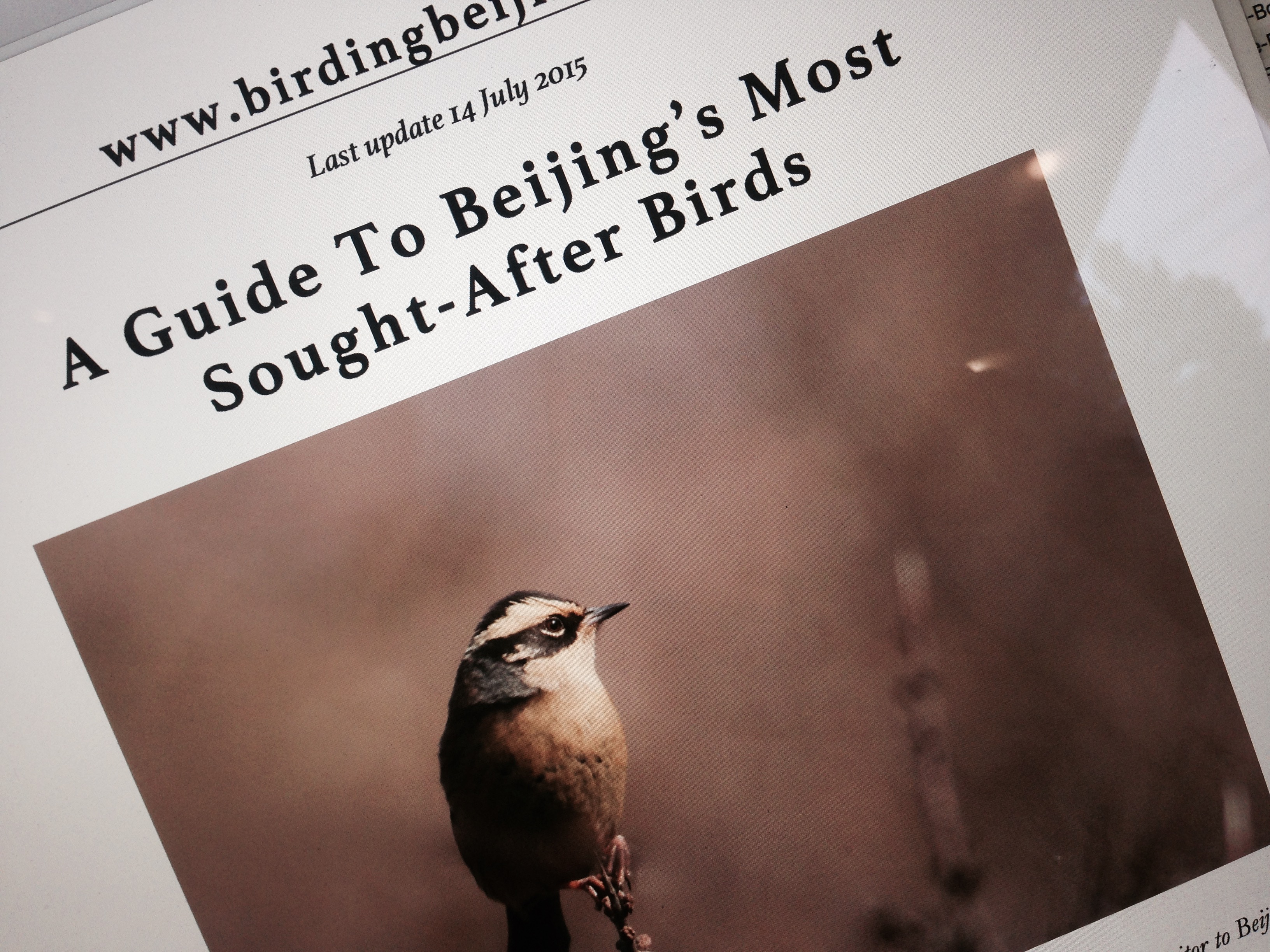
The second – A Guide To Beijing’s Most Sought-after Birds – is designed to help visiting birders to connect with the “Top 10” special birds that can be found in China’s capital. From range-restricted species such as the Grey-sided Thrush to the spectacular Przewalski’s Redstart, this guide should help to increase the chances of encountering these birds during a visit to Beijing.
Of course, bird distributions are not static and so these guides are works in progress, based on best-available information at this time. If you spot any errors or omissions or have any information that will improve these guides, please contact me using the Contact form or through the Comments facility.
“That men do not learn very much from the lessons of history is the most important of all the lessons of history.”– Aldous Huxley
So-called “propaganda posters” have been an important part of Chinese culture since the Mao Zedong era. These often colourful and striking artworks were designed to sway public opinion in favour of its policies (a bit like News International does for right wing governments in the West today.. cough). The posters have become collectible and several of my China-based friends spend large amounts of their spare time visiting flea markets to add to their collection. It was one of these friends who introduced me to these posters and I soon became interested in how the environment was depicted. Perhaps surprisingly to some, as far back as the 1950s posters promoted messages about the benefits of planting trees and “greening” the countryside. The header image is from the early 1970s with the message “Start a new upsurge of the people’s duty of tree planting movement”.
However, there is one poster that jumped out at me.
Eliminating the last sparrow. This poster, aimed at schools, was part of a series to support the “4 pests campaign” to eradicate sparrows, rats, flies and mosquitoes.
This poster is from 1959 and was part of a series to support Mao’s “Four Pests” campaign to eradicate rats, flies, mosquitoes and sparrows. How this policy played out is an important lesson about the unintended consequences of altering the natural balance of ecosystems. It won’t surprise many to hear that the campaign backfired spectacularly and it’s a lesson that ALL governments would do well to heed.
Mao Zedong initiated the “Four Pests” campaign in 1958 after concluding that several blights should be exterminated – namely mosquitoes, flies, rats, and sparrows. According to environmental activist Dai Qing, “Mao knew nothing about animals. He didn’t want to discuss his plan or listen to experts. He just decided that the ‘four pests’ should be killed.”
Mao was particularly annoyed by the Eurasian Tree Sparrow (Passer montanus, 树麻雀) part of the diet of which was grain. Chinese scientists had calculated that each sparrow consumed 4.5kg of grain each year — and that for every million sparrows killed, there would be food for 60,000 people. Armed with these statistics, Mao launched the Great Sparrow Campaign to address the problem. Millions of people were mobilised and the excitement was captured in this report from a Shanghai newspaper:
“On the early morning of December 13, the citywide battle to destroy the sparrows began. In large and small streets, red flags were waving. On the buildings and in the courtyards, open spaces, roads and rural farm fields, there were numerous scarecrows, sentries, elementary and middle school students, government office employees, factory workers, farmers and People’s Liberation Army shouting their war cries. In the Xincheng district, they produced more than 80,000 scarecrows and more than 100,000 colorful flags overnight. The residents of Xietu road, Xuhui distrct and Yangpu road Yulin district also produced a large number of motion scarecrows. In the city and the outskirts, almost half of the labour force was mobilised into the anti-sparrow army. Usually, the young people were responsible for trapping, poisoning and attacking the sparrows while the old people and the children kept sentry watch. The factories in the city committed themselves into the war effort even as they guaranteed that they would maintain production levels. In the parks, cemeteries and hot houses where there are fewer people around, 150 free-fire zones were set up for shooting the sparrows. The Nanyang Girls Middle School rifle team received training in the techniques for shooting birds. Thus the citizens fought a total war against the sparrows. By 8pm tonight, it is estimated that a total of 194,432 sparrows have been killed.”
The effectiveness of the campaign was such that the Tree Sparrow population was decimated. And without the sparrows to curb the insect population, crops were being devastated in a way far worse than if birds had been spared. At least partly as a result, agricultural yields that year were disastrously low.
The campaign against the sparrows was finally terminated in late 1959 when the Academy of Sciences leaders highlighted the findings of scientists such as Zhu Xi and Zheng Zuoxin. Zhu and Zheng had autopsied the digestive systems of sparrows and found that three-quarters of the contents were harmful insects and only one-quarter was human food. This showed that sparrows were beneficial for humans.
On this advice from the Chinese Academy of Sciences, Mao declared a complete halt to the Great Sparrow Campaign, replacing sparrows with “bed bugs” in the “Four Pests” campaign. Suddenly sparrows were not just protected but the domestic population was supplemented by imports of sparrows from Russia! Eventually, after several years of poor crop yields, the situation began to improve. The number of people who starved in the 1958-1961 famine is disputed – and it’s impossible to say how much of the disaster was caused by the extermination of sparrows – but there can be no doubt that this episode is a stark lesson about the unintended consequences of human interference into natural ecosystems. I hope it’s one lesson in history that is not forgotten by the current generation of leaders, not just in China but around the world.
It’s been a busy couple of weeks. After the incredibly successful project to track the migration route of Beijing’s Swifts, and the unprecedented media coverage including articles in the UK’s Guardian and Xinhua (one of China’s largest media agencies), there was barely time to catch up on sleep before I boarded a plane to Ulaanbaatar to participate in a survey of remote southeastern Mongolia to look for Jankowski’s Bunting (栗斑腹鹀, Emberiza jankowskii).
The survey team (from left to right): Baatargal Otgonbayar “Oggy” (driver, spotter, photographer and all round good guy), Yann Muzika (The Wilderness Alternative), Yu Yat-tung (Hong Kong Birdwatching Society, Huiga (driver and excellent chef!), Vivian Fu (Hong Kong Birdwatching Society, Wu Lan (China Birdwatching Society), Terry and Dr Tseveenmydag Natsagdorj from the Mongolian Academy of Sciences.
The status of Jankowski’s Bunting is precarious. It is clinging on at just a handful of sites in Chinese Inner Mongolia and Jilin Province. However, the sighting of a single bird in southeastern Mongolia in September 2013 raised hopes that there could be a previously undiscovered population in this remote and under-birded part of the country and a plan was devised to put together a team to survey this area in early June. Hopes were high. The area was close to the known sites in Chinese Inner Mongolia and would likely contain areas of similar habitat – grassland dotted with Siberian Apricot bushes – preferred by Jankowski’s Bunting in Inner Mongolia.
The team, consisting of representatives of the China Birdwatching Society, the Hong Kong Birdwatching Society, the Mongolian Academy of Sciences plus Yann Muzika (of Sillem’s Mountain Finch rediscovery fame) and myself arrived in Ulaanbaatar full of optimism.
With the invaluable help of Nyambayar Batbayar, Director of the Wildlife Science And Conservation Center of Mongolia, we had planned a circular route first taking us southeast from Ulaanbaatar to some remote protected areas in the south close to the Chinese border, from where we would head east and then north to another section of the Chinese border, rarely visited by anyone let alone birders. We were to camp wild and drive more than 2,500 kilometres in search of our target bird.
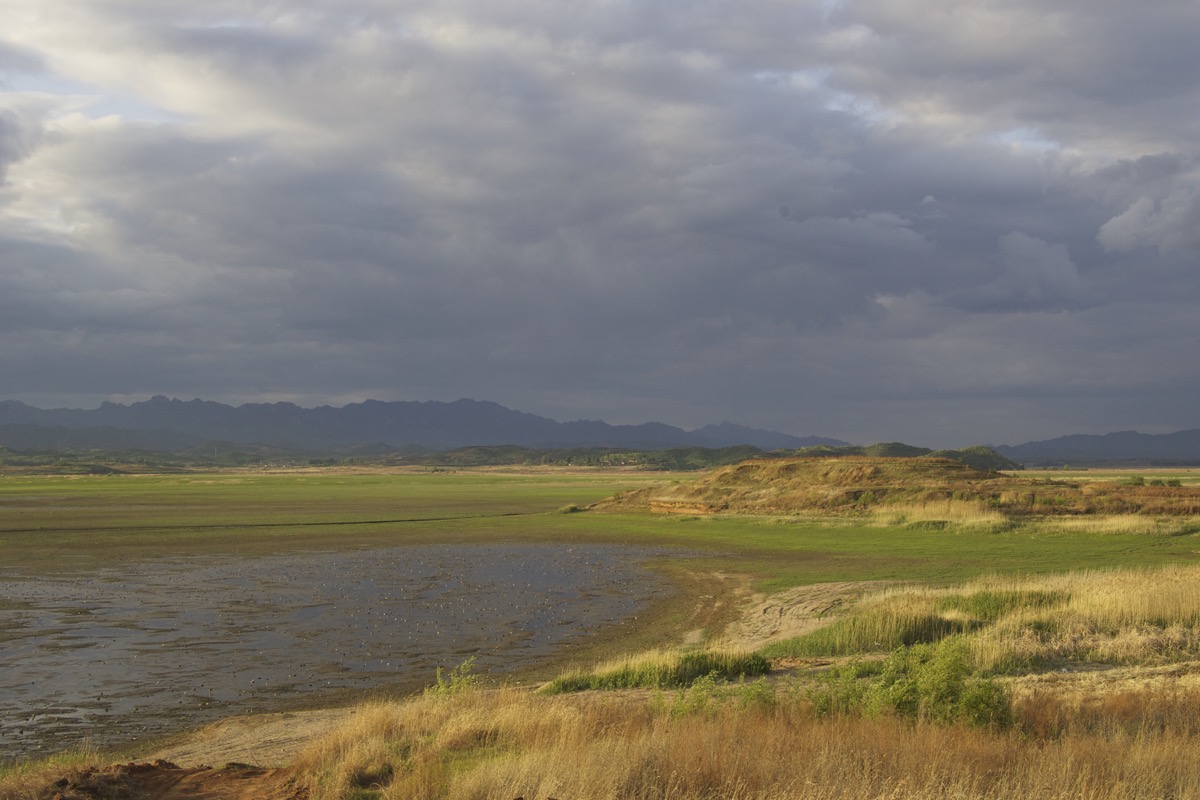
The journey was an adventure that took us through some stunning Mongolian landscapes with the grassland varying in character every day and the spectacular light at sunset and sunrise creating dynamic landscapes that changed in form every few seconds.
Sunset at our camp… image taken with an iPhone and unaltered.Here we woke to singing Siberian Rubythroats, Asian Short-toed Larks and Pallas’s Buntings.Vivian wanted to live in this place forever…
And the birds were brilliant… We recorded 180 species including some spectacular encounters with breeding Oriental Plovers and Saker Falcons, displaying Great Bustards and Pied Harriers, singing Yellow-breasted Buntings and Chinese Bush Warblers and a gezillion larks – Mongolian Larks were omnipresent with Greater Short-toed, Asian Short-toed and Horned Larks also in plentiful supply.
Views of the moon, planets and stars were superb in the crystal clear air. We enjoyed ‘scoping the Moon, Saturn, Jupiter, Mars and Venus. This photo taken with iPhone through the Swarovski ATX95 telescope (with adaptor).
Sadly, despite our best efforts, we drew a blank with Jankowski’s Bunting and, even taking into account the impact of a destructive fire that ripped through the area in April, we found very few suitable sites, all of which were small and fragmented. Due to a current fire in the far southeast, we were unable to reach potentially the best habitat and it is just possible that some Jankowski’s Buntings may exist here.
Despite our disappointment at not finding Jankowski’s Bunting in Mongolia, negative results are just as important and positive results and the existing known sites in Inner Mongolia now take on even greater importance. If Jankowski’s Bunting is to survive we must re-double our efforts to protect these birds by continuing our engagement with the local government, farmers and communities. That work begins now.
Big thanks to Vivian Fu, Yu Yat-tung, Yann Muzika and Wu Lan for their great company on the adventure and a special thanks to our Mongolian hosts, Nyambayar, Dr Tseveen, Oggy and Huiga, all of whom put in an enormous amount of work to make our survey possible.
“Woohoo!” was the shout when the first geolocator-carrying Swift was caught early this morning at The Summer Palace.
After a wait of 12 months, we were finally going to find out, for the first time, where Beijing’s swifts spent the winter. In the end we re-captured 13 of the 31 birds fitted with geolocators last spring and, after downloading and processing the data (all worked perfectly – big kudos to Migrate Technology in England), we discovered that these magnificent birds travel an incredible 26,000km per year on migration to spend the winter in southern Africa. It’s astonishing to think that, over the lifetime of the average Beijing Swift, the distance travelled on migration is equivalent to half way from Earth to the Moon!
The map below shows a typical track of a Beijing Swift, based on preliminary analysis of the data from the 13 birds re-trapped today. A fuller analysis will be made in due course with a scientific paper planned for later this year.
A typical track of a Beijing Swift based on preliminary analysis of the data captured today.
These iconic birds – synonymous with Beijing since 1417 when they made their nests in the original city gatehouses – arrive in Beijing in April and, after breeding, begin their long journey to Africa in late July, taking a route that first leads them west-northwest into Mongolia, from where they pass north of the Tianshan mountains, then south through Iran and central Arabia into tropical Africa, before spending 3 months of the winter in Namibia and the Western Cape. They begin the return journey in February, retracing a similar route, arriving in Beijing in mid-April, a journey that sees them cross about 20 borders. Wow!
Again, I was hugely impressed with the professionalism of the China Birdwatching Society and its army of volunteers. Not only did they get up incredibly early to set up the nets at 0230 but, together with visiting swift ringer Lyndon Kearsley and Dick Newell, they captured, processed and released more than 80 birds in 2 hours, including downloading data from 13 birds with geolocators and fitting a further 25 geolocators to ‘new’ birds. Impressive stuff. And it was great to see Liu Yang, one of China’s top ornithological professors, making the trip from Guangdong to participate in the catch.
This was the scene at around 0600 on the day of the catch. A wonderful sight and sound.
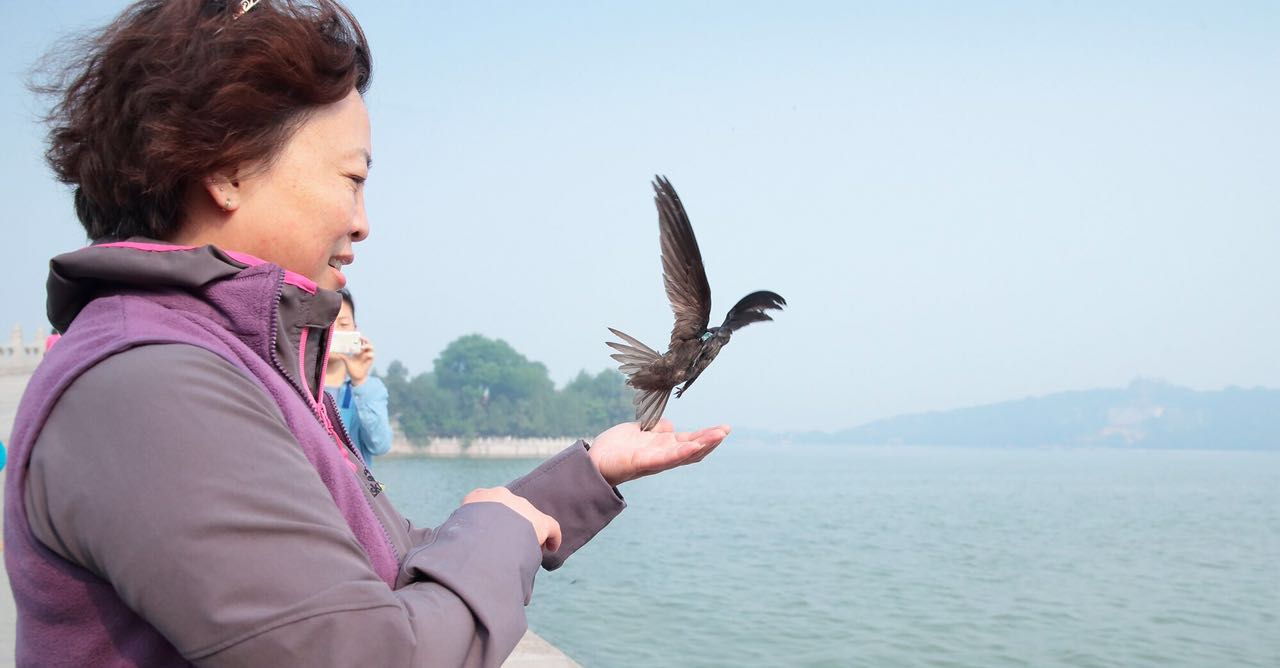
I had the privilege of releasing a geolocator-tagged bird and Zhang Weimin took this photo. A special moment for me. I wish it well on its journey to southwest Africa..
Terry releasing a Swift fitted with a geolocator at The Summer Palace this morning.Swift expert, Lyndon Kearsley, releasing a Swift this morning at The Summer Palace.
Big thanks to Professor Zhou, Ms Fu Jianping and Wu Lan from the China Birdwatching Society for their incredible hard work in making this project possible. And big kudos to Dick Newell and Lyndon Kearsley for their vision and expertise. I’d also like to thank Lyndon’s wife, Hilde and Rob Jolliffe (“JJ”) for their help and good company during these past few days..
There is a world-class birding site, visited by very few birders, just an hour from downtown Beijing.
Its name is Miyun Reservoir.
Historically, most birders visiting Beijing have headed to the coast to visit the well-known birding spots of Beidaihe and Kuaile Dao (Happy Island). This is understandable when one considers the observations made there between 1910-1917 by British Consul John D D La Touche, by Dane Axel Hemmingsen in the 1940s and by Dr Martin Williams, among others, in the mid-1980s. These pioneers put northern China, and in particular the coastal town of Beidaihe, on the birding map.
And these locations have dominated the northern China birding scene ever since, with international tour companies visiting annually in May to offer their clients “up close and personal” experience of some of East Asia’s specialities, including the sought after ‘Sibes’ that cause so much excitement when they turn up as vagrants in western Europe or North America.
However, it is increasingly clear that the phenomenal migration along the East Asian flyway is not only concentrated on the coast. It is happening on a broad front and Beijing, China’s bustling capital, is slap bang in the middle of this birding superhighway.
Until recently, coverage of Beijing’s birds can most generously be described as ‘sparse’. Even now, with a growing young Chinese birding community, it is no more than partial. And yet, when one considers the diversity of species (more than 460 species have been recorded in the capital), together with the numbers, it is clear that Beijing is up there with the best birding sites in China. And, within Beijing, there is one location that stands out right now – Miyun Reservoir. The evidence? How about this:
– More than 50,000 Little Buntings in one morning on 26 September 2014
– More than 8,000 Horned Larks on 15 October 2014
– 7 species of goose: Bar-headed, (Taiga and Tundra) Bean, Greater and Lesser White-fronted, Greylag and Swan
– 7 species of crane recorded in the last two years: Common, Demoiselle, Hooded, Red-crowned, Sandhill, Siberian and White-naped.
– A raptor list that includes Amur Falcon, Lesser and Common Kestrels, Hobby, Saker, Peregrine, Chinese, Eurasian and Japanese Sparrowhawks, Goshawk, Booted, Golden, Greater Spotted, Eastern Imperial, Short-toed and White-tailed Eagles, Osprey, Grey-faced, ‘Eastern’, Oriental Honey and Rough-legged Buzzards, Cinereous Vulture, Black and Black-winged Kites, Eastern Marsh, Hen and Pied Harriers.
– Red-throated and Black-throated Loon, Baikal and Eurasian Teal, Baer’s and Common Pochards, Falcated, Ferruginous, Spot-billed and Tufted Ducks, Gadwall, Mallard, Pintail and Wigeon, Greater Scaup and White-winged (Stejneger’s) Scoter.
For an inland location, the shorebird list is impressive, too. Black-winged Stilt, Avocet, Northern and Grey-headed Lapwings, Jack, Common and “Swintail” Snipe, Asian Dowitcher, Bar- and Black-tailed Godwits, Eurasian, Far Eastern and Little Curlews, Whimbrel, Common and Spotted Redshank, Greenshank, Common, Curlew, Green, Marsh, Pectoral, Sharp-tailed, Terek and Wood Sandpipers, Long-toed, Red-necked and Temminck’s Stints, Ruff, Dunlin, Grey, Kentish, Little Ringed, Oriental and Pacific Golden Plovers, Greater Sandplover, Turnstone, Red Knot, Grey and Red-necked Phalarope and Oriental Pratincole have all been recorded.
And how about this for a bunting list: Black-faced, Chestnut, Chestnut-eared, Common Reed, Godlewski’s, Japanese Reed, Lapland, Little, Meadow, Pallas’s Reed, Pine, Rustic, Tristram’s, Yellow-breasted, Yellow-browed and Yellow-throated.
Not to mention the cuckoos, shrikes, gulls, terns, pipits, wagtails etc
The author (left) and Paul Holt enjoying a brilliant day at Miyun Reservoir. Photo by Marie.
It is not unusual in spring, especially in May, to record more than 100 species in a day. This year Paul Holt achieved that in March! And Jan-Erik Nilsen, a Beijing-based Swedish birder, recorded 123 species last week.
As a general birding location, it is probably THE best in the capital.
So opens a 1961 poem by British ornithologist, Beryl Patricia Hall.
Thankfully, our appreciation of pipits has matured a little since then and, in Beijing, we have 10 species on the official list: Blyth’s, Buff-bellied, Meadow, Olive-backed, Pechora, Red-throated, Richard’s, Rosy, Tree and Water. Rosy and Richard’s are scarce breeders and passage migrants; Blyth’s, Buff-bellied, Olive-backed, Pechora and Red-throated are all passage birds; Water Pipit is a winter visitor; and Meadow (three records) and Tree Pipit (one record, photographed in the UK Ambassador’s garden in May 2013!) are vagrants.
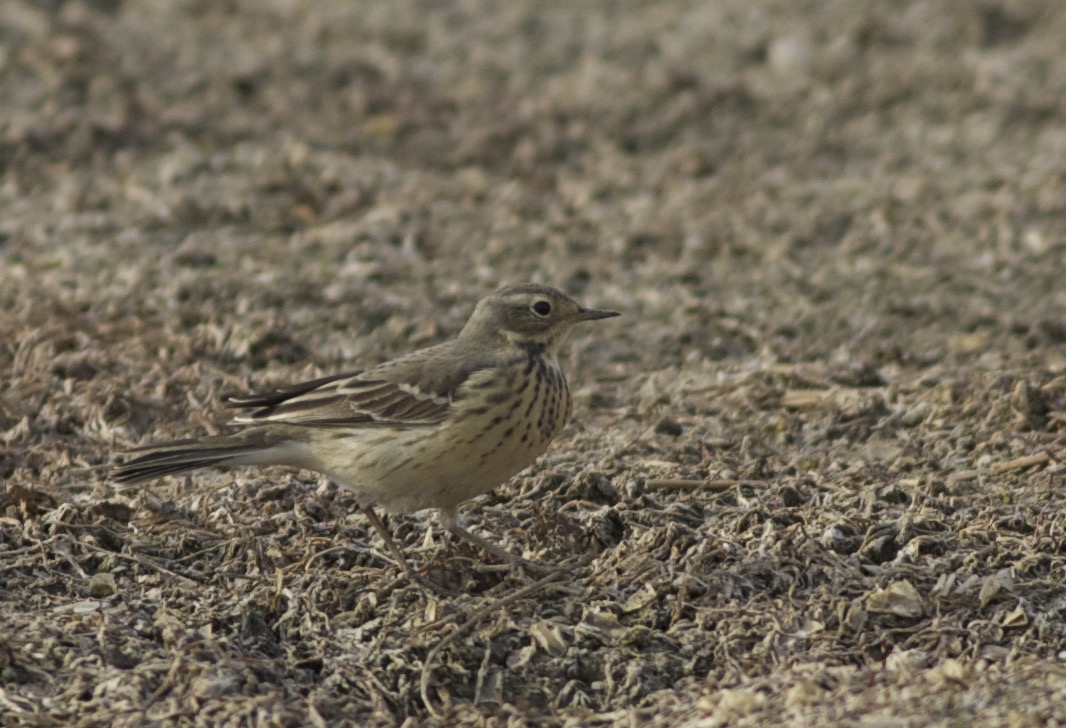
In mid-April the passage of pipits is in full swing and, last weekend, I encountered large flocks of Buff-bellied Pipits (ssp japonicus) at Miyun Reservoir. With a few late Water Pipits (ssp blakistoni) mixed in, it was an ideal opportunity to get to grips with this subtle and underrated species.
Here are some photos that show typical japonicusBuff-bellied Pipits in breeding plumage.
Buff-bellied Pipit ssp japonicus, Miyun Reservoir, Beijing, 19 April 2015. Note the buffy colour of the underparts, lacking a contrasting white belly, wing bars, complete eye-ring and relatively pale legs (compared with Water Pipit).Buff-bellied Pipit ssp japonicus. Note the dark spotting, not streaking, on the mantle.Buff-bellied Pipit ssp japonicus, Miyun Reservoir, Beijing, 19 April 2015. On this bird the streaking on the underparts extends onto the flanks. Also note the fine bill.Fine crown streaking is also a feature of Buff-bellied.The eye-ring is at least as prominent as the supercilium, a good feature of Buff-bellied vs Water Pipit.Buff-bellied is scarce in winter in Beijing. This one was at Shidu in late November. At this season, more heavily streaked and lacking the buff underparts but eye-ring still prominent.This is a bird from October. Note, in particular, the prominence of the eye-ring compared with the supercilium.
And here are a few Water Pipits (ssp blakistoni), the most likely confusion species.
Water Pipit ssp blakistoni, Shidu, February 2012. Note the relative prominence of the supercilium vs the eye-ring. Also much less streaked underparts and dark legs.This bird from 21 April 2012. Relatively unstreaked underparts, greyish head, relatively prominent supercilium and dark legs all point to Water Pipit.A very clean breeding plumage Water Pipit from April 2012. Even without taking into account the very clean underparts (almost never shown on japonicus Buff-bellied), it shows a greyish-tinged head, prominent supercilium and dark legs.
Of course, another good indicator of ID is call. The calls of Water and Buff-bellied Pipits are similar but with practice can be differentiated. To my ears Buff-bellied sounds slightly down-slurred compared with Water Pipit’s slightly up-slurred call note. You can hear the calls of Buff-bellied Pipit here and Water Pipit here. What do YOU think?
It was as recently as 1970 that RELICT GULL (Larus relictus, 遗鸥) was confirmed as a valid species. Before that it was thought to be either an eastern race of Mediterranean Gull (Ichthyaetus melanocephalus) or a hybrid between Brown-headed Gull (Chroicocephalus brunnicephalus) and Pallas’s Gull (Ichthyaetus ichthyaetus)! Since its rather late acceptance into the global ornithological fold much has been discovered about this beautiful gull. Breeding sites have been found in China, Russia, Kazakhstan and Mongolia and it appears that, although a few spend the winter in Korea, almost the entire world population winters on the northeast China coast, around the Bohai Bay.
And just before their spring migration, gatherings on the coast of birds in stunning breeding plumage, are simply spectacular.
Last week, local Tianjin birder Mo Xunqian (“Nemo”) and friend Zhu Bingrun (“Drew”) counted 10,652 Relict Gulls from 3 sites around Hangu, Tianjin. This is a world record count and was simply too much to resist. So, together with Paul Holt and members of Beijing Birdwatching Society, including President Fu Jianping, I headed to the coast to try to catch a glimpse of these awesome birds before they left for the breeding grounds.
With the help of Nemo and local bird photographer and conservationist Mr Wang Jianmin, we arrived on site at the perfect time – just as the tide was beginning to fall. And we were greeted with a sea of Relict Gulls, the adults resplendent in their hooded breeding plumage and with hormones raging. Many were engaging in courtship display, throwing back their heads and holding open their wings as they called loudly. Superb!
Relict Gulls pairing up ahead of the breeding season, Hangu, Tianjin. Photo by Wang Jianmin.
After a few minutes of simply admiring this breathtaking spectacle, Paul was quick to get to work counting the flock. His tally was an outstanding 10,405, a record for a single site. I focused on capturing some video footage and, as the wind began to increase, making the conditions difficult for video, I began to scan the flock, observing their behaviour and enjoying the birds.
It wasn’t long before I found a leg-flagged adult sporting an orange flag on its right tibia and then, incredibly, another with an orange flag engraved with the number “1”.
Relict Gull with orange flag. Another bird sported a similar flag with the engraving “1”.
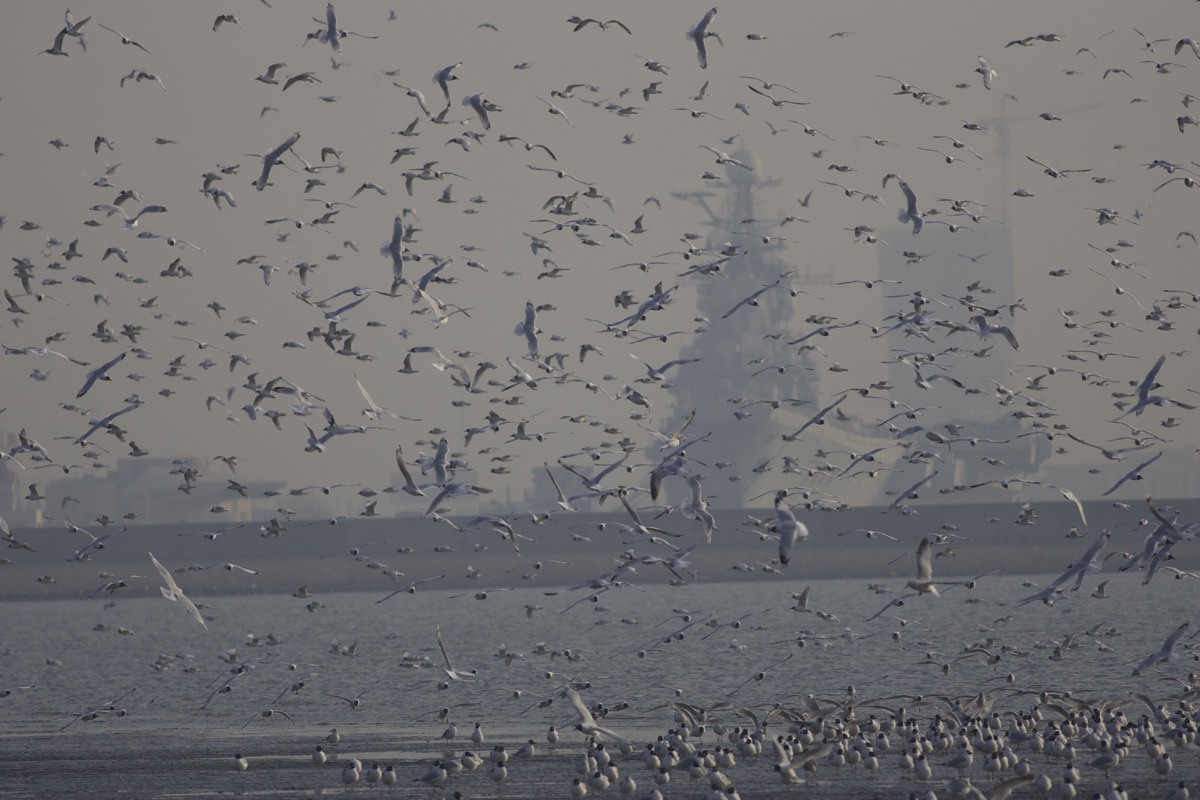
We enjoyed several hours with these birds until, as the tide receded, the birds began to move out onto the mud to feed. Every few minutes, as more mud became exposed, the whole flock would rise into the air, wheeling around before settling a few metres closer to the retreating sea. It was an awesome sight. All against the unlikely backdrop of an aircraft carrier, moored to the north…
10,000 RELICT GULLS and an aircraft carrier, Hangu, Tianjin.Relict Gulls, Hangu, Tianjin, 26 March 2015Relict Gulls, Hangu, Tianjin, 26 March 2015. Occasionally the flock would take to the air, following the retreating sea.At 10,405 birds, this flock was the largest ever seen at a single site.
As the birds moved away we made our way back to the car, still buzzing from witnessing one of the most impressive birding sights during my time in China.
Mr Wang took us to a local restaurant for lunch where we reflected on the status of Relict Gull. It was then that a hint of sadness hit us. As impressive as this spectacle was, the fact that so many are concentrated in one spot is not a good sign. It’s a symptom of shrinking habitat. And the concentration into such a small area makes the population extremely vulnerable to shocks.. A serious oil spill, for example, could devastate these birds.
Anyone familiar with east Asia won’t be surprised that the cause of the shrinking habitat is land reclamation. Mr Wang told us that, so far, around 80% of Tianjin’s tidal mudflats have been reclaimed, with just over 30km of coastal mudflat remaining of an original 140+km. And then the news got worse; the site where we had just recorded a world record count of this special gull was due to be reclaimed and turned into housing. My heart sank.
Much has been made of the breathtaking pace of ‘development’ along China’s east coast, in particular in the context of Spoon-billed Sandpiper. And whilst the disappearance of tidal mudflats will undoubtedly affect many shorebird species, the Relict Gull is perhaps the most vulnerable species of all. With almost the entire global population dependent on the tidal mudflats of the Bohai Bay, this bird is being squeezed into ever-decreasing pockets of viable habitat. At the present rate of land reclamation it is questionable for how long the remaining areas of tidal mudflats will be able to sustain the wintering population. And with human disturbance, unsustainable water use and climate change, there are significant threats to the breeding grounds, too. The Relict Gull fully deserves its “Vulnerable” status.
Development is clearly necessary for the government to continue to bring millions of Chinese out of poverty. That includes expanding ports, improving infrastructure and building homes and businesses. The key question is whether or not this development can be more sensitive to the natural world. Unfortunately, it is still the case that ecosystems and biodiversity have zero value in our economic model. That’s not unique to China, it’s a global phenomenon. To protect sites and species often requires monumental efforts from passionate individuals and groups. It should be the default.
Mr Wang has been championing the need to protect the remaining tidal mudflats around Tianjin. He has exhibited his excellent photographs to raise awareness among the local community and, importantly, he has met with local government officials to highlight the global importance of this habitat. He is committed to doing everything he can to help Relict Gull, a species that is clearly very close to his heart. With the vast majority of the population breeding in China and wintering along the Bohai Bay, Relict Gull is a Chinese treasure, just like the Forbidden City, Temple of Heaven or the Terracotta Warriors. I hope that, one day, it will be given the same protection.
Big thanks to Nemo, Zhu Bingrun, Wang Jianmin, Paul Holt, Wang Qingyu, Fu Jianping and the Beijing Birdwatching Society for ensuring our trip to see Relict Gulls was successful, for the use of photographs and for their fun company in Tianjin.
Birders at Hangu, Tianjin, on a high from seeing 10,000 Relict Gulls! Mr Wang is fourth from the right.
When I first arrived in Beijing it took me almost two years to find my first Japanese Reed Bunting (Emberiza yessoensis, 红颈苇鹀). It is a scarce, probably overlooked, winter visitor to the capital and it can be tricky to find in its favoured habitat of weedy scrub, usually close to water. This habitat is also used in winter by the much more common, almost abundant, Pallas’s Reed Bunting (Emberiza pallasi, 苇鹀) and it’s this species that one must be careful to eliminate when looking for Japanese. As is the case with separating many similar species, call is a good indicator. Japanese Reed Bunting utters a thin “tseep”, contrasting with the Pallas’s Reed Bunting’s chirpy sparrow-like call. Japanese Reed Buntings tend to feed on the ground in long grass and are usually skittish. Often the first sight or sound is when one is accidentally disturbed. When flushed, they tend to fly quite a long way before diving into long grass. However, just occasionally, they sit up in the open, which is exactly what these two posers did last week during a walk with Steve Bale along the Wenyu He.
Japanese Reed Buntings usually look ‘warmer’ in overall colouration than Pallas’s Reed Bunting. The yellowy look, combined with the black ear coverts, are good indicators of Japanese Reed. With orangey tones on the wing feathers, I think Japanese Reed Bunting is one of the most beautiful, if subtle, of the East Asian buntings and it’s always a delight to see.
Japanese Reed Bunting (Emberiza yessoensis), Wenyu River, Beijing, March 2015.Japanese Reed Buntings, Wenyu River, Beijing, March 2015For comparison, here is a Pallas’s Reed Bunting at Ma Chang in April 2012. Pallas’s is a variable species but always looks ‘colder’ overall, lacking any orange tones.
In Beijing in winter we are blessed with good numbers of East Asian thrushes… In my experience NAUMANN’S (Turdus naumanni) is the most common, followed by RED-THROATED (Turdus ruficollis) and DUSKY (Turdus eunomus) with BLACK-THROATED (Turdus atrogularis) being the most scarce. It is not uncommon to encounter intergrades, and birds exhibiting features of both NAUMANN’S and DUSKY are frequently encountered (see images at the end of this post). It is much less common to find birds showing features of both Red-throated and Black-throated. However, that is exactly what I found on Sunday at Lingshan.
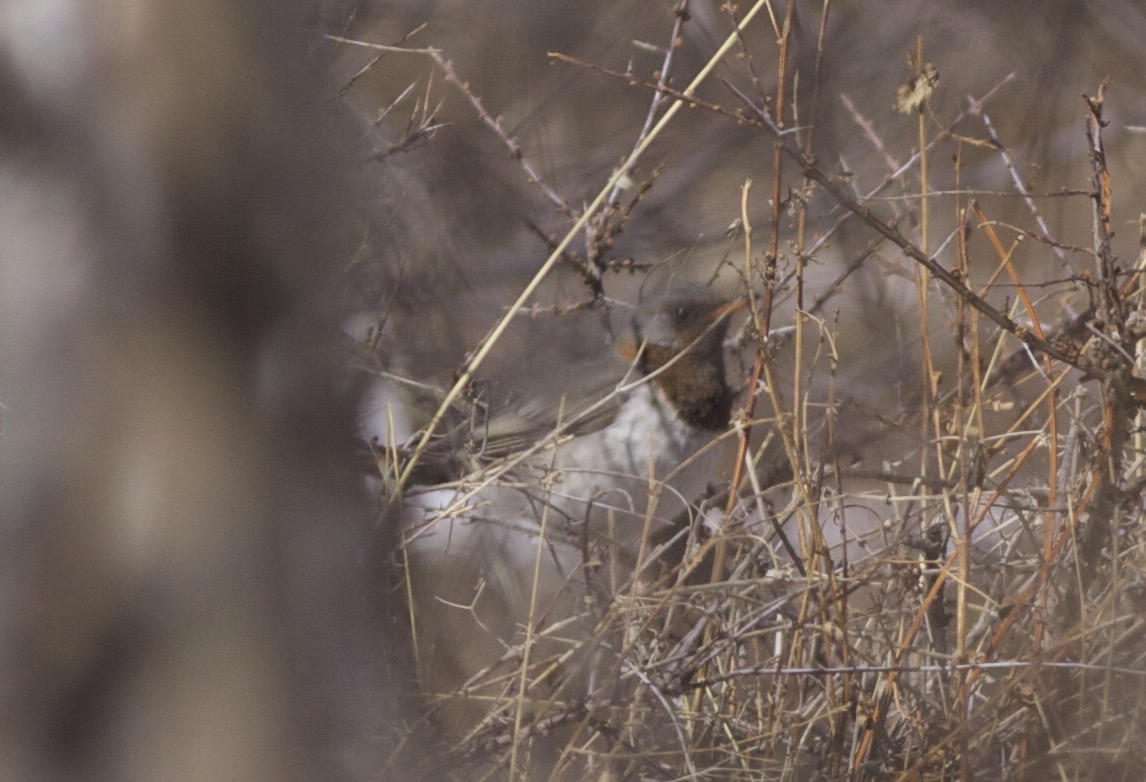
An apparent adult RED-THROATED x BLACK-THROATED THRUSH, Lingshan, 1 March 2015. Note the presence of both black and reddish feathers on the throat/upper breast.
Unfortunately I wasn’t able to capture many (any!) good quality photographs but the two I did manage (above) show the unusually-marked throat and upper breast. A ‘pure’ Red-throated should show reddish orange marks only on the throat and breast with no black. And Black-throated should show only black or grey markings here, lacking any reddish tones. This bird clearly shows a mixture, with black dominating the lower part of the throat-patch and red dominating the upper part and the neck surrounds. I have never seen a bird like this before but it seems reasonable to assume that this is an intergrade between RED-THROATED and BLACK-THROATED. Although Red x Black-throated Thrushes are rare in Beijing, they are fairly frequent in Central Asia – see here for some information from Kazakhstan.
Vagrant East Asian thrushes, especially first year birds, still cause some identification problems in Europe (e.g. the 2013 Dusky Thrush at Margate in the UK and the recent putative Red-throated Thrush in Finland). This is because we don’t know for sure the variability of ‘pure’ birds, complicated by the fact that we know they interbreed. If we are to improve our knowledge, studies must be made on the breeding grounds, away from areas of potential interbreeding, so that we can better understand natural variation of pure species and pin down the tell-tale signs of intergradation. Although birders in Beijing and East Asia have a lot of experience of these thrushes, because we see these birds on the wintering grounds, in some cases we cannot be certain whether or not we are looking at pure birds or intergrades.. This means we are not best-placed to provide anything other than opinions about what we *think* are signs of intergradation based on seeing hundreds, and in some cases, thousands of these beautiful thrushes.
That said, I think we can all agree that the Lingshan bird is an intergrade. And what a cracker it was!
Just for interest, here are a couple of apparent DUSKY x NAUMANN’S THRUSHES from Beijing.
Superficially this bird resembles DUSKY THRUSH but look at those red markings on the breast and flanks… a good indicator of NAUMANN’S influence. Peking University, December 2013
Another bird showing characters of both DUSKY and NAUMANN’S with many reddish marks on the breast and flanks. Botanical Gardens, November 2011.
When I arrived in Beijing I soon discovered a small, but amazingly passionate and dedicated, group of people working to conserve birds and their habitats in East Asia. The wonderful people at Birds Korea, an independent NGO headed by Nial Moores, is one such example.
In China, at least, much original habitat remains and the volume of birds I see on migration still eclipses anything I ever saw in Europe. However, the conservation challenges in this part of the world are substantial. With rapid economic growth, large populations, a lack of credible environmental legislation and enforcement, and relatively low environmental awareness among the general public, it is tough to ensure that policymakers give the environment the consideration it deserves. And even when lawmakers and governments do show a willingness to take into account environmental concerns, there is often a lack of credible data to make an evidence-based case to protect endangered species and their habitats.
That is why the Birds Korea Status of Birds 2014 is such an important publication. It not only documents the status of the “regularly occurring” species but examines the trends based on habitats and makes concrete recommendations to strengthen conservation of birds in Korea. It’s an impressive report and will not only serve to inform the Korean government but will also act as the standard-bearer for conservation organisations in the region. Robust data, interpreted intelligently with practical recommendations for policymakers, is essential to coherent and sustainable economic planning. And until we have a more complete global measure of wealth (rather than the outdated and not fit for purpose measure of GDP) that requires governments to take into account natural wealth in their national accounts and economic decision-making, it will be up to NGOs and volunteers to provide this information.
Well done Birds Korea!
To gain a sense of the report the key messages are listed below, and you can download the full report here.
Key Messages:
By the end of April 2014, 535 bird species had been adequately documented in the ROK
365 of these species are considered “regularly occurring”, either historically or in the present century
87% of regularly occurring and all irregularly occurring species are migratory
Two of the 365 species are Globally Critically Endangered (with one of these presumed Globally Extinct), seven are Globally Endangered, and 19 are Globally Vulnerable
Five regularly occurring species were lost to the regular avifauna between 1910 and 1999
At least 103 species have declined substantially during the present century
Half of all regularly occurring species still have an unknown trend
On present knowledge, 126 species are identified as “Highest” and “High” Conservation Priorities
Some progress has been made in recent decades, especially in reforestation, afforestation and the reduction of hunting
However, habitat loss and degradation is the main driver of decline for many of the species in decline, including birds of Grassland-type and Open Habitat and most especially waterbirds
Three-quarters of the nation’s tidal-flats have been reclaimed and most natural freshwater wetlands have been degraded or lost
A third of all waterbird species are in decline, and more than a third still have an unknown trend (and might be declining)
Improved research in and especially conservation of Freshwater and Intertidal Wetland remains the most urgent priority
An improvement in knowledge by itself will not be enough: policies and laws need strengthening
“Life-changing”, “Eye-opening”, “Amazing” and “Inspirational” were some of the words used (or, rather, their Chinese equivalents!) by students and teachers to describe their trip to Yinggeling.
As trailed in the previous post, last week I spent 7 days at Yinggeling Nature Reserve, nestled in the mountains of central Hainan, a tropical island off the south coast of China, with 14 students and two teachers from Beijing’s 94th Middle School . The trip was organised by Luo Peng of Eco Action, a new Chinese company dedicated to raising awareness of sustainability and environmental issues in China, in particular with young people.
The aims were twofold: first, to introduce the students to a forest ecosystem so that they could understand the benefits provided by a forest and the importance of a sustainable relationship between nature and people; and second, to provide income to the village to support an agreement not to hunt wild animals or plant more rubber trees (their main source of income) and to help pay some of the villagers to act as “rangers” (to patrol the forests, remove illegal traps and snares and, if possible, apprehend any poachers).
I was invited to lead the birdwatching activities and, in partnership with officials from the Kadoorie Farm and nature reserve staff from the Yinggeling National Nature Reserve, we put together an itinerary that included conducting a biodiversity survey, birdwatching, night safaris to observe fish and amphibians, learning about local practices, including harvesting honey and basket-weaving, and helping the villagers to plant their rice crop.
The trip started with a flight to Haikou, a city on the northern coast of Hainan. After a short birding session around Haikou on the first day, where we met with staff from Kadoorie Farm, the local Mangrove Nature Reserve (and some visiting Beijing birders!), we met the students at the airport and set off for the 3-4 hours drive to Yinggeling Nature Reserve. Here we spent two nights learning about Yinggeling, its wildlife, hiking, birding and even playing football!
Introducing some of the younger members of the group to birding near Haikou before travelling to YinggelingIntroductions and initial briefing at YinggelingAn impromptu game of football (in walking boots!) between the students and reserve staff was a good pre-lunch workout at our base in Yinggeling.
After familiarising ourselves with the local area, including a beautiful hike to a stunning waterfall, we prepared for what was to be the highlight of the trip – three days and two nights at Daoyin, a remote village deep inside the nature reserve.
The students take a breather during the hike to the waterfall in Yinggeling Nature ReserveThe hike took us through some beautiful forest and alongside a narrow stream..The students collected 6 bags of litter over the day!
Daoyin, with a population of 90 ethnic Li people, has no roads to link it with the outside world, no phone signal, no hot water (a revitalising dip in the river is the nearest thing to a shower) and, of course, no WiFi (hard for those of us addicted to smart phones!). It was only recently that the fitting of solar panels provided limited electricity (for lighting) for the first time.
Getting to Daoyin required a 3.5 hour drive from our base at the nature reserve, mostly along rough dirt tracks, followed by a stunning, but demanding, 5-6 hour hike along the river, crossing the river three times… it was a real adventure and wonderful to see the students pushing themselves and helping each other to reach the village.
Preparing for the hike to DaoyinStudents making one of the river crossings on the way to DaoyinA spectacular old tree on the way to Daoyin
On arrival we were met by the local villagers, including Mr Fu Guohua, the current village leader, and Mr Fu Jinhai, the former leader (the villagers have a system whereby the leadership is rotated). Although the villagers lived a very basic life with mud-huts and chickens and pigs wandering around, we were struck by just how happy everyone looked… the children were having a ball exploring the forest, climbing trees and playing badminton.. as the villagers busied themselves with their daily tasks – fishing, preparing food, washing clothes and building or repairing houses. Surrounded by bird, insect and frog song, with none of the noise and stresses of the city, life seemed idyllic.
Local childrenOne of the new houses in Daoyin. On the orders of the government, any new buildings must have metal roofs as traditional grass roofs are considered a fire hazard.A more traditional house, made from mud and bamboo, with a roof of dried leaves.
At this point, feeling adventurous and slightly proud of myself for making it to this remote place, I asked Mr Fu if I was the first British person to visit the village… He thought for a moment and then said “no!” A scientist – an expert from Kadoorie Farm – had visited several years previously. My slight disappointment soon melted away when he told me that this British scientist was well-remembered for having given the then leader a gift of a wind-up head torch, something the leader cherished… and now almost everyone in the village owned one. I felt proud to be British and offered the leader my own gift – a Swiss Army Knife – which he looked at with some confusion before I showed him what it could do!
The villagers were fantastic hosts. Over the two full days that we spent in the village they helped us to arrange a host of activities for the students, including early morning bird walks, a survey of the “fish sanctuary”, an area where fishing is prohibited to ensure fish stocks remain healthy, the release back into the wild of a Hainan Partridge that had been found in an illegal trap several weeks before, a hike to collect footage from some of the camera traps that have been placed inside the forest (the rare and endemic Hainan Peacock Pheasant has been caught on film!), harvesting honey from the village hives, making baskets and cups from bamboo and helping the villagers to plant their rice crop.
Harvesting honey from one of the villages’ hives
Eating the grubs from the beehive was not to everyone’s taste!
Local children released a Hainan Partridge back into the wild after it had recovered from being injured in an illegal trap (see more on the video at the end of this post!)
On the second day a group of villagers returned from a 3-day expedition into the mountains to look for poachers and traps… After great work by Kadoorie and the local nature reserve staff, these villagers had agreed to become “rangers”, paid to sacrifice hunting and, instead, help to protect the forest’s wildlife. They told us that, with the rubber price very low this year and the forthcoming Chinese New Year (a traditional time to eat exotic food), some of the people in other local villages had been tempted to try to make money through hunting and selling of wild animals.. The head of the nature reserve told me that demand for exotic meat was such that a hunter could receive as much as Yuan 1,000 (GBP 100) for 1.5 kilos of wild animal meat.. With prices like that, it’s no wonder that some people are tempted to break the law… and it’s an indicator of just how important it is to tackle demand..
The rangers enjoying a well-earned cup of tea after three days patrolling the forest.
The rangers had found an injured Yellow-bellied Weasel in an illegal trap and, the day we returned to the nature reserve HQ, they found an endemic Hainan Flying Squirrel that had been shot. Hunting is clearly still an issue but the villagers say that it is much reduced, largely thanks to the hard work and of the nature reserve officials and Kadoorie Farm, together with the positive engagement of the local villagers.
This Yellow-bellied Weasel was caught in an illegal trap. After recuperating, it will be released back into the wild in the area where it was found.
On our second and last night, the local villagers not only provided us with a tasty meal of fish, vegetables and rice, but also put on an impromptu talent contest… one of the villagers was famed for his ability to “play” the leaf… and we were treated to renditions of some traditional Li songs before the nature reserve staff and village leaders together sang the “Yinggeling Song” (the soundtrack to the video at the end of this post).
After enjoying our time in the village, all too quickly we had to leave, and after hiking a different route back to the road, over the mountains instead of along the river, we met our 4wd vehicles and headed back to the nature reserve HQ.
As we left the village, I just had time for a farewell toast with village leader, Mr Fu Guohua, using the bamboo cups he had made for me as a gift..Farewells at Daoyin
Back at HQ, the students were divided into teams and were invited to make a presentation about what they had learned, their ideas about how to protect the forest and the livelihoods of the local people, and how their experience would affect them.
One of the student groups explaining what they had learned and their ideas for the futureAll 14 students received a certificate from the head of the Yinggeling nature reserve
After receiving their certificates for volunteering in Daoyin we made our way back to Haikou where we enjoyed a delicious meal at the local seafood market before resting ahead of our early morning flight back to Beijing.
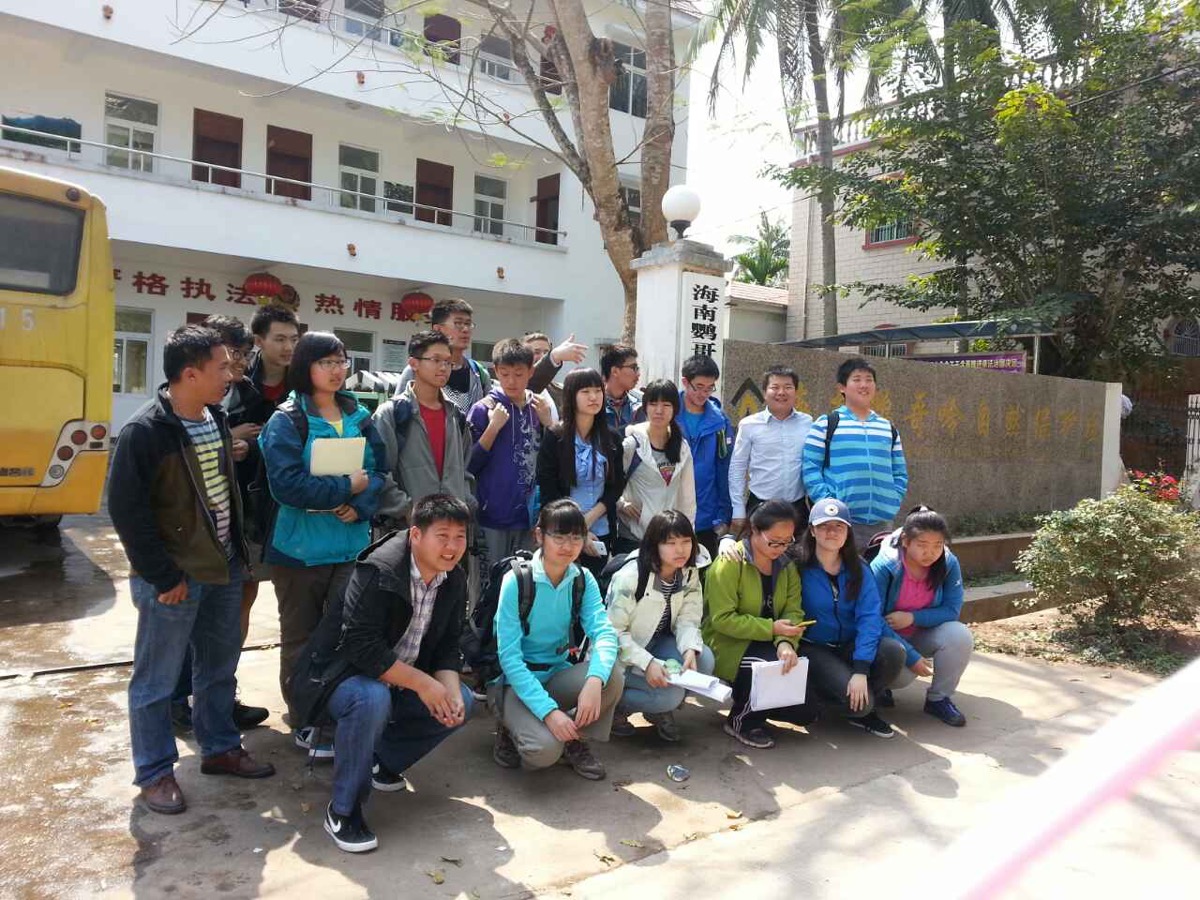
The group photo at the reserve HQ just before departure to HaikouThe seafood market in Haokou was a visual treat!Some strange-looking fish were on sale in Haikou marketEnjoying a coconut was a great way to end the trip for most of the students
I felt privileged to be part of such a rewarding and meaningful trip. The students clearly gained a lot and it was easy to see that several were truly inspired by their experience. The head teacher told us that, when they had spoken about the village of Daoyin in the classroom, the students did not believe that such places existed… …and yet, here they were at the end of the trip, devising lots of positive ideas about how to support the villagers and to protect the forest. It was great to see. And, of course, it wasn’t just the students who benefitted. For each guest, a payment was made to the local village that will help to ensure they do not need to hunt wild animals to sustain a living and also providing the resources to make some improvements to the village…
My heartfelt thanks go to Luo Peng , of EcoAction, for devising the initiative, to Mr Fu Guohua and Fu Jinhai and all the villagers at Daoyin who made us feel so welcome, to the Yinggeling Nature Reserve staff, especially Mi Hongxu and Liao Gaofeng, and to the officials at Kadoorie Farm, in particular Li Fei, who accompanied us throughout. Finally, a big thank you to the students and teachers from Beijing’s 94th Middle School for engaging so positively and for making the trip so much fun.
EcoAction hopes to plan similar trips to Daoyin in the future, not only for schools but, potentially, for small parties of tourists, ideally families. If you are interested in a truly authentic Chinese experience that will benefit the local community as well as providing you with an unforgettable encounter, feel free to contact me..
I’ll finish the post with a short video that captures some of the activities during the trip.. all to the backdrop of the “Yinggeling Song”, as sung by the nature reserve staff and local villagers..!
PS I almost forgot the birds! In total, we saw 105 species, including 2 of the 3 endemic species, Hainan Leaf Warbler and Hainan Partridge. A full species list is available here.
For more than a year Birding Beijing has been a proud partner of EcoAction, a new and innovative Chinese organisation focused on education for the environment, sustainable development and ecotourism. In November I helped to introduce birding to a group of middle school students at the Botanical Gardens in Beijing. On Friday I will travel to Hainan, an island off the south coast of China, to help lead my first field trip outside the capital. We will be taking 16 students to Yinggeling (鹦哥岭) Nature Reserve in the remote and mountainous centre of Hainan.
The reserve covers a large area – 33km from north to south and 39km from east to west – crossing the boundaries of Baisha, Wuzhishan and Qiongzhong Counties, and with an elevation range of 200-1812m. It is apparently the largest remaining contiguous tract of primary rainforest in China.
Yinggeling is a treasure trove of biological diversity and recent scientific expeditions have discovered many new species, including more than a dozen new trees and the Yinggeling Tree Frog (first described in 2003). Scientists believe that there are still many discoveries to be made in this relatively unspoiled part of China.
We are privileged to have been invited into the heart of the nature reserve (no wifi or mobile phone signal and not even electricity or running water!), where we will be hosted by staff from the conservation organisation, Kadoorie Farm, and local minority people. The aim is to demonstrate to the students the beauty and value of a forest ecosystem and the intricate dependencies, from the smallest leaf-ant to the mammals and birds of prey at the top of the food chain. Activities will include exploring the forest looking for, and studying plants, insects, amphibians, reptiles, mammals and, of course birds, as well as learning about the local Li minority’s culture and how they have lived in harmony with the environment for generations.
It’s going to be an adventure… and with three Chinese endemics possible – Hainan Peacock-pheasant, Hainan Partridge and Hainan Leaf Warbler – as well as a host of amazing wildlife, I can’t wait!
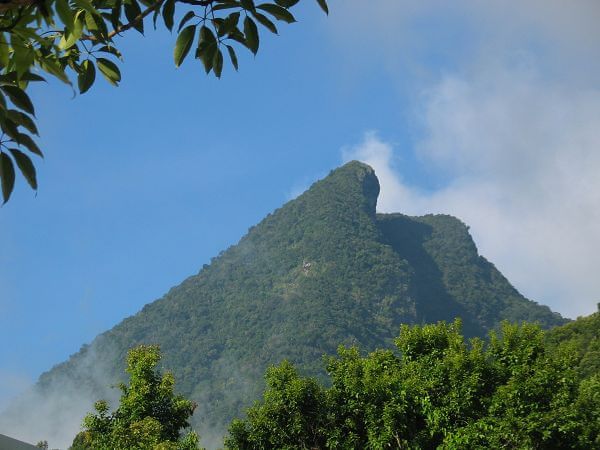
Here are a couple of photos of the reserve to whet the appetite…
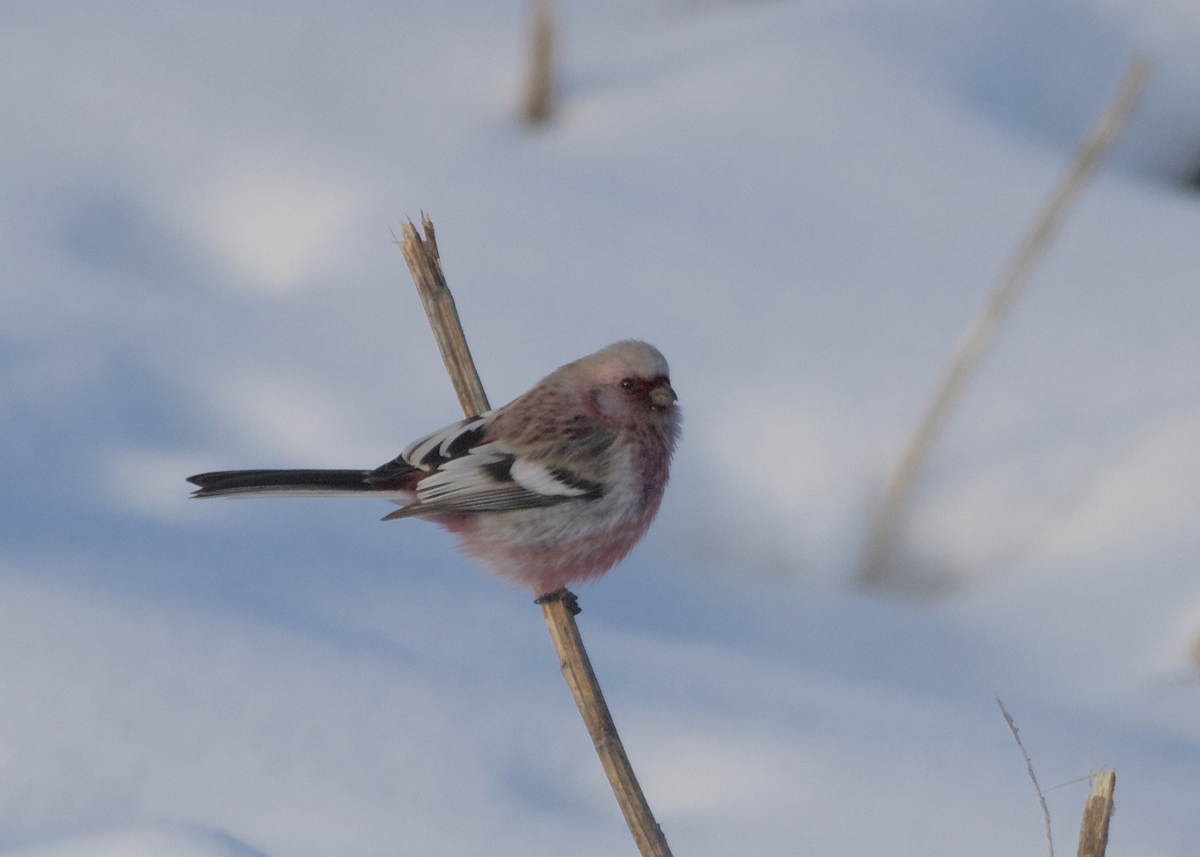
The Rosefinches were one of the highlights of our recent trip to northern Inner Mongolia. Long-tailed Rosefinch (Uragus sibiricus, 长尾雀) is a scarce but regular visitor to Beijing in winter. I have seen it three times in the capital – once at Yeyahu and twice at Lingshan. Usually we only see the brown, streaky immatures or females, so it was very cool to see some stunning adult males in Wuerqihan. On the journey from Hailar airport to Wuerqihan we counted more than 25 of these stunning finches.
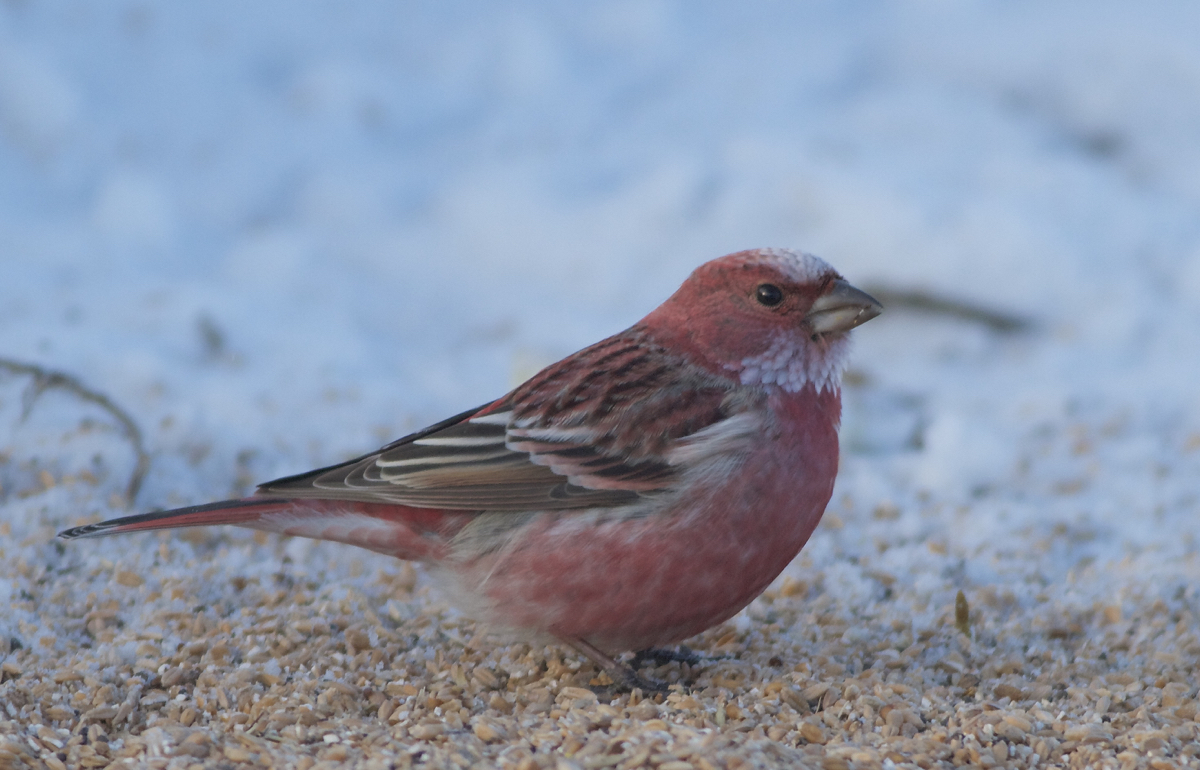
And it wasn’t only Long-tailed that we saw in Wuerqihan. There were also some of the sought after Pallas’s Rosefinches (Carpodacus roseus, 北朱雀). Pallas’s Rosefinch is a difficult bird to see anywhere and we were fortunate to see several small flocks of these beautiful birds around Wuerqihan.
Our guide, Mr Zhang, regularly puts out seed to attract birds and, as well as these stunning rosefinches, the food attracted Northern Bullfinch (Pyrrhula pyrrhula, 红腹灰雀), including some of the grey-bellied race, cineracea, Common and Arctic Redpolls (Carduelis flammea, 白腰朱顶雀, and Carduelis hornemanni, 极北朱顶雀), Eurasian Jay (Garrulus glandarius, 松鸦) and even a Siberian Weasel. That’s a quality line up for any bird table!
Introducing the last of the “most-wanted 3” owls we saw in Inner Mongolia this Christmas. This is the unmistakeable HAWK OWL, a bird that blew me away when I first saw it in Sweden in the 1990s. It often sits, sentinel-like, on the top of a tree from where it monitors the surrounding activity with razor-sharp vision and incredibly sensitive hearing. Such a different character to the more deliberate and almost “royal” Great Grey Owl….
Wishing everyone a very happy, healthy and bird-filled 2015!
For interest, here are some pictures of the superb habitat in which we found two of these special owls.
To me, seeing a GREAT GREY OWL (Strix nebulosa) ranks as one of the most magical sights of the bird world. With its human-like face and haunting stare, any encounter with the “Phantom of the North” in a snow-blanketed spruce forest makes for an eerie experience. In China, this magnificent owl can be found in the forests of the northern Provinces of Heilongjiang, Jilin and Inner Mongolia and it was a much-wanted bird during our recent visit to Wuerqihan and XiQi. Fortunately, after a long search, we finally caught up with this silent assassin. We enjoyed a spectacular encounter with this bird, watching as it surveyed the immediate area with slow, deliberate turns of its head. Typically it was not unduly bothered by our presence and, with my iPhone and Swarovski ATX I was able to take this video which captures the spirit of this most majestic of owls.
I have just returned from a few days in northern Inner Mongolia, near the Russian border, where I spent Christmas with Marie and SoSo from Hong Kong looking for owls. Highlights were many, including 6 species of owl – Eagle, Great Grey, Hawk, Little, Ural and Snowy. Spending Christmas morning watching 6 of the latter on the sparkling snow-covered grassland, was an experience that will stay with me for a very long time….
Wishing everyone a belated Merry Christmas, here is a glimpse of one of the magnificent Snowy Owls that we were fortunate enough to encounter on our trip. More details on this adventure very soon!
I love this quote from one of the most progressive Senators in the US Congress, Ed Markey – “Although children are only 24% of the population, they’re 100% of our future”. In China, a country that is growing fast in terms of economic power and global influence, the children here will perhaps have a disproportionate influence on the world this century. And with the environment relatively absent in the Chinese curriculum, it’s of utmost importance to engage with young people if China’s wildlife is to prosper in this rapidly urbanising and developing country.
Luo Peng, a young Chinese environmentalist and entrepreneur, has set up a company called Eco Action Now to promote environmental education and sustainable tourism, focusing on benefiting local communities and working with scientists, nature reserves and ordinary people.
One aspect of their work is to develop educational programmes for schoolchildren in Beijing. It’s a great initiative that aims to connect urban children to their environment. I was honoured to be invited to help lead a birding trip for Beijing’s 13th Middle School to the Botanical Gardens this weekend and what fun we had!
On a beautiful, crisp and pollution-free Saturday morning we arrived at the entrance gate at 0730 and, after a short briefing to hand out the binoculars, the tailor-made birdwatching guide and the election of ‘scribes’, we split into four groups and began to explore… The first birds we saw were Magpies (Common and Azure-winged) and they were soon followed by Tree Sparrow, Naumann’s Thrush, Japanese and Marsh Tits, Spotted Dove (“they look fat!“) and Chinese Nuthatch…. and later we were to enjoy stunning views of Plain Laughingthrushes (“they really do laugh!“) and Siberian Accentors, the headmistress’s favourite bird! It was great to see these young people so enthused during their first ever birdwatching trip and enjoying the sight and sound of their local birds. Inevitably, as the groups met up periodically to compare notes, a little competitiveness crept in and we even had a mini ‘twitch’ at the end to ensure all of the groups saw the Little Grebes on the main lake..
It was fantastic to meet the students of Beijing’s 13th Middle School and I can’t wait to do more… Even if none of them become birders, their appreciation and understanding of wild birds has been increased and, in a country home to around 1/6th of the world’s bird species, that’s a wonderful reward in itself. Big thanks to Luo Peng for making the arrangements and for inviting me along…
The class, and the group leaders, from Beijing’s 13th Middle School outside the gate to the Botanical Gardens.Me with one of the groups and the headmistress (far right).The Botanical Gardens were looking good in the early winter sunshine.Showing the headmistress the plate of Siberian Accentor in Mark Brazil’s “Birds of East Asia” just after enjoying 4 of these beautiful birds in the scrub…Taking notes about a sighting of Great Spotted Woodpecker, one of the birds we enjoyed during our Saturday at the Botanical GardensOne of the groups focusing on a Dusky Thrush.For some reason, I was asked to sign some bird postcards at the end.. Here is me feeling uncomfortable…
When the male PRZEWALSKI’S REDSTART turned up at Lingshan last winter, it was only the third occurrence in Beijing and the first for 20 years… Given the lack of observer coverage in winter, we speculated whether it might be a more regular visitor than the records suggested… and this speculation gained credibility when a female was found nearby soon after. The only way we would know the true status of this star bird was to monitor the site over the following winters to see whether they returned…
So far this November I have already made three visits to the site and, despite seeing plenty of the other high-altitude loving redstart – Guldenstadt’s – I have not seen any Przewalski’s. Was it a late migrant? Or was the occurrence of the pair last winter really a one-off? I was beginning to wonder….
Fast forward to late on Thursday evening when I received a message from Breght Vandenberghe, a Belgian birder, to say that he had just visited Lingshan and seen a male PRZEWALSKI’S! My heart leapt.. and a voice inside my head whispered:
“It’s Back!!!”
Here is a photo from last year as a reminder of just how stunning is this spectacular species. Big congratulations to Breght for finding the Przewalski’s and huge thanks for passing on the news.
Male PRZEVALSKI’S REDSTART at Lingshan, Sunday 23 February 2014.
This autumn has been exceptional. As well as some outstanding rarities in the traditional autumn period of September and October such as Streaked Reed Warbler, Swinhoe’s Rail, Great White Pelican etc etc, November has continued in the same vein with Lesser Spotted Woodpecker and Black Redstart at Lingshan (both very rare), European Robin and Eurasian Bullfinch (both 2nd records for Beijing and still present, as I write, in the Temple of Heaven Park) – Brown-cheeked Bulbul in Yuanmingyuan Park and now a pair of Long-tailed Duck at Shahe Reservoir, an excellent find by Chen Yanxin.
Here are a few pictures and video of the star attractions of November (so far!). Long may this incredible run continue…
EUROPEAN ROBIN, Temple of Heaven, 11 November 2014Eurasian Bullfinch (but which ssp?), Temple of Heaven ParkBrown-eared Bulbul, Yuanmingyuan Park, 2 November 2014Black Redstart, Lingshan, 9 November 2014.
Lingshan is Beijing’s highest mountain and lies on the border of the Municipality of Beijing and neighbouring Hebei Province. At a little over 2,300 metres, it is high enough to attract a noticeably different avifauna to that of most sites in the capital and is a great place to connect with some difficult to see species including GULDENSTADT’S REDSTART (Phoenicurus erythrogaster, 红腹红尾鸲) and PALLAS’S (北朱雀), LONG-TAILED (长尾雀) and CHINESE BEAUTIFUL (红眉朱雀) ROSEFINCHES. ALPINE ACCENTORS (Prunella collaris, 领岩鹨) are regular and, of course, last winter, Lingshan also hosted a pair of the stunningly pretty PRZEWALSKI’S REDSTARTS (Phoenicurus alaschanicus, 贺兰山红尾鸲). So it is with great anticipation that I make my first visits of the winter, never knowing what might be present. On Thursday I visited with Dutch birder, Ben Wielstra, and his wife Sisi. Thanks to the anti-pollution measures taken by the Chinese government in advance of hosting the APEC leaders’ summit (essentially shutting down polluting industry, severely restricting private cars and providing cash incentives for residents to take holidays), the weather and air quality were both stunning. And with hardly a breath of wind, conditions were perfect. Our first stop was at “Przewalski’s Gully”, the buckthorn-filled valley 100m or so below the road’s plateau. There was no sign of last winter’s star bird but GULDENSTADT’S REDSTARTS (红腹红尾鸲) were present in good numbers with at least 8 males at this site plus a similar number of females. We also connected with LONG-TAILED (长尾雀), PALLAS’S (北朱雀) and CHINESE BEAUTIFUL (红眉朱雀) ROSEFINCHES, a few RED-THROATED THRUSHES (赤颈鸫), some mobile flocks of COMMON REDPOLL (白腰朱顶雀), SIBERIAN ACCENTOR (棕眉山岩鹨) and a supporting cast including WILLOW (ssp songarus, 褐头山雀) and SILVER-THROATED (北长尾山雀银喉长尾山雀) TITS, CHINESE HILL BABBLER (山鹛) and PLAIN LAUGHINGTHRUSH (山噪鹛).
Long-tailed Rosefinch (female), Lingshan
After maybe half an hour we made our way up to the scree slopes to check for ASIAN ROSY FINCH (粉红腹岭雀). This species is almost certainly annual here but they are nomadic and very unpredictable, probably rotating their time among the several high peaks in the area. This time we were lucky. First, we encountered two HORNED LARKS (角百灵) by the side of the road. Then, a little further along, a small flock of ALPINE ACCENTORS (领岩鹨) flew in close to us. As we were enjoying these birds I caught sight of a small woodpecker below us in some stunted birches. Small woodpeckers are not common on Lingshan, especially up high, so my immediate thought was to check that it was indeed the default GREY-CAPPED PYGMY WOODPECKER (星头啄木鸟) and not the very rare JAPANESE PYGMY WOODPECKER (小星头啄木鸟). I trained my telescope on this bird and immediately noticed a bright red cap – it was a male LESSER SPOTTED WOODPECKER (小斑啄木鸟), a very rare bird in the capital with just a handful of records (some of which are by visiting birders in the capital’s parks and almost certainly relate to mis-identified GREY-CAPPED PYGMY WOODPECKERS). Just as I called out the bird to Ben and Sisi, a flock of finches flew in to join the accentors – ASIAN ROSY FINCHES! At least 4 were present at first and we were immediately distracted from the woodpecker, allowing it to slip away undetected into the birch forest. I could hardly complain – with birding this good, it would be churlish to be disappointed that I did not capture any image at all of the Lesser Spot. We continued to watch the ROSY FINCHES and, soon after, some CHINESE BEAUTIFUL and PALLAS’S ROSEFINCHES joined the group and 3 more ‘brandti‘ HORNED LARKS appeared by the roadside. Then, some chattering overhead signalled the arrival of a large flock of more ASIAN ROSY FINCHES… we estimated at least 100 birds. Wow! This flock was extremely mobile and no sooner had they settled they would lift up again and wheel around before alighting a few hundred metres away for a few seconds and then up again they went.. it was as if the ground was too cold for their feet! They finally settled on a scree slope close by and we enjoyed prolonged views of these beautiful birds… After some time with these special birds we parked up by the derelict buildings and began to check the area along the old road. This is an area with many buckthorn bushes and, in the previous two winters, has been a good place to see GULDENSTADT’S REDSTARTS, RED-THROATED THRUSHES and PALLAS’S ROSEFINCHES. It didn’t disappoint. Here there were at least 10 more male GULDENSTADT’S REDSTARTS with at least 4 females. A mobile flock of REDPOLLS wheeled around noisily overhead and, about half way along the old road, regularly stopped to drink from a small pool. As they sat in the birch trees awaiting their turn to drink, we were able to ‘scope some of the birds and, in a sample of around 15 birds, we were able to identify 2 definite ARCTIC REDPOLLS (极北朱顶雀) sporting clean undertail coverts and beautifully unmarked white rumps. Wow – another Beijing mega-rarity. Again, these birds were highly mobile, and despite spending some time close to the drinking pool, I was not able to capture any images of the ARCTIC REDPOLLS.
Common Redpoll, Lingshan, 6 November 2014
Further down the old road we encountered more PALLAS’S ROSEFINCHES, a calling LONG-TAILED ROSEFINCH and a juvenile GOLDEN EAGLE (金雕) soared overhead. This was Lingshan at its best.
Pallas’s Rosefinch (ad male), Lingshan, 6 November 2014
After enjoying a cockle-warming coffee we made another circuit of the same sites, checking thoroughly for the only bird missing – PRZEWALSKI’S REDSTART. Alas, despite our search, we drew a blank. Maybe we were too early? Or maybe it’s not an annual visitor here and last winter was exceptional? Only time will tell… One thing is for sure – I can’t wait for my next visit to this special site. Big thanks to Ben and Sisi for their company on what turned out to be a memorable day.